

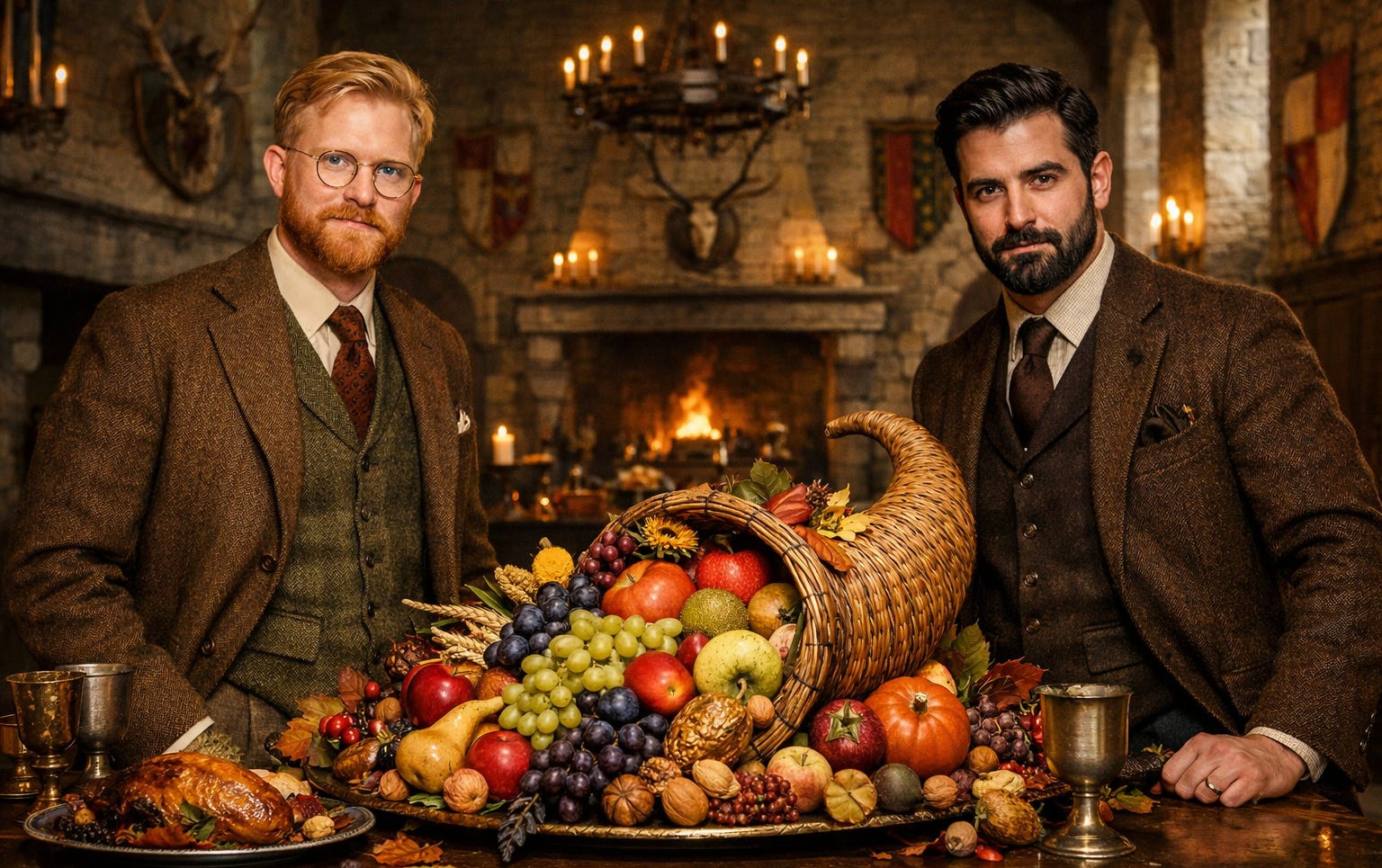
A comprehensive ‘horn of plenty’ of Catholic material for the current crisis in the Church.
The WM Review Annual Report for 2025
Part II: What We Built in 2025
Dear Readers and Friends of The WM Review,
Having seen how things stand at the end of 2025, let’s turn to the work that has been accomplished in the last year.
Because the growth statistics from Part I tell only half the story.
Behind those numbers – 480 articles, triple the subscribers, nearly a million views – lies a year of sustained work undertaken during one of the most shocking crises in Catholic history.
What follows is a thematic overview of the major strands of work accomplished in 2025.
Some of it was reactive, forced upon us by events. While Trad Inc rallied to “Leo XIV”, The WM Review doubled down on the principles that justified our existence in the first place.
Much of it was proactive: translations, historical recovery, and spiritual formation that would have been necessary regardless of who was claiming to sit on the chair of Peter.
What was the common thread amongst these varied themes?
Every article, every translation, every podcast was produced to strengthen what remains – for Catholics who refuse to choose between their faith and their reason, and who insist that the Church’s promises are true, that her doctrine is coherent, and that intellectual honesty need not end in despair.
Here is an estimated breakdown of the main topics covered in 2025 – with Father Coleridge Reader cross-posts excluded:
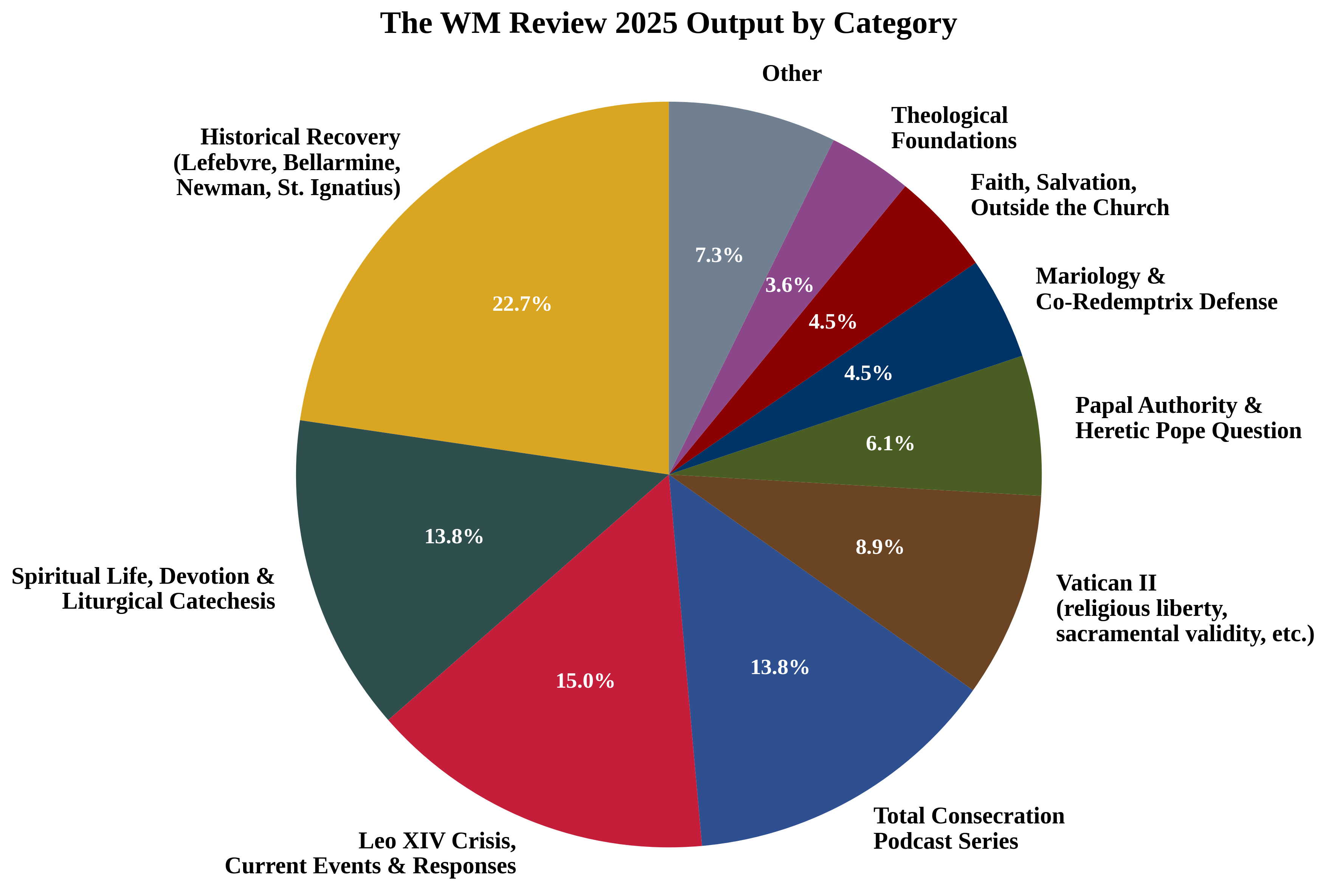
In all honesty, we are not aware of any other traditional Catholic outlet producing such a comprehensive range of work at this scale – simultaneously defending the faith intellectually, and nourishing it devotionally.
If you value what we’ve achieved, then please take out an annual or monthly WM+ membership.
“The Cult of Free” is a term used to describe the expectation that one can and should get everything for free. It arose from how bigger platforms in the legacy media operate – deriving their funds from advertising or from special interest groups.
The reality is that if you like The WM Review, if it has helped you, and you want to see it succeed… then you know what to do.
In the last part we featured many testimonies of those who put some “skin in the game” by supporting our growing project – like this beautiful one:
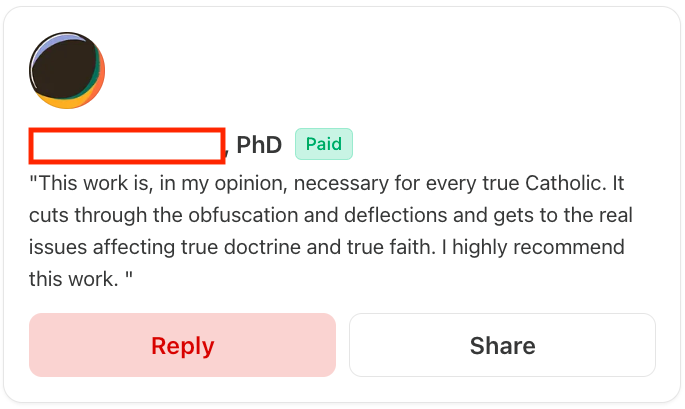
You can see more of that here:

In this part, we’re going to take a trip down memory lane, and see what we built in 2025:
The election of Robert Francis Prevost as Leo XIV
As we said above, we did not freely choose our own agenda in 2025. It was imposed by events – and by the failure of others to speak out.
Prior to the conclave that elected Leo XIV, we published a few articles about the state of the Church between popes – and how an extended interregnum might come to an end (even with the help of an invalid conclave).
2 weeks or 60 years: Which fits Franzelin’s account of sede vacante?
Two days before Cardinal Prevost was elected by the conclave, one of the editors had a report published, which concluded that this man could not be validly elected as Pope – even if the conclave purported to do so.
But something else happened that we didn’t expect – the fundamental shift in the status quo of the Catholic media landscape which I’ve already mentioned.
The very outlets that had spent years documenting the Bergoglian catastrophe – the ones these confused Catholics had relied on for clear thinking – went silent.
In that moment, The WM Review became one of the few remaining voices (along with Novus Ordo Watch, Catholic Family Podcast, Stephen Kokx, Chris Jackson, and others) willing to state the obvious: an open heretic who practices a false religion cannot be elected to the Roman Pontificate, and the organization that purports to so elect him is not the Catholic Church. Those still clinging to it are clinging to wreckage, not to Peter’s barque.
In this moment of hesitation, it seemed necessary to step into the breach and document a sequence of statements and actions as they unfolded. That’s when we set up WM Round-Up and WM Reports. Here are some of the stories we covered which few others wanted to touch, in that moment of COVID-style mass hypnosis or mafia-style omerta:
Leo XIV affirms Vatican II’s Catholic-Jewish dialogue on Day 1?
Leo XIV’s pledge to continue Vatican II’s dialogue with the Jewish people confirmed
Card. Prevost: You can’t be pro-life without opposing capital punishment
Leo XIV doubles down on conviction that Francis is in Heaven
Leo XIV affirms Francis’ climate vision, calls COP30 prep a ‘synodal work of discernment’
Leo XIV meets Vatican cardinal behind ‘synodal papacy’ blueprint
‘Open borders’ – Leo XIV’s Pentecost sermon (taking aim at JD Vance?)
But The WM Review is not a news site, and chronicling errors was never our primary mission.
Once the immediate crisis of clarity was met, and others found their voices again, we returned to what we do best: providing the theological and historical foundations that explain why such enormities are possible, and how Catholics can navigate them without losing either faith or reason.
The rest of 2025 was spent on that deeper work.
Back to the principles
Probably our most important piece in this vein for the year – if not our most important piece, full stop – was a comprehensive case for why we are obliged to conclude that Leo XIV and his recent predecessors have not enjoyed the authority of Christ or legitimately held the papal office:
At this time, it also seemed that Leo XIV was deliberately citing Pope St Pius X’s Pascendi Dominici Gregis, and other great anti-modernist encyclicals, as a means of trolling those who knew them. We produced several articles demonstrating the textual parallels in his early sermons:
Leo XIV and the Popes: Naturalism, religious liberty and ‘experience’
Leo XIV and the Popes: The origin of doctrine
Leo XIV and the Popes: ‘Autocracy’ vs. Authority
‘What we have in common’—Leo XIV and the Popes
We also addressed in detail some of the false ideas spread abroad by the Vatican:
Where is ‘Trad Inc.’ in the face of the most ‘hyperpapalist’ statement ever made?
‘I will not pray with you, and you shall not pray with me’ – Bl. Margaret Clitherow vs. Leo XIV
In the same vein, we addressed the ever-present confusion over the status of the Old Covenant – prompted by comments made by Leo XIV, as well as secular politicians:
Is ‘Rabbinic Judaism’ the religion of Moses and the Prophets?
Are Christians obliged to ‘bless Israel’? Points missed in Cruz/Carlson commentary
Vatican II and Religious Liberty
In addition to topics raised by contemporary events and comments, we continued our work publishing analyses of the Second Vatican Council, the crisis which it provoked, and the response which Catholics should have towards it. In particular, we have focused on the issue of religious liberty, and considered how it is a keynote theme for Vatican II itself:
Did Vatican II betray ‘Christ the King’? (Podcast)
How far does Vatican II’s ‘right to religious liberty’ extend?
Linking Satanism with religious liberty triggered some outrage—here’s why
What Leo XIV’s ‘complete commitment’ to Vatican II REALLY means
Lucien refuted: ‘Religious Liberty: Illusory Distinction, Unwarranted Conclusion’
Pepino and Fimister attack Catholics rejecting Vatican II’s novel religious liberty
Religious Liberty: The failed attempts to defend Vatican II (John S. Daly)
Leo XIV presents naturalistic world politics vision, affirms condemned errors
‘The greatest hope of the world’ – Paul VI on the United Nations
A continuing theme from us from 2024 was the implications of this crisis on the validity of the Novus Ordo sacramental rites:
Can liturgical changes affect validity? Cardinal Vaughan says yes
Classic study radically overstates Lefebvre’s position on holy orders
Is it valid? The proximate matter of Baptism (2025 update)
‘Painful uncertainty’—new rite of holy orders critiqued in 1978 by Athanasius Kröger OSB
‘I do not hesitate to administer conditional confirmation when asked’—Archbishop Lefebvre
However, we also took a wider look at the crisis in the Church of papal authority.
The Papacy
One of the chief means of coping with the crisis in the Church is the invention (or “rethinking”) of points of theology. Addressing this has always been a key theme for The WM Review, and 2025 was no different.
The Magisterium always transmits revelation in its integrity (Reply to Matt Gaspers IV)
‘Totem Pope’—Does the mere election of a pope fulfil Christ’s promises?
‘Totem Pope’—Should we ignore what goes on in Rome?
When did St Peter become the Pope? It might not be when you think
Rex Mottram theology: Andrew Likoudis, anti-intellectualism and Pope Susan
‘The Bishop of Rome’: Francis’ plan, continued by Leo XIV, for a grotesque parody of the papacy
Although some of these texts took current events or comments as a springboard, they are focused on principles and doctrine, rather than a fascination with controversy.
Revisiting the Revisionists
At the start of 2025, I stated:
“Over the last few decades, many traditionalists have been aware of a “sanitisation” of Archbishop Marcel Lefebvre’s legacy – by which we mean a one-sided, revisionist focus on his softer, more ‘respectful’ or conciliatory engagement with the post-conciliar Vatican.
“To be sure, Lefebvre was a complex figure who took different positions at different times, according to how he believed providence and prudence wanted him to act. But the one-sidedness is liable to be extremely misleading. […]
“Those who want to cast St Robert Bellarmine as a conciliarist, or want to paint Archbishop Marcel Lefebvre as just another heroic conservative Novus Ordo churchman who got aggravated towards his death, or want to claim that traditionalist groups have always accepted the Novus Ordo sacramental rites are going to have to deal with us.”
We made good on this promise.
First, we published (and in many cases, freshly translated) many late addresses from Archbishop Lefebvre, showing the state of his mind following the defining event of his life – the 1988 episcopal consecrations:
Open Letter from the Superiors of the SSPX – July 1988
‘The visibility of the Church and the current situation’ (1988)
We also published several other key texts presenting his thought:
‘I do not hesitate to administer conditional confirmation when asked’—Archbishop Lefebvre
Classic study radically overstates Lefebvre’s position on holy orders
‘She is neither liberal, nor modernist, nor ecumenical’ – Abp. Lefebvre on Our Lady
We also drew this issue together in an article defending the historical and apologetic value of considering Archbishop Lefebvre’s thought:
Should we care what Archbishop Lefebvre had to say? (with Index of Articles)
Sean Johnson, author and long-time commentator on the SSPX/Resistance conflict, testified to the value of this work (which began with our 2024 translations) and announced that such texts had led him to abandon his opposition to the thesis of an extended vacancy, and to become a “sede-doubtist.”
We also continued and completed our series of fresh translations of St Robert Bellarmine’s treatment of the heretic pope question. Each text contained extensive explanatory material to help readers understand that the revisionist perspectives of St Robert Bellarmine are utterly false.
Bellarmine does not teach councils are necessary for ipso facto loss of office
What’s superior, Pope or Council? Bellarmine sets out the objections
‘Ipso facto’: Bellarmine’s ‘five opinions’ on the heretic pope question
The Pope is absolutely above Councils, can’t submit to their coercive judgment
‘Resisting the pope?’—Bellarmine on doubtful and tyrannical popes
But we didn’t stop there. We also translated contextual material from the saint himself, and the earlier authorities to whom he referred – further demonstrating the untenability of those who claim that what he taught was different to our understanding of it:
Could a Pope destroy the Church? John de Torquemada answers
How an evil pope could ‘destroy the Church’—Cajetan’s objections
How to defeat a destroyer pope – Cajetan explains
Final nail in the Bellarmine ‘resistance quote’ coffin? Cajetan’s decisive context
We also brought together the texts from three Doctors of the Church – and whom the Conciliar/Synodal Church has made a Doctor – to show that that the weight of authority is decisively on our side:
Critiquing the critics
The revisionists mentioned seek to co-opt figures of history for their own agenda. But similarly problematic is the attempt to slander other such figures. 2025 saw us focus on defending St Ignatius of Loyola and the Society of Jesus, and Cardinal John Henry Newman.
We found that contemporary debates often rested on selective quotation, anachronism, or outright misrepresentation. Correcting these distortions was a necessary act of intellectual hygiene.
First, St Ignatius of Loyola – the great saint who has been blamed for the crisis in the Church!
Pius XI: The Spiritual Exercises and modernity (Meditantibus Nobis)
Why Pope Pius XI wanted more Catholics to make the Spiritual Exercises (‘Mens Nostra’)
‘One of the most effective means of regeneration’—Pius XII on the Spiritual Exercises
‘Providential weapon’ which must not be lost—Pius XII on the Spiritual Exercises
Why the Church declared St Ignatius patron of spiritual exercises (Pope Pius XI)
How the Spiritual Exercises prepared men for martyrdom before the Spanish Civil War
Defending the Jesuits against accusations of ‘tyranny’ and ‘servile obedience’
Obedience on trial: Did St Ignatius plant the seeds of the crisis in the Church?
But as already stated, The WM Review is not all about controversy and intellectual work. At the end of 2025, we went beyond the mere defence of St Ignatius and the Spiritual Exercises, and provided a 34-day series of podcasts, meditations and reflections making his spiritual treasury – synthesised with St Louis de Montfort’s True Devotion to the Blessed Virgin Mary – available for all, for free:
Preparing for Total Consecration to the Blessed Virgin Mary – The WM Review’s series
Few Catholics are able to make a five-day Ignatian retreat, and even fewer are able to make a full thirty-day retreat. This mammoth undertaking may be one of the most important efforts made this year – but more on that later.
Let’s turn to Cardinal Newman. We have long defended Newman’s name against those who slander him as a proto-modernist or responsible for Vatican II. In 2025, Leo XIV declared that he would be making Newman a Doctor of the Church in November of that year. This reignited the controversy, and thus reignited our defence of his orthodoxy and critique of his critics:
Newman, Doctor of the Church? McCusker’s interview with Kokx News
Newman would be the fourth ‘ipso facto loss of office’ Doctor of the Church
Cardinal Newman critiqued: How Cardinal Lépicier went about it
Did Cardinal Manning really accuse Cardinal Newman of ‘ten distinct heresies’?
Significant figures of the post-conciliar period
In addition to our treatment of Archbishop Lefebvre, we also shone a light on other significant figures of the post-conciliar period.
In January 2025, Bishop Richard Williamson died. Our obituary, and other accounts of his legacy, have since been translated into other languages and feature on his Wikipedia pages:
+Viganò’s Eulogy for +Williamson—and other responses
Farewell to a ‘turbulent priest’: Bishop Richard Williamson’s funeral and burial
We also began a series on the controversial French priest Père Noël Barbara and his writings in Fortes in Fide – regrettably interrupted by the need to complete the series on Archbishop Lefebvre, and the December podcast series, but which we intend to resume this year:
‘Strong in the Faith’: Fr Noël Barbara + a new series on The WM Review
‘CATHOLICS! Beware! A new religion has been established!’ (Fortes in Fide)
‘Gone is the time for a peaceful life for easy-going Christians’ (Fortes in Fide)
‘Faith is absolutely necessary for salvation’ (Fortes in Fide)
Why you MUST understand what Revelation is (Fortes in Fide)
We also featured a brief biography of Bishop Robert Fidelis McKenna, and his consecration by Bishop Michel-Louis Guérard des Lauriers:
We drew to a close our coverage of Abbé Henri Mouraux – the long-time sedevacantist collaborator of Archbishop Lefebvre – with his article on Pope Paul IV’s bull Cum ex Apostolatus Officio:
‘Cum ex Apostolatus is still in force’—so said Abbé Henri Mouraux
Notwithstanding clear views on the crisis in the Church held by the editors, it is important to know about and to appreciate these brave men who confessed the faith – more or less integrally at different times – in this most terrible period.
Faith and the dogma Outside the Church there is no Salvation
Much confusion and controversy surround the dogma that there is no salvation outside the Church. But beneath this mess lies a more fundamental concern: the nature of faith itself.
We published several articles on what it means to believe with divine faith, what that faith requires – and how it grounds this most fundamental dogma.
The great Thomists: On the Church as a necessary condition for faith (Marín-Sola)
St Fulgentius’ witness against ‘Eastern Orthodox’ and neo-Catholics
‘Faith is absolutely necessary for salvation’ (Fortes in Fide)
This matter became especially relevant following the assassination of non-Catholic Charlie Kirk. While others were rushing to canonise Kirk as a martyr, and others seeking to highlight his particular flaws, we returned to the sources in a set of fresh translations on the vexed questions of prayers for deceased non-Catholics and “non-Catholic martyrs.”
Catholic rites and prayers for deceased non-Catholics? Pope Gregory XVI answers
Can a non-Catholic be a martyr? Benedict XIV’s explanation
Can a schismatic be a saint – or someone mistaken about the Pope’s identity? Benedict XIV answers
Martyrs and Pseudo-Martyrs: Benedict XIV compares
What non-Catholic ‘martyrs’ have – and what they lack: Conclusion to Benedict XIV’s chapter
Defending the Mother of God against the Conciliar/Synodal Vatican
The last part of the year was dominated by our response to the Vatican’s attempt to strip the Blessed Virgin Mary of her titles Co-Redemptrix and Mediatrix of All Graces.
Earlier in the year, we had published a few articles on this very topic:
We had also published two relevant articles on Our Lady’s compassion on Father Coleridge Reader, in honour of the feast. This compassion (com-passion) represents one basis for Our Lady’s title of Co-Redemptrix:
How Mary united both perfect sorrow and peace during the Passion
How Our Lady consented to and ‘co-offered’ Christ’s sacrifice
As such, we had plenty of material available to be able to respond rapidly to the outrageous assault on Our Lady’s honour:
‘Co-Redemptrix’ – The testimony of Popes, Saints and Theologians
Mediatrix: Mary’s universal mediation (Garrigou-Lagrange)
Mediatrix: Mary’s distribution of grace (Garrigou-Lagrange)
Mediatrix: ‘Theologically certain’ (Garrigou-Lagrange)
‘She is neither liberal, nor modernist, nor ecumenical’ – Abp. Lefebvre on Our Lady
However, we considered that a greater response was necessary. This is why we launched a series inspired by St Louis de Montfort’s True Devotion to the Blessed Virgin Mary, which consisted of 34 days of Ignatian-inspired meditations and podcasts ordered according to St Louis’ specification. In his kind endorsement for this series, Bishop Pierre Roy said:
“This initiative of having Catholics consecrate themselves to the Blessed Virgin Mary in reparation for the recent Vatican’s document declaring as “inappropriate” titles of Our Lady that have been used by a number of popes, theologians and saints is an excellent one and can only be encouraged.”
In order to prepare readers for the undertaking, we provided a rigorous exposition of St Louis de Montfort’s spiritual doctrine – addressing the doctrine in itself, and contemporary reservations such as the idea of slavery and offending Protestants:
The theological basis of ‘True Devotion’ and the Consecration to Mary (Garrigou-Lagrange)
The fruits of ‘True Devotion’ and Consecration to Mary (Garrigou-Lagrange)
Preparing for Total Consecration to the Blessed Virgin Mary – The WM Review’s series (This article draws together the various original articles on the topic we put out at the time).
We are glad to have made good on our promise to increase our video/audio material – and it would not have been possible without the help of David from Catholic Hub, and our other friends who contributed recordings to this project.
Here’s what some of our readers and listeners said about this project:

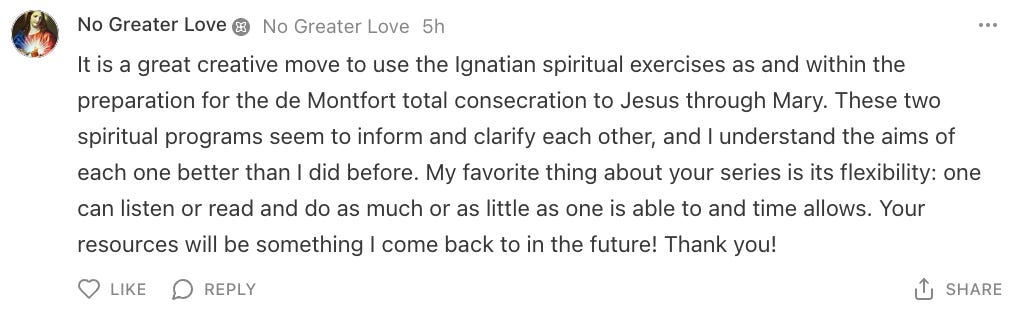




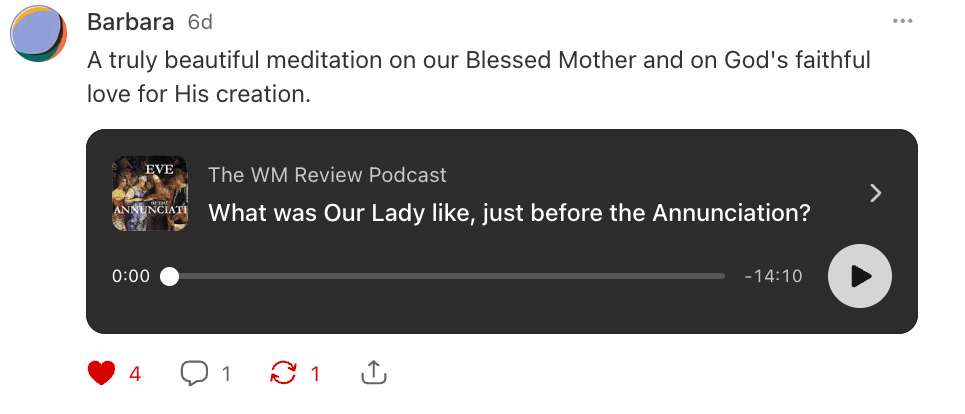


The learning curve for recording and sound editing was very steep, and the quality improves as the series progresses. You can find the full playlist here or at YouTube:
In time, we hope to add further instalments to this series, and to publish the meditations in book form.
More aids for the spiritual life
In addition to this series, and our Fr Coleridge pieces, we also published the following practical aids for the spiritual life of readers:
How to meditate – two methods
Meditation and mental prayer—Pope St Pius X explains their importance
Did the Church intend to abolish fasting—or modify it? Newman explains
One psychological challenge of fasting today—and ways to beat it
The Passion: Four Evangelists, ONE Narrative (with Catholic Hub)
Anger and revenge can be virtuous: St Thomas explains
All this constructive spiritual work – along with Father Coleridge Reader and the Total Consecration series – exists to restore familiarity with Our Lord Jesus Christ, untainted by modern sentimentality or theological compromise. Its growth confirms that many Catholics are hungry not only for answers, but for depth, reverence, and sustained contact with Christ himself.
It is not ancillary to the mission of The WM Review. It is essential to it.
This comprehensive approach – combining theological rigor and spiritual nourishment – really distinguished The WM Review’s output from most traditional Catholic media. We’re not aware of any other publication that has maintained such a balance of both critical and constructive material.
But none of this is possible without YOU and your help.
How things stand for 2026
In short, here’s what separates The WM Review from the outlets that folded in 2025.
We didn’t just respond to Leo XIV’s election – we provided the theological framework to understand it.
We didn’t just defend tradition – we recovered the actual texts and teachings that define it.
We didn’t just critique errors – we offered positive spiritual formation rooted in the Church’s perennial wisdom.
That comprehensive approach is what your support makes possible. And it’s what will be lost if that support doesn’t grow.
We have worked really hard this year to produce free, in-depth Catholic resources, responding to urgent questions about the Faith and expanding our reach via podcasts and Substack. With your help, we can keep the vast majority of our articles and podcast episodes free for everyone who needs them.
The output documented above represents days and weeks of research, writing, translation, and editing – not counting podcast production, correspondence with readers, or the invisible work of maintaining a publication.
This was only possible because a small core of WM+ members made it financially viable.
But as Part I made clear, we’re at an inflection point. Without growth in committed support, output at this level cannot continue in 2026.
The choice is stark: either The WM Review expands its base of support and increases its impact, or both editors will be forced to scale back drastically to meet other obligations.
There are two key ways that you can be a part of this communal effort for the Church and for the Faith:
Subscribe to articles—preferably as a monthly or annual member.
Ensure you never miss the essays, deep dives, and theological resources. By subscribing, you’ll also receive access to members-only content—all while helping us continue offering free articles for readers who depend on us.
Share our material with everyone whom you think will benefit.
Make a commitment today to share our essays with at least one person whom you think will benefit from them. This is really crucial for helping us get the ideas out there.
You can do this by liking and retweeting the articles, sending links, forwarding emails, hitting “share” buttons or even by “gift subscriptions”—Substack offers nice rewards for those who do this often:
Sometimes readers – existing WM+ members or not – like to support us with one-time donations.
Donations of $50 or $150 or $500 or even $1,000 make an incredible difference to our work, allowing us to focus on research and writing knowing that the costs are covered and the time can be justified.
If you make a one-time donation higher than the annual fee, we will gladly count that towards membership costs upon request.
Donations higher than that are a rarity, but they grant us even more independence and power to research, translate, create, publish and disseminate materials for the good of our fellow Catholics.
They could allow us to…
Commission articles from other writers, and even take on a team of writers in a stable way
Make much-needed upgrades to equipment, like microphones and other tech
Develop our reach in different areas (books, YouTube, and so on).
The sky is the limit. There is no reason why, with the right sort of major funding, The WM Review could not grow to the same size and reach as some of the Trad Inc. outlets – and challenge them on their own terms.
While so much of the Catholic commentariat is still lulling itself to sleep with optimistic dreams, let’s make 2026 the year in which we wake up as many of our fellow Catholics as possible.
In Christ the King
S.D. Wright
Editor
The WM Review
PS: One final thanks to the band of brothers (and sisters!) who have supported us financially throughout 2025
The cornucopia documented above – 480 articles, 34 podcast episodes, dozens of fresh translations, the recovery of suppressed texts from Lefebvre and Bellarmine – was only possible because a committed core of readers made it financially viable.
Both editors have many pressures and constraints on our time and headspace, and are under increasing pressure to justify the time this demands.
Without expanded support in 2026, output will necessarily contract. Not because we want it to, but because we have families to feed and other obligations that can’t be indefinitely deferred.
Your support – through a monthly or annual subscription – truly keeps The WM Review going.
If you found even a fraction of 2025’s work valuable…
If the Bellarmine and Lefebvre translations clarified your thinking
If Father Coleridge Reader and the Total Consecration series deepened your devotion
If our analysis of Leo XIV helped you maintain the faith when others were capitulating
… then you know what The WM Review is worth.
Subscribe today. Not because we offer premium perks (we don’t), but because you’re investing in work that makes a measurable difference in Catholic discourse.
The crisis isn’t going away. Neither should The WM Review.
Together, we can “strengthen what remains” by reaching more souls with the clear, uncompromising truths of the Catholic Faith.
And we can continue this vital work without interruption.
Thank you!
Follow on Twitter, YouTube and Telegram:
I cannot believe the volume of articles that you have produced, and even more of their uniformly excellent and orthodox content.
Keep up the good work.
Digging those tweeds.