

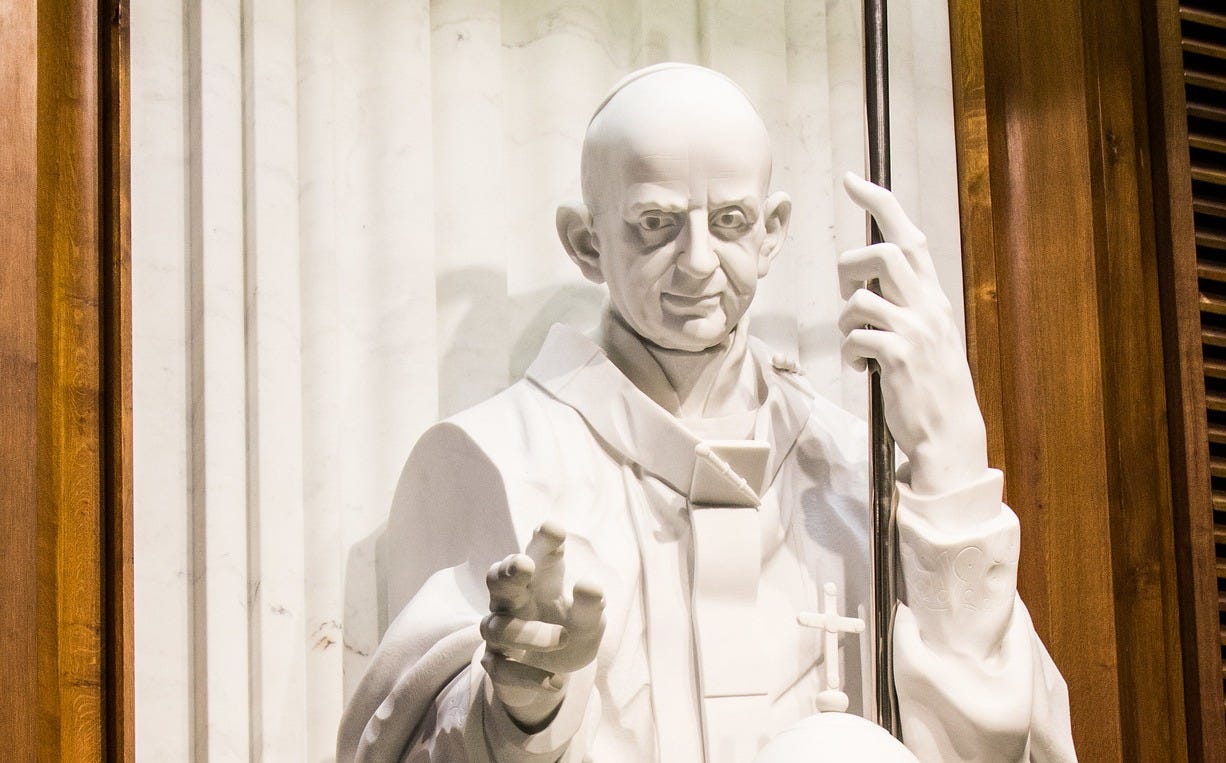
Why was Paul VI permitted to choose the Eve of the Immaculate Conception as the date for the final promulgation of the documents of Vatican II – and what are the implications of this promulgation?
(WM Review) – Each year, December 8 marks a great moment in the history of the world – the Immaculate Conception of the Blessed Virgin Mary.
This moment marked the first lights of Sun of Justice dawning on the world. Each year, we celebrate this feast with great joy.
You can read some of our top articles on this great dogma and feast here:

We hope that readers are enjoying our 33-day Total Consecration series – and will forgive us for today’s double-post (which we promise we are keeping to a bare minimum in this period of daily posts).

However, this year, the feast marks a very inauspicious and earth-shattering anniversary.
Anniversaries in 2025
2025 is, in fact, a year of anniversaries, some of which are very good. This year, we see the 100th anniversaries of:
The canonisation of St Thérèse of Lisieux on 17 May 1925
Our Lady’s revelation of the First Saturday devotions to Sister Lucy of Fatima, on 10 December 1925
Pope Pius XI’s promulgation of the Encyclical Quas Primas on the Social Kingship of Christ.
However, there are also a number of “diamond anniversaries” of events that took place in 1965. Most of them are very bad.
Here are some of the more positive anniversaries…
In 1965, Jacques Maritain coined the useful (although not wholly unproblematic) idea of “immanent apostasy”
In 1965, Père Noël Barbara began publishing his influential catechetical review Forts dans la Foi.
… and here are some of the more negative ones:
In March 1965, the so-called “Interim Missal” was introduced, which permitted the use of the vernacular and other changes that were solidified and extended in the 1969 Novus Ordo rite.
In October 1965, Paul VI delivered his outrageously naturalist address to the United Nations, which did not refer to Our Lord Jesus Christ at all – and in which he proclaimed the right of religious liberty, and described the UN as “the greatest hope of the world.”
However, on the eve of the Immaculate Conception, three exceptionally evil events took place:
On 7 December 1965, Paul VI claimed that the Council represented alleged proof that Catholics, “more than anyone else, have the cult of man”
On the same day, Paul VI issued a Joint Declaration with the Eastern schismatic Patriarch Athenagoras – in which both claimed to lift the mutual excommunications of 1054. This appears to have been a risible PR-exercise, intended to confuse – as if the separation of the “Orthodox” from the Catholic Church was based on an excommunication, rather than a) heresy and b) schism.
However, there can be no doubt that the most inauspicious event of 7 December 1965 was Paul VI’s final promulgation of documents from the Robber Council of Vatican II – including the Declaration on Religious Liberty Dignitatis humanae. The Council was closed on the following day – the feast itself.
This promulgation is bad enough. However, it in turn rendered clear and completely certain the vacancy of the Holy See, and Paul VI’s own illegitimacy.
In other words: this year on the Immaculate Conception, we are marking 60 years of certainty that we are living in an extended vacancy of the Holy See.
As impossible, far-fetched or problematic as this conclusion may seem, it is indeed possible – and less far-fetched or problematic than any other alternative.
To understand why, we have to understand what Vatican II was and is, and its implications for the Church.
The WM Review is free for readers. This is because we believe these ideas must reach as many people as possible.
However, we also provide WM+ articles—additional material for those who choose to support this work financially.
This helps us continue producing serious Catholic research, while ensuring that the main body of material remains accessible to all.
If you want to ensure that our work continues, join WM+ today.
You can see our Testimonials page for what some of our readers are saying about the WM Review.
(We offer free membership on request for clergy and seminarians – please contact us for details.)