

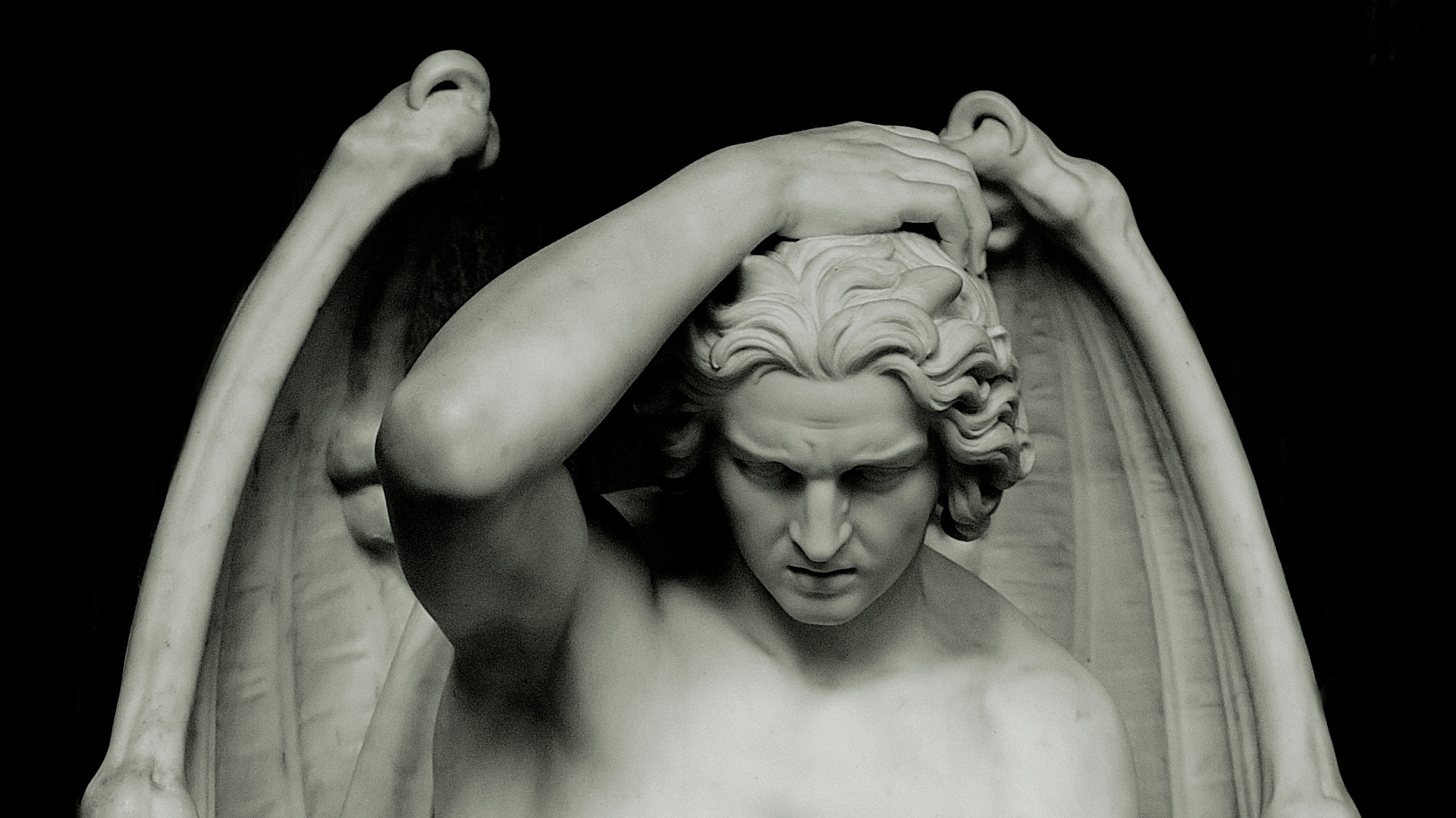
‘The cult of man’—its roots in Enlightenment philosophy, Freemasonry, Luciferianism, and its triumph at Vatican II.
Introduction
This was an advanced preview for WM+ subscribers. It has now been released for all readers.
In a recent piece, we alleged that Vatican II’s doctrine of religious liberty not only extends to Satanists, but that both this doctrine and Vatican II itself are Luciferian in nature.
In this article, we’re going to make good on this latter claim, building and expanding on an earlier treatment of this subject.
Contents
THE MEANING OF THE NAME ‘LUCIFER’
THE ENLIGHTENMENT AS PHILOSOPHICAL MOVEMENT
LUCIFER AS THE PROMETHEAN MASCOT OF THE ENLIGHTENMENT
THE RELIGION OF THE ENLIGHTENMENT: FREEMASONRY
THE BRINGING OF NEW LIGHT IN FREEMASONRY
THE GOALS OF THIS ENLIGHTENMENT ‘RELIGION’
THE FULFILMENT OF THESE GOALS AT VATICAN II
RELIGIOUS LIBERTY AS LUCIFERIAN INVERSION
CONCLUSION: FRUITS OF THIS FULFILMENT
The meaning of the name ‘Lucifer’
“Lucifer” is a Latin word meaning “light bearer” or “morning star.” It is a translation of the Hebrew word “Hêlêl,” which has the additional connotation of “shining one.”
It is often applied to the planet Venus, which is visible before dawn (as well as at sunset). It appears in this context in the hymns of the Roman breviary on several occasions—for example:
Aeterne rerum conditor (Lauds on Sundays)
Hoc excitatus lucifer
Solvit polum caligine:
Hoc omnis erronum cohors
Viam nocendi deserit.Roused at the note, the morning star
Heaven's dusky veil uplifts afar:
Night's vagrant bands no longer roam,
But from their dark ways hie them home.1
Aeterne coeli gloria (Lauds on Fridays)
Ortus refulget lucifer,
Praeitque solem nuntius:
Cadunt tenebrae noctium:
Lux sancta nos illuminet.The morning star fades from the sky,
The sun breaks forth; night's shadows fly:
O Thou, true Light, upon us shine:
Our darkness turn to light divine.(The same verse appears in Tu, Trinitatis Unitas, at Lauds on Most Holy Trinity)
Dum nocte pulsa lucifer (Feast of St Venantius)
Dum nocte pulsa lucifer
Diem propinquam nuntiat,
Nobis refert Venantius
Lucis beatae munera.The golden star of morn
Is climbing in the sky;
The birthday of Venantius
Awakes the Church to joy.
The name is applied to Christ in the Exsultet on Holy Saturday:
Flammas eius lucifer matutinus inveniat: ille, inquam, lucifer, qui nescit occasum. Christus Filius tuus, qui, regressus ab inferis, humano generi serenus illexit, et tecum vivit et regnat in sæcula sæculorum.
May this flame be found still burning by the Morning Star: the one Morning Star who never sets, Christ thy Son, who, coming back from death's domain, has shed his peaceful light on humanity, and lives and reigns for ever and ever.
“Lucifer” was itself a given name in previous times, including of the fourth-century bishop, Lucifer of Cagliari. This person is sometimes referred to as a saint, even though he appears to have been a problematic figure who may not even have died a Catholic. The Catholic Encyclopaedia refers to his followers as a schismatic sect,2 and he is not listed as a saint in The Roman Martyrology, Butler’s Lives of the Saints or Guéranger’s The Liturgical Year.
The word is used in the “astronomical sense” in the Vulgate, the traditional Latin translation of Holy Scripture, in Job,3 the Psalms,4 and the second epistle of St Peter.5 There are other references to the “morning star” throughout the Scriptures which use a different word (for example, in Apoc. 22.16).
However, the most famous appearance of the word in Scripture, and the source of its application to Satan by Christian tradition, is in the condemnation of Nabuchodonosor, the king of Babylon.
Thou shalt take up this parable against the king of Babylon, and shalt say: […]
How art thou fallen from heaven, O Lucifer, who didst rise in the morning? how art thou fallen to the earth, that didst wound the nations?
And thou saidst in thy heart: I will ascend into heaven, I will exalt my throne above the stars of God, I will sit in the mountain of the covenant, in the sides of the north. I will ascend above the height of the clouds, I will be like the most High.
But yet thou shalt be brought down to hell, into the depth of the pit. (14.4, 12-15).
It is from this text that the association between Satan and Lucifer arose—perhaps inspired by Our Lord’s words in the Gospel of St Luke:
I saw Satan like lightning falling from heaven. (Luke 10.18)
It may also have been inspired by St Paul saying that “Satan himself transformeth himself into an angel of light,” in order to deceive mankind—just as “false apostles” were “transforming themselves into the apostles of Christ” at the time (2 Cor. 11.13-4).
While “Lucifer” is sometimes imagined to be Satan’s name prior to his fall, it also appears to be an ironic reference to his deceitfulness, particularly in the Garden of Eden. It is in this episode, when Satan slanders God as a tyrant and claims to offer mankind light, knowledge, liberty and equality with God, that his deceptive claim to be the bringer of light is at its clearest:
For God doth know that in what day soever you shall eat thereof, your eyes shall be opened: and you shall be as Gods, knowing good and evil. (Gen. 3.5)
The Enlightenment as a philosophical movement
The connotation of Lucifer as the bringer of light to mankind is crucial in understanding the Enlightenment philosophy and politics of the last few centuries, and the ecclesiastical landscape of the last few decades.
Since the 18th century, the West has been living in a world of Enlightenment revolution. The presuppositions of this philosophical movement have progressively become the defaults of our society, to the point at which they dominate.
They include the French Revolution’s classic trio of liberty, equality, and fraternity, understood in a naturalistic sense and presuming to make man independent of God and his Church.
The idea of religious liberty—itself a denial of the first commandment—and the independence of the state from the Church grew out of such ideas. Along with this false liberty, condemned by the Church on many occasions, came the denial that individuals and states had duties towards God and the true Church, and that this Church was unique among religious bodies and sovereign in its sphere. We shall address the Luciferian nature of this idea below.
These Enlightenment and revolutionary ideals include rationalism—a presumption that there is no knowledge possible outside of what is available to natural human reason. They include also the sovereignty of nature over supernature, of individual licence over authority, and a general philosophical scepticism when it comes to epistemology and the knowability of divine revelation.
They also include a rejection of the anciens regimes, the older orders of Church, Throne and Patriarchy—against which the Enlightenment revolutions rebelled.
The importance of “light” to this intellectual rebellion against God is clear from the name “enlightenment.” This is why what Catholics might call “the ages of Faith” are called, under the influence of the Enlightenment, “the dark ages.”
Lucifer as the Promethean mascot of the Enlightenment
We can understand the role of Lucifer in the Enlightenment by comparing him with the figure of Prometheus.
In ancient Greek mythology, Prometheus was a Titan who defied the gods of Olympus by stealing fire and giving it to mankind. For this, he was bound to a rock and condemned to have his liver devoured daily by an eagle. In Romantic literature, he became a tragic hero—a bringer of light and knowledge, unjustly punished for empowering mankind.
It is in this Promethean mould that modern philosophy has recast the figure of Lucifer. Just as Prometheus brought fire, Lucifer is presented as bringing light; and just as Prometheus defied Olympus for mankind, Lucifer is presented as defying Heaven for mankind.
Thus Lucifer’s name ceases to be an ironic reference to the deceitful promise of light and knowledge. In effect, his claims to bring us light and knowledge become treated as credible. He becomes symbolic of the ideals which undergird modernity: liberty from God, the exaltation of reason over revelation, and the promise of a new order built not on grace, but on human pride.
In this way, Lucifer becomes a mascot of the Enlightenment, the Revolution and the Romantic movement which grew out of them. He is reimagined along benevolent and Milton-inspired lines as a radiant emblem of liberty, equality, and fraternity.
John Milton himself was a republican and a revolutionary, and it is notorious that the figure of Satan in Paradise Lost is portrayed—perhaps in spite of Milton’s intentions—as at least ambivalent, if not as a sympathetic and inspiring proto-republican, against what the devil perceived as the “tyrannical” monarchy of God.6
These ideas were taken up by the Romantic poet and artist William Blake, who produced illustrations of Paradise Lost according to this theme, as well as inventing his own mythology along gnostic lines. Siobhan Lyons states:
The Devil in Romantic literature and poetry became a figure of insight and necessary rebellion, being seen as a tragic, heroic figure. Moreover, in various Romantic works, the Devil incorporates the basic theme of human desire, as epitomized in the works of William Blake, Percy Shelley, and Lord Byron, all of whom perceived Satan as their hero. […]
The Devil in Romanticism, far from being the personification of evil, is instead posited as an essential, if not experimental, figure of human psychology.7
Although the Romantic movement was in some ways a rebellion against aspects of the Enlightenment, its leading figures were united in many of its presuppositions and goals.
The nineteenth century freethinker Moses Harman, whose Kansas-based journal was titled Lucifer, expressed all this with great clarity.
The title was selected, stated Harman, because it expressed the paper's mission. Lucifer, the name given the morning star by the people of the ancient world, served as the symbol of the publication and represented the ushering in of a new day.
He declared that freethinkers had sought to redeem and glorify the name Lucifer while theologians cursed him as the prince of the fallen angels. Harman suggested that Lucifer would take on the role of an educator. “The god of the Bible doomed mankind to perpetual ignorance,” wrote Harman, “and [people] would never have known Good from Evil if Lucifer had not told them how to become as wise as the gods themselves.”8
The “community organiser” Saul Alinsky included the following presentation of Lucifer in his book Rules for Radicals:
Lest we forget at least an over-the-shoulder acknowledgment to the very first radical: from all our legends, mythology, and history (and who is to know where mythology leaves off and history begins or which is which), the first radical known to man who rebelled against the establishment and did it so effectively that he at least won his own kingdom—Lucifer.9
This is how the advocates of these “values” of the Enlightenment and its revolutions frame their work. They profess to have discovered that the Serpent was telling the truth in the Garden of Eden, and really does wish to bear light to mankind.
As well as constituting the predominant ideology of modern society, these Enlightenment/Romantic values are also expressed by the more prominent Satanist groups today. These groups claim not to believe in a personal devil, professing to pursue merely naturalistic values, and presenting Satan as a literary figure standing for the same Enlightenment ideas already mentioned: religious liberty, “reproductive rights,” the separation of church and state, and rebellion against authority.
Many such satanists may well mean what they say here. However, they will find out in the next life (if not in this life) that one does not engage in “live-action role play” with the Devil, even for political purposes.
This was an advanced preview for WM+ subscribers.
WM+ subscribers ensure that we can keep going, no matter how much flak we take for telling the truth about the Conciliar/Synodal Church. Thank you!
If you are enjoying it, then please consider supporting us by joining WM+ today.
The religion of the Enlightenment: Freemasonry
The emphasis on light is even more pronounced in the quintessential Enlightenment movement of Freemasonry. In some ways, it is the central theme of Freemasonry and the central link with the Enlightenment.
Albert Pike, the author of a classic masonic text Morals and Dogma of the Accepted Scottish Rite of Freemasonry, wrote:
Humanity has never really had but one religion and one worship. This universal light has had its uncertain mirages, its deceitful reflections, and its shadows; but always, after the nights of Error, we see it reappear, one and pure like the Sun.10
This supposed true religion of mankind is a kind of meta-religion above and behind all the other religions of the world, and is conceived as purely rational, and shorn of supernatural and “superstitious elements.” It reduces the particular religions of the world to optional flavours, with the “true religion” being a more minimalist set of ethical principles to which they all must conform.
This Enlightenment conception is now the predominant way in which most of the West views religion. It is also manifest in Francis’s infamous statements in September 2024, which express the same Enlightenment and Masonic conception of the transcendental unity of religion as found in Pike:
“All religions are a path to reach God.” (13 Sep 2024)
“The diversity of your cultural and religious identities is a gift of God.” (17 Sep 2024)
“We need […] to allow ourselves to be guided by the divine inspiration present in every faith.” (17 Sep 2024)
The theme of a new light being brought to mankind, mentioned by Pike above, appears throughout Masonic writings and ritual. In his study Darkness Visible, the Anglican clergyman Walton Hannah—who became a Catholic precisely because of the Anglican church’s refusal to take seriously the dangers of Freemasonry—stated the following:
For Masonry claims to impart to its initiates a spiritual and esoteric light.11
The ceremony of initiation which Hannah cites echoes the questions at the door of the Church in the traditional rite of baptism, replacing “faith” with “light”:
Worshipful Master: Having been kept for a considerable time in a state of darkness, what in your present situation is the predominant wish of your heart?
Candidate: Light.12
Hannah also cites a very disturbing ceremony used at higher degrees, which refers to the death of Our Lord Jesus Christ on the Cross:
Most Wise Sovereign. Excellent and Perfect First General, what is the hour?
1st General. The ninth hour of the day.
Most Wise Sovereign. Then it is the hour when the Veil of the Temple was rent in twain and darkness overspread the earth, when the true Light departed from Us, the Altar was thrown down, the Blazing Star was eclipsed, the Cubic Stone poured forth Blood and Water, the Word was lost, and despair and tribulation sat heavily upon us.
(A solemn pause).
Since Masonry has experienced such dire calamities, it is our duty, Princes, to endeavour, by renewed labours, to retrieve our loss. May the benign influence of Faith, Hope, and Charity prosper our endeavours to recover the lost Word; for which purpose I declare this Chapter of Princes Rose Croix of Heredom duly open, in the Name of the Great Emmanuel.13
At first glance, this may appear to be a lament for the death of Christ. A second glance shows this to be at best more ambiguous. Hannah explains:
For any Christian to declare that Masonry experienced a “dire calamity” at the Crucifixion, or that Masons suffered a “loss” in the triumphant redemptive death of Our Saviour on the Cross which the Excellent and Perfect Princes of the Rose Croix of Heredom can by their own labours “retrieve” seems not only heretical but actually blasphemous. The only interpretation which makes sense of this passage would appear to be that it is not the death of Our Lord which is mourned, but the defeat of Satan.14
In addition to this focus on Lucifer in Freemasonry, we find the closely related idea of “the cult of man,” in:
The humanism of the post-medieval world
An overestimation of man’s faculties and dignity
The worship of man himself—as promised by Satan in the Garden of Eden (“You shall be as Gods”).
It is important to emphasise that this discussion of Freemasonry, and its links with the Enlightenment and the Revolution, is far from a sensationalist topic, and is based on objectively verifiable facts and history.
The goals of this Enlightenment ‘religion’
The sectaries of these Enlightenment movements—be they Jacobins or other revolutionaries, freemasons, or anyone else—long stated that their intention was to have the Church accept and endorse their ideals. In his book on St Athanasius, Bishop Rudolph Graber of Regensburg quoted a Freemason who said that:
[T]he goal [of Freemasonry] is no longer the destruction of the Church, but to make use of it by infiltrating it.15
There are many texts that could be cited along these lines. One such text was The Permanent Instruction of the Alta Vendita. Although others may or may not be authentic, the Permanent Instruction is of undoubted authenticity, and the popes have treated it as such. It has also been confirmed by the course of history ever since in many ways, including by mainstream post-conciliar churchmen.
The Permanent Instruction states its goal explicitly and in detail:
Our ultimate end is that of Voltaire and of the French Revolution—the final destruction of Catholicism, and even of the Christian idea…
What we must ask for, what we should look for and wait for, as the Jews wait for the Messiah, is a Pope according to our needs […]
And this Pontiff, like most of his contemporaries, will be necessarily more or less imbued with the [revolutionary] Italian and humanitarian principles that we are going to begin to put into circulation. […]
You wish to establish the reign of the chosen ones on the throne of the prostitute of Babylon [Rome]; let the clergy march under your standard, always believing that they are marching under the banner of the apostolic keys.
You intend to make the last vestige of tyrants and the oppressors disappear; lay your snares [nets] like Simon Bar-Jona: lay them in the sacristies, the seminaries and the monasteries rather than at the bottom of the sea: and if you do not hurry. We promise you a catch more miraculous than his. The fisher of fish became the fisher of men; you will bring friends around the Apostolic Chair.16
The Permanent Instruction ends with the avowal:
You will have preached a revolution in tiara and in cope, marching with the cross and the banner; a revolution that will need to be only a little bit urged on to set fire to the four corners of the world.17
The fulfilment of this goal at Vatican II
Although it may seem shocking to conservative defenders of the Second Vatican Council today, it is an undisputed fact that the Council was heralded by friends and foes alike as a fulfilment of the goal stated above.
Archbishop Marcel Lefebvre, one of the Council Fathers and the founder of the Society of St Pius X, echoed critically Cardinal Suenens’ praise of Vatican II as “the French Revolution in the Church.”18
Lefebvre cited Suenens in his explanation for this claim:
The parallel I have drawn between the crisis in the Church and the French Revolution is not simply a metaphorical one. The influence of the philosophes of the eighteenth century, and of the upheaval that they produced in the world, has continued down to our times. Those who have injected that poison into the Church admit it to themselves.
It was Cardinal Suenens who exclaimed, “Vatican II is the French Revolution in the Church,” and among other unguarded declarations he added “One cannot understand the French or the Russian revolutions unless one knows something of the old regimes which they brought to an end… It is the same in church affairs: a reaction can only be judged in relation to the state of things that preceded it.”19
Lefebvre also cited Yves Congar:
Père Congar, one of the artisans of the reforms, spoke likewise: “The Church has had, peacefully, its October Revolution.” Fully aware of what he was saying, he remarked “The Declaration on Religious Liberty states the opposite of the Syllabus.”20
He cited other “Catholics liberals,” including Mgr Prelot:
“We had struggled for a century and a half to bring our opinions to prevail within the Church and had not succeeded. Finally, there came Vatican II and we triumphed. From then on the propositions and principles of liberal Catholicism have been definitively and officially accepted by Holy Church.”21
Cardinal Ratzinger himself said the same thing of Vatican II’s Gaudium et Spes—that it represented a reconciliation with the world as established in the Revolution of 1789:
If it is desirable to offer a diagnosis of the text as a whole, we might say that (in conjunction with the texts on religious liberty and world religions) it is a revision of the Syllabus of Pius IX, a kind of counter-syllabus. Harnack, as we know, interpreted the Syllabus of Pius IX as nothing less than a declaration of war against his generation. This is correct insofar as the Syllabus established a line of demarcation against the determining forces of the nineteenth century: against the scientific and political world view of liberalism. In the struggle against modernism this twofold delimitation was ratified and strengthened. Since then many things have changed. […]
[T]he one-sidedness of the position adopted by the Church under Pius IX and Pius X in response to the situation created by the new phase of history inaugurated by the French Revolution was, to a large extent, corrected via facti, especially in Central Europe, but there was still no basic statement of the relationship that should exist between the Church and the world that had come into existence after 1789.
In fact, an attitude that was largely prerevolutionary continued to exist in countries with strong Catholic majorities. Hardly anyone today will deny that the Spanish and Italian Concordats strove to preserve too much of a view of the world that no longer corresponded to the facts. […]
Let us be content to say here that the text serves as a counter-syllabus and, as such, represents, on the part of the Church, an attempt at an official reconciliation with the new era inaugurated in 1789. Only from this perspective can we understand, on the one hand, its ghetto-mentality, of which we have spoken above; only from this perspective can we understand, on the other hand, the meaning of this remarkable meeting of Church and world. Basically, the word “world” means the spirit of the modern era, in contrast to which the Church’s group-consciousness saw itself as a separate subject that now, after a war that had been in turn both hot and cold, was intent on dialogue and cooperation.22
Three key fruits of this triumph at Vatican II are found in the promotion of religious liberty, the collegiality of bishops and ecumenism (and interreligious dialogue). These correspond directly to Enlightenment ideals, as even Ratzinger acknowledged.
Let us examine the controversial example of religious liberty in light of these ideas.
Vatican II’s religious liberty as Luciferian inversion
Religious liberty, as understood by the Enlightenment and by Vatican II, is not a reaffirmation of the Church’s sovereign freedom, nor a prudent application of tolerance. It is not just a doctrine which was repeatedly condemned by the Church before Vatican II: it is also an inversion of the divine order.
Dignitatis Humanae, the relevant document, states:
This Vatican Council declares that the human person has a right to religious freedom. This freedom means that all men are to be immune from coercion on the part of individuals or of social groups and of any human power, in such wise that no one is to be forced to act in a manner contrary to his own beliefs, whether privately or publicly, whether alone or in association with others, within due limits.23
There is no logical ground to exclude polytheism or Satanism from this category, on the grounds that they do not worship the true God or are outside the limits of “just public order”—as if other kinds of false religion were inside those limits. We have answered the various objections to this point elsewhere.

After such concessions, it is wishful thinking to assume that the Church is to have influence over the limits of “just public order.” These limits will be determined by politicians in theory, and policemen in practice. Though adorned with noble phrases to deceive the unwary, Dignitatis Humanae’s commands entail that “all men” be given the civil right to reject Christ, to blaspheme God, and to spread error publicly.
The liberty once affirmed for the Catholic Church has thus been exchanged for the liberty of all religions, true or false. This new doctrine necessarily entails the Church being treated not as the true religion to which all society must submit, but as one option among many—also subject to civil regulation. Her freedom comes to depend, like that of the false religions, on the “just limits of public order.”
The popes before the Council condemned this blasphemous inversion in the strongest terms. Gregory XVI called it a deliramentum.24 Leo XIII condemned it as “legal apostasy.” And yet it is this very doctrine—proposed at Vatican II—that defends false religion, even Satanism, provided that “public order” is not disturbed.
That the worship of Satan, the first Liberal, should find refuge in such a doctrine is no surprise. This doctrine is Luciferian, in that it elevates human dignity above divine truth, and necessarily entails that man has, by nature, the liberty to defy the first commandment.
This is because those who presume to worship God without regard for what he has revealed—placing their own dignity, conscience and private judgment above this revelation—are not worshipping God at all. Rather, they are worshipping themselves—their own liberty, religious sense, and perceived dignity.
Such worship is not the adoration of God “in spirit and in truth,” but a self-referential idolatry.
It is the proverbial “cult of man”: the glorification of human dignity and “freedom to choose,” detached from grace. And it is the very essence of Lucifer’s rebellion, and his promise to Eve: the assertion of oneself against the authority of divine truth, and the presuming of equality with God.
Conclusion: The fruits of this fulfilment
It has been alleged that this is not just evident in certain individual statements in Vatican II, but rather suffuses all the documents in its presuppositions and priorities. As Archbishop Lefebvre put it in 1990:
The more one analyzes the documents of Vatican II, and the more one analyzes their interpretation by the authorities of the Church, the more one realizes that what is at stake is not merely superficial errors, a few mistakes, ecumenism, religious liberty, collegiality, a certain Liberalism, but rather a wholesale perversion of the mind, a whole new philosophy based on modern philosophy, on subjectivism.25
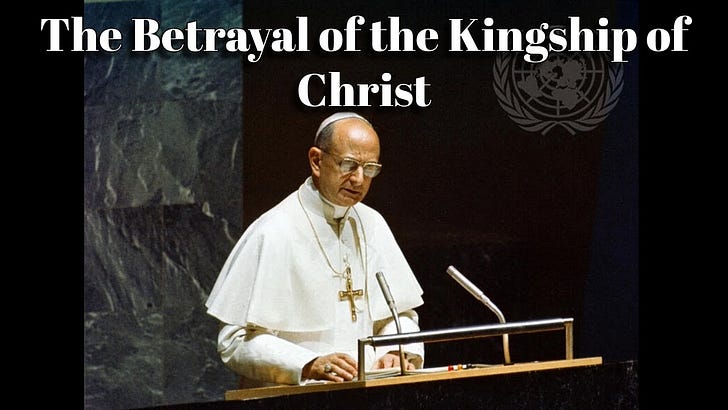
This “wholesale perversion of the mind” is summarised as the radical anthropocentrism of the Council, stated clearly by Paul VI, in his closing speech:
Secular, profane, humanism has finally revealed itself in its terrible shape and has, in a certain sense, challenged the Council. The religion of God made man has come up against a religion – for there is such a one – of man who makes himself God.
And what happened? An impact, a battle, an anathema? That might have taken place, but it did not. It was the old story of the Samaritan that formed the model for the Council’s spirituality. It was filled only with an endless sympathy. Its attention was taken up with the discovery of human needs – which become greater as the son of the earth (sic) makes himself greater.
Do you at least recognize this its merit, you modern humanists who have no place for the transcendence of the things supreme, and come to know our new humanism: we also, we more than anyone else, have the cult of man.26
Whether or not Paul VI consciously intended it, this echoes the promise made by Satan in the Garden of Eden:
… you shall be as Gods… (Gen. 3.5)
As a “mascot” of the philosophies examined above, Lucifer does not appear as a monstrous tempter, but as an “angel of light” (2 Cor. 11.14)—the bearer of enlightenment, liberty, equality and fraternity. Yet what he brings is the worship of man, the rejection of grace and the supernatural order, and rebellion against God.
The “counter-syllabus,” the “official reconciliation with the new era inaugurated in 1789,” and the wholesale reorientation of the Church around man rather than God—these all lead us to the unavoidable conclusion:
Vatican II is a robber council, founded on Luciferianism—and it must be abrogated and anathematised.
Postscript
Those who find this conclusion and these links disturbing, and are tempted to “shoot the messenger” are invited to consult the previous piece.
However, it may be objected that Dignitatis Humanae contains statements such as the following:
[The doctrine] leaves untouched traditional Catholic doctrine on the moral duty of men and societies toward the true religion and toward the one Church of Christ. (n. 1)
Among the things that concern the good of the Church and indeed the welfare of society here on earth-things therefore that are always and everywhere to be kept secure and defended against all injury-this certainly is preeminent, namely, that the Church should enjoy that full measure of freedom which her care for the salvation of men requires.(31) This is a sacred freedom, because the only-begotten Son endowed with it the Church which He purchased with His blood. Indeed it is so much the property of the Church that to act against it is to act against the will of God. The freedom of the Church is the fundamental principle in what concerns the relations between the Church and governments and the whole civil order. (n. 13)
Do such statements undermine our analysis? In the face of other statements, do they render the document ambiguous?
They do not—and the correct way of dealing with such statements will be the subject of the essay below:
Read next:



See also: Religious Liberty – The Failed Attempts To Defend Vatican II
HELP KEEP THE WM REVIEW ONLINE!
As we expand The WM Review we would like to keep providing free articles for everyone.
Our work takes a lot of time and effort to produce. If you have benefitted from it please do consider supporting us financially.
A subscription from you helps ensure that we can keep writing and sharing free material for all. Plus, you will get access to our exclusive members-only material.
(We make our members-only material freely available to clergy, priests and seminarians upon request. Please subscribe and reply to the email if this applies to you.)
Subscribe now to make sure you always receive our material. Thank you!
Follow on Twitter, YouTube and Telegram:
This and the other hymns are taken from Rev. Matthew Britt OSB, The Hymns of the Breviary and Missal, Revised Edition. Benziger Brothers, New York, 1922.
Leclercq, H. (1910). Lucifer of Cagliari. In The Catholic Encyclopedia. New York: Robert Appleton Company. http://www.newadvent.org/cathen/09410b.htm
The word appears on two occasions in the Book of Job:
Et quasi meridianus fulgor consurget tibi ad vesperam ; et cum te consumptum putaveris, orieris ut lucifer.
And brightness like that of the noonday, shall arise to thee at evening: and when thou shalt think thyself consumed, thou shalt rise as the day star. (Job 11:17)
Numquid producis luciferum in tempore suo, et vesperum super filios terræ consurgere facis?
Canst thou bring forth the day star in its time, and make the evening star to rise upon the children of the earth? (Job 38:32)
The word appears in Psalm 109, as words spoken by God the Father to his eternal Son:
Tecum principium in die virtutis tuæ in splendoribus sanctorum : ex utero, ante luciferum, genui te.
With thee is the principality in the day of thy strength: in the brightness of the saints: from the womb before the day star I begot thee. (Psalm 109:3)
St Peter uses the term “lucifer” in a metaphorical sense to describe the light of the Gospel:
Non enim doctas fabulas secuti notam fecimus vobis Domini nostri Jesu Christi virtutem et præsentiam : sed speculatores facti illius magnitudinis. Accipiens enim a Deo Patre honorem et gloriam, voce delapsa ad eum hujuscemodi a magnifica gloria : Hic est Filius meus dilectus, in quo mihi complacui, ipsum audite. Et hanc vocem nos audivimus de cælo allatam, cum essemus cum ipso in monte sancto. Et habemus firmiorem propheticum sermonem : cui benefacitis attendentes quasi lucernæ lucenti in caliginoso loco donec dies elucescat, et lucifer oriatur in cordibus vestris
For we have not by following artificial fables made known to you the power and presence of our Lord Jesus Christ: but we were eyewitnesses of his greatness. For he received from God the Father honour and glory, this voice coming down to him from the excellent glory: This is my beloved Son, in whom I am well pleased. Hear ye him. And this voice, we heard brought from heaven, when we were with him in the holy mount. And we have the more firm prophetical word: whereunto you do well to attend, as to a light that shineth in a dark place, until the day dawn and the day star arise in your hearts. (2 Peter 1.16-19)
We were taken to task for this claim a few months ago, by someone who alleged that we were abusing a great work of Western civilisation, and misrepresenting Milton’s work and beliefs. On the contrary, the ambivalent presentation of Satan in Paradise Lost is a standard question in the study of Milton and English literature. Frankly, it is astonishing that anyone would be so strident in their criticism of this point.
An overview of this topic can probably be found in any account of Milton’s work, for example in ‘Milton’s Satan’ by John Carey, Chapter 9 of The Cambridge Companion to Milton, 1989.
Siobhan Lyons, Nietzsche, Satan and the Romantics: The Devil as ‘Tragic Hero’ in Romanticism (2015), p 33.
William Lemore West, ‘The Moses Harman Story,’ Kansas Historical Quarterly, Spring 1971, Vol. 37, No. 1, pp 41-63. Available here. We see a similar allusion in the title of socialist newspaper Morning Star, apparently “[t]he only English-language socialist daily newspaper in the world.”
Saul Alinsky, Rules for Radicals, Vintage Books, New York, 1972.
Albert Pike, Morals and Dogma of the Ancient and Accepted Scottish Rite of Freemasonry, p 102. Charleston A.M., 1871.
Walton Hannah, Darkness Visible: A Revelation & Interpretation of Freemasonry, p 31. Augustine Publishing Company, Devon, 1980.
Hannah, 41
Hannah 203.
Ibid.
Bishop Rudolph Graber, Athanasius and the Church of Our Time, p 39. Christian Book Club, Palmdale, CA, 1974.
Cited in John Vennari, The Permanent Instruction of the Alta Vendita, p 7, 10. Tan, Rockford, IL, 1999.
Ibid.
Archbishop Marcel Lefebvre, Open Letter to Confused Catholics, Ch. 15. Angleus Press, Kansas City MO, 1986. 2010 edition.
Ibid.
Ibid.
Ibid.
Joseph Ratzinger, Principles of Catholic Theology, pp 381-2, 391. Ignatius Press, San Francisco CA, 1989. On 391, he added:
The task is not, therefore, to suppress the Council but to discover the real Council and to deepen its true intention in the light of present experience. That means that there can be no return to the Syllabus, which may have marked the first stage in the confrontation with liberalism and a newly conceived Marxism but cannot be the last stage. In the long run, neither embrace nor ghetto can solve for Christians the problem of the modern world. The fact is, as Hans Urs von Balthasar pointed out as early as 1952, that the “demolition of the bastions” is a long-overdue task.
Gregory XVI, Mirari Vos, 1832.
Archbishop Lefebvre, ‘Two years after the Consecrations.’ This interview is difficult to find today, but is available here: https://web.archive.org/web/20240228183416/https://sspx.org/en/two-years-after-consecrations
V2 is THE modernist 'great Ape'. Apes who call themselves 'Catholic', like 'The Meaning of Catholic' frauds and Fradds and Marshalls etc., are 'apes', serving the great Ape of V2.
For any who are interested in the methods by which these ideas were proliferated, see Fr. Augustin Barruel’s “Memoirs Illustrating the History of Jacobinism.” It reveals the conspiracy against the altar, throne, and society. Written in exile during the French Revolution, the veracity of its allegations are corroborated by the English philosopher Edmund Burke. The writing style is to amass so much evidence that the psychological resistance of the reader is overcome. It is the preeminent source on the causes leading to the revolution later embraced by the conciliar church. Wikipedia gives a somewhat decent review of the central thesis, though as expected, it feels itself required to dismiss some of the more distressing claims, evidence notwithstanding.