

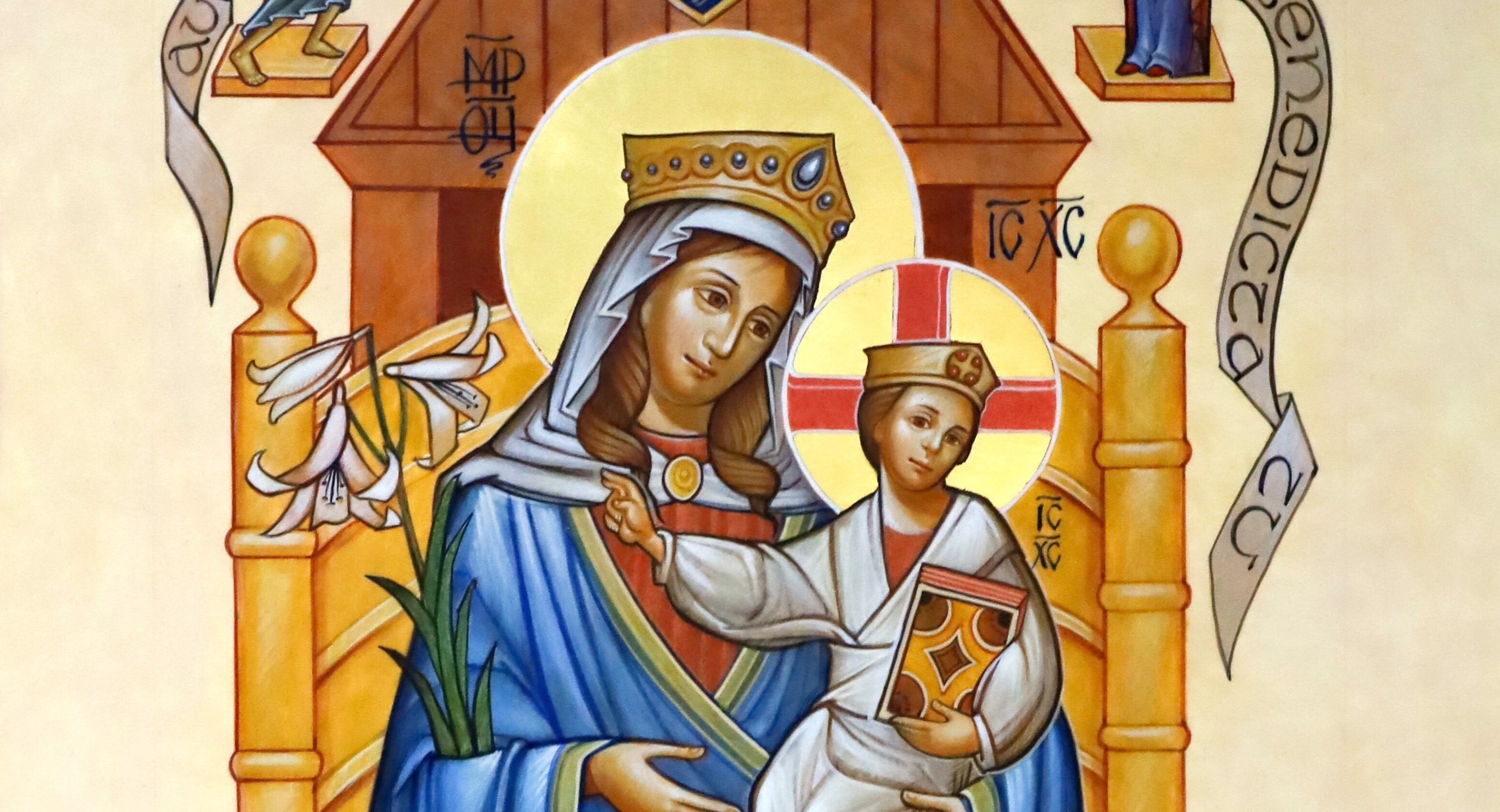
A 33-day preparation according to the method of St Louis de Montfort, drawing on the Spiritual Exercises of St Ignatius Loyola.
Index
Week 0 – Knowledge of the Spirit of the World
About Week 0
Day 1: Why did God make you?
Principle and Foundation
Day 2: Why did God make everything else?
Principle and Foundation
Day 3: Sin and the spirit of the world
The Three Sins
Day 4: What is ‘the spirit of the world’?
The Triple Colloquy
Day 5: Liberalism – apotheosis of the spirit of the world
From Liberalism is a Sin
Day 6: Satan’s battle plan to ensnare souls – and Christ’s battle plan to save them
The Two Standards
Day 7: Catholics and the spirit of liberalism
From Liberalism is a Sin
Day 8: Are you a weakling, a self-seeker... or something better?
The Three Classes of Men
Day 9: Do we actually want what humility entails?
The Three Ranks of Humility
Day 10: Ten ways YOU may be complicit with Liberalism – plus an uncomfortable ‘Portrait of a Liberal Catholic’
From Liberalism is a Sin
Day 11: How will YOU answer the Call of the King?
The Call of the King (Part I)
Day 12: Why Christians become liberals – and how to avoid it happening to YOU
From Liberalism is a Sin
Week 1: Knowledge of ourselves and of sin
About Week 1
Day 13: Have you ever tried to count all the sins of your life?
Our Own Sins
Day 14: Are YOU on your way to Hell?
Hell
Day 15: Does venial sin actually matter?
Venial Sin
Day 16: Why lukewarmness towards God can be worse than actual coldness
Tepidity
Day 17: Every minute brings us closer to death – and judgement
Death and Judgement
Day 18: Why you can and should return to God TODAY
The Prodigal Son
Day 19: Will you be a close companion of Christ the King?
The Call of the King (Part II)
Week 2: Knowledge of Our Lady
About Week 2
Day 20: The Blessed Virgin Mary and YOU
The Catholic doctrine of the Blessed Virgin in the spiritual life
Day 21: What was Our Lady like, just before the Annunciation?
The Eve of the Annunciation
Day 22: The central fact of the whole universe – The Incarnation of Christ
The Annunciation and Incarnation of Our Lord
Day 23: The blessed womb of Mary – Where Christ began the redemption
The Life of Our Lord in the Womb
Day 24: Did the Virgin Mary suffer in giving birth to Jesus?
The Nativity
Bonus Instalment:
The King appears for the first time at Christmas
The Nativity
Day 25: It’s time for YOU to visit Nazareth
The Holy Family and the Hidden Life
Day 26: What the Blessed Virgin felt when Jesus announced his departure
The Baptism of Christ Part I
Week 3: Knowledge of Our Lord
About Week 3
Day 27: Christ the King begins his crusade
The Baptism of Christ Part II
Bonus Instalments:
Christ the King’s first combat
The Temptation in the DesertThe Queen’s Request
The Wedding at Cana
Day 28: The King comes to claim his City
Palm Sunday
Day 29: The King looks his Passion in the eye
The Agony in the Garden
Day 30: The King rejected, scourged, and mocked with a crown of thorns
King and Victim
Day 31: The King upon his throne
Seven Last Words from the Cross (Third, Sixth and Seventh Words)
Bonus Instalment:
Christ’s Sermon from the Cross
The rest of the section on the Seven Last Words
Day 32: The King tramples down death, gives life to those in the grave
The Resurrection
Day 33: Heaven – The Court of the King which awaits us
Heaven
The Day of Consecration
Day 34: The Day of Total Consecration has arrived
Contemplation to Obtain Divine Love
Bonus Instalment:
If you would like to receive the daily meditations and readings, subscribe to emails here:
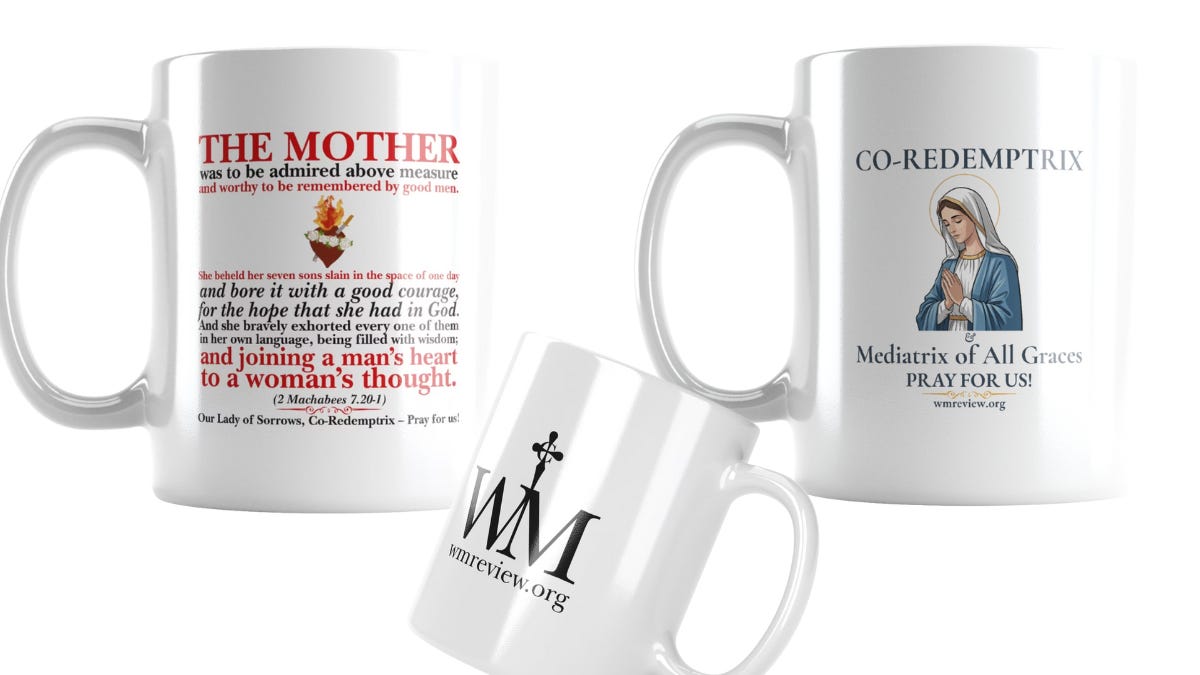
If you are enjoying the series, why not get it in mug form?
About the series
On Friday 21 November, The WM Review launched its 33-day preparation for St Louis de Montfort’s Total Consecration to the Blessed Virgin Mary, particularly to her Immaculate Heart and under the titles of Co-Redemptrix and Mediatrix of All Graces:
In reparation for the insults to Our Lady in and following the Vatican’s “Doctrinal Note”
As an antidote to the premature celebration of Christmas by the secular world, as well as the logistical chaos of shopping, cooking and preparing for family Christmas ourselves.
St Louis de Montfort offers a suggested plan for the 33-day period of preparation for total consecration to the Blessed Virgin, which he says can be lengthened or shortened as preferred. Our series follows this overview, supplemented by the Spiritual Exercises of St Ignatius and other relevant texts – which are intended as aids for the accompanying points of meditation.
Some of the prayers and many of the readings in what some think of as the “official” preparation do not appear to have come from St Louis himself. This “official” schema appears in the Tan edition of The Secret of Mary, which is a reprint of an American version from 1947, itself an update from an earlier edition in 1940.1 Other versions of The Secret of Mary do not include this schema.
In any case, St Louis stresses the general overview, but offers rather than prescribes particulars. As such, no-one should feel obliged to follow the schema found in Tan’s book. Those who have made the preparation several times before may profit from a slightly different approach and a greater focus on meditation and fewer vocal prayers.
We have provided the vocal prayers and readings which St Louis prescribes – which are actually lighter than those found in the Tan edition mentioned above.
What is ‘Total Consecration’ and ‘True Devotion’?
We advise readers to buy St Louis de Montfort’s book and read it themselves – as our series is not a guided reading of the book, and some knowledge is presumed:
Baronius Press edition (Baronius Press)
Baronius Press edition (Amazon)
You can also see our indispensable friend and colleague David from Catholic Hub discussing the devotion in relation to Advent (the first running of this series) below:
We have published a number of texts from Fr Réginald Garrigou-Lagrange OP, explaining the theological foundation of St Louis de Montfort’s “True Devotion” and “Total Consecration” to the Blessed Virgin.
Here are St Louis’ own words in summary form:
“Chosen soul, this devotion consists in surrendering oneself in the manner of a slave to Mary, and to Jesus through her, and then performing all our actions with Mary, in Mary, through Mary, and for Mary. Let me explain this statement further.
“We should choose a special feast-day on which to give ourselves. Then, willingly and lovingly and under no constraint, we consecrate and sacrifice to her unreservedly our body and soul. We give to her our material possessions, such as house, family, income, and even the inner possessions of our soul, namely, our merits, graces, virtues and atonements.
“Notice that in this devotion we sacrifice to Jesus through Mary all that is most dear to us, that is, the right to dispose of ourselves, of the value of our prayers and alms, of our acts of self-denial and atonements. This is a sacrifice which no religious order would require of its members. We leave everything to the free disposal of our Lady, for her to use as she wills for the greater glory of God, of which she alone is perfectly aware.
“We leave to her the right to dispose of all the satisfactory and prayer value of our good deeds, so that, after having done so and without going so far as making a vow, we cease to be master over any good we do. Our Lady may use our good deeds either to bring relief or deliverance to a soul in purgatory, or perhaps to bring a change of heart to a poor sinner.
“By this devotion we place our merits in the hands of our Lady, but only that she may preserve, increase and embellish them, since merit for increase of grace and glory cannot be handed over to any other person. But we give to her all our prayers and good works, inasmuch as they have intercessory and atonement value, for her to distribute and apply to whom she pleases.” (The Secret of Mary, nn. 28-31)
While the doctrine itself is older than St Louis, his work and teaching also has the approbation of the recent Popes prior to Vatican II. St Louis himself was beatified by Pope Leo XIII (1888) and canonised by Pope Pius XII (1947).
In 1907, Pope St Pius X approved the perpetual extension of Leo XIII’s indulgence attached to St Louis’ consecration prayer – itself a full expression of the doctrine and devotion. His encyclical Ad diem illum teaches the same doctrine, as Fr Réginald Garrigou-Lagrange OP wrote:
“Pius X has made his own the teaching of St. Grignon de Montfort, and sometimes of his very expressions, in the Encyclical Ad diem illum on Mary, universal Mediatrix.” (Mother of the Saviour, Ch. XV, fn. 2.)
Bishop Pierre Roy’s encouragement and other testimonies
We are delighted to say that this initiative has the encouragement and blessing of Bishop Pierre Roy, who is based in the Maritime Provinces of Canada.
Mgr Roy was kind enough to give us the following statement:
This initiative of having Catholics consecrate themselves to the Blessed Virgin Mary in reparation for the recent Vatican’s document declaring as “inappropriate” titles of Our Lady that have been used by a number of popes, theologians and saints is an excellent one and can only be encouraged. Adding elements of the spiritual exercises of St Ignatius to this devotion is a great idea. What a powerful and saintly season of Advent will undergo those who embrace this preparation!
The document of the Vatican has the obvious signature of the evil one. Let us answer by honoring our Blessed Mother, consecrating ourselves to Her, and starting to live a true devotion towards Her. She obviously will have a great role to play in putting an end to the terrible crisis the Church is in at the moment. She will crush the head of the infernal Serpent.
For this, although She does not need it, armed as She is with the fullness of grace of Her Immaculate Conception, She nevertheless deigns to be willing to raise an army of Her true children: those consecrated to Her. Who can refuse to be part of this army?
Let us therefore undergo this consecration, propagate it around us and take part in the rising up of this army with which Our Lady will prove once again that she is as “powerful as an army prepared for battle”!
Our Lady, Coredemptrix, pray for us!
Our Lady, Mediatrix of all graces, pray for us!With my blessing,
Mgr Pierre Roy
We are very grateful for Mgr Roy’s encouragement.
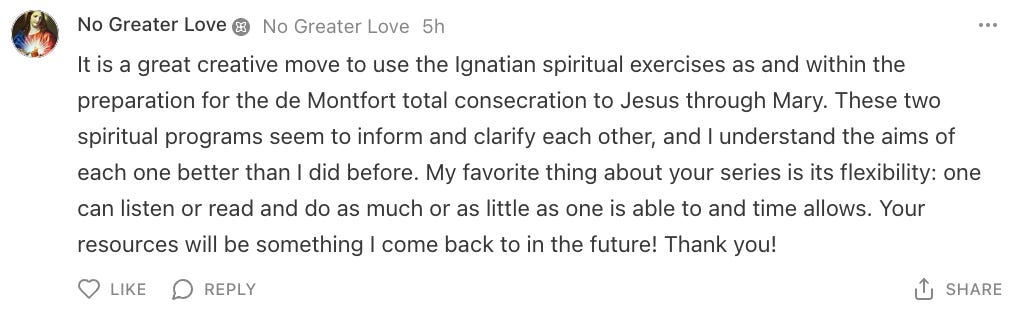
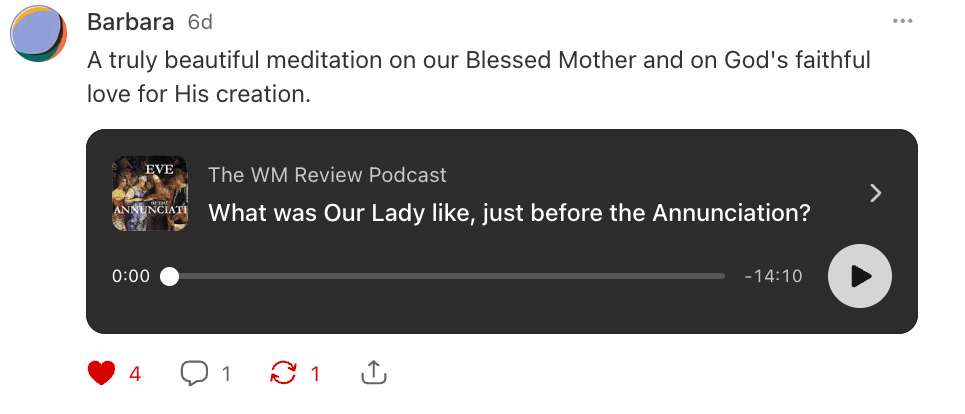
In addition, take a look at what some have been saying about this series in the public comments:







To get started, see Day 1:

Some Objections
Slavery?
Even from the beginning, some have had reservations about St Louis de Montfort’s devotion – including the admirable Bishop Bernard Ullathorne. However, it seems clear that those reservations were either unfounded (certain similarities with previously condemned devotions being merely superficial) or have been answered. Further, St Louis’ text has the clear approval of the Popes.
Today, some might be able to accept the devotion as the writings of a saint, but wonder how it compares to the Church’s doctrine and more rigorous theology. To that end, Garrigou-Lagrange demonstrates the doctrinal and theological basis of St Louis’ method, and its acceptance by the Popes.
In those texts, Garrigou-Lagrange offers a short reflection on the concept of “slavery,” so central to St Louis’ method – and so difficult for many. As this will be tucked away in a footnote, we are reproducing it here:
“The expression ‘holy slavery’ used by the Saint has been sometimes criticised. This is to forget that it is a slavery of love which accentuates rather than diminishes the filial character of our love of Mary. Besides, as Mgr. Garnier, Bishop of Luçon, remarked in a pastoral letter of March 11th, 1922, if there are in the world slaves of human respect, of ambition, of money, and of shameful passions, there are also, thank God, slaves of conscience and of duty. The holy slavery belongs to this group. The expression ‘holy slavery’ is a striking metaphor, opposed to the slavery of sin.”
Father Coleridge Reader has recently published some articles considering whether we may properly be called “slaves of God.”
In addition, The Journal of American Reform has published Archbishop Kenrick’s treatment on the topic of slavery itself, which shows that the concept covers a wider and less odious set of historical practices than the African slave trade and contemporary human trafficking. American Reform summarises the explanation as follows:
“First, and most important, a just title to owning a slave (capture in war, State-inflicted punishment, debt, nativity, voluntary acceptance, etc.) is morally necessary. Reducing a man to servitude without a legal title, robbing him of his liberty, is seriously sinful. This holds for all men, irrespective of their race, nationality or class.
“Secondly, respect must be given to the rights of the slave, meaning provisions for Catholic education, housing and food, along with ensuring his right to marry and receive the other sacraments. A slave is not to be looked upon as a brute, as mere chattel, but only as chattel in things superadded to nature. The slave is a fellow-man, with the same intrinsic dignity as the master, yet his master has the right to perpetually dispose of his labor and its fruits.”
Although St Louis’ does present the rights of masters extending even further than this as a matternof history, it is clear that he does not intend the image of slavery to God as conveying abuse, but rather love and care. Such is the abstract concept of slavery which philosophers have discussed, and which was sometimes realised with the more virtuous Romans, whose slaves could be beloved members of the household, rather than the dehumanising and exploitative idea which the word normally suggests today.
Scandalising Protestants?
There is the additional concern, raised by Ullathorne, about scandalising Protestants. As has been clear since 4th November, this continues to be a concern. Ullathorne wrote the following:
“Let me give an instance out of several within my knowledge of the injudicious use of certain books. Quite recently, a lady had but one difficulty that kept her from entering the Church – it concerned the Blessed Virgin; De Montfort’s book was put into her hands as the proper remedy, and it drove her away in terror. Had it been Dr. Newman’s book, how different might have been the result.”
We are also aware of neophytes being recommended to read this book and begin this devotion. We are unsure of the prudence of such a measure – at least as a general rule. Let us note first that Ullathorne was writing not just about Protestants, but a powerful and hostile Protestant majority – amongst whom a level of caution was necessary for Catholics. That situation does not obtain today.
However, on the subject of Cardinal Newman, let us consider his words in his Letter to Pusey:
“[Protestants] content themselves with saying that our devotions to our Lady must necessarily throw our Lord into the shade; and thereby they relieve themselves of a great deal of trouble. Then they catch at any stray fact which countenances or seems to countenance their prejudice.
“Now I say plainly, I never will defend or screen any one from your just rebuke, who, through false devotion to Mary, forgets Jesus. But I should like the fact to be proved first; I cannot hastily admit it.
“There is this broad fact the other way;—that, if we look through Europe, we shall find, on the whole, that just those nations and countries have lost their faith in the divinity of Christ, who have given up devotion to His Mother, and that those on the other hand, who had been foremost in her honour, have retained their orthodoxy. Contrast, for instance, the Calvinists with the Greeks, or France with the North of Germany, or the Protestant and Catholic communions in Ireland.
“As to England, it is scarcely doubtful what would be the state of its Established Church, if the Liturgy and Articles were not an integral part of its Establishment; and, when men bring so grave a charge against us, as is implied in your Volume, they cannot be surprised if we in turn say hard things of Anglicanism.
“In the Catholic Church Mary has shown herself, not the rival, but the minister of her Son; she has protected Him, as in His infancy, so in the whole history of the Religion. There is then a plain historical truth in Dr. Faber’s words, which you quote to condemn, ‘Jesus is obscured, because Mary is kept in the background.’”
He continues:
“When strangers are so unfavourably impressed with us, because they see Images of our Lady in our churches, and crowds flocking about her, they forget that there is a Presence within the sacred walls, infinitely more awful, which claims and obtains from us a worship transcendently different from any devotion we pay to her. That devotion to her might indeed tend to idolatry, if it were encouraged in Protestant churches, where there is nothing higher than it to attract the worshipper: but all the images that a Catholic church ever contained, all the Crucifixes at its Altars brought together, do not so affect its frequenters, as the lamp which betokens the presence or absence there of the Blessed Sacrament.”
In a similar vein, he refers to a passage in his own Essay on the Development of Christian Doctrine, expressly approved by Cardinal Wiseman:
“[I]t must be asked, whether the character of Protestant devotion towards our Lord, has been that of worship at all; and not rather such as we pay to an excellent human being... Carnal minds will ever create a carnal worship for themselves; and to forbid them the service of the saints, will have no tendency to teach them the worship of God.”
He ends this point by asking Pusey the following question:
“When then, my dear Pusey, you read anything extravagant in praise of our Lady, is it not charitable to ask, even while you condemn it in itself, did the author write nothing else? Had he written on the Blessed Sacrament? had he given up ‘all for Jesus?’”
The sad reality is that few online Protestants are interested in the pause that Newman suggests above – and few are capable of articulating the question-begging nature of their theological method (if such it can be called) of Sola Scriptura – let alone reflecting on its legitimacy or defending it.
We certainly do not wish to scandalise anyone. But as Newman indicates, much of this scandal is rooted in prejudice, and is often pharisaical in nature. It is not the way of the Church to restrict language to that which will not offend the sensibilities of the lowest common denominator prejudices of the most unreflective anti-Catholics.
As such, if Protestants are offended by articles which they stumble across, which were written by Catholics for other Catholics, then we are sorry for their trouble, and we pray that they convert (for outside the Church there is no salvation, and without the Catholic faith it is impossible to please God) – but we will not change what we write based on such a possibility.
The preparation itself
Initial period (‘Week 0’)
The first period – which we could call “Week 0” – is focused on knowing and divesting ourselves of the spirit of the world:
“Those who desire to take up this special devotion, (which has not been erected into a confraternity, although this would be desirable), should spend at least twelve days in emptying themselves of the spirit of the world, which is opposed to the spirit of Jesus, as I have recommended in the first part of this preparation for the reign of Jesus Christ.” (True Devotion, n. 227)
Our preparation will consist of relevant meditations from the first two weeks of the Spiritual Exercises, along with readings from Fr Aloysius Ambruzzi on these meditations and from Liberalism is a Sin on the ways in which worldliness affects us all.
Taken altogether with the vocal prayers, some may find it too much. They should do what they can, and not stress themselves.
You can see the prayers that are usually recommended for this period here:

Following the initial period of “Week 0”, St Louis says, devotees “should then spend three weeks imbuing themselves with the spirit of Jesus through the most Blessed Virgin.” He offers the following as a suggested – not mandatory – programme:
Week 1: Knowledge of Self
“During the first week they should offer up all their prayers and acts of devotion to acquire knowledge of themselves and sorrow for their sins.
“Let them perform all their actions in a spirit of humility. With this end in view they may, if they wish, meditate on what I have said concerning our corrupted nature, and consider themselves during six days of the week as nothing but sails, slugs, toads, swine, snakes and goats.
“Or else they may meditate on the following three considerations of St. Bernard: ‘Remember what you were – corrupted seed; what you are – a body destined for decay; what you will be – food for worms.’”
“They will ask our Lord and the Holy Spirit to enlighten them saying, ‘Lord, that I may see,’ or ‘Lord, let me know myself,’ or the ‘Come, Holy Spirit’” (n. 228)
He suggests the following prayers:
“Every day they should say the Litany of the Holy Spirit, with the prayer that follows, as indicated in the first part of this work. They will turn to our Blessed Lady and beg her to obtain for them that great grace which is the foundation of all others, the grace of self-knowledge. For this intention they will say each day the Ave Maris Stella and the Litany of the Blessed Virgin.” (n. 228)
Our preparation will consist of the relevant meditations from the first week of the Spiritual Exercises – a week which is focused especially on knowledge of self.
You can see the prayers that are usually recommended for this period here:

Week 2: Knowledge of Our Lady
St Louis de Montfort continues:
“Each day of the second week they should endeavour in all their prayers and works to acquire an understanding of the Blessed Virgin and ask the Holy Spirit for this grace. They may read and meditate upon what we have already said about her.” (n. 229)
He suggests the following prayers:
“They should recite daily the Litany of the Holy Spirit and the Ave Maris Stella as during the first week. In addition they will say at least five decades of the Rosary for greater understanding of Mary.” (n. 229)
We will be especially focusing on Week 2 of the Spiritual Exercises, which deal with Our Lady and Our Lord’s hidden life.
You can see the prayers that are usually recommended for this period here:

Week 3: Knowledge of Our Lord
For the third week, St Louis writes:
“During the third week they should seek to understand Jesus Christ better. They may read and meditate on what we have already said about him.” (n. 230)
For the prayers, he writes:
“They may say the prayer of St. Augustine which they will find at the beginning of the second part of this book [n. 67]. Again with St. Augustine, they may pray repeatedly, ‘Lord, that I may know you,’ or ‘Lord, that I may see.’ As during the previous week, they should recite the Litany of the Holy Spirit and the Ave Maris Stella, adding every day the Litany of the Holy Name of Jesus.” (n. 230)
We will be especially focusing on Weeks 2-4 of the Spiritual Exercises, which focus on Our Lord’s ministry, Passion and Resurrection.
You can see the prayers that are usually recommended for this period here:

The day of the consecration
St Louis says what should happen on “Day 34”, the last day – for us, Christmas Eve:
“At the end of these three weeks they should go to confession and Holy Communion with the intention of consecrating themselves to Jesus through Mary as slaves of love. When receiving Holy Communion they could follow the method given later on. They then recite the act of consecration which is given at the end of this book. If they do not have a printed copy of the act, they should write it out or have it copied and then sign it on the very day they make it.
“It would be very becoming if on that day they offered some tribute to Jesus and his Mother, either as a penance for past unfaithfulness to the promises made in baptism or as a sign of their submission to the sovereignty of Jesus and Mary. Such a tribute would be in accordance with each one’s ability and fervour and may take the form of fasting, an act of self-denial, the gift of an alms or the offering of a votive candle. If they gave only a pin as a token of their homage, provided it were given with a good heart, it would satisfy Jesus who considers only the good intention.” (nn. 231-2)
The Spiritual Exercises end with the “Contemplation to Attain the Love of God,” which is especially appropriate in its form for making St Louis de Montfort’s consecration.
Some may find it difficult to confess on Christmas Eve or Christmas Day – although having 33 day’s notice might make it easier to arrange in advance. Nonetheless, if this is foreseen as impossible then it seems reasonable enough to go a few days in advance.
This series is a major, multi-faceted endeavour – and while it might look straightforward from the outside, it is consistently daunting to contemplate how much is involved. Please keep us in your prayers as we are getting it up and running, and consider taking out a monthly/annual membership to WM+ to help out:
HELP KEEP THE WM REVIEW ONLINE WITH WM+!
As we expand The WM Review we would like to keep providing free articles for everyone.
Our work takes a lot of time and effort to produce. If you have benefitted from it please do consider supporting us financially.
A subscription gets you access to our exclusive WM+ material, and helps ensure that we can keep writing and sharing free material for all.
You can see what readers are saying over at our Testimonials page.
(We make our WM+ material freely available to clergy, priests and seminarians upon request. Please subscribe and reply to the email if this applies to you.)
Subscribe to WM+ now to make sure you always receive our material. Thank you!
If you are enjoying this preparation for Total Consecration, why not get it in mug form?
We also have our best-selling Co-Redemptrix mugs:
Read Next:


Books
True Devotion to the Blessed Virgin Mary (St Louis de Montfort)
The Foot of the Cross: Or the Sorrows of Mary (Fr Faber)
Mariology, Vol. II (Fr Juniper Carol OFM)
Mariology (Fr Matthias Scheeben)
Mother of the Saviour and our Interior Life (Fr Garrigou-Lagrange)
Sacrae Theologiae Summa IIIA: On the Incarnate Word, On the Blessed Virgin Mary
Follow on Twitter, YouTube and Telegram:
Twitter (The WM Review)
For example:
https://archive.org/details/secretofmaryunve00grig/
https://archive.org/details/the_secret_of_mary_1926-louis_marie_grignon_de_montfort/
http://www.montfortian.info/writings/files/The-Secret-of-Mary.pdf