
One last reading and meditation to help you make the Consecration with as much fervour as possible.
Editor’s Notes
This is Day 34 – the day to which we have been working these last 33 days.
On the first run of this series, we suggest that you make the consecration itself either on Christmas Eve, at Midnight Mass, or in the day on Christmas Day – according to what suits you best.
Here’s what St Louis de Montfort has to say about the day of Consecration:
231. At the end of these three weeks they should go to confession and Holy Communion with the intention of consecrating themselves to Jesus through Mary as slaves of love. When receiving Holy Communion they could follow the method given later on. They then recite the act of consecration which is given at the end of this book. If they do not have a printed copy of the act, they should write it out or have it copied and then sign it on the very day they make it.
232. It would be very becoming if on that day they offered some tribute to Jesus and his Mother, either as a penance for past unfaithfulness to the promises made in baptism or as a sign of their submission to the sovereignty of Jesus and Mary. Such a tribute would be in accordance with each one’s ability and fervour and may take the form of fasting, an act of self-denial, the gift of an alms or the offering of a votive candle. If they gave only a pin as a token of their homage, provided it were given with a good heart, it would satisfy Jesus who considers only the good intention.
233. Every year at least, on the same date, they should renew the consecration following the same exercises for three weeks. They might also renew it every month or even every day by saying this short prayer: “I am all yours and all I have is yours, O dear Jesus, through Mary, your holy Mother.”
We have been providing daily readings for this preparation, inspired by St Ignatius’ Spiritual Exercises – and today will be no different. This final meditation – the last one from the Spiritual Exercises – is The Contemplation to Obtain Divine Love. In this exercise, he wants us to consider precisely why we should offer ourselves wholly and entirely to Our Lord, out of love for him.
This is a very fitting way to end this synthesis of St Ignatius and St Louis. St Louis’ prayer of consecration includes the phrase “In the presence of all the heavenly court I choose thee this day for my Mother and Mistress.” St Ignatius also invokes the entire court of Heaven – on which we meditated yesterday – in his response to the Call of the King, and in the famous Sume et Suscipe prayer of this meditation:
The Answer to The Call of the King
Eternal Lord of all things, I make my oblation with Thy grace and help, in the presence of Thine infinite goodness, and in the sight of Thy glorious Mother, and of all the Saints of the Heavenly Court, protesting that I wish and desire, and that it is my deliberate determination, provided only it be to Thy greater service and praise, to imitate Thee in bearing all injuries, and all reproach, and all poverty, as well actual as spiritual, if only Thy Divine Majesty be pleased to choose and receive me to such a life and state. Amen.
Sume et Suscipe
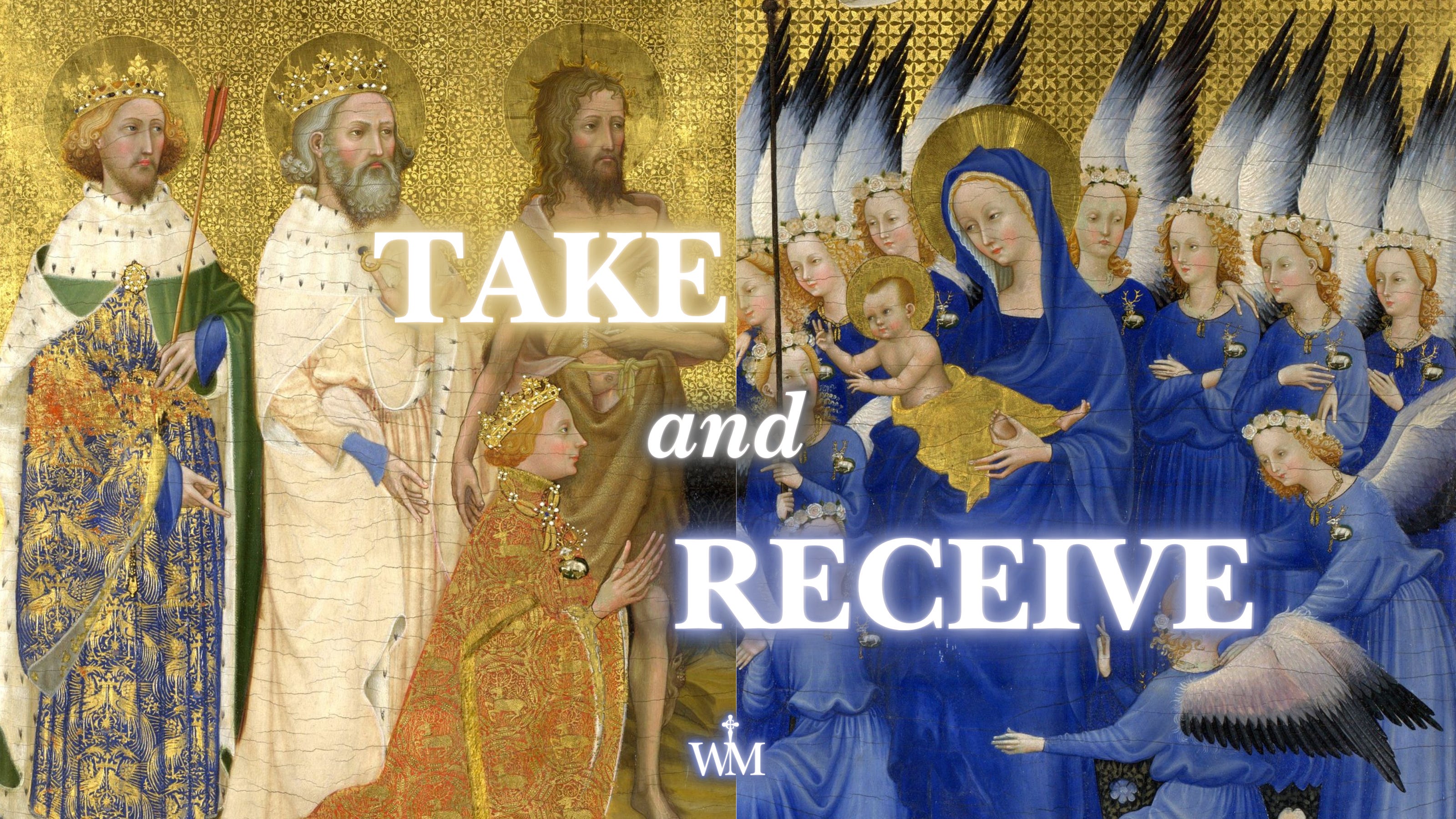
Take, Lord, and receive all my liberty, my memory, my intellect, and all my will—all that I have and possess. Thou gavest it to me: to Thee, Lord, I return it! All is Thine, dispose of it according to all Thy will. Give me Thy love and grace, for this is enough for me. Amen
This latter offering, which began with the former in Week 1, is precisely what St Louis’ true devotion is all about – it is just that it St Louis’ made specifically through the hands of Our Lady, the Queen of Heaven.
For that reason, we can use this meditation as a backdrop, setting and context for making our consecration, and turning once again to Fr Aloysius Ambruzzi’s explanation.
The text of the Consecration
St Louis says that we should have a written copy of the consecration. This needs to be personal: handwritten is especially nice if possible, but you can find a printable version here:

The text also follows the reading and meditation below.
If you have enjoyed this series, then please consider taking out a paid annual or monthly subscription to WM+.
Those paid subscriptions really help the WM Review keep going, and it wouldn’t be possible without them. It is important for us to keep the main body of our work free for all, but we do also publish exclusive material for WM+ members as our way of saying thanks.
For example, we have published a bonus instalment to today’s exercise for WM+ members:
CONTENTS:
READING: The text is based on an extract from Fr Aloysius Ambruzzi SJ.
MEDITATION: The points for meditation are included below. A guide on how to use these points in meditation can be found here.
Reading: Contemplation for Obtaining Love
Heaven Anticipated
A Companion to the Spiritual Exercises of Saint Ignatius
Fr Aloysius Ambruzzi SJ
The Contemplation for obtaining love, though placed outside the Fourth Week, is the crowning point of the Spiritual Exercises.
Heaven is the home of love: of the Eternal Love that is God Himself, and of the created love poured by God into His creatures and requited by them to Him. Earthly life is a preparation for it, or, better, its beginning. That is why, throughout the Gospel, our Lord lays stress on the infinite love of God, our Father; and that is why, too, St John, to whom heavenly secrets were primarily revealed, wrote that God is Love. To love God is the greatest and the first commandment: “Thou shalt love the Lord thy God, with thy whole heart, with thy whole soul, and with thy whole mind.” (Matt. xxii, 37)
The Contemplation for obtaining love gives us an idea of God’s love, and teaches us how to return love for love. The subject-matter of its various points should be the constant food of our minds and of our hearts.
At the outset, St Ignatius calls attention to two things. “The first is that love ought to show itself in deeds rather than in words.” It is an echo of the teaching of the Beloved Disciple: “My little children, let us not love in word, nor in tongue, but in deed and in truth” (I John iii, 18). We are warned against hollow protestations of love, and even against sterile feelings. Though love is mainly an affair of the heart, we should distrust feelings that do not lead to work and to self-sacrifice.
“The second, that love consists in mutual interchange of gifts, i.e., in the lover giving and communicating to the beloved that which he has or can give, and in like manner the beloved to the lover. So that if one has knowledge he gives it to him who has it not, and likewise if he has honours and riches; and the other in turn does the same.”
A true lover desires to give himself wholly to the beloved and be one with him. The gifts which he offers him are merely marks of such an ardent desire and a preparation for the moment of consummate union.
The first Prelude is to see how I stand before God our Lord, before the Angels and Saints who are interceding for me.
The second Prelude is to ask for an interior knowledge of so many favours that I have received, so that acknowledging them to the full, I may be able to love and serve His Divine Majesty in everything.
First Point
1. Creation and conservation
God is Love. For God to love is infinitely more natural than it is for the bird to fly, the wind to blow, the sun to shine. As Love, God has wished to communicate Himself and His perfections to creatures, capable of knowing and of returning His love.
Through love He has created us. “Yea I have loved thee with an everlasting love, therefore have I drawn thee taking pity on thee” (Jer. xxxi, 3). Creation is but the overflowing of the life of God on to His creatures.
Through love He has created the beautiful world which we inhabit and the whole universe which gladdens our gaze. Everything proclaims loudly the love of our Creator: the smallest blade of grass whispers that it exists for us. Well did that Saint hear the voice of inanimate creation, who, walking through meadows, would gently touch the flowers and say: “I know, you tell me that God has made you for me, and that I must love Him with my whole heart.”
“We do not think enough of what is going on around us, the molecular wonders of every stone, the sap in the trees, the blood in the veins, chemistry, electricity, astronomy, the human mind, and then the Angels. Spiritual men too much neglect the study of the nature in view of God. What is nature but a divine handwriting? What are its laws but the conceptions of a Divine Mind proceeding upon the exemplar of Itself and the consequent behests of a Divine Will? What lends efficiency to those laws and carries them out, but an ever present Divine activity?” (Rickaby, Waters that go softly, pp. 158-59)
It is God that supports us and prevents us from falling into nothingness. Like a tender mother He carries us in His Divine arms, shelters us from all danger, and showers His gifts profusely on and around us.
2. Redemption, sanctification and glorification
God is infinite love. The gift of life which He has made to us, and for our sake, to the material universe, could not satisfy His heart’s desire. A lover longs to give himself to, and sacrifice himself for his beloved, and to make this gift and sacrifice an everlasting act. Bethlehem, Calvary, and the Altar show how God has fulfilled the law of love. In Bethlehem He gave Himself to us: “To you a Saviour is born.” On Calvary He shed the very last drop of His Blood for us: “And walk in love, as Christ also hath loved you and delivered Himself up for us, an offering and a sacrifice of sweet savour to God” (Eph. v, 2). On the Altar He gives and sacrifices Himself for each one of us, every minute of the day: “This is My Body which is given for you; do this for a commemoration of Me.” (Luke xxii, 19)
In Christ and through Christ, God has made us the partakers of His very life. He has given us His grace and the host of gifts that go along with it: “By whom He hath given us most great and precious promises: that by these you may be made partakers of the Divine Nature” (2 Pet. i, 4). Christ our Lord has established the Church to teach us infallibly His sacred doctrine, to sanctify and to guide us. He has left us seven channels through which the waters of grace flow from His Heart into our soul and body. From the Cross He gave us the sweetest gift of all—the gift of a mother—His Mother.
And what is God’s purpose in showering so many gifts on us? Such gifts are but an earnest of the gift which God will make of Himself to the blessed soul, a beginning of that intimate union of God, the Infinite Lover, with the soul which He has drawn to Himself. God is, indeed, the heavenly Father Who, with outstretched arms, calls to Himself the soul which He has created, along the path traced by His loving Providence and strewn with ever new flowers.
3. God’s gifts are individual
But are not all such gifts—the creation of the universe and its preservation, man’s Redemption and Sanctification—made indiscriminately to all men? Even if I had never existed, God would have created the world, and Christ would have died on the Cross. How then do such gifts argue God’s love for me in particular?
And yet God’s love in pouring out such gifts on each one of us could not be greater, were one alone the recipient of them. God loves us individually. For the least of us He would have created the world, He would have become man, and would have died on the Cross. “He loved me,” St Paul would repeat, “and delivered Himself for me.”
Moreover, is the benefit and the enjoyment which we derive from God’s gifts, both natural and supernatural, less because we share them with others? “What does it matter,” says St John Chrysostom, “that they are given to others, if what are given to you are as complete and perfect as if none of them were given to another than yourself?” Besides, is not companionship requisite to enjoy fully the good things of life? Is it not something mean and selfish to wish to have all things to oneself, with no one to share them?
4. Particular gifts
Moreover, is not our whole life an uninterrupted series of gifts and favours received from God by each one of us in particular?
First, in the order of nature, God has given to each one of us a perfect, healthy body and the full use of our faculties, parents that care lovingly for us, the sweet companionship of brothers and sisters and friends, sufficiency, if not abundance, of temporal goods—joys, pleasures, amusements without number. From how many evils He has preserved us! How many dangers He has averted from us! With growing years, His gifts have also increased both in number and in magnitude, and if they be not unaccompanied with crosses, we know that, whatever the world and our weak nature may suggest to the contrary, the cross is the greatest gift of God to man.
Secondly, in the order of grace. Who can count or measure what God has done for each one of us in this order? The gift of Faith—how many favours it includes! And then our first Communion, our Christian education, and our state of life, lovingly chosen by God—it may be our call to a higher life in Religion, or to the Priesthood. How many sins He has forgiven us! How many warnings and inspirations He has sent us! How many prayers He has heard! How much light He has shed on our path! How many consolations He has poured into our hearts! Truly He has been all things to us.
Thirdly, in the order of glory. “I go to prepare a place for you.” The Infinite Lover seems to be wholly occupied in preparing a throne and a crown of glory for the soul He loves. For every good deed of ours He adds a precious stone to our diadem. Every gift He lavishes on us is a mark of His desire to give Himself eternally to us and a means to draw us powerfully to His Heart. “In that day you shall know that I am in My Father, and you in Me, and I in you.”
“God beholds thee individually, whoever thou art. He ‘calls thee by thy name.’ He sees thee, and understands thee, as He made thee. He knows what is in thee, all thy own peculiar feelings and thoughts, thy dispositions and likings, thy strength and thy weakness. He views thee in thy day of rejoicing and thy day of sorrow. He sympathizes in thy hopes and thy temptations. He interests Himself in all thy anxieties and remembrances, all the risings and fallings of thy spirit. He has numbered the very hairs of thy head and the cubits of thy stature. He compasses thee round and bears thee in His arms; He takes thee up and sets thee down. He notes thy very countenance, whether smiling or in tears, whether healthful or sickly. He looks tenderly upon thy hands and thy feet; He hears thy voice, the beating of thy heart, and thy very breathing. Thou dost not love thyself better than He loves thee. Thou canst not shrink from pain more than He dislikes thy bearing it; and if He puts it on thee, it is as thou wilt put it on thyself, if thou art wise, for a greater good afterwards.”
(Cf. The Newman Book of Religion, p. 15)
5. Sume et suscipe
“What shall I render to the Lord for all that He hath given to me?”
First, a hymn of praise and thanksgiving. “It is truly meet and just, right and salutary that we should at all times and in all places give thanks to Thee, O holy Lord, Father Almighty, everlasting God.”
Humble gratitude is the only attitude which befits the soul in the presence of God’s overwhelming benefits. “I am not worthy of the least of all Thy mercies, and of all the truth which Thou hast showed unto Thy servant” (Gen. xxxii, 10). To praise and give thanks is hard and galling to the proud man who boasts that he owes nothing either to his fellowmen or even to his Creator; but to good and noble men it is the sweetest of tasks. Gratitude opens more and more the hand that has given already. Gratitude to God is nothing else but the hymn of intelligent creatures, returning to Him all the rivulets of beauty, of wealth, and of grace that have flowed from that Primal Source; it is a joyful confession of our entire dependence on God’s love and power.
Secondly, along with thanks, I must, with great reason and justice, give to His Majesty all that I have and all that I am. Dilectus meus mihi et ego illi.
“Take O Lord, and receive all my liberty, my memory, my understanding, and all my will, whatever I have and possess. Thou hast given me all these things; to Thee, O Lord, I restore them; all are Thine, dispose of them entirely according to Thy will. Give me Thy love and Thy grace, for these are enough for me.”
Such an unreserved gift and absolute surrender to God, the Infinite Lover, on the part of the beloved soul is the best and surest expression of love, whether we consider what the beloved gives, or the extent of the gift, the manner in which the gift is made, or the motive that prompts it. Whoever makes such an oblation must neither do anything that he does not know to be God’s Will, nor omit anything that he knows to be such. He must seek only God’s pleasure in everything. The Sume et Suscipe realized in all the details of life, will make our life an uninterrupted act of love, free from illusions and self-deception.
O Bonitas infinita!
1. O Infinite and inexhaustible Giver, how numerous and immeasurably great are Thy gifts! All is from Thee—The beauties of the earth and the magnificence of the heavens—my body and soul and all the things with which Thou hast blessed me throughout my life—what I am—what I have and whatever good I have done! From Thee the marvels of the world of grace and glory—Christ, the gifts of Redemption, of Adoption, of Sanctification, and of Glorification—Mary, the Angels and Saints, and the Church—the particular gifts of the Faith, of conversion, of vocation, and the other graces which Thou hast never ceased to pour lovingly on me! All is from the infinite love of Thy Heart—a mark of Thy love for me—a pledge of Thy desire to give Thyself to me! Truly every moment of my life proclaims Thy love, Thy liberality, Thy mercy!
2. What shall I render to Thee, O God of love? Oh that I may ever sing to Thee the hymn of joyful praise and of humble thanksgiving—that I may offer Thee all that I have and all that I am!
Take, O Lord, and receive all my liberty, my memory, my understanding, and all my will, whatever I have and possess. Thou hast given me all these things; to Thee, O Lord, I restore them; all are Thine, dispose of them entirely according to Thy will.
Give me, O Infinite Lover, but one more grace—the greatest of graces. Give me Thy love and Thy grace, for these are enough for me. I long to be only Thine, to have nothing left to myself but the power to love Thee and please Thee in all things, every moment of my life.
The rest of the Fr Ambruzzi’s text (on the other three points of the exercise) is available as a Bonus for WM+ members:
The act of consecration follows the meditation below, and ideally should be made as a part of the meditation.
Meditation for the Day of Consecration (Day 34)
Contemplation for Obtaining Love
Taken from St Ignatius’ Spiritual Exercises (the first of the four parts of this contemplation)
The purpose of including this meditation is to bring before our minds all the benefits God has given us, as a motive for making our own consecration and offering to him, through the Blessed Virgin, more fervent. We should apply everything that St Ignatius and Fr Ambruzzi say about this offering of oneself to God to our imminent offering of ourselves to God, through Our Lady.
It is in mental prayer that that much of the preparation will be achieved – and meditation is a means of entering mental prayer. See our guide to meditation for two ways to use the below texts.
Note
First, it is well to remark two things: the first is that love ought to be put more in deeds than in words.
The second, love consists in interchange between the two parties; that is to say in the lover’s giving and communicating to the beloved what he has or out of what he has or can; and so, on the contrary, the beloved to the lover. So that if the one has knowledge, he give to the one who has it not. The same of honors, of riches; and so the one to the other.
The Preparation
Prayer. The usual Preparatory Prayer.
The first Prelude. The first Prelude is a composition, which is here to see how I am standing before God our Lord, and of the Angels and of the Saints interceding for me.
The second Prelude. The second, to ask for what I want. It will be here to ask for interior knowledge of so great good received, in order that being entirely grateful, I may be able in all to love and serve His Divine Majesty.
The Points for Meditation
First Point. The First Point is, to bring to memory the benefits received, of Creation, Redemption and particular gifts, pondering with much feeling how much God our Lord has done for me, and how much He has given me of what He has, and then the same Lord desires to give me Himself as much as He can, according to His Divine ordination.
And with this to reflect on myself, considering with much reason and justice, what I ought on my side to offer and give to His Divine Majesty, that is to say, everything that is mine, and myself with it, as one who makes an offering with much feeling:
Take, Lord, and receive all my liberty, my memory, my intellect, and all my will – all that I have and possess. Thou gavest it to me: to Thee, Lord, I return it! All is Thine, dispose of it according to all Thy will. Give me Thy love and grace, for this is enough for me.
The above is prescriptive, but here are our usual points for the sake of completeness.
One could consider these points in reference to oneself: How far have we been conscious of this in our daily lives so far, what practical conclusions should we draw from these truths, how far have we lived up to them so far, what must we do to live up to them in the future, etc.
One could consider the acts of virtue we can make in response to these truths – Acts of faith, humility, hope/confidence, thanksgiving, contrition and love – talking all the while to God, the Blessed Virgin, our Guardian Angels, etc.
One should feel free to linger on only one of the points, if this is how the meditation proceeds.
The Colloquy
Colloquy. I will finish with a Colloquy to Christ our Lord, and, at the end, with an Our Father.
Fr Ambruzzi has further suggestions above. It is important to speak frankly to God in our own words, rather than simply reading somebody else’s. If one feels moved to speak to God before meditating on all the points, one should certainly do so. The same applies if one feels moved to simply rest in God, rather than engaging in discursive meditation. These impulses should be followed over any particular method of meditation.
Today, the Prayer of Consecration could also play an important part in the colloquy.
The End
End the meditation with a vocal prayer – such as the Our Father, the Anima Christi – or, most fittingly, the Consecration of St Louis de Montfort
Reflect on how well we have prayed, and how well we have followed our chosen method.
Select a spiritual nosegay from your meditation to keep with you for the rest of the day.
The Total Consecration of St Louis de Montfort
O Eternal and Incarnate Wisdom! O sweetest and most Adorable Jesus! True God and True Man, only Son of the Eternal Father, and of Mary always Virgin! I adore Thee profoundly in the bosom and splendours of Thy Father during eternity; and I adore Thee also in the Virginal bosom of Mary, Thy most worthy Mother, in the time of Thine Incarnation.
I give Thee thanks for that Thou hast annihilated Thyself, in taking the form of a slave, in order to rescue me from the cruel slavery of the devil. I praise and glorify Thee for that Thou hast been pleased to submit Thyself to Mary, Thy holy Mother, in all things, in order to make me Thy faithful slave through her. But, alas! ungrateful and faithless as I have been, I have not kept the promises which I made so solemnly to Thee in my Baptism; I have not fulfilled my obligations; I do not deserve to be called Thy son, nor yet Thy slave; and as there is nothing in me which does not merit Thine anger and Thy repulse, I dare no more come by myself before Thy Most Holy and August Majesty. It is on this account that I have recourse to the intercession of Thy most holy Mother, whom Thou hast given me for a mediatrix with Thee. It is by her means that I hope to obtain of Thee contrition, and the pardon of my sins, the acquisition and the preservation of wisdom. I salute thee, then, O immaculate Mary, living tabernacle of the Divinity, where the Eternal Wisdom willed to be hidden, and to be adored by Angels and by men. I hail thee, O Queen of heaven and earth, to whose empire everything is subject which is under God.
I salute thee, O sure refuge of sinners, whose mercy fails to no one. Hear the desires which I have of the Divine Wisdom; and for that end, receive the vows and offerings which my lowness presents to thee. I, (Name), a faithless sinner, I renew and ratify to-day in thy hands the vows of my Baptism; I renounce forever Satan, his pomps and works; and I give myself entirely to Jesus Christ, the Incarnate Wisdom, to carry my cross after Him all the days of my life, and to be more faithful to Him than I have ever been before.
In the presence of all the heavenly court I choose thee this day for my Mother and Mistress. I deliver and consecrate to thee, as thy slave, my body and soul, my goods, both interior and exterior, and even the value of all my good actions, past, present, and future; leaving to thee the entire and full right of disposing of me, and all that belongs to me, without exception, according to thy good pleasure, to the greatest glory of God, in time and in eternity.
Receive, O benignant Virgin, this little offering of my slavery, in the honour of, and in union with, that subjection which the Eternal Wisdom deigned to have to thy Maternity, in homage to the power which both of you have over this little worm and miserable sinner, and in thanksgiving for the privileges with which the Holy Trinity hath favoured thee. I protest that I wish henceforth, as thy true slave, to seek thy honour and to obey thee in all things.
O admirable Mother, present me to thy dear Son as His eternal slave, so that as He hath redeemed me by thee, by thee He may receive me.
O Mother of mercy, get me the grace to obtain the true Wisdom of God; and for that end put me in the number of those whom thou lovest, whom thou teachest, whom thou conductest, and whom thou nourishest and protectest, as thy children and thy slaves.
O faithful Virgin, make me in all things so perfect a disciple, imitator, and slave of the Incarnate Wisdom, Jesus Christ thy Son, that I may attain, by thy intercession, and by thy example, to the fullness of His age on earth, and of His glory in the heavens. Amen
The Prayers of St Ignatius
The Answer to the King
Eternal Lord of all things, I make my oblation with Thy grace and help, in the presence of Thine infinite goodness, and in the sight of Thy glorious Mother, and of all the Saints of the Heavenly Court, protesting that I wish and desire, and that it is my deliberate determination, provided only it be to Thy greater service and praise, to imitate Thee in bearing all injuries, and all reproach, and all poverty, as well actual as spiritual, if only Thy Divine Majesty be pleased to choose and receive me to such a life and state. Amen.
Sume et Suscipe
Take, Lord, and receive all my liberty, my memory, my intellect, and all my will—all that I have and possess. Thou gavest it to me: to Thee, Lord, I return it! All is Thine, dispose of it according to all Thy will. Give me Thy love and grace, for this is enough for me. Amen.
Thank you for following! Hit subscribe to make sure you don’t miss it or any of our other material:
And don’t forget that rest of the Fr Ambruzzi’s text (on the other three points of the exercise) is available as a Bonus for WM+ members:
See the index and explanation to this series here:
For more on the St Louis de Montfort’s True Devotion and Total Consecration, for which we are preparing, see here:
The theological basis of ‘True Devotion’ and the Consecration to Mary (Garrigou-Lagrange)
The fruits of ‘True Devotion’ and Consecration to Mary (Garrigou-Lagrange)
For more on the importance of not getting bogged down with methods, and on allowing God to act, see here:
For more on Week 3, and the vocal prayers that are are suggested for each day, see here:
‘Week 3’ of St Louis de Montfort’s Total Consecration preparation (Prayers, practices and reading)
Get the book here:
True Devotion to the Blessed Virgin Mary (St Louis de Montfort)
HELP KEEP THE WM REVIEW ONLINE WITH WM+!
As we expand The WM Review we would like to keep providing free articles for everyone.
Our work takes a lot of time and effort to produce. If you have benefitted from it please do consider supporting us financially.
A subscription gets you access to our exclusive WM+ material, and helps ensure that we can keep writing and sharing free material for all.
You can see what readers are saying over at our Testimonials page.
(We make our WM+ material freely available to clergy, priests and seminarians upon request. Please subscribe and reply to the email if this applies to you.)
Subscribe to WM+ now to make sure you always receive our material. Thank you!
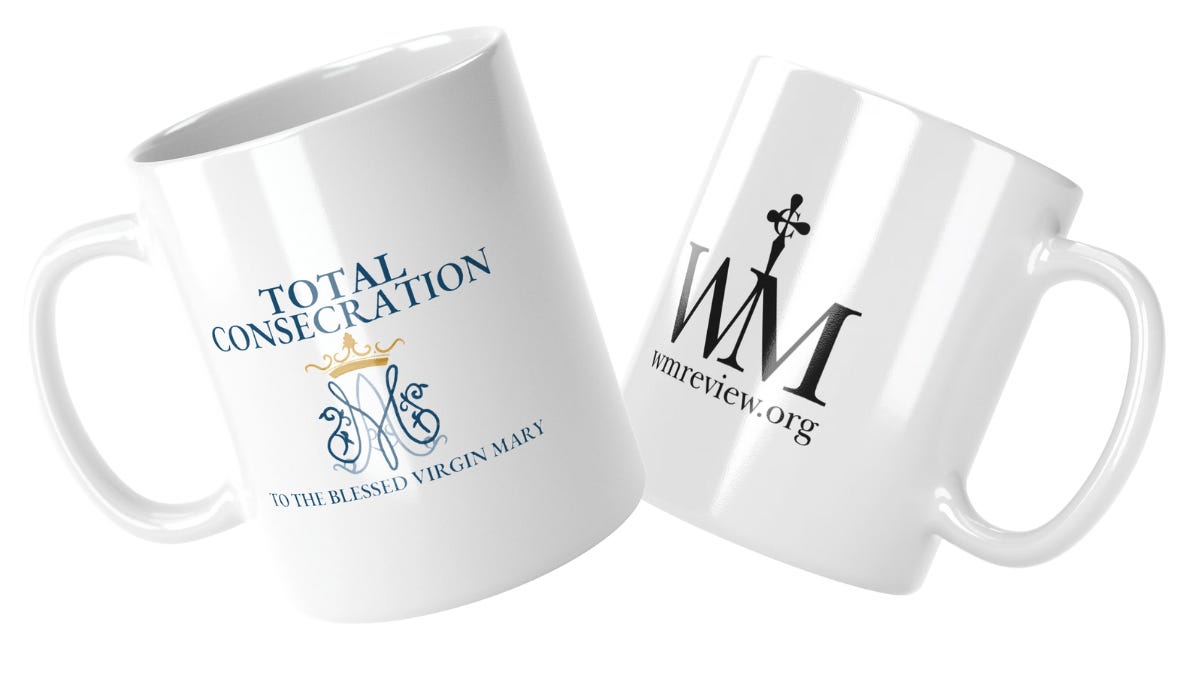
If you are enjoying this preparation for Total Consecration, why not get it in mug form?
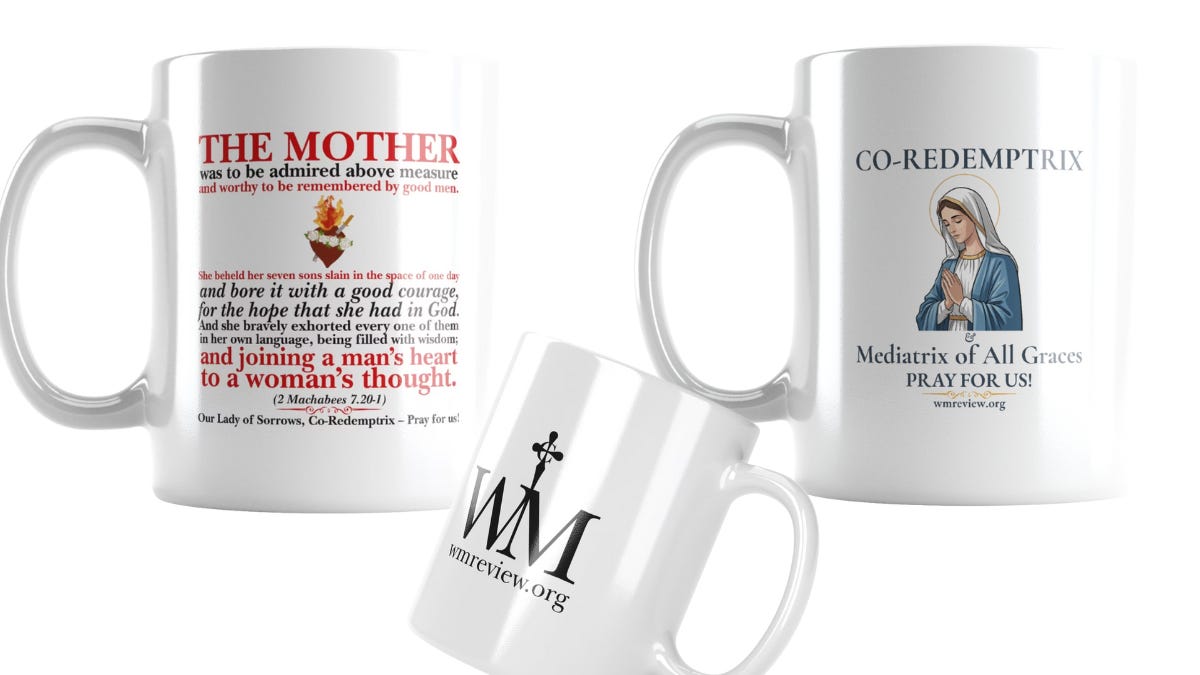
We also have our best-selling Co-Redemptrix mugs:
Follow on Twitter, YouTube and Telegram:
Twitter (The WM Review)


