

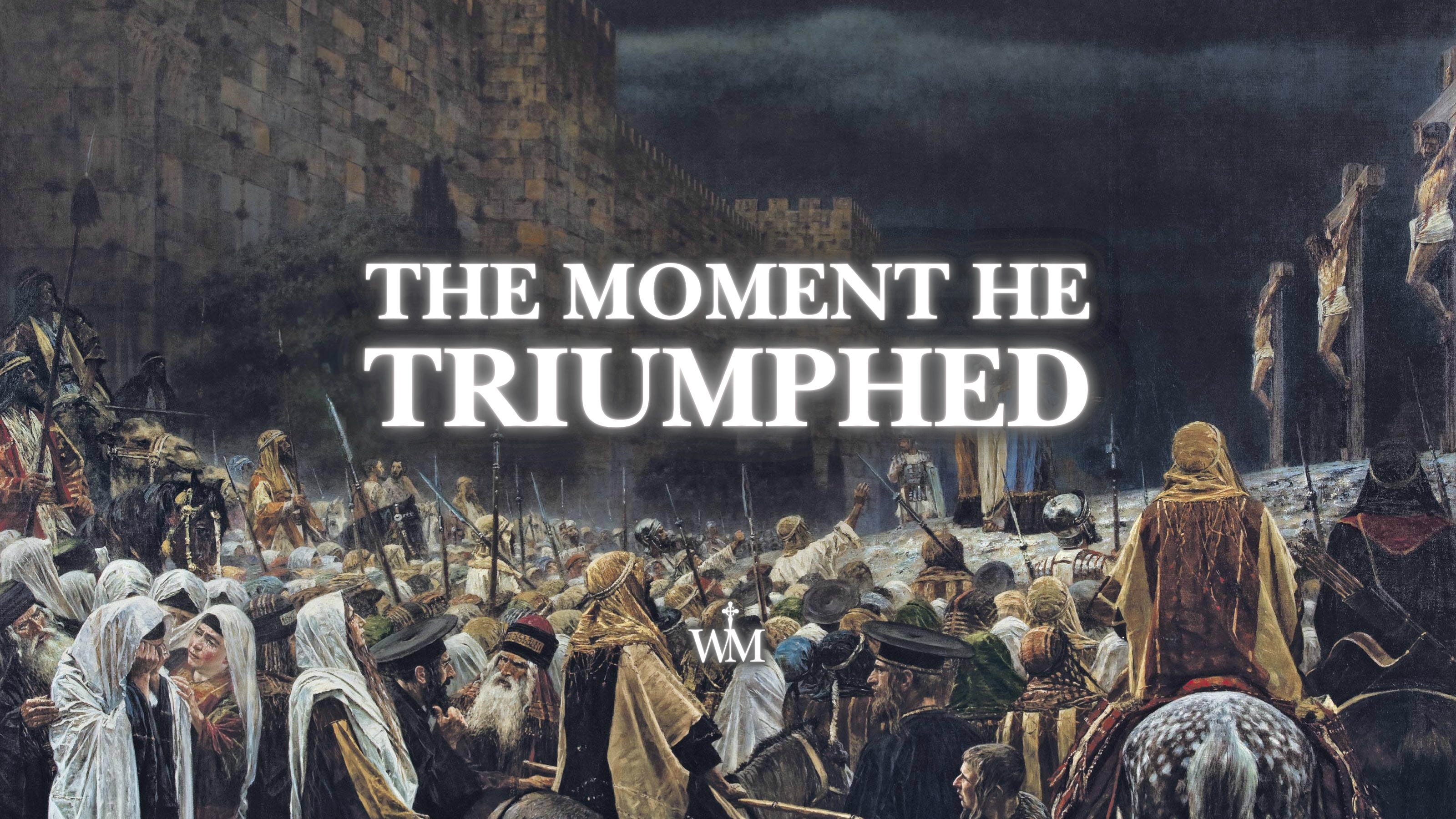
From his throne, the Cross, Jesus gives us his Mother – and wins the triumph for which he was born.
Editor’s Notes
This is Day 31, in Week 3 – the purpose of which is growing in knowledge of Our Lord, so that we may love him more dearly and follow him more nearly.
Today we are returning to Fr Aloysius Ambruzzi’s Companion to the Spiritual Exercises of Saint Ignatius, and considering his treatment of the Passion of Our Lord and his last words on the Cross – particularly the third, sixth and seventh words as most fitting for this series, and a manageable length.
However, the full section and meditation is also available as a Bonus Post for WM+ subscribers:
Christmas and the Passion?
At the time of publishing this, we are only a few days from Christmas. It might seem strange or unfitting to some, that we are meditating on the Passion so close to Christmas.
But as we have already mentioned in different ways over the last few days, there is no time in which it is unfitting to recall the Passion of Christ. Even in Eastertide, the Church traditionally commemorated the Cross in the Divine Office. The Cross is evergreen – and each season derives its meaning from the Cross, and sheds its own light upon it. In Eastertide, this commemoration reminds us that the Passion was not a defeat or something to be forgotten, but the glorious triumph of Christ.
As for Christmas: we celebrate the birth of Christ because he was born to be our suffering Redeemer – and immediately after Christmas, we begin celebrating a series of martyrdoms, starting with St Stephen.
Perhaps the reason the secular Christmas seems so empty and trite is not because leaves the Baby Jesus out of it – but because it leaves the Cross out of it.
While we are spending the next few days meditating on the Passion, let us keep St Ignatius’ advice in mind – which may be hard, amidst the “mandatory fun” of the premature Christmas of the secular world:
[I]mmediately on awaking, to set before me where I am going and to what, and summing up a little the contemplation which I want to make, according as the Mystery shall be, to force myself, while I am getting up and dressing, to be sad and grieve over such great grief and such great suffering of Christ our Lord.
[S]o as not to try to bring joyful thoughts, although good and holy, as, for instance, are those on the Resurrection and on heavenly glory, but rather to draw myself to grief and to pain and anguish, bringing to mind frequently the labors, fatigues and pains of Christ our Lord, which He suffered from the moment when He was born up to the Mystery of the Passion in which I find myself at present.
We should also consider the following. Neither Our Lord nor Our Lady suffered the Passion in a merely passive way. St Ignatius wants us to remember in such meditations (as surely would St Louis de Montfort) that Our Lord willed to suffer all this. It was why he came to earth and assumed human nature; in the Gospel, he describes it as a “baptism” that he was strongly desiring to suffer. He was not a helpless victim, brutalised by forces stronger than him; and his “defeat” was, in fact, his moment of triumph – as Fr Ambruzzi beautifully explains below.
St Ignatius also wants us to meditate on the fact that he could have put an end to it all in an instant, had he so desired – but that he hides his divinity and holds back his power out of obedience to his father.
And finally, that he did and suffered all this for us – and indeed for me, and for you, as individuals and in particular – and to reflect on the response which this call for from us.
Neither did Our Lady suffer at the foot of the Cross in a merely passive way, but she united herself with the sacrifice of her Son, willing that he sacrifice himself for the glory of God and the salvation of men. She consented to this sacrifice as the most loyal and zealous follower of the King and Priest.
This is why she is rightly called “Co-Redemptrix,” as Fr Ambruzzi says below, and as we have tried to explain elsewhere.
Finally, St Louis de Montfort recommends going to confession on the day of the consecration. Look ahead now, and consider whether you need to arrange that with a priest in advance.
CONTENTS:
READING: The text is based on an extract from Fr Aloysius Ambruzzi SJ.
MEDITATION: The points for meditation are included below. A guide on how to use these points in meditation can be found here.
Reading: The Last Seven Words
The Message from the Throne
A Companion to the Spiritual Exercises of Saint Ignatius
Fr Aloysius Ambruzzi SJ
The first Prelude is to call to mind how Christ spoke seven words on the Cross: He prayed for those who were crucifying Him; He forgave the Good Thief; He commended St John to His Mother and His Mother to St John; He complained: “I thirst”; He groaned that He was forsaken; He said: “It is finished”; and finally He cried out: “Father, into Thy hands I commend My spirit.”
The second Prelude is to see the place of the Crucifixion.
The third Prelude is to ask of my dying Master, through the intercession of Mary, His Mother and my Mother, of John and Mary Magdalene, light to understand His parting message, and grace to treasure it in my heart and make it the mainspring of my whole life.
“And seeing the multitudes, He went up into a mountain and when He had sat down, His disciples came to Him, and opening His mouth He taught them.” (Matt. vi, 1, 2)
Calvary is the counterpart of the Mountain of the Beatitudes. There the Master raised His Standard and issued the Code of His Kingdom. Here He seals it with His Blood. There He opened His mouth and uttered the words of Eternal Life, in the presence of His ecstatic disciples and the astonished multitude. Here but a few words break forth from His lips, but they come from the innermost depth of His agonizing Heart, and are re-echoed by every wound of His body and every drop of His sacred Blood. They sum up and fix the teaching of His life. They are His last message delivered to a few chosen friends, in the presence of an angry, hostile, and scoffing crowd.
The three hours of darkness and of agonizing silence divide the Sermon of Christ into two parts. The first three words refer to the persons around Jesus: His cruel and impenitent enemies; His companion in suffering, the penitent thief; His dear ones, Mary and John. In the midst of His sufferings Christ does not forget to forgive, to console, to help and to succour. The last four words refer to Jesus Himself; the fourth and the fifth reveal the intensity of His interior and exterior sufferings; the sixth and the seventh are a cry of triumph and a cry of confidence, and constitute the Saviour’s immediate preparation for death.
Third Word
Now there stood by the Cross of Jesus, His Mother... When Jesus therefore, had seen His Mother, and the disciple standing, whom He loved, He saith to His Mother: Woman, behold thy son. After that, He saith to the disciple: Behold thy Mother. And from that hour the disciple took her to his own.
(John xix, 25-27)
1. Christ’s Co-redeemer
Christ is about to offer Himself as a perfect holocaust to the Father and thus to restore Adam’s sinful descendants to the high dignity of children of God.
“If He shall lay down His life for sin He shall see a long-lived seed.” (Is. liii, 10)
It is “His Hour”—the hour when, through His martyrdom on the Cross, He will become “the First-Born among many brethren,” the Head of the Church, i.e., of all those who have been chosen in Him by God before the foundation of the world, to be holy and unspotted in His sight.
“Now there stood by the Cross of Jesus, His Mother.”
She was not seen in the hour of triumph, a few days ago, when her Son entered Jerusalem as the acclaimed King of Israel. But now she stands by His Cross that out of the sufferings of both we may be given to partake of the life of God:
“She is spiritually the mother of the members of the Saviour, because she cooperated with charity – so that the faithful might be born into the Church.”—St Augustine)
In Bethlehem she gave birth to the Child Jesus in the midst of ecstatic joy. On Calvary she offers Him to the Father as the Victim she has long prepared for the Sacrifice, and is with Him nailed, in spirit, to the Cross.1 It is the moment when Christ proclaims her the Woman that would crush the head of Satan—the new Eve and Mother of the regenerated family of God: “Woman, behold thy son.”
St John represented on Calvary all the disciples of Christ. Pointing out everyone of us to Mary, the dying Saviour, says with a lovely glance: “Woman, behold thy son!” That cry was the creative word through which all the elect were born of Mary to God, through adoption, but through a real, efficacious adoption.
We are not only placed under the protection of Mary, but we are her children—the children born of her travail and just for that reason passionately loved. To her as Christ’s co-Redeemer, we owe our salvation and all that salvation implies.
“For, as she suffered and almost died together with her suffering and dying Son, she gave up her rights as mother over this Son for the salvation of men and, to appease Divine justice, she, as much as it pertained to her [quantum ad se pertinebat], immolated Him, so that it can be said appropriately that she has, together with Christ, redeemed the human race.”
(Benedict XV, Inter sodalicia, 22 March 1918)
2. Christ’s parting gift
“Behold thy Mother!”
Mary is our Mother in the spiritual order. Through her was Jesus given to us, and through her alone we become brothers of Jesus and children of God.
“Behold thy Mother!”
It is the last gift of our dying Saviour—the last and the best of His gifts: the gift of a Mother and of His Mother. It sums up all other gifts. Whoever finds Mary finds every good thing; whoever keeps his eyes fixed on Mary will never perish.
“O thou, whoever thou art that knowest thou art exposed to the dangers of the stormy sea of this world more than thou enjoyest the security of dry land, do not turn away thy eyes from the splendour of this Star, from Mary the Star of the sea, unless thou wishest to be swallowed up in the tempest.
“If the winds of temptation arise, if thou art thrown upon the rocks of tribulation, look towards the Star, call on Mary.
“If thou art tossed hither and thither on the billows of pride, of ambition, of detraction, of envy, look towards the Star, call on Mary. Should anger, or avarice, or fleshly enticement strike against the bark of thy soul, look on Mary. If thou art terrified at the enormity of thy sins, or confused by the unclean state of thy conscience, or if stricken with awe for thy Judge, thou beginnest to feel thyself sinking in the abyss of sadness or the pit of despair, think of Mary.
“In danger, in difficulty, or doubt, think of Mary, call on Mary. Thou wilt not go astray if thou followest her, thou wilt not despair if thou prayest to her, thou wilt not err if thou thinkest of her.”
(St Bernard)
Sixth Word
“Jesus, therefore, when He had taken the vinegar, said: It is consummated.”
John xix, 30
1. The vision of the Dying Saviour
By this word, Christ announces His triumphant victory. He has been sent by His Father to save the world. At the first moment of His Incarnation He said:
“Behold, I come to do Thy Will, O God.”
In the Temple of Jerusalem He declared to His parents that He had to be about His Father’s business. During His public life He repeatedly stated that His food was to do the Will of Him Who had sent Him. And now, from the summit of the Cross, He casts a retrospective glance over His whole life, the glance which dying men, we are told, are empowered to cast and which comprehends every thought, every word, every action in its minutest details. What a glorious vision unfolds itself before the eyes of the dying Saviour. He sees Nazareth where first He pitched His tent in our midst. He sees Bethlehem where He was born in extreme poverty and lowliness; and then Egypt where He had to fly from the anger of Herod; and, then, Nazareth again and the long, long years of submission, of toil, of concealment. He sees the synagogues, towns and villages through which He has passed preaching the Gospel and doing good to all. He sees the Supper Room, Gethsemane, and the road that leads from it to Calvary, with all its painful stations. And He cries: Consummatum est, “It is finished.”
2. Christ’s work of sanctification begins
Looking at the whole of His past life Jesus has the clear consciousness that the Will of His Father has been His only guide. Everyone of His deeds, every word, and every throb of His Heart have been solely prompted by the desire of giving the greatest glory to His Father. He repeats then what He said the previous night in the Supper Room:
“I have glorified Thee on earth: I have finished the work which Thou gavest Me to do.”
He has manifested His Father’s name to the men whom the Father has given Him. He has delivered His message, in obedience to the Father. He has sealed it with His Blood. He has drunk the Chalice which the Father has given Him. He has fulfilled all that had been foretold of Him by the Prophets. Consummatum est. His work is accomplished. He has overcome on the Tree of the Cross him who had overcome man in the Garden of Eden. He has become the spring of eternal life to all those who would come and believe in Him. He has thrown open the gate to Heaven. And yet His work is not finished. Why, one would almost say that now it just begins. It is now for us, His members, to follow Him—to work, to suffer, and to die for Him.
“Who now… fill up those things that are wanting of the sufferings of Christ in my flesh.” (Coloss. i, 24)
Only when the last of the Elect will, through suffering, enter with Christ into the glory of the Father, will the work of Christ be accomplished. Till then, Christ continues from the Cross to call men to Him that they may be purified in His Blood, and that dying to themselves they live in Him, with Him, and for Him.
Seventh Word
“And Jesus, crying with a loud voice, said: Father, into Thy hands I commend My spirit. And saying this He gave up the ghost.”
(Luke xxiii, 46)
1. Christ’s cry of boundless confidence
After the reassuring glance which Christ has thrown on His past life there remains for Him but to turn to His Father and leave in His hands the life He has received from Him: “A body Thou hast fitted to Me.” Accordingly, not with the gasping accents of a dying man, but with a loud voice, to prove that no man could take His life away from Him, but that He was laying it down of Himself, He cries “Father, into Thy hands I commend My spirit;” to Thy Wisdom, i.e., that knows all things and to Thy Power that can do all things, I entrust My life that Thou mayest restore it to its full and to immortality.
Christ knows that immortality will be His, and that even His poor and mangled Body will soon rise full of glory. “Therefore doth the Father love Me; because I lay down My life that I may take it again.” (John x, 17)
He prayed for His glorification, before He crossed the Cedron to begin His agonizing Passion in the Garden of Gethsemane. However, the pitiful scene we watched there; the abandonment, the sufferings, and the ignominy of the Divine Victim; and the cry we heard not long ago, may possibly have suggested the thought that either God had forsaken His Son, or, at least, that the Victim’s confidence was shaken. This cry of Christ is one of boundless confidence and of triumphant hope. Consummatum est. Out of love for the Father “He humbled Himself by obedience unto death, yea, unto death upon a cross” (Phil. ii, 8). He may well then, say: “Father, into Thy hands I commend My spirit.” The Father will exalt Him, and will give Him a name which is above all names, “that at the name of Jesus every knee should bend in Heaven, on earth and under the earth.”
2. God our loving Father
To glance at our past, alas, can only fill our hearts with fear and trembling. God’s Will has not been the only rule of our life, nor, perhaps, the main rule. We have not always lived to promote the cause of Christ and to do good to His suffering members. God, however, is a tender and merciful Father, who knows our poverty and our weakness. We may, then, turn to Him and, like the insolvent debtors and unfaithful servants that we are, throw ourselves on His Love and Mercy, and with the Church, often cry during life, but especially, at our last hour: “Into Thy hands I commend my spirit: Thou has redeemed me, O Lord, the God of Truth”; or with St Stephen: “Lord Jesus, receive my spirit.”
The last loud cry of the suffering Saviour seems to sum up the whole of His Message. However deaf to all our entreaties and almost austere and hard God may apparently seem, He is always our loving Father. Of us He only demands an absolute abandonment and a total resignation to His ever watchful Providence, in life and in death.
The full section is available as a Bonus Post for WM+ subscribers:
Speak, O Lord!
Suggestions for the colloquy
1. Forgive me, O Jesus; for truly I don’t know what I am doing when I offend Thee! Grant that, following Thy example and helped by Thy powerful grace, I, too, forgive those that offend and displease me.
2. O the infinite generosity of Thy Heart to the Penitent Thief who has only asked to be remembered by Thee! O my crucified Lord, I, too, acknowledge Thee as the King of the Kingdom of God—as the King of my heart! And do Thou remember me in Thy Kingdom!
3. Thanks to Thee, O Lord, for the parting gift Thou makest to us—the gift of Thy Mother! My constant prayer to Mary shall be: O Mother, behold thy son!
4. In the Garden Thou wast abandoned by Thy Apostles; on the Cross, by Thy Father; and now Thou art abandoned by us—in the Tabernacle, and on the Cross whereon, as Thy members, we should be nailed with Thee. O my loving Jesus, grant that I may never abandon Thee; that I may ever be with Thee!
5. O Jesus, that I may ever work to appease the thirst of Thy Heart by giving Thee my soul—by bringing Thee many souls.
6. O Jesus, Thou hast finished the work which the Father gave Thee to do. It is for us now to follow Thee—to work and suffer with Thee. Then only will Thy work be truly finished!
7. May Thy cry of love and perfect abandonment be the cry of my whole life, O Jesus!
Meditation for Day 31
King and Victim
Taken from St Ignatius’ Spiritual Exercises
It is in mental prayer that that much of the preparation will be achieved – and meditation is a means of entering mental prayer. See our guide to meditation for two ways to use the below texts.
The Preparation
Prayer. The usual Preparatory Prayer.
The first Prelude is to call to mind the narrative. On the Cross, Christ spoke but seven times; and we are hear considering how he gave us his Mother; how he announced that his work was consummated; and how he commended his soul to his Father.
The second Prelude is to see Calvary, with the Christ and the two thieves on their crosses, and the Blessed Virgin, St John, St Mary Magdalen, the other holy women, and the rest of the crowd.
The third Prelude is to ask for sorrow with Christ in sorrow, a broken heart with Christ heart-broken, tears, confusion and pain for the great sufferings which Christ endures for me – as well as gratitude for his dying gift, and for the redemption which he has wrought.
The Points for Meditation
First Point. “‘Woman, behold thy son…. Behold thy Mother.’ And from that hour the disciple took her to his own.” Consider Our Lady’s zealous consent to our Son’s work, such that she suffered with him and, in so far as she was able, joined him in offering his life as the sacrifice of redemption; that amidst her sorrow, she rejoiced that God’s will was done; and thus she is truly called “Co-Redemptrix.”. Consider also the even greater sorrow that this consent and joy caused her.
Second Point. “It is consummated.’”
Third Point. “‘Father, into Thy hands I commend My spirit.’ And saying this He gave up the ghost.”
In addition to the usual consideration of persons, words and actions, St Ignatius wants us to consider the following in all meditations on the Passion:
Fourth Point. To consider that which Christ our Lord is suffering in His Humanity, or wants to suffer, according to the passage which is being contemplated, and here to commence with much vehemence and to force myself to grieve, be sad and weep, and so to labor through the other points which follow.
Fifth Point. To consider how the Divinity hides Itself, that is, how It could destroy Its enemies and does not do it, and how It leaves the most sacred Humanity to suffer so very cruelly.
To consider how He suffers all this for my sins, etc.; and what I ought to do and suffer for Him.
One could consider these points in reference to oneself: How far have we been conscious of this in our daily lives so far, what practical conclusions should we draw from these truths, how far have we lived up to them so far, what must we do to live up to them in the future, etc.
One could consider the acts of virtue we can make in response to these truths – Acts of faith, humility, hope/confidence, thanksgiving, contrition and love – talking all the while to God, the Blessed Virgin, our Guardian Angels, etc.
One should feel free to linger on only one of the points, if this is how the meditation proceeds.
The Colloquy
Colloquy. I will finish with a Colloquy to Christ our Lord, and, at the end, with an Our Father.
Note. It is to be noted, as was explained before and in part, that in the Colloquies I ought to discuss and ask according to the subject matter, that is, according as I find myself tempted or consoled, and according as I desire to have one virtue or another, as I want to dispose of myself in one direction or another, as I want to grieve or rejoice at the thing which I am contemplating; in fine, asking that which I more efficaciously desire as to any particular things.
And in this way I can make one Colloquy only, to Christ our Lord, or, if the matter or devotion move me, three Colloquies, one to the Mother, another to the Son, another to the Father, in the same form as was said in the Second Week, in the meditation of the Three Pairs, with the Note which follows The Pairs.
Fr Ambruzzi has further suggestions above. It is important to speak frankly to God in our own words, rather than simply reading somebody else’s. If one feels moved to speak to God before meditating on all the points, one should certainly do so. The same applies if one feels moved to simply rest in God, rather than engaging in discursive meditation. These impulses should be followed over any particular method of meditation.
The End
End the meditation with a vocal prayer – such as the Our Father, the Anima Christi.
Reflect on how well we have prayed, and how well we have followed our chosen method.
Select a spiritual nosegay from your meditation to keep with you for the rest of the day.
See you tomorrow. Hit subscribe to make sure you don’t miss it or any of our other material:
See the index and explanation to this series here:
For more on the St Louis de Montfort’s True Devotion and Total Consecration, for which we are preparing, see here:
The theological basis of ‘True Devotion’ and the Consecration to Mary (Garrigou-Lagrange)
The fruits of ‘True Devotion’ and Consecration to Mary (Garrigou-Lagrange)
For more on the importance of not getting bogged down with methods, and on allowing God to act, see here:
For more on Week 3, and the vocal prayers that are are suggested for each day, see here:
‘Week 3’ of St Louis de Montfort’s Total Consecration preparation (Prayers, practices and reading)
Get the book here:
True Devotion to the Blessed Virgin Mary (St Louis de Montfort)
HELP KEEP THE WM REVIEW ONLINE WITH WM+!
As we expand The WM Review we would like to keep providing free articles for everyone.
Our work takes a lot of time and effort to produce. If you have benefitted from it please do consider supporting us financially.
A subscription gets you access to our exclusive WM+ material, and helps ensure that we can keep writing and sharing free material for all.
You can see what readers are saying over at our Testimonials page.
(We make our WM+ material freely available to clergy, priests and seminarians upon request. Please subscribe and reply to the email if this applies to you.)
Subscribe to WM+ now to make sure you always receive our material. Thank you!
If you are enjoying this preparation for Total Consecration, why not get it in mug form?
We also have our best-selling Co-Redemptrix mugs:
Follow on Twitter, YouTube and Telegram:
Twitter (The WM Review)
Fr Ambruzzi’s original text runs:
“On Calvary she, the Virgo Sacerdos, offers Him to the Father as the Victim she has long prepared for the Sacrifice, and is with Him nailed, in spirit, to the Cross.”
We have previously considered the ways in which theologians treat Our Lady’s role as “priestly” (see here and here). However, while there seems to be a legitimate sense to this idea, the Holy Office intervened in 1916 and 1927 against devotions to “the Virgin Priest”. The BAC authors summarised the matter:
“It is clear that in both cases the Holy Office wished to avoid confusion with the ministerial priesthood in the minds of the less-instructed faithful” (STS IIIA, n. 189, pp 465-6.)
The two potential problems with the language seem to be 1) the error of attributing a priesthood in the strict sense to Our Lady, and 2) the confusion of the less-instructed faithful. The it remains true, even if it is best not to focus on it, that there is a priesthood of the faithful distinct from the ministerial priesthood; and that it could be argued that Our Lady’s participation in the sacrifice of Christ was somewhat priestly, in a broad sense.
On balance, with all due respect to the good Fr Ambruzzi, and to the imprimatur which his work received in 1938, we have thought it best to redact this phrase from this passage on the basis that the inclusion of this phrase may have been an oversight, or based on a lack of awareness of the Holy Office decrees.


