
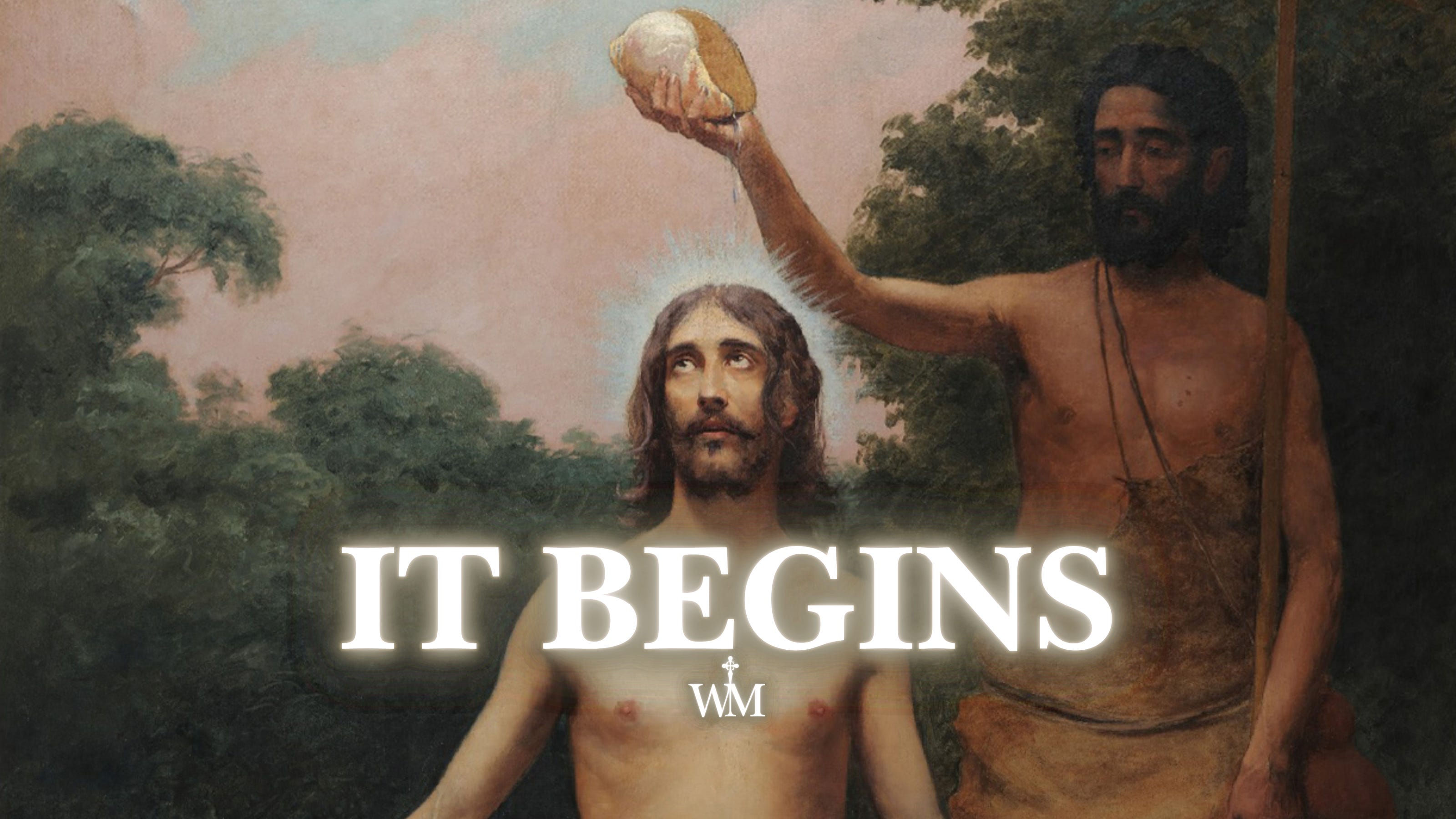
His Baptism at the hand of St John the Baptist marks the opening of Christ’s public life – and the start of his war.
Editor’s Notes
This is Day 27, the first day of Week 3 – the purpose of which is growing in knowledge of Our Lord, so that we may love him more dearly and follow him more nearly. The whole purpose of this preparation has been to give ourselves to Christ, through the hands of his Mother, and so we are now at an important stage.
Today we are reading from Fr Aloysius Ambruzzi’s account of the Baptism of Christ in his Companion to the Spiritual Exercises of Saint Ignatius. This present text is the second half of his meditation on this episode – the first half being Our Lord’s departure from Nazareth and the home of his Mother (which we considered yesterday).
We noted yesterday Fr Ambruzzi’s words on the importance of meditation on the public life of Our Lord. On the full spiritual exercises, this public life would be the focus for much of the second week (which we have divided between Week 2 and 3) – with his third week being focused on the Passion, and the fourth on his Resurrection and glorification. The retreatant might be meditating on the public life of Christ several times a day, for several days, throughout the second week.
There can be no doubt that the common five-day Ignatian retreats lose something significant in omitting this, excellent though they are. And there can be no doubt that we are losing something here too, because one meditation a day for a week is just not enough time to cover everything that happened in those three years.
In due course we hope to supplement this Week on Our Lord with some more, as well. In the meantime, we have provided some bonus instalments for WM+ subscribers:
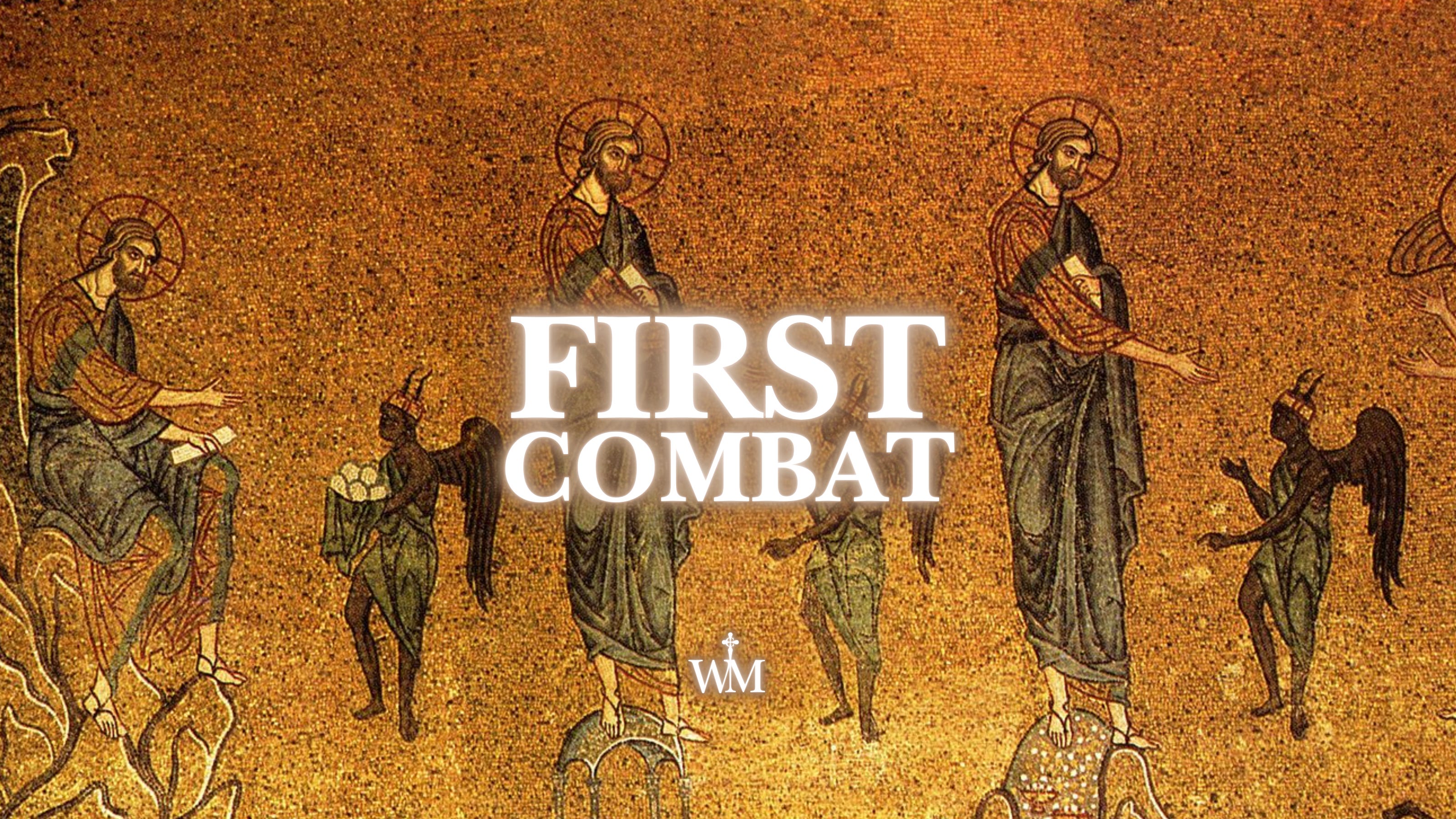
Bonus: Christ the King’s first combat
The Temptation in the Desert
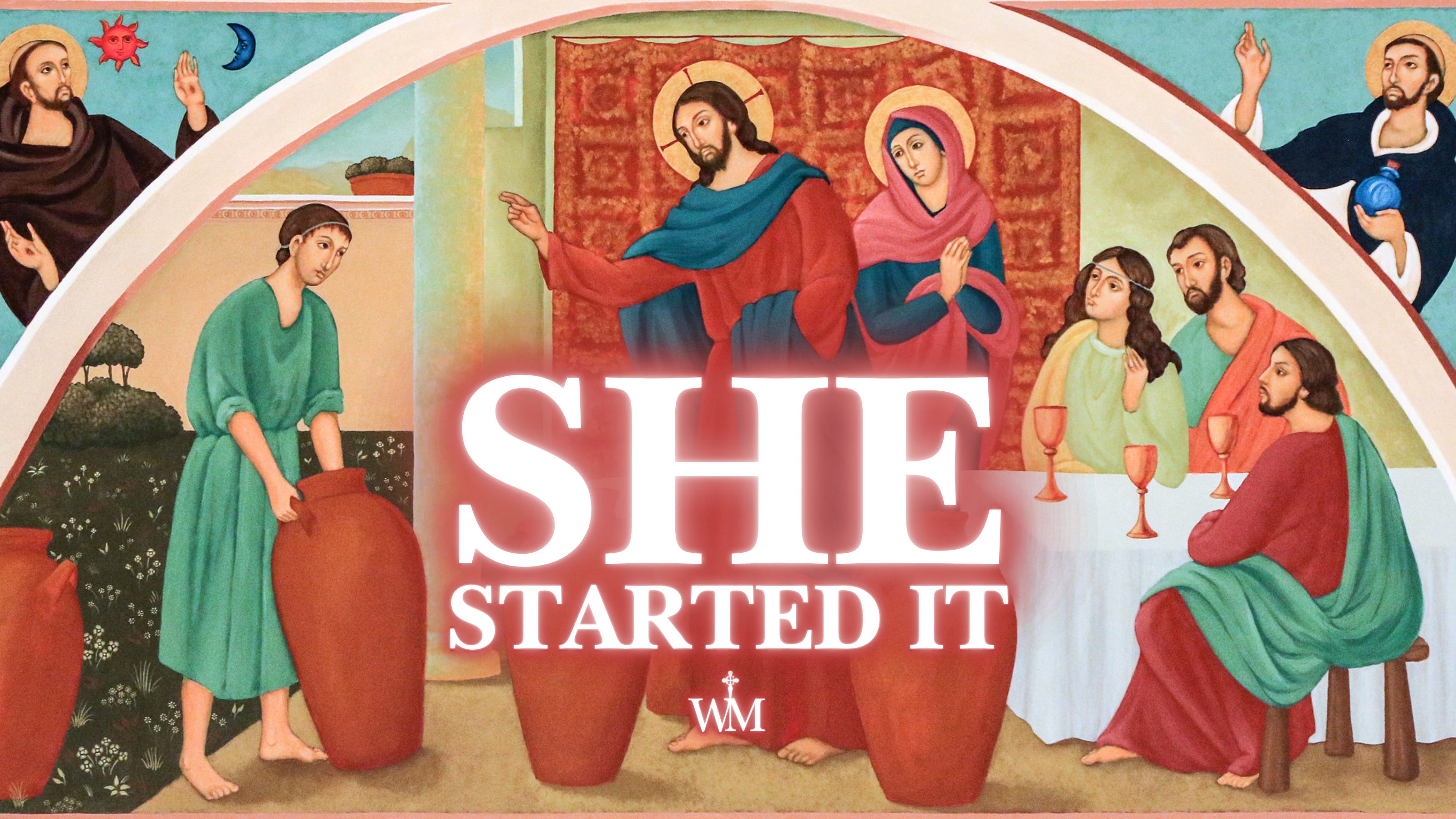
Bonus: The Queen’s Request
The Wedding at Cana
WM+ material represents our thanks to those who support us with an annual or monthly paid subscription. Those paid subscriptions really help the WM Review keep going, and it wouldn’t be possible without them.
If you appreciate this series and our other work, then please consider taking out a WM+ subscription yourself, or making a donation.
If readers want another very full resource for meditation on the public life of Our Lord, they should visit The WM Review’s project Father Coleridge Reader. We are just finishing the collation of Fr Coleridge’s commentaries on the episodes recounted on the Sunday Gospels. If readers have a spare moment for spiritual reading or prayer, we refer them to the index to this project.
Alternatively, it would be good to return to the meditations on the Three Classes of Men and the Three Ranks of Humility this week – as well as the meditation on The Two Standards. They are a crucial part of growing in knowledge of Christ. We anticipated them in Week 0, but St Ignatius puts them with the meditations we are considering in Week 2 and 3:
Day 6: Satan’s battle plan to ensnare souls – and Christ’s battle plan to save them
The Two StandardsDay 8: Are you a weakling, a self-seeker... or something better?
The Three Classes of MenDay 9: Do we actually want what humility entails?
The Three Ranks of Humility
Finally, St Louis de Montfort recommends going to confession on the day of the consecration. Look ahead now, and consider whether you need to arrange that with a priest in advance.
CONTENTS:
READING: The text is based on an extract from Fr Aloysius
MEDITATION: The points for meditation are included below. A guide on how to use these points in meditation can be found here.
Reading: The Baptism of Christ
The Divine King Starts His Campaign
A Companion to the Spiritual Exercises of Saint Ignatius
Fr Aloysius Ambruzzi SJ
3. Baptism of Our Lord
(i) Mission of the Baptist
“It came to pass in those days that Jesus came from Nazareth of Galilee and was baptised of John in Jordan.” (Mark i, 9)
The journey of our Lord from Nazareth to the Jordan is second only to the Incarnation. Then, He left His Father and His eternal home to come down to the earth. Now He leaves His Mother and even the little comforts of His temporal home to do His Father’s work, to open the Messianic era.
His entry into public life was being prepared for and heralded abroad.
Thirty years before, Zacharias had foretold of his son:
“And thou, child, shalt be called the prophet of the Most High, for thou shalt go before the face of the Lord to prepare His ways.” (Luke i, 76)
The task of John was thus fixed. While preparing for His mission, “the child grew, and waxed strong in spirit, and was in the desert till the day of his showing unto Israel.” (Luke i, 80)
At last that day rose.
“In the fifteenth year of the reign of Tiberius Caesar… Annas and Caiphas being the high priests, the word of God came unto John the son of Zacharias in the wilderness. And he came into all the country about the Jordan, preaching the baptism of repentance for the remission of sins.” (Luke iii, 2, 3)
John’s preaching is summed up in those words: “Do penance,” i.e., change your wills, turning them to God, “for the Kingdom of Heaven is nigh unto you.” And people came from Jerusalem, from Judea, and from the countries lying round the Jordan, to hear that voice crying in the wilderness, which spared none, and talked of the hope of Israel to the poor and to the humble.
(ii) Significance of Christ’s Baptism
Might he [St John the Baptist] not be the expected Messiah? “No,” he had answered to the Priests and Levites sent from Jerusalem to ask him, Who art thou?
“I am not the Christ, nor Elias, nor that prophet. I am the voice of one crying in the wilderness. Make straight the way of the Lord.”
“I baptise with water, but there standeth One among you Whom ye know not. He it is Who coming after me is preferred before me, the latchet of whose shoe I am not worthy to unloose.” (John i, 26-27)
It was Jesus on the bank of the Jordan, waiting, along with the publicans and sinners, to be baptized by John.
But why such a public humiliation? Does He seem thereby to disown His innocence and His Divine origin?
Having taken upon Himself the form of a servant and made Himself similar in all things to us His brethren, Christ willed to obey in everything the laws of natural and intellectual growth. Like every child of Israel, He was circumcised and offered in the Temple, and like them He passed many years in solitude and silence.
But, at last, the time is accomplished: the Messianic era, the era of Christ, is about to begin. John opens it by calling the people to repentance:
“Make straight the way of the Lord. Do penance for the Kingdom of Heaven is at hand.”
And Christ, too, comes to seek baptism of John. Not only does He mix with sinners to show that He loves them and has come mainly for them, but He is the Great Penitent. The Baptism of Christ is His public and solemn consecration to the office of Saviour of the world. He was such from the moment of His Incarnation. Henceforth His office assumes a public character.
“Behold the Lamb of God, behold Him Who taketh away the sin of the world.” (John i, 29)
He is the Victim for sin: for the sins of the whole world.
There are two elements in the expiation of sin: first, the humiliation of the heart, i.e., shame and contrition; and, secondly, the satisfaction. In Baptism, Christ takes on Himself the humiliation and shame due to the sins of men; on the Cross, He makes satisfaction for them.
His Baptism, then, is not a mere external rite. It is the formal acceptance of His Messianic role and the vow of His future immolation.
(iii) “It behoves us to fulfil all justice”
John had surely reason to wonder when he saw Christ descend into the waters of the stream along with the penitents, and ask for baptism at his hands: “I ought to be baptized by Thee, and comest Thou to me?” He exclaimed in words that recall those of St Elizabeth, his mother. “And he withstood Him.”
“Suffer Me to do this now, thus it behoves us to fulfil all justice,” was Christ’s answer: His second word recorded by the Gospel.
It was Heaven’s decree that Christ should begin to redeem mankind by the deepest humiliation.
Humility, particularly the sense of sin, the feeling of shame and the hatred of self, is the fundamental virtue of Christianity, out of which there arises the true love of God and of men. Pride and self-conceit mark one off as the child of Satan.
And the more then is the sense of sin, shame and hatred of self, proper to those souls who work for the salvation of others and who want to be victims for sin. At Mass, especially, and whenever they appear before God to plead for themselves and for others, they should be imbued with a sense of their lowliness and unworthiness.
4. “Thou art my Beloved Son”
“And straightway, as He came out of the water, He saw the Heavens rent asunder, and the Spirit coming down upon Him as a dove; and there came a voice from the Heavens, Thou art My beloved Son, in Thee I am well pleased.” (Mark i, 10-11)
Over the Incarnate Son of God lying in a manger the Angels had sung: “Glory to God in the highest, and on earth peace to men of good will.” Laden with all the sins of men, He stands now on the bank of the Jordan as a sinner in need of purification, as much as the harlot and the publican; and above Him the Heavens are again thrown open. The Father Himself comes to glorify Him, and the Holy Spirit descends in bodily shape upon Him, in the form of a dove, as a sign of the boundless grace shed on His soul:
“For God giveth not the Spirit by measure: the Father loveth the Son, and He hath given all things into His hand.” (John iii, 35.)
The effusion is a permanent one. Truly could the Baptist say:
“I saw the Spirit coming down as a dove from Heaven and It remained upon Him.” (John i, 32)
At the same time the voice of the Father is heard, declaring Christ to be His own beloved Son, and expressing an absolute and eternal complacency in Him. “Thou art My beloved Son, in Thee I am well pleased.”
The Messianic era is thus opened. Christ is the Son that will lead men back to God, block the descent to Hell, and open the way to Heaven. He Himself will be the Way. In Him and through Him men will become children of God, well-pleasing to their Heavenly Father.
At the same time the way to this Divine Sonship is shown. The Father manifests Christ as His Son and as the Messias after the humiliation of His Baptism. The same had happened at His Birth and at His Presentation in the Temple. Still more, His Resurrection, and His Glorification by the Father, as Messias and Saviour of men, will follow the sufferings and the humiliations of His Passion.
“Ought not Christ to have suffered these things, and thus to enter into His glory?” (Luke xxiv, 26)
It is in suffering and humiliations that we are truly born children of God and that we achieve the salvation of men.
In Spiritu Humilitatis
Suggestions for the colloquy
1. On becoming Man, O Jesus, Thou didst leave Thy Father and the splendours of Thy Eternal Home. On starting now Thy public life, Thou leavest Thy holy Mother, full of sorrow and grief, and the little comforts of Thy Nazareth Home.
2. Thou art the Lamb of God, who taketh away the sins of the world. And that is why, laden with the sins of all men, I see Thee standing on the bank of Jordan—waiting, along with the harlots and the publicans, to be baptized by St John. What an example of deepest abasement Thou, dear Lord, givest me! Imprint on my heart, I beseech Thee, a sincere feeling of shame and hatred of myself. Make me abhor pride and self-conceit as the mark of the children of Satan. Especially when I appear in prayer with Thee, to plead before Thy Eternal Father for me and for others, fill me with a sense of my utter lowliness and unworthiness.
3. After the humiliation of Thy baptism, the Heavens are thrown open above Thee—the Holy Spirit descends upon Thee, in the form of a dove, as a sign of the boundless grace shed on Thy Soul—and the voice of Thy Father is heard declaring that Thou art His beloved Son. O Jesus, give me to see that it is by humility of heart that one becomes a true child of God and a saviour of men.
4. O Jesus, through the loving intercession of Mary Thy Mother and my Mother also, obtain for me from Thy Divine Father the grace to follow Thee under the standard of the Cross—in true humility and contrition—that in Thee and through Thee I, too, may become a child of Thy Heavenly Father and a saviour of men.
Meditation for Day 27
The Baptism of Christ
Taken from St Ignatius’ Spiritual Exercises
It is in mental prayer that that much of the preparation will be achieved – and meditation is a means of entering mental prayer. See our guide to meditation for two ways to use the below texts.
The Preparation
Prayer. The usual Preparatory Prayer.
First Prelude. The first Prelude is to call to mind how Christ went from Galilee to the Jordan to be baptized by John, and how on His coming out of the water, the Heavens opened and the Spirit of God, in the shape of a dove, descended upon Him, while a Voice from Heaven said: “This is my beloved Son, in Whom I am well pleased.” (Matt. iii, 13-17; Mark i, 9-11; Luke iii, 21-22.)
Second Prelude. The second Prelude is to see with the eyes of the imagination the little house of Nazareth and the road that led southwards to Bethabara, beyond the Jordan—a spot located, by tradition, opposite to Jericho—where John was baptizing.
Third Prelude. The third Prelude is to ask light to know intimately the Divine King and the feelings with which He starts His campaign, that I may love Him more and follow Him more closely beneath His holy Standard.
The Points for Meditation
First Point. First: Christ our Lord, after having taken leave of His Blessed Mother, came from Nazareth to the River Jordan, where St. John Baptist was.
Second Point. Second: St. John baptized Christ our Lord, and wanting to excuse himself, thinking himself unworthy of baptizing Him, Christ said to him: “Do this for the present, for so it is necessary that we fulfill all justice.’”
Third Point. Third: “The Holy Ghost came and the voice of the Father from heaven affirming: ‘This is My beloved Son, in Whom I am well pleased.’”
Contemplate each of these points: Persons, Words, Actions.
One could consider these points in reference to oneself: How far have we been conscious of this in our daily lives so far, what practical conclusions should we draw from these truths, how far have we lived up to them so far, what must we do to live up to them in the future, etc.
One could consider the acts of virtue we can make in response to these truths – Acts of faith, humility, hope/confidence, thanksgiving, contrition and love – talking all the while to God, the Blessed Virgin, our Guardian Angels, etc.
One should feel free to linger on only one of the points, if this is how the meditation proceeds.
The Colloquy
End with a Colloquy to Our Lady, or to Our Lord.
In this period of the meditation, St Ignatius would particularly have us make the triple colloquy from The Two Standards, begging Our Lady, Our Lord and God the Father, to allow us to be received under the standard of Christ.
Fr Ambruzzi has further suggestions above. It is important to speak frankly to God in our own words, rather than simply reading somebody else’s. If one feels moved to speak to God before meditating on all the points, one should certainly do so. The same applies if one feels moved to simply rest in God, rather than engaging in discursive meditation. These impulses should be followed over any particular method of meditation.
The End
End the meditation with a vocal prayer – such as the Our Father, the Anima Christi.
Reflect on how well we have prayed, and how well we have followed our chosen method.
Select a spiritual nosegay from your meditation to keep with you for the rest of the day.
See you tomorrow. Hit subscribe to make sure you don’t miss it or any of our other material:
See the index and explanation to this series here:
For more on the St Louis de Montfort’s True Devotion and Total Consecration, for which we are preparing, see here:
The theological basis of ‘True Devotion’ and the Consecration to Mary (Garrigou-Lagrange)
The fruits of ‘True Devotion’ and Consecration to Mary (Garrigou-Lagrange)
For more on the importance of not getting bogged down with methods, and on allowing God to act, see here:
For more on Week 3, and the vocal prayers that are are suggested for each day, see here:
‘Week 3’ of St Louis de Montfort’s Total Consecration preparation (Prayers, practices and reading)
Get the book here:
True Devotion to the Blessed Virgin Mary (St Louis de Montfort)
HELP KEEP THE WM REVIEW ONLINE WITH WM+!
As we expand The WM Review we would like to keep providing free articles for everyone.
Our work takes a lot of time and effort to produce. If you have benefitted from it please do consider supporting us financially.
A subscription gets you access to our exclusive WM+ material, and helps ensure that we can keep writing and sharing free material for all.
You can see what readers are saying over at our Testimonials page.
(We make our WM+ material freely available to clergy, priests and seminarians upon request. Please subscribe and reply to the email if this applies to you.)
Subscribe to WM+ now to make sure you always receive our material. Thank you!
If you are enjoying this preparation for Total Consecration, why not get it in mug form?
We also have our best-selling Co-Redemptrix mugs:
Follow on Twitter, YouTube and Telegram:
Twitter (The WM Review)


.jpg)