
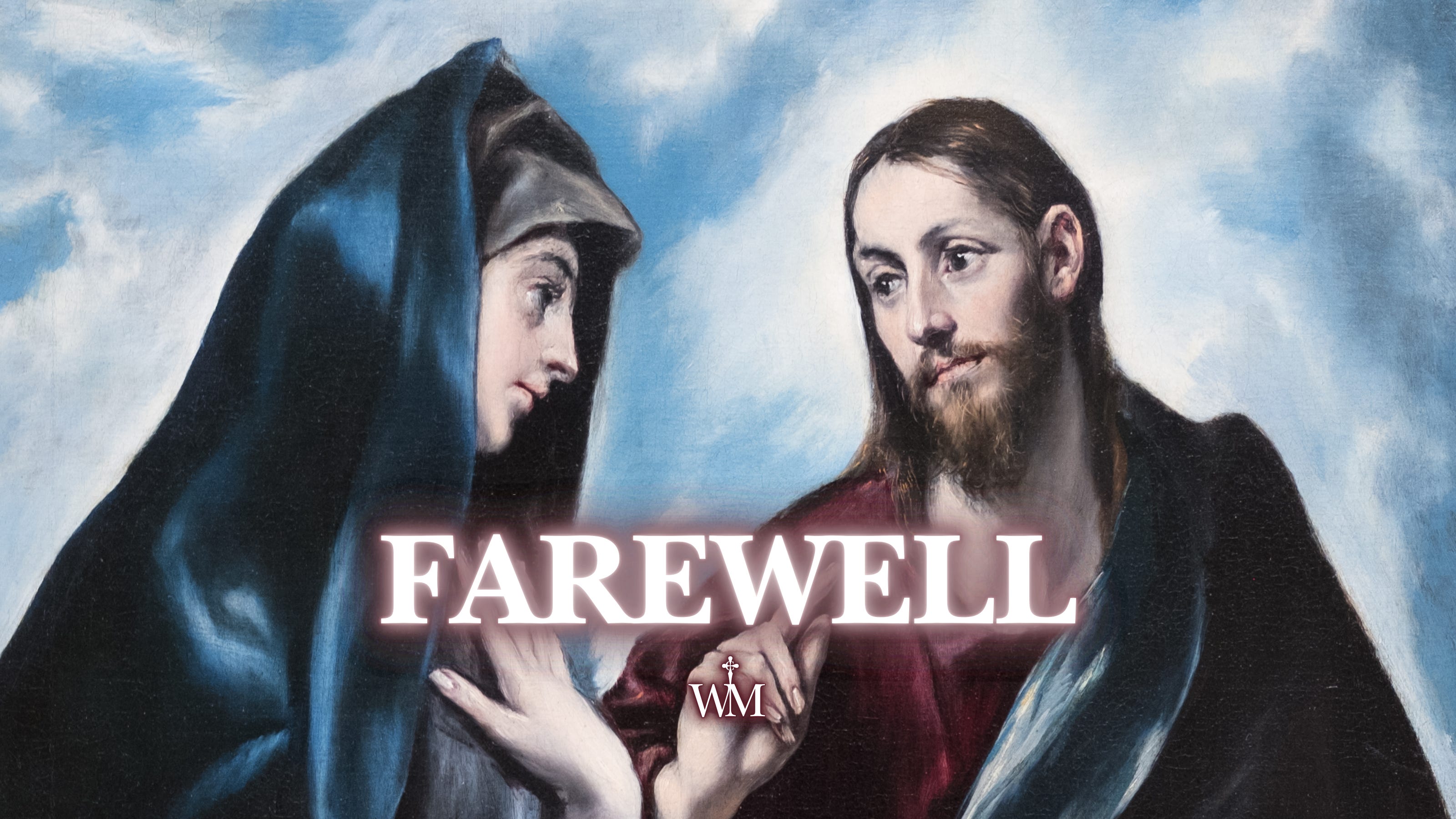
It was the end of their domestic life, and the beginning of the Redemption.
Editor’s Notes
Have you ever lost the person closest to you in the whole world?
This is Day 26, in Week 2 of the preparation for St Louis de Montfort’s Total Consecration to the Blessed Virgin is focused on gaining a greater knowledge of Our Lady, and seeking to unite ourselves to her.
Today we are reading from Fr Aloysius Ambruzzi’s Companion to the Spiritual Exercises of Saint Ignatius, and reflecting on what he has to say about Our Lord’s departure from Nazareth and his Mother, to start his public life with the baptism by St John the Baptist in the River Jordan. This text considers Our Lord taking his leave of his Mother is the first half of this meditation on the Baptism of the Lord.
Many artistic representations of this scene depict Our Lady swooning with grief, but Fr Ambruzzi suggests nothing of the kind.
As usual, this text is intended to provide fuel and material for our meditation – the points of which follow the reading. The themes, as well as vocal prayers and readings associated with Week 2, can be found here. You can find the book here.
Although this is part of the Total Consecration preparation, it also stands alone as a great text in its own right.
There is so much more that we could have included in this week. Except from the long reading on the first day, we haven’t really been able to discuss Our Lady’s immaculate conception – nor have we had the time or space to discuss her role in the Church following the Ascension and Pentecost, or her glorious Assumption.
These are topics to which we will return in the future, in supplementary material for this core of our preparation. In the meantime, we recommend reading Fr Reginald Garrigou-Lagrange’s work Mother of the Saviour for the dogmatic and doctrinal side of what I just mentioned (e.g., the Immaculate Conception and the Assumption), and Fr Henry James Coleridge’s Mother of the King and Mother of the Church for more about her life and role. You can find parts of those works over at our project Father Coleridger Reader.
Finally, for those following it would be good to return to the meditations on the Three Classes of Men and the Three Ranks of Humility this week – as well as the meditation on The Two Standards. We anticipated them in Week 0, but St Ignatius puts them with the meditations we are considering now in Week 2:
Day 6: Satan’s battle plan to ensnare souls – and Christ’s battle plan to save them
The Two StandardsDay 8: Are you a weakling, a self-seeker... or something better?
The Three Classes of MenDay 9: Do we actually want what humility entails?
The Three Ranks of Humility
CONTENTS:
READING: The text is based on an extract from Fr Aloysius
MEDITATION: The points for meditation are included below. A guide on how to use these points in meditation can be found here.
Reading: The Baptism of Christ
The Divine King Starts His Campaign
A Companion to the Spiritual Exercises of Saint Ignatius
Fr Aloysius Ambruzzi SJ
1. Significance of Our Lord’s Public Life
The whole of Christ’s life is the pattern on which our own life is to be modelled. His hidden life—especially that portion of it which He spent in Nazareth—brings vividly before us the virtues we need to practise in our homes. His Passion and Death convey lessons of patience and courage, in the hour of grief and agony. His Resurrection raises our souls to Him and to the glory which He has prepared for us.
But we often overlook His public life. And yet the Gospels are mostly concerned with it: two of them begin relating the Baptism of the Son of God, entirely passing over all previous events. St Ignatius himself in the Contemplation of the Kingdom of Christ, which opens the Second Week of the Exercises, wants us, “to see with the eyes of the imagination the synagogues, towns and villages, through which Christ our Lord went preaching.”
(Animated by this thought, St Ignatius and his companions wanted to go and work in Palestine, copying the Divine King in everything. It was only later that they found that the Holy Land was to be every country in Christendom. However, the copying of Christ’s life continued to be the key-note of the Society which the Saint founded.)
Nowadays, nowhere is Christianity truly the Religion of the land. The principles that practically rule public and social life are often diametrically opposed to the principles of Christ. Even good people sometimes lead a double life, or a life that is but a contradiction in terms. They believe one thing and do just the opposite; they act one way in private and in quite a different way in public.
Christ’s teaching and example will show us what to think of the various problems of life and how to act in all social occurrences.
Christ’s public life is a life of zeal, of service, and of sacrifice. The Divine Master lives to do good and to help the needy, to teach and enlighten those that grope in the dark, to suffer and to die for their salvation. And he calls us to follow Him: Si quis vult post Me venire, or in the words of St Ignatius:
“My Will is to conquer the whole world, and all enemies, and thus to enter into the glory of My Father. Whoever, therefore, desires to come with Me, must labour with Me, in order that following Me in pain, he may likewise follow Me in glory.”
With His Baptism, the Divine King starts His campaign.
2. Our Lord takes leave of his Mother
(i) The sad news
First, He takes leave of His Blessed Mother.
Since the day of Simeon’s prophecy, and still more, since the day she heard those words: “I must be about My Father’s business,” Mary was always dreading this sad farewell. But so many years had passed since the finding of her Boy in the Temple, that, we may well imagine, she had come to think that she might be spared that grief. Fond mothers often cherish in their hearts the most unrealizable hopes, and what mother has been fonder of her children than Mary was of her Divine Son. She probably hoped that Jesus would close her eyes in the sleep of death, as He had done Joseph’s. That was to be the sword foretold by Simeon.
One evening, however, Jesus accosted His Mother, and, calm and serene, broke the sad news to her. What grief for the heart of Mary! Think of a mother’s grief in bidding farewell to her only child that goes far away, to war, to death! Mary well knew that her Son’s journey would end on the Cross. But she does not say: “Why hast Thou done so?” She only bows to the Divine Will and repeats:
“Behold the handmaid of the Lord: be it done unto me according to Thy word.”
(ii) Mary’s grief
They passed the night together, mostly in silence and in prayer. There was no need for talk. In such moments the soul tries to remember all the past—even the most insignificant details, the very features of the beloved, that it might treasure them passionately all through the endless hours of separation. This it is that makes those moments so infinitely precious.
Mary goes over the thirty years she has passed with Jesus—the great Message of the Angel, the miraculous birth in the stable of Bethlehem, her trials and her joys, the sweet and intimate companionship with Jesus—and on the morrow all would be over. She would meet her Son from time to time, but she knew she would no more be the happy Mother of Nazareth. Henceforth Jesus would belong to others:
“Who are My Mother and My brothers!”
No wonder that her heart endured and would continue to endure…
The pang of all partings gone,
And partings yet to be.
(iii) The grief of Jesus
No less intense was the grief of the Divine Saviour. He loved Mary with a most passionate love. He knew that she would be left all alone, with relations that could not understand her. His Heart bled for her, but He had heard the call of His Father, and cost what it may, He had to be about His Father’s business. The hearts of Jesus and Mary were just like our own hearts, except that they were sinless. They felt the parting as we have felt many a parting in our lives—and infinitely more. It was only their submission to God’s Will and their love for souls that conquered their grief.
(iv) The parting
And now it was dawn. Jesus knelt for His Mother’s blessing, and took the road southward. Mary stood on the threshold—her heart a veritable ocean of grief—till Jesus reached the corner of the road. He stopped to wave His last farewell. The next moment Jesus had disappeared, and the tears, which the Mother had so far kept back, began to flow freely. Of her, even more than of Jerusalem, the prophet could say:
“Weeping she hath wept in the night and her tears are on the cheeks; there is none to comfort among all them that were dear to her.” (Lam. i. 2)
Meanwhile Jesus pursues His way to the Jordan whither the voice of His Father calls Him. Step by step, He will follow that voice wherever it leads Him—entirely trusting in the Father’s love and care, with one object in view: the accomplishment of God’s Will and the salvation of souls.
Let us obey the Divine Call with childlike confidence. Let us do God’s Will even if that implies the sacrifice of all that is dearest to us—of our family affections, our comforts, our honour, our plans and schemes. Only then shall we deserve to be numbered among the disciples of Christ.
In spiritu humilitatis
Suggestions for the Colloquy
1. On becoming Man, O Jesus, Thou didst leave Thy Father and the splendours of Thy Eternal Home. On starting now Thy public life, Thou leavest Thy holy Mother, full of sorrow and grief, and the little comforts of Thy Nazareth Home.
Meditation for Day 26
Christ taking his leave of his Mother
It is in mental prayer that that much of the preparation will be achieved – and meditation is a means of entering mental prayer. See our guide to meditation for two ways to use the below texts.
The Preparation
The retreatant has to excite in his heart great desires to imitate Our Lord. To imitate Him it is necessary to contemplate Him. “Let this mind be in you, which was also in Christ Jesus” (St. Paul, Philip. 2, 5). This is the purpose of this second week [of the Spiritual Exercises].
Prayer. The usual Preparatory Prayer.
First Prelude. Mental representation of the place: Nazareth, the road to the Jordan
Second Prelude. Request: To know Christ in order to follow Him (the grace of light and strength). [And to know Our Lady in order to love her and give ourselves to Christ through her.]
The Points for Meditation
First Point. Our Lord breaks the news of his departure to his Mother. Both understand that this road will lead to the Cross, and that their former life together was now over. Consider what they say to each other, and what they do.
Second Point. Consider the great grief of Our Lady, and also Our Lord, and how they pass the evening together.
Third Point. Consider the departure itself; Our Lord on the road to Jordan, Our Lady watching his departure from Nazareth.
Contemplate each of these points: Persons, Words, Actions.
One could consider these points in reference to oneself: How far have we been conscious of this in our daily lives so far, what practical conclusions should we draw from these truths, how far have we lived up to them so far, what must we do to live up to them in the future, etc.
One could consider the acts of virtue we can make in response to these truths – Acts of faith, humility, hope/confidence, thanksgiving, contrition and love – talking all the while to God, the Blessed Virgin, our Guardian Angels, etc.
One should feel free to linger on only one of the points, if this is how the meditation proceeds.
The Colloquy
End with a Colloquy to Our Lady, or to Our Lord.
Fr Ambruzzi has a suggestion above. It is important to speak frankly to God in our own words, rather than simply reading somebody else’s. If one feels moved to speak to God before meditating on all the points, one should certainly do so. The same applies if one feels moved to simply rest in God, rather than engaging in discursive meditation. These impulses should be followed over any particular method of meditation.
The End
End the meditation with a vocal prayer – such as the Our Father, the Anima Christi.
Reflect on how well we have prayed, and how well we have followed our chosen method.
Select a spiritual nosegay from your meditation to keep with you for the rest of the day.
See you tomorrow. Hit subscribe to make sure you don’t miss it or any of our other material:
See the index and explanation to this series here:
For more on the St Louis de Montfort’s True Devotion and Total Consecration, for which we are preparing, see here:
The theological basis of ‘True Devotion’ and the Consecration to Mary (Garrigou-Lagrange)
The fruits of ‘True Devotion’ and Consecration to Mary (Garrigou-Lagrange)
For more on the importance of not getting bogged down with methods, and on allowing God to act, see here:
For more on Week 2, and the vocal prayers that are are suggested for each day, see here:
‘Week 2’ of St Louis de Montfort’s Total Consecration preparation (Prayers, practices and reading)
Get the book here:
True Devotion to the Blessed Virgin Mary (St Louis de Montfort)
HELP KEEP THE WM REVIEW ONLINE WITH WM+!
As we expand The WM Review we would like to keep providing free articles for everyone.
Our work takes a lot of time and effort to produce. If you have benefitted from it please do consider supporting us financially.
A subscription gets you access to our exclusive WM+ material, and helps ensure that we can keep writing and sharing free material for all.
You can see what readers are saying over at our Testimonials page.
(We make our WM+ material freely available to clergy, priests and seminarians upon request. Please subscribe and reply to the email if this applies to you.)
Subscribe to WM+ now to make sure you always receive our material. Thank you!
If you are enjoying this preparation for Total Consecration, why not get it in mug form?

We also have our best-selling Co-Redemptrix mugs:
Follow on Twitter, YouTube and Telegram:
Twitter (The WM Review)


