
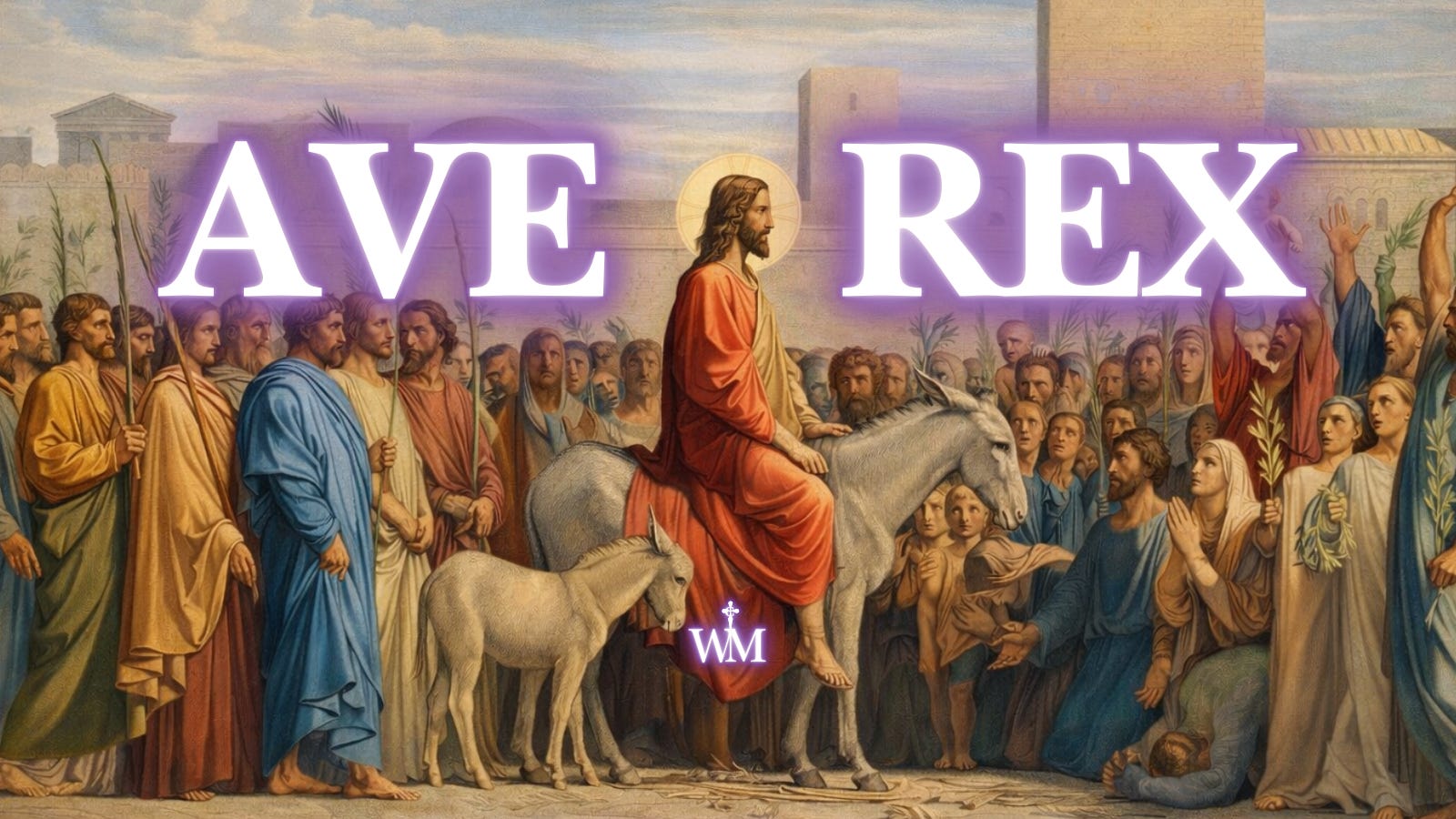
Jesus enters Jerusalem in a way that declares himself its King, and he allows himself to be acclaimed as such – but what sort of King is he?
Editor’s Notes
This is Day 28, in Week 3 – the purpose of which is growing in knowledge of Our Lord, so that we may love him more dearly and follow him more nearly.
Today we are returning to Fr Aloysius Ambruzzi’s Companion to the Spiritual Exercises of Saint Ignatius, and considering his treatment of Our Lord’s triumphal entry into Jerusalem on Palm Sunday.
The Kingship of Christ is central to the Spiritual Exercises. Christ is King – but what kind of king is he? He answers this question on Palm Sunday.
It would be good to return to the meditations on the Three Classes of Men and the Three Ranks of Humility this week – as well as the meditation on The Two Standards. They are a crucial part of growing in knowledge of Christ. We anticipated them in Week 0, but St Ignatius puts them with the meditations we are considering in Week 2 and 3:
Day 6: Satan’s battle plan to ensnare souls – and Christ’s battle plan to save them
The Two StandardsDay 8: Are you a weakling, a self-seeker... or something better?
The Three Classes of MenDay 9: Do we actually want what humility entails?
The Three Ranks of Humility
Finally, St Louis de Montfort recommends going to confession on the day of the consecration. Look ahead now, and consider whether you need to arrange that with a priest in advance.
CONTENTS:
READING: The text is based on an extract from Fr Aloysius Ambruzzi SJ.
MEDITATION: The points for meditation are included below. A guide on how to use these points in meditation can be found here.
Reading: Palm Sunday
The King, Meek and Humble of Heart
A Companion to the Spiritual Exercises of Saint Ignatius
Fr Aloysius Ambruzzi SJ
The first Prelude is to call to mind how our Lord started from Bethany, mounted on the colt of an ass, amidst the enthusiastic acclamations of the people, and how as He drew near Jerusalem, He wept over it (Matt. xxi, 1-11).
The second Prelude is to see the road from Bethany to Jerusalem.
The third Prelude is to ask light to know our Divine King and the nature of His Kingdom, and grace to love and follow Him more and more.
On the tenth day of Nisan the paschal Lamb was set apart. It is the day which Christ, the true Passover to be slain for us, chooses for making His public entry into Jerusalem and the Temple, and for declaring solemnly the nature of the Messianic Kingdom which He will open in a few days.
1. Our Lord’s Triumph
“And it came to pass, when He was come nigh to Bethphage and Bethania unto the mount called Olivet, He sent two of His disciples, saying: Go into the town which is over against you, at your entering into which, you shall find the colt of an ass tied, on which no man ever hath sitten: loose him, and bring him hither…
“And they brought him to Jesus. And casting their garments on the colt, they set Jesus thereon. And as He went, they spread their clothes underneath in the way.” (Luke xix, 29-30; 35-36)
The Saviour had always rebuked those friends of His who had urged Him to show Himself to the world. He had often forbidden those whom He healed, to publish His miracles abroad. He had silenced the devils that would proclaim Him the Son of God. He had run away from the crowd bent on making Him King. He wanted wholly to dispel the vain dreams of a temporal Messias, so common amongst the Jews of His time.
And yet He is truly the King of the Jews, the Messias foretold by the prophets and expected by all men of good-will. A few months ago He had elicited from his Apostles the confession of His Divinity. To-day He triumphantly enters Jerusalem and receives, without the least opposition, the acclamations of the crowd saluting Him as the Messias of Israel. In a few days He Himself will proclaim His mission before the two greatest tribunals: that of Israel and that of the Romans.
He does not set out, however, as the deliverer of His people from the oppression of the foreigner.
“Tell ye the daughter of Sion, behold Thy King cometh unto thee, meek and sitting upon an ass, and a colt, the foal of an ass.”
Such was God’s plan. The Messias was to be a true King—Rex regum et Dominus dominantium—and yet a King Who would conquer through meekness and humility, and Whose throne would be a cross. Accordingly, “the entry into Jerusalem on Palm Sunday is no mere fleeting and accidental pageant. It is the entrance of a King about to win to Himself a Kingdom, not of this world, in His Blood. It is the solemn opening of the Great Sacrifice the entrance at once of the High Priest and the Victim.”
The whole of our Lord’s life, and the three years of uninterrupted preaching had been directed to exemplify and bring home that hard lesson to His Apostles and to the people. The object of to-day’s triumph is to repeat it once more in the capital of Israel, during the Paschal time, in the midst of millions of pilgrims.
2. “Seeing the City, He wept over it”
“And when He drew near, seeing the City, He wept over it, saying:
“If thou also hadst known, and that in this thy day, the things that are to thy peace; but now they are hidden from thy eyes. For the days shall come upon thee: and thy enemies shall cast a trench about thee, and compass thee round, and straiten thee on every side, and beat thee flat to the ground, and thy children who are in thee: and they shall not leave in thee stone upon a stone; because thou hast not known the time of thy visitation.” (Luke xix, 41-44)
It was our Lord’s final appeal to the ungrateful City. But alas, He knew it would be rejected. Already He has heard the murmurings of His enemies irritated by the enthusiasm of the crowd. Shortly they will be bold enough to nail Him to the Cross.
“And seeing the City, He wept.” It was not on account of His coming Passion that Christ shed tears; His Heart was too brave and generous for that. For His people He would have endured not one, but a thousand deaths. It was their blindness, their ingratitude, and alas, the punishment that would inevitably fall on them, that made Jesus cry in the midst of the universal rejoicing. Another would have called God’s vengeance on the City, but the Saviour wept over her fate.
The mercy and patience of our Lord are everywhere admirably manifested. He repeatedly knocks at the heart of the sinner, and if the sinner refuses the proffered mercy, He weeps over him and his impending ruin. If human freedom is to be respected even by God, sin committed cannot escape punishment.
On the other hand, we are here shown what hinders the soul from seeing and accepting God’s plan and dispensation. Any self-seeking and wilful blindness is an impenetrable wall that stands between the soul and God.
Only the poor of heart, the humble and the pure will see God and joyfully enter into His Kingdom. The lovers of this world, the proud, and the hypocrites can see but themselves and work only to establish or strengthen the kingdom of Satan.
3. The acclamations
“And when He was now coming near the descent of Mount Olivet, the whole multitude of His disciples began with joy to praise God with a loud voice, for all the mighty works they had seen, saying:
“Blessed be the King Who cometh in the name of the Lord peace in heaven, and glory on high!'
“And some of the Pharisees from amongst the multitude said to Him: Master, rebuke Thy disciples.
“To whom He said: I say to you, that if these shall hold their peace, the stones will cry out.” (Luke xix, 37-40)
It is simple souls and little children that enthusiastically acclaim the Divine King: “and the children crying in the temple, and saying: Hosanna to the Son of David.” (Matt. xxi, 15)
Only to such the vision of the Kingdom is vouchsafed:
“I confess to Thee, O Father, Lord of Heaven and earth, because Thou hast hid these things from the wise and prudent, and hast revealed them to the little ones.” (Matt. xi, 25)
And even they must guard it most carefully against the false lights that may distort it, or make it appear as a mere illusion of an enthusiastic mind. Alas, how many, who to-day have cried out: “Hosanna”, will, on Good Friday, ask for the Crucifixion of Jesus. And likewise how many who, in their prayer, dream that they love the meek and humble King, deny Him their homage in almost every incident of their life and every aspiration of their hearts.
Jesus meek and humble of heart!
Suggestions for the colloquy
1. O my Lord, in the past Thou didst run away from the crowds bent on making Thee their temporal king. And yet Thou art truly the King of kings, the Messias foretold by the Prophets and expected by men of good-will, the Saviour of mankind! That is why, now that Thy end is near, Thou allowest a public manifestation of Thy true kingship. Thou triumphantly enterest Jerusalem, meek and sitting upon an ass, and receivest, without the least opposition, the acclamations of the crowds, saluting Thee as the Messias of Israel—a King Who will conquer through meekness and humility, and Whose throne will be a Cross.
2. Thou didst direct Thy life, and particularly Thy three years of uninterrupted preaching, to exemplify and bring home to Thy Apostles and to the people that hard lesson. Thou makest use of to-day’s triumph to repeat it once more in the capital of Israel, during the Paschal time, in the midst of millions of pilgrims, and to declare openly and solemnly the nature of Thy Kingdom.
3. It is simple souls and little children that enthusiastically acclaim Thee their Divine King. To such only is the vision of Thy Kingdom vouchsafed, as Thou hast said: I confess to Thee, O Father, Lord of Heaven and earth, because Thou hast hid these things from the wise and prudent, and hast revealed them to the little ones.
4. Hail, then, O my Divine King! After the loving contemplation of the Mysteries of Thy infancy, of Thy hidden and public life, with the knowledge Thou hast given me of Thee and of Thy Kingdom, I solemnly renew my oblation to Thee and my strong determination to love Thee, to follow Thee as closely as possible, and to distinguish myself in Thy service.
Meditation for Day 28
The Triumphal Entry of Christ
Taken from St Ignatius’ Spiritual Exercises
It is in mental prayer that that much of the preparation will be achieved – and meditation is a means of entering mental prayer. See our guide to meditation for two ways to use the below texts.
The Preparation
Prayer. The usual Preparatory Prayer.
The first Prelude is to call to mind how our Lord started from Bethany, mounted on the colt of an ass, amidst the enthusiastic acclamations of the people, and how as He drew near Jerusalem, He wept over it (Matt. xxi, 1-11).
The second Prelude is to see the road from Bethany to Jerusalem.
The third Prelude is to ask light to know our Divine King and the nature of His Kingdom, and grace to love and follow Him more and more.
The Points for Meditation
First Point. First: The Lord sends for the ass and the foal, saying: “Loose them and bring them to Me, and if any one shall say anything to you, say ye that the Lord hath need of them, and forthwith he will let them go.”
Second Point. Second: He mounted upon the ass, which was covered with the garments of the Apostles.
Third Point. Third: They went out to receive Him, strewing in the way their garments and the branches of the trees, saying: “‘Save us, Son of David, blessed is He that cometh in the name of the Lord: Save us in the heights!’”
Contemplate each of these points: Persons, Words, Actions.
One could consider these points in reference to oneself: How far have we been conscious of this in our daily lives so far, what practical conclusions should we draw from these truths, how far have we lived up to them so far, what must we do to live up to them in the future, etc.
One could consider the acts of virtue we can make in response to these truths – Acts of faith, humility, hope/confidence, thanksgiving, contrition and love – talking all the while to God, the Blessed Virgin, our Guardian Angels, etc.
One should feel free to linger on only one of the points, if this is how the meditation proceeds.
The Colloquy
End with a Colloquy to Our Lady, or to Our Lord.
In this period of the meditation, St Ignatius would particularly have us make the triple colloquy from The Two Standards, begging Our Lady, Our Lord and God the Father, to allow us to be received under the standard of Christ.
Fr Ambruzzi has further suggestions above. It is important to speak frankly to God in our own words, rather than simply reading somebody else’s. If one feels moved to speak to God before meditating on all the points, one should certainly do so. The same applies if one feels moved to simply rest in God, rather than engaging in discursive meditation. These impulses should be followed over any particular method of meditation.
The End
End the meditation with a vocal prayer – such as the Our Father, the Anima Christi.
Reflect on how well we have prayed, and how well we have followed our chosen method.
Select a spiritual nosegay from your meditation to keep with you for the rest of the day.
See you tomorrow. Hit subscribe to make sure you don’t miss it or any of our other material:
See the index and explanation to this series here:
For more on the St Louis de Montfort’s True Devotion and Total Consecration, for which we are preparing, see here:
The theological basis of ‘True Devotion’ and the Consecration to Mary (Garrigou-Lagrange)
The fruits of ‘True Devotion’ and Consecration to Mary (Garrigou-Lagrange)
For more on the importance of not getting bogged down with methods, and on allowing God to act, see here:
For more on Week 3, and the vocal prayers that are are suggested for each day, see here:
‘Week 3’ of St Louis de Montfort’s Total Consecration preparation (Prayers, practices and reading)
Get the book here:
True Devotion to the Blessed Virgin Mary (St Louis de Montfort)
HELP KEEP THE WM REVIEW ONLINE WITH WM+!
As we expand The WM Review we would like to keep providing free articles for everyone.
Our work takes a lot of time and effort to produce. If you have benefitted from it please do consider supporting us financially.
A subscription gets you access to our exclusive WM+ material, and helps ensure that we can keep writing and sharing free material for all.
You can see what readers are saying over at our Testimonials page.
(We make our WM+ material freely available to clergy, priests and seminarians upon request. Please subscribe and reply to the email if this applies to you.)
Subscribe to WM+ now to make sure you always receive our material. Thank you!
If you are enjoying this preparation for Total Consecration, why not get it in mug form?
We also have our best-selling Co-Redemptrix mugs:
Follow on Twitter, YouTube and Telegram:
Twitter (The WM Review)


