
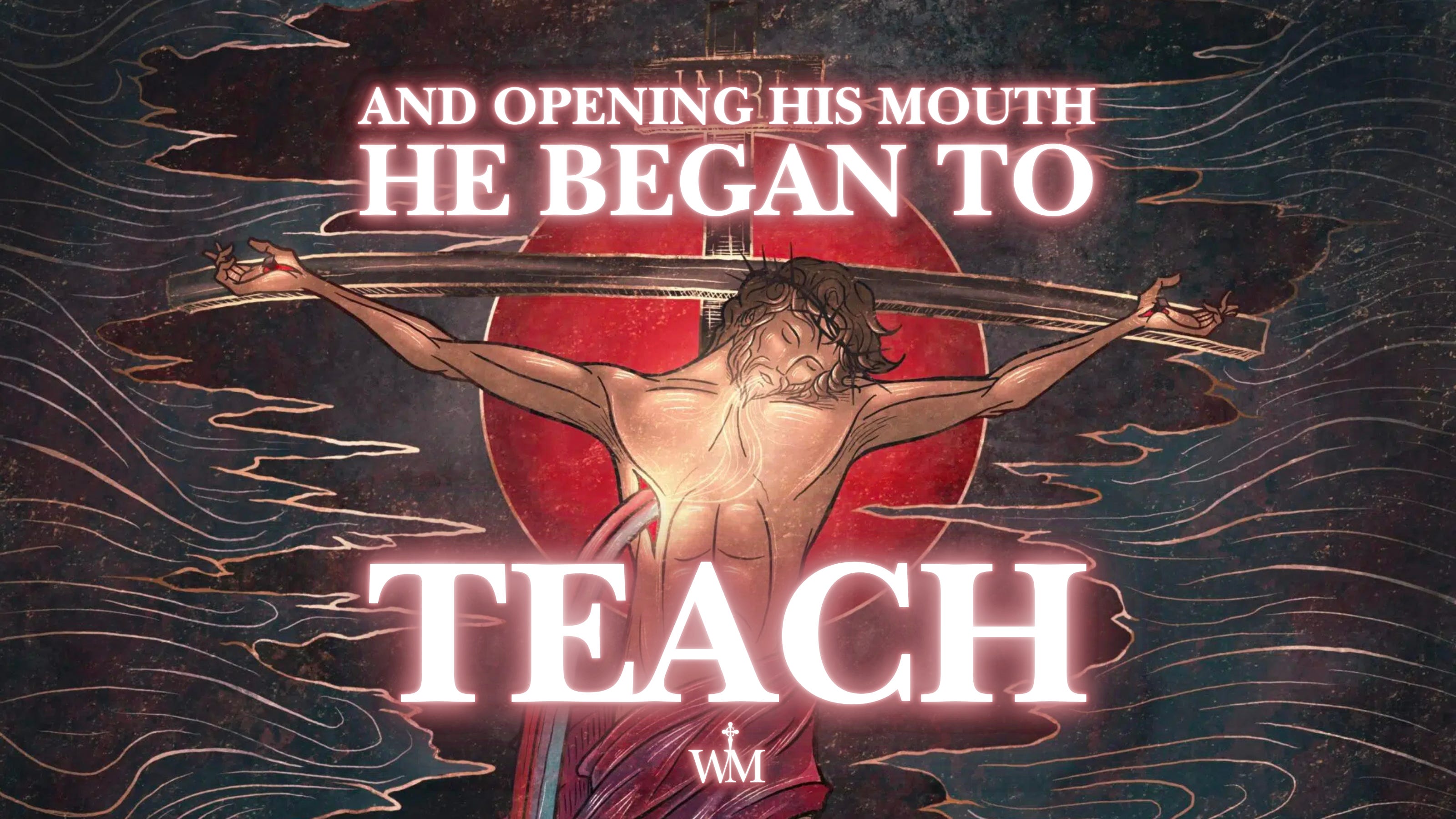
Christ’s seven last words were the counterpart to the Sermon on the Mount.
Editor’s Notes
This is a bonus instalment (without audio) for Day 31 of our Total Consecration series. Day 31 falls in in Week 3, which is focused on growing in knowledge of Our Lord, so that we may love him more dearly and follow him more nearly.
(Readers who are encountering this series for the first time through this article can find out more here.)
Day 31’s instalment features Fr Aloysius Ambruzzi’s commentaries on three of Christ’s Seven Last Words: this bonus includes the full chapter, which was too long to record in audio format.
For consideration of why it is important to meditate on the Passion, even in the lead up to Christmas – and some important tips from St Ignatius, on how to do so fruitfully – see Day 31.
Finally, St Louis de Montfort recommends going to confession on the day of the consecration. Look ahead now, and consider whether you need to arrange that with a priest in advance.
CONTENTS:
READING: The text is based on an extract from Fr Aloysius Ambruzzi SJ.
MEDITATION: The points for meditation are included below. A guide on how to use these points in meditation can be found here.
Reading: The Last Seven Words
The Message from the Throne
A Companion to the Spiritual Exercises of Saint Ignatius
Fr Aloysius Ambruzzi SJ
The first Prelude is to call to mind how Christ spoke seven words on the Cross: He prayed for those who were crucifying Him; He forgave the Good Thief; He commended St John to His Mother and His Mother to St John; He complained: “I thirst”; He groaned that He was forsaken; He said: “It is finished”; and finally He cried out: “Father, into Thy hands I commend My spirit.”
The second Prelude is to see the place of the Crucifixion.
The third Prelude is to ask of my dying Master, through the intercession of Mary, His Mother and my Mother, of John and Mary Magdalene, light to understand His parting message, and grace to treasure it in my heart and make it the mainspring of my whole life.
“And seeing the multitudes, He went up into a mountain and when He had sat down, His disciples came to Him, and opening His mouth He taught them.” (Matt. vi, 1, 2)
Calvary is the counterpart of the Mountain of the Beatitudes. There the Master raised His Standard and issued the Code of His Kingdom. Here He seals it with His Blood. There He opened His mouth and uttered the words of Eternal Life, in the presence of His ecstatic disciples and the astonished multitude. Here but a few words break forth from His lips, but they come from the innermost depth of His agonizing Heart, and are re-echoed by every wound of His body and every drop of His sacred Blood. They sum up and fix the teaching of His life. They are His last message delivered to a few chosen friends, in the presence of an angry, hostile, and scoffing crowd.
The three hours of darkness and of agonizing silence divide the Sermon of Christ into two parts. The first three words refer to the persons around Jesus: His cruel and impenitent enemies; His companion in suffering, the penitent thief; His dear ones, Mary and John. In the midst of His sufferings Christ does not forget to forgive, to console, to help and to succour. The last four words refer to Jesus Himself; the fourth and the fifth reveal the intensity of His interior and exterior sufferings; the sixth and the seventh are a cry of triumph and a cry of confidence, and constitute the Saviour’s immediate preparation for death.
First Word
“And when they were come to the place, which is called Calvary, they crucified Him there… And Jesus said: Father, forgive them, for they know not what they do.”
(Luke xxiii, 33, 34)
1. The infinite mercy of Christ
Many a time had Jesus shown His pity for sinners. He had declared that He had come into this world not to judge it, “but that the world may be saved by Him” (John iii, 17), “not to call the just, but sinners to penance” (Luke v, 32). The inhabitants of a town once refused to receive Him. Indignant at this insult, James and John said to Him:
“Lord, wilt Thou that we command fire to come down from Heaven and consume them?
“And turning, He rebuked them, saying: You know not of what spirit you are. The Son of man came not to destroy souls but to save.”
No one, then, could possibly doubt the merciful goodness of the Saviour. However, well knowing how liable we are, after repeated sins, to fall into despondency and despair, He desired to make such a revelation of the infinite mercy of His Divine Heart as to drive out the last shred of diffidence from the heart of even the greatest sinner.
Throughout His Passion our Lord has hardly opened His mouth except to remind His persecutors of that awful day when He will appear to judge them, and to explain to Pilate the object of His mission and the crime the Roman Governor was perpetrating. No feeling of rancour can dwell for an instant in the Heart of Christ—of that we are quite certain. But when for the first time, after a long silence, He opens His lips, will He not call down the Divine vengeance on His ungrateful and cruel executioners and pronounce the final condemnation of His enemies? Instead He only says: “Father, forgive them,”—forgive the soldiers, the priests, the whole people.
Let us consider for a moment, on one side the gravity of the crime committed on Mount Calvary, and on the other, the sufferings of our Lord; and then let us measure, if we can, the love and the mercy of His Heart, when, tenderly addressing His Father, He says: “Father, forgive them.” Truly, “many waters cannot quench charity, neither can the floods drown it.” (Cant. viii, 7)
2. The quintessence of the Law of Love
It is always difficult to forgive in true sincerity, and not merely out of cowardice and laziness. It is difficult even when the wrong done to us, or the sufferings inflicted on us, are things of the past. But to forgive in the very act of being wronged and tormented by the men on whom we have lavished our love and favours, to intercede and pray for them, is surely above man’s strength. Christ has obtained for us the grace to do it. He wholly forgets His offended dignity and His outraged love to remember only His infinite mercy and the almost infinite weakness of His creatures.
To love our enemies, to do good to them that hate us, and to pray for them that persecute and calumniate us, is the quintessence of the law of love and the characteristic note of Christianity. We must obey that law and make that characteristic note our own, if we want to be the children of the Heavenly Father, “Who maketh the sun to rise upon the good and the bad, and raineth upon the just and the unjust”; if truly we desire that the Crucified Saviour be our hope in life and at the moment of death. If we look on Him and trust in His all-powerful grace, surely we shall be able, even in the midst of persecution and torments, to repeat with St Stephen:
“Lord, lay not this sin to their charge.”
3. “They know not what they do”
They have heaped on Him torments and insults of every kind. They breathe freely only when they see Him nailed to the Cross. But not yet is their hatred appeased. They blaspheme Him, they mock Him, they challenge Him to come down from the Cross:
“He saved others; Himself He cannot save. If He be the King of Israel, let Him now come down from the Cross, and we will believe Him. He trusted in God, let Him deliver Him now, if He will have Him; for He said: I am the Son of God.”
Were He the worst of malefactors there would be no justification for all this, and they know it. The only thing they do not know, and that because they did not care to know, is that He is the Son of God. His Heart clings to this slight excuse and cries out: “They know not what they do.”
4. The Memento of our High Priest
We have crucified Jesus many a time. Our sins were the executioners of the Incarnate Son of God: “crucifying again to themselves the Son of God and making Him a mockery” (Heb. vi, 6). For us, then, is that prayer: “Father, forgive them, for they know not what they do.” It is the Memento of our High Priest offering His eternal Sacrifice for us.
Truly we do not know what we are doing when we sin. We are fools that in a fit of frenzy stab the most loving of fathers. And that Father turns to us with eyes of tenderness and opens to us His Heart—the Heart which in the midst of sufferings, of ingratitude and ignominy, throbs only with love for us His erring children.
If the sight of Jesus, crucified by us and imploring His Father’s forgiveness for us, does not pierce our heart; if we do not restrain ourselves with a kind of horror from wounding again the Divine Heart, we may well ask ourselves whether the last shred of human feeling has not perchance disappeared from us.
This is a bonus instalment of our Total Consecration series for WM+ members.
The WM Review is free for readers. This is because we believe these ideas must reach as many people as possible.
However, we also provide WM+ articles—additional material for those who choose to support this work financially.
This helps us continue producing serious Catholic research, while ensuring that the main body of material remains accessible to all.
If you want to ensure that our work continues, join WM+ today.
You can see our Testimonials page for what some of our readers are saying about the WM Review.
(We offer free membership on request for clergy and seminarians – please contact us for details.)