
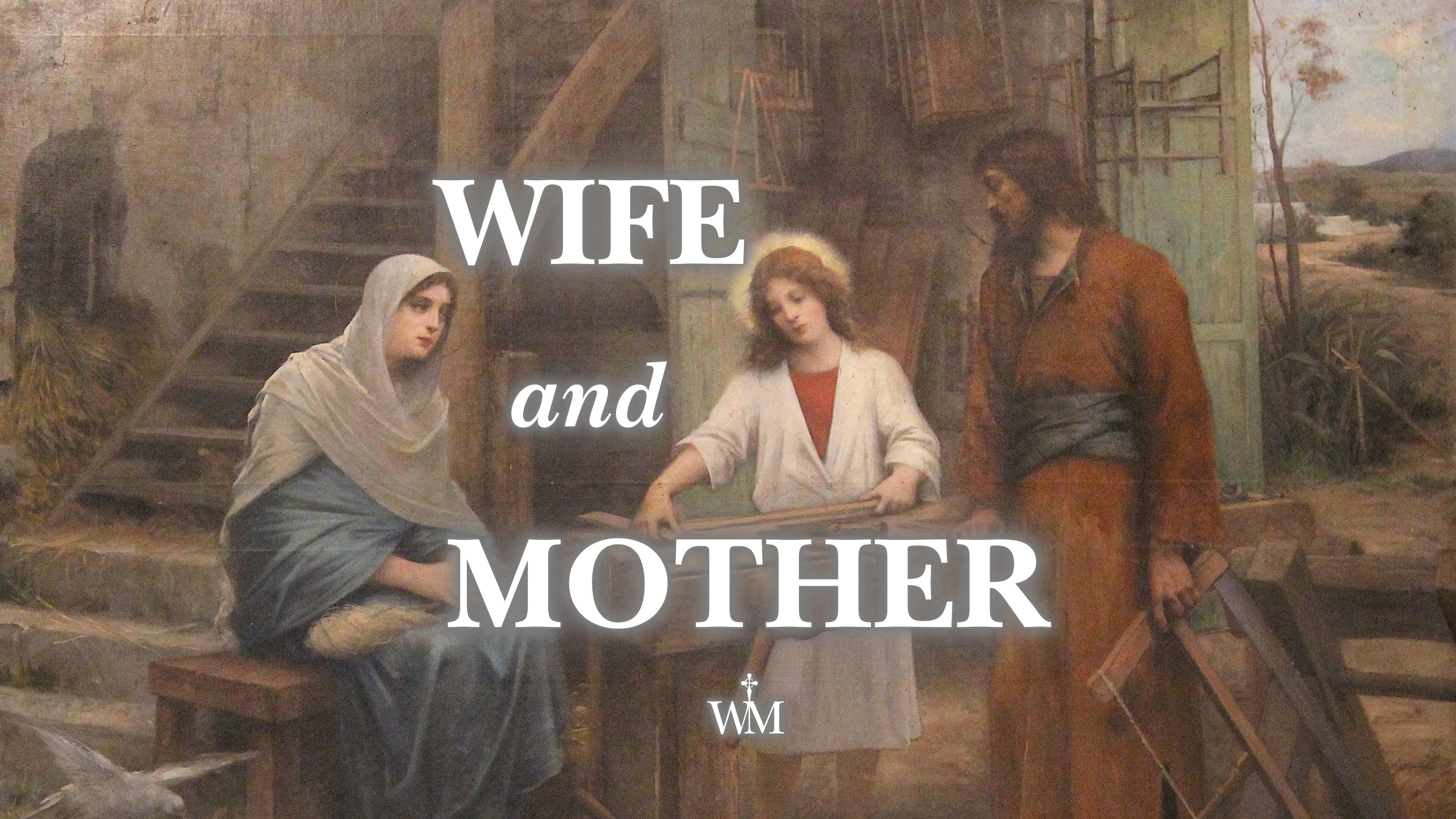
Jesus, the Hidden King, is waiting for you – with his Blessed Mother and St Joseph.
Editor’s Notes
What would you find, if you knocked on the door of the Holy Family’s home in Nazareth?
This is Day 25, in Week 2 of the preparation for St Louis de Montfort’s Total Consecration to the Blessed Virgin is focused on gaining a greater knowledge of Our Lady, and seeking to unite ourselves to her.
Today we are reading from Fr Aloysius Ambruzzi’s Companion to the Spiritual Exercises of Saint Ignatius, and reflecting on what he has to say about the hidden life of the Holy Family in Nazareth.
If we are trying to grow in knowledge of Our Lady, so that we can go to Our Lord through her, then we must also appreciate how she lived as a mother and wife – and how her Son and husband lived with her.
Kevin Davis from Catholic Family Podcast has kindly agreed to read this text for us today. He also recently published a video about this series, St Louis’ True Devotion and important considerations when engaging in controversy with others – which you can see here:
As usual, this text is intended to provide fuel and material for our meditation – the points of which follow the reading. The themes, as well as vocal prayers and readings associated with Week 2, can be found here. You can find the book here.
Although this is part of the Total Consecration preparation, it also stands alone as a great text in its own right.
Finally, for those following it would be good to return to the meditations on the Three Classes of Men and the Three Ranks of Humility this week. We anticipated them in Week 0, but St Ignatius puts them with the meditations we are considering now in Week 2:
Day 8: Are you a weakling, a self-seeker... or something better?
The Three Classes of MenDay 9: Do we actually want what humility entails?
The Three Ranks of Humility
CONTENTS:
READING: The text is based on an extract from Fr Aloysius
MEDITATION: The meditation is one from Fr Francisco Vallet, included in Christian Warfare. A guide on how to use these points in meditation can be found here.
Reading: Nazareth
The Hidden King
A Companion to the Spiritual Exercises of Saint Ignatius
Fr Aloysius Ambruzzi SJ
The first Prelude is to call to mind how our Lord went down with His parents and came to Nazareth; and was subject to them and how He advanced in wisdom, and age, and grace with God and men (Luke ii. 51-52).
The second Prelude is to see the house of Nazareth in detail: the place where Jesus and Mary and Joseph dwell; where they gather together; where they work.
The third Prelude is to knock reverently at the door of the home of the Word Incarnate, and ask Mary, our Mother, to allow me to step in and spend some time with Jesus, her Son and our Lord, with her, and with her beloved Spouse St Joseph.
Christ is our Model. Every act of His is a lesson to be treasured up and lovingly reproduced in our life so far as circumstances allow. As of Mary so of every Christian it should be said that he keeps all the words of Jesus, and still more His deeds, pondering them in his heart. But of all the lessons of our Saviour those which He gives in the House of Nazareth must be mostly deep impressed on our hearts. They are the lessons of thirty long years, by far the greatest part of the Saviour’s life. They are meant for all Christians, whatever their condition or state of life may be—for all Christian families and all Christian homes. They lay open the secret of the interior life of the soul, i.e., the life of the heart. “Ye are dead and your life is hidden with Christ in God.” (Coloss. iii, 3)
Part I: Interior life
1. Importance of the interior life
“This is no other but the house of God, and the gate of Heaven.” (Gen. xxviii, 17)
In the sweet and holy house of Nazareth we breathe a divine atmosphere—an atmosphere of joy, of peace, of tranquillity and order.
But it is to Jesus that our eyes are immediately directed. Inspice et fac secundum exemplar. A simple look on the Saviour is life-giving. The companionship and conversation of great and holy men elevate and ennoble our souls. The companionship and conversation of Jesus deify them. By looking constantly on Him, the mist is lifted off our eyes and the ice around our heart is melted away. We begin to see things eye to eye with Jesus. Our heart throbs along with His Divine Heart, and at last we cry out with St Paul:
“It is no longer I that live, but Christ that liveth in me” (Gal. ii, 20).
Then alone are we counted among His true disciples.
There is nothing in this holy house of Nazareth to strike the eyes accustomed to the marvels of the world—nothing of what the world calls great and heroic. All is interior.
And really, true nobility is nobility of the soul. It is only the life of the heart that matters—what we are, not what we do. And we are what we love. The life of the Heart of Jesus, especially in Nazareth, is, then, the infallible criterion of true greatness and nobility—of life, in one word, for it is life and a greater life that He has come to give us:
“I am come, that they may have life, and may have it more abundantly.” (John x, 10)
Let us, then, look on Jesus and enter, as much as possible, into His Heart, the Sacred Temple of God. What is it that constitutes the life of the Sacred Heart? It is a life of perfect conformity with the Will of His Father. It is a life of perfect and uninterrupted prayer. It is a life of burning zeal for the salvation of souls.
2. Christ’s conformity with the Will of the Father
Doing willingly the Will of His Father, in everything and at every moment—this is the life of the Divine Heart. At the first instant of His existence He cried out:
“I delight to do Thy Will, O My God: Yea Thy law is within My heart.”
And now:
“I do always the things that please Him.” (John viii, 29)
He lives in a secluded spot, in a lowly village, engaged in humble occupations. But such is the Will of His Father. Christ loves it and far from desiring that it might be otherwise, He finds it infinitely lovely. And the humble duties of daily life, the humdrum tasks which Mary and Joseph enjoin on Him, the simple furniture His hands turn out, are as beautiful as the stars that came out of the hands of the Word that was in the beginning. They are the colours with which Christ paints things of eternal beauty, the instruments on which He plays a heavenly melody, and the words that form poems of unsurpassing excellence.
In Mary and Joseph He sees the representatives of His Divine Father—their will and their desires are the Will and the Desires of His Father. See how promptly and attentively He listens to their voice. How readily He complies with their commands. How perfectly and how lovingly He conforms His Will to theirs.
“And He came to Nazareth, and was subject to them.”
That is all that the Evangelist, inspired by God, has recorded for us of those long thirty years. Now, as later, Christ can say:
“My meat is to do the Will of Him that sent Me.” (John iv, 34)
Nor is Mary’s life different from that of her Son. In the temple, in her home, and here in Nazareth, she is always the handmaid, the slave of the Lord. Her life is the accomplishment of the Divine Will:
“Behold the handmaid of the Lord. Be it done unto me according to thy word.”
And St Joseph’s life is the same. The Saint lives to obey the Divine Voice, whether it tells him to fear not to take Mary as his wife or to fly into Egypt, or to return to the land of Israel, or to dwell in Nazareth and be the master of the Son of God and then die just when Christ was about to open the Messianic era.
3. Christ’s perfect and uninterrupted prayer
The life of Jesus in Nazareth is a life of perfect and uninterrupted prayer.
To pray is to raise one’s mind to God, and to commingle our hearts humbly and confidently with the Heart of our Creator and Father.
Prayer is natural to Christ—every throb of his Heart is a prayer of the most perfect kind. His prayer is continuous. It is fervent and calm, not something artificial and constrained. It is humble. It is full of gratitude and confidence.
His prayer is the prayer of the Saviour of men. From the first moment of His Incarnation He has gathered in His Heart all our aspirations, our needs and miseries. On our behalf He adores the Father; He offers Himself to Him, and with Himself He offers everyone of us; He gives to Him the tribute of thanks; He pleads for our sins; He asks of the Divine Goodness the graces and favours which we need.
The prayer of Jesus knows no cessation, nor does that of Mary or of St Joseph. Mary’s heart is one with the Heart of her Son, and St. Joseph’s heart stands between the two.
Along with this interior prayer, they love to meet, at stated times, during the course of the day, to pray in common.
Look at them pouring out their souls to God in the fervent aspirations of the Psalter at dawn, at midday before and after their simple meal, and at evening. See with what devotion they attend Divine Service in the Synagogue, and join in the singing of the Psalms, or listen attentively to the Prophecies which, they know, have begun to be fulfilled.
Truly this house is the Temple of God and the Gate of Heaven.
4. Christ’s burning zeal
The life of Jesus in Nazareth is a life of burning zeal for the salvation of souls.
To save His people and give His life as a ransom for many, is the work which the Father has given Him to do. And even now, in the solitude of Nazareth, He is wholly in it. Not only does He teach us the most important lessons of life, and obtain for us the grace to sanctify our humble duties, but He is the Victim for the remission of sin, the Lamb of God that takes away the sins of the world. Calvary will only see the consummation of the Sacrifice begun at the Incarnation.
And with Jesus, Mary and Joseph work also at the salvation of souls, offering the Divine Victim to the Father, and with Him offering themselves as victims of propitiation.
Sanctity is not something saddled on our ordinary life. It is an orientation, an atmosphere, a life—it is living with Christ, through Christ, and in Christ. Jesus, Mary and Joseph teach us how independent it is of every external circumstance—nay, how a poor, humble, hidden state of life forms the best background to the highest sanctity.
It is the fulfilment of, and conformity with, the Will of God, out of love; it is prayer, the communing of our hearts with the Heart of God; it is zeal and love of souls. Nazareth is the school of sanctity, and the Heart of Jesus is its source.
Let us dwell in that Divine Heart, with Mary and Joseph. His conformity with the Will of the Father, His prayer and His zeal are ours.
Part II: Life of Love
1. The Commandment of Love
Christ our Lord is the Love of God made visible to men. All His words and deeds are but the expression of this love. All His commands are summed up in one, the commandment of love.
“This is my commandment, that you love one another as I have loved you.” (John xv, 12)
“These things I command you, that you love one another.” (John xv, 17)
One thing does He fervently desire for His disciples—perfect union of love.
“And not for them (the Apostles) only do I pray, but for them also who through their word shall believe in Me; that they all may be one, as Thou Father in Me, and I in Thee, that they also may be one in Us.” (John xvii, 20, 21)
If all the disciples of Christ, however widely they differ in race, language, economic and social conditions, must be bound together by such a love, how much more those who, after freeing themselves of all earthly ties, have joined together to reproduce more easily in themselves the traits of the Divine Saviour and make earth the ante-chamber of Heaven.
“That they may be one as We also are one.” The union of the Blessed Trinity, however, on which our union is to be modelled, is unfathomable to our minds. God, therefore, has willed that there should be a visible counterpart of it in the loving union of the Holy Family. Nazareth is Heaven on earth, and Jesus, Mary and Joseph are the earthly embodiment of the Heavenly Trinity. If every religious house is an attempt to continue throughout the centuries the life of Nazareth, all its members must be bound together by the love that unites Jesus, Mary and Joseph.
2. The love of the Holy Family
The love of Jesus, Mary and Joseph is kind. It is sympathetic. It is helpful.
Let us look attentively on them and study with reverence their very feelings. Virtue will even now go out of them to heal our miseries.
Listen to their words—how sweet and kind. Look on their faces—how serene and smiling. Consider their conversation—how joyful and yet how heavenly.
See how they help one another in the performance of their daily tasks. There is not the least trace of self-love in this holy house; each one lives and sacrifices himself for the others, and vies with the others in taking upon himself what is most humiliating and hard. “Christ did not please Himself”—His only pleasure is to do His Father’s Will and sacrifice Himself in the service of Mary and Joseph:
“The Son of man also is not come to be ministered unto, but to minister, and to give His life a redemption for many.” (Matt. xx, 28)
Let us enter into their hearts and see, if we can, how sympathetically they feel for one another, how each one rejoices in the joys of the others and grieves in their sufferings.
“Rejoice with them that rejoice; weep with them that weep.” (Rom. xii, 15)
How tenderly is this feeling of common suffering conveyed in those words of Mary:
“Behold Thy father and I have sought Thee sorrowing.”
Truly this is “the House of God and the Gate of Heaven,” where peace is supreme—the peace of the children of God who repose trustfully in the arms of their heavenly Father, and have but one object in life—to fulfil His Will and to love one another.
3. The neighbourliness of the Holy Family
Happy those who can approach this holy house and experience the kindness, the helpfulness, the sympathy of the love of Jesus, Mary and Joseph!
See the sweet smile with which Mary welcomes the poor women of Nazareth that come to her! How ready she is to please and to help them! What words of comfort and of encouragement come from her lips! How they leave the place happier, stronger, and brought nearer to God!
Look on Joseph transacting business with the men of Nazareth. See his constant calm, his straightforwardness, his sense of the presence of God even in the most material actions of life!
But above all keep your eyes constantly on Jesus. How sweet and kind He is to all, even to those who are rude to Him, who refuse to pay what they owe Him.
“He shall not contend, nor cry out, neither shall any man hear his voice in the streets.” (Matt. xii, 19)
He passes along the streets of Nazareth doing good and healing those tormented by the devil, not by means of miracles, but by the sweet odour of His virtues. Already He conquers hearts by the meekness of His own Heart and the charm of His ways.
May the sight of Jesus, Mary and Joseph cause the ice of our heart to melt away! May they fill it with their kind, helpful, and sympathetical love, so that whether with the dear circle in our home, which should be the home of Jesus, or with outsiders, our feelings, our words, and our actions may, however faintly, reproduce the feelings, the words, and the actions of the Holy Family of Nazareth!
Part III: Life of hardship
1. Poverty of the Holy Family
“I am poor and in labours from my youth.” (Ps. lxxxvii, 16)
The life of the Holy Family in Nazareth is a life of hardships, of privations, of toil and of neglect on the part of men.
It must be so. To be in want, to work hard, and to live unknown to men, if not actually despised by them, is the lot of most of us. Our Divine Teacher and Saviour has, then, to show us how to make these painful circumstances and trials, the means of our salvation and sanctification. He has to gain for us the grace to embrace them lovingly for His love and in union with Him.
First of all, see how poorly the Holy Family lives. The house is that of a poor artisan. The furniture is what is strictly necessary, and even that is of the simplest kind. Their clothes, clean though they be, bear the marks of long years. Their fare is simple and often scanty. Alas! Sometimes Jesus goes to His Mother for bread and she has none to give Him.
They experience the bitter effects of poverty—the necessity to work for their daily bread, the knowledge that there is no more food in the cupboard, the need to sell the work of their hands, to deal with hard and cruel men, to beg and be sent away with harsh words, and, what is still worse to tender hearts, the inability to relieve the misery they see around them.
And yet no complaint crosses their lips. They are happy in their poverty, in the feeling that a Father watches over them, and in the knowledge that their trials are golden chains that bind them close to His loving Heart.
O that we may copy in our lives the poverty of the Holy Family—that we abhor the comforts and the luxuries of the world, and rejoice in the want even of necessary things, with Jesus and like Jesus!
2. Work
“In the sweat of thy face shalt thou eat bread.” (Gen. iii, 19)
Labour, manual labour above all, which, since the Fall has been a punishment, is turned by Jesus into a means of expiation.
All work hard in the house of Nazareth.
We have contemplated the spiritual activities of the Holy Family—the continued elevation of the Heart of Jesus, of Mary, of Joseph. Let us see now their external activity also.
Let us follow our Blessed Mother as she goes about her work from early morning till late at night. Truly she is the valiant woman of the Proverbs.
“She has girded her loins with strength and hath strengthened her arm… She has put out her hands to strong things, and her fingers have taken hold of the spindle....She hath looked well to the paths of her house, and hath not eaten her bread idle.” (Prov. xxxi)
She is busy, either in cleaning the house, or in preparing the meals for Jesus and Joseph, or in mending their poor clothes, yet always finding time to help others poorer and more needy than herself.
Let us enter the workshop of Joseph. It is early morning and we already hear the sound of the hammer. It is hot midday: big drops of sweat stand on the Saint’s forehead, but he continues to work. It is night! but the light within tells us that the Saint is still at work.
Jesus is no less active. Let us see Him, first of all, helping His Mother to go through the humble tasks of a poor housewife. There He is carrying water and firewood, lighting the fire, laying the table, washing the plates. Then, let us look at Him at work with St Joseph. The hands of Him Who has created the universe handle the hammer, the plane, the saw. The first thing He fashions is a cross. His Mother sees it, and the sword predicted by Simeon pierces her heart.
This is really the house of work—of painful and unceasing work. If we want to be in the company of Jesus, Mary and Joseph we must work like them. We must work seriously; we must work constantly; we must declare war on any kind of idleness. How can we possibly remain idle in the presence of these holy Persons who know no rest? The house of Nazareth is not for idle people. But woe to us if we do not seek constantly to live there!
3. Concealment
“Love to be unknown and to be accounted as nothing.”
This is the last lesson which the Holy Family teaches us, and it is the most difficult of all. We can endure every trial if only it brings our little self into prominence. On the other hand, nothing is harder than self-concealment, and nothing embitters one so much as neglect.
And yet this is the lot of the Holy Family.
There is no one on earth, and there never will be anyone that comes near their high dignity. God Almighty looks down on them with infinite complacency. The Angels come down from Heaven to sing the Divine Praises around this blessed abode; and yet their concealment and the neglect which they suffer could not be greater. Their relations are all poor, and so are their acquaintances. Even these seem to make very little account of the Holy Family. Later on they will be offended with Jesus and will say:
“Whence hath this man this wisdom, and these mighty works? Is not this the carpenter’s Son? Is not His mother called Mary?”
“Is not this the carpenter, the Son of Mary?”
His very cousins will, for long, refuse to believe in Him.
“For neither did His brethren believe in Him.”
Not only is the splendour and the glory of the world completely absent from this place—even sanctity seems to hide itself. We hear but one voice:
“Learn of Me, because I am meek and humble of heart.” (Matt. xi, 29)
“This is my rest for ever and ever: here will I dwell, for I have chosen it.” (Ps. cxxxi, 14)
Here shall I often come to look upon Jesus and Mary and Joseph, and learn from them the lessons of life.
Meanwhile I shall ask leave to retire and having prostrated myself to receive the blessing first of Jesus, then of Mary, and then of St Joseph, I shall take leave of them with humility, with tenderness, with love.
Ever with thee in Nazareth
Suggestions for the Colloquy
1. O Jesus, grant that I may look on Thee and learn the secret of the life of Thy Heart in the Nazareth Home! Thy life is doing Thy Father’s will in everything and at every moment—in perfect submission to His representatives, Thy Mother and St Joseph. Of Thy thirty years in Nazareth, the Evangelist records only that Thou wast subject to them. It is a life of perfect and uninterrupted prayer. On our behalf Thou adorest the Father—Thou givest to Him the tribute of thanks—Thou pleadest for our sins—Thou askest of the Divine Goodness the graces and favours which we need. It is a life of burning zeal for the salvation of souls. In Nazareth, as on the Cross, Thou art the Lamb of God that takest away the sins of the world.
2. Thy life in Nazareth is a life of love—kind, sympathetic, helpful, self-sacrificing. How truly Thou canst say, even now, that Thou hast come not to be ministered unto, but to minister.
3. Thy life is a life of painful and unceasing work—hardships and toil—of privations and want—of neglect and contempt on the part of men.
4. O my Jesus, May I constantly live in Thy Heart and make Thy conformity with Thy Father’s will, Thy prayer, and Thy zeal my own. Fill, O Jesus, my heart with Thy love! May I copy in my life the poverty of the Holy Family. May I work with Thee seriously and constantly—and with Thee love to be unknown and accounted as nothing.
Meditation for Day 25
The Trials of the Holy Family (The Contemplation of the Joyful Mysteries)
The following meditation is taken from the book Christian Warfare. One should feel free to meditate on any relevant points in Fr Ambruzzi’s text if this is preferable.
It is in mental prayer that that much of the preparation will be achieved – and meditation is a means of entering mental prayer. See our guide to meditation for two ways to use the below texts.
The Preparation
The Son of God has chosen what is best for Himself, for His Mother and for His Virginal Father. Do I agree?
The retreatant has to excite in his heart great desires to imitate Our Lord. To imitate Him it is necessary to contemplate Him. “Let this mind be in you, which was also in Christ Jesus” (St. Paul, Philip. 2, 5). This is the purpose of this second week [of the Spiritual Exercises].
Prayer. The usual Preparatory Prayer.
First Prelude. Mental representation of the place: Bethlehem; Nazareth; Jerusalem.
Second Prelude. Request: To know Christ in order to follow Him (the grace of light and strength). [And to know Our Lady in order to love her and give ourselve to Christ through her.]
The Points for Meditation
First Point. Trials of the Holy Family at the time of the Nativity. Bethlehem. Temptations of St. Joseph, unaware of the secret of the Incarnation… The arrival in Bethlehem... The stable to receive the Child Jesus... The flight into Egypt. (See the mysteries #’s 264 to 269 [in the Exercises]).1 God does not keep his friends from suffering. Let us remember these lessons for which the Word Incarnate paid such a great price. Do we think as He does about the goods of this world and the value of worldly things?
Second Point. Nazareth (See the Mysteries #’s 270-271).2 30 years doing what? What is the most important here below?... Our fleeting occupations do not matter. What counts, it is to do the will of God... We know it by obedience. And Jesus Himself obliges Himself to apply to one of the most humble duties of state, by obedience for 30 years, to change our ideas on this point, “And He was submitted to them”.
Third Point. Jesus at 12 years of age. Jerusalem (See the mysteries no 272).3 We belong to God before we belong to relatives or to our homeland. If God calls us by a vocation to serve Him exclusively, no one can prevent us from answering.
“Did you not know that I must be about my Father’s business?”
Contemplate each of these points: Persons, Words, Actions.
One could consider these points in reference to oneself: How far have we been conscious of this in our daily lives so far, what practical conclusions should we draw from these truths, how far have we lived up to them so far, what must we do to live up to them in the future, etc.
One could consider the acts of virtue we can make in response to these truths – Acts of faith, humility, hope/confidence, thanksgiving, contrition and love – talking all the while to God, the Blessed Virgin, our Guardian Angels, etc.
One should feel free to linger on only one of the points, if this is how the meditation proceeds.
The Colloquy
End by one or several fervent colloquies: to Saint Joseph, to Our Lady, to the Child Jesus. Ask to understand and penetrate yourself with the Christian spirit, to arrive at thinking and willing, like our Divine Model.
Fr Ambruzzi has some suggestions above. It is important to speak frankly to God in our own words, rather than simply reading somebody else’s. If one feels moved to speak to God before meditating on all the points, one should certainly do so. The same applies if one feels moved to simply rest in God, rather than engaging in discursive meditation. These impulses should be followed over any particular method of meditation.
The End
End the meditation with a vocal prayer – such as the Our Father, the Anima Christi.
Reflect on how well we have prayed, and how well we have followed our chosen method.
Select a spiritual nosegay from your meditation to keep with you for the rest of the day.
See you tomorrow. Hit subscribe to make sure you don’t miss it or any of our other material:
See the index and explanation to this series here:
For more on the St Louis de Montfort’s True Devotion and Total Consecration, for which we are preparing, see here:
The theological basis of ‘True Devotion’ and the Consecration to Mary (Garrigou-Lagrange)
The fruits of ‘True Devotion’ and Consecration to Mary (Garrigou-Lagrange)
For more on the importance of not getting bogged down with methods, and on allowing God to act, see here:
For more on Week 2, and the vocal prayers that are are suggested for each day, see here:
‘Week 2’ of St Louis de Montfort’s Total Consecration preparation (Prayers, practices and reading)
Get the book here:
True Devotion to the Blessed Virgin Mary (St Louis de Montfort)
HELP KEEP THE WM REVIEW ONLINE WITH WM+!
As we expand The WM Review we would like to keep providing free articles for everyone.
Our work takes a lot of time and effort to produce. If you have benefitted from it please do consider supporting us financially.
A subscription gets you access to our exclusive WM+ material, and helps ensure that we can keep writing and sharing free material for all.
You can see what readers are saying over at our Testimonials page.
(We make our WM+ material freely available to clergy, priests and seminarians upon request. Please subscribe and reply to the email if this applies to you.)
Subscribe to WM+ now to make sure you always receive our material. Thank you!
If you are enjoying this preparation for Total Consecration, why not get it in mug form?

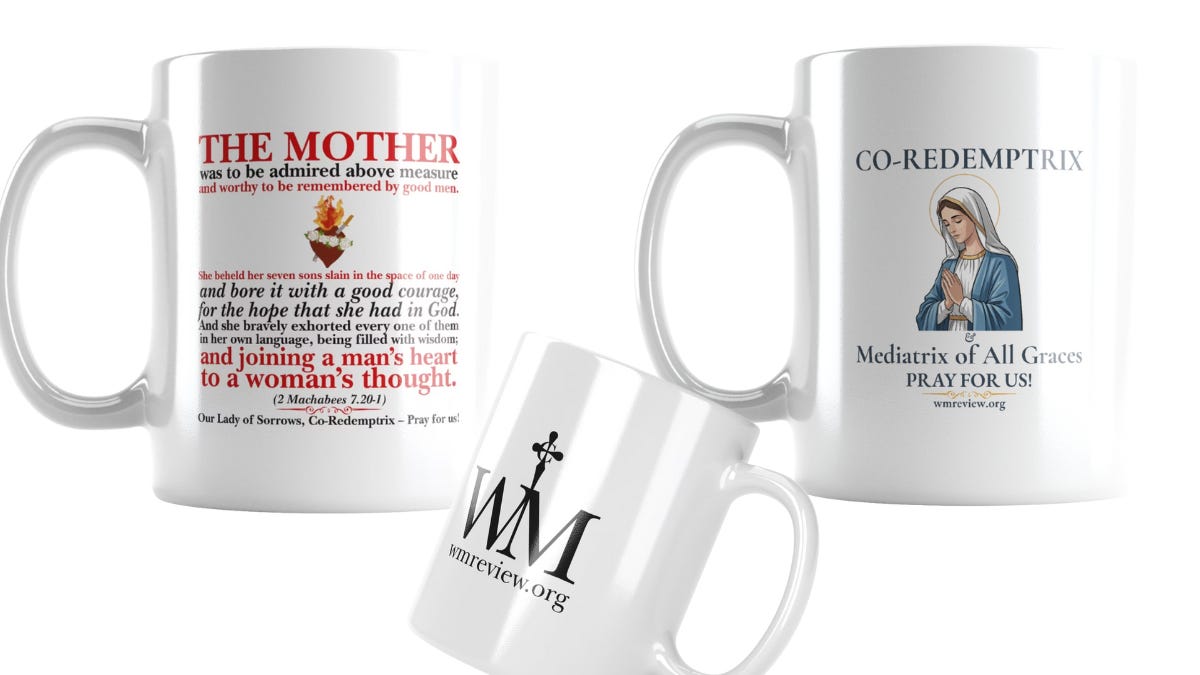
We also have our best-selling Co-Redemptrix mugs:
Follow on Twitter, YouTube and Telegram:
Twitter (The WM Review)
OF THE BIRTH OF CHRIST OUR LORD
St. Luke speaks in the second Chapter [1-15].
First Point. First: Our Lady and her husband Joseph go from Nazareth to Bethlehem. “Joseph went up from Galilee to Bethlehem, to acknowledge subjection to Caesar, with Mary his spouse and wife, already with child.”
Second Point. Second: “She brought forth her first-born Son and wrapped Him up with swaddling clothes and laid Him in the manger.”
Third Point. Third: “There came a multitude of the heavenly army, which said: ‘Glory be to God in the heavens.’”
OF THE SHEPHERDS
St. Luke writes in the second Chapter [8-21].
First Point. First: The birth of Christ our Lord is manifested to the Shepherds by the Angel. “‘I manifest to you great Joy, for this day is born the Saviour of the world.”‘
Second Point. Second: The Shepherds go to Bethlehem. “They came with haste and they found Mary and Joseph, and the infant put in the manger.”
Third Point. Third: “The Shepherds returned glorifying and praising the Lord.”
OF THE CIRCUMCISION
St. Luke writes in the second Chapter [21].
First Point. First: They circumcised the Child Jesus.
Second Point. Second: “His Name was called Jesus, which was called by the Angel, before He was conceived in the womb.”
Third Point. Third: They gave back the Child to His Mother, who had compassion for the Blood which came from her Son.
OF THE THREE MAGI KINGS
St. Matthew writes in the second Chapter [1-13].
First Point. First: The three Magi Kings, guiding themselves by the star, came to adore Jesus, saying: “‘We have seen His star in the East and are come to adore Him.’”
Second Point. Second: They adored Him and offered gifts to Him. “Falling down on the earth, they adored Him, and they offered Him gifts, gold, frankincense and myrrh.”
Third Point. Third: “They received answer while sleeping that they should not return to Herod, and went back by another way to their country.”
OF THE PURIFICATION OF OUR LADY AND PRESENTATION OF THE CHILD JESUS
St. Luke writes, Chapter 2 [23-39].
First Point. First: They bring the Child Jesus to the Temple, that He may be presented to the Lord as first-born; and they offer for Him “a pair of turtle doves or two young pigeons.”
Second Point. Second: Simeon coming to the Temple “took Him into his arms” saying: “‘Now Thou dost dismiss Thy servant, O Lord, in peace!’”
Third Point. Third: Anna “coming afterwards confessed to the Lord, and spoke of Him to all that were hoping for the redemption of Israel.”
OF THE FLIGHT TO EGYPT
St. Matthew writes in the second Chapter [13-16].
First Point. First: Herod wanted to kill the Child Jesus, and so killed the Innocents, and before their death the Angel warned Joseph to fly into Egypt: “‘Arise and take the Child and His Mother, and fly to Egypt.’”
Second Point. Second: He departed for Egypt. “Who arising by night departed to Egypt.”
Third Point. Third: He was there until the death of Herod.
OF HOW CHRIST OUR LORD RETURNED FROM EGYPT
St. Matthew writes in the second Chapter [19-23].
First Point. First: The Angel warns Joseph to return to Israel. “‘Arise and take the Child and His Mother and go to the land of Israel.’”
Second Point. Second: Rising, he came to the land of Israel.
Third Point. Third: Because Archelaus, son of Herod, was reigning in Judea, he withdrew into Nazareth.
OF THE LIFE OF CHRIST OUR LORD FROM TWELVE TO THIRTY YEARS
St. Luke writes in the second Chapter [51, 52].
First Point. First: He was obedient to His parents: “He advanced in wisdom, age and grace.”
Second Point. Second: It appears that He exercised the trade of carpenter, as St. Mark shows he means in the sixth chapter. “‘Perhaps this is that carpenter? ‘“
272. OF THE COMING OF CHRIST TO THE TEMPLE WHEN HE WAS OF THE AGE OF TWELVE YEARS
St. Luke writes in the second Chapter [42-51].
First Point. First: Christ our Lord, of the age of twelve years, went up from Nazareth to Jerusalem.
Second Point. Second: Christ our Lord remained in Jerusalem, and His parents did not know it.
Third Point. Third: The three days passed, they found Him disputing in the Temple, and seated in the midst of the doctors, and His parents asking Him where He had been, He answered: “‘Did you not know that it behooves Me to be in the things which are My Father’s?’”


