
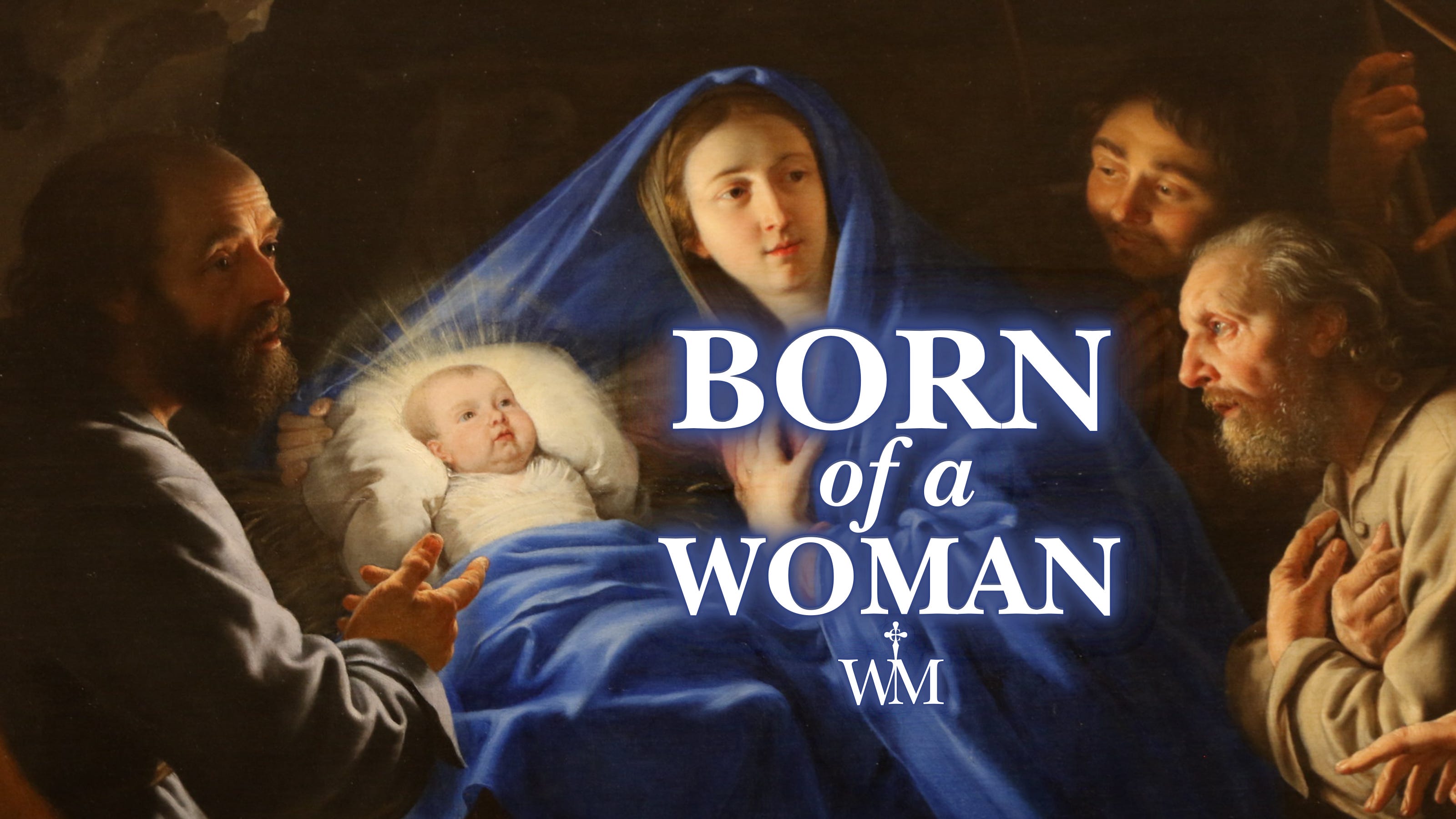
Here’s what happened at the first Christmas.
Editor’s Notes
In this reading, we’re going to reflect on the Nativity – birth of Our Lord at Christmas – and consider how this important period can make us grow in knowledge and love of her and her son.
This text is taken from Fr Henry James Coleridge. The vision of St Bridget, which Fr Coleridge recounts in this text, contains a number of striking parallels with the medieval Mystery Play tradition.
The WM Review runs a project called Father Coleridge Reader, which serialises this great nineteenth century Jesuit’s works. But while Fr Coleridge is great to read, his style and language make reading him aloud a little difficult. That is why the text in the attached audio has been simplified. The original text is below.
This is Day 24, in Week 2 of the preparation for St Louis de Montfort’s Total Consecration to the Blessed Virgin is focused on gaining a greater knowledge of Our Lady, and seeking to unite ourselves to her. The themes, as well as vocal prayers and readings associated with Week 2, can be found here. You can find the book here.
Although this is part of the Total Consecration preparation, it also stands alone as a great text in its own right.
Finally, for those following it would be good to return to the meditations on the Three Classes of Men and the Three Ranks of Humility this week. We anticipated them in Week 0, but St Ignatius puts them with the meditations we are considering now in Week 2:
Day 8: Are you a weakling, a self-seeker... or something better?
The Three Classes of MenDay 9: Do we actually want what humility entails?
The Three Ranks of Humility
CONTENTS:
READING: The text is based on an extract from Fr Henry James Coleridge’s The Thirty Years.
MEDITATION: Fr Coleridge’s text intended to provide material for the meditation, which is taken from St Ignatius’ Spiritual Exercises and appears in point-form following it. A guide on how to use these points in meditation can be found here.
Reading: The Nativity
The Nine Months
Fr Henry James Coleridge SJ
St. Luke’s narrative
The simple narrative of the Gospel of St. Luke tells us in the fewest possible words the circumstances of the Nativity. “It came to pass, when they were there,” at Bethlehem, “her days were accomplished that she should be delivered. And she brought forth her first-born Son, and wrapped Him in swaddling-clothes, and laid Him in a manger, because there was no room for them in the inn.”
That is all that we are told of the mystery which fulfilled the expectation of Heaven and earth, and on which the contemplations of devout souls are never weary of feeding themselves. Tradition hands on but little to fill up the picture for us. Though it has carefully preserved the spot in which the Nativity took place, it has added but little to the incidents and surroundings of this great mystery.
Concourse at Bethlehem
The town itself was not large. The Prophet Micheas speaks of it as if it might have been altogether insignificant, but for the unique distinction which it was to possess as the birthplace of the Messias. It had its traditional greatness in the remote past, for it was known all over the Holy Land as the city of David, and there must have been many sites in its neighbourhood connected with the history of this greatest of the heroes of Israel.
At the moment of the visit of St. Joseph and our Blessed Lady it had put on perhaps an air of unusual activity, and it would be remembered at the time of the enrolment that it was in this sense the royal city. It would not require a very great concourse of strangers to fill up the little khan to which those who had no friends with whom to seek for hospitality would naturally betake themselves.
But it is very probable that the occasion was one when there was some strain on the resources of the small community, though it is not certain that all who had to be enrolled were to present themselves on the same day. There must have been some bustle and excitement in the narrow streets, and as the night fell in that wintry season of the year, there may have been more than one party of new-comers who had to contend for lodging in the khan.
Opportunity of hospitality
St. Joseph and our Lady were certain to retire and give way to others. Perhaps even if he had acquaintances or relatives in the town, he did not choose, or had not time, to hunt them out and beg for shelter.
It is always the case with occasions of charity, for one that is declined or directly refused, there are a dozen others that are missed because they are not looked for. No one can doubt that there must have been, even in that small town, and at such a time as that of the enrolment, not a few houses with empty rooms in which the Holy Family might gladly have taken refuge, if refuge had been offered them.
There may have been not a few good persons, who would not have turned away from their door that gracious maiden, so soon to be a mother, with her gentle, humble, and soft-spoken spouse. If such persons had been on the look-out for an occasion of charity, certainly they might have found it, by going out to the gate or into the street. And then they might have been the hosts of the new-born God and of the Queen of Angels.
But it was the will of God that had ordained all the circumstances of the entrance of His Son into the world which He was to redeem, and He was to come to His own and His own were not to receive Him. A little indolence, a little thoughtlessness, a reluctance to exert themselves on an occasion when a high reward might have been reaped, brought down on the people of Bethlehem the unenviable distinction of being the first of the human race to fulfil these words. The one title of their town to fame was their connection with David, and the King, the Son of David, was turned from their doors.
The far greater distinction which had been promised to Bethlehem was that it should be the birthplace of the Incarnate God, and when He came to them, He could find no one to give Him shelter.
“He came unto His own, and His own did not receive Him.”
The Cave
It is not likely that St. Joseph spent a long time in seeking for hospitality. He was told of a cave in the hillside near the end of the town, which may have had some little tenement in front of it, as is so often the case in that country, and there he took shelter and prepared for our Lady’s passing the night.
The legend about the ox and the ass in the stable may have been founded on the words of one of the Prophets,1 but it is very likely that St. Joseph had with him these animals, the one for our Blessed Lady to ride on, and the other that he might sell it in case of any emergent need. As the night drew on, as it appears, our Lady became aware that the time of her delivery was nigh at hand. She made her simple preparations with the few cloths she had brought with her from Nazareth.
Time for the Birth fulfilled
“Her days were accomplished that she should be delivered.”
The words, which come to us so immediately from our Blessed Lady herself, seem to imply that she was fully aware beforehand of the appointed time. She could not have missed a single day of that sacred time during which the Incarnate God had been carried in her womb. She had looked forward to His Birth with the most intense desire.
Happy and blessed indeed had been the days of the nine months, but yet, with all their happiness, they had left her something more to long for, not with the common yearning of mothers to see a man born into the world, but with the intense desire which belonged to the Divine Maternity, that the Saviour and King should come forth and begin His work and His reign.
Childbirth in the state of innocence – Our Lady’s immunities
Some of the Fathers tell us that, if the state of innocence had continued, the conception of children, which is now accompanied, more or less, by the indulgence and excitement of concupiscence, would have been entirely free therefrom, and that, in the same way, the pangs and even dangers of childbirth would have been altogether absent.
It is only natural to think this. Our Blessed Lady had conceived, not only with the most perfect innocence, without inheriting the stain of the Fall, and entirely without concupiscence, but in a manner of her own, which could never have place in any other, because she conceived as a perfect and unsullied Virgin, and not only without any communication with man, but by the most sanctifying operation of the Holy Ghost Himself.
Thus her conception was altogether elevated, even above what might have been the common lot of the daughters of Eve if the first parents of mankind had not fallen. It is only therefore a part of her privilege in her childbirth that she should not have been subject to any of the pains or labour which are now the common lot of mothers, as indeed she had carried our Blessed Lord in her womb without any of the suffering or inconveniences which belong now to the condition of maternity.
The language of St. Luke seems almost intended to bear a silent witness to this truth, when he says of her that she wrapped her Son in the swaddling-clothes and laid Him in the manger, implying that there was no weakness or faintness about her, and that she neither needed nor permitted the help of any one else in all that was required for the service of her Son when He was born.
Virginity in Childbearing
The tradition of the Church goes further than this perfect and absolute immunity of the Mother of God from the usual penalties of the Fall in this matter. For it has always been believed in the Church concerning our Blessed Lady, as she had conceived in a miraculous manner and without carnal delight or concupiscence, so also did she bring forth her Divine Son without any loss at all of her Virginal integrity, remaining a perfect and inviolate Virgin after the birth of her Child as before.
This truth seems to be included in the direct prediction of Isaias, of which we have more than once spoken. For he says that the Virgin shall conceive and also bear a Son, and there would not be the entire accomplishment of such words in the case before us, if there were not to be Virginity in the Childbirth as well as in the Conception of the Child. And the same may be said of the words of the Catholic Creed, in which it is said that our Lord is “born of the Virgin Mary.”
This seems to be in part the reason why the first Evangelist takes so much pains to assure his readers that St. Joseph exactly obeyed the injunction of the Angel, or the command implied in the words of the Angel, who had quoted to him the passage of the Prophet to which we have referred. St. Joseph preserved our Lady altogether untouched during the space of time before her Childbirth and after her Conception.
If this is inserted in the Sacred Text in order that we may be certain of the perfect accomplishment of the prophecy in this respect, it seems to follow that the words of the prediction involve the truth of which we speak, that is, that the act of Childbirth was accomplished in our Blessed Lady without any detriment to her perfect integrity as a Virgin. Thus the truth of which we are speaking may be said to rest on the direct testimony of the Word of God.
Manner of the Birth
It is, moreover, certain that this is the perpetual tradition of the Church, and that whenever, from time to time, the heretics who have anticipated the low ideas of the Protestants of modern Europe concerning our Lord and His Blessed Mother, have uttered their thoughts on this point, they have been met by a chorus of reprobation from the Fathers and the faithful in general, just as Nestorius was met by a universal outcry when he broached his heresy concerning our Lady and the Incarnation.
The passages of the Fathers may be found in such theologians as Suarez or Trombelli, and it may safely be said that this is a doctrine as to which the common sense and feeling of the Church is even more powerful and conclusive than her dogmatic utterances.
There are various ways in which the actual process of the Birth of our Lord from His Mother’s womb may be explained in accordance with this doctrine. But, where we have to do with a miraculous birth in which all the Omnipotence of God must have been exerted to produce the result, it does not seem worth while in a work like the present to enter on such questions.
The common belief is sufficiently expressed by saying that our Lord passed out of His Mother’s womb as He passed into the chamber in which the disciples were assembled after the Resurrection, or as He passed out of the Holy Sepulchre to rise from the dead, as a ray of light passes through the clear glass or crystal. What the Catholic Church has always felt is that our Blessed Lady’s privilege secured her from the slightest infringement of her matchless integrity, and she is content to leave the explanation of the manner of this privilege to the power of God.
Her intense joy
It is also a common contemplation among the Christian writers that she gave birth to our Lord, not only without the pain and labour which are usual among the daughters of Eve, but with the utmost and most intense joy. It seems only natural that, as her Childbearing was the joy of Heaven and earth, it should be the same to her whose spotless purity and unexampled grace were the instruments of that glorious Birth.
No one could understand, as she could understand, the wonders of the Divine counsels which were being accomplished in the Nativity of her Son. No one but she could rise to the comprehension of the unutterable condescension of God in making Himself a creature, and in choosing the nature of man to be united to His own Majesty. No one but Mary could appreciate the dignity of Him Who thus abased Himself, or the infinite glories that were to follow on that abasement, its fruits in time and in eternity to the honour of God and the blessing of His creation.
The joy of the heart of Mary during the nine months which were now ending, must have been indeed truly heavenly, and now she was raised to a fresh height of exultation and delight in the accomplishment of her work, as the living shrine of the Incarnate God, and in the beginning of a new work, as we may well call it, the work of being the nurse and guardian of His years of Infancy and Childhood.
It is not wonderful that the intense and Divine joy of her heart and soul should overflow on her body itself, which had for so long been the temple of the Divinity, now that she was to see His face and clasp Him to her heart, and perform for Him the loving services of the Mother of His helplessness and dependence. He was all and entirely her own, her Child and the Child of no one but her. Her incomparable graces made her capable of a love worthy of its object and of her own dignity, and the shock of joy, which no nature but hers could have borne, came upon her in its fulness, a calm peaceful flood of delight, such as is not felt even by the brightest of the inhabitants of Heaven.
Contemplation of St. Bridget
The circumstances of this marvellous Childbearing are the favourite subject of the contemplations of the saints. Among the many descriptions which may be found of them, we may select a part of that which is given us in the Revelations of St. Bridget,2 though it must be remembered here also that visions of this sort may be very considerably coloured by the mind to which they are addressed.
But the minds and imaginations of the saints are tinged with the hues of Heaven, and thus, even humanly speaking, they may present us with pictures on which we may feed both with delight and safety.
In one of her Revelations, St. Bridget describes what she saw herself while at Bethlehem, though she does not claim for her description any supernatural authority. First she describes the entrance of our Lady and St. Joseph into the cave. Our Lady is most beautiful, clothed in a white mantle, with a thin tunic underneath it, through which her flesh could be seen. This is clearly for the purpose of the description, for in no other way could the Saint describe all that she has to describe. St. Joseph ties up the ox and the ass to the manger, he lights a candle for the Blessed Mother, which he fastens against the wall, and then withdraws.
Our Lady takes off her sandals and lays aside her mantle and the veil which covered her head, and her fair hair falls in long golden waves over her shoulders. She then brings out some small cloths of linen and woollen material, very fine and clean, which she had prepared for the Child Who was about to be born. She kneels down with great reverence and begins her prayer, her back being towards the manger, and her face looking to the east. Her eyes and hands are raised towards heaven.
She remains thus as if rapt in an ecstasy of Divine contemplation, and then in a moment, in the twinkling of an eye, her Son is born.
He lies on the earth. An ineffable light pours forth from Him, entirely eclipsing the other light, and it is all so sudden and instantaneous that the Saint cannot tell how it had come about. Only she sees Him there in a moment, an Infant lying on the ground, radiant with brightness, and all His limbs most pure and without the slightest stain. She hears the most beautiful chantings of the angels, full of wonderful sweetness and melody.
As soon as our Lady saw that she had borne her Child, she bows her head, puts her hands together, and with great reverence and dignity adores Him, bidding Him welcome, as her God, her Lord, and her Son.
The Child lies weeping and trembling as with cold and from the hardness of the earth on which He lay, and He moves a little, and seems to stretch His limbs as if in search of some repose, some cherishing shelter from His Mother, who then takes Him in her arms, and presses Him to her heart, and warms Him at her breast and with her cheek, with immense joy and most tender compassion.
Then she sits herself down on the earth, and takes Him into her lap, proceeding to wrap Him round with her cloths, first the linen and then the woollen, binding His limbs with the fastenings which hung from the corners of the cloths. Lastly she wraps up His Head in the cloths she had ready for that purpose.
Then St. Joseph comes and prostrates himself before the Child, weeping for joy. The Saint sees in our Lady no mark of weakness, no change of colour, or anything else of the kind, which is common in other women at such times.
At the end our Lady rises up with the Child in her arms, and she and St. Joseph place Him in the manger, adoring Him with immense delight and joy.
Mary’s perpetual virginity
The privilege of the Virginal Childbearing has always been considered in the Church as the foundation of the perpetual Virginity which is ascribed to Mary during the whole of her life. This again appears to rest on a universal tradition. The reasons for this belief are so plain, the truth approves itself so clearly to the simple Christian instinct of reverence to our Lord, that it is not easy to imagine that those who deny or question it can really believe that He is the Son of God.
The truth is thought by many of the Christian writers to be set forth in the passage in the Prophet Ezechiel, where it is said of the gate of the Temple:
“This gate shall be shut and no man shall pass through it, because the Lord the God of Israel hath passed thereby.”3
The language is metaphorical, but it seems to belong to no one so naturally as to our Blessed Lady. A further argument from Scripture is found in the history of the Annunciation, that is, in our Lady’s own words to the Angel:
“How shall this be done, seeing that I know not man?”
If these words convey a peremptory reason why our Blessed Lady, before she was the Mother of God, should not be able to conceive a child in the ordinary way, it must be certain, with a still higher degree of certainty, that there was in her condition, with reference to this matter, a still more peremptory reason against the possibility of any conception on her part at a later period.
If our Lady was bound by a solemn obligation to God to remain a Virgin at the time of the Annunciation, it is certainly incredible to suppose that such an obligation did not exist afterwards. It might indeed have occurred to a devout mind, that, if it could have been possible in the counsels of God that our Lord might have been born of one who was not the purest of Virgins, at least after that Divine Birth His Mother must have remained intact.
But to imagine that His Mother had been at the time of the Annunciation consecrated to God by a vow of perpetual virginity, and that this vow was to be violated after the Birth of the Incarnate Son of God, is to imagine something altogether inconsistent alike with reverence to Him and a due estimate of her transcendent virtues.
Meditation for Day 24
The Nativity
The following is taken directly from the Spiritual Exercises.
It is in mental prayer that that much of the preparation will be achieved – and meditation is a means of entering mental prayer. See our guide to meditation for two ways to use the below texts.
The Preparation
Prayer. The usual Preparatory Prayer.
First Prelude. The first Prelude is the narrative and it will be here how Our Lady went forth from Nazareth, about nine months with child, as can be piously meditated, seated on an ass, and accompanied by Joseph and a maid, taking an ox, to go to Bethlehem to pay the tribute which Caesar imposed on all those lands.
Second Prelude. The second, a composition, seeing the place. It will be here to see with the sight of the imagination the road from Nazareth to Bethlehem; considering the length and the breadth, and whether such road is level or through valleys or over hills; likewise looking at the place or cave of the Nativity, how large, how small, how low, how high, and how it was prepared.
Third Prelude. The third will be the same, and in the same form, as in the preceding Contemplation.
The Points for Meditation
First Point. The first Point is to see the persons; that is, to see Our Lady and Joseph and the maid, and, after His Birth, the Child Jesus, I making myself a poor creature and a wretch of an unworthy slave, looking at them and serving them in their needs, with all possible respect and reverence, as if I found myself present; and then to reflect on myself in order to draw some profit.
Second Point. The second, to look, mark and contemplate what they are saying, and, reflecting on myself, to draw some profit.
Third Point. The third, to look and consider what they are doing, as going a journey and laboring, that the Lord may be born in the greatest poverty; and as a termination of so many labors—of hunger, of thirst, of heat and of cold, of injuries and affronts—that He may die on the Cross; and all this for me: then reflecting, to draw some spiritual profit.
The above contemplation is prescriptive; nonetheless, our usual points are here for completeness:
One could consider these points in reference to oneself: How far have we been conscious of this in our daily lives so far, what practical conclusions should we draw from these truths, how far have we lived up to them so far, what must we do to live up to them in the future, etc.
One could consider the acts of virtue we can make in response to these truths – Acts of faith, humility, hope/confidence, thanksgiving, contrition and love – talking all the while to God, the Blessed Virgin, our Guardian Angels, etc.
The Colloquy
I will finish with a Colloquy as in the preceding Contemplation, and with an Our Father.
[The previous: At the end a Colloquy is to be made, thinking what I ought to say to the Three Divine Persons, or to the Eternal Word incarnate, or to our Mother and Lady, asking according to what I feel in me, in order more to follow and imitate Our Lord, so lately incarnate.]
If one feels moved to speak to God before meditating on all the points, one should certainly do so. The same applies if one feels moved to simply rest in God, rather than engaging in discursive meditation. These impulses should be followed over any particular method of meditation.
The End
End the meditation with a vocal prayer – such as the Our Father, the Anima Christi.
Reflect on how well we have prayed, and how well we have followed our chosen method.
Select a spiritual nosegay from your meditation to keep with you for the rest of the day.
See you tomorrow. Hit subscribe to make sure you don’t miss it or any of our other material:
See the index and explanation to this series here:
For more on the St Louis de Montfort’s True Devotion and Total Consecration, for which we are preparing, see here:
The theological basis of ‘True Devotion’ and the Consecration to Mary (Garrigou-Lagrange)
The fruits of ‘True Devotion’ and Consecration to Mary (Garrigou-Lagrange)
For more on the importance of not getting bogged down with methods, and on allowing God to act, see here:
For more on Week 2, and the vocal prayers that are are suggested for each day, see here:
‘Week 2’ of St Louis de Montfort’s Total Consecration preparation (Prayers, practices and reading)
Get the book here:
True Devotion to the Blessed Virgin Mary (St Louis de Montfort)
HELP KEEP THE WM REVIEW ONLINE WITH WM+!
As we expand The WM Review we would like to keep providing free articles for everyone.
Our work takes a lot of time and effort to produce. If you have benefitted from it please do consider supporting us financially.
A subscription gets you access to our exclusive WM+ material, and helps ensure that we can keep writing and sharing free material for all.
You can see what readers are saying over at our Testimonials page.
(We make our WM+ material freely available to clergy, priests and seminarians upon request. Please subscribe and reply to the email if this applies to you.)
Subscribe to WM+ now to make sure you always receive our material. Thank you!
If you are enjoying this preparation for Total Consecration, why not get it in mug form?
We also have our best-selling Co-Redemptrix mugs:
Follow on Twitter, YouTube and Telegram:
Twitter (The WM Review)
Isaias i. 3.
Sanctæ Birgittæ Revelationes, vii. 22.
Ezech. xliv. 2.


