
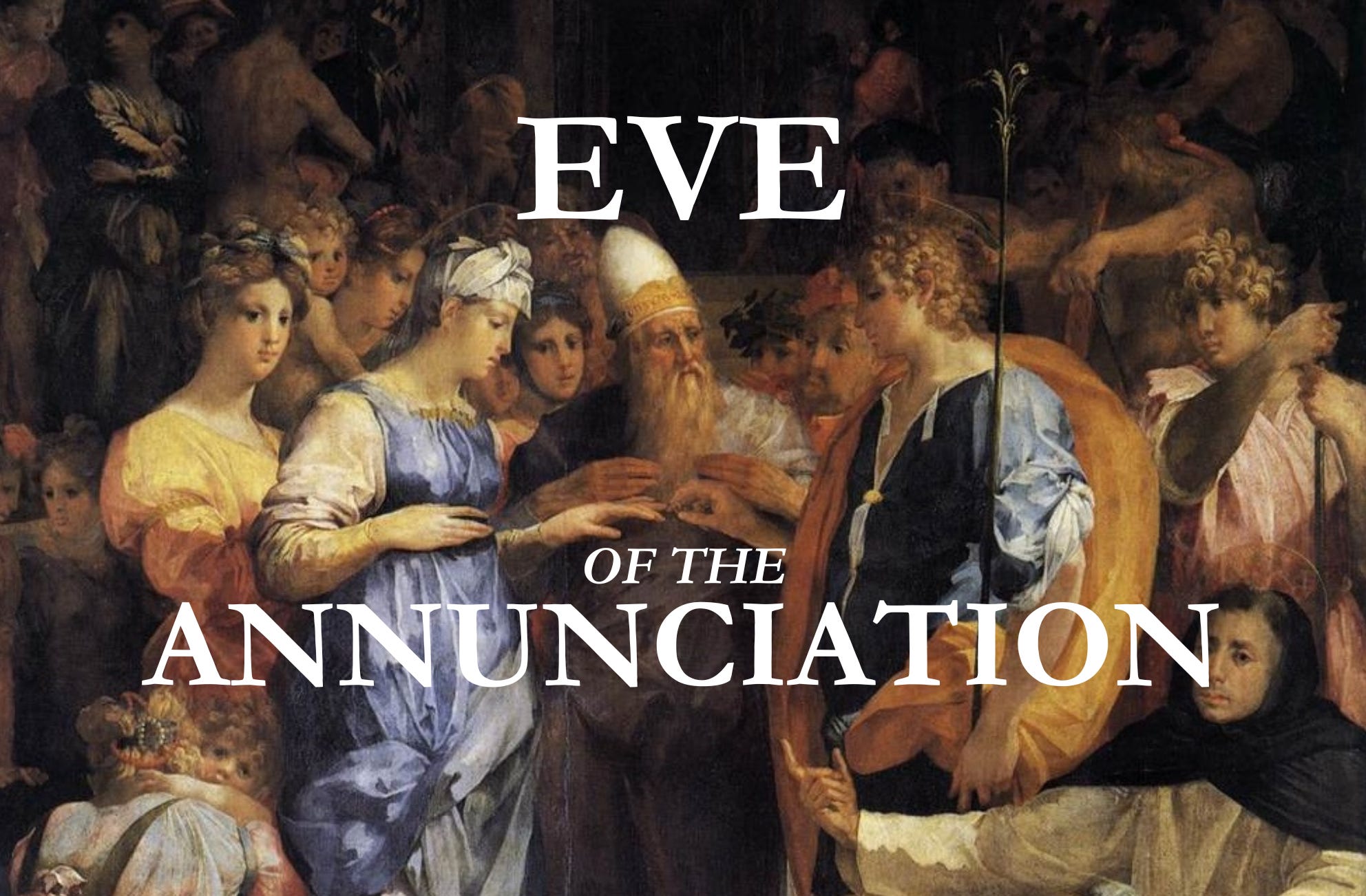
How did God prepare the Blessed Virgin Mary for the most momentous event in her life to date, and the turning point of the history of the world?
Editor’s Notes
The second period of the preparation for St Louis de Montfort’s Total Consecration to the Blessed Virgin is focused on gaining a greater knowledge of Our Lady, and seeking to unite ourselves to her.
In this reading, we’re going to meet Our Lady on the Eve of the Annunciation.
The Annunciation and the Incarnation form an important meditation in the Spiritual Exercises, and so gaining a clear view of Our Lady at this time is really crucial.
This text is taken from Fr Henry James Coleridge. The WM Review runs a project called Father Coleridge Reader, which serialises this great nineteenth century Jesuit’s works. But while Fr Coleridge is great to read, his style and language make reading him aloud a little difficult. That is why the text in the attached audio has been simplified. The original text is below.
The themes, as well as vocal prayers and readings associated with Week 2, can be found here. You can find the book here.
Finally, it would be good to return to the meditations on the Three Classes of Men and the Three Ranks of Humility this week. We anticipated them in Week 0, but St Ignatius puts them with the meditations we are considering now in Week 2:
Day 8: Are you a weakling, a self-seeker... or something better?
The Three Classes of MenDay 9: Do we actually want what humility entails?
The Three Ranks of Humility
Although this is part of the Total Consecration preparation, it also stands alone as a great text in its own right.
CONTENTS:
READING: The text is based on an extract from Fr Henry James Coleridge’s The Preparation for the Incarnation.
MEDITATION: Fr Coleridge’s text intended to provide material for the meditation, which appears in point-form following it. A guide on how to use these points in meditation can be found here.
Reading: The Annunciation
The Mother of the King
Fr Henry James Coleridge
Growth in grace
If the years of the early life of Mary had been uneventful, in the common sense of the term, they were years of the greatest possible spiritual activity. The immense graces which she received at the moment of her Immaculate Conception were but the foundation of other ever-increasing showers of gifts on her soul, as the days went on in a continual succession on her part of the most heroic acts of interior virtue.
We have said that it is the teaching of the theologians of the Church, that she had the anticipated use of her faculties of mind and heart, for the very purpose that she might begin at once to co-operate with the graces vouchsafed to her, and add, by her own incomparable fidelity, a continual increase of grace to that which she had already received as a free gift of God’s bounty to her, for the purpose of fitting her for her great office in His kingdom.
Each event in her life brought with it a fresh dowry of graces, so that her progress was like that of the most splendid dawn, rapidly widening and brightening into a grand and glorious day.
Her oblation of herself in the Temple was an heroic act on her own part, as well as an act of gratitude and fidelity on the part of her parents. As such, it would naturally be the occasion for fresh supplies of grace freely given to her, and then again multiplied by her own co-operation.
So, again, whenever in the course of her infancy, she made her offering to serve God, if such should be His will, in the holy state of perpetual virginity, that also would be an occasion for the confirmation in her of all the previous gifts of God to her soul, and for the addition of large and magnificent treasures of a still higher kind.
For it is the manner of God, not only to go on giving when He has begun to give, unless hindered by the want of fidelity in those on whom His gifts have been bestowed, but also to rise continually higher and higher in the beauty of the gifts themselves which He imparts. It is easy to see how the life of our Lady in the Temple gave her a series of opportunities of advancing in virtue and grace with giant strides, for her whole life became a succession of acts of religion as well as of other virtues.
Another great occasion of the increase of her gifts in the way of which we speak must have been her betrothal, out of obedience, to her blessed spouse, and her renewal with him of her sacred purpose of virginity.
Importance of this moment
And now at last the time was at hand when this mighty process of the sanctification of our Lady for the office of Mother of God was completed. God had built up in her soul the immense fabric of graces which was required to bear, so to say, the weight of the Divine Maternity.
The moment which was at hand was to be distinctly the most important moment in the history of the dealings of God with His creatures. It was to be the birth of the New Creation, a far nobler Creation than that which is recounted in the opening book of Scripture.
God can make infinite numbers of worlds, more beautiful than that of which Moses has recounted the creation. But even God can do nothing greater than make Himself His own creature, and make one of His creatures His own Mother. What would be thought of the work of God in the material creation, if there had been one of His own creatures on whose consent it was to hang whether the design should be accomplished or not? If He could have first asked man whether he would be made, or the whole universe whether it would be?
Yet there is this other distinction between the first creation and the second, that in the first God called His creatures into existence before they could choose or consent or refuse, whereas in the second and infinitely nobler work of the creation which began in the Incarnation, that creature of His, who was to be the conscious and willing instrument of the ineffable work, was not to be made that instrument without her own action.
Our minds fail and flag before the wonders of the mystery of the Incarnation, but the higher we can rise in their appreciation, the more we see the fitness of the immense work of grace carried on in the soul of Mary to prepare her for the moment on which so much was to depend.
Our chief wonder must be, not that this preparation was required, but that a human will could have been made so faithful to all these graces in so short a time.
Mission of an Angel
In sending an Angel to announce to our Blessed Lady that she had been chosen to be the human mother of the Incarnate Son, God dealt with her only according to that general rule of respect, or as the Wise Man has worded it, reverence, to His free creatures on which He continually acts.
One of our spiritual writers has drawn out very beautifully1 the extremely tender and condescending manner in which He dealt with our first parents after their fall, giving them, as it appears, every opportunity of a humble and candid confession, and of pleading their own cause, as far as it admitted of defence, before He passed on them the sentence of His justice. If God could show so much condescension and gentleness with regard to those who had unworthily offended Him, it is not wonderful that, when the time came for Him to repair the evils of the fall in a most magnificent manner by the Incarnation, He should treat with the utmost consideration the chosen Mother who was to be the instrument of the execution of His great design.
Thus Mary was not to be made the Mother of God against her will or without her knowledge and free consent. There were many reasons for this, on which the holy writers dwell, and this of the manner in which God deals with His creatures is the first. He had endowed our Blessed Lady with all the immense gifts of which some little has already been said, and now the moment was come when she was to be asked, so to say, to be what He had designed her to be from all eternity.
The power of God
The power and majesty of God is shown in the embassy of one of the highest Angels, executing His will with the most perfect obedience and joy and rapidity. The great wisdom of God, moreover, is shown in the very manner in which Mary is approached, for it is the very same manner in which the Fall of Man had been brought about by the insidious conversation of Satan with our first mother Eve. We shall have to draw this out more fully when we come to speak of the details of the Annunciation, but we are now only concerned with the fact of the Annunciation in general.
In the first place, it is obvious that God gave to our Lady, by the method which He adopted of carrying out His design in her regard, wonderful opportunities of exercising virtue, of increasing her merit in His sight, and of receiving fresh illumination from Himself. The whole history, short as it is, is a display on her part of the most marvellous virtues—humility, prudence, discretion, love of purity, faith of the most unparalleled beauty, obedience, and the rest. Of these we shall also speak when we come to the dialogue between her and the Angel.
Opportunities to our Lady
This great display of virtue could not but be to her a great occasion of increase of merit, and the Fathers use the most wonderful language when they come to speak of the merit simply of the faith which she displayed on this moment of her trial. Perhaps she was already so high in the degree of her merit and illumination as to be unable to receive any fresh enlightenment from the Angel. But the words of St. Gabriel assured her that the Holy Ghost Himself would come upon her, and thus she received at the time of the Annunciation the great Source of all illumination Himself.
And again, in the third place, the carrying out of this mystery in the manner in which it was carried out is full of instruction for us. Even in our ways of dealing with men we may learn much from it, much as to our own duties and respect to our parents, much also as to the true position and prominence of this blessed Mother in the kingdom of her Son founded on His Incarnation in her blessed womb. It is hardly possible to conceive any one who has a true idea of the Incarnation itself, supposing it morally possible that God should have brought it about without this previous communication of His intention to His blessed Mother. But we may still learn much that may help our contemplations from the consideration of these reasons for the embassy of St. Gabriel which are found in various Christian writers.
We’ve omitted the section about St Gabriel himself. You can see that here:

Silence of God’s works
All the great works of God are done in silence, but surely never did God do a greater work than the work of the Incarnation, and never did He work more silently and secretly than in this. The missions of the Angels are swifter than the rays of light, swifter than the currents of electricity. The moment that the command was given to Gabriel, the same moment he was at Nazareth, and the Angelic choirs may have known that one of their chief princes was sent on an errand of marvellous mercy.
To the rest of the universe all was as it had been the moment before. Hell had no conception of the work about to be accomplished. The “strong armed man” of whom our Lord speaks, was keeping his court in that kind of peace which is possible to realms such as his. At least he had no thought, with all his cunning, all his experience, all his knowledge of the prophecies and study of the ways of Providence, of the overthrow which was to be.
In the blessed abode of the saints who were awaiting their deliverance, there may have been some vague expectation, an insensible strengthening of hope and an instinctive feeling of consolation and joy. Purgatory may have been stirred by a more intense longing, and the holy souls throughout the world, looking for redemption, may have felt as it were a wave of delight passing over their minds.
The world at peace
The great Roman world, we are told, was at peace. But the peace of the Roman world, what did it mean? It did not mean that sin was subdued, that passion was not raging, that lust, and anger, and hatred, and greed were not tearing the hearts of men and hounding them on against their fellows. It did not mean that the abominable idolatries and unutterable turpitudes of the heathen world were less rife than ever. It did not mean that the devils were not being worshipped on a thousand altars by the degradation of all that was noble in human nature. It did not mean that innocence was safe from pollution or weakness protected from violence and tyranny.
Where over the whole wide world could the eye of God rest, as it rested when the original creation was accomplished, and see that all was good? But the wickedness of man could not defeat the faithfulness of God. In the cottage at Nazareth the chosen maid was waiting, unconscious of the divine purpose, but prepared by the most wonderful graces to make the blessed answer on which the salvation of the world hung. The period of promises and predictions—and types of the divine patience struggling with human depravity—was at an end. The fulness of time had come.
Meditation for Day 21
It is in mental prayer that that much of the preparation will be achieved – and meditation is a means of entering mental prayer. See our guide to meditation for two ways to use the below texts.
The Preparation
Prayer. The usual Preparatory Prayer.
First Prelude. The first Prelude is to bring up the narrative of the thing which I have to contemplate. Here, it is how the Three Divine Persons looked at all the plain or circuit of all the world, full of men, and how, seeing that all were going down to Hell, it is determined in Their Eternity, that the Second Person shall become man to save the human race, and so, the fullness of times being come, They sent the Angel St. Gabriel to Our Lady.
Second Prelude. The second, a composition, seeing the place: here it will be to see the great capacity and circuit of the world, in which are so many and such different people: then likewise, in particular, the house and rooms of Our Lady in the city of Nazareth, in the Province of Galilee.
Third Prelude. The third, to ask for what I want: it will be to ask for interior knowledge of the Lord, Who for me has become man, that I may more love and follow Him.
The Points for Meditation
First Point. The first Point is, to see the various persons:
First those on the surface of the earth, in such variety, in dress as in actions: some white and others black; some in peace and others in war; some weeping and others laughing; some well, others ill; some being born and others dying, etc.
To see and consider the Three Divine Persons, as on their royal throne or seat of Their Divine Majesty, how They look on all the surface and circuit of the earth, and all the people in such blindness, and how they are dying and going down to Hell.
To see Our Lady, and the Angel who is saluting her, and to reflect in order to get profit from such a sight.
Second Point. The second, to hear what the persons on the face of the earth are saying, that is, how they are talking with one another, how they swear and blaspheme, etc.; and likewise what the Divine Persons are saying, that is: “Let Us work the redemption of the Human race,” etc.; and then what the Angel and Our Lady are saying; and to reflect then so as to draw profit from their words.
Third Point. The third, to look then at what the persons on the face of the earth are doing, as, for instance, killing, going to Hell etc.; likewise what the Divine Persons are doing, namely, working out the most holy Incarnation, etc.; and likewise what the Angel and Our Lady are doing, namely, the Angel doing his duty as ambassador, and Our Lady humbling herself and giving thanks to the Divine Majesty; and then to reflect in order to draw some profit from each of these things.
The above meditation is prescriptive – however, the below are our usual points for completeness:
One could consider these points in reference to oneself: How far have we been conscious of this in our daily lives so far, what practical conclusions should we draw from these truths, how far have we lived up to them so far, what must we do to live up to them in the future, etc.
One could consider the acts of virtue we can make in response to these truths – Acts of faith, humility, hope/confidence, thanksgiving, contrition and love – talking all the while to God, the Blessed Virgin, our Guardian Angels, etc.
The Colloquy
St Ignatius writes:
At the end a Colloquy is to be made, thinking what I ought to say to the Three Divine Persons, or to the Eternal Word incarnate, or to our Mother and Lady, asking according to what I feel in me, in order more to follow and imitate Our Lord, so lately incarnate.
It is important to speak frankly to God in our own words, rather than simply reading somebody else’s.
If one feels moved to speak to God before meditating on all the points, one should certainly do so. The same applies if one feels moved to simply rest in God, rather than engaging in discursive meditation. These impulses should be followed over any particular method of meditation.
The End
End the meditation with a vocal prayer – such as the Our Father, the Anima Christi.
Reflect on how well we have prayed, and how well we have followed our chosen method.
Select a spiritual nosegay from your meditation to keep with you for the rest of the day.
See you tomorrow. Hit subscribe to make sure you don’t miss it or any of our other material:
See the index and explanation to this series here:
For more on the St Louis de Montfort’s True Devotion and Total Consecration, for which we are preparing, see here:
The theological basis of ‘True Devotion’ and the Consecration to Mary (Garrigou-Lagrange)
The fruits of ‘True Devotion’ and Consecration to Mary (Garrigou-Lagrange)
For more on the importance of not getting bogged down with methods, and on allowing God to act, see here:
For more on Week 0, and the vocal prayers that are are suggested for each day, see here:
‘Week 0’ of St Louis de Montfort’s Total Consecration preparation (Prayers, practices and reading)
Get the book here:
True Devotion to the Blessed Virgin Mary (St Louis de Montfort)
HELP KEEP THE WM REVIEW ONLINE WITH WM+!
As we expand The WM Review we would like to keep providing free articles for everyone.
Our work takes a lot of time and effort to produce. If you have benefitted from it please do consider supporting us financially.
A subscription gets you access to our exclusive WM+ material, and helps ensure that we can keep writing and sharing free material for all.
You can see what readers are saying over at our Testimonials page.
(We make our WM+ material freely available to clergy, priests and seminarians upon request. Please subscribe and reply to the email if this applies to you.)
Subscribe to WM+ now to make sure you always receive our material. Thank you!
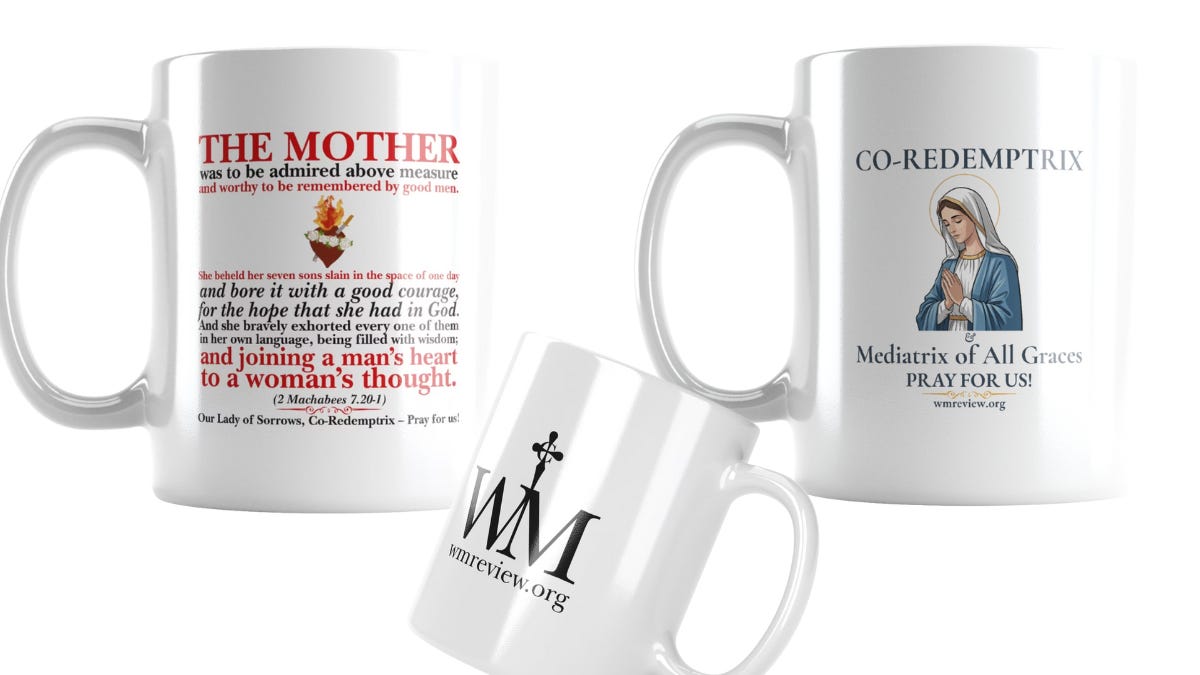
If you are enjoying this preparation for Total Consecration, why not get it in mug form?
Follow on Twitter, YouTube and Telegram:
Twitter (The WM Review)
Lancicius, in the Treatise against Rash Judgments.


