
Start of Week 1 – focusing on knowledge of ourselves and a sorrow for our sins. (Day 13 of Total Consecration)
Editor’s Notes
Having completed St Louis de Montfort’s “Week 0,” we are now at the beginning of “Week 1”. Having focused on gaining a knowledge of the spirit of the world for 12 days, Week 1 is focused on gaining a greater knowledge of ourrselves, and sorrow for our sins.
St Louis de Montfort tells us that we can’t really appreciate the goodness of God, or the Holy Mother of God, without an appreciation of what this week is supposed to teach us. He would have us meditate on “our corrupted nature,” and the humiliating state to which our sins have reduced us. He says we should consider ourselves, for this week, “as nothing but snails, slugs, toads, swine, snakes and goats.”
The meditation for today is a challenging one. We are to spend some time recalling all the sins of our whole life – St Ignatius gives us some ways to go about doing that (see the meditation below). From there, we are to consider what we sinners are in relation to all other men, the rest of creation, and God himself. We should try to repeat this meditation at other times in the week, and keep the thoughts and sentiments that it provokes close to us during this time.
But this isn’t just about being depressed all week. We are supposed to reflect on the sobering realities of sin, death, judgement and our eternal destiny – and to do penance and so on – but St Louis says that we should do them at the feet of Our Lady, asking her to obtain for us the light we need.
This is why we are returning to the start of St Ignatius’ Spiritual Exercises today, to one of the first meditations – on our own sins.
Kevin Davis from Catholic Family Podcast has kindly agreed to read this text for us today. He also recently published a video about this series, St Louis’ True Devotion and important considerations when engaging in controversy with others – which you can see here:
In the Spiritual Exercises, one would make a general confession (of the sins of our whole life, or at least since our last general confession) at the end of the first week. Whether this is possible for those following this series will depend on a multitude of factors. But if it were possible to arrange such a confession with a priest – or even just a regular confession – the most fitting day to do so in this preparation might be Day 18.
To maximise the fruit drawn from Week 1 of our Preparation for Total Consecration, and to prepare for a really good confession on Day 18, one must realise that the effects of the corresponding week in the Spiritual Exercises are meant to be cumulative.
One shouldn’t just breeze through a single use of the readings and meditations and then expect to acquire a profound sense of contrition or tears for our sins. In the Exercises, the exercitant spends much of his day in prayer, repeating individual exercises on more than one occasion. This is how the effects are cumulative.
We suggest returning to Day 3 and 4 at least once (if not more), as well as repeating this week’s exercises more than once.
Day 3: Sin and the spirit of the world
The Three SinsDay 4: What is ‘the spirit of the world’?
The Triple Colloquy
Day 13: Have you ever tried to count all the sins of your life?
Our Own SinsDay 14: Are YOU on your way to Hell?
HellDay 15: Does venial sin actually matter?
Venial SinDay 16: Why lukewarmness towards God can be worse than actual coldness
Tepidity
St Ignatius would also suggest putting away thoughts of the more joyful and glorious aspects of the Faith at t his time, and even depriving ourselves of light, “closing the blinds and doors while I am in the room, if it be not to recite prayers, to read and eat.”
The themes, as well as vocal prayers and readings associated with this ‘Week 1’, can be found here. You can find the book here.
Although this is part of the Total Consecration preparation, it also stands alone as a great text in its own right.
CONTENTS:
READING: The text consists of a few chapters from Fr Aloysius Ambruzzi’s Companion to the Spiritual Exercises. This text is intended to provide material for further consideration of the subject of this week.
MEDITATION: Fr Ambruzzi’s text is intended to provide material for the meditation, which appears in point-form following it. A guide on how to use these points in meditation can be found here.
Reading: Our Own Sins
The Sense of Our Own Sinfulness
A Companion to the Spiritual Exercises of Saint Ignatius
Fr Aloysius Ambruzzi SJ
The first Prelude is to see with the eyes of the imagination and to consider that my soul is imprisoned in this corruptible body, and my whole self on this vale, as if it were in exile amongst brute beasts.
The second Prelude is to beg great and intense sorrow and tears for my sins.
1. The knowledge of ourselves
In the First Book of the Machabees we read that:
“All the army assembled together, and they went up into Mount Sion. And they saw the sanctuary desolate, and the altar profaned, and the gates burned and the shrubs growing up in the courts as in a forest, or on the mountains, and the chambers joining to the temple thrown down. And they rent their garments, and made great lamentation, and put ashes on their heads: and they fell down to the ground on their faces, and they sounded with the trumpets of alarm, and they cried towards heaven.” (1 Mac. 4.37-40)
Having considered the ravages of sin in others, we must enter into our own soul and realise the havoc it has worked therein. A simple glance at our past life—running through its stages, the places where we have dwelt, the offices, occupations and employments that we have had, and our dealings with others—should easily convince us that we are great sinners, loaded with sins without number. We must look at our soul as it truly stands before God, guarding against all hypocrisy and false principles.
“How suggestive is St Ignatius’ word processus. Supposing my sins could be filmed, in such a way as to bring out not merely the outward act, but also the inward operations of memory, understanding, will, imagination, passion; and the whole film were to be shown on the screen. What a processus, indeed!”
Alas, often an ugly polypus settles in our heart, and throws its ramifications into the brain. Blinded by it, we say: “I am rich, and have grown wealthy, and have need of nothing,” while a voice, unheeded if not despised, keeps whispering:
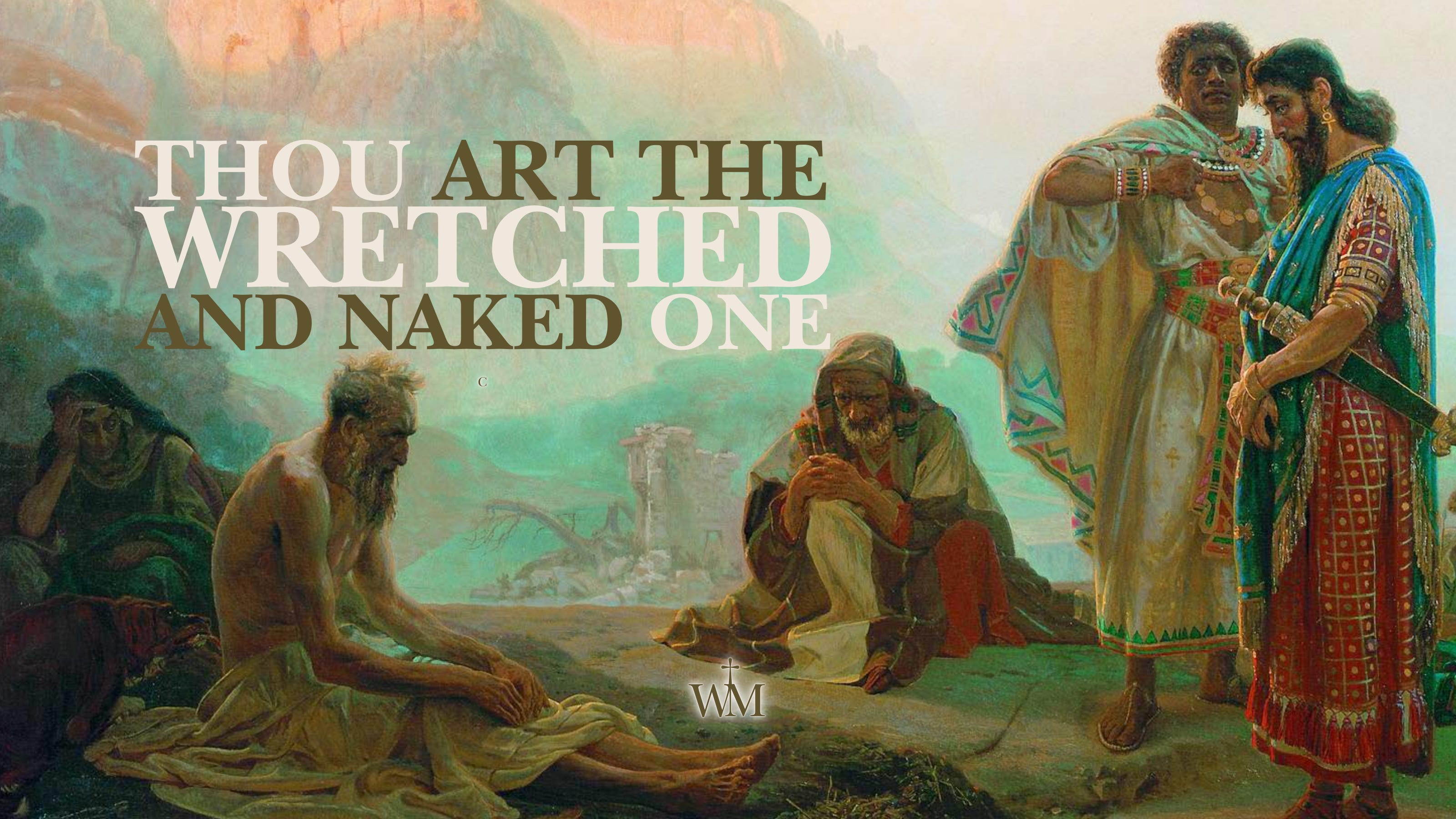
“And knowest not that thou art the wretched and pitiable and poor and blind and naked one.” (Apoc. iii, 17)
Let us then, anoint our eyes with the salve which Christ offers to us, that we may see ourselves as St Augustine saw his soul when he wrote:
“But Thou, O Lord… didst force me to look at myself, taking me from behind my back, where I had placed myself, unwilling to observe myself. Thou didst set me before my face, that I might see how foul I was, how crooked and defiled, bespotted and ulcerous. And I looked and stood aghast, and there was no escape for myself.” (Confessions, viii, 7)
2. The number of our sins
Like the Jews, we shall see the sanctuary desolate—the temple of our soul deprived of sanctity, or, at least of the sacred fire of fervour; the altar profaned—the Divine Sacrifice and the Sacrament of Love treated irreverently and even offered or received sacrilegiously; and the gates burnt—the doors of our senses thrown open that wild beasts may enter into the soul and devour it; and the shrubs growing up in the courts—worldly and evil habits daily asserting themselves; and the chambers adjoining the temple thrown down—the edifice of good resolutions pulled down and its ruins scattered all around.
And if God’s powerful hand has preserved us from serious falls, our offences and negligences have been truly innumerable.
The Imitation of Christ says the following:
“Sigh and grieve that thou art yet so carnal and worldly, so unmortified in thy passions, so full of the motions of concupiscence: so unguarded in thy outward senses, so often entangled with many vain imaginations:
“So much inclined to exterior things, so negligent as to the interior:
“So prone to laughter and unbridled mirth, so hard and indisposed to tears and compunction:
“So prompt to relaxation and the pleasures of the flesh, so sluggish to austerity and fervour:
“So curious to hear news and to see fine sights; so slack to embrace things humble and mean:
“So covetous to possess much, so sparing in giving, so close in keeping:
“So inconsiderate in speech, so little able to keep silence:
“So disorderly in thy carriage, so over-eager in thy actions:
“So eager about food, so deaf to the word of God:
“So hasty for rest, so slow to labour:
“So wakeful to hear idle tales, so drowsy to watch in the service of God:
“So hasty to make an end of thy prayers, so wandering as to attention; so negligent in saying thy office; so tepid in celebrating; so dry at the time of Communion:
“So quickly distracted, so seldom quite recollected within thyself:
“So easily moved to anger, so apt to take offence at others:
“So prone to judge, so severe in reprehending:
“So joyful at prosperity, so weak in adversity:
“So often proposing many good things, and effecting little.”
(Imit. of Christ, IV, 7)
O Lord, be merciful to me, a sinner!
3. Intrinsic ugliness of sin
Sin is disorder and ugliness itself.
The glory of God is the end of creation. All creatures give glory to God, and at the same time attain to their perfection and happiness, by pursuing their object in life and thus contributing to the perfect harmony of the whole universe.
The aim of man is to direct himself and all creatures to God—to keep his senses and lower appetites under the control of reason, and his reason subject to God, to pursue his welfare as the member of a social body and in unison with all his fellowmen. In this harmonious working lies his happiness and his perfection.
Any sin is an attempt at marring this harmony and subordination. It is an attack on the essential order of things and on the greatness and dignity of human nature. Hence its extreme ugliness and malice, expressed in the saying: “As ugly as sin.”
Every disorder is ugly. Sin is the greatest disorder.
And if sin is so ugly in any creature simply endowed with reason, how much more so in a Christian redeemed by the Blood of Christ and made to share in His life, in a religious soul bound to Him by the most sacred ties, and in a Priest charged with the task of continuing His mission of saving souls!
4. The littleness and vileness of the offender
The malice of an offence is measured by the greatness and excellence of the person offended, and the littleness and the vileness of the one that offers it. And what is man in comparison with God?
“The whole world before Thee is as the least grain of the balance, and as the drop of the morning dew that falleth down upon the earth.” (Wisd. 11.23)
All creatures, however perfect and beautiful, are as nothing before God. “All nations are before Him as if they had no being at all, and are counted to Him as nothing and vanity” (Is. xl, 17). Then, what can I alone be?
The attitude towards God of even the highest of creatures—the Blessed Virgin—is one of absolute humility and subjection. And I have dared to rise against Him and to refuse obedience to His Holy Will!
If only I were mere nothingness! But when I turn to look at myself, what a horrible sight do I behold! My body is a dunghill of corruption and foulness; my soul is an ulcer and abscess whence have issued so many sins and iniquities and such deadly poison. And a thing so vile and contemptible has dared to prefer itself to God, to make of itself a god, to set its pleasure, its will and its little interests before God’s Will and Glory!
Have mercy on me, O my God, have mercy on me!
5. The infinite greatness of the offended God
The malice of every mortal sin is, in a true sense, infinite on account of the infinite Majesty of the offended God. God is infinitely wise, omnipotent, just, and good. The sinner insults each of these attributes and, as far as lies in him, seeks to destroy them.
God commands that we “do the truth in charity” (Eph. 4.15). The sinner is a liar, “that loveth and maketh a lie” (Apoc. xxii, 15); a fool that condemns by his life the wisdom of God and of His Divine Law. He is a self-constituted god that claims to know good and evil.
The sinner is weakness and powerlessness itself. Without God’s help, he could not possibly make the slightest movement or conceive the simplest thought. And yet he rises against the Almighty. He challenges the arrows of God’s vengeance.
“Who have said: We will magnify our tongue: our lips are our own; who is Lord over us?” (Ps. 11.5).
“I have sinned and what harm hath befallen me?” (Eccli. 5.4)
Still more, he forces the Almighty to serve with his sins, to aid him to think, to speak and to do what is abomination to God’s sanctity.
God is infinite Justice and Sanctity. The perfection of every one of us lies in reflecting the Sanctity of God in our life, in an ever-increasing degree, by taking His Will as the only rule of our own. The sinner rejects the all-holy Will of God. He embraces what is opposed to God, Who is infinite Beauty and Order and Harmony. With Satan he cries: “Evil, be thou my good.” No wonder if his act has been defined as an attempt on the very life of God.
God is infinite Goodness. He is the All-Good: Summa fons et origo omnium bonorum. “When Thou openest Thy hand, they (the creatures) shall all be filled with good” (Ps. 103.28). He has showered all His gifts on everyone of us—gifts of creation, of loving conservation and care. “Is he not thy Father that hath possessed thee and made thee, and created thee?” And yet, “thou hast forsaken the God that begot thee and hast forgotten the Lord that created thee?” (Deut. 32.6, 18)
He has showered on our soul far higher gifts: the gifts of His grace. He has made us partakers of His Divine Nature, brothers of His Son, and the living shrines of His Spirit of Love.
And we have risen against Him. We have rejected His gifts. We have despised His Love. We have trodden underfoot the Son of God—and all that for a vile pleasure, for a paltry earthly good, for a mark of vain honour and distinction, or to avoid a transitory sacrifice and humiliation.
6. The soul’s cry
O my God, how is that Your creatures have suffered me to live and have preserved me in life while I was so grievously offending You, their Creator and benefactor? How is that Your Angels, who are the sword of Your Divine Justice, have borne with me and guarded me, and prayed for me? How is it that the Saints have interceded for me? How is it that the heavens, the sun, the moon, the stars and the elements, the fruits of the earth, the birds, the fishes and the animals have served me and helped to sustain me? How is it that the earth has not opened to swallow me up, creating new hells that I might suffer in them for ever?
“The mercies of the Lord that we are not consumed: because His commiserations have not failed.” (Lam. 3.22)
Thanks to You, O my Lord: thanks to Your infinite mercy. It is You that have stopped the avenging hand of Your creatures. It is You that have given me life till now.
O give me grace also to amend myself—to live only for You and for the accomplishment of Your Holy Will!
Lord, have mercy on me, a sinner!
Suggestions for the colloquy
1. O Lord, what a great and horrible sinner that I am—guilty of innumerable sins, offences, and negligences! Truly I am like an ulcer and an abscess whence have issued so many sins and so many iniquities—and such a vile poison.
Give me, O Lord, a real and true knowledge of my malice and sinfulness! Give me Thy eyesalve that I may see how wretched, and pitiable, and poor, and blind, and naked, I am.
2. O my God, Thou art the Eternal and Infinite Beauty. What an ugly thing, unworthy of a rational and immortal being, I have done whenever I acted against Thy Holy Will!
3. O my God, Thou art the Absolute, Self-subsisting Being. All creatures are as nothing before Thee—and how have I, a contemptible atom, dared rise against Thee—defied Thy Omnipotence, Thy Wisdom, Thy Goodness, and Thy infinite Love—preferred my will to Thy Will, and my petty interests to Thy Glory?
4. The creatures of Thy hands should have risen against me. Earth itself should have opened to swallow me up—creating new hells that I might suffer in them for ever, had it not been for Thy infinite mercy. Thanks to Thee, O God of Mercy!
5. Add to Thy past mercies and graces, O Jesus, the grace which I need most—an intense and abiding sorrow for my sins. Draw from my stony heart tears of compunction that I may be able to weep for my sins and win forgiveness for them from Thy mercy.
Give me grace to amend myself—to live only for Thee and for the accomplishment of Thy Holy Will.
Meditation for Day 13
It is in mental prayer that that much of the preparation will be achieved – and meditation is a means of entering mental prayer. See our guide to meditation for two ways to use the below texts.
Our Own Sins
In this preparation for the consecration of ourselves to the Blessed Virgin Mary, we could keep Our Lady in mind throughout our meditation. What does she think of our sins? What role has she played in helping us turn away from them, seek forgiveness for them, or avoid falling into worse sins? How do we in our sinfulness, compare to her in her sinlessness? Etc.
The Preparation
Prayer. The usual Preparatory Prayer.
First Prelude. The composition will be to see with the sight of the imagination and consider that my soul is imprisoned in this corruptible body, and all the compound in this valley, as exiled among brute beasts: I say all the compound of soul and body.
Second Prelude. The second is to ask for what I want. It will be here to beg a great and intense sorrow and tears for my sins.
The Points for Meditation
First Point. The first Point is the statement of the sins; that is to say, to bring to memory all the sins of life, looking from year to year, or from period to period. For this three things are helpful: first, to look at the place and the house where I have lived; second, the relations I have had with others; third, the occupation in which I have lived.
Second Point. The second, to weigh the sins, looking at the foulness and the malice which any mortal sin committed has in it, even supposing it were not forbidden.
Third Point. The third, to look at who I am, lessening myself by examples:
First, how much I am in comparison to all men;
Second, what men are in comparison to all the Angels and Saints of Paradise;
Third, what all Creation is in comparison to God: (Then I alone, what can I be?)
Fourth, to see all my bodily corruption and foulness;
Fifth, to look at myself as a sore and ulcer, from which have sprung so many sins and so many iniquities and so very vile poison.
Fourth Point. The fourth, to consider what God is, against Whom I have sinned, according to His attributes; comparing them with their contraries in me—His Wisdom with my ignorance; His Omnipotence with my weakness; His Justice with my iniquity; His Goodness with my malice.
Fifth Point. The fifth, an exclamation of wonder with deep feeling, going through all creatures, how they have left me in life and preserved me in it; the Angels, how, though they are the sword of the Divine Justice, they have endured me, and guarded me, and prayed for me; the Saints, how they have been engaged in interceding and praying for me; and the heavens, sun, moon, stars, and elements, fruits, birds, fishes and animals—and the earth, how it has not opened to swallow me up, creating new Hells for me to suffer in them forever!
The above points are reasonably prescriptive. However, here is our usual comment for the sake of consistency:
One could consider these points in reference to oneself: How far have we been conscious of this in our daily lives so far, what practical conclusions should we draw from these truths, how far have we lived up to them so far, what must we do to live up to them in the future, etc.
One could consider the acts of virtue we can make in response to these truths – Acts of faith, humility, hope/confidence, thanksgiving, contrition and love – talking all the while to God, the Blessed Virgin, our Guardian Angels, etc.
The Colloquy
Colloquy: Let me finish with a Colloquy of mercy, pondering and giving thanks to God our Lord that He has given me life up to now, proposing amendment, with His grace, for the future.
In addition, Fr Ambruzzi offers some suggestions for the colloquy above. However, it is important to speak frankly to God in our own words, rather than simply reading somebody else’s.
If one feels moved to speak to God before meditating on all the points, one should certainly do so. The same applies if one feels moved to simply rest in God, rather than engaging in discursive meditation. These impulses should be followed over any particular method of meditation.
The End
End the meditation with a vocal prayer – such as the Our Father, the Anima Christi.
Reflect on how well we have prayed, and how well we have followed our chosen method.
Select a spiritual nosegay from your meditation to keep with you for the rest of the day.
See you tomorrow. Hit subscribe to make sure you don’t miss it or any of our other material:
For more on Liberalism:
For more on the St Louis de Montfort’s True Devotion and Total Consecration, for which we are preparing, see here:
The theological basis of ‘True Devotion’ and the Consecration to Mary (Garrigou-Lagrange)
The fruits of ‘True Devotion’ and Consecration to Mary (Garrigou-Lagrange)
For more on the importance of not getting bogged down with methods, and on allowing God to act, see here:
For more on Week 0, and the vocal prayers that are are suggested for each day, see here:
‘Week 0’ of St Louis de Montfort’s Total Consecration preparation (Prayers, practices and reading)
Get the book here:
True Devotion to the Blessed Virgin Mary (St Louis de Montfort)
HELP KEEP THE WM REVIEW ONLINE WITH WM+!
As we expand The WM Review we would like to keep providing free articles for everyone.
Our work takes a lot of time and effort to produce. If you have benefitted from it please do consider supporting us financially.
A subscription gets you access to our exclusive WM+ material, and helps ensure that we can keep writing and sharing free material for all.
You can see what readers are saying over at our Testimonials page.
(We make our WM+ material freely available to clergy, priests and seminarians upon request. Please subscribe and reply to the email if this applies to you.)
Subscribe to WM+ now to make sure you always receive our material. Thank you!
If you are enjoying this preparation for Total Consecration, why not get it in mug form?

We also have our best-selling Co-Redemptrix mugs:

Follow on Twitter, YouTube and Telegram:
Twitter (The WM Review)
Sound effects credits:
Sound Effect Mind Mist from Pixabay
Sound Effect by freesound_community from Pixabay
Sound Effect by Jurij from Pixabay
Sound Effect by Universfield from Pixabay


