


Hell is real, and when the temptations of sin prove to be more forceful than our love for God, a salutary fear can help us stay on the straight road to life.
Editor’s Notes
The second period of the preparation for St Louis de Montfort’s Total Consecration to the Blessed Virgin – “Week 1” – is focused on gaining a greater knowledge of ourselves, and sorrow for our sins.
Today, we are reading Fr Aloysius Ambruzzi’s explanation of the meditation on Hell, from St Ignatius’ Spiritual Exercises. Peter Bevan of The Corner Cabinet has kindly agreed to read this text for us today.
The themes, as well as vocal prayers and readings associated with this ‘Week 1’, can be found here. You can find the book here.
Although this is part of the Total Consecration preparation, it also stands alone as a great text in its own right.
Reminder
In the Spiritual Exercises, one would make a general confession, of all the sins of one’s life, at the end of this week. This might be beneficial for those following this series: whether it will be possible or not is another question, and will depend on a multitude of factors.
But if it were possible to arrange such a confession (or even just a regular confession) with a priest, the most fitting day to do so in this preparation might be Day 18.
To maximise the fruit drawn from Week 1 of our Preparation for Total Consecration, and to prepare for a really good confession on Day 18, one must realise that the effects of the corresponding week in the Spiritual Exercises are meant to be cumulative.
One shouldn’t just breeze through a single use of the readings and meditations and then expect to acquire a profound sense of contrition or tears for our sins. In the Exercises, the exercitant spends much of his day in prayer, repeating individual exercises on more than one occasion. This is how the effects are cumulative.
We suggest returning to Day 3 and 4 at least once (if not more), as well as repeating this week’s exercises more than once.
Day 3: Sin and the spirit of the world
The Three SinsDay 4: What is ‘the spirit of the world’?
The Triple ColloquyDay 13: Have you ever tried to count all the sins of your life?
Our Own SinsDay 14: Are YOU on your way to Hell?
HellDay 15: Does venial sin actually matter?
Venial SinDay 16: Why lukewarmness towards God can be worse than actual coldness
Tepidity
St Ignatius would also suggest putting away thoughts of the more joyful and glorious aspects of the Faith at t his time, and even depriving ourselves of light, “closing the blinds and doors while I am in the room, if it be not to recite prayers, to read and eat.”
CONTENTS:
READING: The text consists of a chapter from Fr Aloysius Ambruzzi’s Companion to the Spiritual Exercises. This text is intended to provide material for further consideration of the subject of this week.
MEDITATION: Fr Ambruzzi’s text is intended to provide material for the meditation, which appears in point-form following it. A guide on how to use these points in meditation can be found here.
Reading: Hell
Missing the End Forever
A Companion to the Spiritual Exercises of Saint Ignatius
Fr Aloysius Ambruzzi SJ
The first Prelude is the composition of place which is here to see with the eyes of the imagination the length, and breadth, and depth of Hell.
The second Prelude is to ask for that which I want. It will be here to ask for an interior sense of the pain which the lost suffer, so that if I should, through my repeated faults, forget the love of the Eternal Lord, at least the fear of punishment may help me not to fall into sin.
1. The thought of Hell
We are created to know, to serve, and to love God in this life, and to enjoy Him for ever hereafter. The love of God, our Creator, and our Father, should be the ordinary motive of our actions. However, there are moments in our life when temptations of the most alluring kind assail us, when all ideas of right and wrong, so clear at other times, become vague and uncertain, when even God seems to depart from us, leaving us for a moment exposed to the attack of our bitter enemies. It is the thought of Hell that will prove most helpful at such times.
That is why the Saints were familiar with it; even those who most excelled in the love of God. By thinking of the fire of Hell, many martyrs rejected the blandishments of tyrants, and suffered torments, prison, and death for Christ. By thinking often of Hell many Christians refrain from sin in the midst of dangers and temptations. “It is Hell that peoples Heaven”, said Pascal.
Hence our Mother the Church often reminds us of that eternal prison, and prays that we may be delivered from it. At the most solemn moment of Mass, the priest, with his hands spread over the oblation, asks “that we may be delivered from eternal damnation”. Again, just before receiving the Body of Christ, he tenderly whispers to his Lord: “Never permit me to be separated from Thee.”
Let our whole soul, then, and our very senses be filled with the thought of Hell and of the terrible sufferings which the lost endure there so that the fire of Hell may quench the fire of our passions and the thought of what is in store for the sinner may make us to turn away in horror from any suggestion to sin.
2. The existence of Hell
But, does Hell truly exist? Why, the whole Gospel is full of this tremendous fact, the existence of Hell. Many a time does the merciful Saviour warn His disciples against it.
“And if thy right eye scandalize thee, pluck it out and cast it from thee. For it is expedient for thee that one of thy members should perish, rather than thy whole body be cast into Hell.” (Matt. v, 29)
“The children of the kingdom shall be cast out into the exterior darkness: there shall be weeping and gnashing of teeth.” (Matt. viii, 12)
“Depart from me, you cursed, into everlasting fire.” (Matt. xxv, 41)
“They shall gather him up, and cast him into the fire, and he burneth.” (John xv, 6)
The voice of the Incarnate Son of God rises persistently to warn us against the danger of eternal punishment. He is not satisfied with having done all He could to induce us to submit to His sweet guidance and thus enter the way that leads to life. Seeing our wilful blindness and waywardness, He tenderly begs of us to consider that, though the way along which we gambol is broad and full of flowers, sooner or later it will inevitably end in an abyss of miseries from which there will be no exit.
There is a Hell as truly as there is God, and as truly as there are men free to choose between good and evil, with souls destined to live for ever. Heaven is the choice of God begun in this life and made irrevocable on passing into eternity; Hell is the final rejection of God.
Our very sense of justice demands a Hell. Sin is an offence of an infinite magnitude. It requires an infinite punishment—an eternal Hell. It is because many think little of God and of His rights that they find it hard to believe in the existence of Hell. They lay hold of God’s mercy as their support, and forget that Hell is but the result of a persistent contempt of this very mercy on the part of the obdurate soul. “It is the refuse-heap of men and angels, of those who have irrevocably refused God and are in turn refused by Him.”
3. Locus tormentorum
What is Hell? The most terrifying descriptions have been drawn up by preachers and writers—the consuming fire, the torments of every sense, the agony of the soul, the cries, the despair, the curses and blasphemies—and they have been called by many the work of wild and diseased imaginations. And such, indeed, they are in one sense.
“My dear friend, I must change my life.”
“Are you mad to believe all that nonsense?”
“I am not mad. I merely don’t want to go to Hell.”
Thus spoke two young men who had gone in fun to a sermon on Hell. A few years after, the impenitent one died and appeared in a globe of fire to his former friend, crying:
“There is a Hell, and I am in it.”
“Was it merely about a figment of the imagination that the Friar preached to us long ago?”
“Yes, it was a figment of the imagination. What he said was absolutely nothing compared with the reality. The reality is beyond comprehension.”
What is Hell? Locus Tormentorum: a place of torments. We may conjure up the most terrifying scenes, but we shall never conceive a better idea of Hell than that conveyed by these two words of the Son of God. Let us look into that dark prison enlightened only by the fire of God’s anger, and see Dives plunged into it and horribly tormented. He lifts up his eyes and cries to Abraham:
“Father Abraham, have mercy on me, and send Lazarus that he may dip the tip of his finger in water, to cool my tongue: for I am tormented in this flame.”
(Luke xvi, 24. (See also St Teresa on hell: Autobiography, xxxii, 1-10)
For nigh two thousand years the wretch has been in that flame, for nigh two thousand years he has been asking for that little solace, and he will continue to ask for it for all eternity, and always in vain.
“Between us and you there is fixed a great chaos.”
4. The loss of God
But it is not physical torments that make Hell. Even in their midst a soul may be happy and at peace. Hell is the loss of God.
“Depart from me, you cursed, into everlasting fire.” (Matt. xxv, 41)
We are made for God and in Him alone we can find rest and peace. God alone can satisfy our immense craving for happiness. In this world we should go to God through creatures. They are steps to His throne, reflections of His Beauty, windows to look into eternity. But the sinner attaches himself to them: he makes them his idols, forgetful of God and in defiance of His Will. It is a perversion—an anticipated Hell, as a matter of fact, though the distractions, the tumult and the glamour of the world, somehow, conceal it from him.
In death the sinner’s soul leaves behind this world of sense and all its illusions. It enters a solitude where nothing is left to make it happy but God alone. Alas! The evil dispositions with which it has entered into eternity remain eternally impressed upon it. It is forever chained to the object of its love—a love in opposition to the eternal Love—and it is fully conscious that this love is but nothing, and that it will never appease its hunger.
The soul was created for beauty, for truth, for holiness, for love, for happiness. God alone is Beauty, Truth, Holiness, Love, and inexhaustible Happiness; and the soul hates Him. God alone is its Father, its Lover, its Home; and the soul will be eternally separated from Him.
“Dost thou want Me?” was, up to the very last moment of the sinner’s life, the continual pleading of the Divine Lover. And he passed away rejecting Him. His soul landed on the shore of eternity in a state of deformity and of opposition to the Infinite Love, and that is why there is hatred and eternal hatred in it. There is no love in it, because it has lost the Eternal Love.
Between the lost sinner and God there is no more any affinity. In him there is no power to grasp God. He sees God still in every creature, but no longer can he go to Him. He has eyes, but they are sightless. He has a heart, but it is void. He has a mind, but it is empty.
The consciousness that he was made for God, that only in God he can satisfy all his longings, but that now God is absolutely unattainable, drives him to despair. He knows that he is a disinherited son, a rejected partner, a wreck on the shore of eternity, an outcast from God, a true atheist, i.e., a man with no God.
If the lost sinner could, at least, conceive some feeling of sorrow and contrition! Nothing of the kind. Grief on account of the punishment which he endures for his sins, he will have—but sorrow for his sins, never. He will cling desperately to the sinful objects of his love, though they have now become his executioners. He will be eternally sunk in filthy mire—eternally united most intimately with a horrid corpse, a worse plight than that of Jane the Mad carrying about with her, in all her travels, the dead body of her husband, Philip of Burgundy.
The lost days of my life........
I do not see them here, but after death,
God knows, I know the faces I shall see.
Each one a murdered self, with low, last breath:
“I am thyself—what hast thou done to me?
“And I—and I—thyself (lo! each one saith),
“And thou, thyself to all eternity.”
5. Eternity of Hell
And this eternally:
“Depart from me, you cursed, into the everlasting fire.”
“Duration without motion, changeless, uniform—a noonday heat without a breath—a wilderness without a limit—as leaden sea without a ripple—and never any change, never any hope.”
These are faint ideas of eternity.
In billions and billions of centuries a bird may possibly dry up the boundless ocean—an ant may rub off the mighty Himalayas—a man may count every atom of created matter, but eternity will still be at its beginning. This whole world will pass away, new worlds may possibly be created and in turn pass away, and eternity will remain changeless and unchangeable like God Himself. There will be neither past nor future in it, but an infinite now, heavily pressing on the soul, like a tremendous ball of iron whose weight is entirely felt by the underlying surface on one single point.
Truly the eternity of Hell is the most terrible and frightening thing. As long as God will last, the soul of the impenitent sinner will be plunged in that lake of fire, rejected and cursed. Its torments will continue for ever—never will it know any kind of comfort or solace.
Eternity alone can counterbalance the attractions of the flesh and of the world. For eternal beings a temporary pain is little—less than a drop of water compared with the immensity of the sea. The comparative inefficiency of Purgatory is the best proof of this.
Si finis omnium similis erit, praeteritum omne pro nihilo est: quia non quaerimus quid aliquando fuerimus, sed quid semper futuri sumus.
If the end of all will be alike, all the past is as nothing: because we do not seek what we once were, but what we shall always be in the future.
(St Jerome)
6. Three momentous questions
And now each one of us must ask himself three questions.
“Have I deserved Hell?” What feelings of gratitude, of love, and of desire to atone for the past must burst from my heart!
“The mercies of the Lord that we are not consumed: because His commiserations have not failed.” (Lam. iii, 22)
“Do I deserve Hell?” Is there any unrepented for and unforgiven mortal sin in my soul? If so, I stand on the very brink of that bottomless abyss. If death comes upon me I shall fall into it by my sheer weight; and yet I remain unmoved.
Consider, O my soul, that your eternal fate is at stake. Have mercy on you: have pity on Christ Who for you has shed all His Blood. You say that it is difficult to fight against your passions and avoid sin. Difficult, indeed, it is, but will you find it easier to stand the fire of Hell, not for a moment, but for a whole eternity?
“Shall I eventually deserve Hell?” Along which way am I walking? Is it the hard road of self-denial and of submission to God’s Will? Is it the royal road of the Cross? It will infallibly lead me to life. Or is it the broad and spacious road of self-indulgence, of compliance with one’s caprices and whims, of freedom and independence? The end will be eternal misery and despair.
“Enter ye in at the narrow gate; for wide is the gate, and broad is the way that leadeth to destruction, and many there are who go in thereat. How narrow is the gate, and straight is the way that leadeth to life: and few there are that find it.” (Matt. vii, 13, 14)
Fight and you will be crowned. Give way, and you will be eternally lost. Do God’s Will, and in that Will you will find eternal happiness. Refuse submission to it, and you will eternally be a member out of joint. Use all creatures as means to go to God, and they will lead you to Him. Use them for your own pleasure, and they will become your tormentors.
7. ‘That way lies Hell’
How often, climbing a high and difficult mountain, the mountaineer sees bright, alluring paths branching off right and left. They attract him with the attraction of the unknown and of the unexplored. They may be short-cuts or, at most, they may lengthen the way but a little. And it is sometimes so tiresome to follow the beaten track, in company with so many others, and forced to obey the directions of the expert guide. O just for a bit of adventurous romping! Woe to the inexpert and wayward mountaineer if he follows the promptings of his heart and takes to one of these inviting paths. On and on he will go, with less and less desire to return, till he loses himself and falls to the bottom of this or that precipice, over the corpses of others whose ruin he had treated as but a tale to frighten children.
For a good Christian the way to Hell is naturally a horror inspiring view. No one who has begun climbing God’s holy mountain would turn back and plunge into the valley below. But there are other ways apparently harmless and almost innocent—ways that depart here and there from the beaten path, i.e., from the narrow road of the Gospel, on one side of which there rises the safe wall of the Commandments of God and of the Church, and on the other that of our duties and obligations. Woe to the man that forgetting the beaten track, takes to some of these alluring ways! ‘That way lies Hell.’
Of course, he never means to turn back altogether into the valley of death. But he is no more on the royal path. He is no more protected by walls and embankments, no more under the guidance of expert guides, no more in the company of trusty fellow travellers who would ever support him, encourage him, animate him with their very presence. He will soon go astray—astray in the midst of luxuriant vegetation, of enchanting views. He will find it difficult to return. Most probably he will not even think of it. He is lost.
Thanks to thee, O my Saviour
Suggestions for the Colloquy
1. O my Jesus, how infinitely good and merciful Thou hast been to me! How many souls are suffering unspeakably in hell! Had I died in grievous sin, I, too, should be in that place of torments—to curse Thee, and burn eternally.
2. I thank Thee, O my Saviour, who hast until now treated me with so great pity and mercy. Truly Thou hast stood between me and hell—with Thy mangled body and with Thy pierced Heart—pleading for me with Thy Divine Father.
3. O Jesus, give me grace never to offend Thee! Give me grace never to grow deliberately lukewarm in Thy service—never to leave the royal road of generosity in order to follow the easier way—never to give up fighting against my habitual sins, my evil tendencies, my worldly and base inclinations. Let the thought that even a little venial sin, habitually indulged in, may slowly, gradually, and almost insensibly, lead me away from Thee, restrain me and strengthen me to keep straight to the narrow path that leads to Thee and eternal happiness.
Meditation for Day 14
It is in mental prayer that that much of the preparation will be achieved – and meditation is a means of entering mental prayer. See our guide to meditation for two ways to use the below texts.
Hell
In this preparation for the consecration of ourselves to the Blessed Virgin Mary, we could keep Our Lady in mind throughout our meditation. We could consider how perfectly united she is to God’s will, even in the decree of eternal punishment for the damned. We could also consider how much she works for each soul in its time of probation, and how she is working and praying even now to help us avoid this terrible fate.
The Preparation
Prayer. The usual Preparatory Prayer.
First Prelude. The first Prelude is the composition, which is here to see with the sight of the imagination the length, breadth and depth of Hell.
Second Prelude. The second, to ask for what I want: it will be here to ask for interior sense of the pain which the damned suffer, in order that, if, through my faults, I should forget the love of the Eternal Lord, at least the fear of the pains may help me not to come into sin.
The Points for Meditation
First Point. The first Point will be to see with the sight of the imagination the great fires, and the souls as in bodies of fire.
Second Point. The second, to hear with the ears wailings, howlings, cries, blasphemies against Christ our Lord and against all His Saints.
Third Point. The third, to smell with the smell smoke, sulphur, dregs and putrid things.
Fourth Point. The fourth, to taste with the taste bitter things, like tears, sadness and the worm of conscience.
Fifth Point. The fifth, to touch with the touch; that is to say, how the fires touch and burn the souls.
One could consider these points in reference to oneself: How far have we been conscious of this in our daily lives so far, what practical conclusions should we draw from these truths, how far have we lived up to them so far, what must we do to live up to them in the future, etc.
One could consider the acts of virtue we can make in response to these truths – Acts of faith, humility, hope/confidence, thanksgiving, contrition and love – talking all the while to God, the Blessed Virgin, our Guardian Angels, etc.
The Colloquy
Colloquy: Making a Colloquy to Christ our Lord, I will bring to memory the souls that are in Hell, some because they did not believe the Coming, others because, believing, they did not act according to His Commandments; making three divisions:
One could also use the Triple Colloquy previous discussed:

In addition, Fr Ambruzzi offers some suggestions for the colloquy above. However, it is important to speak frankly to God in our own words, rather than simply reading somebody else’s.
If one feels moved to speak to God before meditating on all the points, one should certainly do so. The same applies if one feels moved to simply rest in God, rather than engaging in discursive meditation. These impulses should be followed over any particular method of meditation.
The End
End the meditation with a vocal prayer – such as the Our Father, the Anima Christi.
Reflect on how well we have prayed, and how well we have followed our chosen method.
Select a spiritual nosegay from your meditation to keep with you for the rest of the day.
See you tomorrow. Hit subscribe to make sure you don’t miss it or any of our other material:
For more on the St Louis de Montfort’s True Devotion and Total Consecration, for which we are preparing, see here:
The theological basis of ‘True Devotion’ and the Consecration to Mary (Garrigou-Lagrange)
The fruits of ‘True Devotion’ and Consecration to Mary (Garrigou-Lagrange)
For more on the importance of not getting bogged down with methods, and on allowing God to act, see here:
For more on Week 0, and the vocal prayers that are are suggested for each day, see here:
‘Week 0’ of St Louis de Montfort’s Total Consecration preparation (Prayers, practices and reading)
Get the book here:
True Devotion to the Blessed Virgin Mary (St Louis de Montfort)
HELP KEEP THE WM REVIEW ONLINE WITH WM+!
As we expand The WM Review we would like to keep providing free articles for everyone.
Our work takes a lot of time and effort to produce. If you have benefitted from it please do consider supporting us financially.
A subscription gets you access to our exclusive WM+ material, and helps ensure that we can keep writing and sharing free material for all.
You can see what readers are saying over at our Testimonials page.
(We make our WM+ material freely available to clergy, priests and seminarians upon request. Please subscribe and reply to the email if this applies to you.)
Subscribe to WM+ now to make sure you always receive our material. Thank you!
If you are enjoying this preparation for Total Consecration, why not get it in mug form?

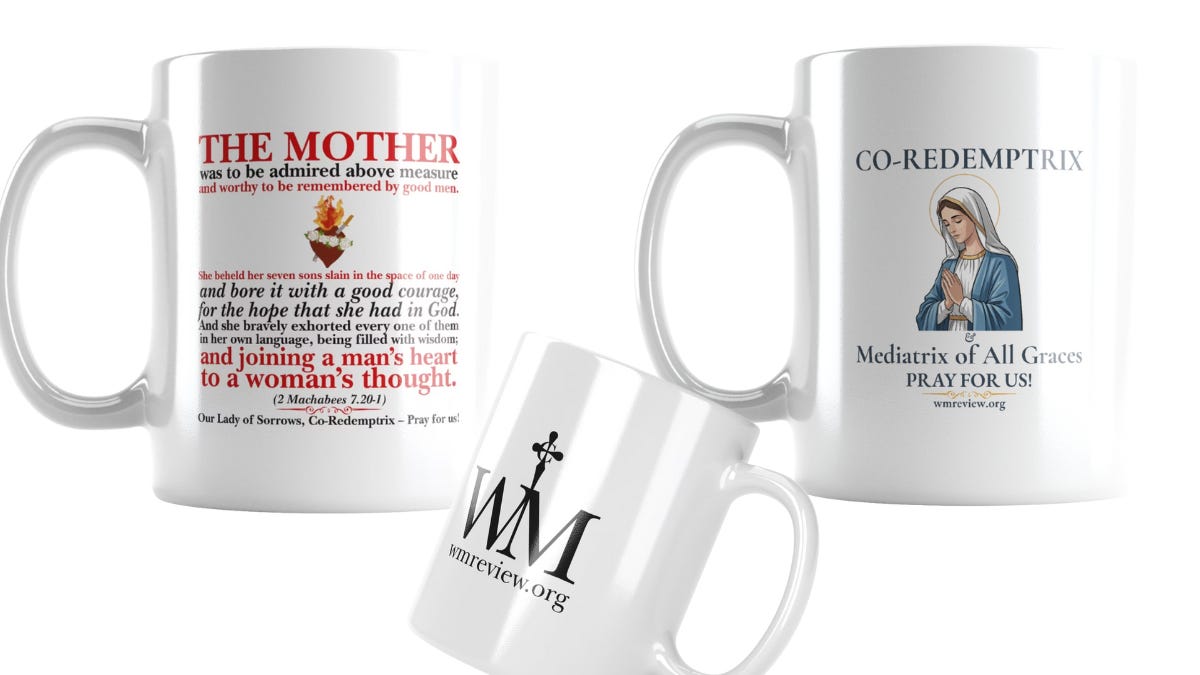
We also have our best-selling Co-Redemptrix mugs:
Follow on Twitter, YouTube and Telegram:
Twitter (The WM Review)
Sound effects credits:
Sound Effect Mind Mist from Pixabay
Sound Effect by freesound_community from Pixabay
Sound Effect by Jurij from Pixabay
Sound Effect by Universfield from Pixabay


