
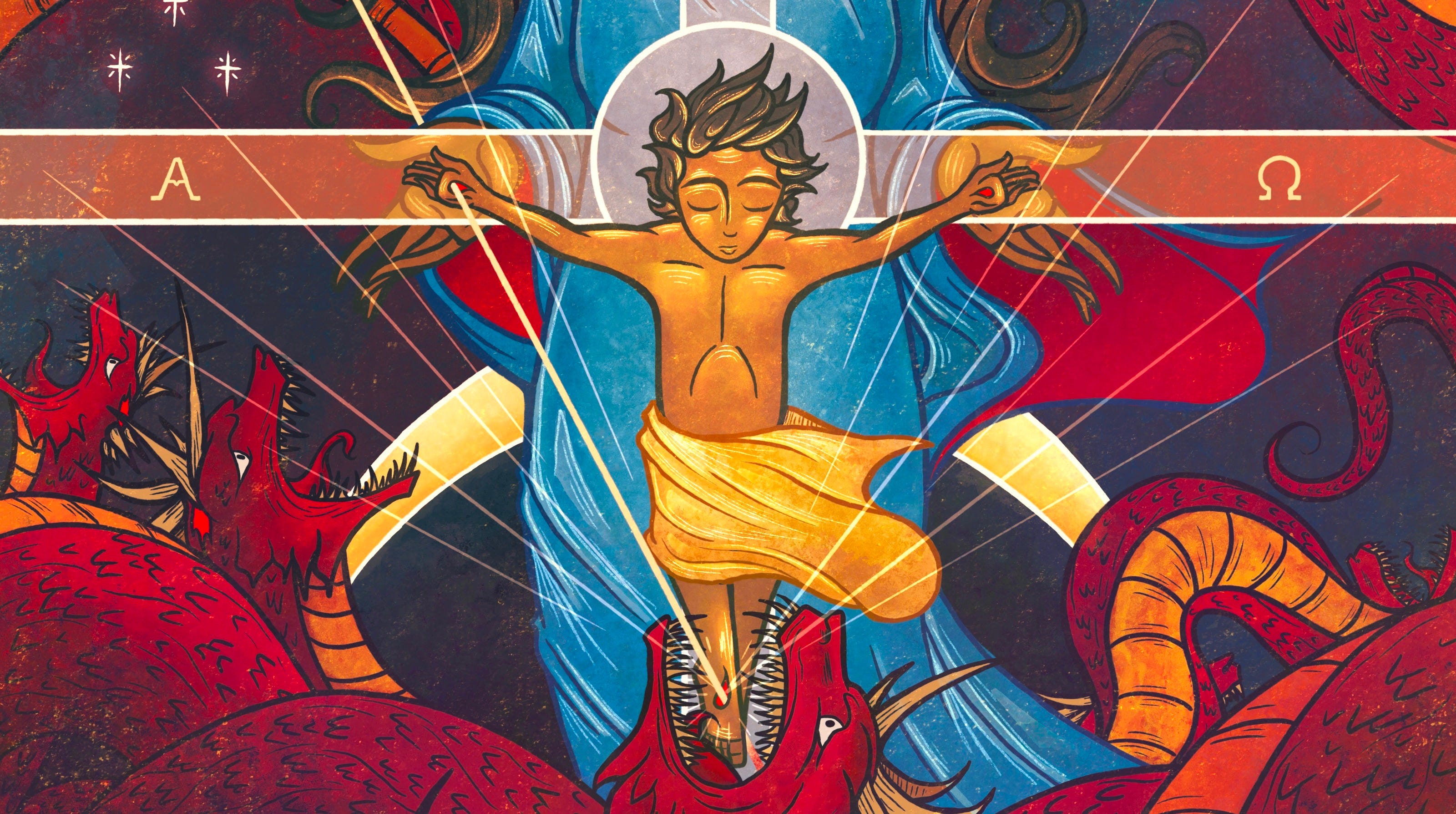
But no door opens to receive him, except that of a little stable cave.
Editor’s Notes
This is a bonus instalment (without audio) for Day 24 of our Total Consecration series – although like all parts of that series, it stands alone as a great text in its own right.
(Readers who are encountering this series for the first time through this article can find out more here.)
Day 24’s instalment featured Fr Henry James Coleridge’s commentary on the Nativity of Christ. You can listen to that part here:
However, as we have spent so much time with Fr Aloysius Ambruzzi in this series, we wanted to provide this section (without audio) as well.
CONTENTS:
READING: The text is based on an extract from Fr Aloysius Ambruzzi SJ.
MEDITATION: The points for meditation are included below. A guide on how to use these points in meditation can be found here.
Reading: The Nativity
The First Appearance of the Divine King
A Companion to the Spiritual Exercises of Saint Ignatius
Fr Aloysius Ambruzzi SJ
The first Prelude is to call to mind how our Lady and St Joseph set forth from Nazareth in order to go to Bethlehem to be enrolled and how, while there, Mary gave birth to the Son of God (Luke ii, 1-7).
The second Prelude is to see, with the eyes of the imagination, the road from Nazareth to Bethlehem and the place of the Nativity.
The third Prelude is to ask light to know intimately my Divine King Who has become a little Child for me, and grace to love Him and follow Him in poverty, suffering, and humiliations.
1. The Nativity of Our Lord
“And it came to pass in those days there went out a decree from Caesar Augustus that the whole world should be enrolled .... And all went to be enrolled, everyone into his own city” (Luke 2.1, 3)
Though it must needs have been hard in their circumstances, Joseph and Mary prepared to obey Caesar’s command, seeing in it, in their spirit of humble submission, not the exaction of a harsh and grasping master, but a disposition of their ever-watchful and ever-loving Father.
Bethlehem is some eighty miles distant from Nazareth. Riding on an ass, as, with St Ignatius, we may piously conjecture, Mary covered the distance with much suffering and with many privations, sweetened by the thought of Jesus dwelling in her, and the companionship of Joseph. At last, having left behind them the plain of Esdraelon, Sichem, and Jerusalem, they reached Bethlehem, and immediately went to the place where they had to be enrolled and had to pay the tribute. This done, Joseph went in search of some shelter in the public inn. But Mary and Joseph were too poor to find a welcome in that place, when there were so many important persons to be attended to.
“There was no room for them in the inn.” Bethlehem could offer hospitality to thousands of its children. Every house rang with the cheering voices of relatives and friends, happy to sit at the common board, after years of absence. The prophet Micheas had foretold that Bethlehem would gain immortal glory from its being the birthplace of Christ. “Out of thee shall He come forth unto me that is to be the ruler in Israel” (Mich 5.2). And yet no door opens to welcome the Divine King. Not even the public inn can spare a corner for Him.
“He came unto His own, and His own received Him not.” (John 1.11)
It is a presage of the great rejection that was to come after—“Not this man, but Barabbas”—and of the numberless rejections that would follow it along the centuries, even at the hands of many who call themselves Christians and who receive Him not, or, at most, give Him the coldest and most neglected corner in their hearts.
Mary and Joseph, the greatest beings our race has produced, are forced to take shelter in a cave, used as stable by the people in the neighbourhood of Bethlehem. In this wretched place, in the cold of the night, deprived of all things, and crying out once more: “Behold the handmaid of the Lord, be it done unto me according to thy word,” Mary, with her virginal purity unsullied, brought forth the Son of God Whom she had miraculously conceived.
This is a bonus instalment of our Total Consecration series for WM+ members.
The WM Review is free for readers. This is because we believe these ideas must reach as many people as possible.
However, we also provide WM+ articles—additional material for those who choose to support this work financially.
This helps us continue producing serious Catholic research, while ensuring that the main body of material remains accessible to all.
If you want to ensure that our work continues, join WM+ today.
You can see our Testimonials page for what some of our readers are saying about the WM Review.
(We offer free membership on request for clergy and seminarians – please contact us for details.)