
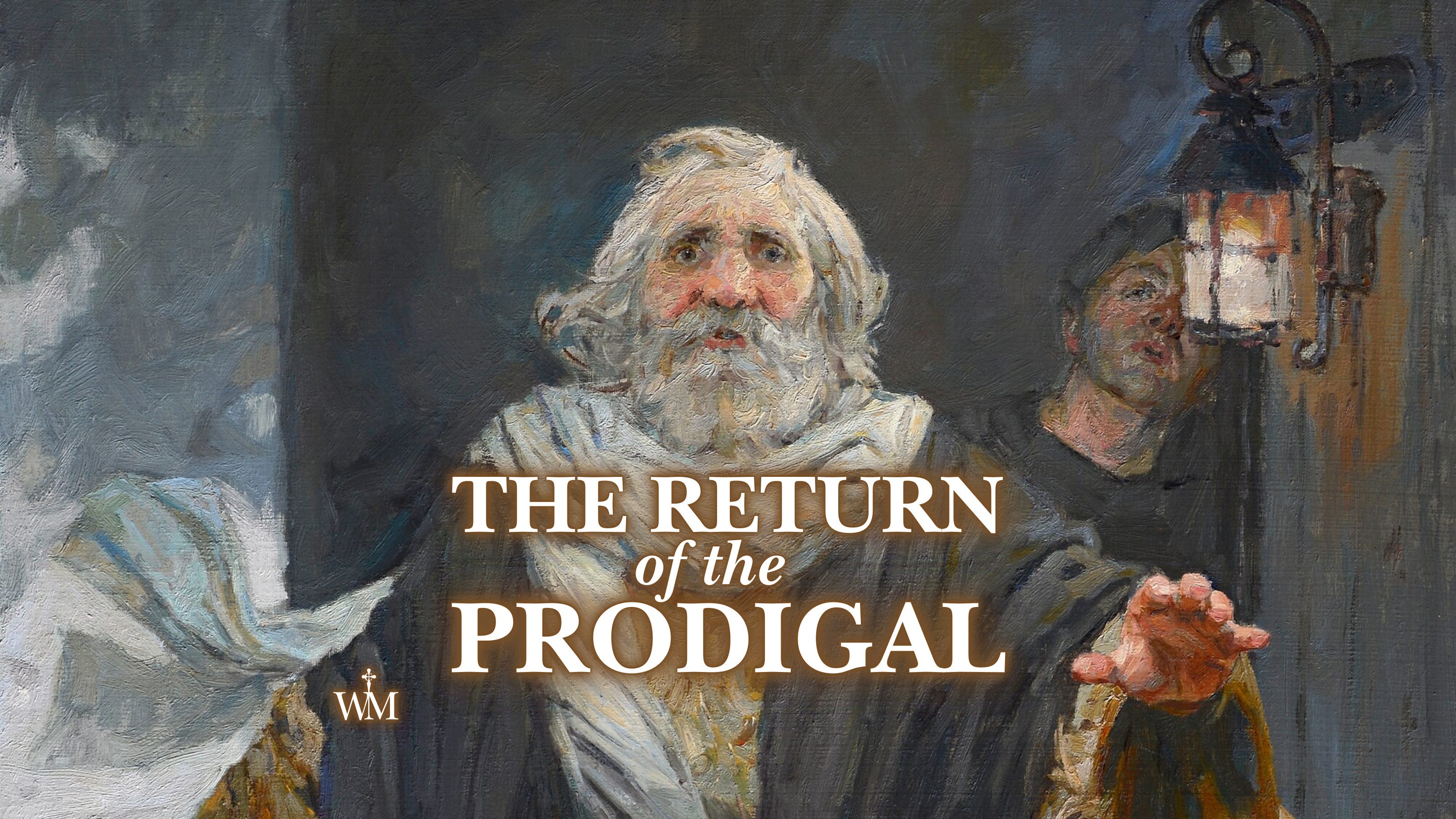
The parable of the Prodigal Son is the dawn at the end of a period focused on sin, death, judgement and Hell.
Editor’s Notes
The second period of the preparation for St Louis de Montfort’s Total Consecration to the Blessed Virgin – “Week 1” – is focused on gaining a greater knowledge of ourselves, and sorrow for our sins.
We are nearly at the end of Week 1. Today, we are reading Fr Aloysius Ambruzzi’s explanation of The Prodigal Son – the sinner’s return to God. We’re reading from his Companion to the Spiritual Exercises of St Ignatius.
The purpose of these readings is to provide material to help with our meditation – and you can find the points for the meditation in the link below. The themes, as well as vocal prayers and readings associated with this ‘Week 1’, can be found here. You can find the book here.
Although this is part of the Total Consecration preparation, it also stands alone as a great text in its own right.
As we read or listen to this text, especially as a part of this preparation for Total Consecration to Our Lady, perhaps we could consider a certain person who is not mentioned in the parable – the mother of the Prodigal Son. Perhaps we could consider: What is she doing when the younger son asks for his share of the inheritance? What does she think of him going away? What does she say to the father and the older brother while he is gone? How does she feel when she sees him returning to the house? And so on.
Reminder
It would be normal on the Spiritual Exercises to make a general confession at this point. That is where all these meditations have been leading. Whether this is possible or not for those following this series will depend on many different factors – including whether they have been able to arrange it with a priest. It is not always easy for a priest to hear a general confession at short notice.
If it is not possible, even a regular confession would be fitting at this point too.
If even that is not possible, then strive (asking for God’s help) to conceive the greatest contrition possible. Novus Ordo Watch has an article about how to strive a perfect act of contrition.
Whichever means is possible, today is your opportunity for a real interior conversion: to start again, and to resolve to live in God’s grace for the rest of your life. Sometimes on the Spiritual Exercises, there’s a little celebratory meal of that conversion after the general confession.
Perhaps some of that joy could be brought to your home in some way this evening – especially as this is being first published on the feast of the Immaculate Conception.
CONTENTS:
READING: The text consists of a chapter from Fr Aloysius Ambruzzi’s Companion to the Spiritual Exercises. This text is intended to provide material for further consideration of the subject of this week.
MEDITATION: Fr Ambruzzi’s text is intended to provide material for the meditation, which appears in point-form following it. A guide on how to use these points in meditation can be found here.
Reading: The Prodigal Son
Back to the Road to God
A Companion to the Spiritual Exercises of Saint Ignatius
Fr Aloysius Ambruzzi SJ
The first Prelude is to see with the eyes of the imagination the house of the Prodigal, the road leading into a far country, and the farm where he is sent to feed swine.
The second Prelude is to ask light to know the infinite goodness of God whom I have offended, and grace to trust in His equally infinite mercy.
PART I: The Prodigal’s ingratitude
1. The shocking request
“A certain man had two sons; and the younger of them said to his father: Father, give me the portion of substance that falleth to me. And he divided unto them his substance.”
The younger son lacked nothing in his father’s house. He was the father’s beloved. But, one day, looking round him, it seemed to him that many of his companions were enjoying a freedom which he had not. From that day he longed to shake off his father’s yoke, till, forgetful of his father’s love, he went up to him and cried out: “Give me the portion of the substance that falleth to me.”
With the heart near breaking, the father divided his substance between them.
God is our Heavenly Father and we are His beloved children. In His house alone we experienced true joy and happiness. We were constantly loaded with His favours. We had only to love Him and to use His gifts to love Him more and more.
Unfortunately we stopped to look with regret at the imagined happiness of worldly men, or, at least, at the freedom and success of those who take things easy, and make the best of this world in the house of God. “Why so many bonds and restrictions for us?” And one day we cried to God:
“Take Your gifts, the robe of innocence and grace. Give me back my senses, my imagination, my heart, my intelligence, that I may freely use and enjoy the things and the persons of this world.”
Or if we did not wholly reject God’s gifts, we did what somehow appears is almost worse in His eyes: we began to neglect them, to make light of them, and to leave them unused. “I would thou wert cold.”
God, our Father, our Creator and Lord, could have refused to give back to us what was His by so many titles. He might have instantly put an end to our life. Instead He let us go. But His Heart was bleeding: a new sword had pierced it cruelly.
2. Into a far country
“And not many days after, the younger son, gathering all together, went abroad into a far country.”
He cannot stand the sight of his father and of his home. He must needs sell his substance, turn it into money, and go far, far away, that nothing may remind him of his father’s love and of his past dependence on him.
In long years of patient work we had acquired many good habits and some degree of sanctity. In a moment sin destroyed everything. The distance between the All-Holy and the sinful creature is immeasurable. Still, even after throwing off the sweet yoke of God, we could not leave His home: we can never escape from Him. We were, however, only physically present to Him. In reality, we lived in another world, far away from our Father. The stream of Divine life passed us by, hardly entering into us. Seeing we did not see, and hearing we did not hear. Prayer to God became a heavy burden, and the very remembrance of Him, painful.
3. Living riotously
“And there he wasted his substance living riotously.”
The sinner wastes God’s goods. He loses the most precious supernatural virtues. He loses the Divine gifts. Even the good things he does, cease to be meritorious for eternal life.
Impurity, in most cases, causes such ruin. It gradually makes the sinner a wreck: morally, always, often even physically and intellectually.
On the other hand, freedom of the senses, an uncontrolled imagination, and the plunging into external things fix the soul in the state of tepidity. God’s gifts, if not wasted, remain idle, and God’s graces lie unused. The soul is the idle, wicked, and unprofitable servant against whom the Lord has pronounced a terrible sentence of condemnation.
PART II: The Misery of the Prodigal
1. In want
“And after he had spent all, there came a mighty famine in that country, and he began to be in want.”
What wild dreams of happiness had the sinner dreamt! To realize them he sacrificed God and his soul, and, behold, he finds no satisfaction and no peace. Independence, ambition, pleasures, cannot fill his heart. “To be in want,” to be plunged in a bottomless abyss, has become his fate.
God alone can satisfy the thirst and the hunger of our souls. If we leave Him and His sweet service to go in pursuit of other consolations, we soon experience the misery of the Prodigal; and that sad experience will be a real blessing. Woe to us if, as a penalty for our infidelities, we were to find pleasure in things which displease God, and feel no remorse of conscience!
2. In a tyrant’s clutches
“And he went and cleaved to one of the citizens of that country.”
He, the beloved son and a free man, becomes, in his search after false liberty, the slave of a cruel master.
We were the free children of God. We had, it is true, to carry the yoke of His Law, but it was a sweet yoke. Sin delivered us into the hands of our passions. We became the slaves of cruel, low, and insatiable tyrants. They bound us hand and foot as by so many iron chains. And yet, horrible to say, we kept kissing our bonds.
3. Feeding swine
“And he sent him into his farm to feed swine. And he would fain have filled his belly with the husks the swine did eat; and no one gave unto him.”
Such is the state of a soul that has turned away from God.
“They that were brought up in scarlet, have embraced the dung.” (Lam. iv, 5)
“They have forsaken Me, the fountain of living water, and have digged to themselves cisterns, that can hold no water.” (Jer. ii, 13)
Away from all good influences, the sinner is wholly engrossed in feeding his lowest passions. Often he would fain be even a swine. “Happy those that know no God, that hear not the voice of conscience,” he murmurs to himself. “O! If I were not a Christian! If I were not a Priest, a Religious! If I had never heard His call!”
Look at Him, in that far distant country—naked—starved—in the midst of swine! Look at the change in his senses; at the havoc which sin has worked in his mind and in his heart! What has become of the man in him—of the Christian—of the Priest?
Do I perchance recognise myself in that wretch?
PART III: The Prodigal’s Repentance
1. I perish with hunger
“And returning to himself, he said: How many hired servants in my father’s house abound with bread, and I here perish with hunger.”
It is in the midst of his utter misery that the memory of home comes to him.
The sinner is one that lives out of himself. He is all abroad. Distractions and excitement are his daily food. What he fears most is solitude. It is so with the tepid and lukewarm man. Recollection, prayer, self-examination, he cannot bear. The very thought of a retreat frightens him.
Something extraordinary may recall the sinner to his senses, and then, face to face with his soul, he sees it like a garden through which a pack of wild animals have passed on a dark night. He thought himself happy and free, and now he sees that he is “wretched, and miserable, and poor, and blind, and naked.” He realizes that others, whom he thought bigoted and narrow-minded and dissatisfied, abound in all good things. “Do you remember,” a voice whispers in his heart, “the days of your fervour?”
2. I will arise
“I will arise, and will go to my father, and say to him: Father, I have sinned against heaven and before thee: make me as one of thy hired servants.”
Satan suggests to the unhappy Prodigal thoughts of diffidence and even of despair: “My iniquity is greater than that I may deserve pardon” (Gen. iv, 13), but the Prodigal remembers that the father whom he has cruelly offended is still his father: that he is blood of his blood.
However much we may have sinned, however great and numerous our infidelities may be, God is still our Father and we the creatures of His hands. Let us, then, rise from our misery and go to him with confidence and hope. We shall make a simple and straight confession of all our sins, and be ready for any consequence. We only know that we are utterly unworthy of enjoying the sweetness which God keeps for His dear friends.
3. He came to his father
“And rising up he came to his father.”
The difficulties and obstacles must have been great. He was weak. His evil habits made constant attempts to reassert themselves. His past friends mocked at him. The shame which he knew he had to face would frighten him. And yet on he went.
PART IV: The Father’s Forgiveness
1. The father’s love
“And when he was yet a great way off, his father saw him, and was moved with compassion.”
The ingratitude of the son had wounded the father’s love, but had not diminished its strength. The old man had waited for the return of the Prodigal. Daily he would look out for him, though scorned by all, especially by his elder son. The Prodigal felt instinctively how much the father loved him, whom he said: “I will arise and go to my father.” It was that love that drew him home. One day the father saw a traveller from afar. “It is he,” he cried, and his heart beat violently.
Even the greatest sinners are God’s children, His images, the princes of His Court, and the sharers of His life. They are created for eternal happiness. He cannot bear to see them rushing towards the abyss. He Himself goes to them and sweetly touches their heart with His grace. He invites them to Him in so many and such wonderful ways. Everywhere, through friends, through His ministers, through His creatures, He cries to the sinner: “Come back to My Heart!”
2. The father’s forgiveness
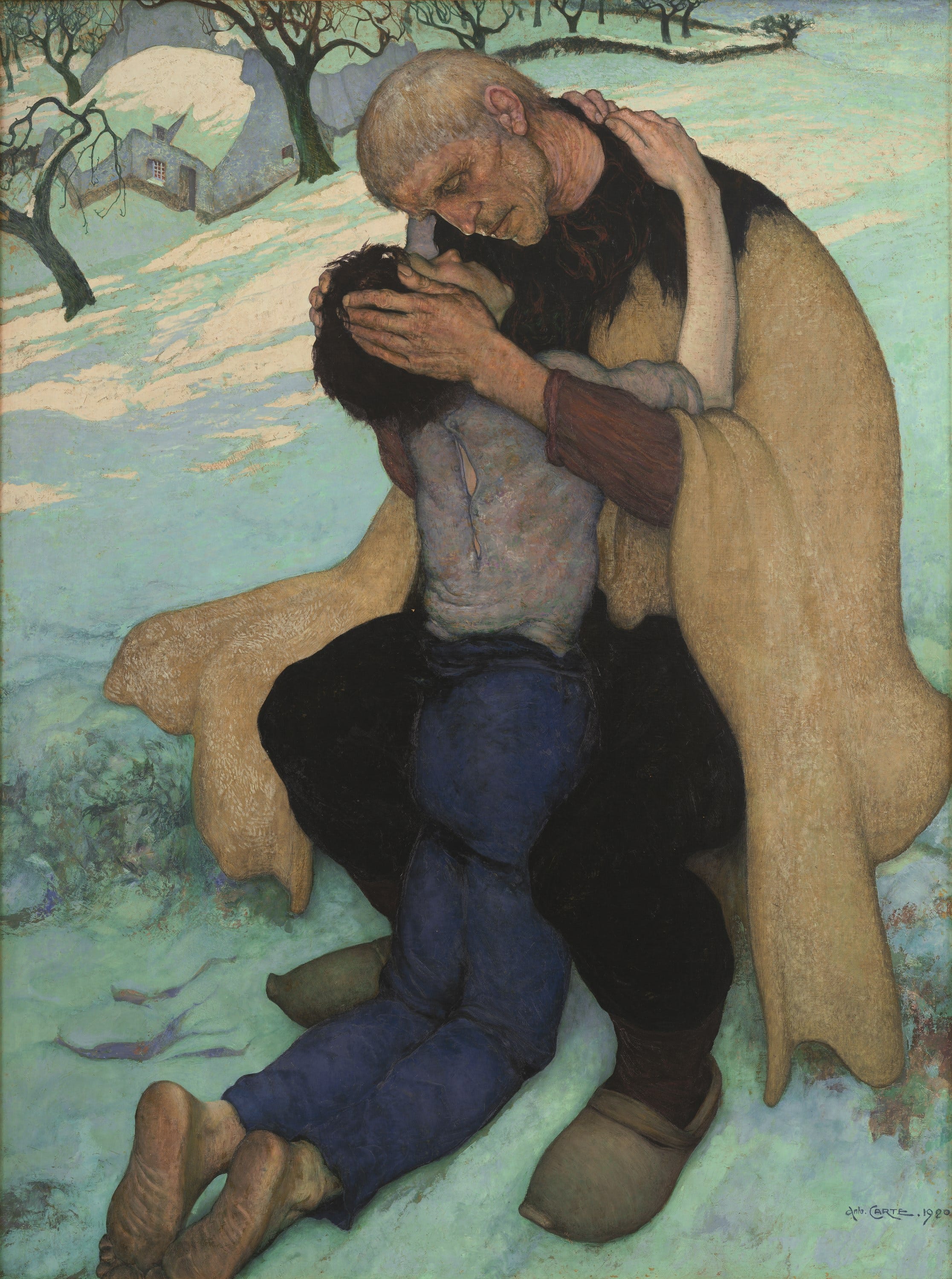
“And running to him, fell upon his neck, and kissed him.”
The old man, forgetful of his years and of his dignity, runs. He waits for no other advance on his son’s part. He kisses him before any confession. He does not allow him to complete it.
This is but a faint idea of the meeting between God and the penitent soul.
3. Let us eat and make merry
“And the son said to him: Father, I have sinned against heaven and before thee, I am not now worthy to be called thy son.
“And the father said to his servants: Bring forth quickly the first robe, and put it on him, and put a ring on his hand, and shoes on his feet, and bring hither the fatted calf, and kill it, and let us eat and make merry.”
What a change the return of the Prodigal has worked—the father is rejuvenated and the son sits at table like a king.
Put on him the best robe, i.e., the stole of divine grace. Again will the Angels recognize in the penitent soul the child of God; with his virtues, good habits, and past merits.
Put a ring on his hand: he is again united to God. Again are his hands made beautiful with the ring of the free.
Put shoes on his feet: no more shall he walk in the mud. Henceforth he will run freely on the way of God.
Bring hither the fatted calf: God the Father gives him the object of His own happiness—His Word become Flesh, hidden under the Sacramental Species.
And let us eat and make merry: there is joy in the heart of the repentant sinner, and even greater joy in the Heaven before the Angels of God.
I will arise and go to my father!
Suggestions for the Colloquy
1. O my Jesus, give me to realize more and more Thy infinite goodness and mercy—and at the same time the misery into which I sank whenever I left the more generous and higher path to take the lower, the easier, the more self-indulgent.
2. How happy I was when I served Thee with generosity and fervour! How laden with favours from Thy loving Heart! Alas, I, too, like the Prodigal, looked with envy at the freedom of those who took things easy—and longed to shake off the sweet yoke of Thy love. I had given Thee all myself—my senses, my imagination, my heart, my intelligence, to use them only according to Thy pleasure. I asked them back in order to use them as I pleased. Prayer became hard—recollection irksome—mortification unendurable—charity distasteful—and every duty, a heavy burden. Deprived of Thy joy, I sought consolation in creatures—in the satisfaction of my senses, of my whims and caprices. I let myself go—and if I did not fall into the abyss, it was but for Thy infinite Goodness and Mercy that held me back.
3. Yes, O my Jesus, I am wretched, and miserable, and poor, and blind, and naked. Grant that I, too, may cry out with the Prodigal: I will arise and go to my Father—to Thy Heart, O Jesus. I have often saddened and grieved Thy Heart; I have wounded It and crowned It with thorns. But Thou hast loved me all the same—Thou hast never ceased to pour Thy graces on me; to call me to Thee.
Here I am prostrate before Thee, O Jesus, covered with shame and confusion, and yet full of confidence and hope.
4. O Mary, Mother of God and my Mother, take my poor heart, full of sins and miseries, and plunge it into the abysses of the Sacred Heart. Mount guard, O sweet Mother, that I may never depart from the Heart of Thy Son!
Meditation for Day 18
The Infinite Merciful Love
Taken from Christian Warfare
It is in mental prayer that that much of the preparation will be achieved – and meditation is a means of entering mental prayer. See our guide to meditation for two ways to use the below texts.
In this preparation for the consecration of ourselves to the Blessed Virgin Mary, we could keep Our Lady in mind throughout our meditation.
The Preparation
Prayer. The usual Preparatory Prayer.
First Prelude. The first Prelude is to see with the eyes of the imagination the house of the Prodigal, the road leading into a far country, and the farm where he is sent to feed swine.
Second Prelude. The second Prelude is to ask light to know the infinite goodness of God whom I have offended, and grace to trust in His equally infinite mercy.
The Points for Meditation
Resumption of all the colloquies of the first week.
First Point. God loves us with an infinite merciful love. (Weigh each of these words).
Our faults are all the more serious because of this.
Love demands confidence. Do not worsen our forgiven faults by doubting the love of God for us.
Quotations on the Infinite Merciful Love of God for us:
From all eternity: (Jer. 31:3) “I have loved thee with an everlasting love, therefore have I drawn thee, taking pity on thee.”
Tender Love: (Is. 49:15-16) “Can a woman forget her infant so as not to have pity on the son of her womb? And if she should forget, yet I will not forget thee. Behold, I have graven thee in my hands: thy walls are always before my eyes.”
Efficacious Love: (Is. 1:18) “And then come, and accuse me, saith the Lord: if your sins be as scarlet, they shall be made as white as snow: and if they be red as crimson, they shall be white as wool.”
Second Point. The Sacred Heart of Jesus, symbol of the infinite love of God for us (the Good Shepherd, the Prodigal Son).
(Col. 1:15) “Who is the image of the invisible God, the First-born of every creature.”
Like the Father of the Prodigal Son, Jesus waits for you, to forgive you. Go throw yourself, with sorrow and confidence at the feet of the Priest, His Minister. That which, by the intermediary of the Priest, God will forgive you today, He will not impute to you on the day of the judgement. If the demon troubles you, invoke Mary. With her assistance be assured of always making good confessions.
One could consider these points in reference to oneself: How far have we been conscious of this in our daily lives so far, what practical conclusions should we draw from these truths, how far have we lived up to them so far, what must we do to live up to them in the future, etc.
One could consider the acts of virtue we can make in response to these truths – Acts of faith, humility, hope/confidence, thanksgiving, contrition and love – talking all the while to God, the Blessed Virgin, our Guardian Angels, etc.
The Colloquy
Colloquy. An affectionate colloquy. Weep for our sins that have offended a God who is infinitely good. Promise the Sacred Heart of Jesus, with the help of His grace, to sin no more... to take in the future, the means... to escape dangerous occasions of sin... to pray... to receive the Sacraments often.
And to consecrate myself to the Blessed Virgin Mary, and through her, to her Divine Son.
In addition, Fr Ambruzzi offers some suggestions for the colloquy above. However, it is important to speak frankly to God in our own words, rather than simply reading somebody else’s.
If one feels moved to speak to God before meditating on all the points, one should certainly do so. The same applies if one feels moved to simply rest in God, rather than engaging in discursive meditation. These impulses should be followed over any particular method of meditation.
The End
End the meditation with a vocal prayer – such as the Our Father, the Anima Christi.
Reflect on how well we have prayed, and how well we have followed our chosen method.
Select a spiritual nosegay from your meditation to keep with you for the rest of the day.
See you tomorrow. Hit subscribe to make sure you don’t miss it or any of our other material:
For more on the St Louis de Montfort’s True Devotion and Total Consecration, for which we are preparing, see here:
The theological basis of ‘True Devotion’ and the Consecration to Mary (Garrigou-Lagrange)
The fruits of ‘True Devotion’ and Consecration to Mary (Garrigou-Lagrange)
For more on the importance of not getting bogged down with methods, and on allowing God to act, see here:
For more on Week 0, and the vocal prayers that are are suggested for each day, see here:
‘Week 0’ of St Louis de Montfort’s Total Consecration preparation (Prayers, practices and reading)
Get the book here:
True Devotion to the Blessed Virgin Mary (St Louis de Montfort)
HELP KEEP THE WM REVIEW ONLINE WITH WM+!
As we expand The WM Review we would like to keep providing free articles for everyone.
Our work takes a lot of time and effort to produce. If you have benefitted from it please do consider supporting us financially.
A subscription gets you access to our exclusive WM+ material, and helps ensure that we can keep writing and sharing free material for all.
You can see what readers are saying over at our Testimonials page.
(We make our WM+ material freely available to clergy, priests and seminarians upon request. Please subscribe and reply to the email if this applies to you.)
Subscribe to WM+ now to make sure you always receive our material. Thank you!
If you are enjoying this preparation for Total Consecration, why not get it in mug form?

We also have our best-selling Co-Redemptrix mugs:

Follow on Twitter, YouTube and Telegram:
Twitter (The WM Review)
Sound effects credits:
Sound Effect Mind Mist from Pixabay
Sound Effect by freesound_community from Pixabay
Sound Effect by Jurij from Pixabay
Sound Effect by Universfield from Pixabay


