

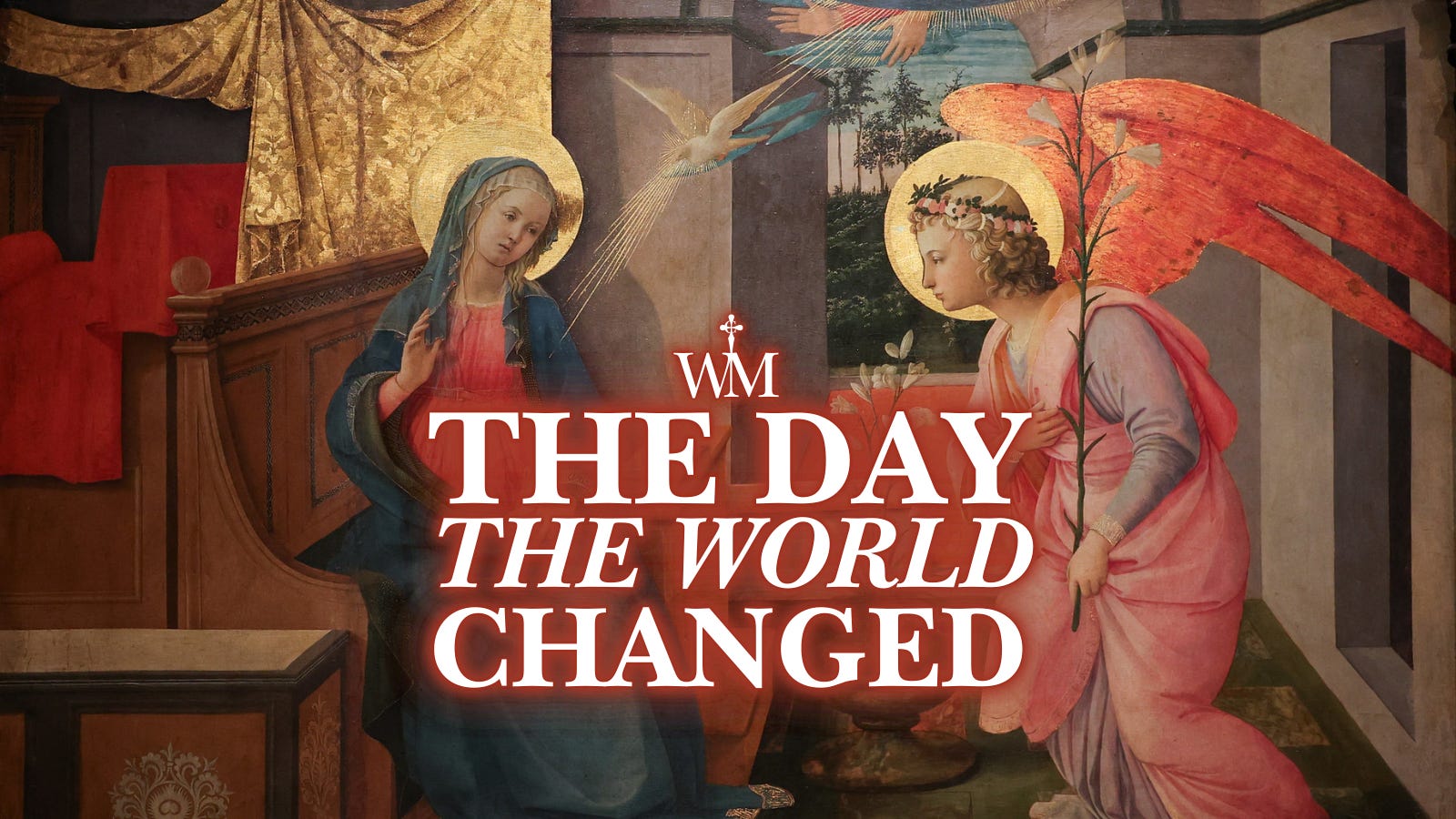
This is the moment that the Blessed Virgin Mary became the first and highest ranking soldier in Christ’s army.
Editor’s Notes
The second period of the preparation for St Louis de Montfort’s Total Consecration to the Blessed Virgin is focused on gaining a greater knowledge of Our Lady, and seeking to unite ourselves to her.
In this reading, we’re going to meet Our Lady on the Eve of the Annunciation.
The Annunciation and the Incarnation form an important meditation in the Spiritual Exercises, and so gaining a clear view of Our Lady at this time is really crucial. St Ignatius has us contemplate the state of the world at the time of the Annunciation, so that we can really appreciate the infinite goodness of God in becoming man for our sake. The following explanation of the meditation is taken from Fr Aloysius Ambruzzi SJ’s A Companion to the Spiritual Exercises of Saint Ignatius.
The themes, as well as vocal prayers and readings associated with Week 2, can be found here. You can find the book here.
Finally, it would be good to return to the meditations on the Three Classes of Men and the Three Ranks of Humility this week. We anticipated them in Week 0, but St Ignatius puts them with the meditations we are considering now in Week 2:
Day 8: Are you a weakling, a self-seeker... or something better?
The Three Classes of MenDay 9: Do we actually want what humility entails?
The Three Ranks of Humility
Although this is part of the Total Consecration preparation, it also stands alone as a great text in its own right.
CONTENTS:
READING: The text is based on an extract from Fr Henry James Coleridge’s The Preparation for the Incarnation.
MEDITATION: Fr Coleridge’s text intended to provide material for the meditation, which appears in point-form following it. A guide on how to use these points in meditation can be found here.
Reading: The Incarnation
The Coming of the Divine King
A Companion to the Spiritual Exercises of Saint Ignatius
Fr Aloysius Ambruzzi SJ
The first Prelude is to call to mind how the Three Divine Persons, beholding all the surface and circuit of the whole world, full of men, and seeing that so many were going to Hell, determined in Their eternity, that the Second Person should become Man to save the human race; and thus, when the fulness of time had come, They sent the Angel Gabriel to our Lady. (Luke i, 26-28; John i, 24.)
The second Prelude is to see the great extent and circuit of the world where so many and such diverse nations dwell; then likewise to see in particular, the house and chamber of our Lady, in the city of Nazareth, in the province of Galilee.
The third Prelude is to ask for an interior knowledge of our Lord that I may love Him and follow Him better.
1. Significance of the Incarnation
The Incarnation is the great landmark that divides the history of mankind into two periods. The first period is one of long preparation and expectation. From the gates of Eden, fallen man sets out on a painful journey, through a dark and barren country only now and then illumined by stars, in search of a Saviour. The Incarnation marks the beginning of the second period, one of ever-progressing development in Christ. It is the joyful journey of man along with Christ, towards that sublime moment when, God the Father having put all his enemies under His feet, “the Son Himself shall be subject to the Father who subjected all things to Him, that God may be all in all.” (Cor. xv, 28)
The Incarnation is the central fact of the whole universe. Everything finds its reason in the Word Incarnate. Everything converges towards Him.
“The line of division between men is not chronological, but, we may say, Christological; there is man with Christ, and man without Christ. Nor again is that division quite plain to the eye. Men there are who stand with Christ in outward profession and according to lip service, but in heart and action they are as far from Him as hell from heaven. And some who know very little of Him, and derive no appellation from His name, are faithful to Him according to the little that they know, and are more truly His than sundry professed Christians.”
(Rickaby, Waters that Go Softly, p. 54)
St Paul states this truth in the clearest terms.
“He (Christ) is the image of the unseen God, first-born before every creature. For in Him were created all things in Heaven and on earth, things seen and things unseen, whether thrones or dominations or principalities or powers, all creation is through Him and unto Him. And Himself is prior to all, and in Him all things hold together.”
(Coloss. i, 15-17)
For each man, to believe in the Incarnation is to begin an altogether new life; to penetrate more deeply into that abysmal mystery is to rise nearer to God: incorporation with Christ is his all in all.
2. Mercy and Love in the Incarnation
The malice of Satan had defaced the beauty of man, the marvel of God’s creative power. Deprived of original justice, man could no longer render to God the love that He owed Him. Then it was that the Son of God, Who had taken part in man’s creation, offered Himself to atone for man’s sin and to repair his misfortune. The end of the Incarnation is to reinstate man in his former condition, i.e., in that supernatural sonship which he lost by sin. It was fitting that this gratuitous adoption as sons should be restored to us by Him Who is naturally and of necessity the Son, for thus we become heirs by grace with Him Who is the heir by nature, and we have Him for our elder Brother Who is the Son of the Eternal Father. (Cf. E. Hugon, The Mystery of the Incarnation)
The mystery of God’s Holy Will, according to St Paul, is “to bring all things to a head in Christ, both the things in the heavens, and the things upon the earth” (Eph. i, 10); or, as our Lord says:
“As Moses lifted up the serpent in the desert, so must the Son of the Man be lifted up: that whosoever believeth in Him, may not perish, but may have life everlasting. For God so loved the world, as to give His only begotten Son.” (John iii, 14-16)
3. Mankind before the Incarnation
At the very moment that He cast out our first parents from the Garden of Eden, God opened to them a vista full of hope. Addressing the Serpent, He said:
“I will put enmities between thee and the woman, and thy seed and her seed; she shall crush thy head and thou shalt lie in wait for her heel.” (Gen. iii, 15)
Thousands of years had to pass before the Great Event, here foretold, would be accomplished. Man had first to learn by experience that salvation is only from the Lord and that, far from becoming a god, of himself he could only sink lower and lower.
It is the sight of the horrible state of moral depravity in which the word had sunk just before the coming of Christ that St Ignatius wants us to contemplate minutely when he says:
“To see the persons… on the face of the earth, so varied in dress and bearing, some white and others black; some weeping and others laughing; some in health, others sick; some being born, and others crying, etc., […] to hear how they converse with each other, how they swear and blaspheme, etc… to consider what they are doing, viz., smiting, killing, and going down into Hell, etc.”
None can deny or even belittle the high stage of civilization reached by many ancient peoples before Christ. Egypt, India, Greece, and Rome surpassed in material wealth and outward show, in philosophy and literature, in architecture and the fine arts, in law and the art of government, anything our modern times have achieved. However, we have only to read the first chapter of St. Paul’s Epistle to the Romans to realize the spiritual misery of one of the most advanced peoples of the world before the coming of Christ.
“Being filled with all wickedness, villainy, covetousness, malice, replete with envy, murder, strife, guile, spite; backbiters, slanderers, God-haters, insolent, arrogant, braggarts, devisers of evil, rebellious to parents, without understanding, without honour, without affection, without pity.” (Rom. i, 29-31)
God looked down with eyes of pity on these poor creatures of His hands, and proceeded to fulfil the Promise which He had made in the garden of Eden and which He had often renewed, in the course of the ages, to the Patriarchs and the prophets.
“When the fulness of time came, God sent forth His Son, born of a woman.” (Gal. iv, 4)
4. The Fact of the Incarnation
“The Angel Gabriel was sent from God into a city of Galilee, called Nazareth, to a virgin espoused to a man whose name was Joseph, of the house of David, and the Virgin’s name was Mary.”
The Divine message is not sent to the great ones of the world, but to a poor and unknown maiden, living in an obscure village of a small and insignificant country. And yet this maiden is so noble and high that she draws the Son of God into her womb. To her God the Son first addresses the invitation: Will thou be with Me, in this enterprise—work with Me the Redemption of men?
“Hail, full of grace, the Lord is with thee: blessed art thou among women.”
Far from being elated by such a greeting and by the announcement it implied, the pure and humble Virgin “was troubled at his saying and thought within herself what manner of salutation this should be.”
“And the Angel said to her: Fear not, Mary, for thou hast found grace with God. Behold thou shalt conceive in thy womb, and shall bring forth a Son, and thou shalt call His name Jesus. He shall be great, and shall be called the Son of the Most High, and the Lord God shall give unto Him the throne of David His Father, and He shall reign in the house of Jacob for ever. And of his Kingdom there shall be no end.”
This Son is the long-expected Messias.
Either to make sure of the reality of the Divine message, or to show that she esteemed her spotless virginity above all other gifts of God, Mary said to the Angel:
“How shall this be done, because I know not man? And the Angel, answering, said to her: The Holy Ghost shall come upon thee, and the power of the Most High shall overshadow thee. And therefore, also, the Holy which shall be born of thee shall be called the Son of God… And Mary said: Behold the handmaid of the Lord, be it done to me according to thy word.”
To celebrate the espousals of the Divine with our human nature, God waits for the consent of Mary, the only unspotted flower of the seed of Adam. Mary’s answer to the undreamt-of offer is one of the deepest humility—“Behold the slave of the Lord”—and of the most perfect submission—“Be it done unto me according to thy word”. Among all creatures, she stands out as the most perfect model of the deep humility and submission which behoves the creature in the presence of the Almighty Creator. Those simple words embody the programme of her whole life. They are the key to the greatness of her soul. At the first fiat, in the beginning, light was made. At Mary’s fiat, in the fulness of time, “the Word was made flesh and dwelt amongst us,” i.e., a most perfect human nature, created by God in Mary’s womb and out of her purest blood, began to exist through the Personality of the Word that is from all eternity.
To the humble and whole-hearted fiat of the Mother of God there answers an act of infinite humiliation and submission on the part of her Son, the Incarnate Word:
“For He, though He was by nature God, yet did not set great store on His equality with God: rather, He emptied Himself by taking the nature of a slave and becoming like unto men. And after He had appeared in outward form as man, He humbled Himself by obedience unto death, yea, unto death upon a cross.” (Phil. ii, 6-8)
Truly humility and submission sum up the whole life of Mary and of Jesus.
5. The Fruits of the Incarnation
The Word Incarnate works the restoration of mankind. The Church expresses this fact beautifully in one of the prayers at Mass:
“O God, Who in creating human nature didst marvellously ennoble it, and hast still more marvellously renewed it, grant that, by the mystery of this water and wine, we may be made partakers of His divinity Who vouchsafed to become partaker of our humanity, Jesus Christ, Thy Son, our Lord.”
First, by His Incarnation, Christ saved us from sin:
“Thou shalt call His name Jesus: for He shall save His people from their sins.” (Matt. i, 21)
Secondly, He gave testimony to the truth. He brought to us the knowledge of God and the knowledge of ourselves—of our misery and of our greatness. He revealed God as a loving and watchful Father, and taught us to see in every man not a rival nor an enemy nor a slave, but a brother.
Thirdly, in Himself He has made us one with His Father and one with all our fellowmen. “I in them and Thou in Me,” is the double filling up: St Paul’s pleroma, constituted by the mystery of the Incarnation.
The Incarnation, then, is not only the nuptial feast of humanity indissolubly united in Christ to the Word of God, but our bridal feast too. By the strength of the God Incarnate, we are lifted up to God, even to the participation of His Divine Nature: divinæ consortes naturæ. It is the feast of our union with all God’s children, the lost only excepted—the feast of our oneness with them as brothers in Christ.
To live in Christ, in union with our fellowmen, is the whole secret of the New and Eternal Alliance. Sanctity is the constant effort to find Christ and to possess Him more and more. The Church is nothing else but the internal and external union of men in Christ. All God’s works which have any relation to the end of the Incarnation—to restore all things—will be done through Christ’s Humanity. Truly, then, the Word Incarnate is all in all to everyone of us.
God’s Infinite Love
Suggestions for the Colloquy
1. O Almighty and Eternal God, Father, Son, and Holy Ghost, Thou art moved to pity for the creatures of Thy hand and, in Thy infinite love and mercy, Thou decreest to redeem and restore mankind. Thou sayest: “Let us work out man’s Redemption. Let One of Us become a member of this degraded and sinful race—atone for their sins—give them once more the power to become Our children.” O how infinitely great is Thy love for us, O Eternal Father, Who givest Thy only begotten Son—that whosoever believes in Him should not perish, but have everlasting life! How infinitely great is Thy love for us, O Eternal Son of God, Who, being equal to the Father, didst empty Thyself by taking the nature of a slave, in all things like one of us, sin excepted.
2. Thou hast loved me, O God, and Thou hast delivered Thyself for me. From Thy Heavenly Throne Thou sawest me, what I was, what I should be if wholly left to myself—ignorant, proud, vicious, helpless, hopeless, a fire-brand of hell—and Thou hadst pity on me, and in Thy infinite love and mercy Thou camest to overthrow the kingdom of Satan and of self-love in my heart—to repair the ravages caused by them, and to plant in it the Kingdom of God, Thy Kingdom.
3. Thou art God Almighty and yet a true man like one of us. Thou comest to share my life, my sufferings, difficulties, and trials—to be my Companion—to walk with me, to carry me in Thy arms, to enter into my very heart and make me live by Thy very life—to help me, guide me, teach me—to conquer and triumph through me and in me—to be all in all to me. And Thou placest all Thy infinite treasures at my disposal, telling me: Thou art ever with Me and all that I have is thine.
4. And not only Thou wantest to redeem, save, and sanctify me; but Thou invitest me to help Thee to save and sanctify others—to be Thy companion in the great work of establishing the Kingdom of God on earth. What a great condescension and what an honour! Here I am, ready to do all I can to continue and complete the work of Thy Incarnation.
5. O Emmanuel, God with us! Thou art with me—Thou my Brother, my Friend, my Companion, my All—leading me to Thy Father, in the company of Mary, Thy Mother and my Mother, along with all men, my brethren in Thee. May I know, love and possess Thee more and more—especially in the Sacrament of Thy love, the continuation of Thy Incarnation!
Meditation for Day 22
A repeat of Day 21, on the Annunciation and Incarnation of Christ
It is in mental prayer that that much of the preparation will be achieved – and meditation is a means of entering mental prayer. See our guide to meditation for two ways to use the below texts.
The Preparation
Prayer. The usual Preparatory Prayer.
First Prelude. The first Prelude is to bring up the narrative of the thing which I have to contemplate. Here, it is how the Three Divine Persons looked at all the plain or circuit of all the world, full of men, and how, seeing that all were going down to Hell, it is determined in Their Eternity, that the Second Person shall become man to save the human race, and so, the fullness of times being come, They sent the Angel St. Gabriel to Our Lady.
Second Prelude. The second, a composition, seeing the place: here it will be to see the great capacity and circuit of the world, in which are so many and such different people: then likewise, in particular, the house and rooms of Our Lady in the city of Nazareth, in the Province of Galilee.
Third Prelude. The third, to ask for what I want: it will be to ask for interior knowledge of the Lord, Who for me has become man, that I may more love and follow Him.
[Note: In this preparation, we should also include a knowledge and love of Our Lady in this third prelude.]
The Points for Meditation
First Point. The first Point is, to see the various persons:
First those on the surface of the earth, in such variety, in dress as in actions: some white and others black; some in peace and others in war; some weeping and others laughing; some well, others ill; some being born and others dying, etc.
To see and consider the Three Divine Persons, as on their royal throne or seat of Their Divine Majesty, how They look on all the surface and circuit of the earth, and all the people in such blindness, and how they are dying and going down to Hell.
To see Our Lady, and the Angel who is saluting her, and to reflect in order to get profit from such a sight.
Second Point. The second, to hear what the persons on the face of the earth are saying, that is, how they are talking with one another, how they swear and blaspheme, etc.; and likewise what the Divine Persons are saying, that is: “Let Us work the redemption of the Human race,” etc.; and then what the Angel and Our Lady are saying; and to reflect then so as to draw profit from their words.
Third Point. The third, to look then at what the persons on the face of the earth are doing, as, for instance, killing, going to Hell etc.; likewise what the Divine Persons are doing, namely, working out the most holy Incarnation, etc.; and likewise what the Angel and Our Lady are doing, namely, the Angel doing his duty as ambassador, and Our Lady humbling herself and giving thanks to the Divine Majesty; and then to reflect in order to draw some profit from each of these things.
The above meditation is prescriptive – however, the below are our usual points for completeness:
One could consider these points in reference to oneself: How far have we been conscious of this in our daily lives so far, what practical conclusions should we draw from these truths, how far have we lived up to them so far, what must we do to live up to them in the future, etc.
One could consider the acts of virtue we can make in response to these truths – Acts of faith, humility, hope/confidence, thanksgiving, contrition and love – talking all the while to God, the Blessed Virgin, our Guardian Angels, etc.
The Colloquy
St Ignatius writes:
At the end a Colloquy is to be made, thinking what I ought to say to the Three Divine Persons, or to the Eternal Word incarnate, or to our Mother and Lady, asking according to what I feel in me, in order more to follow and imitate Our Lord, so lately incarnate.
Fr Ambruzzi has some suggestions above. It is important to speak frankly to God in our own words, rather than simply reading somebody else’s.
If one feels moved to speak to God before meditating on all the points, one should certainly do so. The same applies if one feels moved to simply rest in God, rather than engaging in discursive meditation. These impulses should be followed over any particular method of meditation.
The End
End the meditation with a vocal prayer – such as the Our Father, the Anima Christi.
Reflect on how well we have prayed, and how well we have followed our chosen method.
Select a spiritual nosegay from your meditation to keep with you for the rest of the day.
See you tomorrow. Hit subscribe to make sure you don’t miss it or any of our other material:
See the index and explanation to this series here:
For more on the St Louis de Montfort’s True Devotion and Total Consecration, for which we are preparing, see here:
The theological basis of ‘True Devotion’ and the Consecration to Mary (Garrigou-Lagrange)
The fruits of ‘True Devotion’ and Consecration to Mary (Garrigou-Lagrange)
For more on the importance of not getting bogged down with methods, and on allowing God to act, see here:
For more on Week 0, and the vocal prayers that are are suggested for each day, see here:
‘Week 0’ of St Louis de Montfort’s Total Consecration preparation (Prayers, practices and reading)
Get the book here:
True Devotion to the Blessed Virgin Mary (St Louis de Montfort)
HELP KEEP THE WM REVIEW ONLINE WITH WM+!
As we expand The WM Review we would like to keep providing free articles for everyone.
Our work takes a lot of time and effort to produce. If you have benefitted from it please do consider supporting us financially.
A subscription gets you access to our exclusive WM+ material, and helps ensure that we can keep writing and sharing free material for all.
You can see what readers are saying over at our Testimonials page.
(We make our WM+ material freely available to clergy, priests and seminarians upon request. Please subscribe and reply to the email if this applies to you.)
Subscribe to WM+ now to make sure you always receive our material. Thank you!
If you are enjoying this preparation for Total Consecration, why not get it in mug form?
We also have our best-selling Co-Redemptrix mugs:
Follow on Twitter, YouTube and Telegram:
Twitter (The WM Review)


