


Having spent a week considering the evil of sin, it’s time to give our answer to the Call of the King.
Editor’s Notes
We are now at the end of the second period of St Louis de Montfort’s preparation for Total Consecration to the Blessed Virgin. “Week 1” has been focused on gaining a greater knowledge of ourselves, and sorrow for our sins.
Today, we are returning to Fr Aloysius Ambruzzi’s explanation of St Ignatius’ iconic exercise The Call of the King. At the end of Week 0, we made the first half of the exercise: we are now ready to make it in full.

Let’s remind ourselves of the outline of the “Parable” of the St Ignatius:
The first Point is, to put before me a human king chosen by God our Lord, whom all Christian princes and men reverence and obey.
The second, to look how this king speaks to all his people, saying:
“It is my Will to conquer all the land of unbelievers. Therefore, whoever would like to come with me is to be content to eat as I, and also to drink and dress, etc., as I: likewise he is to labor like me6 in the day and watch in the night, etc., that so afterwards he may have part with me in the victory, as he has had it in the labors.”
The third, to consider what the good subjects ought to answer to a King so liberal and so kind, and hence, if any one did not accept the appeal of such a king, how deserving he would be of being censured by all the world, and held for a mean-spirited knight.
The second part of this Exercise consists in applying the above parable of the temporal King to Christ our Lord, conformably to the three Points mentioned.
If we consider such a call of the temporal King to his subjects, how much more worthy of consideration is it to see Christ our Lord, King eternal, and before Him all the entire world, which and each one in particular He calls, and says:
“It is My will to conquer all the world and all enemies and so to enter into the glory of My Father; therefore, whoever would like to come with Me is to labor with Me, that following Me in the pain, he may also follow Me in the glory.”
The second, to consider that all those who have judgment and reason will offer their entire selves to the labor.
We already approached this iconic exercise last week, at the end of Week 0. But its proper place in the Spiritual Exercises is after Week 1, after one has spent a week contemplating sin – both in general and our own sins – and the punishment it deserves.
This is why Fr Ambruzzi suggests we see ourselves as “recreant knights covered with shame and confusion.” We were recreant knights and traitors – but we now stand around our King, having been received back into his court and friendship despite our unworthiness and the heinousness of our crimes against him.
St Ignatius makes clear that not accepting the King’s Call is out of the question. The only question is whether we will respond with reason, or with love. In this second part, we will see Fr Ambruzzi’s discussion of the Oblation – the higher and more perfect response to the King’s call – which is the offering of ourselves to our divine King.
This offering has much in common with the consecration of ourselves to the Queen, the Blessed Virgin. In this preparation, we should keep that similarity in mind.
The purpose of these readings is to provide material to help with our meditation – and you can find the points for the meditation below.
Although this is part of the Total Consecration preparation, it also stands alone as a great text in its own right.
CONTENTS:
READING: The text consists of Fr Aloysius Ambruzzi’s commentary on The Call of the King, from St Ignatius’s Spiritual Exercises.
MEDITATION: Fr Ambruzzi’s text is intended to provide material for St Ignatius’ meditation, which appears in point-form following it. A guide on how to use these points in meditation can be found here.
Reading: The Kingdom of Christ
The Call of the Divine King
A Companion to the Spiritual Exercises of Saint Ignatius
Fr Aloysius Ambruzzi SJ
You can find Part I here.
6. The answer to Christ’s call
What must be our answer to the invitation of the Divine King?
Not to accept it is out of the question for any one of us. By such unworthy conduct we would, indeed, deserve to be accounted as the most ignoble and wretched of men and reprobated by all the world, if only the world knew it. We should certainly be accounted as such in the eyes of God and of His Angels!
Two answers are possible. The first is the answer of reason. It is truly proper and reasonable that we offer ourselves to fight God’s enemies and our own—Satan, the world, and our passions—and thus establish in our souls the Kingdom of God, that is to say, the supremacy of His rule. This constitutes the following of Christ in the way of the precepts. In the First Week we worked to implant in our souls a deep hatred of sin and of a disorderly life: now we offer ourselves to labour and fight with Christ. It is this union and incorporation with Christ, and not the mere avoidance of evil and the doing of one’s duty, which turns a man into a Christian and a soldier of the Divine King. This, in fact, is what we vowed at Baptism, when we renounced Satan, the world and its pomps, and professed our allegiance to Christ.
These offerings form the central point of the Oblation with which St Ignatius ends the contemplation of the Kingdom of Christ and which may be called an heroic act of consecration to the Divine King.
Secondly, there is the answer of love and of generosity, the answer of those “who wish to show greater affection, and to distinguish themselves in every kind of service of their Eternal King and Universal Lord;” in other words, the answer of those who want to be the special friends and companions of Christ. Others may content themselves with being simple soldiers in the big army of Christ, stationed sometimes in the fighting line, but more often behind the line. Not so the more generous hearts. As far as it lies with them, they set no limit to their service. They want to follow their King as closely as possible, to be with Him, to labour, to fight, to suffer and even to die with Him. If in His kind condescension, Christ holds out to His friends the prospect of an eternal reward as an inducement to follow Him, it is love for Him and an ever intense desire to prove themselves worthy of Him that prompt His devoted followers.
And what are the offerings of greater worth and moment made by such generous souls?
These offerings form the central point of the Oblation with which St Ignatius ends the contemplation of the Kingdom of Christ and which may be called an heroic act of consecration to the Divine King.
“Eternal Lord of all things, I make my oblation with Thy grace and help, in the presence of Thine infinite goodness, and in the sight of Thy glorious Mother, and of all the Saints of the Heavenly Court, protesting that I wish and desire, and that it is my deliberate determination, provided only it be to Thy greater service and praise, to imitate Thee in bearing all injuries, and all reproach, and all poverty, as well actual as spiritual, if only Thy Divine Majesty be pleased to choose and receive me to such a life and state.”
As far as it lies in its power, the generous soul is ready and willing to imitate Christ “in bearing all injuries and all reproach and all poverty as well actual as spiritual,” to follow him in the way of poverty and humiliation, in the difficult path of the Evangelical Counsels. Obviously the King alone has the right to choose His close friends. But He has only to say the word, “Come, after Me,” and the soul is at His side.
Strange to say, writes somewhere Fr. Rickaby, a person might think to signalize himself in the service of the Eternal King by filling high positions, by organizing movements, by coming forward as a public man, by being in all eyes and in all mouths. Instead of that St Ignatius directs him to bare his back for all manner of injuries, reproaches and poverty—for not otherwise did Christ go about His work, and our engagement with Him is that we are to fare as He fared.
7. The inner meaning of the oblation
Why is it that, in the wording of the Oblation, St Ignatius lays so much stress on poverty and humiliations? The Saint wants to inflame the soul with the desire to follow Christ in the hardest things. Poverty and humiliations are such: they were the inseparable companions of Christ, the two pieces, so to speak, of His Cross. By it He entered into His Kingdom, and by it alone is it given to us to enter the same Kingdom with Him. The esteem and love of poverty and humiliations constitute the quintessence of His message.
“Blessed are the poor in spirit.”
“Blessed are ye when they shall revile you, and persecute you, and speak all that is evil against you, untruly, for my sake.” (Matt, v, 3, 110)
Poverty and humiliations lovingly accepted are the means that most effectively take us out of ourselves to enter into Christ, to live His life and to do His work. The love of the things of this world, on the contrary, and the longing for its praise and glory are the most powerful destroyers of God’s work in individuals and in corporate bodies, and the only disqualifications for service in Christ’s army.
Poverty, and above all humiliations, make up the uniform of Christ’s soldiers. It is not enough to enlist in His army. It is only when we share in the poverty and humiliations of Christ that we are truly His and can cry out with St Ignatius of Antioch: “Now I begin to be Christ’s disciple.” No wonder if Pati et contemni pro Te was the ardent prayer of so many Saints. Though it is not given to all actually to observe the Evangelical Counsels or to be with the suffering and despised Master, the spirit of the Evangelical Counsels and the desire to imitate Christ in privations and humiliations are for every high-souled Christian.
8. How to prepare oneself to make the oblation
How shall we be able to make the offerings of greater worth and moment implied in the Oblation, to accept lovingly from the hands of our King poverty and humiliations? By fighting constantly against our own sensuality, i.e., the love of ease and comfort and of what pleases our senses, against our carnal love, i.e., human and natural affections not based on God, against our worldly love, i.e., the longing for praise, honour and recognition. It is not enough to wage war against the world, the flesh, and the devil. That must be done by everyone who wants to be in Christ’s army. Those who desire to be Christ’s close companions must detest His enemies and their own, pursue them to their very last retreat and exterminate them. They must not be satisfied acting on the defensive, but often take the offensive. Constant and serious self-denial, mortification out of love and reverence for Christ, losing one’s life for Him, giving up all things and becoming like little children—these are the essential preliminary steps to enter into the Kingdom, to be numbered among the friends of the Divine King and to act as such.
But how can we seriously make our Oblation, and say that “we wish and desire and that this is our deliberate determination to imitate Thee in bearing all injuries and all reproaches and all poverty”, when we probably resent even the slightest word of blame, when we cannot stand the least neglect, and when we long so much for comforts? Are we not deceiving ourselves?
Well, if we feel that we cannot with truth say, Volo et desidero et mea est determinatio deliberata, we may at least acknowledge that we are far from the way of Saints. At the same time we may ardently desire to make the Oblation in full sincerity, and hope that, by constant self-denial in little things, we may, one day, be found worthy of making our oblation ex toto corde and of being thus enrolled amongst Christ’s chosen ones.
Let the Oblation of the Kingdom be the goal of our endeavours. Though we may still be walking in the valley, it is good to keep our eyes wistfully fixed on the heights above.
You can find Part I here.
The Answer to the King’s Call
Suggestions for the Colloquy
1. O Jesus, I lie prostrate before Thee and Thy heavenly Court—like a recreant knight covered with shame and confusion, a criminal bound in chains and deserving of death, a fire-brand plucked out of hell. Thou art my King—Thou art the Son of God made Man, my Creator and Lord—I am wholly Thine. Thou hast redeemed me out of love—I am doubly Thine: the spoils and the slave of Thy Heart. At the feet of Thee crucified, I have repeatedly asked myself: What shall I do for Christ? and, behold Thou invitest me to be one of Thy dearest friends and companions—to continue Thy life and mission—to establish in myself and others the Kingdom of God—the Kingdom of truth and life; of holiness and grace; of justice, love, and peace.
2. “Come and be with Me.” This is Thy sweet and persistent call, O my Jesus. “Be with Me. Thou shalt be encamped under my tent—eat at my table—drink of the same cup—be clothed as I am clothed. To make thee live by My very life, I shall give thee My very Body as the food. I shall crown thee with My glory—have thee be with Me eternally, in the House of My Father. Come, then, and be with Me—work and watch, fight, and suffer as I do—for Me and with Me.”
3. O Jesus, may I answer readily and wholeheartedly the calls of Thy love! I want to distinguish myself in Thy service—wage a constant and relentless warfare against the enemies of Thy Kingdom. I want to establish it in my heart; to labour, to suffer, and even to die with Thee in spreading it in the heart of others, as far as it lies in my power sustained by Thy grace.
Master, go and I will follow Thee
To the last gasp with truth and loyalty.
Meditation for Day 19
It is in mental prayer that that much of the preparation will be achieved – and meditation is a means of entering mental prayer. See our guide to meditation for two ways to use the below texts.
The Call of the King
In this preparation for the consecration of ourselves to the Blessed Virgin Mary, we should keep Our Lady in mind throughout our meditation. We should consider that Our Lady, the Queen, has her own call for us – and that it is perfectly united to that of her Son. We should be conscious that the means we have chosen for answering the Call of the King, for which we are presently preparing, is to enlist ourselves in the special service of his Queen.
She stands at his side. His will to conquer the world, is her will. His embrace of the suffering that entails is also hers. She too is watching us, as Our Lord makes his call – watching to see how we will respond, and praying to obtain for us the graces to respond well.
The Preparation
Prayer. The usual Preparatory Prayer.
First Prelude. The first Prelude is a composition, seeing the place: it will be here to see with the sight of the imagination, the synagogues, villages and towns through which Christ our Lord preached.
Second Prelude. The second, to ask for the grace which I want: it will be here to ask grace of our Lord that I may not be deaf to His call, but ready and diligent to fulfill His most Holy Will.
The Points for Meditation
The Call of the Temporal King
First Point. The first Point is, to put before me a human king chosen by God our Lord, whom all Christian princes and men reverence and obey.
Second Point. The second, to look how this king speaks to all his people, saying:
“It is my will to conquer all the land of unbelievers. Therefore, whoever would like to come with me is to be content to eat as I, and also to drink and dress, etc., as I: likewise he is to labour like me in the day and watch in the night, etc., that so afterwards he may have part with me in the victory, as he has had it in the labors.”
Third Point. The third, to consider what the good subjects ought to answer to a King so liberal and so kind, and hence, if any one did not accept the appeal of such a king, how deserving he would be of being censured by all the world, and held for a mean-spirited knight.
The Call of the Eternal King
The second part of this Exercise consists in applying the above parable of the temporal King to Christ our Lord, conformably to the three Points mentioned.
First Point. And as to the first Point, if we consider such a call of the temporal King to his subjects, how much more worthy of consideration is it to see Christ our Lord, King eternal, and before Him all the entire world, which and each one in particular He calls, and says: “It is My will to conquer all the world and all enemies and so to enter into the glory of My Father; therefore, whoever would like to come with Me is to labor with Me, that following Me in the pain, he may also follow Me in the glory.”
Second Point. The second, to consider that all those who have judgment and reason will offer their entire selves to the labor.
Third Point. The third, those who will want to be more devoted and signalise themselves in all service of their King Eternal and universal Lord, not only will offer their persons to the labor, but even, acting against their own sensuality and against their carnal and worldly love, will make offerings of greater value and greater importance, saying:
“Eternal Lord of all things, I make my oblation with Thy favor and help, in presence of Thy infinite Goodness and in presence of Thy glorious Mother and of all the Saints of the heavenly Court; that I want and desire, and it is my deliberate determination, if only it be Thy greater service and praise, to imitate Thee in bearing all injuries and all abuse and all poverty of spirit, and actual poverty, too, if Thy most Holy Majesty wants to choose and receive me to such life and state.”
St Ignatius advises making this meditation twice – when rising, and an hour or so before dinner.
This exercise is prescriptive and should be followed as given. Nonethless, here are our usual points for completeness:
One could consider these points in reference to oneself: How far have we been conscious of this in our daily lives so far, what practical conclusions should we draw from these truths, how far have we lived up to them so far, what must we do to live up to them in the future, etc.
One could consider the acts of virtue we can make in response to these truths – Acts of faith, humility, hope/confidence, thanksgiving, contrition and love – talking all the while to God, the Blessed Virgin, our Guardian Angels, etc.
The Colloquy
Fr Ambruzzi offers some suggestions for colloquies above. However, it is important to speak frankly to God in our own words, rather than simply reading somebody else’s.
If one feels moved to speak to God before meditating on all the points, one should certainly do so. The same applies if one feels moved to simply rest in God, rather than engaging in discursive meditation. These impulses should be followed over any particular method of meditation.
The End
End the meditation with a vocal prayer – such as the Our Father, the Anima Christi.
Reflect on how well we have prayed, and how well we have followed our chosen method.
Select a spiritual nosegay from your meditation to keep with you for the rest of the day.
See you tomorrow. Hit subscribe to make sure you don’t miss it or any of our other material:
See the index and explanation to this series here:
For more on the St Louis de Montfort’s True Devotion and Total Consecration, for which we are preparing, see here:
The theological basis of ‘True Devotion’ and the Consecration to Mary (Garrigou-Lagrange)
The fruits of ‘True Devotion’ and Consecration to Mary (Garrigou-Lagrange)
For more on the importance of not getting bogged down with methods, and on allowing God to act, see here:
For more on Week 0, and the vocal prayers that are are suggested for each day, see here:
‘Week 0’ of St Louis de Montfort’s Total Consecration preparation (Prayers, practices and reading)
Get the book here:
True Devotion to the Blessed Virgin Mary (St Louis de Montfort)
HELP KEEP THE WM REVIEW ONLINE WITH WM+!
As we expand The WM Review we would like to keep providing free articles for everyone.
Our work takes a lot of time and effort to produce. If you have benefitted from it please do consider supporting us financially.
A subscription gets you access to our exclusive WM+ material, and helps ensure that we can keep writing and sharing free material for all.
You can see what readers are saying over at our Testimonials page.
(We make our WM+ material freely available to clergy, priests and seminarians upon request. Please subscribe and reply to the email if this applies to you.)
Subscribe to WM+ now to make sure you always receive our material. Thank you!
If you are enjoying this preparation for Total Consecration, why not get it in mug form?

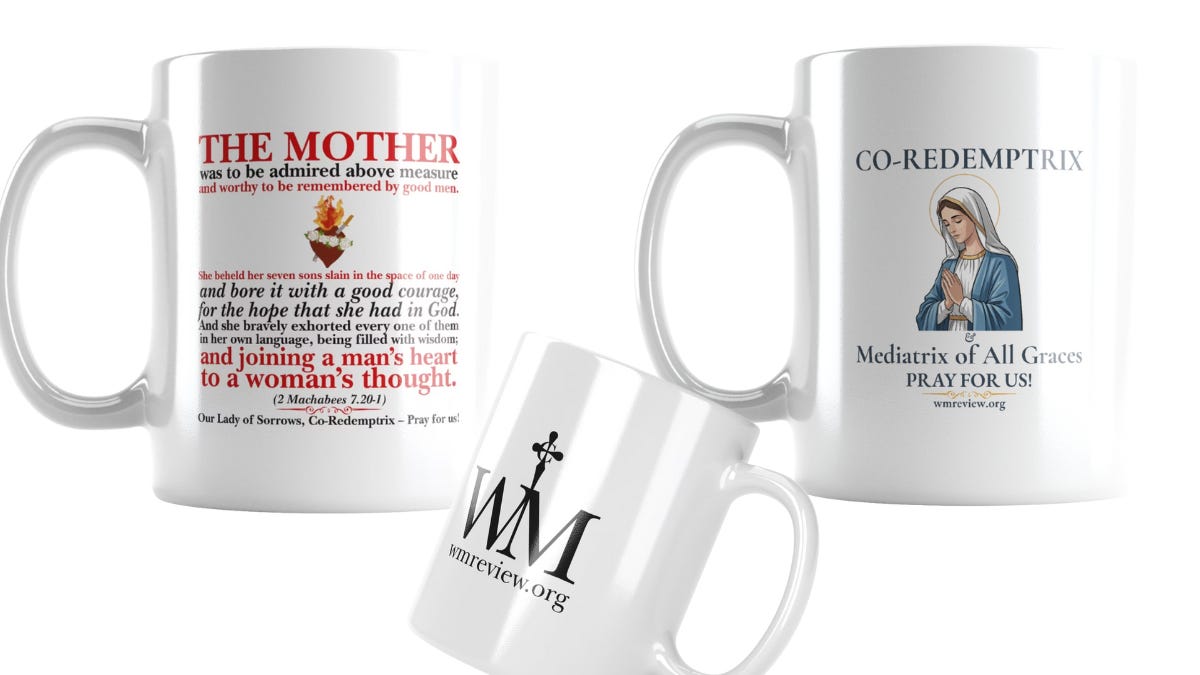
We also have our best-selling Co-Redemptrix mugs:
Follow on Twitter, YouTube and Telegram:
Twitter (The WM Review)


