
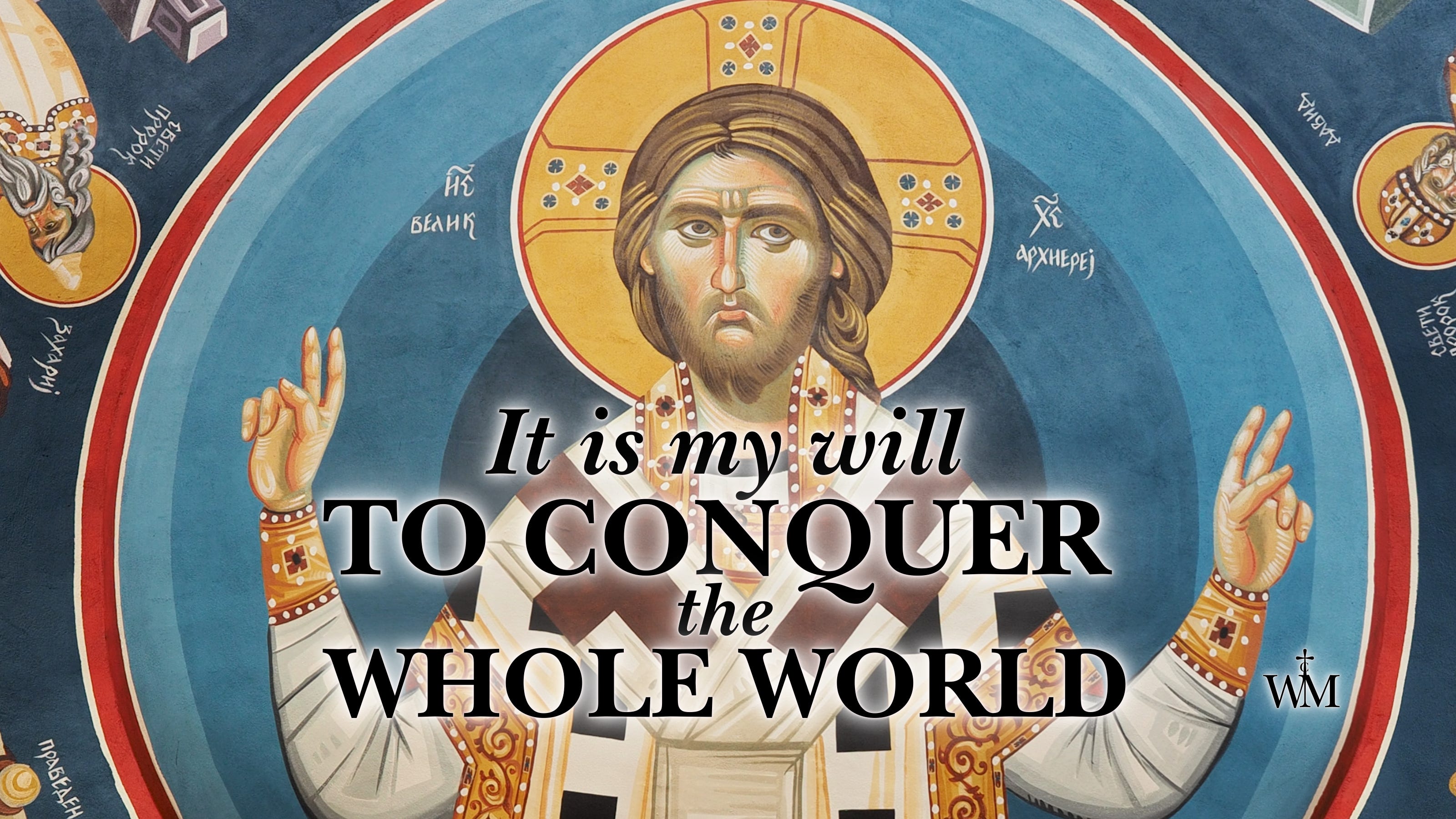
The spirit of the world can only be conquered by Christ the King. He calls each one of us to join his campaign – and every individual must answer his call. (Day 11 of Total Consecration)
Editor’s Notes
The first period of the preparation for St Louis de Montfort’s Total Consecration to the Blessed Virgin is focused on gaining a greater awareness of the spirit of the world, and emptying ourselves of it.
David from Catholic Hub – who has been collaborating with us on this project, and has been indispensable – has released a video about True Devotion and this series:
We are over a week into this series, which is something very new for The WM Review, and a truly mammoth project. What are your thoughts on it? Are you enjoying it? What’s been the best thing about it so far? Let us know in the combox:
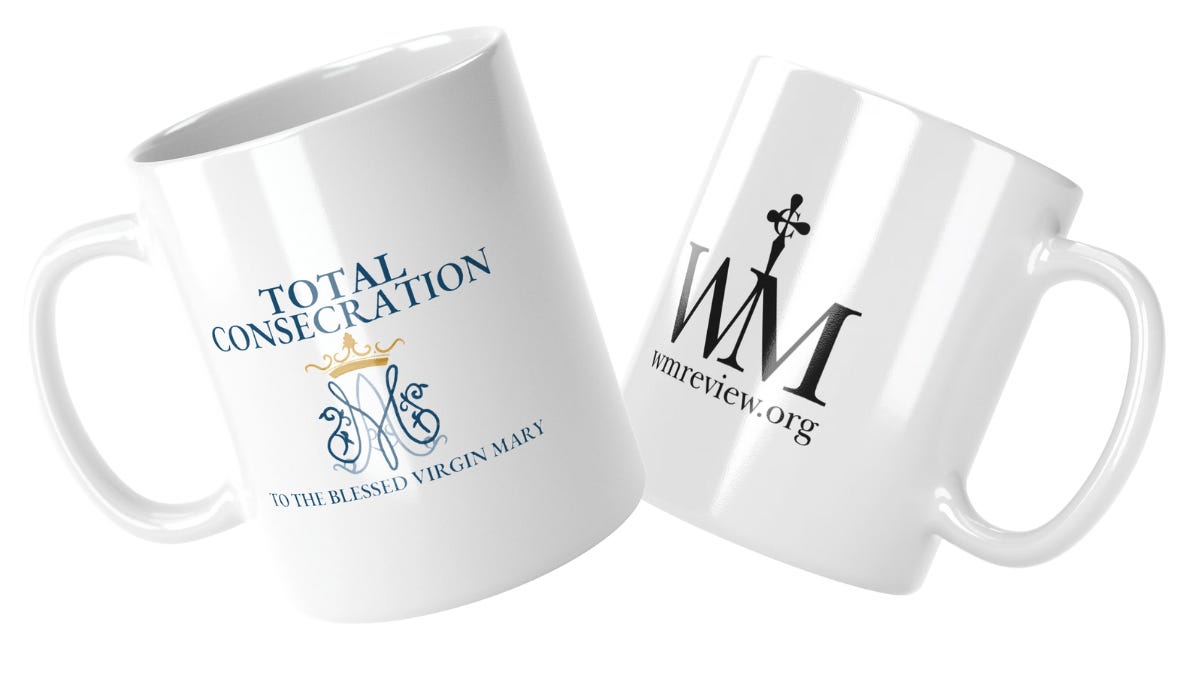
You can also show your support with our new mugs commemorating this series:
Now, let’s get down to business.
Today, we are reading Fr Aloysius Ambruzzi’s explanation of St Ignatius’ classic exercise – if not iconic – of The Call of the King.
In the Spiritual Exercises themselves, this meditation is supposed to come after “the first week,” in which we specifically contemplate the reality of sin – both in general and our own sins – and the punishment it deserves. It is the first exercise following the general confession, our re-admittance to Holy Communion after a temporary period of abstention, and a little celebratory meal.
This is why Fr Ambruzzi suggests we see ourselves as “recreant knights covered with shame and confusion.” We were recreant knights and traitors – but we now stand around our King, received back into his court and friendship despite our unworthiness and the heinousness of our crimes against him.
But as we reach the end of St Louis de Montfort’s Week 0, we need to anticipate all this, and consider the call of our King to join his crusade against the spirit of the world.
This is why we are dividing our consideration of this exercise between now and the end St Louis’ Week 1. This week, we will consider the call of the King; next week, we will return to take a closer look at our response to his call – the oblation of ourselves.
Fr Ambruzzi’s text is intended to provide fuel for a more fruitful meditation on the points, which follow the text below. As we approach this text, as part of this preparation for giving and consecrating ourselves to the Blessed Virgin, we could remember that she, our Queen, stands at the side of our King – and that her will is wholly united to his. His will to conquer the world, is her will. His embrace of the suffering that entails is also hers. She too is watching us, as Our Lord makes his call – watching to see how we will respond, and praying to obtain for us the graces to respond well.
We must not let her down.
The themes, as well as vocal prayers and readings associated with this ‘Week 0’, can be found here. You can find the book here.
Although this is part of the Total Consecration preparation, it also stands alone as a great text in its own right.
CONTENTS:
READING: The text consists of Fr Aloysius Ambruzzi’s commentary on The Call of the King, from St Ignatius’s Spiritual Exercises.
MEDITATION: Fr Ambruzzi’s text is intended to provide material for St Ignatius’ meditation, which appears in point-form following it. A guide on how to use these points in meditation can be found here.
Reading: The Kingdom of Christ
The Call of the Divine King
A Companion to the Spiritual Exercises of Saint Ignatius
Fr Aloysius Ambruzzi SJ
The first Prelude is to see with the eyes of the imagination the synagogues, towns, and villages through which Christ our Lord went preaching.
The second Prelude is to ask of our Lord that I may not be deaf to His call, but prompt and diligent to accomplish His most Holy Will.
The Everlasting King
“The fulness of time is come, and the Kingdom of God is nigh; repent, and believe in the Gospel.” (Mark i, 15)
Such is the message which Christ addressed to the Jews nineteen centuries ago, and which He keeps on repeating to every man “that cometh into this world.” His Kingdom is as everlasting as Himself.
“Jesus Christ is the same yesterday, and to-day, yea and for ever.” (Heb. xiii, 8)
“And of His Kingdom there shall be no end.” (Luke I, 33)
It is the full recognition and acceptance of the Gospel, of the Good News which Christ announces, and which is nothing else but Himself as “the Way, the Truth, and the Life.” (John xiv, 6)
Christ has willed that His life on earth should not be limited to the thirty-three years which He spent visibly amongst us. The words which He spoke to His own disciples, on ascending to Heaven, only assure us of His abiding presence in our midst.
“Behold I am with you, even to the consummation of the world.” (Matt. xxviii, 20)
In us and through us, He continues the life which He led in Palestine and the work which the Father gave Him to do.
“As the Father hath sent Me, I also send you.” (John xx, 21)
To live a Christian life implies something more than the modelling of our life on that of Christ. It means the constant denial of ourselves in order that Christ may reign in our minds, in our hearts, and in our bodies. Every Christian must be able to say with the Apostle, in some measure at least:
“It is no longer I that live, but Christ that liveth in me.” (Gal. ii, 20)
The whole world, then, has become a vast extended Palestine where every day, in the various members of His mystical body, Christ is born amidst the poor surroundings of Bethlehem, works in the silence and concealment of Nazareth, goes about doing good and announcing the Gospel of the Kingdom, suffers and even dies for the salvation of men. And that is why, before starting to contemplate the mysteries of our Lord’s life, St Ignatius wants us “to see with the eyes of the imagination the synagogues, towns and villages through which Christ our Lord went preaching.” We should, in other words, re-create the Holy Land in our hearts. Still more. The light of faith must transfigure for us the towns, villages, plains, and hills of our land into the land of Christ—the land that Christ wants to hallow through us. Every town will then be Nazareth or Jerusalem; every mountain, a Mountain of the Beatitudes; every hillock, a Calvary; and every tree, a Cross. It was in this light that St Ignatius came to regard Rome, Italy, Europe, the whole world itself, as the Holy Land to which He and his companions had at first vowed to go.
Christ constantly walks through the length and breadth of the earth calling men to Him as He called His first disciples, while passing along the shore of the lake of Gennesaret or through the streets of Capharnaum. Not only does He summon many to leave all things—father, mother, brethren, and possessions—and join Him in the immediate work of saving souls, but He constantly invites everyone of us, whatever our state of life may be, to come nearer and nearer to Him. He calls us by the secret whispering of His grace, by the dispositions of His Providence, by the voice of our superiors, of our Rules or of our duties, by the silent example of our companions and their demands on our time, our patience, and our sympathy.
Must we not continually cry out with St Paul: “Lord, what wilt Thou have me to do?” (Acts ix, 6)—or, with the Prophet Samuel: “Speak, Lord, for Thy servant heareth;” (1 Kings iii, 10)—or, with St Ignatius, ask grace from our Lord that we may not be deaf to His call, but prompt and diligent to accomplish His most Holy Will. O that our Divine King and Saviour would indeed remove the veil off our eyes and the crust off our hearts, so that, turning a deaf ear to the cravings of our passions, we may constantly hearken to His calls and answer Him readily and wholeheartedly.
Part One
1. The exercitant’s dispositions
Who is our King? What is His plan and programme? What are the conditions which He offers to His followers? What are their answers and the motives that prompt them? Of what nature is their oblation? Such are the main points of this truly magnificent contemplation of St Ignatius.
The feelings of shame, of confusion and sorrow, of hatred of self on the one hand and of heartfelt gratitude on the other, with which our hearts must be overflowing at the end of the First Week, are the best preparation to grasp and enter fully into the spirit of the Kingdom of Christ. We stand before our King and all His court like recreant knights covered with shame and confusion, criminals bound in chains and deserving of death, firebrands plucked out of Hell. At the feet of Christ nailed on the Cross for our sins, each one of us has put to himself that momentous question: What shall I do for Christ? And Christ himself suggests the answer, when He invites us to be His dearest friends and companions, to labour and suffer with Him.
2. The Parable of the Temporal King
However, that we may all the better grasp the significance of the call of the Divine King, and be convinced of the whole-hearted generosity with which it must be answered, St Ignatius introduces the parable of The call of the temporal king. We are to place before our eyes “a human king elected by God Himself” and, accordingly, endowed with all the qualities that call forth the most enthusiastic devotion, or, as St Ignatius says, “whom all Christians reverence and obey.” St Louis of France, the noblest of Christian kings, loved and obeyed even by those of his vassals who thought his crusades hopeless adventures, would be the nearest approach to the ruler of the parable.
“It is my will to conquer the whole country of the infidels,” says the king, addressing his subjects.
“Wherefore, whoever desires to come with me must be content to eat as I eat, and likewise to drink and be clothed. In like manner he must, as I do, labour by day, and watch by night, in order that afterwards he may share with me in the victory, according as he has shared in the toils.”
Obviously, such a proposal is beyond man’s power and condescension. But if it were possible, what would good subjects answer a king so generous and so gracious? As a matter of fact, what answer did men give, in the past, to appeals made by kings and leaders not endowed with the qualities of the king of St Ignatius’ parable, for objects far less noble and holy, and in circumstances and conditions that bear no comparison with those of the parable? Without recalling the heroism of times long past, we have before us the example of the millions of men who in the Great War freely offered themselves to extreme hardships. They faced death almost hourly and constantly endured what is even worse—the agony of fear and of expected attack. They suffered excruciating pains in trenches, on battle-fields, and in hospitals, often with joy, and even with a smile on their lips, anxious to distinguish themselves by acts of bravery and self-sacrifice, and repeatedly asking to be sent on the most dangerous and desperate expeditions. Who can forget the contempt that was felt everywhere for those who lagged behind and refused to join till compelled by force? And to what purpose were such devotion and so many sacrifices? To defend one’s country against what seemed an unjust and unwarranted attack. And under what conditions? To die on the battle-field, or to come home a cripple for life, wearing perhaps a military cross, if fortunate enough to have called for recognition.
With good reason, then, does St Ignatius conclude his parable by inviting us to consider that “if anyone were not to accept the call of such a king he would deserve to be reprobated by all the world and held as a wicked knight.”
Part Two
1. Christ, the King of Love
Is the king of the parable merely a fanciful figure, and are the conditions which he offers to his followers quite beyond the realm of reality? On the contrary, though the parable itself is but imagined, it falls infinitely short of the reality which it is meant to set forth.
Christ is the Divine and Supreme King, the “King of Kings, and Lord of Lords.” (Apoc, xix, 16)
He is the Creator of all and their Eternal Lord, “the image of the invisible God, the first born of every creature: for in Him were created all things in Heaven and on earth, things seen and things unseen, whether thrones or dominations or principalities or powers—all creation is through Him, and unto Him. And Himself is prior to all, and in Him all things hold together.” (Coloss. i, 15-17)
Even as man, He is our King, by reason of His personal union with the Word of God. We are His, and we owe Him adoration and obedience.
But He is our King by another title, even more glorious for us. He has ransomed us from the power of evil and the darkness of Hell.
“Ye are not your own, for ye have been bought at a price.” (1 Cor. vi, 20)
And He has ransomed us out of love. Love prompted the Son of God to take a human body and redeem us through His sufferings and death. We are the spoils of the Sacred Heart, the slaves bound to it as to a conqueror’s chariot. The whole world is subject to Him. His last words to the Apostles: “All power is given to Me in Heaven and on earth” (Matt, xxviii, 18), clearly indicate the greatness of His power and the infinite extent of His Kingdom. And yet it is not by force that He wants to reign over us, but by the charm of His infinite beauty and goodness and by the all-powerful attraction of His love. Truly is He the King of hearts.
2. The Call of Christ
Hence He invites us to Him, when He could have commanded us. He wants free and willing service; and His invitation is made to each one in particular.
What is the plan and programme of the Divine King?
“My will is to conquer the whole world and all enemies, and thus to enter into the glory of My Father.”
He wants to destroy the power of evil, to submit all men to His dominion, and thus deliver to God, the Father, an eternal and universal Kingdom—a Kingdom of truth and life, a Kingdom of holiness and grace, a Kingdom of justice, love, and peace. He wants to reign in our minds, which must assent with perfect submission and firm belief to His revealed truths and His doctrine. He wants to reign in our wills, which must obey the laws and precepts of God. He wants to reign in our hearts, which must spurn natural desires and love God above all things, and cleave to Him alone. He wants to reign in our bodies and in our members, which should serve as instruments for the interior sanctification of our souls. (Cf. The Encyclical Letter on the Kingship of Christ)
“Then shall be the end, when He shall surrender the Kingdom to God the Father, when He shall have brought to nought all other rule and all other authority and power. For He must reign until the Father hath put all His enemies under His feet… And when all things shall be subject to Him, then shall the Son Himself be subject to the Father Who subjected all things to Him, that God may be all in all.” (1 Cor. xv, 24-28)
3. Self-denial, the condition to enter into the Kingdom
“The Kingdom” implies a constant and unrelenting warfare against all its enemies—the world, the devil, and the flesh, with all their confederates. This warfare is a conditio sine qua non to enter the Kingdom and become one of its subjects.
“Repent,” says our Lord: i.e., change thy mind, convert thyself by a perfect change of feelings, of judgements, of aims, of the ordinary values of life.
“If any man will come after Me, let him deny himself,” (Matt. xvi, 24) i.e., let him make himself indifferent to his own feelings and interests that he may follow Christ. “Let us first learn what it is to deny another, and then we shall know what is to deny oneself,” says St John Chrysostom. To deny another, he observes, is to disown him, stand aloof from him, let him suffer as though it were no concern of ours. Denial of self implies all this towards ourselves.
4. Solidarity with Christ
It is our Lord Himself, however, Who is to wage war and, through His powerful grace, defeat the enemy in us and through us. We have only to follow Him and do as He does.
What then are the terms that Christ offers to those who want to join Him? He does not order them to go and fight, but He invites them to come and live with Him. “Come,” He says, “and be with Me. Thou shalt encamp under My tent. Thou shalt eat at My table, and drink of the same cup, and be clothed as I am clothed. Be with Me and labour as I do; like Me work by day and watch by night; like Me, and with Me, suffer and endure.”
He calls us out of our selfish, vain, and easy-going life, out of our whims and evil inclinations, to be with Him in the poverty of Bethlehem, in the submission of Nazareth, in His fatigues and labours for poor and often ungrateful souls, in His desolation, in His insults, in His agony and crucifixion. “Come and be with Me.”
This is the Kingdom which Christ offers us—the Kingdom which the Father gave Him and in which He wants us to share.
“And you are they who have continued with Me in My temptations: and I dispose to you, as My Father hath disposed to Me, a Kingdom; that you may eat and drink at My table, in My Kingdom: and may sit upon thrones, judging the twelve tribes of Israel.” (Luke xxii, 28-30)
The Kingdom spells solidarity with Christ. It is to live Christ’s life, and do Christ’s work in Christ’s own way. It is to share in His Mission of suffering and of saving souls. It is a companionship, strengthened here on earth by the partaking of His Body and Blood, and perfected in Heaven by the vision of His glory and our transformation into Him. It is only when the Kingdom is solidly established in our hearts that we can help Christ to establish it in the hearts of others. Look at our Lord. He first calls the disciples to Himself and shows them the final object of their vocation. “Come ye after Me, and I will make you to be fishers of men.” (Matt. iv, 19) Meanwhile, however, He establishes in them the interior Kingdom and reveals to them the mystery of the Cross. Then only, He sends them to conquer the world through the Cross. Establishing the Kingdom in ourselves is the condition, the means, and the measure of our establishing it in others. That is why St Ignatius so strongly insists on this. The goal, however, is not the cross, but to work with Christ for the salvation of the whole world.
5. The Saints and Christ’s Kingdom
Thus have the Saints understood the Kingdom of Christ. To mention but a few. St Paul, in his epistles, constantly repeats that we are dead to sin and to the passions of the flesh, and live a new life in Christ and with Christ; and he earnestly requests us to put on Christ and have the same mind which was in Him. The life of St Francis of Assisi was but a walking with Christ. His desire to reproduce in his own life every detail of Christ’s life on earth was so ardent and so sincere that “while he called himself only the Herald of the Great King, he was justly saluted as another Christ, having shown himself before the men of his age and those of future ages as Christ come to life again” (Piux XI). To live again the life of our Lord on earth was likewise the mainspring of St Ignatius’ life, the central point of his Spiritual Exercises, and the characteristic note of the Society founded by him.
What must be our answer to the invitation of the Divine King?
Not to accept it is out of the question for any one of us. By such unworthy conduct we would, indeed, deserve to be accounted as the most ignoble and wretched of men and reprobated by all the world, if only the world knew it. We should certainly be accounted as such in the eyes of God and of His Angels!
Two answers are possible. Both are in the affirmative – and we shall address them, when we return to The Call of the King at the end of next week.
The Answer to the King’s Call
Suggestions for the Colloquy
1. O Jesus, I lie prostrate before Thee and Thy heavenly Court—like a recreant knight covered with shame and confusion, a criminal bound in chains and deserving of death, a fire-brand plucked out of hell. Thou art my King—Thou art the Son of God made Man, my Creator and Lord—I am wholly Thine. Thou hast redeemed me out of love—I am doubly Thine: the spoils and the slave of Thy Heart. At the feet of Thee crucified, I have repeatedly asked myself: What shall I do for Christ? and, behold Thou invitest me to be one of Thy dearest friends and companions—to continue Thy life and mission—to establish in myself and others the Kingdom of God—the Kingdom of truth and life; of holiness and grace; of justice, love, and peace.
2. “Come and be with Me.” This is Thy sweet and persistent call, O my Jesus. “Be with Me. Thou shalt be encamped under my tent—eat at my table—drink of the same cup—be clothed as I am clothed. To make thee live by My very life, I shall give thee My very Body as the food. I shall crown thee with My glory—have thee be with Me eternally, in the House of My Father. Come, then, and be with Me—work and watch, fight, and suffer as I do—for Me and with Me.”
Meditation for Day 10
It is in mental prayer that that much of the preparation will be achieved – and meditation is a means of entering mental prayer. See our guide to meditation for two ways to use the below texts.
The Call of the King
In this preparation for the consecration of ourselves to the Blessed Virgin Mary, we should keep Our Lady in mind throughout our meditation. We should consider that Our Lady, the Queen, has her own call for us – and that it is perfectly united to that of her Son. She stands at his side. His will to conquer the world, is her will. His embrace of the suffering that entails is also hers. She too is watching us, as Our Lord makes his call – watching to see how we will respond, and praying to obtain for us the graces to respond well.
After the meditation, St Ignatius includes this very important note. It is worth reading it beforehand:
Note. So, it is very helpful for whoever desires to get this third Humility, to make the three already mentioned Colloquies of The Classes of Men, asking that Our Lord would be pleased to choose him to this third greater and better Humility, in order more to imitate and serve Him, if it be equal or greater service and praise to His Divine Majesty.
The Preparation
Prayer. The usual Preparatory Prayer.
First Prelude. The first Prelude is a composition, seeing the place: it will be here to see with the sight of the imagination, the synagogues, villages and towns through which Christ our Lord preached.
Second Prelude. The second, to ask for the grace which I want: it will be here to ask grace of our Lord that I may not be deaf to His call, but ready and diligent to fulfill His most Holy Will.
The Points for Meditation
The Call of the Temporal King
First Point. The first Point is, to put before me a human king chosen by God our Lord, whom all Christian princes and men reverence and obey.
Second Point. The second, to look how this king speaks to all his people, saying:
“It is my will to conquer all the land of unbelievers. Therefore, whoever would like to come with me is to be content to eat as I, and also to drink and dress, etc., as I: likewise he is to labour like me in the day and watch in the night, etc., that so afterwards he may have part with me in the victory, as he has had it in the labors.”
Third Point. The third, to consider what the good subjects ought to answer to a King so liberal and so kind, and hence, if any one did not accept the appeal of such a king, how deserving he would be of being censured by all the world, and held for a mean-spirited knight.
The Call of the Eternal King
The second part of this Exercise consists in applying the above parable of the temporal King to Christ our Lord, conformably to the three Points mentioned.
First Point. And as to the first Point, if we consider such a call of the temporal King to his subjects, how much more worthy of consideration is it to see Christ our Lord, King eternal, and before Him all the entire world, which and each one in particular He calls, and says: “It is My will to conquer all the world and all enemies and so to enter into the glory of My Father; therefore, whoever would like to come with Me is to labor with Me, that following Me in the pain, he may also follow Me in the glory.”
Second Point. The second, to consider that all those who have judgment and reason will offer their entire selves to the labor.
One could consider these points in reference to oneself: How far have we been conscious of this in our daily lives so far, what practical conclusions should we draw from these truths, how far have we lived up to them so far, what must we do to live up to them in the future, etc.
One could consider the acts of virtue we can make in response to these truths – Acts of faith, humility, hope/confidence, thanksgiving, contrition and love – talking all the while to God, the Blessed Virgin, our Guardian Angels, etc.
The Colloquy
Fr Ambruzzi offers some suggestions for colloquies:
1. O Jesus, I lie prostrate before Thee and Thy heavenly Court—like a recreant knight covered with shame and confusion, a criminal bound in chains and deserving of death, a fire-brand plucked out of hell. Thou art my King—Thou art the Son of God made Man, my Creator and Lord—I am wholly Thine. Thou hast redeemed me out of love—I am doubly Thine: the spoils and the slave of Thy Heart. At the feet of Thee crucified, I have repeatedly asked myself: What shall I do for Christ? and, behold Thou invitest me to be one of Thy dearest friends and companions—to continue Thy life and mission—to establish in myself and others the Kingdom of God—the Kingdom of truth and life; of holiness and grace; of justice, love, and peace.
2. “Come and be with Me.” This is Thy sweet and persistent call, O my Jesus. “Be with Me. Thou shalt be encamped under my tent—eat at my table—drink of the same cup—be clothed as I am clothed. To make thee live by My very life, I shall give thee My very Body as the food. I shall crown thee with My glory—have thee be with Me eternally, in the House of My Father. Come, then, and be with Me—work and watch, fight, and suffer as I do—for Me and with Me.”
However, it is important to speak frankly to God in our own words, rather than simply reading somebody else’s.
If one feels moved to speak to God before meditating on all the points, one should certainly do so. The same applies if one feels moved to simply rest in God, rather than engaging in discursive meditation. These impulses should be followed over any particular method of meditation.
The End
End the meditation with a vocal prayer – such as the Our Father, the Anima Christi.
Reflect on how well we have prayed, and how well we have followed our chosen method.
Select a spiritual nosegay from your meditation to keep with you for the rest of the day.
See you tomorrow. Hit subscribe to make sure you don’t miss it or any of our other material:
For more on the St Louis de Montfort’s True Devotion and Total Consecration, for which we are preparing, see here:
The theological basis of ‘True Devotion’ and the Consecration to Mary (Garrigou-Lagrange)
The fruits of ‘True Devotion’ and Consecration to Mary (Garrigou-Lagrange)
For more on the importance of not getting bogged down with methods, and on allowing God to act, see here:
For more on Week 0, and the vocal prayers that are are suggested for each day, see here:
‘Week 0’ of St Louis de Montfort’s Total Consecration preparation (Prayers, practices and reading)
Get the book here:
True Devotion to the Blessed Virgin Mary (St Louis de Montfort)
HELP KEEP THE WM REVIEW ONLINE WITH WM+!
As we expand The WM Review we would like to keep providing free articles for everyone.
Our work takes a lot of time and effort to produce. If you have benefitted from it please do consider supporting us financially.
A subscription gets you access to our exclusive WM+ material, and helps ensure that we can keep writing and sharing free material for all.
You can see what readers are saying over at our Testimonials page.
(We make our WM+ material freely available to clergy, priests and seminarians upon request. Please subscribe and reply to the email if this applies to you.)
Subscribe to WM+ now to make sure you always receive our material. Thank you!
If you are enjoying this preparation for Total Consecration, why not get it in mug form?
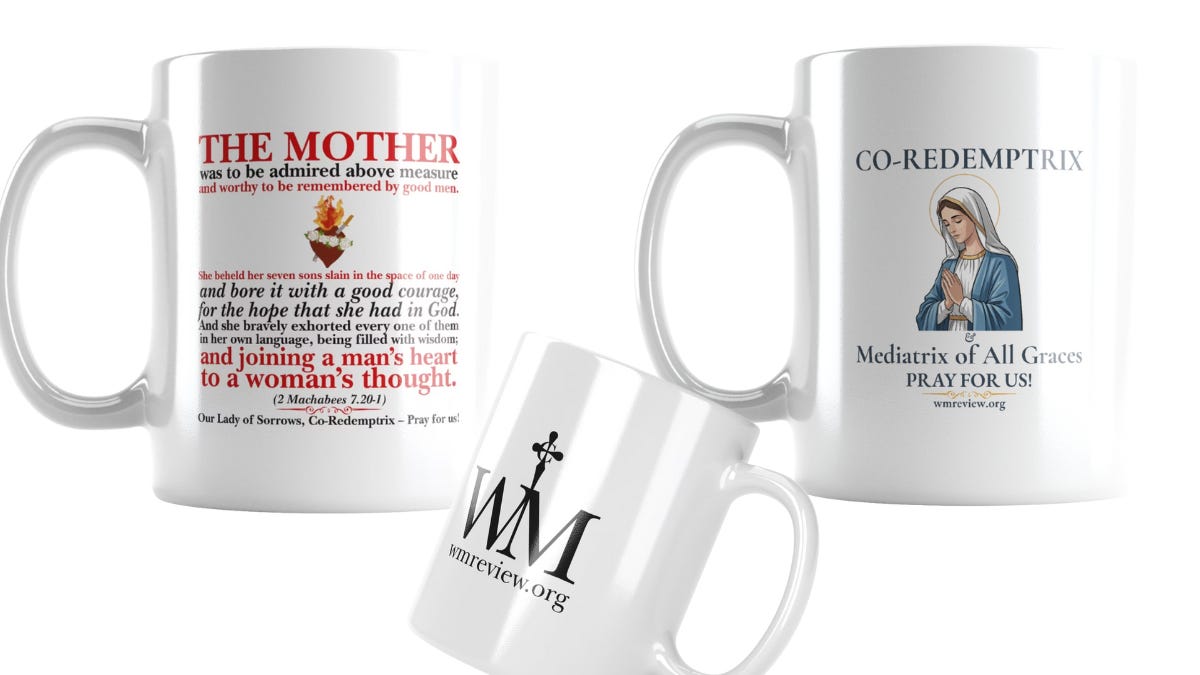
We also have our best-selling Co-Redemptrix mugs:
Follow on Twitter, YouTube and Telegram:
Twitter (The WM Review)


