
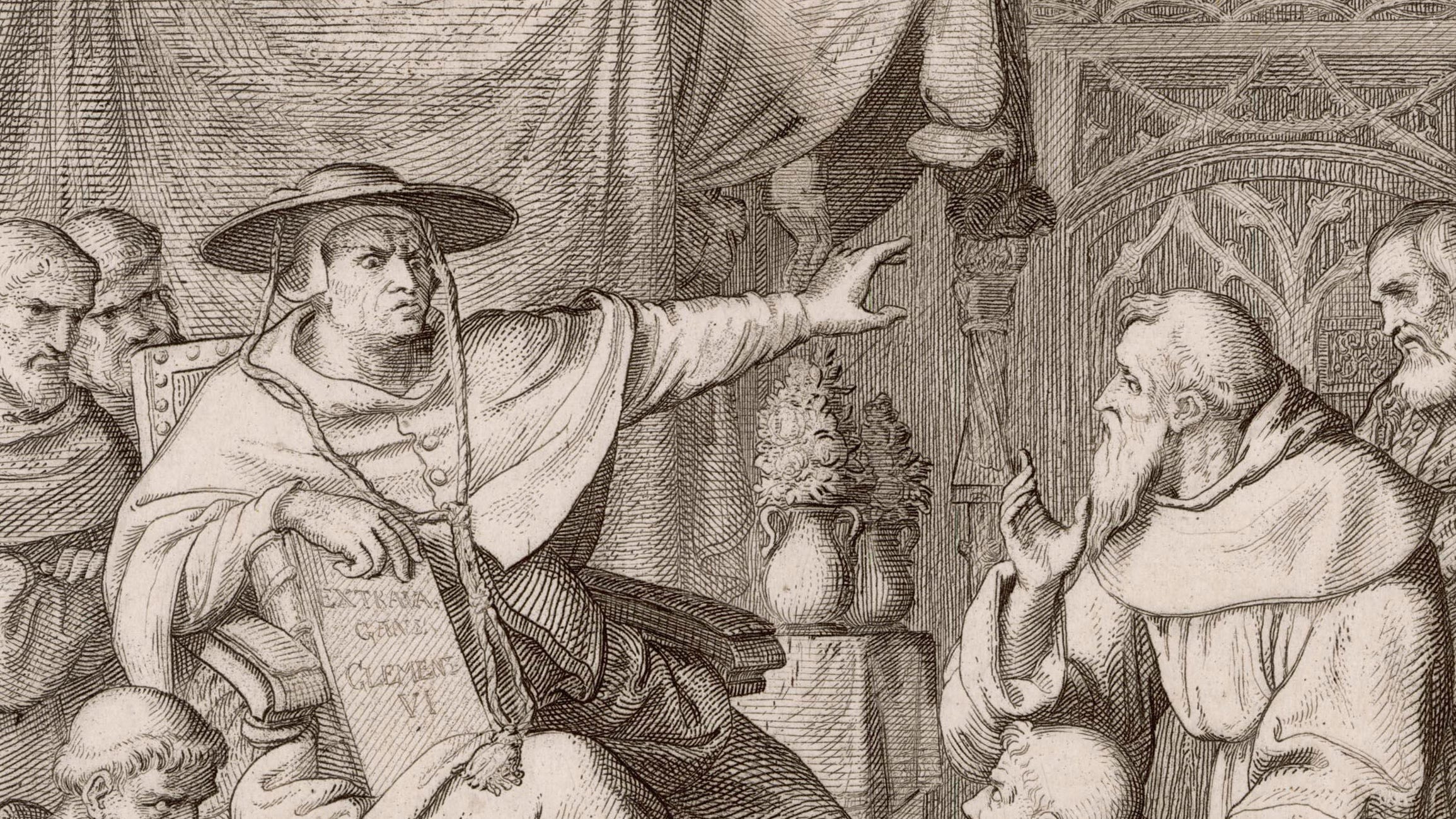
Excluding the question of heresy from his discussion, Cajetan considers whether other reasons might justify deposing a pope.
Editor’s Notes
The following text is from the scholastic theologian Cardinal Thomas de Vio Cajetan OP (1469—1534).
Cajetan was a famous commentator on St Thomas Aquinas and an influential theologian.
In his brief discussion on the possibility of a pope who tries to destroy the Church, Bellarmine refers readers to two specific treatments from Cardinal Torquemada and from Cardinal Cajetan.
Bellarmine refers readers to Chapter 27 of Cajetan’s treatise on the authority of pope and council, which we shall provide in due course. This present text is that of Chapter 24, in which Cajetan sets out the objections to be answered in Chapter 27.
Although these texts from Bellarmine—as well as Cajetan and Torquemada—have been presented to justify…
The possibility of a pope trying to destroy the Church through the profession and teaching of heresy and promulgation of evil laws, namely within the legitimate sphere of his authority
The continuing legitimacy of such a pope
The necessity of resisting this pope within this legitimate sphere of his authority.
However, this is not borne out in the particular texts, let alone in the immediate context of Bellarmine’s work.
As further proof of this, we are considering the texts to which Bellarmine points his readers—both of which are explicitly excluding doctrinal questions and that of a heretic pope, and considering issues such as simony, nepotism and profligacy.
Evil popes vs heretic popes
In fact, Bellarmine’s texts are dealing with an entirely different situation, namely a wicked, tyrannical or evil pope. As such, they cannot be taken as evidence that a true pope can destroy the Church doctrinally and in her laws whilst retaining office.
This is evident from Bellarmine’s own work, but it is also evident in the texts which he cites—including the below.
It does not include the teaching of heresy and error, the promulgation of evil laws and liturgy, or the imposition of a new religion.
Conclusion
It is well known that Cajetan was an advocate for the “fourth opinion”—namely, that a heretic pope should be deposed—and roundly refuted by St Robert Bellarmine in his chapter on the pope heretic question. That said, Cajetan seems to have later adopted the second opinion later in life.
Regardless, the key point of this text is that it provides an illustration of what Bellarmine had in mind, when writing his “resistance quotes.” He did not have in mind a heretic pope, or one whose attempts to destroy the Church involved imposing his heresy on the Church, or promulgating laws that run counter to the faith. As Bellarmine wrote elsewhere:
[T]he Pontiff is the shepherd and teacher of the whole Church; therefore, the whole Church is bound to hear him and to follow him; therefore, if he errs, the whole Church will err. [Therefore, he cannot err, at least as a public teacher.]1
As Chapter 24 presents objections, and as we are presenting it by way of context for Chapter 27, the following text should not be taken as a statement of doctrinal principles.
See also Torquemada here:

If you would like to be a part of maintaining The WM Review’s relentless flow of essays, texts and information, hit SUBSCRIBE today:
Can the pope be deposed for crimes other than heresy?
Cardinal Thomas de Vio Cajetan
Chapter 24: Wherein the opinion is set forth that the pope is subject to the power of the council, even to the point of deposition, in cases where, refusing to amend himself for some notorious crime, he causes scandal to the Church
Introduction to the objections
353. We have concluded explaining the nature of the relationship between the pope and the council in cases of heresy; it is now necessary to examine whether, in cases other than heresy, the pope is subject to the power of the council and may be deposed by it for a reason other than heresy.
First, we must address cases that pertain to the pope’s sins. Then, we shall discuss cases arising from certain circumstances.
354. Some, therefore, uphold the following opinion: that apart from the case of heresy, the pope can be deposed by a general council, and this is proven by seven reasons.
1. From the fact that heresy is a greater crime than others?
355. First, because of a crime: if the pope can be deposed for the crime of heresy, he can therefore be deposed for another crime as well.
356. Here is the proof of this inference.
In the first place, if the pope can be deposed, either:
This is only in the case of heresy because of the gravity of this fault—which cannot be the case, since hatred of God is a graver sin than heresy, as is shown in the Summa Theologica2
Or this deposition is justified because of the harm heresy causes to the Church—which also cannot be the case, since when he sells all benefices, elevates corrupt individuals to dignities, behaves as a tyrant, gives an example of vice, and is openly filled with blasphemy, avarice, etc., the pope causes greater harm to the Church than when he pertinaciously holds that the Holy Spirit does not proceed from the Son, while otherwise leading an honest life and being alone in maintaining this heresy.
In the second place, there is no indication in Holy Scripture that the pope may be deposed specifically for heresy rather than for another crime; this point is therefore left to the interpretation of theologians and ecclesiastical law. And just as Saint Boniface I, pope and martyr, referred to the case of heresy,3 in like manner one can admit the case where the pope is notoriously guilty of a crime and refuses to amend himself, which would cause scandal to the Church, as the Gloss understands regarding the same passage.
In the third place, because he who can do the greater can also do the lesser, as is stated in the Decretal4; thus, if the council can judge the pope for a graver matter, that is, heresy, it can also judge him for a lesser matter, for example, for notorious simony.
2. For abuse of power?
357. Secondly, because of an abuse of power.
For it is certain that one can and must take a weapon out of the hands of a madman; that one who attacks bodily life and kills must be imprisoned; and that one who obstinately clings to an erroneous position must be restrained.
If the pope were to act like a madman, leading souls to ruin and abusing the weapon that is papal power, how much more ought he to be deprived of it, as one would deprive a person in a state of delirium or drunkenness, dominated by his passions.
Indeed, by his example, such a pope incites others to sin, as the Apostle (Gal. 2.14) testifies when he says to Saint Peter, “You compel the Gentiles to Judaise”. The Gloss adds this comment: “by the example of your actions.”
And here is further proof: if the pope wanted to assault or kill a woman, one could rightly5 repel, strike, and kill him. A fortiori, if the pope commits violence against the Church and destroys souls, resistance must first be offered to him; and if necessary, he must be “killed” by proceeding to his deposition. This argument is confirmed by considering the purpose for which power was received, for this power is given for the building up of the Church and not for its destruction.
3. From papal obligations?
358. Thirdly, because the pope is bound by certain obligations.
Indeed, the pope is obliged to make reparation if he incurs infamy as a result of a scandalous crime.
Examples of this are found in the cases of popes Damasus,6 who was accused of adultery according to the testimony of Saint Jerome,7 Sixtus III,8 Leo IV,9 and Symmachus.10 Here is a rational proof of this: the pope is obliged to feed his sheep, and it is clear that scandal opposes this duty by producing the contrary effect. Now, if someone bound to make reparation does not fulfil this duty, they must be judged. Therefore, the pope can be judged by the Church for a crime other than heresy.
This is confirmed by the authority of Gregory IV,11 who says in the Decree:
“If anyone wants to quarrel with us about this point, or tries to diminish our authority, let them come to the Apostolic See, and there, before the confession of the blessed Peter, submit to a just examination, so that in this place one of us may receive his condemnation”.12
Gerson affirms that Pope Gregory acted thus not out of humility but because it was his duty.13
4. From the rights of the Church?
359. Fourthly, from the point of view of the Church.
For if the pope, who is the spouse of the Church, can hand her a bill of repudiation—as he does when he renounces the papacy—the same must hold for the Church, since in this respect it should not be considered that the two spouses do not share the same prerogative.
Against the pope, one can invoke a weighty reason in favour of the Church: either because the pope seeks to prostitute his spouse as much as he can, or because he intends to inflict cruel tyranny upon her by tearing her apart, wounding her, or wasting her goods, or because he attempts to exceed the rights he holds over her to harm her children.
Here is a confirmation of this argument: it belongs to the whole community to correct or depose the prince if he remains incorrigible, as Aristotle says in Book 5 of his Politics.14 Such power cannot be taken away from a free community, nor can it abdicate this power. How much more does this apply in the case of the Church?
5. From what God has provided the Church?
Fifthly, from the point of view of divine providence.
For “the works of God are perfect” (Deut. 32.4), and the Church is an institution that proceeds immediately from the hands of God, even more so than the Synagogue, to which God nevertheless said: “What more ought I to have done for you that I have not done?” (Isa. 5.4)
Therefore, God must have perfectly provided for the governance and constitution of the Church. But it is clear that if the body cannot remove from itself or heal a member that has fallen into corruption, and must endure that member to the evident detriment of the whole organism, this body is not perfect.
Similarly, if a government cannot safeguard the common good by removing from the political body those who manifestly and notoriously divert or exploit the common good, this government is not perfectly ordered.
Thus, if a pope notoriously causes scandal by engaging in simony, lust, blasphemy, tyranny, or by elevating the unworthy, he causes all these harms and manifestly acts against the good of charity, which is the common good of the Church militant and triumphant.
6. From the decrees of the Councils of Constance and Basel?
Sixthly, if we rely on the Decrees and acts of the councils of Constance and Basel.
For at the council of Constance, those whom the fathers of the council considered to be the true pope, John XXIII, as well as Benedict XIII, were deposed, each with the consent of his obedience.
At the council of Basel, Eugene IV was deposed,15 and Felix V16 was designated as pope. In earlier times, numerous pontiffs were deposed for reasons other than heresy,17 such as Felix II,18 Stephen VI,19 Christopher,20 Benedict IX,21 Gregory VI,22 and John XII.23
The argument from authority drawn from these councils is confirmed by the authority of many theologians who hold the same opinion as these councils, as can be seen in the Gloss on the Decree in the chapter Si papa and the passages that follow.24
7. From an analogy with human judgement?
Seventhly, if we consider human judgement—that is, a judgement proceeding from testimonies and probabilities or from what the judge presumes.
By virtue of this, it follows that a pope who is not a heretic could be deposed on mere suspicion of heresy on several occasions.
For instance, he might be presumed a heretic:
For having shown contumacy, as provided in the Sextus in the chapter Cum contumaciam25
Or because he remains under excommunication for a year without amending himself, as stated in the Extravagantes in the chapter Excommunicamus26
Or if, fearing danger of death, he externally performs acts signifying heresy, as is reported of Pope Marcellinus
Or if, under a similar fear, he utters heretical words without intending them
Or if he is convicted of relapse into heresy by the deposition of false witnesses
Or if he cannot prove his innocence in matters of faith.
For these and similar reasons, it is thought that in several cases where he cannot be amended, the pope is subject to the judgement of a general council, so that the council may depose him.
Cajetan answers these objections in Chapter 27, to follow shortly.
Read next:


HELP KEEP THE WM REVIEW ONLINE!
As we expand The WM Review we would like to keep providing free articles for everyone.
Our work takes a lot of time and effort to produce. If you have benefitted from it please do consider supporting us financially.
A subscription from you helps ensure that we can keep writing and sharing free material for all. Plus, you will get access to our exclusive members-only material.
(We make our members-only material freely available to clergy, priests and seminarians upon request. Please subscribe and reply to the email if this applies to you.)
Subscribe now to make sure you always receive our material. Thank you!
Follow on Twitter, YouTube and Telegram:
Translation based on Fr Jean-Michel Gleize FSSPX’s French translation ‘Le Pape et le Concile’. English Base text translated by AI, each line scrutinised by a human. Headings and line-breaks added by The WM Review. Selected footnotes from Fr Gleize’s translation included.
St Robert Bellarmine, Controversies of the Christian Religion, trans. Fr Kenneth Baker SJ, Keep the Faith Press, USA, 2016, 970. On the Roman Pontiff, Book IV, Ch. III, 963
2a 2ae, q. 34, a. 2
DG 1, 40, 6: Si papa
X, de decimis 3, 30, 27: Ex parte
Fr Gleize’s note:
We thus translate the Latin expression cum moderamine inculpata tutela, taken from Innocent III (X, de homicidio V, 12, 18). It can be translated literally as: “with moderation as is required without fault by prudence.” It characterises legitimate self-defence.
Saint Damasus I was elected pope on 1 October 366 and died on 11 December 384. According to the Liber Pontificalis, Damasus was suspected of involvement in a moral scandal: it was a converted Jew, Isaac, who in 374 brought a criminal case against the pope. Damasus was acquitted of the accusation.
Cf. Françoise Monfrin, “Damasus” in DHP, p. 536.
Cf. DG 2, 2, 7, pars VI, § 9. The testimony is not that of Saint Jerome, but of Pope Anastasius I (399–402), PL 128, 73.
DG 21, 7. Saint Sixtus or Xystus III was elected pope on 31 July 432 and died on 19 August 440. Cf. Christine Fraisse-Coué, “Sixtus III” in DHP, p. 1590. An apocryphal narrative from the 6th century (Gesta de Xysti purgatione, recounting a trial that was allegedly brought against the pope) is the only echo that has come down to us of opposition encountered by the pope in Italy.
DG 2, 2, 7, 41; † 17 July 855, he was elected pope at the end of January 847. Cajetan likely alludes to the conflict between the pope and Louis II, King of Italy and crowned emperor in 850, who became the sole holder of the imperial dignity after the death of his father Lothair in 855. In June 855, the emperor even arrived in Rome to personally investigate various statements allegedly made within the papal entourage. On this occasion, the pope agreed to exonerate himself before Louis II. Cf. E. Amann, “Léon IV” in DTC, vol. IX, first part, cols. 313–314. The incident is reported in the Liber Pontificalis.
DG 2, 2, 7, pars VI, § 10. Upon the death of Pope Anastasius II, the clergy of Rome gathered in the Lateran to elect his successor Symmachus on 22 November 498. However, a minority group assembled at Santa Maria Maggiore and elected the priest Laurentius. The Ostrogoth king Theodoric took charge of the matter and decided in favour of the first election; by March 499, Symmachus was recognised by the entire Roman clergy. But two years later, the supporters of Laurentius reignited the dispute, accusing the pope of attempting to reform the date of Easter, fixing it on 25 March according to the Roman computus instead of following the Alexandrian computus, which set it on 22 April. Symmachus was summoned to the court at Ravenna, where graver charges (simony and debauchery) were prepared against him. The conflict lasted until 506, when King Theodoric withdrew his support from Laurentius’ partisans. Cf. Claire Sotinel, “Symmaque” in DHP, pp. 1609–1610, and E. Amann, “Symmaque” in DTC, vol. XIV, second part, cols. 2984–2986.
† 25 January 844, Gregory IV was elected pope at the end of 827.
DG 2, 2, 7, 42: Si quis.
De auferibilitate papa ab Ecclesia, consideratio, 12a.
Aristotle, Politics Book III, Ch 10.
In the 34th session of 25 June 1439. Cf. A. Baudrillart, “Bäle” in the DC, t. II, col. 124.
Amadeus VIII of Savoy (1383–1451) was elected antipope by the council of Basel on 5 November 1439 and renounced the papacy on 7 April 1449. He was the father of five children and was not a priest. After his widowhood, he retired to his castle on the shores of Lake Geneva, the Ripaille estate, to live as a hermit. This somewhat ridiculous choice is explained by his significant political position as Duke of Savoy (the Duke of Savoy was always considered the “gatekeeper of the Alps”) and because, through his wife, he was the uncle of Philip the Good, Duke of Burgundy.
Cajetan here follows John of Torquemada in his Summa de Ecclesia, Book II, Chapter 103.
† 25 November 365, Felix II was, in fact, an antipope from the end of 355 to 358. His rise to the See of Rome was orchestrated by Emperor Constantius, who sought to appoint a successor to Pope Liberius (352–366), whom he had exiled. When Liberius returned from exile in 357, confusion ensued, as the emperor wanted to recognise two bishops simultaneously on the Apostolic See, while the Romans demanded “one God, one Christ, one bishop.” The schism ended with Felix’s death, shortly before Liberius’ own death. Felix does not appear in the list of bishops compiled by Optatus of Milevis, but curiously, the Liber Pontificalis includes a notice about him between Liberius and Damasus I. Cf. Élisabeth Paoli, “Félix II” in DHP, pp. 670–671.
† August 897, Stephen VI was elected pope at the end of April or the beginning of May 896. Towards the end of June 897, he was imprisoned, deposed, and incarcerated.
This antipope, a cardinal-priest of the title of San Lorenzo, was elected in September 903 upon the death of Pope Leo V and deposed in January 904 during the pontificate of Sergius III. Cf. Klaus Herbers, “Christophe” in DHP, p. 357.
Theophylactus of Tusculum was pope from 21 October 1032 to September 1044; from 10 March to 1 May 1045; and from 8 November 1047 to 16 July 1048. He died at the end of 1055 or the beginning of 1056. Initially opposed by an antipope, Bishop John of Sabina, who took the title of Sylvester III in January 1045, Benedict IX eventually abdicated on 1 May 1045 in favour of Archpriest John Gratian, who assumed the name Gregory VI. The latter was deposed by Emperor Henry III, who orchestrated the election of Bishop Suidger of Bamberg under the name Clement II in December 1046. Upon Clement II’s death in October 1047, the Tusculani faction reinstated Benedict IX in Rome. However, the emperor opposed him and ensured the election of Bishop Poppo of Brixen under the name Damasus II on 25 December 1047. Damasus II died in August 1048, and his successor, Saint Leo IX, excommunicated Benedict IX. In the course of 1054, Benedict IX retired to the monastery of Grottaferrata, where he spent the rest of his days. Cf. Klaus-Jürgen Hermann, “Benoît IX” in DHP, pp. 203–205.
Cf. the previous note. John Gratian was pope from 1 May 1045 to 24 December 1046, when he was deposed by Emperor Henry III. He died in exile at the end of 1047. He must not be confused with the antipope who bore the same name from May 1012 to April 1013 during the legitimate pontificate of Benedict VIII.
Octavian (937–964) was the son of the lord of Rome, Alberic of Spoleto. At Alberic’s command, the Roman nobility designated his son as pope, who took the title John XII on 16 December 955. Emperor Otto I deposed him on 4 December 963 and arranged the election of the protoscriniarius Leo, who assumed the title Leo VIII. In February 964, John XII presided over a synod in Rome to depose and excommunicate Leo VIII. However, he died during this period, on 14 May 964. Cf. Rolf Grosse, “Jean XII” in DHP, pp. 936–937.
Gloss on DG 1, 40, 6: Si papa
VI de haereticis 5, 2, 7: Cum contumaciam
X, de haereticis 5, 7, 13: Excommunicamus