

Now fully available: The Conciliar/Synodal Church cannot be the ‘perpetually visible Church’, because it visibly lacks the four properties mentioned in the Creed.
Preface to Part II
Notice, 5 June 2026: Having released all chapters separately, we are now making the full document available for all readers.
We aim to publish Part III on indefectibility next week (week commencing Sunday 7 June 2026).
This is the second part of a response to Fr Thomas Crean OP’s article “A City Set on a Hill Cannot Be Hidden: The Perpetual Visibility of the Catholic Church Under the Pope.”
Fr Crean’s article was published on Dr Peter Kwasniewski’s Tradition and Sanity Substack, as well as the Pelican+ platform. Dr Kwasniewski advertised this article as “a definitive rebuttal of sedevacantism, at the level of first principles.”


Part I of my response demonstrated that Fr Crean’s treatment of “first principles” was radically insufficient. It considered first what it means for the Church to be visible – namely, that she be distinctly visible as the true Church of Christ. I explained that this is so through the necessary properties of unity, holiness, catholicity and apostolicity which are manifested as the four notes (or marks) of the Church. The nature of this distinct visibility was overlooked by Fr Crean, who reduced the question to the presence of the papacy.
I also explained that this visibility may be reduced or obscured, making the notes of the Church difficult to verify. I provided authorities, such as St Robert Bellarmine, Cardinal Henry Edward Manning, Dom Prosper Guéranger and more, in support of this truth.
Part II is extremely long and detailed (over 30,000 words), and is best read as a whole. We published it in full first for WM+ members, and then released each of the five chapters separately for all readers. Here they are by chapter:
Introduction, and Chapter I: Unity
Chapter II: Holiness
Chapter III: Catholicity
Chapter IV: Apostolicity as a Mark
Chapter V: Apostolicity as a Property
Conclusion: ‘Hovel in the Valley’
We have also discussed each of these chapters of Part II, as well as Part I, with Stephen Kokx on YouTube with Kokx News and Integrity Magazine:
Video: Visibility
Video: Unity
Video: Holiness
Video: Catholicity
Video: Apostolicity as a Mark
Video: Apostolicity as a Property
Video: Conclusion
Although Fr Crean only published a short and popular article, it contained many claims that need to be addressed. This takes time and ink. We are grateful to him for prompting such a response, which has ranged over many different topics.
Substantial work of this length and depth is only possible thanks to those who subscribe to WM+, to whom I am very grateful.
If you would like to be a part of making this kind of work possible – including the subsequent parts of my response to Fr Crean – then sign up to WM+ today:
‘ZERO MARKS’ – WHY THE CONCILIAR/SYNODAL CHURCH IS NOT THE CATHOLIC CHURCH
CONTENTS
Preface
Introduction
Recapitulation
The properties as notes
Chapter I: Unity
What is unity?
Unity of Faith as the most important aspect
How the note of unity may be obscured – or the property absent
The Conciliar/Synodal Church and unity
More surveys revealing the disunity of the Conciliar/Synodal Church
The 2014 Univision ‘Global Survey of Roman Catholics’
The disunity of faith and its source
Conclusions on the property of unity
Chapter II: Holiness
What is holiness?
I. The note of holiness
1. The holiness of past members
Canonisations in the Conciliar/Synodal Church
2. Institutes of Perfection
Institutes of Perfection in the Conciliar/Synodal Church
II. The absence of the property of holiness
Fr Crean as a witness to the unholiness of the Conciliar/Synodal doctrine
Treating that which is holy with contempt
Conclusions on the property of holiness
Chapter III: Catholicity
What is catholicity?
How the property of catholicity could be lacking
The Eastern Schismatics
Rejection of evangelisation with the euphemism of ‘proselytism’
Treatment of false sects as legitimate
What this means for the catholicity of the Church
‘No mission to the Jews’
The prevalence of these ideas in the Conciliar/Synodal Church
Conclusions on the property of catholicity
Chapter IV: Apostolicity as a Note
What is apostolicity?
Apostolic Succession
Formal and material succession
Fr Crean’s reduction of visibility to a claim to material succession
The exercise of apostolic authority
Renunciation of apostolic authority
The renunciation of authority continues
What are the consequences for this renunciation of authority?
Conclusions on the note of apostolicity
Chapter V: Apostolicity as a Property
Rupture with apostolic doctrine
Some specific ruptures with apostolic doctrine
Is the Conciliar/Synodal Church apostolic in origin?
Questions asked about the Conciliar/Synodal Church
Conclusions on apostolicity
Conclusion to ‘Zero Marks’
Appendix
Bishop Tissier de Mallerais and the ‘four causes’ of the Conciliar Church
References and Notes
Introduction
Let us begin with a clear statement of my definition of the Conciliar/Synodal Church, my thesis, and a clarification:
Definition: By “Conciliar/Synodal Church,” I mean the body of men who recognise Leo XIV as their Pope and spiritual leader, claim to be subject to him, and whom he (and his officers) recognise as being in good standing with him. This body of men is taken by many to be the Roman Catholic Church, and it is this body which Fr Crean seeks to defend.
Thesis: The Conciliar/Synodal Church, considered as such, is not the Roman Catholic Church.
Clarification: By “not the Roman Catholic Church”, I mean that this body of men, considered as such, is not identical with the Roman Catholic Church. Taken as defined, it is a body composed of both Catholics and non-Catholics and lacks certain essential properties of the Roman Catholic Church; for this reason, it cannot be identified with that Church. The thesis therefore concerns the identity and nature of the body itself, considered as a social reality or accidental aggregation, rather than the status of the individuals within it. It does not deny the continued visibility of the Catholic Church; rather, it denies that this visibility, and membership of the Church, are determined by the boundaries of the Conciliar/Synodal Church as defined. Accordingly, it does not imply a) that this body constitutes a false sect (since it is an accidental aggregation of Catholics and non-Catholics, rather than a true society); b) that no Catholics exist within it; or c) that a man ceases to be a Catholic simply by being included in this body. Some of these points are clarified in Zero Marks, or will be clarified further elsewhere.
In this second part, we will turn to the four notes themselves. I will explain:
How each of the four properties is manifested as a note
How these notes may be obscured
How the properties may be shown to be absent in a body claiming to be the Church
That these properties are in fact absent in the so-called “Conciliar/Synodal Church.”1
Archbishop Marcel Lefebvre made similar comments in a conference at a priests’ retreat, published in Nov–Dec 1988:
“You continue, and you really represent, the Church: the Catholic Church. I think you need to be convinced of this: you really represent the Catholic Church.
“Not that there is no Church outside of us; that is not the point. But lately we have been told that it is necessary for Tradition to enter the visible Church. I think that this is a very, very serious mistake.
“Where is the visible Church? The visible Church is recognised by the signs she has always given for her visibility: she is one, holy, catholic and apostolic.
“I ask you: where are the true marks of the Church? Are they more in the official Church (it is not the visible Church, it is the official Church) or in us, in what we represent, what we are? […]
“It is not we, but the modernists, who depart from the Church. As for saying “to leave the visible Church,” that is a mistake, for it confuses the official Church with the visible Church. […]
“To leave, then, the official Church? In a certain measure, yes, obviously.”2
The Archbishop gives an account of the four notes in this conference, which is necessarily brief and, in some places, imprecise. This piece is a significantly more detailed and precise account of these four notes, how they manifest the underlying properties, how they may be obscured (and thus difficult to verify), and how the properties may be shown to be absent.
As I stated previously, our contention neither means nor implies that the Conciliar/Synodal Church is itself a false sect, nor that its “members” are necessarily non-Catholics simply by being involved with it. Part of the reason for this is wrapped up with the faulty understanding of authority on the part of the Conciliar/Synodal “hierarchy”, as we shall discuss in Chapter IV.
The properties as notes
I have previously stated the four general criteria by which a property may be treated as a note:
A necessary property – i.e., a property which cannot be absent in the Church of Christ.
Visible – internal or invisible qualities cannot distinguish the Church unless they are manifested mediately or indirectly
More easily known as a fact than the truth of the body’s claim to be the Church – because it is proper to argue from what is more certain to establish what is less certain.
Easily knowable – e.g., unity of faith is more easily knowable than unity of the true faith; material succession is more easily knowable than legitimate formal succession.
This was explained in greater detail in Part I. The necessary properties to be manifested as marks are unity, holiness, catholicity and apostolicity.
Fr Berry writes:
“It follows, then, that any Church lacking a single one of these marks cannot be the Church of Christ, and any Church possessing all of them must be the true Church of Christ.”3
The theologian Fr Joachim Salaverri SJ explains how each of the four properties mentioned are manifested as notes, according to the above criteria:
“[T]he four properties of the Creed are Notes of the true Church, not under every respect but under a certain respect, that is, we are taking the unity and catholicity not of right, but of fact; the apostolicity of succession not formal, but material; moral holiness not as internal, but as evident in good works. For, under other respects we are not completely certain that they assume the character of a Note.”4
As noted in the previous part, Cardinal Billot taught that the visibility of the Church “is the visibility of believability from the four marks which we discussed earlier, by which it is clear that we should believe by faith that this is the only legitimate and genuine religion out of all the religious societies in the world.”5
Billot also observes that:
“[A]ll theologians agree unanimously [in the links between visibility, the four marks and the hierarchy] as in a most firm dogma.”6
The same doctrine is taught by the canonists Wernz and Vidal,7 as well as Vatican I8 and – as we saw above – Archbishop Lefebvre.
What does this mean – both in itself, and for Fr Crean’s argument?
Let us consider each property/note in turn.
This essay is long and detailed, addressing the four notes and properties in five chapters.
As it is best read as a whole, we are first publishing it in full for WM+ members, and then will be releasing each chapter separately for all readers.
Priests, religious and seminarians can contact us for free membership and full access.
Chapter I: Unity
NB: I discussed this chapter with Stephen Kokx over at Kokx News:
What is unity?
The Church is one in faith, government and worship. Being “one Church” does not just mean that Christ has only one true Church. This is, in fact, the Church’s unicity; treating unicity as a note would be begging the question, as any individual sect could claim to be the one Church of Christ.
Instead, the property of unity means that the Church is internally and externally one, or united.
The Church is one by right and in fact. She is one by right, in that Christ gave his true Church the power to demand and enforce the unity with which he endowed her.9 But this property of unity is visible only insofar as it is manifested externally: this is why unity is a note insofar as it is unity of fact.
Christ’s prayer before his Passion indicates that he efficaciously willed a unity for his Church which would distinguish her as his Church:
“[N]ot for them only do I pray, but for them also who through their word shall believe in me. That they all may be one, as thou, Father, in me, and I in thee; that they also may be one in us: that the world may believe that thou hast sent me.
“And the glory which thou hast given me, I have given to them: that, they may be one, as we also are one. I in them, and thou in me: that they may be made perfect in one: and the world may know that thou hast sent me and hast loved them, as thou hast also loved me.” (John 17.20-23 – emphases added)
Louis Cardinal Billot explicitly links this prayer – which he said must infallibly be fulfilled10 – to the notes of the Church:
“[T]his unity is implored by Christ so that it may be a sign of his mission and a mark of the true Church. […]
“Therefore this unity – besides the fact that it is expressly placed in a visible and manifest reality – cannot belong to any false church. For it is asked as a manifestation of the singular love with which the Father loves the Church, as though embracing the Son together with his spouse in one love.
“Likewise it must stand as a perpetual argument, commending before the world the very mission of Christ.”11
Billot also describes this unity as “the principal property with which [Our Lord] wished to clothe his Church forever.”12
The Church is normally treated as being necessarily and visibly united in three ways:
In government
In worship
In faith.
Let us examine these three ways in which the Church is united.
Unity of Government (also referred to as communion or social charity) is, as Salaverri says, “the agreement of wills working for the same social end under the supreme power of the Church of ruling.”13
We shall defer dealing with the Church’s government to our discussion of the Apostolicity of the Church – the fourth of the four properties. In the meantime, here is Cardinal Billot’s explanation of how the role and raison d’être of the unity of government is to ensure the unity of faith and charity:
“The unity of government is in reality the principle that generates and preserves the other two – one of which concerns the intelligence [faith] and the other the will [charity].”14
We shall see in this chapter that the Conciliar/Synodal Church’s alleged “unity of government” cannot be said to produce unity of intelligence/faith at all; and without faith, it is impossible to have charity.15
Unity of Worship is, to cite Salaverri again, “harmony in the celebration of sacrifice and in the use of the sacraments and of liturgical acts, under the supreme power of the Church of sanctifying.”16
The note of unity is not impaired by different liturgical rites (i.e., the Byzantine rite, etc.) because they are all expressions of the same faith. As the theologian Fr Berry writes:
“[T]he Sacraments, sacrifice, prayer, and other acts of worship,—not only demand, but in fact are, outward professions of faith, and that the one faith taught throughout the world.”17
The main focus of this treatment will indeed be the Conciliar/Synodal Church’s disunity of faith – but let us pause to consider whether it can claim to be united in worship.
Do we see visible “harmony in the celebration of sacrifice” in the Conciliar/Synodal Church? The liturgy is one of the most controversial issues in that milieu – with groups calling for the suppression of either the traditional Roman rites or the Novus Ordo rites, refusing to attend one or the other set of rites, and hurling insulting epithets at each other.
Further, in the main form of worship, there is not even visibly a sacrifice: and the sacrificial nature of the liturgy has been consistently downplayed since the definition of the Mass given in the original Institutio Generalis:
“The Lord’s Supper or Mass is the sacred assembly [synaxis] or congregation of the people of God gathering together, with a priest presiding, in order to celebrate the memorial of the Lord. For this reason, Christ’s promise applies supremely to such a local gathering of the Church: ‘Where two or three come together in my name, there am I in their midst.’ (Mt 18:20).”18
As “The Ottaviani Intervention” of 1969 said, of both this definition and the rite itself:
“As is only too evident, the emphasis is obsessively placed upon the supper and the memorial instead of upon the unbloody renewal of the Sacrifice of Calvary. The formula ‘The Memorial of the Passion and Resurrection of the Lord’, besides, is inexact, the Mass being the memorial of the Sacrifice alone, in itself redemptive, while the Resurrection is the consequent fruit of it.”19
The Institutio Generalis was “clarified” to some degree, in part due to the protests of the faithful.20 But although the bare wording of the definition was improved, the “obsessively placed” emphasis on away from the sacrificial nature of the Mass remains in the Novus Ordo rite. In other words, the sacrificial nature of the Novus Ordo is at least difficult to perceive (to put it mildly).
We do not see a great deal of “use of the sacraments and of liturgical acts” at all. Vatican II saw an enormous number of Catholics ceasing to practise their religion altogether – and today, a similarly enormous number of self-identified Catholics either rarely or never attend Mass at all. For many self-identified Catholics, the sacrament of Penance is simply not a part of their life – which is often offered during short windows of time or only upon request. The state of teaching, practice, discipline and oversight also means that one can have little confidence in the baptisms of Conciliar/Synodal ministers, given the proliferation of videos which indicate at least doubtful or even invalid administration. Even if the Conciliar/Synodal Church might be said to maintain unity of worship, it has at least been obscured.
Finally, as unity of worship is an expression of both unity of faith and charity, it is clear that a body which is disunited in faith can be united in neither worship nor charity.
Unity of Faith pertains to the Church teaching, believing and professing the same doctrine. But internal belief is only manifested insofar as it is professed externally, and so only teaching and professing the faith pertain to the note of unity.
Today, many appear to reduce unity to that of government, but of the three manifestations of unity mentioned above, unity of faith has traditionally been treated by theologians as the most fundamental. Billot not only described unity as the “principal property” of the four in question, but also stated that this “principal property” itself consisted principally in the external profession of faith:
“This unity consists principally in the common profession of the same faith, taught by a social magisterium.”21
Elsewhere, he states that unity of faith is “the most important aspect of the note of unity,” and that “unity of communion” (or government) presupposes it.22
Unity of Faith as the most important aspect
Pope Leo XIII taught:
“Agreement and union of minds is the necessary foundation of this perfect concord amongst men, from which concurrence of wills and similarity of action are the natural results.
“Wherefore, in His divine wisdom, He ordained in His Church Unity of Faith; a virtue which is the first of those bonds which unite man to God, and whence we receive the name of the faithful – ‘one Lord, one faith, one baptism’ (Eph. iv., 5).
“That is, as there is one Lord and one baptism, so should all Christians, without exception, have but one faith.”23
He draws out the consequences of this as follows:
“The Church, founded on these principles and mindful of her office, has done nothing with greater zeal and endeavour than she has displayed in guarding the integrity of the faith. Hence she regarded as rebels and expelled from the ranks of her children all who held beliefs on any point of doctrine different from her own. […]
“The practice of the Church has always been the same, as is shown by the unanimous teaching of the Fathers, who were wont to hold as outside Catholic communion, and alien to the Church, whoever would recede in the least degree from any point of doctrine proposed by her authoritative Magisterium.”24
This is why the Church is defined as “the congregation of the faithful,” and why Pope Pius XII reaffirms that membership of the Church depends, among other criteria, on “profession of the true faith.”25 It is also why heresy, at least when publicly manifested, is one of three sins that severs a man from the body of the Church.26
As previously noted, Billot teaches that the unity of faith primarily depends on the exercise of the Church’s teaching authority:
“[I]t is established first that what is implied is a unity which depends upon the public magisterium as upon its proper principle, because this is what the nature of social unity requires.”27
This unity is thus manifested in this primary sense by the actual, visible submission of all the faithful to the teaching authority of the magisterium.28
He continues, explaining that it is manifested in a secondary sense – though perhaps more obvious to us as a striking sign of God’s Church – through the united external profession of all the dogmas of the Catholic religion, by all the faithful:
“It is established second that what is implied is a unity which prevails with respect to all matters of belief, and not with respect to only certain so-called ‘fundamental’ articles – with contradictory and mutually conflicting professions meanwhile existing regarding the remaining non-fundamental articles – because this is repugnant to the nature of the faith of which unity is predicated.”29
Unity of faith is also the most striking aspect of this property as a note. Any society may be united in its recognition of an authority, or in its ritual observance – but no society except the Church has ever manifested a unity of faith like that of the Church. Fr Berry describes this unity as follows, treating it as so obvious as not to require any proof:
“Unity in the profession of faith is a natural consequence of the unity of doctrine; a mere corollary to be explained rather than proved.”30
But even as a “natural consequence” of the unity of doctrine (or teaching), the unity of profession was understood to be an evident, striking fact, sufficient to mark the true Church from false claimants. This is taken as a given everywhere, whether it be magisterial documents, theology textbooks or catechisms for the instruction of children. As an example of the latter, the 1649 Douay Catechism provides a succinct summary of that in which the unity of profession consists:
“All her members live under one evangelical law, obey the same supreme head, and profess the same faith even to the least article, and use the same sacraments and Sacrifice.”31
The striking character of this note is expressed beautifully by M.J. Rhodes:
“Though they may be utter strangers to each other in the flesh, and divided in temporal position as far as men can be divided from their fellow-men, there will be found one and the self-same faith, one and the self-same rule of morals, the self-same sacraments, and the self-same belief respecting those sacraments; there will be found but one mind, one heart, and one voice, as regards all the doctrines and commandments of the Church. This is unity, and it is divine; it is no mere human coincidence or contrivance. The finger of God is here, reversing the confusion of Babel. It is the unity of God’s one Church throughout the universal globe; and it has been her unity through more than eighteen centuries and a half.
“It is a matter to be looked to, and a test to be applied, for the absence of such unity denotes the absence of God.”32
As is clear, this visible unity of faith, both in teaching and in doctrine, is not an ideal, or something that can be achieved or lost at different times.33 It is a necessary property, visible to the senses, so remarkable as to be a note of the Church, and so necessary that its absence is that a given body is not the Church.
How the note of unity may be obscured – or the property absent
All three aspects of the note of unity may be accidentally obscured, whilst unity remains present as a property (and even as a visible note), through factors such as:
Individuals confused or erring in good faith about settled questions, provided that they remain actually and visibly submissive to the supreme authority of the Holy See34
Fierce debates about matters, even doctrinal, which have not been definitively settled or are not on the level of dogma and divine revelation
Multiple papal claimants or other such crises, such as in the Great Western Schism35
Extended vacancies of the Holy See or of various diocesan sees, in which those subject to the respective authorities would be deprived of the actual exercise of authority which maintains the Church’s unity of faith36
It may also be the case that this visibility is obscured by the Church refraining from taking positive action against every individual public heretic. But, as Berry says:
“It is a well-known fact that the Church has always demanded the strictest unity in the profession of faith; those who refused to profess even a single doctrine, were condemned as heretics who had already ceased to be members.”37
Such public heretics are already visibly disunited from the Church. We will address this potential objection further below.
In spite of such accidental obscuration caused by any of these factors, the Church would remain united, and even visibly so.
However, the property of unity is manifestly absent – as opposed to obscured – when phenomena exist that are incompatible with the property of unity itself. Consider Cardinal Billot’s comparison between the marks of holiness and unity, emphasising the fundamental impossibility that a body divided in faith could be the Church:
“The holiness of the members we are talking about here concerns individuals directly – and it is indirectly, through these individuals, that holiness can be attributed to the society whose visible principles and mediations contribute to produce this life of grace.
“Unity, however, deals immediately with the collectivity itself, from which it removes division in the profession of faith. Furthermore, the wicked in the Church do not prevent it from containing saints as well, who show it to be true. But if heretics were in the Church, they would formally remove the indivisibility of the society which is of the very definition of unity.”38
If the Church is necessarily united in its external profession of faith, then a body which is not so united – or even has multiple religions being professed within its boundaries – shows itself by that fact not to be the Church.
The Conciliar/Synodal Church and unity
Fr Crean, and others of the same mind, wish to tell us that the self-styled Conciliar/Synodal Church is the “perpetually visible Church.” But this body of men is visibly disunited in faith.
Large percentages of its adherents openly reject what they know to be Church teaching, and express disregard for the exercise and authority of the Roman magisterium.
Consider the results of the 2019 Pew Research survey What Americans Know About Religion. Only 31% of the American Catholics polled professed belief in the dogma of transubstantiation – with the other 69% claiming that “the bread and wine used in Communion ‘are symbols of the body and blood of Jesus Christ.’”39
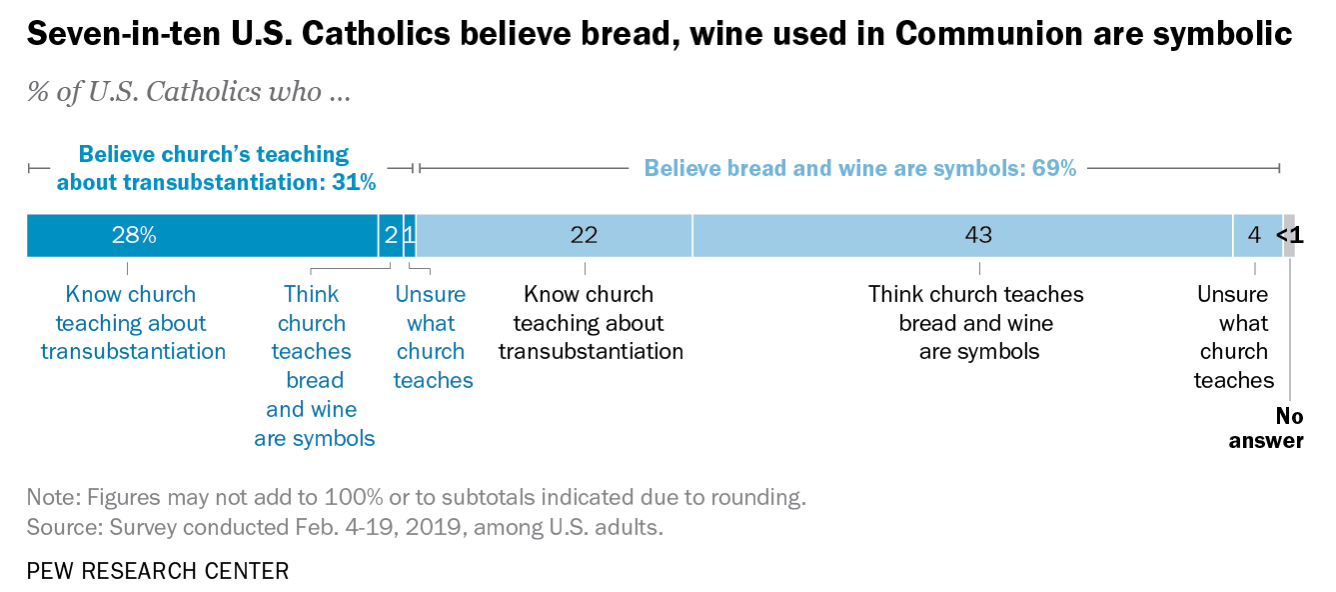
Nearly a third of this latter group – over 22% of those polled – stated that they were aware of the Church’s actual teaching, and yet rejected it. The same poll found that even 37% of respondents who were weekly Mass-goers did not accept the teaching of the Church on this matter.
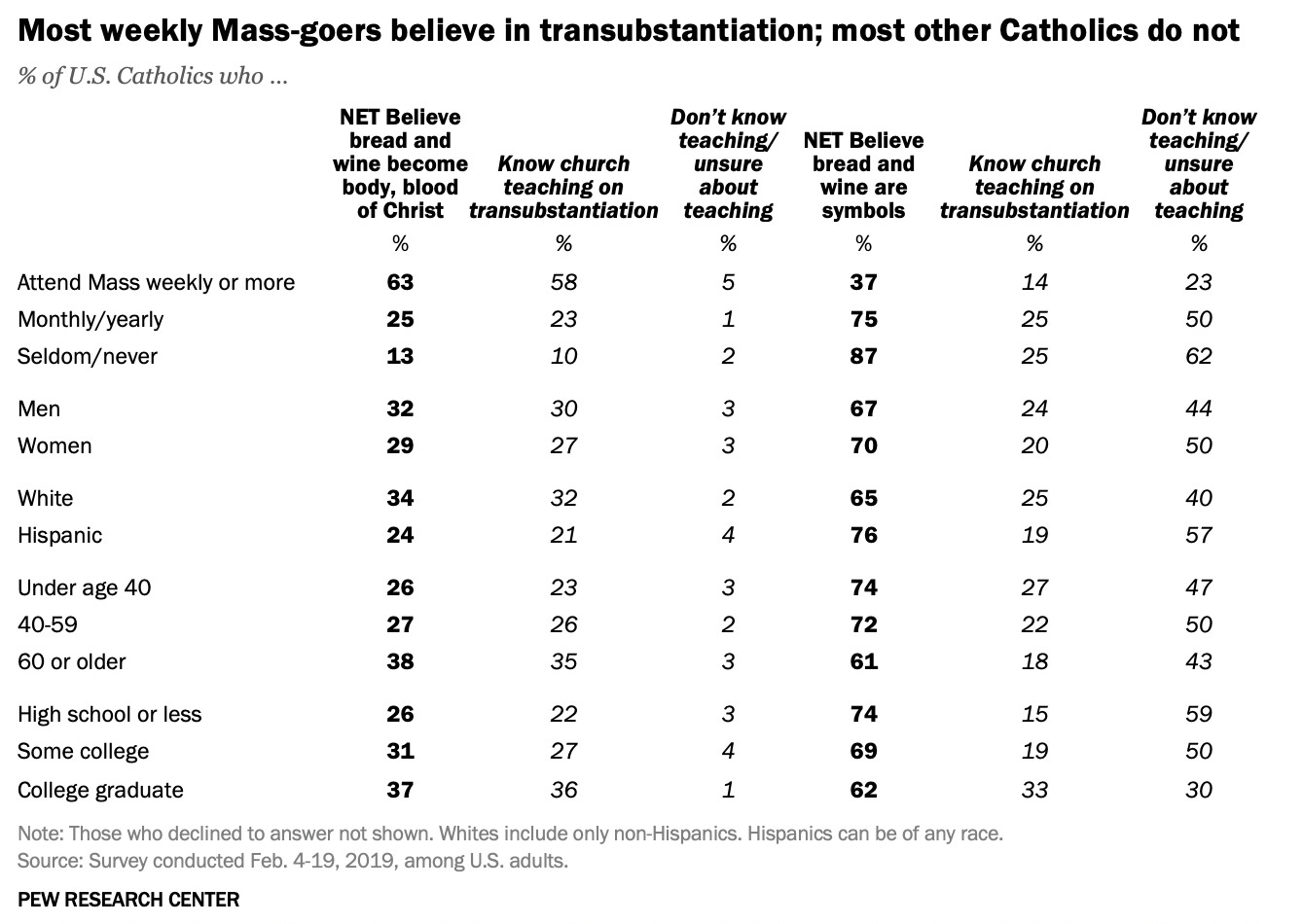
A survey like this reveals the existence of three basic groups:
Those who believe and profess belief in this dogma
Those who do not believe or profess belief in this dogma, but who may be erring in good faith, and may still be submissive to the magisterium
Those who knowingly and openly reject both the dogma and the magisterium which proposes it.
And yet all of these people are generally considered to be Catholics, and as members of the Catholic Church.
Another survey from Pew Research Center (2002) found startling division on the matter of abortion. Only 53% of those identified as Catholics believed abortion was morally wrong.40 76% of respondents claimed that abortion should be legal in some cases; 13% said that it should be legal in all cases. Only 10% said that it should be illegal in all cases.41 .
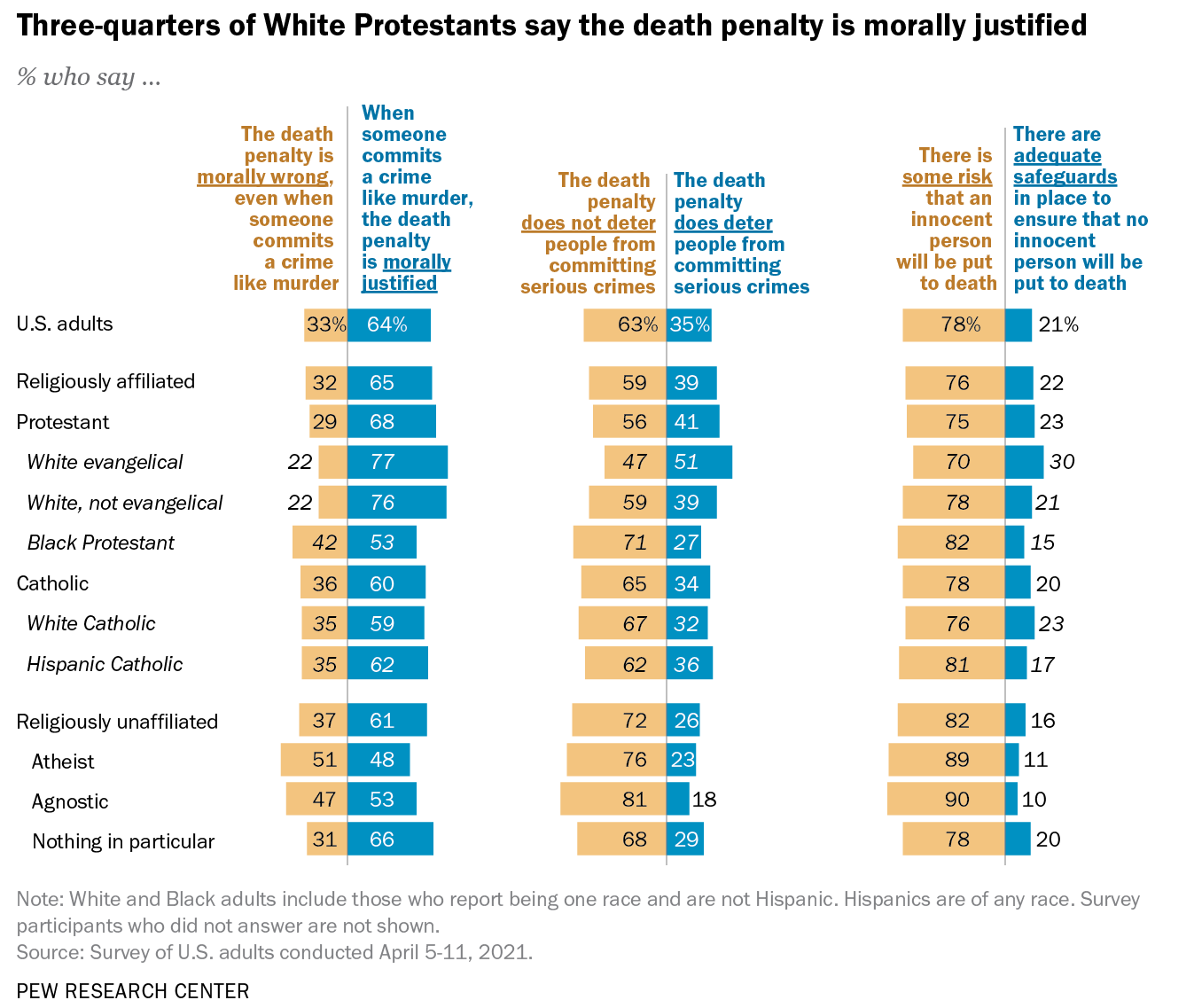
A 2021 Pew Research Center survey found that 36% of American Catholic respondents consider the death penalty to be morally wrong.42
Fr Crean himself rightly stated:
“To claim that capital punishment is intrinsically evil is obviously heretical, being incompatible with sacred Scripture. So any Catholic who publicly maintains this position has to be refused Holy Communion, according to canon 915 of the Latin code.”43
While Fr Crean is correct in saying that those who maintain this position are to be denied Holy Communion, the issue cannot be reduced to one of sin. The primary issue for our purposes is massive and visible disunity in faith.
A further issue is the fact that Leo XIV, while he was the bishop of Chiclayo, publicly presented Francis’ teaching as entailing “the absolute exclusion of the death penalty”44 – an idea he has repeated on numerous other occasions.45
We are thus entitled to ask whether Fr Crean would thus consider himself bound to refuse Holy Communion to the man he holds to be Pope – and not simply for being in a state of public sin, but for making a claim that is “obviously heretical.” We are also entitled to ask how the Conciliar/Synodal Church can be visibly united in faith under these circumstances.
More surveys revealing the disunity of the Conciliar/Synodal Church
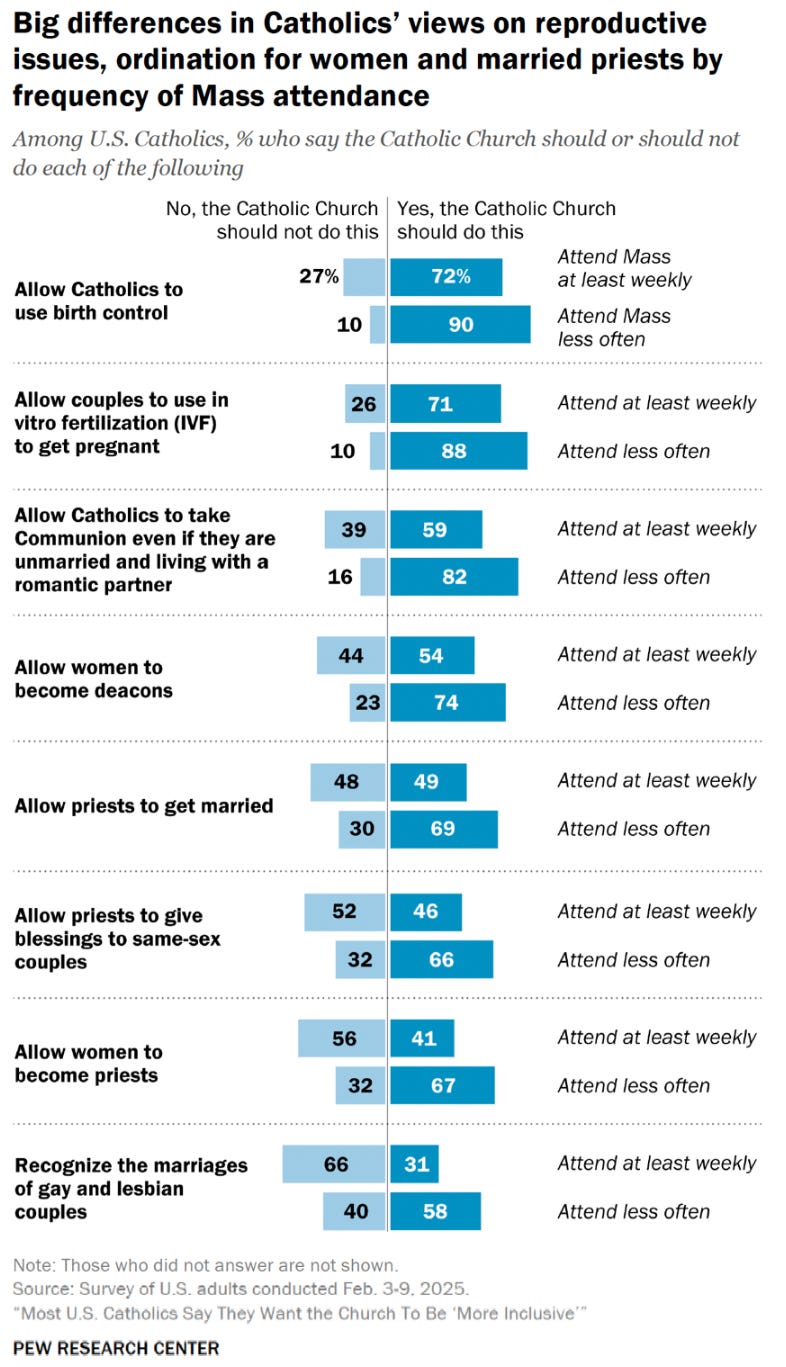
In 2025, yet another Pew Research Center survey uncovered even more shocking results. The result for self-identified US Catholics who go to Mass less often than weekly are bad enough, but here are the results for those who do attend Mass weekly:
72% say the Church should allow birth control (contrary to what Fr Crean himself called the “infallible and irreformable teaching” of Paul VI’s Humanae Vitae.46)
71% were in favour of IVF
59% were in favour of Communion for those living in concubinage
54% were in favour of female deacons
41% were in favour of female priests
46% were in favour of priests blessing same-sex couples
31% were in favour of Church-recognised same-sex “marriages”.47
So far we have been considering surveys of US Catholics. Some might suggest that results might be different elsewhere – and that, for example, African respondents might indicate a greater prevalence of orthodoxy, and thus also the mark of unity; others might allege the same for groups like the Fraternity of St Peter. It might be alleged that their continuity within the unity of faith shows that the Conciliar/Synodal Church is still united.
This objection is without worth. Without denying the continuity of such groups within the unity of faith, let us recall again Cardinal Billot’s comparison between the marks of holiness and unity: unity of faith pertains to the collective, and so it is meaningless to suggest that it is maintained by a section of the collective elsewhere in the world. This is simply first to deny that this body is divided, and then to provide further proof that it is indeed divided.48 As a result, the radical disunity of US Catholics is itself sufficient to indicate the disunity of the Conciliar/Synodal Church as a whole: US Catholics are, of course, part of this collective.
However, in 2014, Bendixen & Amandi International carried out a global survey of self-identified Catholics, which indicated that these results are far from limited to the USA – and that sizeable numbers of respondents from Africa are also visibly disunited.49
The 2014 Univision ‘Global Survey of Roman Catholics’
The 2024 survey yielded the following results.
Divorce and Remarriage: 58% of respondents rejected the Church’s teaching that divorced and remarried persons are living in sin and should be deprived of Holy Communion. Only 45% of those who “frequently” attended Mass agreed with the Church’s teaching. Broken down by continent, this teaching was rejected by:
19% of African respondents
46% of Asia/Pacific respondents
75% of European respondents
67% of Latin American respondents
60% of North American respondents
Abortion: 65% of respondents rejected the Church’s teaching on abortion. This was rejected by:
40% of Democratic Republic of the Congo respondents
35% of Ugandan respondents
27% of Filipino respondents
Contraception: 78% of respondents (and 72% of “frequent” Mass attendees) supported the use of contraceptives. This included:
86% of European respondents
44% of African respondents
91% of Latin American respondents
79% of US respondents
31% of Filipino respondents.
Women priests: 45% of respondents rejected the Church’s teaching on female ordination to the priesthood. This included 37% of “frequent” Mass attendees, and:
64% of European respondents
59% of North American respondents
49% of Latin American respondents
21% of Asia/Pacific respondents
17% of African respondents
Homosexual marriage: 30% of respondents rejected the Church’s teaching on same-sex marriage. This included:
15% of Polish respondents
14% of Filipino respondents
Here is an example of the survey’s visual analysis:
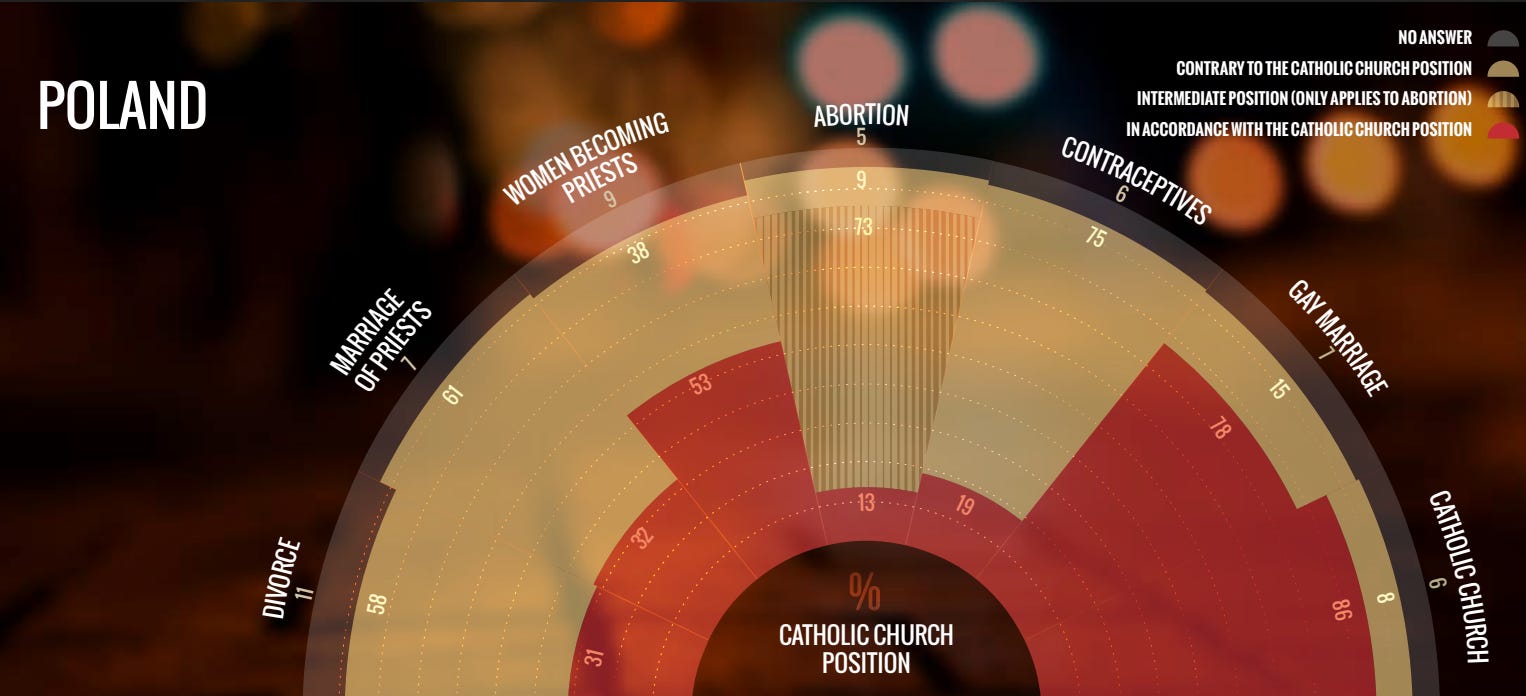
The above results show that, even while countries like Poland, the Philippines or African nations have larger numbers of those who accept more of the Church’s teaching on the above areas, there are substantial numbers of those who do not. Nor can we take too much comfort from 99% of African respondents opposing same-sex marriage, as this is only one issue amongst many – in which their responses are much more varied.
This survey is also over 10 years old, and we can be reasonably certain that the numbers of those who reject the Church’s teaching have increased since that time.
Further, we all have enough personal experience and anecdotal evidence to know that this same phenomenon applies afflicts the Conciliar/Synodal Church – as we have defined it above – wherever it is found. As an example: even the international Catholic dating agency Catholic Match allows its users to select which of six certain dogmas they accept, and allows other users to filter their searches by adherence to or rejection of these dogmas.
Fr Crean himself witnesses to the disunity of faith. He was the third signatory of the 2019 Open Letter to the Bishops of the Catholic Church, which accused Francis of “the canonical delict of heresy.”50 This letter included seven points of dogma – for example, matters pertaining to Amoris Laetitia, as well as God allegedly willing a diversity of religions, along with proof of their dogmatic status and of Francis’ deviation from them.
Even aside from disunity between Francis and the signatories, it is also evident that the heresies of which they accused him are also held by an enormous number amongst the Conciliar/Synodal Church, and the Open Letter provides further evidence of this (e.g., with reference to the Bishops of Buenos Aires).
The disunity of faith and its source
What is the source of this disunity? As we already addressed at the beginning of this section, the Church’s visible unity of faith applies to her teaching as much as to her profession – not least because the teaching of the Church is what causes the profession of faith. As such, the visibly disunited profession of faith is principally caused by a) disunity amongst the hierarchy of the Conciliar/Synodal Church in teaching – both between each other, and sometimes even within their own teaching, which is in turn caused by b) the failure (or refusal) to “teach with authority.” Here is what Romano Amerio wrote in 1985:
“The external fact is the disunity of the Church, visible in the disunity of the bishops among themselves, and with the Pope. The internal fact producing [this disunity] is the renunciation, that is, the non-functioning, of papal authority itself, from which the renunciation of all other authority derives. […]
“There is never a papal document on which the episcopates of the world fail to take up their own position, and in their train, but independently of them, theologians and the laity do the same, contradicting each other in their turn. A host of documents is thus churned out, displaying a disorderly variety in which authority is multiplied and so nullified.”51
We will return to the “internal fact” later in this analysis. But the “external fact” is so obvious as to make examples unnecessary. Nonetheless, we could point to:
The response to Paul VI’s Humanae Vitae on the part of the Canadian Conference of Catholic Bishops (the “Winnipeg Statement”) – as well as other such conferences52
The German Bishops’ Conference’s “Synodal Way”
The reception of Fiducia Supplicans and Amoris Laetitia by various bishops’ conferences
These examples are significant flashpoints, but even aside from them, there is no visible unity of faith between men like Bishop Tomash Peta of Astana, Kazakhstan, and men like Bishop John Stowe of Lexington, Kentucky. These two “camps” cannot credibly be said to teach the same body of doctrine.53
The disunity in the Conciliar/Synodal Church is such that men such as Roberto de Mattei,54 Fr Linus Clovis55 and others have acknowledged the presence of different religions within its structures – and yet the adherents of these “different religions” are construed as members of this body, and in good standing.
It is simply not credible to suggest that the Conciliar/Synodal Church – the body of men who currently recognise Leo XIV as their leader, and are in good standing with him – enjoys either the property of unity, willed for it by God, or its external manifestation in the note of unity. Its members are not united in what they profess to believe; nor do all its dissenting members even pretend to profess what the Church teaches; nor can they all be said to be subject to the alleged magisterium. The same applies to what its hierarchy teaches.
Although de Mattei and Fr Clovis were referring to the situation under Francis, the new religion began earlier – with Vatican II. I have explained and defended this thesis here:
Conclusions on the property of unity
What I have described is no accidental obscuring of the note of unity. It certainly cannot be resolved by alleging that the unity of law remains in the Conciliar/Synodal Church, through a united submission to the Roman Pontiff:
First, because the objects of disunity are more fundamental than examples given for accidental obscuration (i.e., they do not pertain to difficult or obscure points of doctrine, or even the secondary object of infallibility).
Second, because there is no such united submission to the teaching, governing and sanctifying authority of the alleged Roman Pontiff; many members of the Conciliar/Synodal Church openly disregard the exercise of this (alleged) authority in its (alleged) Popes.
Third, because many persons openly reject the idea that the Roman Pontiff has the authority to settle such matters, and is the principle by which even legitimate disunity could be settled.
Nor can it be resolved by saying that, even in normal times, the Church did not identify and deal with every single public heretic, such that they continued to present themselves as Catholics and be taken as such.
First, refraining from dealing with a certain number of public heretics is not comparable with the radical disunity we see in the Conciliar/Synodal Church, caused precisely by an enormous number of public heretics holding themselves out as Catholics, and being treated as such. Further, the Catholic Church holds that open heretics cease to be her members prior to being dealt with by authority.56 As such, a certain number of visible non-Catholics purporting to be Catholics do not undermine the visible unity of the Church, because they are already acknowledged as being non-members by virtue of their public heresy.
But it is precisely this principle which is denied by those who claim that the Conciliar/Synodal Church is the Catholic Church. They cannot, therefore, appeal to it as an explanation for the Conciliar/Synodal Church’s visible disunity of faith.57
Frank Sheed, the twentieth century apologist, writer and publisher, also said the following, which demonstrates both that this objection did not seriously apply to the Church prior to Vatican II, and that the current disunity is sufficient to show that the Conciliar/Synodal Church is not the same Church:
“[T]here was a vast body of doctrine to which the Church had definitely committed herself.
“Catholics knew this. If they did not accept it, they simply dropped out. Officially that is still the position. All the Council documents assume it; no statement of Pope or hierarchy varies from it. Yet things are not the same. There really is a crisis of faith, though the Vatican Council did not discuss it. There are two main elements in it. The dropping out continues, perhaps at an accelerated pace. What is new is the number of Catholics who hold themselves free to differ from Pope and Council but do not drop out.
“[…] We cannot read the future: the falling away might grow to a flood, and the Church be reduced everywhere—might dwindle very much indeed. She would have to re-think her redemptive functioning. Yet she could still be the same Church.
“Whereas if she accepts the presence within her of men who deny teachings to which she has committed herself, she will not.”58
He also wrote elsewhere:
“[V]iews are also propounded, unrebuked, which if they should come to be accepted would really mean that it would no longer be the same Church.”59
Such, on both counts, is the case today.
In short, we are not faced with a difficulty of verifying the mark of unity, but the verification of the absence of the property of unity. And, as Romano Amerio stated:
“Since a thing’s unity is a sign of its being, the condition of its being can be judged from the degree of its unity, inasmuch as it falls to pieces as its unifying principle weakens. Ens et unum convertuntur is true of moral entities no less than physical ones. A molecule ceases to be with the breakup of the atoms of which it consisted. An animal ceases to be the moment its mass of cells loses the vital link that made it one organism.
“By the same token a moral entity loses its being when it loses its own unity. The Church consists of numbers of people undivided among themselves and divided from all other groups, and insofar as it is a community, that is a Church, it is one. This one Church is kept in being by a unifying principle through which individuals become members of a society, that is, parts of a whole in which individuals exist as one. The level of being of that community which is the Church can be determined from the level of its unity.
“Now, in the present circumstances, its unity is fractured in three respects: doctrine, worship and government.”60
The conclusion is obvious. This radical disunity alone – demonstrating the lack of a necessary property – is sufficient to conclude that the Conciliar/Synodal Church is not the Catholic Church. Fr Crean’s “perpetually visible Church” might have visible structures, but they are not distinctly visible as those of the Catholic Church – quite the contrary.
We have published many articles on this topic:
The Anglicanisation of Catholics – are we the ‘high-church wing’?
The Visible Unity of the Church I – on what it means to believe in “One” Holy, Catholic and Apostolic Church
The Visible Unity of the Church II – More on what it means for the Church to be “visibly” one
The Visible Unity of the Church III – Reconciling the Church’s teachings about her own unity with the current crisis
Notes on the nature of heresy, in light of the unity of the Catholic Church
How is the Church “visibly united in faith,” according to twentieth-century master of ecclesiology Cardinal Billot?
Why is “unity of faith” so crucial for making the Church visible, according to Cardinal Billot?
Christ’s prayer and the unity of the Church – Cardinal Billot
The Church’s Unity of Faith – St Francis de Sales
St Thomas More: Heretics leave the unity of the Catholic Church by their own act
Leo XIV: ‘We are one! We already are!’ Correct – but not as intended
A side-chapel in the Conciliar/Synodal Church - Fr de Blignières’ proposal
As an aside, it is also obvious that a radically divided society cannot be said to be “universally and peacefully adhering” to its purported leader as its proximate rule of faith. This is addressed further below:
To summarise, we could end the discussion here, as the absence of even one negative property is sufficient to prove the point.
However, let us continue to consider the other properties and notes, which were also overlooked by Fr Crean.
Chapter II: Holiness
NB: I discussed this chapter with Stephen Kokx over at Kokx News:
What is holiness?
Holiness is a note insofar as it is evident in the members of the Church and her good works. But to understand what this means, we must first examine the property of holiness itself, and the sorts of works that manifest it.
A created thing is holy by participation, either from dedication to God or from union with him.61 The Church is ontologically holy by reason of Christ, her head; the Holy Ghost, her soul; the sanctification of men, her end; her doctrine, laws and sacraments, her means; and grace and virtue as her fruits.62
This ontological holiness is actively applied to the members of the Church through means which are visibly fitted for this purpose (e.g. the sacraments, doctrine, a high moral standard of ethics, and disciplinary laws).63 This is why the Church’s magisterium on several occasions that her universal disciplinary laws as “infallibly safe” (meaning that they cannot entail anything dangerous to the soul or contrary to the Gospel.)64
But this is not all. Although she contains both good and bad men, she is morally holy by virtue of the good – manifested by a purity from sin and a firm union with God.65 This personal holiness must be “formed” by the principles of the society itself – by the principles and active means just mentioned. Cardinal Billot writes:
“[N]o church can be holy with the holiness of its members if it is not holy with the holiness of its principles. Not that it is absolutely impossible for some just persons to be found in such a congregation – far from it – but because if any such persons exist, they can only be in it per accidens, that is, apart from the force and influence of the means of that society. Now, as is well known, one does not derive the defining character of something from what pertains to it only per accidens. […]
“[A religious society] is plainly shown to be adorned with that very holiness if even a few can be pointed out who have been made holy and are being made holy by virtue of its formation and principles. […]
“It is required in addition that there be established not only the fact of the holiness of persons, but also the fact that this holiness is owed to the sanctifying influence of the principles of the society. Otherwise the intended conclusion would not follow, since nothing prevents good and just persons from being found per accidens in a false religion.”66
I. The note of holiness
Billot notes that wicked men themselves will indicate where the true Church is to be found, by their constant and habitual opposition to her, as we explained here:
However, this is only one of several indications, rather than the note of holiness as the theologians describe it. This property of holiness is rendered visible as a note principally through the holiness of the Church’s members. Billot writes:
“[T]his holiness [of members] immediately concerns individuals taken one by one; it is through such individuals that a society, whose sanctifying influence is acknowledged as the cause of holiness, is itself called holy.”67
Salaverri explains how this may be manifested:
“Some” of her members will enjoy “heroic holiness”, excelling in even the smallest and most difficult things.
“Many” of her members will enjoy “perfect holiness”, being free from both mortal and venial sin and fleeing both, and observing the evangelical counsels.
“Most” of her members will enjoy “ordinary holiness”, being free from at least mortal sin and fleeing it, through grace and the commandments.68
Salaverri teaches that the normality of “ordinary holiness” is a fruit and necessary effect of the Church’s “ontological holiness” applied to the faithful, as mentioned above.69 As such, “ordinary holiness” – though not without the presence of the other two – pertains to the visible note of holiness.70 It is through the lives of these members – of all three species of holiness, and to the degree that they flow from the principles of the society – that the holiness of the society and its principles are made visible.
It is true that the mark of holiness admits considerably more obscurity than that of unity. Let us return to Billot’s comparison between the two properties:
“The holiness of the members we are talking about here concerns individuals directly – and it is indirectly, through these individuals, that holiness can be attributed to the society whose visible principles and mediations contribute to produce this life of grace.
“Unity, however, deals immediately with the collectivity itself, from which it removes division in the profession of faith. Furthermore, the wicked in the Church do not prevent it from containing saints as well, who show it to be true. But if heretics were in the Church, they would formally remove the indivisibility of the society which is of the very definition of unity.”71
As such, this note of holiness could be more or less visible – and thus more or less obscured – by a significant number of sinners present within the Church, and by a reduction in the number of members who enjoy the “ordinary holiness” described.
This note is also “visible” through two other means, which are essentially specifications of the general principle already explained.
1. The holiness of past members
The holiness of a society can in part be demonstrated by its history – that it contained persons of the holiness discussed.72 As an example, the work of the Bollandist fathers – the group of Jesuits whose historical critical studies of the lives of the saints make it impossible to deny that the Roman Catholic Church has always contained a multitude of men of extraordinary holiness.73
This aspect is made all the more visible if a society has an investigative process into the holiness of various candidates after their death – especially if it is evidently rigorous, even including attempts to disprove all claims in candidates’ favour. Such a process would be reliable, credible in the eyes of non-members, and would achieve moral certainty in its judgments. This is, of course, what was achieved by the Church’s rigorous process of canonisation.
As this aspect of the note of holiness pertains to past members, it would not necessarily be jeopardised by the abandonment of such a process: if the true Church did this, her defenders could still point to the sanctity of her saints as evidence of her claim.
All parties to this discussion agree that the Roman Catholic Church is that society. However, we must avoid assuming what would need to be proved here.
If there were independent grounds for stating that the Church of past saints was a different society from the Conciliar/Synodal Church – as indeed there are, as proven in Chapter I – then it cannot marshal such saints in its favour: this would be begging the question. It would be like the Eastern Orthodox schismatics marshalling the Apostles or St Augustine as evidence of their own legitimacy. Even without such grounds, the nature of the current discussion means that this would also be simply begging the question (as would be the case if even Catholics appealed to such saints against the Orthodox).
Further, the continuing existence of a stringent process of canonisation is a powerful means of proving the ongoing sanctity of a society’s members; the absence of such a process makes it harder to be morally certain about the holiness of subsequent members and saints.
Canonisations in the Conciliar/Synodal Church
Even if we leave aside the rupture between the Conciliar/Synodal Church and that governed by the Popes up until the modern epoch – thus rendering it impossible to point to the saints of history as evidence of legitimacy – it is notorious that the Conciliar/Synodal Church abandoned a stringent process of canonisation, and replaced it with a procedure of much lower standards.
Such a process is hardly suited to demonstrating, visibly and with moral certainty, the holiness of those canonised; and as such, those canonised in “the saint-making factory”74 (as John Allen Jr. put it) established by John Paul II are not continuing evidence of the Conciliar/Synodal Church’s holiness.
Further, those who have been canonised under this new procedure can be divided into three categories:
Those who do indeed appear to have enjoyed great holiness (e.g., Padre Pio, Fr Maximilian Kolbe, Cardinal John Henry Newman)
Those whose lives were marked by truly horrific crimes (e.g., Paul VI and his religious revolution, John Paul II in perpetuating this revolution, and in his inaction over the sexual abuse crisis)
Those about whom it is difficult to say one way or another (e.g., without denying that Carlo Acutis may have been a holy person, the “hagiography” does not clearly convey this in a compelling way).
Further, the new process offers no credible defence against the allegation that certain persons have been canonised for ulterior motives (e.g., financial reasons have been alleged for Fr Josemaria Escriva and Acutis, and politico-doctrinal reasons for the post-conciliar popes, Kolbe and Newman).
The visible picture that emerges is that the Conciliar/Synodal notion of holiness is not identical with that of the Catholic Church, out of keeping with the principles to which we have referred. It is therefore not a true notion of holiness at all.
One result of this is that many, in an attempt to maintain the infallibility of papal canonisations, now deny that they entail a statement of the heroic virtue of the canonised. Fr Crean himself adopted what he calls the “minimalist” understanding of canonisation in Are Canonizations Infallible?, namely that canonization is “the official, papal declaration that the soul of the canonized person is now in heavenly glory” – a definition which consciously withdraws from consideration of the holiness and heroic virtue of the canonised.75
But while such a definition might allow one to accept the canonisation of those who led manifestly evil lives, it can hardly be used with reference to the visible holiness of the Church.
2. Institutes of Perfection
The holiness of a society can also be demonstrated by “permanent institutes [or institutions] of perfection”, in which many men are actually led to the perfect holiness described above.
Such, according to Salaverri, are the institutions of religious life and that of the secular clergy. These states lead, by their own nature, to the holiness of those within them; they are evidence both of the active holiness of the Church, and the personal holiness of its members.
We have already explained why the sinful members do not destroy the visibility of the note of holiness, even if they might make it harder to discern. Such obscuration could also occur to a great degree by the abandonment of the stringent processes of canonisation and the standards of the institutes of perfection.
But in all three cases, it might become very difficult – or even impossible – to assert that a particular body of men manifests the note of holiness.
This is undoubtedly the case for the Conciliar/Synodal Church.
Institutes of Perfection in the Conciliar/Synodal Church
It is also notorious that the previously high standards of the “institutes of perfection” (viz. the state of the secular clergy and of religious life) have also been relaxed by the Conciliar Church; in many cases, these standards have been replaced with laxity, and even disgusting moral degradation.
As one example: aside from the notorious reputation of many seminaries, it is commonly assumed that a significant number of the Conciliar/Synodal Church’s ministers are homosexuals, and that at least a notable minority act upon such predilections.76
There is no expectation that the ministers of the true Church are free from such problems, as works such as St Peter Damien’s Book of Gomorrah demonstrate. Neither corrupt clergy nor moral laxity amongst the faithful contradict the Church’s holiness – but when such problems are unchecked and become rampant, it necessarily obscures the visibility of the Church’s holiness. (This is distinct from issues raised by documents such as Amoris Laetitia and Fiducia Supplicans, which we will address shortly).
Similarly, one cannot point to “institutions of perfection” as a means of making the Church distinctly visible, if they are actually hotbeds of imperfection.
Thus, two key means (canonisations and institutions of perfection) by which holiness of the Church is to be made visible to the world have been set aside.
To summarise, the property of holiness is made visible as a note principally by a) the ordinary holiness of a society’s members, formed by the principles of the society; b) the holiness of past members of a society, established through historical studies and a stringent process of canonisation; c) the institutes of perfection.
So much for the note of holiness and the distinct visibility of the Church.
II. The absence of the property of holiness
The property of holiness would be shown to be absent in a society in different ways. For instance:
The official promotion or promulgation of false, dangerous and immoral teachings and practices
The toleration of such teaching and practices over a sufficiently long period of time (perhaps long enough for it to have attained the force of custom, if it were not positively evil)
The treatment of what is evidently holy with neglect or contempt – or even attempts to suppress it
The neglect of the active means of holiness over a similarly long period of time.
Billot explains this further:
“[T]he holiness of principles must necessarily proceed ex integra causa, because the principles and institutions of any church coalesce into a single system, and it is impossible that a religion should be truly called holy which possesses even a single dogma,77 whether speculative or practical, that is repugnant to holiness.”78
This is a visible problem for the Conciliar/Synodal Church, which both minimises the principles of holiness discussed above, and has more than one example of that which is “repugnant to holiness.”
Although some of its official monuments maintain a concept of sin, including mortal and venial sin, it is once again notorious that the Conciliar/Synodal Church habitually neglects a classical understanding of sin – including the distinction between mortal and venial sin – and is increasingly substituting it with a naturalistic and humanistic understanding based on contemporary political issues (e.g., environmentalism, globalism, ecumenism and concerns about migration).
Possibly as a result of this neglect of mortal sin, the sacrament of Penance is similarly neglected on a very wide scale by both members of the Conciliar/Synodal Church, and its ministers.
However, let us consider how the Conciliar/Synodal Church has demonstrated its unholiness in its teaching and laws – returning to the Open Letter signed by Fr Crean himself as evidence of this.
Fr Crean as a witness to the unholiness of the Conciliar/Synodal doctrine
In addition to the neglect of the active means of imparting holiness, the high standard of morality – based on Christ’s injunction to “Be perfect, as [his] Father in Heaven is perfect” – has been progressively eroded since Vatican II. Again, the presence of immoral Catholics does not diminish the Church’s holiness, even if it might obscure it: but we are talking here, not about how moral standards are lived out but how they – and the very concepts of morality and holiness themselves – are presented by the alleged magisterium.
In the Open Letter, Fr Crean and the other signatories accused Francis of the following heresies about the moral holiness of the Church’s members:
A justified person cannot necessarily observe God’s law – implying either that this law is impossible, or that God’s grace is insufficient to leave aside grave sin
That a Christian may knowingly and freely break God’s law without being in a state of mortal sin
Sexual acts between persons who are not married can be morally right, or even requested or commanded by God
Divine revelation and the natural law do not contain absolute prohibitions of certain types of actions.
Each of the four propositions above is found in Amoris Laetitia, which is an official act of the Conciliar/Synodal Church’s purported magisterium. Their proposal has been authoritative, and they have in fact been passed on to the faithful, some of whom have acted upon them. Questions of infallibility or degrees are irrelevant here, because the active holiness of the Church is subject to the axiom “bonum ex integra causa, malum ex quocumque defectu”.79
The Open Letter summarises some of these heresies as follows:
“Taken together, all these positions amount to a comprehensive rejection of Catholic teaching on marriage and sexual activity, Catholic teaching on the nature of the moral law, and Catholic teaching on grace and justification.”80
Needless to say, the truth of this judgement is incompatible with holiness of the Conciliar/Synodal Church in her teaching. We note that Frank Sheed also addressed this issue in Is it the Same Church?, saying:
“What has suddenly become an issue overnight is not simply the Church’s right to refuse the sacraments to people who divorce and remarry, for instance, or practice artificial birth control, but her right to give us laws at all in the field of morals. In an extreme form this means that it is for everyone to apply the general principles of divine Revelation to each situation as it confronts him. Less extreme is the view of those who accept Christian morality as it now stands, but feel that in a given instance it must be modified, that there are no moral laws—Christ’s or any other—binding in every circumstance.
“If the Church came to accept this view even in its less extreme form, it would really be no longer the same Church—neither the Church we have grown up in, nor the Church we find in the New Testament.”81
Since the Open Letter, we have also seen the promulgation of the CDF’s declaration Fiducia Supplicans in 2023, which all but the blind understand to be at least a sly or tacit permission for the blessing of homosexual unions. In 2022, Fr Crean correctly noted that someone who “promulgates a rite of blessing of ‘same-sex unions’” is “a public apostate who should be avoided.”82 In 2023, he also stated that he could not baptise “someone [who] thought that the Church had the power to bless homosexual unions.”83 What conclusions are we to draw from this, now that this document has been promulgated?
To be sure, Fiducia Supplicans does not promulgate a rite, and carefully presents itself as blessing “same-sex couples” rather than “same-sex unions.” But any attempt to get this document – or the Conciliar/Synodal Church – off the hook through such distinctions simply plays into the hands of the enemies of the Church, who are counting on such a response on the part of their conservative defenders.
This is the trap into which many – Fr Crean included – have fallen since Vatican II, with regard to teachings which call good what the Church previously called evil, and vice versa. For example:
Religious liberty (Fr Crean’s treatment – and a response by John Daly84)
Communicatio in sacris with members of false religions (Fr Crean’s treatment)
Treating that which is holy with contempt
Cardinal Billot explains that the proper and actual use of the means of sanctification is necessary to establish the holiness of a society. He writes:
“[T]he demonstration of the holiness of principles does not depend on the material retention of any external means whatsoever — even one disposed or instituted by God for the sanctification of men — but rather on the manner in which those external means are employed through preaching, laws, institutions, and an ever-living ministry; in short, and to embrace everything in a single word, it depends on all those signs which are of a nature to reveal in a religious society the character of the font whence the sanctifying influence springs […]”85
The nature of the Conciliar/Synodal Church, as we have defined it, entails that some of the Catholic Church’s “external means” of sanctification are indeed retained and even employed within it. No doubt there are some who make up this body do indeed make use of them, in so far as they are available – even while they are subject to widespread neglect
But far from these means being systematically employed as Billot discusses, or even simply neglected, the authorities of the Conciliar/Synodal Church routinely treat that which is holy with contempt. For example:
Giving the sacraments to non-Catholics without prior conversion (cf. Can. 844, CIC 1983)
Giving the sacraments to persons publicly living in a state of sin (cf. Amoris Laetitia, 2016)
Widening the grounds for declarations of nullity, beyond what is credible and thus, in all likelihood, permitting bigamy
Suppressing and restricting the traditional Roman Liturgy (cf. the conduct of Paul VI et al., as well as Traditionis Custodes)
As mentioned above, the Conciliar/Synodal Church cannot even be relied upon to baptise validly – visibly demonstrated in the many videos online – due to a spirit of innovation, improvisation and experimentation, and the shockingly bad formation imparted to its ministers.
This is to say nothing of the way in which the allegedly holy rites of the Novus Ordo (and what we are told is the Blessed Sacrament) are treated by those who employ them – as well as events such as World Youth Day. The Vatican’s power to exercise liturgical oversight, when it has a will to do so, is clearly demonstrated by Traditionis Custodes; it has chosen not to employ such oversight against the “liturgical abuses” whereby priests deviate from the prescriptions of the Novus Ordo rites.
Finally, some have also argued that, aside from the general liberalisation of religious orders following Vatican II (and the enormous loss of vocations), the 2018 document Cor Orans represents an attack on the very concept of contemplative orders.86
In short, when we consider “the manner in which those external means are employed”, the Conciliar/Synodal Church is not only found wanting, but positively unholy.
Conclusions on the property of holiness
Where does this leave Fr Crean’s claim that the Conciliar/Synodal Church is the “perpetually visible Church”?
The mark of holiness is difficult to verify, due to the widespread lack of interest in what constitutes ordinary holiness, the abandonment of the stringent canonisation process and the shocking loss of standards generally amongst religious and the secular clergy (with noteworthy exceptions). But this mark is a chief means by which the Church is made distinctly visible – thus making the “perpetual visibility” of the Conciliar/Synodal Church similarly difficult to verify.
But this is not all: as Billot said:
“[I]t is impossible that a religion should be truly called holy which possesses even a single dogma, whether speculative or practical, that is repugnant to holiness.”87
Elsewhere, Billot expressed succinctly the Church’s teaching on the infallible safety of her universal disciplinary laws:
“[T]he Church is assisted by God so that she can never institute a discipline which would be in any way opposed to the rule of faith or to evangelical holiness.”88
With the Conciliar/Synodal Church, we are faced with a greater problem than one such example. Between the promotion and toleration of unholy doctrines, laws, practices and rites, and the negative treatment of holy doctrines, laws and rites, the property of holiness is verified to be absent – thus demonstrating that the Conciliar/Synodal Church is not distinctly visible as the Catholic Church; and that it visibly not the Catholic Church.
NB: In 2021, Robert Morrison wrote a useful article on this matter in The Remnant.
Chapter III: Catholicity
NB: I discussed this chapter with Stephen Kokx over at Kokx News:
What is catholicity?
Catholicity means universality. Theologians distinguish this into catholicity “de jure” (of right) and “de facto” (of fact).
Catholicity de jure means that she is “destined for the salvation of all men, and therefore endowed with the ability to spread to all parts of the world to fulfil that mission.”89 But this “destiny” and “ability” are internal properties that are at least difficult to observe, and so do not constitute the mark of catholicity.
Catholicity is a note insofar as it is catholicity de facto, or of fact.
Catholicity can be distinguished in further ways, but we are presently interested in this catholicity of fact – namely an “actual large number of members of the Church everywhere morally, simultaneous and perpetual.”90 Cardinal Billot also writes
“[C]atholicity regards not only the universality of place, but also the universality of time – from the Ascension of Christ and the descent of the Holy Spirit – and immediately there comes to mind the unwelcome question: where on earth was Protestantism for fourteen centuries, down to Luther?”91
Berry states that actual catholicity requires not only that a society have “members scattered far and wide throughout the world”, but also that “the Church itself, as a society, must always exist in the various parts of the world (“simultaneous catholicity”) to exercise its authority and carry on the mission of Christ.”92
It is not necessary that it be the biggest religious society in the world.93 Cardinal Billot writes:
“For does number taken materially bear anything divine in itself? Certainly the Catholic Church appears to surpass every other religion existing in the world with respect to the number of her faithful; but, considering number absolutely, she is neither shown to be divine from a preponderance of number, nor would she be shown not to be divine from an inferiority of number. Furthermore, if it were a question of number alone, since Buddhism closely approaches her with respect to multitude, the latter would also approach her with respect to credibility—which God forbid.
“For this reason it was pointedly stated that simultaneous catholicity consists in a vast number drawn from a multitude of nations.”94
While it is generally considered that the Church could not become limited to just one country,95 both theology and history show that multiple nations can fall away from the Church,96 and that whole nations may find themselves deprived of its hierarchy (cf. as happened in England and Japan at various points in history). The heart of the note of Catholicity is an actual and simultaneous diffusion of members throughout many nations.97
As a note, an actual diffusion (de facto) is more known and knowable than the “de jure” right and aptitude for such diffusion. This note of catholicity may be accidentally obscured in the following ways:
A significant reduction of the number of Catholics in the world
A reduction of the number of nations in which these Catholics are spread
A difficulty in locating the true hierarchy of the Church, or verifying her diffusion.
In particular, theologians have recognised that this catholicity will be greatly restricted towards the end of the world. Fr Timoteo Zapalena explained:
“[I]f at the end of the world apostasy of such a kind actually were to be the case in most men, it would be necessary to think of catholicity in such a manner that it must be understood in a very restricted sense as a stage immediately and very shortly preceding the consummation of the world. However, the difficulty relates to the end of the world, not the existence of the Church throughout the ages, about which we especially speak in this thesis.”98
Cardinal Pie also noted that the Church’s catholicity could be “increasingly reduced” at the end of the world:
“The Church, a society that will undoubtedly always be visible, will be increasingly reduced to simply individual and domestic proportions. She, who said in her early days, ‘The place is too small for me, make room for me to dwell,’ Angustus mihi locus, fac spatium ut habitem, will find herself fighting for ground inch by inch, surrounded and hemmed in on all sides: as much as the centuries had made her great, so much will be done to restrict her.”99
Cardinal Journet also noted, without regard for the end of the world, that the schisms could leave the true Church with an obscured catholicity:
“[I]t was not altogether impossible for the dissidents at a given moment to be more numerous than the faithful. […]
Geographical and numerical universality, the quod ubique, quod ab omnibus, will often be a fully sufficient criterion to mark the true Church and distinguish her from schism. […] However, because the true Church is mysterious in her essence and in the mode of her diffusion, it may happen in other circumstances—likely to become more and more common nowadays when errors, like truths, make the circuit of the world in a moment and insinuate themselves everywhere—that the criterion of universality will remain ambiguous, and must then be supplemented by other criteria – including the four notes of the Church, and, as he says, the “faith of our fathers” and (legitimate) succession to the papacy.”100
Cardinal Billot considers St Robert Bellarmine’s opinion – that the Church could be restricted to a single nation, so long as “one could clearly see that this Church identifies itself with the one that was spread at another moment throughout the whole world” – and his rejection of this idea contains a number of instructive points:
“From these considerations, I repeat, it is best to prescind, because if there were any foundation whatsoever for such an opinion, it would assuredly be nothing other than what is read concerning the end of the world and the persecution of Antichrist (Luke XVIII, 8; Matthew XXIV, 21–29; 2 Thessalonians II, etc.).
“Now, even granting the interpretation which Bellarmine appears to have followed, the conclusion would still remain intact, because it would still be true that simultaneous catholicity is, by the will and promise of God, a necessary endowment of the Church, at least according to the ordinary law, which would in no way be prejudiced by a foretold exception, for a certain determinate period of time.
“For in moral matters, each thing is denominated absolutely from those characteristics which ordinarily affect it or ought to affect it.”101
It is not necessary for us to take a position on whether we are currently in the end times: the principles which Billot states are sufficiently applicable to our time even without that being the case.
Now, it is undeniable that the Conciliar/Synodal Church is indeed diffused very widely throughout the world, both in its members and in its structures. But is it catholic, in the sense under discussion?
However, let us return to our distinction between that which is difficult to verify and that which is verified to be absent.
How the property of catholicity could be lacking
The property of catholicity would be verified to be absent when de jure catholicity is rejected and disclaimed – as when evangelisation is rejected as a sin, or when groups of humanity are told that they need not enter the Church, or treated as such.
But this is precisely what the Conciliar/Synodal Church has done. Its officers have repeatedly dismissed or even rejected evangelisation under the name of “proselytism,” denied that whole groups are required to enter the Church, and its missionary orders and impetus collapsed following Vatican II.
This latter point cannot be disputed. Eric Sammons even published a book titled Deadly Indifference, with the blasphemous subtitle: How the Church Lost Her Mission, and How We Can Reclaim It. Sammons defines the Church’s mission as being the salvation of souls, achieved through conversion to the Catholic faith.102 He links this mission specifically to the dogma outside the Church there is no salvation, and considers it to have been “lost” because the dogma itself has been denied by so many. He even cites Benedict XVI as evidence of this:
“If it is true that the great missionaries of the 16th century were still convinced that those who are not baptized are forever lost — and this explains their missionary commitment — in the Catholic Church after the Second Vatican Council that conviction was finally abandoned.”103
Benedict XVI continues:
“From this came a deep double crisis. On the one hand this seems to remove any motivation for a future missionary commitment. Why should one try to convince the people to accept the Christian faith when they can be saved even without it?
“But also for Christians an issue emerged: the obligatory nature of the faith and its way of life began to seem uncertain and problematic. If there are those who can save themselves in other ways, it is not clear, in the final analysis, why the Christian himself is bound by the requirements of the Christian faith and its morals. If faith and salvation are no longer interdependent, faith itself becomes unmotivated.”104
While he explores some possible solutions – the wholly unacceptable theories of Rahner and de Lubac – Ratzinger provides no answer to his question. What was abandoned was not just the necessity for baptism, but the claim to catholicity de jure – and as such, no answer is possible.
In this chapter, we will consider how the Conciliar/Synodal Church has disclaimed catholicity de jure, and thus is visibly not the Catholic Church.
The Eastern Schismatics
In 1993, the Joint International Commission for Theological Dialogue Between the Catholic Church and the Eastern Orthodox Church issued the “Balamand Declaration,” which was also published by the Dicastery for Promoting Christian Unity.105
This document, which treats the existence of Eastern Catholic “Uniate” Churches as a problem, speaks with truly stunning audacity of “passing beyond the outdated ecclesiology of return to the Catholic Church.”106
Here is how it describes the missionary activity of the Catholic Church:
“Progressively, in the decades which followed these unions, missionary activity tended to include among its priorities the effort to convert other Christians, individually or in groups, so as ‘to bring them back’ to one’s own Church. In order to legitimize this tendency, a source of proselytism, the Catholic Church developed the theological vision according to which she presented herself as the only one to whom salvation was entrusted.”107
Its “practical rules” forbid “proselytism”:
“Pastoral activity in the Catholic Church, Latin as well as Oriental, no longer aims at having the faithful of one Church pass over to the other; that is to say, it no longer aims at proselytizing among the Orthodox. It aims at answering the spiritual needs of its own faithful and it has no desire for expansion at the expense of the Orthodox Church.”108
Towards the end, the document again refers to missionary activity as “proselytism”, and insinuates again that it was based on a “desire for expansion”:
“… excluding for the future all proselytism and all desire for expansion by Catholics at the expense of the Orthodox Church…”
The Declaration is clear: this approach has been abandoned, and replaced with one in which the evangelisation of Eastern schismatics “can no longer be accepted”:
“Because of the way in which Catholics and Orthodox once again consider each other in their relationship to the mystery of the Church and discover each other once again as Sister Churches, this form of ‘missionary apostolate’ described above, and which has been called ‘uniatism’, can no longer be accepted either as a method to be followed nor as a model of the unity our Churches are seeking.”109
Further, as the document itself makes clear, the Conciliar/Synodal hierarchy has taught the same ideas:
“Towards this end, Pope Paul VI affirmed in his address at the Phanar in July 1967:
“‘It is on the heads of the Churches, of their hierarchy, that the obligation rests to guide the Churches along the way that leads to finding full communion again. They ought to do this by recognizing and respecting each other as pastors of that part of the flock of Christ entrusted to them, by taking care for the cohesion and growth of the people of God, and avoiding everything that could scatter it or cause confusion in its ranks” (Tomos Agapis, n. 172).
“In this spirit Pope John Paul II and Ecumenical Patriarch Dimitrios I together stated clearly:
“‘We reject every form of proselytism, every attitude which would be or could be perceived to be a lack of respect’ (December 7th, 1987).”110
Leo XIV himself cited Benedict XVI and Francis in support of the same idea at the Extraordinary Consistory in January 2026:
“The Church does not engage in proselytism. Instead, she grows by ‘attraction’: just as Christ ‘draws all to himself’ by the power of his love, culminating in the sacrifice of the Cross, so the Church fulfils her mission to the extent that, in union with Christ, she accomplishes every one of her works in spiritual and practical imitation of the love of her Lord.” Pope Francis was in perfect agreement with this, and repeated it several times in different contexts.111
Rejection of evangelisation with the euphemism of ‘proselytism’
But what is “proselytism”? Those who try to defend these texts introduce a distinction between “evangelisation” and “proselytism”, with the former being positive and the latter negative, characterised by coercion or undue motives. They point to provisions in this very text such as the following:
“Religious freedom would be violated when, under the cover of financial assistance, the faithful of one Church would be attracted to the other, by promises, for example, of education and material benefits that may be lacking in their own Church.”112
However, this is a distraction – and those who defend this document with such distinctions are simply carrying water for those destroying the Church. The tenor of the document – and of the post-conciliar magisterium – is that the Church’s missionary activity itself – the seeking of converts, the preaching of the necessity of the Church for salvation – is itself proselytism, and rooted in what it calls “triumphalism”, empire-building, the exploitation of the poor, and a lack of respect for the alleged rights of the Eastern sects.
The late Francis also clearly conveyed that he did not consider “proselytism” in the narrow sense of his conservative defenders. In 2016, he equated it with trying to convince another of the truth of the Catholic religion:
“What must I say to convince them?” Listen, the last thing you must do is to “speak.” You have to live as a Christian, like a Christian: convinced, forgiven, and on a path. It is not licit to convince them of your faith; proselytism is the strongest poison against the ecumenical path.”113
Treatment of false sects as legitimate
The document provides its rationale as to why “prosletyism” must be abandoned. It explicitly teaches that the schismatic “hierarchs” enjoy a divine mandate, which it does not distinguish from that of the Catholic Church:
“Bishops and priests have the duty before God to respect the authority which the Holy Spirit has given to the bishops and priests of the other Church and for that reason to avoid interfering in the spiritual life of the faithful of that Church.”114
It recognises the Eastern sects as “Sister Churches”, openly referring to “the two Churches” on several occasions, and using similar language throughout.115 All this, aside from being a tacit denial of both the unicity and unity of the Church, conveys again the idea that they enjoy a divine mandate and legitimacy:
“It is in this perspective that the Catholic Churches and the Orthodox Churches recognize each other as Sister Churches, responsible together for maintaining the Church of God in fidelity to the divine purpose, most especially in what concerns unity. […]”116
What this means for the catholicity of the Church
There are three consequences of this idea for the de jure catholicity of the Church, which the document itself draws out for us.
The first is that the document presumes to restrict the liberty of the Catholic Church by stating that neither she, nor the Eastern sects, should involve themselves with “the faithful of other churches, without previous consultation with the pastors of these Churches.”117 Later on, the document states that:
“[…] Catholic and Orthodox bishops of the same territory consult with each other before establishing Catholic pastoral projects which imply the creation of new structures in regions which traditionally form part of the jurisdiction of the Orthodox Church, in view to avoid parallel pastoral activities which would risk rapidly degenerating into rivalry or even conflicts.”118
The second is that the Catholic Church is not the sole legitimate source of Christ’s teaching, government and sanctification. Rooting itself in the Second Vatican Council, the document acknowledges that this mission is the “property” of both “Churches”:
“In fact, especially since the panorthodox Conferences and the Second Vatican Council, the re-discovery and the giving again of proper value to the Church as communion, both on the part of Orthodox and of Catholics, has radically altered perspectives and thus attitudes. On each side it is recognized that what Christ has entrusted to his Church – profession of apostolic faith, participation in the same sacraments, above all the one priesthood celebrating the one sacrifice of Christ, the apostolic succession of bishops – cannot be considered the exclusive property of one of our Churches.”119
The third is a denial of the necessity of the Church for salvation, and the dogma outside the Church there is no salvation. This is implicit throughout, and made explicit here:
“While the inviolable freedom of persons and their obligation to follow the requirements of their conscience remain secure, in the search for re-establishing unity there is no question of conversion of people from one Church to the other in order to ensure their salvation.”120
Paragraph 25 also states that “every form of pressure, of any kind whatsoever” must be excluded – which, we are obliged to assume, includes any mention of the dogma outside the Church there is no salvation.
It does not matter that the document only “strongly recommends that these practical rules be put into practice.”121 The point is not whether they are put into practice, but that this document represents a rejection of the Church’s catholicity de jure – as well, we should note, as a clear denial of dogma by those who wrote it.
Pope Felix III expressed the principle that “silence implies consent” – in other words, if one is silent in the face of doctrinal error, one is presumed to accept it:
“An error which is not resisted is approved; a truth which is not defended is suppressed… He who does not oppose an evident crime is open to the suspicion of secret complicity.”122
This is simply a principle of reason. However, the hierarchy of the Conciliar/Synodal Church has not been silent about it: they have praised it, and endorsed its ideas in their teaching – and it was explicitly praised by John Paul II in his encyclical Ut Unum Sint.123
‘No mission to the Jews’
A similar situation applies to the Jews.
The Vatican’s Commission for Religious Relations with the Jews, in its document The Gifts and the Calling of God are Irrevocable, correctly states that “[t]here cannot be two ways of salvation”, because “Christ is also the Redeemer of the Jews in addition to the Gentiles.”124
However, it immediately states that this “is not a matter of missionary efforts to convert Jews, but rather the expectation that the Lord will bring about the hour when we will all be united.”125 This appears to be a clear statement that the Catholic Church is not necessary for Jews.
The document further clarifies:
“It is easy to understand that the so-called ‘mission to the Jews’ is a very delicate and sensitive matter for Jews because, in their eyes, it involves the very existence of the Jewish people. This question also proves to be awkward for Christians, because for them the universal salvific significance of Jesus Christ and consequently the universal mission of the Church are of fundamental importance.
“The Church is therefore obliged to view evangelisation to Jews, who believe in the one God, in a different manner from that to people of other religions and world views. In concrete terms this means that the Catholic Church neither conducts nor supports any specific institutional mission work directed towards Jews. While there is a principled rejection of an institutional Jewish mission, Christians are nonetheless called to bear witness to their faith in Jesus Christ also to Jews, although they should do so in a humble and sensitive manner, acknowledging that Jews are bearers of God’s Word, and particularly in view of the great tragedy of the Shoah.”126
It continues, again denigrating the Church’s missionary activity, and equating it a quasi-pelagian attempt to save souls without God:
“Christians must put their trust in God, who will carry out his universal plan of salvation in ways that only he knows, for they are witnesses to Christ, but they do not themselves have to implement the salvation of humankind. Zeal for the ‘house of the Lord’ and confident trust in the victorious deeds of God belong together. Christian mission means that all Christians, in community with the Church, confess and proclaim the historical realisation of God’s universal will for salvation in Christ Jesus (cf. “Ad gentes”, 7). They experience his sacramental presence in the liturgy and make it tangible in their service to others, especially those in need.”127
It also makes clear that the purposes of the dialogue are:
“[T]o add depth to the reciprocal knowledge of Jews and Christians”128
“[J]oint engagement throughout the world” for social justice issues129
“[J]ointly combatting all manifestation of racial discrimination against Jews and all forms of anti-semitism.”130
“Conversion to Jesus Christ and to the Catholic religion” does not appear in this list. As such, the “dialogue” which replaces a mission to the Jews cannot be described as an alternative form of evangelisation – and any infrequent references to the need for Jews to convert simply provide contradictory evidence, rather than resolving the question.
The prevalence of these ideas in the Conciliar/Synodal Church
Directly related to the catholicity of the Church is the concept that Jews may be saved by virtue of either the Abrahamic or Mosaic covenant – which, it is alleged, has not been revoked.
In 1980, John Paul II referred to the Jewish people as “the people of God of the Old Covenant, never revoked by God.”131
As with the Balamand Declaration, these ideas about the Jews are not limited to one document, but are current throughout the Conciliar/Synodal milieu. In 2018 – following his resignation – Benedict XVI wrote the following in Communio:
“[T]he Great Commission is universal – with one exception: A mission of the Jews was therefore not envisaged and not necessary simply because they alone among all peoples knew the ‘unknown God.’ For Israel, therefore, mission was not and is not valid, but dialogue about whether Jesus of Nazareth is ‘the Son of God, the Logos,’ for whom, according to the promises made to his people, Israel was and is waiting and, without knowing it, mankind as well.”132
In official letters written to Jewish authorities at the behest of Francis, Cardinal Kurt Koch, President of the Dicastery for Promoting Christian Unity, said:
“The phrase ‘The law does not give life, it does not offer the fulfilment of the promise’ should not be extrapolated from its context, but must be considered within the overall framework of Pauline theology.
“The abiding Christian conviction is that Jesus Christ is the new way of salvation. However, this does not mean that the Torah is diminished or no longer recognized as the ‘way of salvation for Jews.’”133
Cardinal Jean-Marc Aveline – a member of the Dicastery for Interreligious Dialogue – has also expressed such ideas in great depth, attributing a “vocation” and “mission” to Rabbinic Judaism – and even suggesting, citing Cardinal Ratzinger, that the Church needs to be “purified” by Rabbinic Judaism, and that the latter has no reciprocal need from the Church.134
As one final example, Bishop Robert Barron stated the following to Ben Shapiro:
“[T]he Second Vatican Council says it very clearly. I mean, Christ is the privileged route to salvation. I mean, God so loved the world He gave His only Son that we might find eternal life. So that’s the privileged route. However, Vatican II clearly teaches that someone outside the Christian Faith can be saved.
“Now they’re saved through the grace of Christ, indirectly received. So, I mean, the grace is coming from Christ. But it might be received according to your conscience. So, if you’re following your conscience sincerely — or in your case, you’re following the commandments of the Law sincerely — yeah, you can be saved.
“Now that doesn’t conduce to a complete relativism. We still would say the privileged route, and the route that God has offered to humanity, is the route of His Son. But no, you can be saved.”135
He even adds that this applies also to “an atheist of good will.”
Many other such examples could be cited: the key message that they convey is that Jews do not strictly need to enter the Catholic Church.
Conclusions on the property of catholicity
As Fr Berry teaches, the Church’s catholicity de jure means that she alone is “destined for the salvation of all men, and therefore endowed with the ability to spread to all parts of the world to fulfil that mission.”136 It is, as Fr Salaverri said, “the power or right and office divinely given to the Church of gathering herself all men everywhere on earth.”137 This universality (or catholicity) is itself a crucial reason as to why the Church must be visible at all, as Fr Berry explains in that very context:
“[T]he only means established by Christ to teach His doctrines, to inculcate His moral precepts, to administer the Sacraments, and to regulate and direct divine worship. No one can practice the Christian religion otherwise than as Christ Himself has ordained; whoever would be His disciple and embrace His religion must submit to the authority of His Church, be taught and ruled by it, and receive through it all the means of salvation.”138
Treating any class of men, be they Eastern schismatics, or Jews, or simply those of any other religion, as if the Catholic Church is not necessary for them, and as if they are not obliged to enter her, is not just a denial of the dogma outside the Church there is no salvation; it is also a denial of this catholicity.
It might be objected that neither of these documents are magisterial texts – but this misses the point. No-one can deny that these documents, and others like them, are at least tolerated by the Conciliar/Synodal Church. But in fact, they are indicative, representative and symptomatic of the positions and mentality of the Conciliar/Synodal Church – notwithstanding lip service to orthodoxy present on occasion. Further, the praise which they receive from authorities of the Conciliar/Synodal Church endows them with further weight than that with which they started.
The important points here are the distortion and sidelining of:
The dogma outside the Church there is no salvation
The duty to become Catholic
The Church’s necessity for all men.
The documents mentioned illustrate these realities, but the realities predate the documents and exists independently of them.
In short, it is fruitless to wrangle over the level of authority involved in these documents: their claims are so abhorrent that the silence with which they are greeted (when not openly supported) is, as per Felix III, to be regarded as revealing the tacit approval by the leaders of this milieu. It is further reinforced by the sorry state of the missionary orders following Vatican II.139
As we reach the end of this part, I offer Fr Crean a choice of two conclusions.
The first possible conclusion is that the reasons and evidence produced have demonstrated that the Conciliar/Synodal Church has disclaimed catholicity de jure.
But a body whose officers have openly denied its catholicity de jure cannot be said to enjoy the necessary property of catholicity.
This is not saved by the undoubtedly wide diffusion of the Conciliar/Synodal Church’s members: it is possible, and recognised by theologians, that even a false sect may appear to enjoy a diffusion even greater than that of the Church;140 this is, in turn, why catholicity de facto is a negative mark. But when catholicity de jure is visibly absent – let alone when it is positively denied and abandoned – this diffusion is just a façade. The body in question is visibly not catholic, and so it is visibly not the Catholic Church.
The second possible conclusion is that, even if the reasons and evidence are not felt to demonstrate this renunciation of catholicity de jure, they certainly demonstrate that the Conciliar/Synodal Church has allowed the note of catholicity to be very significantly obscured, and to be very difficult to verify.
But, as we have already established, this note is one of four key means by which the Church is rendered visible – which would force Fr Crean to accept that the visibility of the Church can indeed be reduced, and thus legitimise at least in principle such arguments when they point to a different conclusion to his own.
At any rate, we can see that a third ground for Fr Crean’s claim that the Conciliar/Synodal Church is the “perpetually visible Church” is either refuted or significantly undermined.
Chapter IV: Apostolicity as a Note
NB: I discussed this chapter with Stephen Kokx over at Kokx News:
What is apostolicity?
We now turn to the fourth mark, for which stronger arguments can perhaps be made for the Conciliar/Synodal Church. However, even this is not sufficient to prove Fr Crean’s claim that the Conciliar/Synodal Church is the “perpetually visible Church.”
Given the importance of apostolicity, we will address this note and property in two chapters. But first, let us consider the concept in general.
In its fundamental sense, the property of apostolicity refers to “the perennial identity in the Church of the mission, which Christ gave the Apostles when he instituted the Church.”141
The true Church must be apostolic in doctrine (by the objective identity of her doctrine with that received from the Apostles) and in origin (by her essential identity with the Church of the Apostles).142
She must also be apostolic in succession – enjoying a “juridical identity” between her current power of teaching, sanctifying and ruling; and “the ordinary power of the Apostles.”143
The property of apostolicity would be shown to be absent in a society which does not even claim to enjoy apostolic succession (as, for example, in certain Protestant groups). A society established at a later date, independent of the Church of the Apostles, would also lack apostolicity of origin.
It would also be shown to be absent in a body which teaches a doctrine different to that of the Apostles – or which contradicts its own prior teaching.144
Apostolic Succession
However, the apostolicity of doctrine is difficult (if not impossible) to verify with certainty without the testimony of the Church, and so cannot serve as a note of the Church.145 This is why apostolicity of succession is considered to be the note (and is only “inadequately distinguished” from apostolicity of origin).146
The “juridical identity” is “handed on by a legitimate succession” in the officers of the society.147
What makes a succession legitimate? The answer is whether or not it takes place according to law. This, of course, means more than being authorised by someone in authority – as if those in authority are unable to violate the rules of such a process.
One must also ask: Which law? The law of the Roman Church – or those of Canterbury, Constantinople, Moscow, or elsewhere? One cannot answer this question without assuming what one is trying to prove. This is why formal succession, while a property of the true Church, cannot properly serve as a note: it is not more known than the identity of the Church.
However, the fact of a material succession from the apostles is more knowable than the legal conditions for formal succession.
This is why apostolicity of succession is manifested as a note insofar as there is a material succession.
Formal and material succession
Berry explains the distinction between formal and material succession:
“Succession, as used in this connection, is the following of one person after another in an official position, and may be either legitimate or illegitimate. Theologians call the one formal succession; the other material.”148
Salaverri calls material succession, “the pure continuation of one person after another in the performance of some office,” without regard for the law.149
Material succession is not necessarily just illegitimate succession; as stated, it is succession considered without regard for legitimacy. A merely material succession is equivalent to illegitimate succession; and formal succession just is “material succession” taking place according to the law of the society.150 (Some would distinguish this by arguing that a succession could take place according to law, but be impeded by a defect or obstacle; they would thus call this “legal material succession.” This is outside the scope of this work.)
This is not to say that a material succession alone will establish a society as the true Church: several false sects can and do enjoy such a succession. Rather, it is to say that a society without even a material succession cannot, in itself, be the true Church, which is hierarchical by constitution.151 Thus, groups of heretics which do not claim to enjoy apostolic succession (such as Evangelical denominations) demonstrate by that fact alone that they are not the true Church.
Anyone making the claims we are making must have some kind of explanation as to how one has (or remains united to a body with) some form of apostolic succession. This is addressed in detail in our comments to a text by Cardinal Journet below:
However, the purpose of this article is not to present our own position on this question, but to examine the Conciliar/Synodal Church’s claim to apostolicity.
Fr Crean’s reduction of visibility to a claim to material succession
We have no reticence in conceding that the Conciliar/Synodal Church has a strong claim on this note of material succession – as well as on the property of formal succession, given that it is governed by a man who is taken to be the Roman Pontiff by almost all the world. This is the basis of Fr Crean’s central defence of the Conciliar/Synodal Church. He writes:
“[T]he Catholic Church is an empirically identifiable organisation, by which I mean that it can be distinguished from other societies by the application of criteria accessible to the senses, even by a person without faith. From this point of view, the Catholic Church is no different from the Southern Baptist Convention, FIFA, or the Locomotive Club of Great Britain.
“The criterion by which we may identify the Catholic Church is the papacy; she is the society governed by the man who succeeds to St Peter, according to the norms in force at the time of the succession.”152
In essence, Fr Crean treats the papacy as a positive note. In principle, I agree that this is legitimate, with certain qualifications. According to the “argument from prescription”,153 the papacy may indeed serve as a kind of positive mark of the true Church, but on the independent grounds of having studied Holy Scripture, history and the monuments of tradition, and having concluded that the papacy was instituted by Christ and that the contrary arguments are false. But this runs contrary to the definition of a note, which must be “more known to us than the identity of the true Church herself”, and “easily knowable”; therefore, it is note a note, properly speaking.
Even though this does not conform to the definition of a note, a prima facie consideration of this could result in one concluding that the Conciliar/Synodal Church manifests the note of apostolicity. But the papacy only can serve as a kind of positive note in ordinary times, when only one society in the world claims to “have” the papacy. As Fr Gustave Thils writes:
“… the via primatus is a mere simplification of [the via apostolicitatis], since, neglecting the other types of historical continuity, it would establish the truth of the Roman Church simply by proving that her head is the only bishop who can legitimately call himself the successor of Peter.”154 (Emphasis added)
But when there are multiple groups which credibly claim to “have” the papacy (i.e. the Great Western Schism), or when there are reasonable arguments against the legitimacy of a certain claimant to the papacy, it cannot serve as a positive mark without begging the question.
Under circumstances of contested legitimacy for the See itself, the papacy has the status of a negative note: a body which does not even claim to “have” the papacy (whether through a living papal claimant, or through unity with the vacant See) cannot possibly be the true Church. Independent arguments would then be needed to sift through the competing accounts of where the Roman Catholic Church exists, and who is the true Roman Pontiff – if there is indeed a legitimate claimant.
This is precisely what we have done in our response. But Fr Crean, unfortunately, is simply begging the question. He passes over all the factors which we have discussed, and appears to reduce the question to legal structures, observance of positive law, and a claim to material succession to the papacy.
I say that he reduces his “via primatus” to material succession, because he takes insufficient cognisance of the requirements for formal succession. While he recognises that the election must be conducted according to law, he does not take adequate account of real necessities:
That he is elected according to the law in force
That the person elected to the papacy is eligible; namely, baptised, male, of sound mind, and a Catholic
That he accepted the office to which he is elected
That he has retained the office to which he is elected, and has not lost it through one of the various means recognised (death, resignation, insanity, or ceasing to be a Catholic).
But Fr Crean’s reduction is a problem: as already stated, merely material apostolic succession is a negative note; its absence establishes a false church (or that a particular group is not the Church in a taxative sense), but its presence does not prove the true Church. It will not avail him to demonstrate that the Conciliar/Synodal Church enjoys material apostolic succession, if it visibly lacks the properties of unity, holiness and catholicity – or if it lacks the property of apostolicity, through a rupture with the Church’s apostolic doctrine and origin.
Under the current circumstances, Fr Crean has proven no more than that the Conciliar/Synodal Church possesses a mark shared also by the Anglican church and the Eastern schismatics.
Let us turn to the purpose for which apostolic succession exists – and the problems which this raises for the Conciliar/Synodal Church.
The exercise of apostolic authority
Apostolic succession does not exist in a vacuum or for its own sake: it exists for the purpose of apostolic authority.
St Matthew tells us that Our Lord “was teaching them as one having power” – sometimes rendered as having authority. The Church, which in a real sense is Christ, continuing his life on earth, is no different. As Mgr Robert Hugh Benson wrote:
“She is authoritative. Yes, because her Master was. She despises mere conventions, contradicts human laws, divides families. Yes, because her Master did. She turns the accusation of supplanting Christ into a claim to possess him in her heart, mind, and mouth. She welcomes the distrust of the world; because he said that she would be so distrusted.
“She is not afraid to gather up sinners and keep them, even though they pervert her policy and misrepresent her spirit; because it is her function to sweep humanity – dregs and all – into her net. She is not ashamed to count miracles among her jewels, because he said that his Bride should wear them.
“She rejoices in her self-control, the rigidity of her attitude, the subordination of every member of her being to her supreme will, because it is at his wish that it is so, that the world whom he loves, and for whom he gave Himself, may recognise her as Queen, and Himself as King.”155
This authority is why formal succession is an essential property of the Church. Vatican I teaches:
“The eternal shepherd and guardian of our souls, in order to render permanent the saving work of redemption, determined to build a church in which, as in the house of the living God, all the faithful should be linked by the bond of one faith and charity.
“Therefore, before he was glorified, he besought his Father, not for the apostles only, but also for those who were to believe in him through their word, that they all might be one as the Son himself and the Father are one.
“So then, just as he sent apostles, whom he chose out of the world, even as he had been sent by the Father, in like manner it was his will that in his church there should be shepherds and teachers until the end of time.
“In order, then, that the episcopal office should be one and undivided and that, by the union of the clergy, the whole multitude of believers should be held together in the unity of faith and communion, he set blessed Peter over the rest of the apostles and instituted in him the permanent principle of both unities and their visible foundation.”156
Christ established the apostolic hierarchy in order to perpetuate his religion until the end of time, and so that the Apostles and their successors would secure, with Christ’s own authority, the unity of the Church in both faith and communion (social charity). Wilhelm and Scannell, in their translation of Scheeben’s Dogmatik, wrote:
“The heirs of the Apostles have the right and duty to prescribe, promulgate, and maintain at all times and on behalf of the whole Church the teaching of the Apostles and of the Church in former ages; to impose and to enforce it as a doctrinal law binding upon all; and to give authoritative decisions on points obscure, controverted, or denied.
“In this capacity the Church acts as regulator of the Faith, and these doctrinal laws, together with the act of imposing them, are called the Rule of Faith. All the members of the Church are bound to submit their judgment in matters of Faith to this rule, and thus by practising the ‘obedience of Faith’ to prove themselves living members of the one kingdom of Divine truth.”157
This is precisely what the Conciliar/Synodal Church’s “successors of the Apostles” fail to do – as is evident in the effect of the manifest disunity of faith, and by the fact many of those who do continue to profess the faith allegedly being “outside of communion”.
As we have already seen in reference to the property of unity, Romano Amerio takes this disunity as a primary “external fact” in need of explanation. To return to what he said:
“The external fact is the disunity of the Church, visible in the disunity of the bishops among themselves, and with the Pope. The internal fact producing [this disunity] is the renunciation, that is, the non-functioning, of papal authority itself, from which the renunciation of all other authority derives.”
Let us now consider his analysis of this “internal fact.”
Renunciation of apostolic authority
Amerio writes:
“In whatever social setting it is exercised, authority has a necessary and some would say a constitutive function in society, because a society is always a collection of free wills that needs to be unified. The role of authority is to effect this unification, which is not a reduction of all wills ad unum, but a coordination of their freedom by a united intent. It must direct men’s freedom towards a social goal, by laying down the means, that is the order, in which it will be reached.
“Authority thus has a double function: it is merely rational in as far as it discovers and promulgates the order by which a society will operate; but it is practical in as far as it commands that order, by arranging the parts of the social organization in accordance with it. This second act of authority is governing.”158
He then explains how this has manifested itself since the reign of Paul VI:
“Now, the peculiar feature of the pontificate of Paul VI was the tendency to shift the papacy from governing to admonishing or, in scholastic terminology, to restrict the field of preceptive law, which imposes an obligation, and to enlarge the field of directive law, which formulates a rule without imposing any obligation to observe it. The government of the Church thus loses half its scope, or to put it biblically, ‘the hand of the Lord is foreshortened.’”159
In fact, it is arguable that this “foreshortening” began not with Paul VI, but with John XXIII.160
Amerio then provides the evidence for this “foreshortening” claim (which we will omit here), before proceeding to a very perceptive analysis of what it means: it is, we allege, effectively a refusal to be the Pope. In other words, Paul VI was at least functionally not the Pope – whatever further conclusions are to be drawn from this. The effect of this is as follows, part of which we have already cited:
“The Pope laments and denounces and defends and accuses, but in the very act of defending authority he reduces it to a warning: as if merely a party in the case rather than the judge, he makes the accusation but will not pass sentence.
“The general effect of a renunciation of authority is to bring authority into disrepute and to lead it to be ignored by those who are subject to it, since a subject cannot hold a higher view of authority than authority holds of itself. One French archbishop has said:
‘Today the Church no longer has to teach, command and condemn, but to help men to live and develop.’ [Courrier de Rome, No.137, 5 December 1974, p.7.]
“And to descend from the Palatine to the Suburra, at a round table of priests, organized by the newspaper L’Espresso in 1969, it was maintained that the Pope was like a layman, or to be precise, that he was like a policeman set on a stand higher than other people so that he can direct the traffic.
“It is alleged that the ever present disputes which make the Church today so different from the historical and preconciliar Church, are the distinctive feature of authentic religion and a symptom of the Church’s vitality, rather than an abnormal or pathological phenomenon.
“There is never a papal document on which the episcopates of the world fail to take up their own position, and in their train, but independently of them, theologians and the laity do the same, contradicting each other in their turn. A host of documents is thus churned out, displaying a disorderly variety in which authority is multiplied and so nullified.”161
This renunciation is powerfully exemplified in Archbishop Fulton Sheen’s interview with William F. Buckley Jr. in 1971. Buckley pressed Sheen on whether Paul VI should “affirm Catholic dogma by excluding people from the Church, by excommunicating them, who in fact plainly refused to subscribe to the basic articles of faith.”162 Sheen attempted to frame the matter as solely tolerating sinners, and
“… the Church has become much more related to the world. Being related to the world, I think, has become much more compassionate of sinners. And I would say that perhaps that is the spirit that has changed us, from the rigidity of excommunication, to the patient bearing of offenses.”163
Upon being pressed by Buckley, all Sheen could suggest – after a difficult period of reflection – was desecration of the Blessed Sacrament or breaking the seal of confession. Buckley pressed further:
Buckley: “If an individual says ‘I cannot believe in the divinity of Christ,’ is that an excommunicable statement?”
Sheen: “No. The Church would not excommunicate a man for saying that. It would not be a true statement, but it would not be excommunicable.”164
The renunciation of authority continues
Although Amerio opines that John Paul II “began to restore the full ambit of papal government”,165 the past sixty years have been characterised by the phenomenon that he described above.
The chief exception to this is the treatment of those who seek to teach and profess the Catholic faith in its integrity. We have elsewhere referred to this phenomenon as “weaponised orthodoxy” – the tendency to apply Catholic principles almost exclusively to those who recognise them, whilst generally allowing those who deny and undermine the faith to run riot. But even then, this is not universal, and such persons are called to a voluntaristic notion of obedience, rather than to abjuration of supposedly erroneous propositions.
We could contrast this again to its treatment of those who hold politically incorrect views about historical matters (like, for example, the late Bishop Richard Williamson); such views are indeed treated as errors and punished as such.
But this withdrawal from enforcement in matters of doctrine is one reason why it is difficult to say that those who are involved with the Conciliar/Synodal Church cease to be members of the Church on the grounds of a defective profession of faith: by and large, the Conciliar/Synodal Church permits them to profess the Catholic Faith.
What are the consequences for this renunciation of authority?
Fr Maciej Sieniatycki, a professor of Dogmatic Theology at the Jagiellonian University of Krakow, wrote a series of anti-modernist articles. He concludes with a penetrating analysis of what a “Church” based on modernist principles – including this renunciation of authority – would be like:
“A Church that would arise on modernist principles – if indeed those principles can create a concrete religious community at all, which is a very doubtful matter – would no longer be the Church of Christ, but a creation of the twentieth century, based partly on Protestant principles and chiefly on the worldviews of agnosticism and positivism prevalent today among many, with an admixture of mystical dreams.
“This new Church could have both a Pope and bishops, but they would be mere puppets; it could speak of dogmas, revelations, of a supernatural religion, but these would be names from which the old content had fled – rather, they would be words without content. So how could one truthfully maintain that the old Church had not been changed, but merely perfected?
“No, never – the old Church would be demolished, and on its ruins there would arise a religious assembly of the twentieth century, beginning the era of its existence from the appearance of the modernists. […]
“Leaving aside the fact that Christ established the Pope as the head of the entire Church and its supreme, infallible teacher in matters of faith, to whose governance therefore even the Saints are obliged to submit and whose dogmatic pronouncements they are to accept as truth – leaving that aside, I say, this principle of the modernists would bring about complete anarchy in the Church, would pulverize the Church, would make it an invisible Church. […]
“But what is to be done with the Pope, with the bishops, with the ecclesiastical hierarchy in general? It cannot be abolished, for that would look too radical, and no one would then believe that the church of the modernists is the Catholic Church; so the old authority must be retained in name, but without the attributes of authority.
“However, some occupation must be devised for them. Well then, they are only to track the revelations of the Saints, to correct nothing, to restrict nothing, to give no directives, but to organize those revelations, to sort them, to create a terminology for them, to formulate them into dogmas – of course only provisional ones. They are to be merely the court historians and philosophers of the church of the modernists, but not rulers or teachers of the faith, for that belongs to the Saints!”166
The principles which he condemns in these articles are startlingly similar to the ideals of the “Synodal Church” expressed in documents like The Bishop of Rome, and the “Synod on Synodality.” For more on this, see the following:
‘The Bishop of Rome’: Francis’ plan, continued by Leo XIV, for a grotesque parody of the papacy
How the Synod on Synodality exemplifies the heresy of Modernism warned of by Pope St. Pius X
In fact, these ideals have long been manifested in the Conciliar/Synodal Church, ever since Vatican II; the Synod documents mentioned do nothing more than put them into words.
Before he was elected to the papacy, Pope Gregory XVI refuted those who alleged that the Church’s constitution could cease to be monarchical, and become instead aristocratic (i.e., with the supreme authority not in the Pope but in the body of bishops). In the course of this refutation, he considered a hypothetical counter-example suited to the antiquarian presuppositions of his opponents, in which the Church had been founded as an aristocratic society, which had allowed itself to function monarchically, but could return to an aristocratic form. Even the first stage, he said, was impossible and absurd:
“It is impossible that the Church founded by Christ, and founded in such a way as to express perpetually her identity, should cease to be the Church; therefore it is impossible that she should strip herself of her authority – as impossible as that God should lie. He indeed conferred upon her His own authority; but the object of this authority is the actual ministry itself, as Christ immediately explains: ‘Go, teach, baptise,’ etc. – never the destruction of government.
“The same reasoning applies if the government of the Church had been established by God as monarchical [as indeed it was, as was his point]: once changed into aristocratic, it would no longer be the identical Church.”167
What would he say of a situation in which both “Pope” and bishops seek to renounce authority altogether – as we see exacerbated even further in the concept of “Synodality”? He rightly says that this is impossible for the Church to suffer a substantial change in her constitution – but also adds the following explanation, which is most instructive for our time:
“Nor does the argument end here: another consequence, no less evidently deduced, is that that body of pastors which, amid the most subtle conflicts, the most groundless claims, the most illegitimate usurpations – in short, amid the densest darknesses of fanaticism, violence, and ambition – resists invincibly and alone does not allow itself to be seduced, would exclusively constitute the true Church, and would therefore possess the notes and properties of the true Church inseparable from her, such as the theoretical and practical recognition of her government.
“This can evidently be proved by this concise syllogism. The Church must always subsist such as Christ instituted her, and therefore must always maintain insuperably the essential form of her government; but this is not verified in the part which does not resist innovations; therefore it is verified in the part alone which resists them, which alone will consequently be the true Church.”168
For these reasons, the conclusion for Fr Crean’s argument is the same: he may be able to point to men who can make a claim to material succession from the Apostles, or a man who can make a claim to material succession from St Peter. But are these men visibly successors of the Apostles and St Peter in the relevant sense? As far as visibility is concerned, their refusal to be successors of the Apostles leaves them without the very raison d’être of apostolic succession itself.
Conclusions on the note of apostolicity
Although it may have what is necessary for the note of apostolicity (i.e., a material succession), the Conciliar/Synodal Church visibly undermines its own claim to the property of apostolicity by its mode of acting. The scholastic axiom holds that “agere sequitur esse” (“the operation of anything follows the mode of its being”169). It is wholly unclear why we should believe that the Conciliar/Synodal hierarchy enjoys formal apostolic succession and apostolic authority under these circumstances.
However, when we consider the other aspects of the property of apostolicity, we can see that what appears to be the note of apostolicity is not manifesting the property of apostolicity at all – because the latter is demonstrably absent.
This is especially clear when we consider apostolicity of doctrine and of origin.
Chapter V: Apostolicity as a Property
NB: I discussed this chapter with Stephen Kokx over at Kokx News:
Rupture with apostolic doctrine
We have seen above that the true Church must be apostolic in doctrine – that is, there must be an objective identity between her doctrine and that received from the Apostles.
The normal course of action would be first to identify the true Church and submit to her authority, because there – with her apostolic hierarchy – we will find the apostolic doctrine.170 This is, again, an example of “the argument from prescription,” and pertains to the very reason for the visibility of the Church.
Some take this argument from prescription as the end of the question, as Fr Crean appears to do – at least for identifying the true Church.
However, this “argument from prescription” is manifestly insufficient, because the Conciliar/Synodal hierarchy teaches a variety of different doctrines, some of which are contrary to the Catholic faith. One cannot submit to this hierarchy, taken as such: one is obliged to identify individual members whom one believes to be orthodox – and these are rarely one’s own diocesan bishop. One is also obliged to write (or consult) lengthy studies attempting to reconcile prima facie errors with what is known to be Catholic doctrine. This is thus a self-contradictory solution to the problem: one is left with a visibility which does not achieve the purpose for its existence.
However, our problem is not precisely identifying the true Church. We have already identified her: she is the Roman Catholic Church. Our problem is identifying where the Roman Catholic Church is, and who is and is not a member of her hierarchy. This distinction provides the key to the solution.
All parties to this discussion agree that the society which was headed by St Peter the Apostle, Pope St Pius I (d. 154 AD), Pope St Pius V (d. 1572 AD), Pope St Pius X (d. 1914 AD) and Pope Pius XII (d. 1958) was the true Church of Christ.171
This agreement is very significant for the purpose of this reply to Fr Crean, and the topic in general. As the theologian Mgr Van Noort wrote:
“[I]f the Roman Catholic Church is the true Church of Christ, it doubtless has in its possession the religion of Christ, genuine and unsullied.”172
For this reason, we know that what the Church taught up until the death of Pius XII was “the religion of Christ, genuine and unsullied.” We are in possession of a point of data that someone seeking the true Church, without knowing that this is the Roman Catholic Church, does not have.
“The doctrine of the Apostles” is a broad concept, and is not limited to the doctrines we see explicitly stated in Holy Scripture by the Apostles, or written in a text such as the Didache. In fact, it refers to all of Holy Scripture and Sacred Tradition, as proposed to us by the Magisterium of the Church.173 This Magisterium proposes to us the doctrine of the Apostles: sometimes that which was taught directly, and sometimes that which was contained within it implicitly. This is necessarily true, because otherwise we would have to assert that the Church was able to impose upon the faithful “some new doctrine” – which is expressly rejected by Vatican I.174
As such, rupture with or contradiction of the definitive teaching of the Church of Pius XII and his predecessors is a rupture with apostolic doctrine, in the sense relevant to this question.
Some specific ruptures with apostolic doctrine
We have already seen that the Conciliar/Synodal Church has committed itself to a variety of doctrines which are in contradiction with what was taught by the Church of Pius XII and his predecessors. We detailed some of these in each of the previous sections, and we could add to them the following, drawn from John S. Daly’s The Principal Heresies and Errors of Vatican II:
The supposed right to religious liberty (as taught by Dignitatis Humanae – condemned on multiple occasions by the pre-conciliar Church, based on the teaching of Holy Scripture)
That revelation was completed “when [Christ] accomplished on the Cross the work of redemption” (Dignitatis Humanae n. 11, directly contradicting “the traditional and definite Catholic teaching that many truths proposed by the Church as Divinely revealed were not revealed by Our Lord until after His Resurrection”,175 and what is implicit in the statement of revelation closing at the death of the last Apostle).
That heretical/schismatic sects are “means of salvation” (Unitatis Redintegratio n. 3, contradicting, for example, the Council of Florence)
That prayers in common with non-Catholics are “desirable” and “very effective means for petitioning the grace of unity” (Unitatis Redintegratio n. 8 – contradicting what Fr Crean himself states is divine law, whilst denying the contradiction)176
That Catholic missionaries can cooperate “with the missionary undertakings of other Christian communities, so that as far as possible the scandal of division may be removed” (Ad Gentes, n. 29, contrary to the constant practice and teaching of the Church)
That the Jews are faithful to God’s covenant (as is implicit in the Good Friday Prayer that they “may grow/continue in faithfulness to His Covenant” – contrary to the constant teaching of the Church).
When combined with the other doctrinal errors we have considered, it is clear: the Conciliar/Synodal Church is visibly not apostolic in doctrine, and is therefore visibly not the Catholic Church.
Even Fr Crean cannot deny the appearance of such rupture, given that he has written studies attempting to reconcile some of these very points with Catholic doctrine. Thus, even if he cannot accept that it is visibly not the Catholic Church, his own work shows that it is not visibly the Catholic Church.
While I have no doubt that Fr Crean and others have the best of intentions here, such “close reading” harmonisations are scarcely plausible, given that they run contrary to the interpretations and implementations of the alleged authorities, who have little-to-no interest in reconciling their novel doctrines with those of the Catholic Church.
Further, the multiplicity of such “merely apparent contradictions” is itself a phenomenon in need of explanation. And the sufficient and true explanation is that the Conciliar/Synodal Church, which is responsible for them, is not the Catholic Church.
Is the Conciliar/Synodal Church apostolic in origin?
The radical disunity, unholiness, and non-catholicity of the Conciliar/Synodal Church demonstrate that it lacks identity with the Church of the Apostles. As such, it is a visibly new body, and not apostolic in origin.
Again, even if Fr Crean cannot accept that it is visibly not apostolic in origin, it is still certain that it is not visibly so.
The idea that people could be deceived into accepting a new and different body or society as the Church is by no means new. Prior to Vatican II, Archbishop Fulton Sheen wrote the following – applying it to Communism, but with much analogical value:
“The third temptation in which Satan asked Christ to adore him and all the kingdoms of the world would be His, will become the temptation to have a new religion without a Cross, a liturgy without a world to come, a religion to destroy a religion, or a politics which is a religion – one that renders unto Caesar even the things that are God’s.
“In the midst of all his seeming love for humanity and his glib talk of freedom and equality, he will have one great secret which he will tell to no one: he will not believe in God. Because his religion will be brotherhood without the fatherhood of God, he will deceive even the elect. He will set up a counter-church which will be the ape of the Church, because he, the Devil, is the ape of God. It will have all the notes and characteristics of the Church, but in reverse and emptied of its divine content. It will be a mystical body of the Antichrist that will in all externals resemble the mystical body of Christ.”177
Elsewhere, in the same work, he wrote the following – which is especially instructive, given what we have already discussed regarding the disunity of faith and the renunciation of authority (and its replacement by voluntarism):
“The third reason for the appeal of the passion of totalitarianism is the need of social unity. When a civilization loses a unifying philosophy of life and a common purpose, like a body without a soul, it begins to break up into a thousand discordant and warring elements.
“For a while – and this is the present tactic – an attempt is made to balance opposing forces and keep them in equilibrium. Men then begin to recognize the need of unity and authority. Having surrendered a spiritual bond of unity, like to that which the soul gives to the body, or morality to the state, they seek to compensate for the loss by a compulsory organization from without in the form of a dictatorship.
“The unity now comes not from within – but from without like a whip. Thus does a society which lost its faith in the authority of a Church sneak authority back into society through the door of the counter-church, as Kant who exiled God through pure reason sneaked him back through practical reason. Inner authority based on the truth of God revealing gives way to external authority based on the party line of the dictator dictating. Once inner faith is lost, a dictatorship becomes imperative to re-establish some kind of order by force.”178
The Catholic Church is governed by law (with teaching as a kind of doctrinal law, as discussed in the previous chapter). It is not goverened by raw power, administrative tyranny, or the mere will of the “Pope” – as is the Conciliar/Synodal Church.
The idea of an “ape of the Church” is not limited to Archbishop Sheen. Fr Berry, to whom we have referred throughout this piece, also wrote the following:
“The prophecies of the Apocalypse show that Satan will imitate the Church of Christ to deceive mankind; he will set up a church of Satan in opposition to the Church of Christ. Antichrist will assume the role of Messias; his prophet will act the part of Pope; and there will be imitations of the Sacraments of the Church. There will also be lying wonders in imitation of the miracles wrought in the Church.”179 (Emphases added)
He refers to his other work, The Apocalypse of St John, in which he writes:
“Our divine Saviour has a representative on earth in the person of the Pope upon whom He has conferred full powers to teach and govern. Likewise Antichrist will have his representative in the false prophet who will be endowed with the plenitude of satanic powers to deceive the nations.
“If Antichrist be of Jewish extraction, as he probably will, the sea from which he arises signifies Judaism. Then the earth whence comes the second beast is a symbol of the Gentile nations in revolt against the Church. The two horns denote a twofold authority – spiritual and temporal. As indicated by the resemblance to a lamb, the prophet will probably set himself up in Rome as a sort of antipope during the vacancy of the papal throne mentioned above.”180 (Emphases added)
Another commentator on the Apocalypse, Fr Bernard Kramer, wrote the following:
“The Church having fled from Rome after the murder of the pope leaves the papal chair vacant. This false prophet possibly at the behest of Antichrist usurps the papal supremacy and proposes himself as emperor of Rome. His assumed spiritual authority and supremacy over the Church would make him resemble the Bishop of Rome, and his temporal regency over the re-established empire would make him emperor of Rome.
“He would be Pontifex Maximus, a title of pagan Roman emperors, having supreme spiritual and temporal authority. Assuming authority without possessing it makes him the False Prophet.”181 (Empasis added)
Fr Owen Francis Dudley wrote the following in a short tract on the Church:
“We speak of the Church as the Mystical Body of Christ, a framework, a supernatural organism living by the life of Christ. Is it beyond the genius of Satan to build to himself a parallel kind of framework, an antithesis to the Mystical Body of Christ?
“There is a carefully planned framework to be found in freemasonry – a supreme pontiff, a hierarchy, a temple, ceremonial worship, degrees of initiation, festivals, a creed. This planned framework is an antithesis to God’s plan for His Church. It is a deliberate plan of worship. It is naturalism as opposed to supernaturalism.”182
Finally, Padre Pio allegedly gave Fr Gabriele Amorth the following warning:
“You know, Gabriele? It is Satan who has been introduced into the bosom of the Church and within a very short time will come to rule a false Church.”
The conversation itself touched on the possibility of a false pope.183
These examples, whether they are more or less accurate descriptions of our current situation, show that sober writers have considered such a scenario to be possible. As discussed in the previous part, it is certain that the Church is to shrink and undergo a great deception at some point in her history; it is neither absurd nor even apocalyptic to consider that many Catholics may be deceived by the existence of a distinct body posing as the Catholic Church.
Questions asked about the Conciliar/Synodal Church
Similarly, the idea that the Conciliar/Synodal Church itself is a different body to the society of the Catholic Church is by no means a new idea either. The persistence of the questions raised about the continuity between the two seriously undermines the idea that the Conciliar/Synodal Church is the “city on a hill that cannot be hidden”, and easily recognisable as the true Church.
The thesis statement for this study has not specified a “date of birth” for the body denoted as the Conciliar/Synodal Church. Nonetheless, it is clear that the distinction between the society of the Catholic Church and the body of the Conciliar/Synodal Church started becoming visible from about 1965, with the promulgation of the documents of Vatican II.
This is also when the term “Conciliar Church” entered common parlance. In 1966, Paul VI said in an address to lay leaders:
“For it is not a matter merely of collecting and spreading the council’s teachings, but of transforming oneself into the image of the conciliar Church.”184
The question as to a “new Church” became so common after Vatican II that in 1968, Frank Sheed was prompted to write a book titled Is it the Same Church? In this work, Sheed recognised the legitimacy of the question, and affirmed that it was the same Church – but set out a number of “red lines”, the crossing of which would mean that it was a new and different body. All these “red lines” have been crossed, as we indicated in an article annexed to this response:
In 1971, the Jesuit theologian Fr Joaquín Sáenz y Arriaga wrote a book titled The New Montinian Church, in which he raised the question of Paul VI’s legitimacy, and claimed that he was turning the Church into a new “homocentric [anthropocentric] religion of universal brotherhood.”185 In a classic case of “weaponized orthodoxy”, Fr Sáenz y Arriaga was subsequently suspended and then excommunicated – while the propagators of doctrinal error ran rampant.
In the same year, Fr Roger Calmel OP wrote the following, in an essay included in Brief Apologia for the Church of the Ages, and cited in Bishop Tissier de Mallerais’ essay Is There a Conciliar Church? on the same subject:
“The false church which is showing itself amongst us since the curious Vatican II is diverging tangibly year after year, from the Church founded by Jesus Christ. The false post-conciliar church is splitting away more and more from the holy Church which has saved souls for twenty centuries (not to mention the support and enlightenment lent to civil society). The pseudo-church in construction splits away more and more from the true Church, the only Church of Jesus Christ, by the most strange innovations in the hierarchical constitution as well as in its teachings and morals.”186
(This book has just been republished by Arouca Press, with a foreword by Fr Crean himself. For more on Bishop Tissier de Mallerais’ essay, see the Appendix below.)
In April 1972, Bishop Antonio de Castro Mayer – who later joined Archbishop Lefebvre as co-consecrator at the 1988 episcopal consecrations – wrote an article titled ‘Since the Council there has been a new Church’ in his diocesan bulletin, stating:
“In the implementation of the plan outlined by Vatican II, in most of the Catholic world, the attempt to adapt has gone beyond simply a means of expression more in conformity with the mentality of the day.
“It has even touched the essence of Revelation itself. They do not preoccupy themselves with explaining revealed Truth in such a way as to enable man to understand it more easily; rather their goal, by using ambiguous and flowery language, is to put forward a new Church to man’s tastes formed according to the maxims of the modern world. […]
“With that, they now spread, more or less everywhere, the idea that the Church must undergo a radical change in its morality, in its liturgy, and even in its doctrine. In what has been written and done in Catholic milieu since the [Vatican II] Council, the thesis has been spread that the Traditional Church, such as it existed until Vatican II, is no longer adequate for the needs of modern times, so that it must be completely transformed.
“A profound observation on what has taken place in Catholic circles leads to the conviction that, truly, since the Council there is a new Church that is essentially distinct from the one we knew prior to the Council, as the unique Church of Christ. Indeed, human dignity is now exalted as an absolute and untouchable principle to whose rights truth and good must submit.”187
In 1975, the modernist Cardinal Léon Joseph Suenens, in the preface of his book A New Pentecost?, recognised that many Catholics were unable to see an identity between the emergent Conciliar Church and “the Church of their childhood or even that of yesterday”:
“To those who at this moment are distressed because they cannot recognize – in the confusion and the changes of today – the Church of their childhood or even that of yesterday, this book offers a message: be of courage, the power of the Holy Spirit is at work deep within the heart of his Church, breathing into it a fresh youthfulness. It is the Spirit who is our living hope for the future.”188
Archbishop Marcel Lefebvre asserted that the Conciliar Church was a distinct society on numerous occasions. In 1976, he said:
“This Conciliar Church is a schismatic Church, because it breaks with the Catholic Church of all time. It has its new dogmas, its new priesthood, its new institutions, its new worship—already condemned by the Church in many official and definitive documents. […]
“The Church which affirms such errors is at once schismatic and heretical. This Conciliar Church is therefore not Catholic. Insofar as the Pope, bishops, priests, and faithful adhere to this new Church, they separate themselves from the Catholic Church.”189
He affirmed the same on many occasions in the following years, as documented elsewhere:
More recently, Mgr Brunero Gherardini recognised this reality in his 2009 book The Ecumenical Vatican Council: A Much Needed Discussion:
“There is a question which lies latent within the pages of this long treatise. It is a burning question, which manages to make itself heard as an everlasting act of love – a question which has been pronounced by the ever more distant and feeble voices which were silenced or drowned out by the Poltergeist [the “Spirit of Vatican II”]: Where is the Church?
“Granted that she is still present in the Vatican II documents, in spite of the fact that the documents themselves may have partially clouded her identity, is she still – I am asking – overlooking the implications of the post-conciliar period, or is this only one of her unrecognisable counterfeits?”190 (Emphasis in original)
Cardinal Leo Burke also recognised it in 2012, in a now-unavailable191 video interview with Raymond Arroyo:
“Sadly, what happened after the Second Vatican Council was – an idea developed that we were forming a new Church and that everything that had gone on since the time of the first Christians was all retrograde and in some way a defection from what was supposedly this Church of freedom and truth and joy.”192
Finally, Cardinal Joseph Ratzinger, responding to the 1988 episcopal consecrations of Archbishop Marcel Lefebvre, also recognised what Vatican II and its religious revolution had conveyed, and voiced the same idea:
“It is a necessary task to defend the Second Vatican Council against Msgr. Lefebvre, as valid, and as binding upon the Church. Certainly there is a mentality of narrow views that isolate Vatican II and which has provoked this opposition. There are many accounts of it which give the impression that, from Vatican II onward, everything has been changed, and that what preceded it has no value or, at best, has value only in the light of Vatican II.
“The Second Vatican Council has not been treated as a part of the entire living Tradition of the Church, but as an end of Tradition, a new start from zero. The truth is that this particular council defined no dogma at all, and deliberately chose to remain on a modest level, as a merely pastoral council; and yet many treat it as though it had made itself into a sort of superdogma which takes away the importance of all the rest.
“This idea is made stronger by things that are now happening. That which previously was considered most holy – the form in which the liturgy was handed down – suddenly appears as the most forbidden of all things, the one thing that can safely be prohibited. It is intolerable to criticize decisions which have been taken since the council; on the other hand, if men make question of ancient rules, or even of the great truths of the faith – for instance, the corporal virginity of Mary, the bodily Resurrection of Jesus, the immortality of the soul, etc. – nobody complains or only does so with the greatest moderation. I myself, when I was a professor, have seen how the very same bishop who, before the council, had fired a teacher who was really irreproachable, for a certain crudeness of speech, was not prepared, after the council, to dismiss a professor who openly denied certain fundamental truths of the faith.
“All this leads a great number of people to ask themselves if the Church of today is really the same as that of yesterday, or if they have changed it for something else without telling people. The one way in which Vatican II can be made plausible is to present it as it is; one part of the unbroken, the unique Tradition of the Church and of her faith.”193 (Emphasis added)
Fr Crean himself may believe that something like Ratzinger’s analysis is the correct one, and that he should work towards the programme suggested at the end of this text – although we should note that Ratzinger himself here witnesses to the “external fact” of the radical disunity of faith in the Conciliar/Synodal Church.
But the point here is not whether Ratzinger, Lefebvre, or anyone else cited is correct about whether there was a “new Church”. The point, rather, is that they all recognise the fact that enormous changes took place, and the fact that many people believed, suspected or worried that it was a new Church.
Thus, even if we are wrong in asserting that the Conciliar/Synodal Church is visibly not apostolic in origin, it is once again not visibly so. The attempt to prove its identity with the true Church is something that requires explanation, nuance and argument; and this is a reality overlooked in the claim that, as the Church is the “city on a hill” and easily recognisable by all, the sedeplenist explanation must be true.
However, Lefebvre and those of a similar mind were correct. As we have demonstrated throughout this response, it was indeed (and is) a “new Church” – beginning not with Leo XIV or Francis but with Vatican II.
Conclusions on apostolicity
At the heart of apostolicity is the concept of continuity. It might be alleged that the various ruptures in apostolicity we have considered are “merely accidental”, and that the substance of the Church continues nonetheless. In response, let us turn once more to Romano Amerio, who considers this very point:
“The whole question of the present condition of the Church can be summed up as follows: is the essence of Catholicism preserved? Do the changes that have occurred allow the same essence to continue in existence amidst changing circumstances, or do they turn it into something else?”194
In fact, he had already answered this question earlier in Iota Unum:
“This raises the difficult question of the relation between the essence of a thing and its accidental parts, between the essence of the Church and its accidents. Is it not possible that all the things we have listed pertaining to the Church, whether individually or generically, could be reformed and yet leave the Church unchanged?
“Yes, but three points must be noted. First: there are those things that the scholastics called absolute accidents, that is, accidents which are not indeed identical with the substance of something, but without which it does not exist. These are such things as quantity in corporeal substances, and in the case of the Church, faith.
“Second: although there are accidental parts to the life of the Church, she cannot assume and abandon any and every accidental quality indifferently, because, just as every entity has certain accidents and not others (a ship one hundred stades long, as Aristotle remarked, is no longer a ship) and as, for example, the body has extension but lacks consciousness, so the Church too has certain accidents and not others, and there are such things as accidents which are incompatible with the Church’s essence, and which destroy it. […]
“Third: the things we have listed as being affected by the post-conciliar change are indeed accidents in the life of the Church, but accidents should not be regarded as matters of indifference, which can be or not be, be in one way or be in another, without thereby changing the nature of the Church. This is not the place to conduct a full metaphysical debate or to appeal to St. Thomas’s De ente et essentia. It is, however, essential to remember that the substance of the Church exists only in her accidents, and that an unexpressed substance, that is, one without any accidents, is a nullity, a non-existent.
“The entire existence of an individual across time is, furthermore, contained in his acts of intellect and will: and what are intellection and volition but accidental realities which occur, come and go, emerge and disappear? Yet one’s moral destiny, salvation or damnation, depends on just those accidents.
“So too the whole life of the Church in time is her life as it exists in accidentalities and contingencies. How then can one fail to recognize her accidentals as important, and indeed substantially important? Are not changes in accidental forms accidental and historical changes, occurring within the unchangeable nature of the Church?
“And if all the accidents were to change, how would we be able to tell that the substance of the Church had not changed?”195
This is why conceding to Fr Crean the appearance of a material succession in the Conciliar/Synodal Church establishes nothing contrary to our previous demonstration. A claim to be the true Church, based on Conciliar/Synodal Church’s apparent possession of the note of apostolicity, is nullified by this body’s evident lack of the property of apostolicity. It certainly does not establish the Conciliar/Synodal Church as the Roman Catholic Church: the apparent presence of a note does not remedy the absence of even one property (let alone the others). “Bonum ex integra causa, malum ex quocumque defectu”.196
So much for the apostolicity of the “perpetually visible” Conciliar/Synodal Church.
Conclusion to ‘Zero Marks’
NB: I discussed this chapter with Stephen Kokx over at Integrity Magazine.
With reference to the properties and notes of unity, holiness, sanctity and apostolicity, we have demonstrated that the Conciliar/Synodal Church is both not distinctly visible as the Catholic Church, and that it is visibly not the Catholic Church.
Unity: The Conciliar/Synodal Church is visibly divided in faith, teaching, worship, and discipline; open rejection of divinely revealed doctrine is treated as compatible with membership. This is incompatible with the Church’s necessary unity.
Holiness: Unholy doctrines and practices are tolerated or promoted. This goes beyond obscuration to a failure of the property itself.
Catholicity: Though widely diffused, the Conciliar/Synodal Church has renounced catholicity of right by a programme towards certain sects which repudiates the need for conversion, implying that whole classes of men need not enter the Church for salvation. A society that abandons this mandate may be diffused, but this diffusion does not manifest the property of catholicity.
Apostolicity: The current crisis and the state of the question mean that material succession to the Papacy cannot resolve the question as it might at other times. Apostolicity exists for apostolic authority and doctrinal continuity; yet authority is habitually set aside, and apostolic doctrine teaching has been contradicted, also entailing rupture with apostolic identity. Under these circumstances, material succession cannot manifest the property of apostolicity.
How did this happen? John Lane explained the period following Vatican II as follows:
“Effectively, Paul VI refused to govern in a manner that would permit Catholics to obey him. We could obey him and cease being practicing Catholics; or we could continue practicing the divinely revealed religion and in those very acts disobey. But he did this. The traditionalists didn’t.
“The traditional Catholics didn’t step forward and usurp authority and make judgements, they merely continued practicing the Catholic religion. The physical motion was on their side, it is true, in that it was the traditionalists who ceased attending their local parish church, but the moral movement was all on the other side – the side of Paul VI and his bishops. And it is the moral motion that matters, obviously.”197
For these reasons, Fr Crean’s description of those who reject Vatican II’s moral movement away from the Catholic Church, and have grouped themselves around clergy who have remained faithful, applies to the Conciliar/Synodal Church itself:
“… the ruins of a city, from which men had taken bricks and stones to fashion for themselves a hovel in the valley.”
This comment formed part of a rhetorical dilemma which Fr Crean posed at the end of this article, effectively stating that if we are correct about the extended vacancy of the Holy See, then the conclusions which he incorrectly believes flow from this vacancy essentially “falsify” the Church. Thus, Fr Crean claims, either Leo XIV is the Pope and the Conciliar/Synodal Church is the Catholic Church, or there is no Church at all.
In the first part of my response, I noted the following:
In general, I consider this attempt to create a dilemma extremely dangerous (including for men of our own position). Under ordinary circumstances, arguments like this might be legitimate, but the nature of the present crisis has meant that it has actually led men of both “sedevacantist” and sedeplenist conclusions to abandon the Catholic Church altogether.
As we reach the end of this lengthy second part, the problems caused by Fr Crean’s rhetorical dilemma should be apparent.
I believe that I have succeeded in demonstrating that the Conciliar/Synodal Church, taken as such, is not the Catholic Church. It is my hope that I have also succeeded in convincing Fr Crean of this fact. But if I have, then I must ask him the following questions:
If the Conciliar/Synodal Church is not the Catholic Church, are you so attached to the idea that it was, that you are now prepared to give up the Catholic faith in its entirety, as your rhetorical dilemma would require?
Are you more attached to the idea that the Conciliar/Synodal Church is the Roman Catholic Church, than you are to the Roman Catholic Church herself?
For my part, I am neither so prepared nor attached. Anyone who would lose the faith over this crisis, and turn either to one of the false Eastern sects, to Protestantism, or to any other false religion (or even atheism) evidently lacks the love of truth proper to a Catholic.
Further, as Fr Crean no doubt is aware, the theological virtue of faith enjoys a supernatural certitude. Vatican I taught the following:
“[T]he situation of those, who by the heavenly gift of faith have embraced the Catholic truth, is by no means the same as that of those who, led by human opinions, follow a false religion; for those who have accepted the faith under the guidance of the Church can never have any just cause for changing this faith or for calling it into question.”
It states this in the form of a canon:
“If anyone says that the condition of the faithful and those who have not yet attained to the only true faith is alike, so that Catholics may have a just cause for calling in doubt, by suspending their assent, the faith which they have already received from the teaching of the Church, until they have completed a scientific demonstration of the credibility and truth of their faith: let him be anathema.”
The faith is of a different order of certainty to the legitimacy of particular papal claimants – at least during periods of such extreme doctrinal turmoil, wherein we do not have recourse to the universal and peaceful adherence of the Church. As Archbishop Lefebvre said in 1976:
“[I]f it appears certain to us that the faith which was taught by the Church for twenty centuries cannot contain error, we have much less of an absolute certitude that the Pope be truly Pope.”198
The very idea that the claims of the Roman Catholic Church could be falsified is simply monstrous. As such, the discovery that the Conciliar/Synodal Church is not the Catholic Church should not give rise to any doubt or disturbance at all, but merely a renewal of the act of the faith, and a proceeding to the next question: Where, then, is the Catholic Church?
In fact, the claims of the Catholic Church cannot be falsified. I explain the problems with this rhetorical argument here:
However, Fr Crean is correct in stating that the Church is indefectible, and must be perpetually visible – even if he does not account for the extent to which she may be obscured. I affirm that this same Roman Catholic Church, the Mystical Body of Christ, outside of which there is no salvation, remains in the world with all of her essential properties intact.
In the next part, we will analyse the particular claims of the article, and – with God’s help – explain why we must affirm that this same Roman Catholic Church still exists. This is not so in spite of the extended vacancy of the Holy See: it is so only on the basis of this vacancy.
Appendix
Bishop Tissier de Mallerais and the ‘four causes’ of the Conciliar Church
While we have been considering the question from that of the four properties of the Church, Bishop Bernard Tissier de Mallerais of the SSPX took a different approach in his 2013 essay Is there a conciliar church? – that of the “four causes” of scholastic metaphysics.199
Here is how he delineated the distinctions between the Catholic Church and what he called the Conciliar Church:
Let us try first of all to define the two churches in question, by their four causes according to Aristotle. A society is a moral being, of the [philosophical] category of relation. Relations create the link between its members. We can distinguish:
The material cause: These are the persons united to each other within the society.
We will say that in the case of the Catholic Church, as in the conciliar church, these are the baptised.
The efficient cause is the head of the society:
For the Catholic Church, Our Lord Jesus Christ, it’s founder, and the Popes who are his vicars; and
For the conciliar church, the Popes of the Council, therefore the same Popes; in such a way that the same hierarchy seems to govern the two Churches.
The final cause, which is the cause of causes, the common good sought by its members:
In the case of the Catholic Church, the good sought is eternal salvation
In the case of the conciliar church, it is more or less principally the unity of the human race: “The Church”, says the Council, “is in Christ as the sacrament or, if you will, the sign and the means to attain the intimate union with God and the unity of the human race.”
The formal cause is the union of minds and wills of its members in seeking the common good.
In the Catholic Church, by the profession of the same Catholic faith, the practices of the same Divine worship and the submission to the same pastors and therefore to the laws they make, that is Canon law.
In the conciliar church, it is by acceptation of the teaching of the Council and the magisterium which comes from it, and by the practice of the new liturgy and obedience to the new Canon law.
[Sub-bullet points added for clarity of reading]
From this delineations, he defined the “two churches” as follows:
The Catholic Church is the society of the baptised who want to save their souls in professing the Catholic faith, in practising the same Catholic worship and in following the same pastors, successors of the Apostles.
The conciliar church is the society of the baptised who follow the directives of the current Popes and bishops, in espousing more or less consciously the intention to bring about the unity of the human race, and in practise accepting the decisions of the Council, following the new liturgy and submitting to the new Code of Canon law.
If this be so, we have two churches who have the same heads and most of the same members, but who have different forms and ends diametrically incongruous: on the one hand eternal salvation seconded by the social reign of Christ, King of Nations, on the other hand the unity of the human race by liberal ecumenism, that is to say broadened to all religions, the heir of the conciliar decisions of Unitatis Redintegratio, Nostra Aetate, and Dignitatis Humanae, and which is the spirit of Assisi and the antithesis of the social reign of Christ the King.
The Bishop proceeded to expand and defend this thesis in greater detail.
My treatment of the topic has been focused on what the Conciliar/Synodal Church is not, and the Bishop’s treatment provides some possibly valuable insights into what the Conciliar Church is – although these would appear to be less certain than the thesis defended in this article.
That said, I strongly disagree some of the points he raises above, in particular the notion of a legitimate Pope being the head of both the Catholic Church and, given its qualities, a distinct body such as the Conciliar/Synodal Church. To my mind, Archbishop Lefebvre’s account of the matter was more accurate, and its implications adequately accounted for by Bishop Tissier de Mallerais:
“Insofar as the Pope, bishops, priests, and faithful adhere to this new Church, they separate themselves from the Catholic Church.”
While he acknowledges this statement, and the importance of its conditional nature he arbitrarily adds “And of this measure we are not the judges.” In many cases, this is correct; but in many other cases, the “measure” of this adherence is painfully clear, and by no means a matter of judging internal states.
HELP KEEP THE WM REVIEW ONLINE WITH WM+!
As we expand The WM Review we would like to keep providing free articles for everyone.
Our work takes a lot of time and effort to produce. If you have benefitted from it please do consider supporting us financially.
A subscription gets you access to our exclusive WM+ material, and helps ensure that we can keep writing and sharing free material for all.
You can see what readers are saying over at our Testimonials page.
And you can visit The WM Review Shop for our ‘Lovely Mugs’ and more.
(We make our WM+ material freely available to clergy, priests and seminarians upon request. Please subscribe and reply to the email if this applies to you.)
Subscribe to WM+ now to make sure you always receive our material. Thank you!
Read Next:


Follow on Twitter, YouTube and Telegram:
Twitter (The WM Review)
In this last part, I explained:
“The Conciliar Church” is a title invented by Paul VI and popularised throughout the following decades; “The Synodal Church” was used by Leo XIV from the Loggia, moments after his election. Cardinal Koch himself referred to it as the “conciliar/synodal church” in the 2024 document The Bishop of Rome.
Exactly what this term denotes is debated. My working definition is that it refers to a social reality, rather than a society properly defined, made up of two distinct groups. It includes both an ever-shrinking number of Catholics and an ever-growing number of those who have openly and truly ceased to be Catholics, but have not yet been declared as such by authority. This social reality is not the Catholic Church, for the reasons discussed in this piece, but its greater or lesser tolerance of Catholics within its ranks means that it is not clearly a false sect either, and so those who are involved with it do not cease to be Catholics by that fact alone (though they may cease to be Catholics for other reasons).
While this working understanding may be subject to certain difficulties, I consider this the most accurate description of the current state of affairs.
In short, the use of the term Conciliar/Synodal Church, as distinct from the Catholic Church, does not imply that its “members” are necessarily non-Catholics.
Archbishop Marcel Lefebvre, ‘The visibility of the Church and the current situation – Conference at a priests’ retreat at Ecône, 1988’. Originally published in Fideliter n. 87, Nov-Dec, 1988. Translated by The WM Review. Available here: https://www.wmreview.org/p/lefebvre-visibility-church
Rev E. Sylvester Berry, The Church of Christ: An Apologetic and Dogmatic Treatise, p. 83. Mount St Mary’s Seminary, 1955, published now by Wipf and Stock Publishers, Eugene, Oregon, 2009.
Salaverri, n. 1219. Cf. also n. 1222:
“[T]they are manifestly visible, easily recognizable and more known than the Church herself to be recognized as true in the concrete: a) Unity of the social fact of the Church in the profession of faith, in obedience to government and in the offering of worship; b) Catholicity of the moral fact, which is the large numerical and geographical diffusion of the faithful of the Church throughout the world; c) Apostolicity of material succession, which is a pure continuation of one person after another in the performance of some office; d) Moral holiness, which is ordinary, perfect and heroic, because charity is manifested in deeds, with which it is always joined together.
Joachim Salaverri, ‘On the Church of Christ,’ in Sacrae Theologia Summa IB trans. Kenneth Baker SJ , Keep the Faith, 2015.
Cardinal Louis Billot SJ, Selections from Tractatus de Ecclesia, by various translators. Document received by the WM Review in 2021. This text falls in Question 7, just before the start of Thesis XI. [Billot 281-2, as translated by Fr Julian Larrabee.]
Billot 282, as translated by Fr Julian Larrabee.
Wernz-Vidal:
“For the visibility of the Church consists in the fact that she possesses such signs and identifying marks that, when moral diligence is used, she can be recognised and discerned, especially on the part of her legitimate officers.
“But in the supposition we are considering [a pope whose legitimacy is doubtful], the pope cannot be found even after diligent examination.
“The conclusion is therefore correct that such a doubtful pope is not the proper head of the visible Church instituted by Christ.”

Vatican I:
“God, through his only begotten Son, founded the Church, and he endowed his institution with clear notes to the end that she might be recognized by all as the guardian and teacher of the revealed word. […]
“The Church herself, by reason of […] her catholic unity and her unconquerable stability is a kind of great and perpetual motive of credibility and an incontrovertible evidence of her own divine mission.”
Vatican I, ‘Session 3: 24 April 1870 Dogmatic constitution on the catholic faith’ Chapter III no. 10. Available at: https://www.papalencyclicals.net/councils/ecum20.htm
Salaverri, n. 1155.
“[T]his request of Christ could not be deprived of its effect and that it must therefore be considered as a law establishing the necessary properties of which the true Church would inevitably be endowed.
“And, as far as we know, no one has ever denied this point.”
Louis Cardinal Billot, Tractatus de Ecclesia Christi, Tomus Prior, Prati ex Officina Libraria Giachetti, Filii et soc, 1909, p 146. Translated with DeepL from the French translation by l L’Abbé Jean-Michel Gleize SSPX, published as L’Église I – Sa divine institution et ses notes, Courrier de Rome, Versailles, 2009, n. 208. [Translations from Gleize’s edition marked accordingly].
Billot, p. 156 (Gleize, n. 225).
Salaverri, n. 1154.
Billot p. 146 (Gleize n. 208) https://archive.org/details/tractatusdeeccle01bill/page/146/mode/1up
Further along, Billot writes:
“But the unity of communion in the society of believers presupposes the unity of faith, which, as pertaining most especially to the present mark, demands a somewhat fuller explanation, and for this reason was reserved for the last place. In the first place, this unity is considered, no differently from the preceding ones, as consisting in a visible fact — namely, in an exterior profession — which indeed of itself and in the majority of cases is necessarily conjoined with internal faith itself, although per accidens and in fewer cases it can exist without it. Next, the unity of which we now speak is a unity that is not fortuitous, not casual, but stable, having a proportionate and perpetual principle, and consequently a unity not merely of fact but also of right. And because in every society the unifying principle must be said to reside in the social authority, it is already apparent that this stable unity of faith depends by the nature of the thing upon the magisterium of those who have been sent to teach all nations, to preach the Gospel to every creature — in a word, to govern and administer the kingdom of God upon earth. Third, the unity of which we speak is of such a kind that it bears upon the entire complex of matters of belief taken absolutely as a whole, although in different ways, according to the diverse condition of the objects which are supposed to have been already sufficiently proposed in the proximate rule of faith, or not. And indeed the unity of faith must follow the condition of faith itself. Now it pertains to the essential nature of theological faith that it believe without discrimination all and each of the things revealed by God, because the motive which is the divine authority is equally applied to all and each of them. And therefore if it is rejected with respect to any one of the things revealed, by that very fact it is rejected with respect to the rest, nor is it possible that you truly believe God revealing that He is one and triune, if perchance you do not believe Him when He reveals that Abraham had two sons, and so on for other matters. But indeed it will also be most evident to everyone that an act of faith cannot be elicited in the same manner both toward those things which have already been explicitly proposed as comprehended within the scope of revealed truths, and toward those things which, although objectively pertaining to the deposit of revelation, have not yet become known to us as such. For the former are a determinate object of faith both in themselves and with respect to us; whence it comes about that our faith must also bear upon them in a determinate manner. The latter, however, are determinate indeed in themselves, but not yet with respect to us; and therefore they can in no way be an object of explicit faith, except only in desire and in the preparation of the mind — namely, when a sufficient proposal concerning them shall have been made. All these things, I say, flow openly from the essential nature of divine faith; and whatever is said concerning unity must necessarily be consonant with them, since this unity is nothing other than a property of faith itself as considered in the multitude of the society of believers. Now therefore, if you hold well to what was noted above, and what is also urged by evident reason — namely, that the proposal of revealed truths which suffices for a common faith in the society cannot descend except from the social authority — you will easily see that the unity of faith of which we now speak ultimately implies this and nothing else: that all should agree in a determinate confession of all articles already proposed by the authority of the magisterium, and should show themselves prepared for a unanimous confession, equally determinate and explicit, concerning whatever other revealed truths, as soon as these happen to be explicitly proposed and defined by the aforesaid magisterium, to which in matters of faith all profess themselves subject.”
pp. 148-50, https://archive.org/details/tractatusdeeccle01bill/page/148/mode/1up
At present, in the highly unusual period in which we find ourselves, unity of faith or social charity that remains amongst those who call themselves Catholics is principally due to their adherence to the pre-conciliar magisterium and government of the Church, not to the supposed hierarchy of Paul VI and his successors.
Salaverri, n. 1154.
Berry, p. 54.
Rev E. Sylvester Berry, The Church of Christ: An Apologetic and Dogmatic Treatise, p. 54. Mount St Mary’s Seminary, 1955, published now by Wipf and Stock Publishers, Eugene, Oregon, 2009.
Translation taken from Fr Anthony Cekada, Work of Human Hands, p. 106. SGG Resources, West Chester, OH. Institutio Generais Missalis Romani, 1969. IGMR available here: https://archive.ccwatershed.org/media/pdfs/13/08/22/15-12-23_0.pdf
Short Critical Study of the Novus Ordo Missae (The Ottaviani Intervention), Ch. II. https://lms.org.uk/ottaviani-intervention.
Cekada, pp. 148-157.
Billot, p 146 (Gleize, n. 208).
“[T]he unity of communion supposes, in the society of believers, the unity of faith. This is the most important aspect of the note of unity, and requires a little more explanation.”
Billot 148, Gleize n. 212
Pope Leo XIII, Encyclical Satis Cognitum, n. 6.
Ibid., n. 9
Pope Pius XII, Encyclical Mystici Corporis, n. 22.
“For not every sin, however grave it may be, is such as of its own nature to sever a man from the Body of the Church, as does schism or heresy or apostasy.”
Ibid. n. 23.
Billot, p. 150. Available at: https://archive.org/details/tractatusdeeccle01bill/page/150/mode/1up
We have argued elsewhere that those who are taken to be the Popes of the Catholic Church, and almost all of their hierarchy, are illegitimate – and so texts like Billot’s may appear to pose a difficulty for us. However, this is not the case.
As already suggested above in the body of this chapter, any continued adherence to the Catholic religion as it was traditionally believed and lived is principally due to Catholics adhering to what they had received prior to Vatican II; that which followed Vatican II simply either a) confuses such persons, or b) is received only in light of what came before.
As a result, it would be deeply incongruous for any “sedeplenist” traditionalist – or even a “conservative” – to urge such an objection against us: they cannot possibly claim that their adherence to the Catholic religion “depends upon the public magisterium” of Paul VI and his successors “as upon its proper principle, because this is what the nature of social unity requires.” Such an objection simply manifests a profound lack of self-awareness.
Elsewhere in this essay, we provide a number of authorities explaining how the Church’s unity continues during a vacancy of the Holy See, in part due to “keeping the unity of communion with the Petrine See even when vacant, in view of the successor who is awaited and will indefectibly come,” (Franzelin, p. 223) and in part due to a continued observance of the law (and, a fortiori, teaching) that is already in force.
Ibid., pp. 150-1. The passage continues as follows:
“As regards, however, this very distinction between fundamental and non-fundamental articles, note carefully that it can be understood in two ways. First, on the part of the subject matter alone: namely, inasmuch as among the objects of revelation, certain ones implicitly contain others, or are such that every individual believer must be expressly instructed concerning them, for the reason that it does not suffice for them to be believed by that confused faith whereby one believes in general whatever God has revealed; rather, they must be distinctly known in themselves, by a necessity either of means or at least of precept.
“Certain other objects, however, are such that explicit knowledge of them is not strictly necessary for salvation, and which therefore can be unknown without prejudice to the spiritual life, provided the mind is prepared to believe them also explicitly, once a sufficient proposal has been made. And in this sense, the aforementioned distinction is reasonably admitted, all the more so because it is impossible that all things revealed by God be distinctly known, especially by each and every one of the faithful.
“In this sense, those things contained in the Creed could be called fundamental, and much more so those two things which the Apostle enumerates in Hebrews 11:6, since in them the whole doctrine of faith is in a certain manner rooted.
“But in an altogether different sense, the distinction between fundamental and non-fundamental articles was invented by the Protestants – namely, on the part of the authority or the obligation of believing – as though among revealed truths there were certain indifferent ones, concerning which each person would be free to hold whatever opinion he pleased, so that contradictory confessions would in no way be prejudicial to the truth of the faith and its unity.
“And in this way, the distinction is manifestly impious and absurd, because it utterly overthrows the authority of God and erects into a principle the legitimacy of heresy, which is nothing other than eclecticism in the matter of revealed doctrine. To these points many other considerations could still be added, which however will find a more opportune place in what follows.”
The definition of unity adopted by many today – i.e., unity around a few “fundamental” points of dogma – is precisely what Billot condemns as “manifestly impious and absurd.”
Berry, p. 98
Henry Turberville, The Douay Catechism or An Abridgement of the Christian Doctrine, published 1649. In Tradivox II, Sophia Institute Press, 2021, Q3 p 132
M.J. Rhodes The Visible Unity of the Catholic Church Maintained against Opposite Theories Vol I, p. 35. Longmans, Green, London, 1870.
Note that Fr Berry also wrote:
“Before beginning an examination of the Anglican claims, it should be noted that such an examination is really unnecessary, because the Anglican Church is notoriously deficient in another essential mark of the Church; it lacks unity of doctrine, and therefore could not be the true Church of Christ even though it possessed Catholicity and Apostolicity, as claimed.”
This same principle applies to the Conciliar/Synodal Church, whose partisans claim for it the latter two notes even while it manifestly lacks the former.
Berry, p. 99.
Billot again writes:
“This unity is not fluctuating, not transitory, not a mere matter of fact; rather it is firm, perpetual, stable in every respect, and enduring immovably to the very end, according to that saying: “That they may be perfected,” that is, brought to completion, ‘in one — τετελειωμένοι εἰς ἕν.’”
Billot, p. 159. https://archive.org/details/tractatusdeeccle01bill/page/159/mode/1up
On such cases, and how they obscure rather than destroy the visible unity of faith, Fr Victor White OP wrote the following in Blackfriars in 1941:
“There is something wrong with the facile assumption that the distinction of Catholics from non-Catholics, of members of the Church from non-members of the Church, is always a manifest one. Certainly there are those who clearly are such, and those who pretty clearly are not. […]
“Certainly the Church is visible, and visible by reason of the visibility of her members and her organisation. But the edges are very blurred.”
Cardinal Billot explained this point further, with specific reference to the visibility of the Church:
“This visibility also deals with the whole group considered all together, and not each person taken singly […] For this visibility certainly does not require that there be no doubt about anyone at all about whether he be a member of the Church or not, but it is sufficient that there be certitude about most of them; and I mean that certitude which is moral certitude, and sufficient in practice among men.”
Victor White OP, ‘Membership of the Church’, Blackfriars, September 1941, Vol. 22. No. 258 (September 1941), pp. 455-470, 457.
Louis Cardinal Billot, Tractatus de Ecclesia Christi, Tomus Prior, Prati ex Officina Libraria Giachetti, Filii et soc, 1909, 282. Quoted in English in White, 456.
Salaverri provides an overview of how this situation should be understood, in relation to the Church’s unity of faith and of government:
1278. Scholium. On the Western Schism (1378-1417).[7]
The history of this unfortunate so-called Schism in our time is now folly clear. According to it, the Catholic Church seems to have been divided from the year 1378 to 1409, into two factions, namely the Roman and the Avignon, to which, from the year 1409, was added a third faction, namely, of Pisa. Therefore, for 38 years the unity of government in the Catholic Church seems to have been lacking.
In the light of History it can be conceded that this disastrous period of 38 years surely was a brief and sad evident period of confusion in the unity of the Catholic Church.[8]
1279. In order to solve the difficulty arising from this situation, three main solutions are proposed by Theologians:
There were several factions in the Church, I distinguish. One of which was legitimate, namely, the Roman, but the others were schismatic, and therefore separated from the unity of the Church, conceded; all of which are legitimate and persevering in the unity of the Church, denied. Thus more or less Straub.[9]
There were in the Church several factions. I distinguish. All legitimate, denied; one of which, namely the Roman, was legitimate, but the others were schismatic, I subdistinguish: materially, conceded; formally, denied. Thus De Groot and De San.[10]
1280. There were in the Church several factions. I distinguish. All legitimate, denied; one of which, namely the Roman, was legitimate, but the others schismatic, I subdistinguish: with formal schism, denied; with purely material schism, again I subdistinguish: with real and proper schism, that is, with a firm and absolute will of not obeying the true Pontiff, denied; with apparent schism and in the improper sense, that is, with an undecided and conditioned will of not obeying a doubtful Pontiff or one about whom it is not certain that he is the true Pontiff, again I subdistinguish: with such a schism whereby the visibility of unity was obscured, conceded; whereby the visibility itself of unity was destroyed, denied. Thus more or less Dorsch.[11] The same position is found more developed by D’Herbigny.[12]
All these solution presuppose as already proven historically that the legitimate one, of the two or three contenders, is the one who succeeded and lived in Rome, as is certain from the works which we just cited in note 7.
1281. The so-called Western Schism cannot be said to be a formal and proper schism, because, according to the ancient notion of schism which St. Thomas has transmitted to us in his Summa, more than a hundred years before the beginning of the so-called Western Schism; he says that in the proper sense “schismatics are those who refuse to submit to the Sovereign Pontiff, and to hold communion with those members of the Church who acknowledge his supremacy.”[13] Now at that time no one refused to submit to the Sovereign Pontiff, and in fact everyone was trying to find out who really was the legitimate Sovereign Pontiff, so that they could be obedient to him. Therefore there was not a voluntary separation from unity, but merely a disagreement concerning a question of fact, namely, whether this man or that man was the true Sovereign Pontiff. This controversy surely obscured the visibility of unity, but it by no means destroyed it, because it openly revealed the desire for unity common to all. It was like the situation in a Kingdom, during a struggle and civil war among factions disputing about the legitimate successor, when no one says that the Kingdom itself is divided or that the visibility of unity has disappeared; rather, the situation is that the various factions of one and the same Kingdom are fighting over the legitimacy of the person who should legally be ruling over them.
1282. Rightly, therefore, the well-known Protestant historian, Ferdinand Gregorovius, concluded: “A temporal Kingdom caught up in such difficulties would certainly perish; but the organization of the ecclesiastical Kingdom was so wonderfully perfect and the idea of the Primacy so indestructible, that this Schism, surely the most serious of all, did nothing else but demonstrate the indivisibility of the Church.”[14]
1283. Actually, however, unity in faith and worship was evident. The unity of government was also present, because the legitimate Pontiff exercised the power of government:
By himself, as is clear, in the part of the faithful that was obedient to him;
Through his own delegates, in other parts of the faithful, which, given the common error then or the positive and probable doubt, obeyed others whom they thought to be legitimate. For, from the earliest antiquity this principle has been observed in the Church: In a common error or in a positive or probable doubt, the Church supplies jurisdiction (CIC 209 [1917]).[15] Therefore the true Sovereign Pontiff in those circumstances, by supplying jurisdiction, exercised his own proper power of government also through Pontiffs, Bishops and Priests of the other factions, as through his own delegates.
Elsewhere, Salaverri also answers the following objection on the same matter:
1067. 3. At least during the so-called Western Schism (1378-1417), there were factions or schismatic sects, several of which belonged to the same Church of Christ. Therefore schism does not ipso facto separate from the body of the Church.
Response. I deny the supposition, namely, that it was a schism separating people from the Body of the Church. For, during those controversies, when all were trying to discover who in fact really was the legitimate successor of St. Peter so that all might give him the obedience due to him, there was no formal schism or one coming from an attitude of secession; in fact there was not even a material schism in the proper sense, as we shall explain at length in the scholium attached to thesis 31, n.1278-1283.
1139. Objections. A. Against the unicity of the Church. Contrary factions are not opposed to social uniqueness, while contending with the administration and being governed by mutually independent powers. But various groups of Christians are contrary factions, while contending with the administration of the Church and being governed by mutually independent powers. Therefore various groups of Christians are not opposed to the social uniqueness of the Church.
I distinguish the major. Such factions are not opposed to the social uniqueness, if only de facto, but not by right (de iure) they are independent in government, I bypass the major; if not only de facto, but also by right they are constituted with an independent government, denied. I also distinguish the minor. Various groups of Christians are contrary factions, and not only de facto, but also by right constituted with an independent government, conceded; they are contrary factions and only de facto, but not by right are they constituted with an independent government, denied. And under the given distinctions, I deny the consequent and the consequence. In the distinction above of the major, I said that I “bypass,” because I do not want to spend time on this general question, although really the State, while civil wars are going on, and the Church, during the time of the so-called “Western Schism” seem to us to have had factions only de facto, but not by right, with an independent government, which then were not opposed to the social uniqueness of the States or of the Church.
1274. 8. At least at the time of the so-called Western Schism, from the year 1378 to 1417, the unity of the Catholic Church was divided into several factions. Therefore if at one time it was not one, it never was the true Church.
I distinguish the antecedent. It was divided into several factions, all of which were legitimate, denied; of which one, namely the Roman, was legitimate, but the other schismatic, I subdistinguish: with formal schism, denied; with purely material schism, again I subdistinguish: with a real and proper schism, or with an obstinate will of not obeying the true Supreme Pontiff, denied; with a schism in the improper sense, or with an undecided and conditioned will of not obeying a doubtful Pontiff, again I subdistinguish: and with such apparent schism the visibility of the unity of the Church was obscured, conceded; the visibility itself was removed, denied. There is an explanation of these distinctions below in the scholium, n. 1278-1283.
Vatican I teaches the following of the papacy:
“This gift of truth and never-failing faith was therefore divinely conferred on Peter and his successors in this see so that they might discharge their exalted office for the salvation of all, and so that the whole flock of Christ might be kept away by them from the poisonous food of error and be nourished with the sustenance of heavenly doctrine. Thus the tendency to schism is removed and the whole church is preserved in unity, and, resting on its foundation, can stand firm against the gates of hell.”
(Pastor Aeternus)
The same applies, in a lesser degree, to bishops over their respective dioceses, and governing in subjection to and unity with the papacy.
Berry, p. 99.
Billot, De Ecclesia, 1909, p. 146
Pew Research Center, ‘Just one-third of U.S. Catholics agree with their church that Eucharist is body, blood of Christ’, 5 August 2019. Available at https://www.pewresearch.org/short-reads/2019/08/05/transubstantiation-eucharist-u-s-catholics/
Pew Research Center, ‘2. Social and moral considerations on abortion’, America’s Abortion Quandary. 6 May 2022. Available at https://www.pewresearch.org/religion/2022/05/06/social-and-moral-considerations-on-abortion/
Pew Research Center, America’s Abortion Quandary, 6 May 2022. Available at https://www.pewresearch.org/religion/2022/05/06/americas-abortion-quandary/
Pew Research Center, Unlike other U.S. religious groups, most atheists and agnostics oppose the death penalty, 15 June 2021. Available at https://www.pewresearch.org/short-reads/2021/06/15/unlike-other-u-s-religious-groups-most-atheists-and-agnostics-oppose-the-death-penalty/
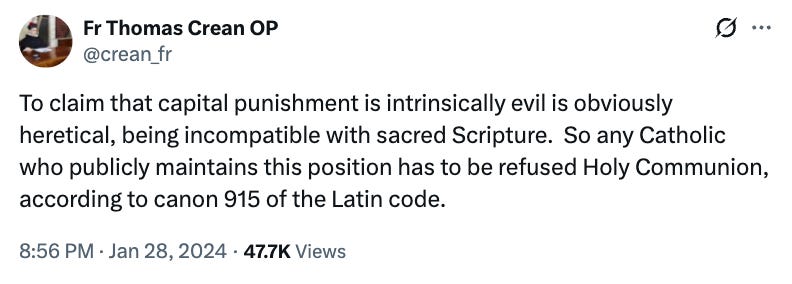
Mons. Robert F. Prevost OSA, Diocesan Bulletin N. 10, February 2021, pp 12-13. Addressed here.
For instance:

He has repeated this several times since he was elected in May 2025.
Fr Thomas Crean OP, Concerning Humanae Vitae, 22 July 2011. Available at: http://www.christendom-awake.org/pages/thomas-crean/cath-herald-hv-letters.htm
Pew Research Center, Most U.S. Catholics Say They Want the Church To Be ‘More Inclusive’, 30 April 2025. Available at: https://www.pewresearch.org/religion/2025/04/30/most-us-catholics-say-they-want-the-church-to-be-more-inclusive/
This should be obvious, but for those who it is not:
Let us imagine a single circle, representing the Catholic Church prior to the Council. It is united as a single shape. One cannot divide this circle up – even by drawing a smaller circle inside it – and say one part continues the unity of the whole for the rest of the shape, without thereby admitting that the circle as a whole is divided.
But this is the very essence of what is being alleged, and so it is not a refutation or explanation at all. It simply makes no sense to say that a part can continue the unity of faith for the whole: either one must admit that the Church is reduced to at least the degree of the smaller part (with some fuzziness around the edges), or that the Church is divided in her profession of faith (and her teaching). But this is untenable, ergo, etc.
Global Survey of Roman Catholics, 2014. Figures taken from the following documents:
Fr Thomas Crean OP et al., Open letter to the bishops of the Catholic Church, Easter Week 2019. Available at https://s3.documentcloud.org/documents/5983408/Open-Letter-to-the-Bishops-of-the-Catholic.pdf
Romano Amerio, Iota Unum – A study of the changes in the Catholic Church in the XXth century, pp. 143, 147. Sarto House, Kansas City MO, 1996.
Canadian Bishops’ Statement on the Encyclical ‘Humanae Vitae’ (“The Winnipeg Statement”), 27 September 1968. Available online: https://isidore.co/misc/Res%20pro%20Deo/Modernism/modernism/winnipeg.html
Bishop Peta, for example, along with four others, published a document titled Declaration of the truths relating to some of the most common errors in the life of the Church of our time – which is evidently intended as a public refusal of assent to the doctrine of Francis, on the basis of its discontinuity with and contradiction of Catholic doctrine.
Cardinals Burke and Pujats, Archbishops Peta and Lenga, Bishop Schneider, Declaration of the truths relating to some of the most common errors in the life of the Church of our time. 31 May 2019. Available at: https://onepeterfive-wp.s3.amazonaws.com/wp-content/uploads/2019/06/Declaration_Truths_Errors_final_version_clean.pdf
“There is only one Catholic Church, in which today cohabitate in a confused and fragmentary way different and counterpoised theologies and philosophies. It is more correct to speak of a Bergoglian theology, of a Bergoglian philosophy, of Bergoglian morality, and, if one wishes, of a Bergoglian religion…”
Roberto de Mattei, Love for the Papacy & Filial Resistance to the Pope in the History of the Church, p. 138. Angelico Press, New York, 2019.
“It is self-evident that the Catholic Church and the anti-Church currently co-exist in the same sacramental, liturgical and juridical space. The latter, having grown stronger, is now attempting to pass itself off as the true Church, all the better to induct, or coerce, the faithful into becoming adherents, promoters and defenders of a secular ideology”
Fr Linus Clovis, ‘The Catholic Church and the anti-Church currently co-exist in the same sacramental, liturgical and juridical space’, Voice of the Family, 22 Mary 2017. Available at https://web.archive.org/web/20250317220520/https://voiceofthefamily.com/the-catholic-church-and-the-anti-church-currently-co-exist-in-the-same-sacramental-liturgical-and-juridical-space/
Berry wrote:
“It is a well-known fact that the Church has always demanded the strictest unity in the profession of faith; those who refused to profess even a single doctrine, were condemned as heretics who had already ceased to be members.”
Cf. also Van Noort, with reference to why material heretics cannot be members of the Church:
“[I]f public material heretics remained members of the Church, the visibility and unity of Christ’s Church would perish. If these purely material heretics were considered members of the Catholic Church in the strict sense of the term, how would one ever locate the ‘Catholic Church’? How would the Church be one body? How would it profess one faith? Where would be its visibility? Where its unity? For these and other reasons we find it difficult to see any intrinsic probability to the opinion which would allow for public heretics, in good faith, remaining members of the Church.”
Berry, p. 99
Mgr. G. Van Noort, ‘Christ’s Church’, Dogmatic Theology II, p. 242. Newman Press, Maryland 1957.
As for the possibility of “liminal cases”, cf. Fr Victor White OP, cited above.
Frank J. Sheed, Is It the Same Church? pp. 156. Pflaum Press, Dayton Ohio, 1968. See here:
Sheed., p. 189.
Amerio, p. 715.
Salaverri, n. 1182
Salaverri, n. 1183.
Berry, p. 86.
cf. Abbé Hervé Belmont, The Infallibility of General Disciplinary Laws, Trans. The WM Review, published 28 July 2022. Available at: https://www.wmreview.org/p/is-the-church-infallible-in-her-discipline
Salaverri, n. 1184.
Billot, pp. 173, 177.
https://archive.org/details/tractatusdeeccle01bill/page/173/mode/1up
Salaverri, nn. 1184-5
Salaverri, n. 1187.
Salaverri, n. 1222.
Billot, De Ecclesia, 1909, p. 146.
Cf. Salaverri, nn. 1221, 1228-1235.
The rigour of the Bollandists’ Acta Sanctorum can be seen in the criticism levelled against them. They – and more so those who have followed them – have been accused of being overly sceptical of those saints about whom positive historical evidence was not found outside of tradition (e.g., certain traditions attached to the Roman martyrs, and so on). However, whatever one thinks of scepticism towards such saints, there can be no doubt that the Bollandists succeeded in establishing the truth of what could be proved with positive historical evidence.
Cf. John L. Allen Jr, ‘With beatification of John Paul II, what makes a ‘fast-track’ saint?’, National Catholic Reporter, 1 February 2011. Available at https://www.ncronline.org/news/vatican/beatification-john-paul-ii-what-makes-fast-track-saint
Crean, ‘Infallibility and Canonizations: A Disputation’, n. I., fn. 8. In Are Canonizations Infallible? ed. Peter Kwasniewski, Arouca Press, Waterloo, Canada, 2021.
For example, cf. the classic work Goodbye, Good Men by Michael Rose, The Church Impotent by Leon Podles, and many other such works.
It would be a mistake to latch onto Billot’s reference to “dogma” here, as is clear from the principles discussed in this piece. Further, as Van Noort writes:
“The charism of infallibility was bestowed upon the Church so that the latter could piously safeguard and confidently explain the deposit of Christian revelation, and thus could be in all ages the teacher of Christian truth and of the Christian way of life.
“But if the Church is to fulfill this purpose, it must be infallible in its judgment of doctrines and facts which, even though not revealed, are so intimately connected with revelation that any error or doubt about them would constitute a peril to the faith.
“Furthermore, the Church must be infallible not only when it issues a formal decree, but also when it performs some action which, for all practical purposes, is the equivalent of a doctrinal definition.”
Mgr G. Van Noort, Dogmatic Theology Volume II: Christ’s Church, n. 8y. 6th edition, 1957, trans. Castelot & Murphy, Newman Press, Maryland 1957.
Billot, pp. 173-4.
https://archive.org/details/tractatusdeeccle01bill/page/173/mode/1up
“Something is good when it is good in every respect, and it is bad when it is wrong in any respect.”
Crean et al. Open Letter, p. 4.
Sheed, p 27.


Daly writes:
“The great philosopher Fr. Julio Meinvielle (1905-73) argued that Vatican II sought to give no absolute teaching, but only to establish prudential guidelines to follow in the present unhappy state of society. Alas this view is quite incompatible with the words ‘it further declares that the right to religious liberty is truly founded on the very dignity of the human person as known by the revealed word of God and reason itself.’ We feel sure that Fr. Meinvielle’s declining health must have blunted his acumen at the time he formed this judgment.
“At least Fr. Meinvielle’s interpretation, though unfaithful to the text of Vatican II, entailed no departure from sound doctrine. The same may be said of an article by Dominican Fr. Thomas Crean which appeared in Christian Order (October 2004). Crean recognises that Dignitatis Humanae is doctrinal, not merely practical, but for him its right to religious liberty belongs exclusively to those who profess the true religion: he adds that the reference to religions in the plural is explained by the fact that its doctrine would have applied even in the hypothetical case in which God had not made any revelation and had left man in the state of nature.
“This is a beautiful theory provided one never actually takes down from the bookshelf a copy of the text under discussion. Once one does, it disappears in a puff of smoke. Dignitatis Humanae applies its supposed right to the freedom to join or to leave any ‘religious community’ whatsoever (paragraph 6), in other words it orders the state to authorise apostasy from the Catholic religion and assures us that the state must not punish this apostasy because man possesses a right to pass from any religion into any other – a right that the state must respect. Indeed Dignitatis Humanae formally forbids any discrimination between religions on the part of the state, whether to outlaw Moslem blasphemy, to forbid Protestant propaganda, to excuse priests from military service or to exclude from public office Jews whose ‘kol nidre’ liturgical prayer explicitly authorises them to lie even on oath.”
John S. Daly, Religious Liberty: The failed attempts to defend Vatican II, Romeward. Available at The WM Review
Cf. Hilary White, ‘A Sister Speaks: “Cor Orans is the Death-Knell of Carmel’”, The Remnant, 27 May 2018. Available at https://remnantnewspaper.com/web/index.php/fetzen-fliegen/item/3911-a-sister-speaks-cor-orans-is-the-death-knell-of-carmel
Berry, p. 125.
Salaverri, n. 1171
Berry, pp. 139-40. He also defines “simultaneous catholicity” as follows:
“SIMULTANEOUSLY CATHOLIC. The Church might have a successive existence in various parts of the world, dying out in one place as it springs up in another, until finally the Gospel would have been announced in all parts of the world. This would constitute successive catholicity, but it is evident that such universality is not sufficient, because at no time would the Church be really Catholic in any true sense of the word. Therefore, the Church must be simultaneously Catholic, i.e., it must be present throughout the whole world at one and the same time. It is true, of course, that the Church may cease to exist in this or that part of the world, but it must ever remain at least morally universal, as explained above.”
Berry, p. 73.
What does it mean to exist “as a society”? A society is an association of men, united in the pursuit of a common good. A perfect society is on which has all the means needed to achieve its end.
For a society like the Church, authority is necessary; and thus did Christ found her. However, such societies may sometimes be left without their chief authority, as is the case for every papal interregnum – during which, as St Antoninus says, papal authority “never dies, because it always remains in Christ, who rising again from the dead, dieth now no more.” At this time, the actual administration of the papal authority does indeed die, he says; and the power of electing remaining in the College of Cardinals (or those to whom this power may devolve).
“[I]f by the name of papacy we understand the election and determination of the person (which is the material thing in the papacy, as has been said before) then such power remains in the College after the death of the Pope. But if by the name of papal power we understand his authority and jurisdiction (which is the formal thing), then such power never dies, because it always remains in Christ, who rising again from the dead, dieth now no more. […]
“If, however, by the name of papal power we understand the actual administration, which is the material and formal thing in the papacy, then it is true that this actual administration dies with the death of the Pope, since the actual administration of the papal power does not remain in the College after the death of the Pope (except to the extent that it was entrusted to them by a decree of the predecessor), nor does it remain, in this manner, in Christ, because, according to the common law, Christ has not exercised such power, after His resurrection, except through the mediation of the Pope; for although He Himself is the door, He has nevertheless constituted Peter and his successors as the His porters, by whose mediation the door of access to Him is opened and closed.
“Wherefore St. Augustine, commenting on the words “all power is given to me in heaven and in earth ... and behold I am with you all days, even to the consummation of the world” (Mat. 28), says that the Apostles, to whom Christ spoke, were not going to remain until the consummation of the world, but He spoke to them in the person of all those that would succeed them, as to a single body of the Church.
“The power of the Church therefore with regard to jurisdiction (which is, as it were, the formal thing in the papacy) does not die with the death of the Pope but persists in Christ. Nor does it die with regard to the election and determination of the person, (which is like the material element), but it persists in the College of Cardinals; it dies, however, with respect to its actual administration and jurisdiction, because after the death of the Pope, the Church is vacant and is deprived of the administration of such power.”
(Cited in Ricossa, p. xxv)
Similarly, parts of the society may be left without their particular subsidiary authority (e.g., the bishop of a diocese).
It is certainly the case that a papal and diocesan interregnum may coincide, such that a number of Catholics may be left without either the Pope or the diocesan bishop, and thus have no individual person who has episcopal jurisdiction over them.
Nonetheless, such Catholics may visibly remain a part of the society for as long they continue to be morally united with each other, and the society as a whole, in pursuit of the same common good – visibly manifested, for example, in their observance of the same laws promulgated by authority. Cardinal Billot makes this point in reference to a situation in which offices are vacant, or succession is doubtful:
“When one says that this succession has always lasted without ever being interrupted, one does not mean that no interval of time elapsed between the death of a pope and the election of his successor, nor that there is absolutely none in the whole genealogy whose legitimacy would be doubtful. One means that the pastors succeeded one another in such a way that their see never ceased to be occupied, even when it was vacant or when its incumbent was doubtful.
“In this way, the preceding government continued to exercise itself virtually through the rights of this see, which always remained in force and were always recognised, and the concern was always maintained to designate a successor with all certainty. It is in this sense that the succession was not interrupted: on condition of denying the interruption insofar as it is compatible with the material subject of the succession, and corresponds to a human mode of succession, in a government where the subject of the power is designated by an election, as Christ willed when He instituted His Church.”
Billot, p. 260.
Similarly, Salaverri refers to the unity of government perduring through the submission to officers of the illegitimate obediences:
1283. Actually, however, unity in faith and worship was evident. The unity of government was also present, because the legitimate Pontiff exercised the power of government:
By himself, as is clear, in the part of the faithful that was obedient to him;
Through his own delegates, in other parts of the faithful, which, given the common error then or the positive and probable doubt, obeyed others whom they thought to be legitimate. For, from the earliest antiquity this principle has been observed in the Church: In a common error or in a positive or probable doubt, the Church supplies jurisdiction (CIC 209 [1917]).[15] Therefore the true Sovereign Pontiff in those circumstances, by supplying jurisdiction, exercised his own proper power of government also through Pontiffs, Bishops and Priests of the other factions, as through his own delegates.
Fr Goupil also explains the same point, concluding “that the government of the predecessors virtually perseveres” in this way:
“Let us not forget that this formal and uninterrupted succession should be understood morally, and such is of the very nature of things where there is a succession of persons who are elected, as Christ wished and which has been practiced since times of ancient Christianity. This perpetuity does not require that there be no lapse of time between the death of a predecessor and the election of a successor; nor that in a series of such pastors there never be one who is dubious; but one understands by this a succession of legitimate pastors, such that the pastoral See, even when vacant, even when occupied by someone whose title is dubious, cannot really be thought to have ceased to exist.
“This is to say that the government of the predecessors virtually perseveres in the law of the See which remains always in force and always recognized; and that it will also always persevere in its solicitude for electing a successor.” (Cf. Antoine, De Eccl.) [Emphasis added.]
The permanence of the Church’s laws means, in effect, that her authority continues even when individuals have no legitimate pastor over them. They remain members of the same society of which they were parts prior to the simultaneous interregnum of the Holy See and their diocesan see.
It does not seem absurd to posit that such a simultaneous deprivation of both papal and episcopal authority could occur on a very wide scale, such that it becomes difficult (or morally impossible) for most persons to verify exactly where the legitimate authorities over other Catholics survive; if this would occur, it could very severely obscure the visibility of the Church, and would create a situation in which many men could cease to be members of the society, pursuing ends different to its common good – as has, of course, been the case on a dramatic scale since Vatican II. However, this would not destroy the visibility of the society where it continues without officers, nor where these officers remain.
In brief, the visibility of a society as a society does not absolutely depend on the visibility of its living office-holders, at least in the sense of their being visible to a great number of men.
I prescind here from the question of whether both the Pope and all diocesan bishops and their equivalents can be absent simultaneously, except to say a) that I do not believe that this can be the case, and b) that an extended period of sede vacante does not entail such a scenario.
St Antoninus, Summae Sacrae Theologiae, Juris Pontificii, et Caesari, Tertia Pars, Titulus Vigesimus Primus, §3. Text taken from Fr Francesco Ricossa, Pope, Papacy and the Vacant See, translated and edited by the seminarians of Most Holy Trinity Seminary, originally published in Sodalitum n. 66, pp. 4-24
Fr Goupil, S. J. L’Église, 5th ed., 1946, Laval, pp. 48-49, cited in Fr Bernard Lucien, La situation actuelle de l’autorité dans l’Église, Brussels 1985.
In support of the comments made by St Antoninus, consider the following from Fr Charles Journet:
“We must not think of the Church, when the Pope is dead, as possessing the papal power in act, in a state of diffusion, so that she herself can delegate it to the next Pope in whom it will be re-condensed and made definite. When the Pope dies the Church is widowed, and, in respect of the visible universal jurisdiction, she is truly acephalous.
“But she is not acephalous as are the schismatic Churches, nor like a body on the way to decomposition. Christ directs her from heaven. There is no one left then on earth who can visibly exercise the supreme spiritual jurisdiction in His name, and, in consequence, any new manifestations of the general life of the Church are prevented.
“But, though slowed down, the pulse of life has not left the Church; she possesses the power of the Papacy in potency, in the sense that Christ, who has willed her always to depend on a visible pastor, has given her power to designate the man to whom He will Himself commit the keys of the Kingdom of Heaven, as once He committed them to Peter.” (Emphasis added)
The above text was also cited by Fr Nicolás Despósito ICR in his article ‘The Apostolicity of the Church and the Cassiciacum Thesis,’ published in January 2026 by Most Holy Trinity Seminary, USA. In this article, Fr Despósito also provided the following from Bernadino López de Carvajal:
“When the See is vacant, does this supreme pontificate or this plenitude of power remain in the Church, or in the College of Cardinals? It is customary among theologians to make a distinction: either this pontificate refers to the authority itself and to the supreme jurisdiction in its source, and then it does not perish when the pope dies—since it remains in Christ the First Pastor who, rising from the dead, is not able to die anymore, which authority Christ has given immediately to Peter and in him to his successors; or this pontificate, taken materially, refers to the faculty of electing and determining the person who is to discharge the office of supreme pontiff and in this sense it remains immediately in the College of Cardinals.” (Second emphasis added)
Berry writes:
“Relative catholicity refers to the universality of the Church as compared with that of some other society. In this latter sense, the Church will be Catholic if it is more widespread than any other single church. As already noted, mere numbers do not constitute universality; one church is not more Catholic, or universal, than another because of the mere fact that it numbers more adherents.
“Absolute Catholicity is necessary in the true Church as shown above, but relative Catholicity does not seem necessary; at least, its necessity can be proved neither from Scripture nor tradition, and there seems to be no reason why a false sect might not become universally distributed over the world, unless perhaps God in His providence prevents it, of which we have no assurance.” p. 73
“Neither will mere numbers constitute universality; a large number of members confined to a relatively small portion of the world does not constitute universality.” p, 127.
“Therefore, if the Church is to be Catholic in fact, its members and all its parts throughout the world must be so united as to form but one society – a visible society with unity of government, faith and worship…
“It is not sufficient for actual Catholicity that a Church have members scattered far and wide throughout the world; the Church itself, as a society, must exist in the various parts of the world to exercise its authority and carry on the mission of Christ. In other words, the Church of Christ must be formally universal.” p. 139-40
He writes:
“Neither will mere numbers constitute universality; a large number of members confined to a relatively small portion of the world does not constitute universality.” (p. 70)
However, he also writes:
“Cardinal Bellarmine held that the Church might be so reduced in extent as to be confined for a time to one single country or province, provided it were still recognized as the Church that had been universally spread over the world. This opinion has been rejected by theologians in general, yet it seems quite evident from the Apocalypse of St. John that just such a situation will be realized in the· days of Antichrist. In chapter xii the Church is symbolized by a woman who is pursued and persecuted by a dragon (Satan). ‘And the woman fled into the wilderness where she has a place prepared by God, that they may nourish her a thousand two hundred and sixty days.” And again, ‘there was given to the woman the two wings of the great eagle, that she might fly into the wilderness unto her place, where she is nourished for a time and times and half a time, away from the serpent.’
“These words clearly indicate that the Church will be forced to seek retreat in some friendly nation or province where she can be protected from destruction for the three and one half years of Satan’s reign. During this time of retreat the Church will be greatly limited in her diffusion, but she will still be morally universal,—he will still be known through- out the world; her very persecution will make her known far and wide through the nations of the world. Today we see the forebodings, if not the actual beginnings, of the situation just described.” (pp. 73-4)
Berry writes:
“MORALLY CATHOLIC. Physical universality would be realized if the Church were so completely spread over the earth that she actually exercised her authority over every portion of the inhabited world. It is evident that the Church has never been so diffused, and therefore such universality cannot be necessary. […]
“lt is sufficient, then, that the Church be morally universal, i.e., that she be so wide-spread throughout the world that she may easily be known even in those regions in which she does not actually exist; or, as Suarez puts it: ‘If she has such universal renown that she may be known and distinguished from all heretical sects.’ SIMULTANEOUSLY CATHOLIC. The Church might have a successive existence in various parts of the world, dying out in one place as it springs up in another, until finally the Gospel would have been announced in all parts of the world. This would constitute successive catholicity, but it is evident that such universality is not sufficient, because at no time would the Church be really Catholic in any true sense of the word. Therefore, the Church must be simultaneously Catholic, i.e., it must be present throughout the whole world at one and the same time. It is true, of course, that the Church may cease to exist in this or that part of the world, but it must ever remain at least morally universal, as explained above.”
Berry, pp. 72-3.
Berry, p. 70. I have discussed what it means for the Church to exist “as a society” above. It might be suggested – as I have in the past – that the term “as a society” denotes the actual existence of a living authority. This now seems to me to be a mistake, because although a living authority is necessary in order for the Church as a society to be existing in the way that she should, it does not follow that those parts of the Church which are temporarily deprived of a living authority cease to be members of the Church as a society – they continue to exist with the Church’s laws intact, in pursuit of the common goal of the society, and so on.
However, it is notable that Berry writes the following:
“It is not sufficient for actual Catholicity that a Church have members scattered far and wide throughout the world; the Church itself, as a society, must exist in the various parts of the world to exercise its authority and carry on the mission of Christ. In other words, the Church of Christ must be formally universal.” (p 70).
If we were to take Berry’s meaning to be that the Church must exist with living authorities, then what he is saying is that she exists in this way in “various parts of the world” – which seems to acknowledge a distinction between the Church’s members existing in “many” parts of the world. The contention here would be that, if living authorities are indeed necessary for the Church, the requirements of the Church’s catholicity are satisfied by these authorities living in “various” parts of the world, even if many of her members are deprived of access to their own legitimate pastors, and are temporarily required to organise themselves according to the dictates of necessity and prudence.
Rev. Timoteo Zapelena, S.J., De Ecclesia Christi: Pars Apologetica, Rome: Gregorian, 1955, p. 489; italics given; underlining added. Translation by Novus Ordo Watch.
Vol. 3, pp. 527–29, in de Saint-Just, at the end of the Conclusion. Soon to be published by Stabat Mater Press.
Cf. the extract here: https://www.wmreview.org/p/rupture-journet
Billot, p. 218. https://archive.org/details/tractatusdeeccle01bill/page/218/mode/1up
Here is the text immediately preceding the text above:
“Here I think it best to prescind from the singular opinion of Bellarmine, who says (Book IV de Ecclesia, ch. 7) that simultaneous diffusion is not required, such that at one and the same time there must necessarily be some of the faithful in all provinces, but that it suffices if this occurs successively.
“‘From which it follows,’ he says, ‘that if one province alone retained the true faith, it would still truly and properly be called the Catholic Church, provided it were clearly shown to be one and the same as that which existed at some time, or at various times, throughout the whole world: just as any diocese is now called Catholic, because it is in continuity with the others which together constitute one Catholic Church.’”
Eric Sammons, How the Church Lost Her Mission, and How We Can Reclaim It, Chapter I (ebook version). Crisis Publications, Manchester NH, 2021.
‘Full text of Benedict XVI’s recent, rare, and lengthy interview’, in The Catholic World Report, 17 March 2016. Available at https://www.catholicworldreport.com/2016/03/17/full-text-of-benedict-xvis-recent-rare-and-lengthy-interview/
Ibid.
Joint International Commission for Theological Dialogue Between the Catholic Church and the Orthodox Church (as a whole), Uniatism, Method of Union of the Past, and the Present search for Full Communion, 23 June 1993.
Ibid., n. 30.
Ibid., n. 10.
Ibid., n. 22.
Ibid., n. 12.
Ibid. n. 18.
Leo XI, Address at the Extraordinary Consistory, 7 January 2026. Available at https://www.vatican.va/content/leo-xiv/en/speeches/2026/january/documents/20260107-concistoro-straordinario.html
Balamand Declaration, n. 24.
Full text cited in Jan Bentz, ‘Pope again criticizes ‘proselytism’: ‘It is not licit that you convince them of your faith’, LifeSiteNews, 19 October 2016. Available at https://www.lifesitenews.com/opinion/pope-to-teen-girl-proselytism-is-the-strongest-poison-against-the-ecumenica/
Balamand Declaration, n. 29.
Ibid., nn. 25, 29, 30.
Ibid., n. 29.
Ibid., n. 25.
Ibid., n. 20.
Ibid., n. 13.
Ibid., n. 15.
Ibid., n. 34.
Cited by Pope Leo XIII in Encyclical Inimica Vis, n. 7, 1892.
John Paul II wrote:
“60. More recently, the Joint International Commission took a significant step forward with regard to the very sensitive question of the method to be followed in re-establishing full communion between the Catholic Church and the Orthodox Church, an issue which has frequently embittered relations between Catholics and Orthodox. The Commission has laid the doctrinal foundations for a positive solution to this problem on the basis of the doctrine of Sister Churches. Here too it has become evident that the method to be followed towards full communion is the dialogue of truth, fostered and sustained by the dialogue of love. A recognition of the right of the Eastern Catholic Churches to have their own organizational structures and to carry out their own apostolate, as well as the actual involvement of these Churches in the dialogue of charity and in theological dialogue, will not only promote a true and fraternal mutual esteem between Orthodox and Catholics living in the same territory, but will also foster their joint commitment to work for unity.99 A step forward has been taken. The commitment must continue. Already there are signs of a lessening of tensions, which is making the quest for unity more fruitful.”
Encyclical Ut unum sint, n. 60.
Cardinal Kurt Koch et al., Commission for Religious Relations with the Jews, ‘The Gifts and the Calling of God are Irrevocable’ (Rom. 11.29), n. 37. 10 December 2015. Available at https://www.christianunity.va/content/unitacristiani/en/commissione-per-i-rapporti-religiosi-con-l-ebraismo/commissione-per-i-rapporti-religiosi-con-l-ebraismo-crre/documenti-della-commissione/en.html.
Ibid.
Ibid., n. 40.
Ibid., n. 42.
Ibid., n. 44.
Ibid., n. 46.
Ibid., n. 47.
John Paul II, Meeting of John Paul II with representatives of the Jewish community, 17 November 1980. Available at https://www.vatican.va/content/john-paul-ii/it/speeches/1980/november/documents/hf_jp_ii_spe_19801117_ebrei-magonza.html
Benedict XVI, Not Mission but Dialogue, published in Herder Korrespondenz, 2018. Available at https://www.catholicculture.org/culture/library/view.cfm?recnum=12765
Cardinal Kurt Koch, Letter to Rabbi Rasson Arussi, 3 September 2021. Sent on headed notepaper from the Commission for Religious Relations with the Jews, available at https://www.christianunity.va/content/dam/unitacristiani/Ebraismo/2021%2009%2003%20Koch-Arussi.pdf
“[A]n asymmetry seems to remain: the Church needs to think theologically about its relationship with Judaism in order to understand itself, which is not the case for Judaism.”
Jean-Marc Aveline, ‘Les enjeux actuels des relations entre juifs et chrétiens,’ Études 2010/10 Tome 413, p 355-366. Available here. Cf. also S.D. Wright, ‘Conclave frontrunner Cardinal Aveline’s views on Judaism subvert Church teaching’, LifeSiteNews, 2 May 2025, available here: https://www.lifesitenews.com/opinion/conclave-frontrunner-cardinal-avelines-views-on-judaism-subvert-church-teaching/
‘Bishop Robert Barron’, The Ben Shapiro Show, 16 December 2018. Available at https://www.dailywire.com/episode/sunday%20special%20ep-31-bishop-robert-barron
Berry, 125.
Salaverri, n. 1164.
Berry, p 23.
Cf, for example, the following hostile source: Paul E. Pierson, ‘Roman Catholic Missions since Vatican II: An Evangelical Assessment’, International Bulletin of Mission Research, Vol. 9, Issue 4, October 1985. Available online at: https://journals.sagepub.com/doi/abs/10.1177/239693938500900404?download=true
Berry writes:
“Absolute Catholicity is necessary in the true Church as shown above, but relative Catholicity does not seem necessary; at least, its necessity can be proved neither from Scripture nor tradition, and there seems to be no reason why a false sect might not become universally distributed over the world, unless perhaps God in His providence prevents it, of which we have no assurance.”
Berry, p. 73.
Note that, as per the definition given at the start of this part, I am not arguing that the Conciliar/Synodal Church is a “false sect” in any sense that would entail its “members” being non-Catholics by that fact alone. My contention is that this group is not the Catholic Church, taken as such. Exactly how it should be understood is debatable.
Salaverri, n. 1176
Salaverri, n. 1176.
Salaverri, n. 1176
It is particularly ironic that such a rupture with apostolic doctrine occurs with regard to apostolicity itself. The Church previously rejected idea that the Orthodox enjoy apostolic succession and are “true particular Churches.” The Church considered them to have only material succession, and to be sects of heretical schismatics. In the Conciliar/Synodal Church, the material/formal distinction has faded into the background, and they seem to be treated as having apostolic succession simpliciter.
Van Noort, n. 131.
Van Noort, n. 131.
Salaverri, n. 1176
Berry, p. 139.
Salaverri, n. 1222.
Cf. also Salaverri:
“The apostolicity of succession is distinguished in two ways: 1) material, is the mere continuation of one person after another in the same office, without a necessary permanence of the same law; 2) formal, is the replacement of one person in the rights and obligations of another in some office, without any change in the law.” N. 1178
It is clear that, if my contention is correct, this issue also poses a question to be considered carefully by those of my position.
However, the focus of this piece is to demonstrate that contention, namely that the Conciliar/Synodal Church (as defined) is not the Catholic Church, and that this is not the place to develop my answer to this difficulty in full. I will limit myself to noting that my contention is only that the Conciliar/Synodal Church is not the Catholic Church as such – not that it is a false sect, and that all those involved are non-Catholics. The answer to the objection lies in this distinction.
We note that “the norms in force” include divine law and the nature of things – something which Fr Crean seems to be overlooking here.
Salaverri explains the argument from prescription with reference to doctrine, but the same principles apply here. He states that it can be difficult, long and even morally impossible to produce documents or monuments, in proof of a point of doctrine, which go back to the apostles. “When this direct proof is impossible or very difficult,” Salaverri says, “one can then make use of Prescription.” (n. 803. 1). He defines this as follows:
“The argument of Prescription is that whereby from the monuments of Tradition indirectly one deduces that the doctrine of faith or morals has been handed down from the Apostles.
“The principle on which the argument of prescription is founded is this: The doctrine of the Apostles is a legitimate possession proper to the Church alone, to which Christ committed his doctrine as a deposit to be entirely protected and faithfully transmitted.
“Indeed the legitimacy of possession legally can be proved in two ways, either by positive documents that are reliable or by Prescription. Since the positive documents are lacking, recourse can be made to Prescription, which is a legal title based on a longstanding possession, by which the legitimacy of the ownership of the thing is proved and by which others are excluded from action concerning the same thing.” (ibid.)
Fr Gustave Thils, Les notes de l’Église dans l’apologétique catholique depuis la Réforme, Gembloux 1937, p. x. Cited in Journet, available here.
Mgr Robert Hugh Benson, The Religion of the Plain Man, p. 44-5. Burns and Oates, London, 1907. Available at https://ia600500.us.archive.org/19/items/TheReligionOfThePlainMan/TheReligionOfThePlainMan.pdf
Pastor Aeternus, 1-4. https://www.papalencyclicals.net/councils/ecum20.htm
Amerio, p. 143.
Amerio, p. 144.
In the Opening Address to the Second Vatican Council, John XXIII set out the charter of the new papacy:
“There has never been a time when the Church has not opposed these errors; often she has also condemned them, and sometimes with the greatest severity. As for the present time, the Bride of Christ prefers to use the medicine of mercy rather than to take up the weapons of rigour; she thinks it necessary to meet today’s needs by setting forth more clearly the value of her teaching rather than by condemning. Not because false doctrines, opinions, and dangers to be guarded against and opposed are lacking; but because all these things so openly contradict the sound principles of honesty, and have produced fruits so deadly, that today men seem to be beginning spontaneously to reject them—especially those forms of life which ignore God and his laws, place excessive trust in technological progress, and found well-being solely upon the comforts of life. They are becoming ever more aware that the dignity of the human person and his natural perfection are matters of great importance and most difficult to realise. What matters above all is that they have learned from experience that external violence exercised upon others, the power of arms, and political domination are absolutely insufficient to resolve in a satisfactory way the very grave problems that trouble them.”
As is typical, the exercise of authority is caricatured as referring to “external violence”, “the power of arms”, etc.
Solemn Opening of the Second Vatican Ecumenical Council, Speech by the John XXIII, Thursday 11 October 1962, 7.2. https://www.vatican.va/content/john-xxiii/it/speeches/1962/documents/hf_j-xxiii_spe_19621011_opening-council.html
Amerio, p. 147.
Firing Line with William F. Buckley Jr., Episode 186, 31min 40. Recorded on January 6, 1970. Available here.
Ibid., 37min 16.
Ibid., 38min. 24
Amerio, p. 146.
Fr Dr Maciej Sieniatycki, ‘The Church in the Conception of the Modernists’, Part III of Modernism in the Polish Book, in Przegląd Powszechny, Oct-Dec 1916, pp. 73-82. Krakow. Available at https://www.wmreview.org/p/sieniatycki-iii
Fr Mauro Cappellari (Later Pope Gregory XVI), II Trionfo della Santa Sede, Preliminaries, § IX. Venice, Vella Casa del Tipgrafe Editore, 1832. Available at https://books.google.fr/books?id=O5opAAAAYAAJ&printsec=frontcover&hl=fr&source=gbs_ge_summary_r&cad=0#v=onepage&q&f=false
Ibid., Preliminaries, § XIII
St Thomas Aquinas, Summa Theologiae I, Q. 75, A. 3.
As Fr Franceso Faà di Bruno wrote:
“Her Apostolic doctrine has never changed; it has from time to time been unfolded and made more clear, especially when heresy or some other necessity has called for a solemn and precise definition; but there is no case of the Roman Catholic Church holding a doctrine which was previously declared heretical, or declaring heretical what was formerly defined by the Church as a dogma of faith; so much so that it is a proverbial saying, even among Protestants, that the Roman Church est semper eadem, is always the same.”
Similarly, M.J. Rhodes wrote:
“There is a necessary succession of doctrine as well as of orders, and apart from the Apostolic communion we have no guarantee for the Apostolic faith. The Apostles alone received from Christ that great depositum, with the assistance of His Spirit to keep it uncorrupt for all time.”
Fr Francesco Faà di Bruno, Catholic Belief. London: Burns & Oates, 1884. pp. 162. https://books.google.vg/books?id=ZbYCAAAAQAAJ&pg=PA161#v=onepage&q&f=false As cited in Eric Hoyle, Questions on Apostolicity.
M.J. Rhodes, The Visible Unity of the Catholic Church. Vol. I, p. 44. London: Longmans, 1870. https://archive.org/details/visibleunityofca01rhod/page/44/mode/1up As cited by Hoyle, ibid.
As we have stated on several occasions, The WM Review does not have a position on the legitimacy of John XXIII, and as such the above statement does not intend to exclude him.
Van Noort, p. 85.
Fr de Zulueta writes, regarding what must be believed with divine faith, and heresy:
The error must concern a doctrine contained or revealed in the Scriptures, and also proposed as such by the Church to our belief. But, be it carefully observed, it is not necessary for the guilt of heresy that the doctrine should have been solemnly defined by supreme authority; it is quite sufficient that it should form part of the ordinary daily teaching of the Church throughout the world, which is infallible. To say, ‘It is not heresy to deny this doctrine: for the Church has never defined it,’ is utterly unsound. Hence it would be heresy to deny any truth clearly contained in the Scriptures, because the Church teaches all that the Scriptures do.”
Letters on Christian Doctrine, Vol. I, p. 51. R&R Washbourne, London, 1914.
Vatican I taught:
“For the holy Spirit was promised to the successors of Peter not so that they might, by his revelation, make known some new doctrine, but that, by his assistance, they might religiously guard and faithfully expound the revelation or deposit of faith transmitted by the apostles.”
In addition, we should consider “the argument from prescription” (see above). Continuing on from his explanation of the argument in general, he distinguishes historical/apologetic prescription and theological/dogmatic prescription:
“The first is reduced to this: The whole Church has this doctrine, received from the Apostles, with a possession of long duration. But what is found as one among many is not an error, but handed on” (Tertullian, De praescr. n.28). Therefore this doctrine really was handed down from the Apostles.
“The other argument of theological Prescription also has two forms: a) The positive form can be reduced to this: The whole Church has this doctrine, received from the Apostles, with a possession of long duration. But the whole Church in virtue of her own infallibility cannot have for a long time in her possession a doctrine as apostolic, which really was not handed down by the Apostles. Therefore this doctrine really was handed down by the Apostles, b) The negative form of the argument goes like this: This doctrine was discovered later and it contradicts what the whole Church held previously with a possession of long duration, having received it from the Apostles. Therefore such doctrine cannot have been handed down by the Apostles.” (n. 804)
For the reasons mentioned above, the traditional doctrine of religious liberty can be said to be “the doctrine of the Apostles” on the basis of positive theological prescription; the new doctrine, based on it is on a novel notion of human dignity, “cannot have been handed down by the Apostles” by virtue of negative theological prescription. The same applies, due to the same novel principle, to the new doctrine on the death penalty and other such matters.
John Daly, The Principal Heresies and Other Errors of Vatican II, ed. John Lane.
Crean, Praying With Non-Catholics — Is it Possible? Apropos, February 2009. Available at http://www.christendom-awake.org/pages/thomas-crean/praying-with-non-catholics.htm
Sheen continues:
“In desperate need for God, whom he nevertheless refuses to adore, modern man in his loneliness and frustration will hunger more and more for membership in a community that will give him enlargement of purpose, but at the cost of losing himself in some vague collectivity. Then will be verified a paradox – the very objections with which men in the last century rejected the Church will be the reasons why they will now accept the counter-church.
“The last century rejected the Church because it was infallible; it refused to believe that the Vicar of Christ would be immune from error when he spoke on matters of faith and morals as chief shepherd of Christendom. But the twentieth century will join the counter-church because it claims to be infallible when its visible head speaks ex cathedra from Moscow on the subject of economics and politics, and as chief shepherd of world Communism.
“The Church was critically spurned in the last few centuries because it claimed that it was Catholic and universal, uniting all men on the basis of one Lord, one faith, and one Baptism. No man, the nineteenth century claimed, could be a good American, a good Frenchman, or a good German if he accepted shepherding, albeit spiritual, from a spiritual head. But in the new era, what the modern lost soul will like particularly about the counter-church is that it is catholic or international. It breaks down all national boundaries, laughs down patriotism, dispenses men from piety to country which the Christ enjoined, makes men proud that they are not Americans, French or British, but members of a revolutionary class under the rule of its vicar who rules from the Kremlin.
Archbishop Fulton J. Sheen, Communism and the Conscience of the West, pp. 9–11. Cluny, Providence, RI, 2021.
Ibid., p. 157.
Berry, p. 66.
Berry, The Apocalypse of St. John, p. 135. John W. Winterich, Columbus, OH, 1921. Taken from Novus Ordo Watch.
Fr Bernard Krame, The Book of Destiny, p. 150 of this online edition: https://archive.org/details/TheBookOfDestinyAnOpenSKramerFr.HermanBernardF.4418_201903/page/n149/mode/1up
Fr Owen Francis Dudley, The Church Unconquerable, 1932. Available at https://www.ecatholic2000.com/cts/untitled-516.shtml
My article Private Revelations, Theology and the Crisis – What should be their relationship? (25th March 2022) contained the following:
Zavala’s conversation with Amorth proceeded as follows:
“Indeed,” [Amorth] states, “One day Padre Pio said to me very sorrowfully: ‘You know, Gabriele? It is Satan who has been introduced into the bosom of the Church and within a very short time will come to rule a false church.’”
“Oh my God! Some kind of Antichrist! When did he prophesy this to you?” [Zavala asks].
“It must have been about 1960, since I was already a priest then.”
“Was that why John XXIII had such a panic about publishing the Third Secret of Fatima, so that the people wouldn’t think that he was the anti-pope or whatever it was …?”
A slight but knowing smile curls the lips of Father Amorth.
“Did Padre Pio say anything else to you about future catastrophes: earthquakes, floods, wars, epidemics, hunger …? Did he allude to the same plagues prophesied in the Holy Scriptures?” [asks Mr. Zavala]
“Nothing of the sort mattered to him, however terrifying they proved to be, except for the great apostasy within the Church. This was the issue that really tormented him and for which he prayed and offered a great part of his suffering, crucified out of love.” [says Fr. Amorth]
“The Third Secret of Fatima?”
“Exactly.” (Zavala 231)
Unterhalt also says the following:
Padre Pio’s special connection with the message of Fatima was also revealed in 2017 in an enormously enlightening dimension: It was disclosed that he even knew the Third Secret – it had already been revealed to him four years before the shepherd children. The renowned journalist José María Zavala testifies to this in his book El secreto mejor guardado de Fátima, which he published to mark the 100th anniversary of the apparitions. In this investigative work, the Spanish author refers to his extensive interview with Don Gabriele Amorth, a spiritual son of Padre Pio. In it, the famous exorcist reveals what the stigmatized saint, struck to the core and shocked, confided to him about the Third Secret: “It is Satan who has entered the womb of the Church, and within a while he will rule over a false church.”
Zavala questioned Don Gabriele Amorth about this in more detail and, as the conclusion of the dialogue, states the following: “There were two recurring and interrelated themes: the great apostasy in the Church from its apex – in accordance with the testimony of Cardinal Ciappi – and the introduction of the devil to the head of the Church by means of the ‘Pope under the control of Satan.’”
José María Zavala, El secreto mejor guardado de Fátima, Spanish edition, Planeta Publishing 2017, quoted in Fr Frank Unterhalt’s essay on the Third Secret of Fatima.
Paul VI, Address to Members of the Permanent Committee of the International Congresses for the Apostolate of the Laity, Mar. 8, 1966; underlining added. Translation taken from The Messenger, Mar. 18, 1966, p. 3.)
Fr Joaquín Sáenz y Arriaga, The New Montinian Church, p. 480.
Fr. Roger Thomas Calmel, O.P. “Authority and Sanctity in the Church”, Itineraires 149 (January 1971), p 13-19; reproduced in the Sel de la Terre 40, p. 77 and 85-87. Cited in Bishop Tissier de Mallerais, Is There a Conciliar Church? Le Sel de la Terre, n. 85, Summer 2013. Available at https://dominicansavrille.us/is-there-a-conciliar-church/#easy-footnote-bottom-21-1759
At the time of writing, Arouca Press have just published a new translation of Brief Apologia for the Church of the Ages. The edition features a foreword by Fr Crean himself, in which he describes the book as “a work of prophecy”, suggesting that Fr Calmel “seems to have received some of portion of [the prophets’] spirit. Although he expresses some reservations about one of Fr Calmel’s ideas, Fr Crean nonetheless states that “the words of Roger-Thomas Calmel still shine a penetrating light.”
Bishop Antonio de Castro Mayer, The Religion of Man – Since the Council there has been a new Church, Diocesan Bulletin, April 1972. Available at https://web.archive.org/web/20260119132906/https://dominicansavrille.us/the-religion-of-man/
Mgr Brunero Gherardini, The Ecumenical Vatican Council II: A Much Needed Discussion, p. 296. Trans Franciscan Friars of the Immaculate, Casa Mariana Editrice, Frigento, Italy, 2009.
Cf. the New Liturgical Movement article here: https://www.newliturgicalmovement.org/2012/08/cardinal-burke-on-of-and-ef.html
Monday, August 13, 2012, Cardinal Burke, Prefect of the Supreme Tribunal of the Apostolic Signatura, speaks with Raymond Arroyo about the revised English translations of the OF Missal as well as the usus antiquior. Available at: https://web.archive.org/web/20121029111150/https://wdtprs.com/blog/2012/08/card-burke-on-summorum-pontificum-and-worship-as-the-key-to-reform-fr-z-rants-and-agrees/
Joseph Cardinal Ratzinger, Address given July 13, 1988, in Santiago, Chile, to the Chilean bishops. Published as ‘Cardinal Ratzinger’s Remarks Regarding the Lefebvre Schism’, published in The Wanderer, The Wanderer Printing Company, June 22, 2000. Available at https://www.catholicculture.org/culture/library/view.cfm?id=3032&repos=1&subrepos=&searchid=292734
Amerio, p. 712
Amerio, p. 109–110.
Something is good when it is good in every respect, and it is bad when it is wrong in any respect.
John Lane, ‘Sedevacantism and Theology of the Church’, at AKA Catholic, 11 February 2021. Available at https://akacatholic.com/sedevacantism-and-theology-of-the-church/
Archbishop Marcel Lefebvre, Interview given to Le Figaro, 2 August 1976, published 4 August 1976. Available at https://www.wmreview.org/p/the-suppressed-interview-of-archbishop
I am waiting until Friday evening to have sufficient time to read this article in a single sitting, as the author recommends.
+de Mallerais once argued that it could be shown that the conciliar church was a distinct entity from its four causes (formal, efficient, final, and material):
https://dominicansavrille.us/is-there-a-conciliar-church/
This was the Frankenchurch theory (ie., one pope for two churches). However, the four causes analysis was perfectly correct, and succeeded in proving the existence of a distinct conciliar entity foreign to the Catholic Church. He only got the pope part wrong, which he thought tethered the two together.
If now there is an additional argument from the four marks/notes -and I suspect I will be satisfied the author will have succeeded in making his case- proving the conciliar entity is a distinct entity from the Catholic Church, the recognition of the papal vacancy will be facilitated for those giving the matter a fair consideration, simply from the cumulation of arguments (to say nothing of the intrinsic strength of those arguments).
The biggest impediments will continue to be disposition and apathy (ie., the lack of moral diligence mentioned as requisite in Part I).
I will also be interested to discover to what degree the two arguments harmonize with each other (eg., is there a causal relationship between the two: Because the four causes are different, therefore the four marks/notes are different. Cause and effect?).
Looking forward to this article!
Thanks for this excellent book. I have but one suggestion: that the chapters and chapter headings in the contents be hyperlinked to their location in the text so that it might be swiftly navigated by readers and those referring back to it in online discussions.
I hope you are interviewed by many more media sources on this topic. May God continue to bless your work. I will send up some prayers in thanksgiving for it.