

Many people draw ‘red lines’, only to redraw them when they’re crossed, or find ways to explain the crossing away.
Is the Conciliar/Synodal Church the Catholic Church?
The question as to whether what came out of Vatican II was really the Catholic Church was asked very early on.
In 1968, before the Novus Ordo Mass was even introduced, the famous apologist Frank J. Sheed wrote a book entitled Is it the Same Church?
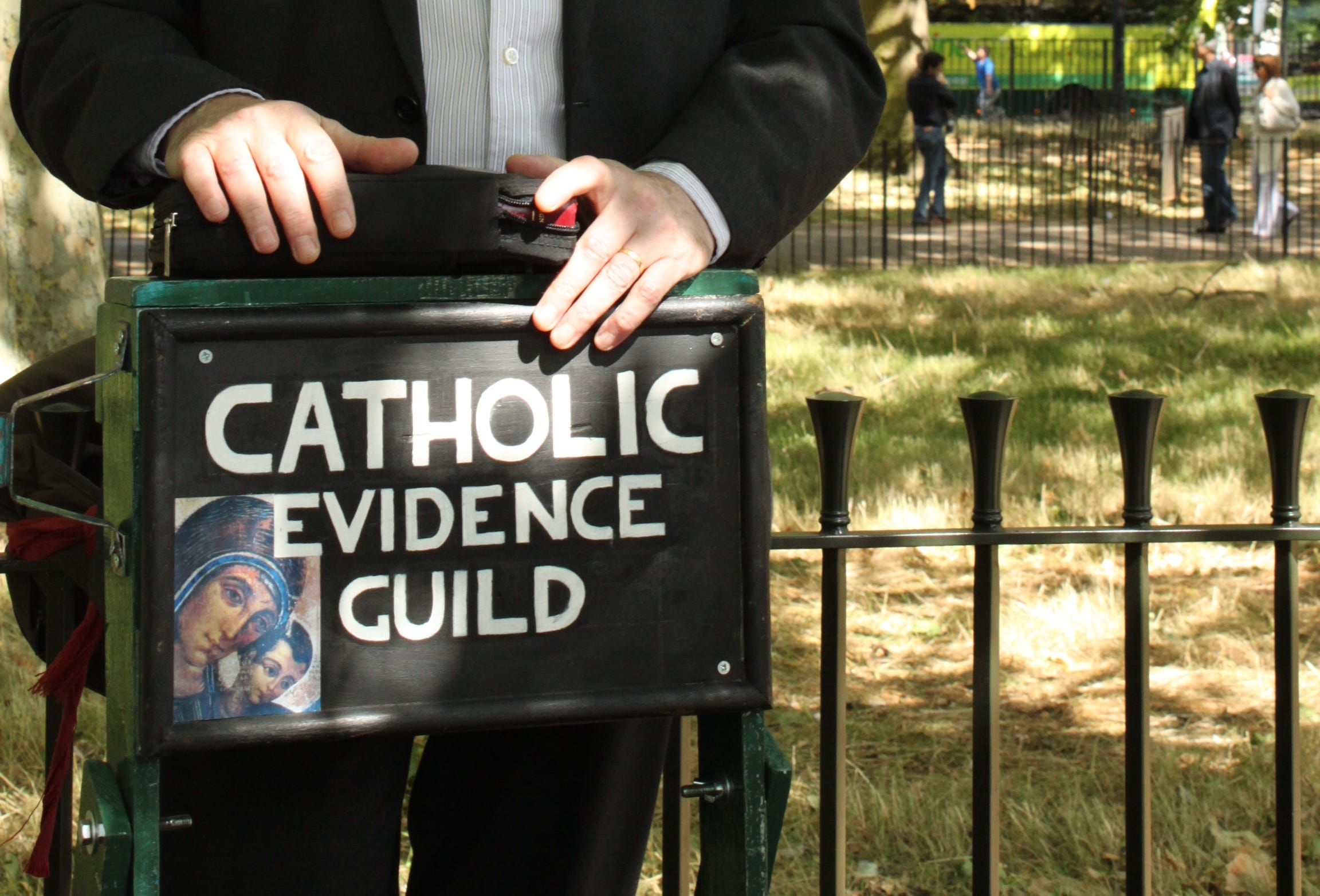
Sheed, born in Australia in 1897, became famous for his role in England’s Catholic Evidence Guild. This organisation aimed to propagate the Catholic religion, notably at Speaker’s Corner, in Hyde Park, London. Its standards were extremely high, such that few online Catholic pundits would be allowed to speak in public on its behalf. Sheed’s wife, Maisie Ward, compiled a work titled Catholic Evidence Training Outlines, which conveys the expectations of the Guild.1
The couple also founded the Sheed and Ward publishing house, responsible for many important works.
Is it the Same Church? was written in the aftermath of the Second Vatican Council. Throughout the work, Sheed argues that what Paul VI had dubbed “The Conciliar Church”2 was indeed the same Catholic Church. However, most interestingly, he both recognises the need to answer such a question, and frequently states that if this or that occurred, then it would no longer be the same Church. In this article we shall consider the particular “red lines” which Sheed draws.
As we consider them, it should be clear that every one of his “red lines” has been crossed. The conclusion is that, at least on the standards that Sheed set down in 1968, the Conciliar/Synodal Church is not the same Church.
One note about this book. Sheed was a giant of the pre-conciliar Anglophone Church, and there can be no doubt that his work achieved a lot of good – some of which will be of eternal value. However, the very book contains much that is regrettable: it is excessively optimistic about Vatican II and ecumenism, as we will see in this piece; he also speaks enthusiastically about that robber council’s declaration of the alleged right to religious liberty, previously condemned by the Church. With regards to this latter point, he shows himself to be of a decidedly liberal bent:
“Nor did we have to wait for the Council’s Declaration on Religious Liberty to know that any sort of religious coercion is indefensible.”3
“And now the Council has issued the Declaration on Religious Liberty, ending the whole subjection of religious belief to compulsion.”4
On the contrary, the legitimacy of coercion in religious matters is infallibly defined doctrine. Even those who wish to exonerate Vatican II, and prove its alleged continuity with pre-conciliar doctrine, usually tend to do so on the basis that Dignitatis Humanae is in continuity with that doctrine.
However, Sheed's response seems to reveal him as one of the many Catholics who were uncomfortable with this doctrine, and who breathed a sigh of relief at being “allowed” to reject it following Vatican II. The same phenomenon takes place with regards to “softer” interpretations of other hard doctrines, such as the dogma Outside the Church there is no salvation.
Sheed’s initial recognition that it at least seems to be a new Church
“But in one sense, certainly, we are living in a new Church—the relation between the clergy and the laity is not altogether what it was. The priest really used to be seen as a man apart, an alter Christus. We might complain of our clergy with various degrees of vigor. But we were conscious of two things concerning even the least admirable of them.
“The first was that they gave us the Mass and the Sacraments, a service so great and life-giving that their faults could not be measured on the same scale. The second, that until they chose to become priests they were under no obligation to serve us thus—they were not the hired help, they need not have become priests. The priestly life was not so very attractive, otherwise there would not be such a world shortage of priests. That was the way priests were seen, in the English-speaking world at least. That way of seeing has not vanished, but in many it has grown pretty dim.”5
“Is it the same Church? We may be clearer about that as our inquiry proceeds. Let us for the moment agree that it does not look quite the same, or feel quite the same.”6
Having seen this acknowledgement, let us turn to the particular “red lines” which Sheed draws.
The WM Review is free for readers. This is because we believe these ideas must reach as many people as possible.
However, we also provide WM+ articles – additional material for those who choose to support this work financially.
This helps us continue producing serious Catholic research, while ensuring that the main body of material remains accessible for all.
If you want to ensure that this continues, join WM+ today.
(Clergy and seminarians can contact us for free membership.)