

Traditionalists are to be what Bishop Fellay once called ‘Dinosaurs’ in a ‘Zoo.’
(WM Round-Up) – Veteran Vaticanist Diane Montagna has just published an article and interview about a proposal for a “Traditioanlist Ordinariate” submitted to the “extraordinary consistory” of cardinals.
Father Louis-Marie de Blignières – the founder of the Fraternity of Saint Vincent Ferrer – sent this proposal in a letter dated December 24. Published in French and English, was mailed in hard copy to fifteen cardinals known for their interest in the issue of the traditional Roman liturgy, and emailed to one hundred others.
At the centre of Father de Blignières’ proposal is the creation of an “ecclesiastical jurisdiction” dedicated to the traditional rite, modelled in principle on military ordinariates. Such a structure, he argues, could provide long-term pastoral stability for traditionalist communities while maintaining institutional communion with Rome.
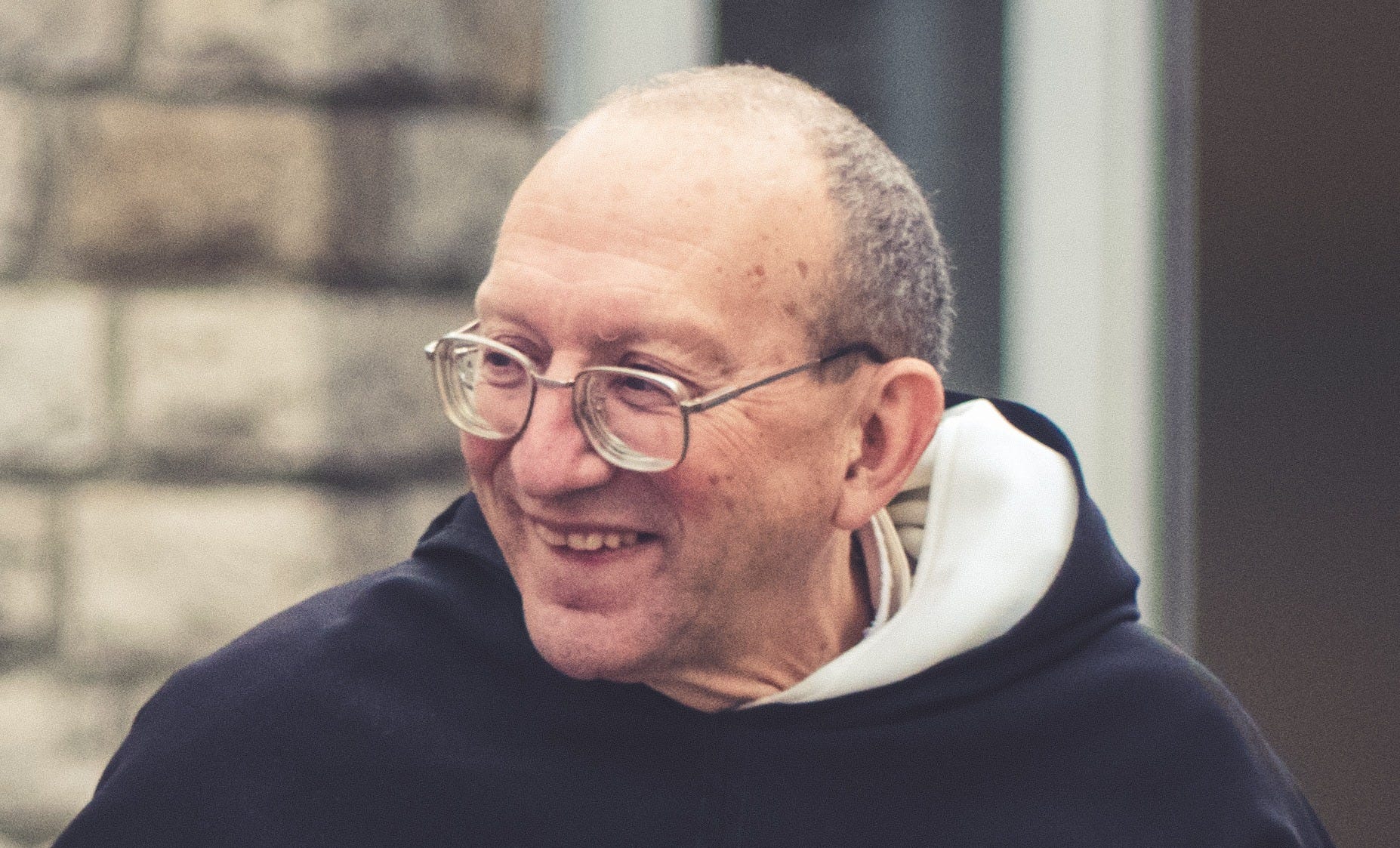
Father Louis-Marie de Blignières
Now 76, Fr de Blignières is a longstanding figure in French traditionalist circles. He was a seminarian at the Society of St Pius X’s seminary in Ecône, and was ordained by Archbishop Marcel Lefebvre in 1977. Initially working with Dom Gérard Calvet of Le Barroux, Fr de Blignières founded his own Dominican-inspired community in 1979, and adopted the “Cassiciacum thesis” of then-Fr Michel-Louis Guérard des Lauriers. This “Thesis” holds that the recent claimants to the papacy have not been true popes.
Even while they worked together, Fr Guérard des Lauriers was cautious about Fr de Blignières’ stability. In his Life of Mgr. Guérard des Lauriers, O.P., Fr Giuseppe Murro IMBC writes:
“In recent times, one can see his ‘precautions’ about events in which we live today becoming true. And, above all, the ‘collapse’ of Fr. Blignières, whose qualities he knew, but of which he had seen what others had not discerned: ‘He will be a man for the best or for the worst,’ he had predicted a long time ago. In 1982, he wrote similarly: ‘I already cannot be sure of him. He seems too anxious to maintain (easy?) contact with all. This is not reassuring.’
“Yet, already, after the consecration of Mgr. Guérard, Fr. Blignières demonstrated such vehemence against this act that his adherence to the Thesis of Cassiciacum did not seem secure. Only God scrutinises hearts and knows the most secret intentions; but Mgr. Guérard tried and hoped until the very end to bring Fr. Blignières again to the good path, aside from the bad returned for good on the part of Fr. Blignières.”1
Surprisingly, Montagna overlooks Fr de Blignières’ period as a so-called “sedeprivationist,” and also claims the following:
“In 1988, following the illicit episcopal consecrations by Archbishop Marcel Lefebvre, Father de Blignières was among the clergy who engaged in dialogue with Pope John Paul II, contributing to discussions that led to the creation of the Pontifical Commission Ecclesia Dei to reconcile groups attached to the traditional rite.”
This comment – along with the silence about his years as a “sedeprivationist” – appears somewhat misleading. Fr de Blignières reconciled with John Paul II in 1987, prior to Archbishop Lefebvre’s episcopal consecrations.2 The consecrations, however, provided the opportunity for Fr de Blignières’ community to obtain an indult to use the Dominican liturgical books.
The proposal
Montagna notes that the idea of a jurisdictional structure for the traditional rite has circulated for years. As early as 1963, the English author Evelyn Waugh suggested this in a letter to The Tablet:
Sir,
The Eastern Uniate Churches retain ancient habits of worship which are dear to them, and liturgies which in many cases are unintelligible to the faithful.
Is this not the time to seek similar privileges for Roman Catholics? Will you promote an appeal to the Holy See for the establishment of a Uniate Latin Church which shall observe all the rites as they existed in the reign of Pius IX?
Your obedient servant, Evelyn Waugh.3
It was raised by Christopher Ferrara and and Thomas E. Woods also raised this possibility in The Great Façade:
“The success of Cluny also demonstrates the potential of the canonical structure referred to today as an apostolic administration. By allowing the Cluniac houses to bypass the authority of the bishops—who, in their day as in ours, were so often opponents of true reform—the Church gave this divinely inspired movement the room it needed to carry out its mission. Even though our situation is arguably worse than what Cluny faced, the immunity from the bishops that Cluny enjoyed would give us the ability to rebuild at least one segment of the Church. That is what Cluny did, and the rest of the Church ultimately followed.”4
More significantly, Archbishop Marcel Lefebvre advocated such a structure at various times in his post-conciliar career, calling it “the experiment of tradition.” At times as early as 1973, and as late as 1987, the Archbishop was calling for an arrangement under this title, which would permit a degree of autonomy from diocesan bishops, whilst having his operations subject to a commission in Rome.
However, as we shall see Lefebvre firmly rejected any such possibility by 1988. But first, let us consider why this proposal is such a doctrinal problem – constituting an adoption of a false Anglican ecclesiology.
The unity of the Church
Since the 1960s, the various mainstream Latin Mass Catholics and Ecclesia Dei groups have all tried to negotiate coexistence and toleration with the Conciliar Reformers, so as to carve out a niche for themselves in the broad tent.
These groups have tried to secure the existence of the Roman liturgy alongside the Novus Ordo liturgy. Some have sought a simple co-existence based on their preference for the old rite; others have held that the Novus Ordo is harmful to souls and should be avoided at nearly all costs.
They have tried (and even succeeded to some degree) to secure an oasis wherein the true faith could be taught and professed in its integrity, whilst coexisting with those who openly deny or obscure it.
Without realising what is happening, these groups have accepted as a strategy the same situation which Cardinal Newman and many others lamented whilst still in the Anglican Communion:
“Men of Catholic views are truly but a party in our Church.”5
As the arch-conciliar/synodalist Cardinal Roche correctly said, in his 2021 comments about Traditionis Custodes, this way of thinking and operating is “an ecclesiology that is not part of the Church’s Magisterium.”
The Anglican Communion is sometimes called a “broad church”, and it is held to be made up of varying “wings”. This idea is prevalent in the Anglican cultural milieu, although does not appear in the Thirty-Nine Articles or the Prayer Book.
These wings (loosely) include:
A “high church”, “ritualist” or “Anglo-Catholic” wing (N.B.: This is an oversimplification of the movements over time which were not identical)6
A “low church”, “evangelical” or “charismatic” wing
A liberal or modernist wing.
Despite their radically different beliefs and practices, these groups, wings or parties are all considered to belong to the same body.
The high-church wing largely believed that they continued the true doctrine, true liturgy and the true Catholic Church within the kingdom of England. They acknowledged that they did so alongside various Protestant errors; and they held that it was their duty to “re-catholicise” their communion – or at least the protestantising trend of some of their co-religionists.
Many today, right across the board, believe that there can also be multiple wings within the Catholic Church, each professing different doctrines. In this schema, these wings might include:
A high-church, traditionalist, “extraordinary form” wing
A conservative wing
An evangelical/charismatic renewal wing
A low church “standard parish Novus Ordo” wing
A liberal or modernist wing.
This ecclesiology entails a changed definition of the Church and her constitution, a denial of the first and most fundamental of the four marks, and thus a denial also of her formal visibility.
Catholic ecclesiology does not countenance such parties and wings within the Church, at least in the sense entailed here. It holds that the Church is necessarily and visibly united. It is impossible that she be divided in worship, containing traditional and Catholic rites alongside those which are non-Catholic, and harmful to those who frequent them.
It also holds that she is visibly united in faith, and that it is impossible for her to be divided in faith: she teaches and professes only one faith – the true one. She is not a body which contains the truth alongside so many other dangerous errors, each with partisans jostling for primacy.
In passing, we should be clear that the true teaching does not exclude different schools of theology, or the possibility of some being mistaken in good faith, nor does it exclude the possibility that Catholics may be more or less disunited over open questions or theses below the level of faith. However, it does exclude the idea that the Church is a merely legal grouping of men, some of whom profess the true Faith and others of whom deliberately and knowingly profess a different faith, contrary to what is taught by the magisterium.
Again, confusion about this doctrine is understandable: it seems impossible to verify the true teaching as a reality today. As a result – even when presented with very clear statements from the popes and theologians – many conclude that the teaching must be being misstated, and that the visible unity of the Church is only a reality at certain times.
However, the difficulty in verifying this remarkable unity today has led many conservative and traditionalist writers to either deny it or “rethink” it – and to replace it with an ecclesiology which has more in common with Anglicanism than the Catholic Faith.
You can read further expositions of this doctrinal point here:
The Anglicanisation of Catholics – are we the ‘high-church wing’?
The Visible Unity of the Church I – on what it means to believe in “One” Holy, Catholic and Apostolic Church
The Visible Unity of the Church II – More on what it means for the Church to be “visibly” one
The Visible Unity of the Church III – Reconciling the Church’s teachings about her own unity with the current crisis
Notes on the nature of heresy, in light of the unity of the Catholic Church
How is the Church “visibly united in faith,” according to twentieth-century master of ecclesiology Cardinal Billot?
Why is “unity of faith” so crucial for making the Church visible, according to Cardinal Billot?
Christ’s prayer and the unity of the Church – Cardinal Billot
The Church’s Unity of Faith – St Francis de Sales
St Thomas More: Heretics leave the unity of the Catholic Church by their own act
Not the Catholic Church
However, it is important to realise that we are not just dealing with a false ecclesiology here: this “Anglicanised” account of the situation is, in a certain sense correct. The Conciliar/Synodal Church is indeed divided into the wings mentioned above.
But a church which is divided into wings, without unity of worship and faith (and which even tries to eradicate Catholic worship and faith) is not the Catholic Church, even if it contains a “Catholic wing” of real Catholics, trying to continue traditional ritual and doctrine.
The Church is not made up only of the just and holy; but she is made up only of Catholics: those who are baptised, profess the faith externally and are not separated from the unity of the body. She is, in other words, wholly Catholic.
But members of a “Catholic wing” or a “traditional movement” within a wider body are – and there is no other way of putting it – trying to be Catholics in a non-Catholic Church. There exists a website dedicated to locating “reverent Masses”: the very idea implicitly concedes the idea of a Church divided and ungoverned.
In fact, the emergent ecclesiology of a “wing” or “ordinariate” of the Church, which is to act as a doctrinal and liturgical leaven for the whole, can justly be called an “Anglicanisation“. In this sense, the mainstream Latin Mass groups have accepted a position for themselves which is equivalent to the “High Church” or “Ritualist” wing of a broad church. Nor does this stand just for those who seek coexistence, even temporarily, with the Novus Ordo regime. Even those who hold that tradition must “reconquer” the Church are accepting the premises of this Anglicanised ecclesiology.
The premises of this idea are openly voiced in the Latin Mass milieu. For example, Professor Roberto de Mattei has written:
“There is only one Catholic Church, in which today cohabitate in a confused and fragmentary way different and counterpoised theologies and philosophies. It is more correct to speak of a Bergoglian theology, of a Bergoglian philosophy, of Bergoglian morality, and, if one wishes, of a Bergoglian religion…”7
But who ever heard of multiple religions cohabitating within the Church of Christ?
Previously, co-existence has been possible, and even promoted to some degree by men such as Benedict XVI. But now co-existence and toleration have been more or less rescinded, Catholics need to pick a side. It is tragic that, despite the best of intentions and so much dedication and charity, those seeking to preserve the Roman liturgy are trying to do so with a theology adopted from Anglicanism.
If the Church is not visibly one, then she is not visible at all; she would not be visible as a society, or as the society which Christ founded. Such a lack of unity entails the lack of a property which is both necessary in itself and for identifying her among false claimants. All the official and “visible” institutions in the world will not make up for this lack of a property which the magisterium and theologians teach is necessary.
Archbishop Lefebvre’s rejection of the idea
As noted above, Lefebvre firmly rejected any possibility of an “experiment of tradition” by 1988 – and condemned those such as Dom Gérard who had sought it. A few months after the consecrations, the Archbishop said:
It is not a small matter that we oppose. It does not suffice for them to say to us: “You may say the old Mass, but you must accept that [the Council].” No, it is not only that (the Mass) which sets us at odds; it is doctrine. That is clear.
This is what is grave in Dom Gérard, and it is what has been his undoing. Dom Gérard has always seen only the liturgy and monastic life. He does not see clearly the theological problems of the Council, of religious liberty. He does not see the malice of these errors.
In 1989, he said:
Amongst the whole Roman Curia, amongst all the world’s bishops who are progressives, I would have been completely swamped. I would have been able to do nothing, I could have protected neither the faithful nor the seminarians. Rome would have said to me, “Alright, we’ll give you such and such a bishop to carry out the ordinations, and your seminarians will have to accept the professors coming from such and such a diocese.” That’s impossible. In the Fraternity of St. Peter, they have professors coming from the diocese of Augsburg. Who are these professors? What do they teach?
Speaking of the Vatican’s alleged benevolence towards the traditionalist communities in the same text – with particular regard for Fr de Blignières’ Fraternity of St Vincent Ferrer – he said:
There are plenty of signs showing us that what you are talking about is simply exceptional and temporary. They are not general rules, applying to all priests throughout the world. They are exceptional privileges being granted in precise cases. Thus, what is granted to the Abbey of Fontgombault or to the Sisters of Jouques, or to other monasteries—they do not say it—but it is according to the Indult. Now, the Indult is an exception. It can always be taken back. An indult confirms a general rule. The general rule in this case is the New Mass and the New Liturgy. Hence, it is an exception which is being made for these communities. […]
That is why what can look like a concession is in reality merely a manoeuvre to separate us from the largest number of faithful possible. This is the perspective in which they seem to be always giving a little more and even going very far. We must absolutely convince our faithful that it is no more than a manoeuvre, that it is dangerous to put oneself into the hands of Conciliar bishops and Modernist Rome. It is the greatest danger threatening our people.
If we have struggled for twenty years to avoid the Conciliar errors, it was not in order, now, to put ourselves in the hands of those professing these errors.
In 1990, he spoke firmly against any idea of accepting deals or arrangements from the Vatican:
We must not be under any illusions. Consequently we are in the thick of a great fight, a great fight. We are fighting a fight guaranteed by a whole line of popes. Hence, we should have no hesitation or fear, hesitation such as, “Why should we be going on our own? After all, why not join Rome, why not join the pope?” Yes, if Rome and the pope were in line with Tradition, if they were carrying on the work of all the popes of the 19th and the first half of the 20th century, of course.
He had very strong words for those who had taken such arrangements:
And we must not waver for one moment either in not being with those who are in the process of betraying us. Some people are always admiring the grass in the neighbor’s field. Instead of looking to their friends, to the Church’s defenders, to those fighting on the battlefield, they look to our enemies on the other side. “After all, we must be charitable, we must be kind, we must not be divisive, after all, they are celebrating the Tridentine Mass, they are not as bad as everyone says”—but they are betraying us—betraying us! They are shaking hands with the Church’s destroyers. They are shaking hands with people holding modernist and liberal ideas condemned by the Church. So they are doing the devil’s work.
Thus those who were with us and were working with us for the rights of Our Lord, for the salvation of souls, are now saying, “So long as they grant us the old Mass, we can shake hands with Rome, no problem.” But we are seeing how it works out. They are in an impossible situation. Impossible. One cannot both shake hands with modernists and keep following Tradition. Not possible. Not possible.
Why all this harshness and rigidity on the question? He explains in the same conference:
This fight between the Church and the liberals and modernism is the fight over Vatican II. It is as simple of that. And the consequences are far-reaching.
The more one analyzes the documents of Vatican II, and the more one analyzes their interpretation by the authorities of the Church, the more one realizes that what is at stake is not merely superficial errors, a few mistakes, ecumenism, religious liberty, collegiality, a certain Liberalism, but rather a wholesale perversion of the mind, a whole new philosophy based on modern philosophy, on subjectivism.
In his final interview, he was asked again about these communities, and stood firm against the possibility of accepting any such arrangement:
When they say they have yielded nothing, that is false. They have yielded the possibility of opposing Rome. They can say nothing now. They must remain silent, in view of the favours that have been granted to them. It is now impossible for them to denounce the errors of the Conciliar Church. Little by little they adhere, if only by the profession of faith demanded by Cardinal Ratzinger. I believe that Dom Gérard is about to publish a small book written by one of his monks on religious liberty, which will attempt to justify it.
From the point of view of ideas, they are gradually turning, and end by admitting the false ideas of the Council, because Rome has granted them a few favours for the sake of Tradition. It is a very dangerous situation.
This is indeed very clear in personages such as Dom Gérard, Fr Bernard Lucien and Fr de Blignières, each of whom have either written or authorised studies defending what they had previously condemned as erroneous in Vatican II.8

All this is why Bishop Bernard Fellay, the SSPX’s former Superior General, said in 2003:
Their perspective is pluralism. Their thinking goes something like this: “Oh, look, if we have progressive people who do silly things as members of the Church, then we should also have a place for those who like tradition—a place in the middle of this circus, of this zoo, a place for dinosaurs and the prehistoric animals”—that’s our place (!).
“But just stay in your zoo cage,” they will train us, “You can get your food—the Old Mass; that’s for the dinosaurs, but only for the dinosaurs. Don’t give that food to the other zoo animals; they would be killed!”9
While it is excellent that Archbishop Lefebvre spoke so clearly on this matter after 1988, we note the words of Bishop Guérard des Lauriers in his final sermon, in a 1987 address to Sous la Bannière:
“[Y]ou say that these negotiations, by their very nature, should never have taken place. Yes, it is true: these negotiations should never have taken place! And the very fact that they are taking place is a serious charge of accusation against Archbishop Lefebvre.”
This is because, as we have discussed above, the very idea of a “traditionalist ordinariate” runs contrary to Catholic doctrine itself.
Conclusion
In July 2025, Montagna broke another explosive story which revealed that the Vatican’s strategy with Summorum Pontificum was, at least in part, intended to permit the old Mass only in order to pacify, neutralise, and absorb resistance to the new Vatican II religion.
Her documents revealed the extent to which some Conciliar/Synodalist bishops – such as Archbishop Allen Vigneron of Detroit, and the Archdiocese of Baltimore and the Diocese of Plymouth, England – embraced Benedict XVI’s permission for this precise purpose.
This aspect of the survey was widely overlooked, until The WM Review exposed it, and explained the way in which it vindicated the warnings made by “less mainstream” traditionalist figures over the last few decades.
We will conclude this piece by recalling what we wrote at the time:
The TLM does not exist today because of the Conciliar/Synodal Vatican’s permission; nor does it exist because of those who merely preferred it to the Novus Ordo, or were content to be the High Church wing in a Broad Church zoo.
It exists because Catholics—priests and laity—rejected the Novus Ordo at the time of Vatican II. It continued, not because of preferences, but because of a rigorous doctrinal rationale on the nature of the Mass, expressed by Cardinal Ottaviani before the Novus Ordo was even promulgated:
[The new rite] represents, overall and in its details, a striking departure from the Catholic theology of the Mass as it was elaborated [at] the Council of Trent which, by permanently fixing the “canons” of the rite, erected an insurmountable barrier against any heresy which could undermine the integrity of the Mystery. […]
[The new rite] renounces actually being an expression of the doctrine that the Council of Trent defined as being of divine and Catholic faith. Yet the Catholic conscience remains forever bound to this doctrine. As a result, the promulgation of the Novus Ordo Mass puts every Catholic in the tragic need to choose.10
Not only that: the continuation of the TLM was and is inextricably linked to a principled stand for the integral Catholic faith, and against the whole new religion of Vatican II, its uncrowning of Christ the King, and its false doctrines of ecumenism, interreligious dialogue, religious liberty, and so on.
This principled stand is largely absent from the “mainstream Latin Mass movement,” whose apologists—when they are not promoting esotericism—spend their time trying to reconcile these errors with tradition, whether through contrived mental gymnastics, or new errors about the papacy and the constitution of the Church.
Over time, thanks in part to Summorum Pontificum and notwithstanding the good that it achieved in spite of itself, the idea that “It is the Mass that matters” has come to predominate over such doctrinal questions.
Many thus fell into the trap about which they had been warned for decades, and have been neutralised. Montagna’s documents confirm that the danger to which these warnings referred has indeed been a conscious strategy all along.
This is the same trap into which so many Catholics are walking today. We can already see this in the attitude some have taken with regards to Leo XIV, despite his clear continuity with Francis. Naivety, and a lack of robust doctrinal foundation, renders them vulnerable to the manoeuvres and tricks of the Conciliar/Synodalists, whose strategy Montagna has revealed.
While some may have been woken up by Traditionis Custodes, the problems with Francis were doctrinal in nature; and, in fact, the problems extend much further back than Francis himself. They will not go away simply by Leo XIV overturning the brutality of Traditionis Custodes.
But if Leo XIV does do this, and adopts the permissive strategy discussed in this article—as perhaps was the intention for the leaks being made available in the first place—many will be ripe for the picking.
The TLM will be permitted, but those attending it will have become Latin Mass Anglicans.
A traditionalist ordinariate, as proposed by Fr Louis-Marie de Blignières, and lauded by Fr Matthieu Raffray in his interview with Montagna, is a trap – even if great goods might come from it.
We should not be aiming to be a Side Chapel in the big Conciliar/Synodalist Church of Vatican II – or exhibits in what Bishop Fellay called the “Zoo.”
But there can be no co-existence between the Catholic faith and the modernist/conciliar religion; there is no fellowship between Christ and Belial.
The Novus Ordo must go, along with the conciliar religion of Vatican II. That might sound unrealistic: but at the very least, if you shoot for the moon, failure is landing amidst the stars.
On the other hand, if you aim for accommodation, toleration and compromise, you will lose what little you still have, starting with an orthodox ecclesiology, or even your own soul.
Those advocating the Fr de Blignières proposal might well get it – but at what cost?
For he that hath, to him shall be given, and he shall abound: but he that hath not, from him shall be taken away that also which he hath.
HELP KEEP THE WM REVIEW ONLINE WITH WM+!
As we expand The WM Review we would like to keep providing free articles for everyone.
Our work takes a lot of time and effort to produce. If you have benefitted from it please do consider supporting us financially.
A subscription gets you access to our exclusive WM+ material, and helps ensure that we can keep writing and sharing free material for all.
You can see what readers are saying over at our Testimonials page.
And you can visit The WM Review Shop for our ‘Lovely Mugs’ and more.
(We make our WM+ material freely available to clergy, priests and seminarians upon request. Please subscribe and reply to the email if this applies to you.)
Subscribe to WM+ now to make sure you always receive our material. Thank you!
Read Next:


Follow on Twitter, YouTube and Telegram:
Twitter (The WM Review)
https://ttu-files.s3.us-east-2.amazonaws.com/Life-of-Mgr-Guerard-des-Lauriers-OP.pdf, p. 22.
https://www.sspxasia.com/Documents/SiSiNoNo/1998_November/Meet_the_Sedevacantist_Priests.htm
https://books.google.co.uk/books?id=YT-Wl5mYrAAC&printsec=copyright&redir_esc=y#v=onepage&q&f=false
Chapter 14, The Great Façade
John Henry Cardinal Newman, Apologia Pro Vita Sua, J.M. Dent, London, 1930. p 203
There have been several varieties of “High Church” wings. There was the original, slow and passive resistance to “Protesantising” at the beginning of the English Reformation, which became more active and in many ways more “Catholic” with Laud and the seventeenth century Anglican divines etc. But by the nineteenth century and the time of the Oxford Movement, this “High Church” had lost a lot of its “Catholicity” (though there were always people, like the Kebles, who adhered to the more “Catholic” tradition). “Anglo-Catholicism” post-Pusey was a new departure again.
Roberto de Mattei, Love for the Papacy & Filial Resistance to the Pope in the History of the Church, p 138. Angelico Press, New York, 2019.
Re: Le Barroux:

Re: Fr Lucien:

Re: Fr de Blignières:
https://www.sspxasia.com/Documents/SiSiNoNo/1998_November/Meet_the_Sedevacantist_Priests.htm
http://www.angelusonline.org/index.php/index.php?section=articles&subsection=show_article&article_id=2185
Alfredo Ottaviani, Antonio Bacci, et al: The Ottaviani Intervention: A Brief Critical Study of the New Order of Mass. Trans. Rev Christopher Danel. Angelus Press, Kansas City MO, 2015. pp17-18, 48
One can only hope that clear and thoughtful articles such as yours will steel Catholics in their resolve not to compromise with Modernists. This current crisis seems to dwarf Arianism, as bad as that was at its time.
Ottaviani is such an enigma to me. Despite his having taken the Oath Against Modernism and his battles for orthodoxy at the Council and regarding the liturgy, he acquiesced to the institution rather it seems to me than continuing to defend the faith, as his "old soldier" 1965 interview indicated. I wonder what he would think of that decision today. And I hope we are thinking clearly and making the right decision at this time as well.
This is much more comprehensive than other articles I've seen being promoted on the same topic. The dinosaur comment is appropriate. Like dinosaurs they end up being fake and gay rather than visibly Catholic and following Christ's spirit in all things.