
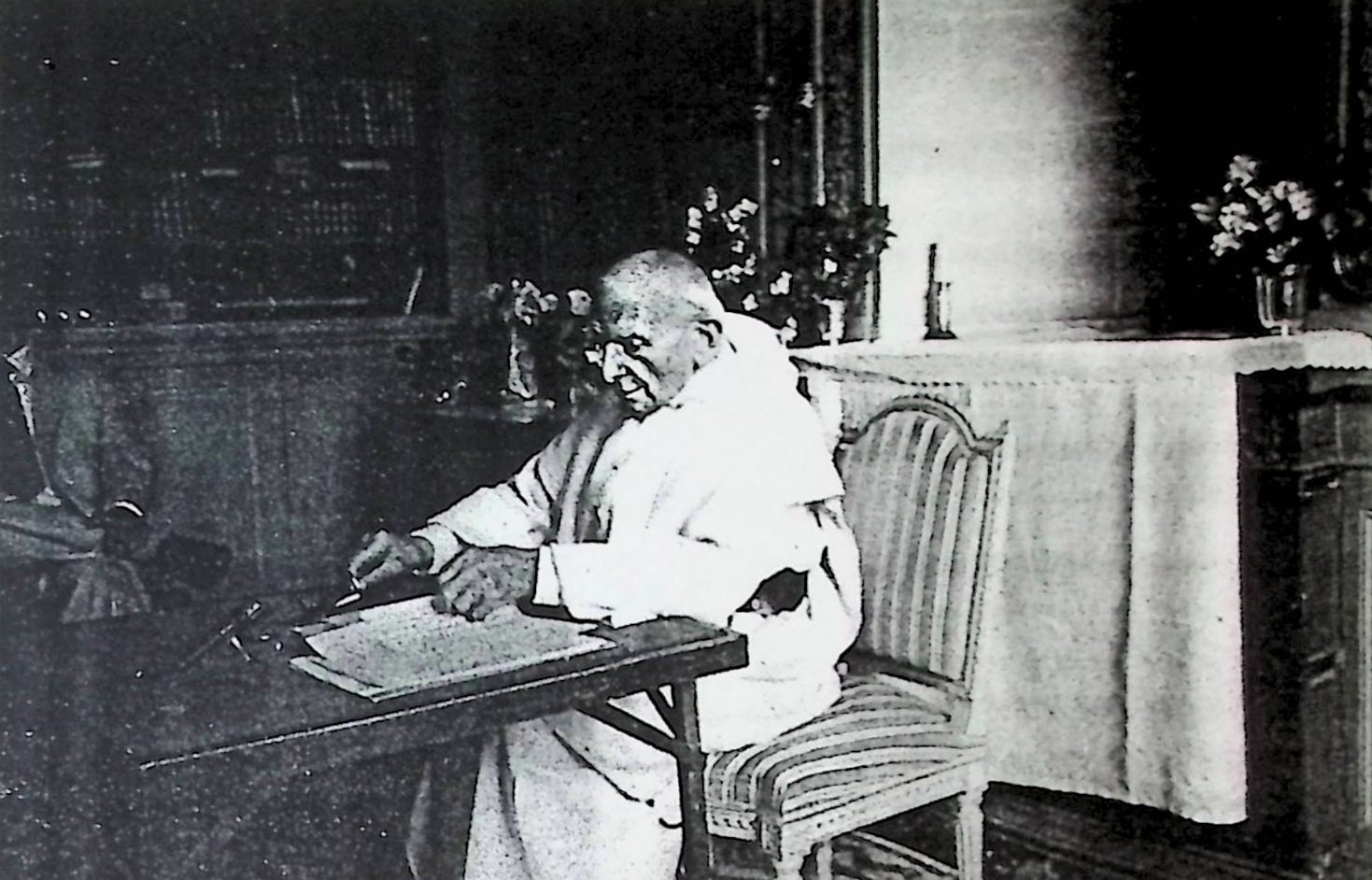
The Feast of the Holy Name of Jesus and the crisis in the Church were the bishop’s two themes in a sermon delivered less than two months before he died.
Editors’ Notes
On 27 February 1988, Mgr Michel Guérard des Lauriers passed to his eternal reward. Less than two months before – on 3rd January, the Feast of the Holy Name – he delivered this final sermon.
Born in 25 October 1898 near Paris, he entered the Dominican Order at age twenty-eight after having studied mathematics, eventually earning doctorates in both mathematics and theology.1 He taught at Saulchoir and the Lateran, contributing to theological debates of the 1950s that preceded Pius XII’s encyclical Humani Generis.
Following the Second Vatican Council, Mgr. Guérard became known for his opposition to liturgical reforms. He authored the critical study of the Novus Ordo Missae in 1969, which led to his removal from the Lateran faculty. He subsequently developed what became known as the “Thesis of Cassiciacum,” a means of explaining the current crisis in the Church and the status of post-conciliar papal claimants. This isolated him from more mainstream traditionalist circles, including Archbishop Lefebvre’s Society of Saint Pius X, where he briefly taught.
While he was there, Lefebvre wrote the foreword to Fr Guérard des Lauriers’ book, Réflexions sur le Nouvel Ordo Missae. This book questioned the validity of the Novus Ordo Missae. Lefebvre wrote:
“The extent and depth of the change in the Roman Rite of the Holy Sacrifice of the Mass, and its similarity to the modifications made by Luther, compel Catholics faithful to their faith to ask themselves the question of the validity of this new rite.
“Who better than the Reverend Father Guérard des Lauriers to make an informed contribution to the solution of this problem, which is still under study?”2 (Emphasis added)
The relationship between the two men broke down, and Lefebvre later distanced himself from Fr Guérard des Lauriers, and his conclusions on the Mass and the Pope, wishing to avoid “confusion and violent divisions”. The Dominican alludes to this breakdown in the sermon below.
Fr Guérard des Lauriers published his “Thesis” in the Cahiers de Cassiciacum, beginning in 1979. He argued that the papal claimants from Paul VI onward had held the office materially but not formally – being validly elected, but lacking actual authority, due to their lack of a habitual intention to procure the “good-end” of the Church (and consequent failure to accept the election).
In 1981, the Dominican accepted episcopal consecration from Archbishop Ngo Dinh Thuc. He maintained that continuing the Church’s mission required episcopal consecrations independent of claimants to the papacy since Vatican II. He himself passed the episcopate onto Bishop Robert McKenna, as well as Bishops Storck and Munari. Bishops Donald Sanborn (RCI) and Geert Stuyver (IMBC) later received episcopal consecration from Bishop McKenna, as did three others.
Mgr Guérard des Lauriers final years were spent largely isolated, traveling to offer the traditional sacraments while continuing to refine his theological positions.
In this sermon, Mgr. Guérard des Lauriers reflects on his criticisms of Archbishop Marcel Lefebvre, providing some insights on this controversy, the Feast of the Holy Name, and the gesture of genuflection. It also contains advice (and even appreciation and encouragement) for laymen involved in contemporary controversies, which some may find surprising.
The late bishop remains a significant figure in post-Vatican II theological controversies. We publish this new translation of his last sermon for its historical value, without endorsing all his positions (either in general or in this sermon) – just as we have published texts by Archbishop Marcel Lefebvre and others.
You can read more about his life in Fr Giuseppe Murro IMBC’s Life of Mgr Guérard des Lauriers, OP.
The Last Sermon
Mgr Michel-Louis Guérard des Lauriers
Address to the authors of Sous la Bannière
Pronounced on January 3, 1988
on the feast of the Holy Name of Jesus
In Sous la Bannière, n. 16, Mars-Avril, 1988.
Base text translated with the help of AI and thoroughly checked by The WM Review.
My very dear brothers,
Since I have before me, if not uniquely, at least principally, the authors and those responsible for the review Sous la Bannière, I wish to congratulate them and thank them for the issue I received yesterday. It is vigorous. I thank you for having taken my defence against the accusation of being gnostic, which is refuted by the history of the “letters” that you publish.
And I humbly confess to you that of which I myself was ignorant, because I attended secular school; I knew of Fréron in particular only what the fraudulent textbooks concerning that era let filter through.
Equally, the preliminary dissertation concerning Joan of Arc, which is of very high inspiration, which can serve as a model, despite defects of youth.
And then the news from Rome. I can only accept what you affirm there; namely that Wojtyla is the master in that place. The fable invented long ago, already by Louis Salleron, accusing Paul VI’s curia of administering in his place, is nothing else but a lie. In truth, it is indeed Wojtyla who is the chief – an ambitious, demanding, implacable chief, who will go to the end of his design, insofar as God does not stop him.
All this, it is excellent to say, it is opportune to recall it as you do, in a style accessible to a public that other reviews cannot reach. I think there is excellent work there, and I tell you again, I thank you for continuing, despite the sacrifices this requires, the difficult, painful questions for fathers and mothers of families constituting such an enterprise.
I have however a very small remark to make to you.
Mgr Guérard des Lauriers’ word of caution
When we read the texts of a council, or of a document that emanates from the magisterium, we do not ask that it say all the truth. But we have the right to demand that there be nothing but the truth. Thus for example, in Vatican II, there are many truths. This is incontestable. But that is not the question. The question is that an ecumenical council, which represents par excellence the ordinary universal magisterium of the Church, is infallible by nature; and therefore one must find there nothing but truth. The fact that there are such truths does not excuse the fact that one might find there a single ambiguity.
Now in the article that is devoted to Rome, if for readers of good will – that is to say for people who, if they read a text consider it as a whole, who do not attach themselves to making the meticulous and often spiteful exegesis of a particular passage to accuse the author and catch him in error; so, if I am a reader of good will, I have nothing to say. But if one takes a grouchy reader, who in this case is an intégriste reader, there is a passage that does not say, that does not express all the truth.3
You say well, to portray the character of Archbishop Lefebvre that he is the only bishop who preserves the mass, who condemns the council, who preserves the catechism. And it is true. It is true that in the eyes of the “Romans”, of the people who are there currently, that is indeed what he is. This is because their view is shorter. And therefore, they do not see, moreover, the viciousness that is the fact of Archbishop Lefebvre’s positions. They see only one thing, that he resists them. And in this sense, you say perfectly truly.
Mgr Guérard des Lauriers’ thoughts on Archbishop Lefebvre
However, it must be added unfortunately that Archbishop Lefebvre holds to the Mass, it is true, but to the Mass una cum.4 It must be added that Archbishop Lefebvre is against the council it is true, but that he admits the council interpreted in the light of tradition.5 It must be added that Archbishop Lefebvre preserves the catechism, it is true, but in this catechism, he allows it to be taught that the ordinary universal magisterium of the Church is fallible, which is an error.6 Now Archbishop Lefebvre has never, never, retracted these errors! Therefore there is here a heresy, a lie, and the faithful of the priories are in general, one can realize it, stopped at this counter truth.
So what does Archbishop Lefebvre want, what will be his future? This escapes us. We do not know the depths of his heart; I think him sincere. I have not always had good relations with him. But if you say these things, which are true, they must be explained, to portray Archbishop Lefebvre with regard to Rome, and to account for the fact that, indeed, he is the object of the hatred of the cardinals faithful to John-Paul II.
It was necessary to also say that Archbishop Lefebvre, as I have just told you, is for the Mass, but unfortunately a Mass una cum; that he is for tradition and against the Council, but that unfortunately he admits the Council interpreted in the light of tradition; he preserves the catechism but however, he allows to pass in the catechism, which he represents as being the official and adequate exposition of traditional doctrine, a thesis that is purely and simply a heresy. These are serious things.
Encouragement and advise to the lay editors of Sous la bannière
So I believe that in your review (which is excellent) it must be taken into account that, even if it is certainly not clothed with infallibility, the state of the magisterium means that you must strive to speak as if you were in its position. It is desirable that, in reading your lines, it be irreproachable. And therefore that all the truth be expressed there, however hard it may be. Without this you risk letting infiltrate into the phalanx of your readers only the idea of the positive things that you say. They will say of Archbishop Lefebvre, “Yes, indeed, he preserves the Mass, he preserves the tradition, the Holy Sacrifice” – and all that is important, all that is excellent. But they will see only that, and then they will say:
“Why not be with Archbishop Lefebvre? Since he does all that, since precisely because of all that, Rome is in antinomy with him, one need only be with him; and indeed it would be much simpler!”
If he converted, if he returned to what he should do – that which you say, moreover, in very clear terms... Because the grievance that I formulate at this moment, it is corrected in the following passage, ten lines later. I repeat that for anyone who reads with benevolence the texts that are presented, there is no possible ambiguity.7
But I place myself at a more strict point of view; a theologian’s point of view, if you will. It seems to me that you must attribute to yourselves a role, which perhaps exceeds what is written, a sublime role; act as if what you write held the place of the magisterium of the Church, so that it be impossible to find there the shadow of an error. Not only affirm the truth in such a way that it be diffused and understood, but also that it satisfies the most exacting requirements, and eliminates all ambiguity – whatever ambiguity it may be in your texts – when it concerns matters of fundamental importance.
This is the only small reservation, you see, which concerns just four lines; four lines which constitute little in what has given you much work, and which costs you much money; it is the only small remark that I have to make. Such is this very paternal and friendly observation, and not a reproach, that I make. And I will defend you against all the attacks that I hear; just as moreover, I repeat, I am grateful to you for defending me from the unjust accusations that have been formulated against me.
Continue this work, this good work, and take care never to deviate from the integrity of orthodoxy, from the requirement of the integrity of orthodoxy.
How Satan works
It is by this means that Satan infiltrates: by formulae that leave place for ambiguity, that lead to believing things that in reality are not true. And well it is necessary to exclude even these formulae, even if you estimate with probability that it is necessary to make allowances, to accommodate the partisans of Archbishop Lefebvre in their opinion. For unfortunately, he has agglutinated around him many people in France; and Providence uses this increasingly considerable mass that is situated among the Lefebvrists, to move opinion. That which causes Wojtyla to oppose Archbishop Lefebvre, as you say yourselves, is doubtless the fear that the Lefebvrists, might end up rallying all of France entirely, and by crushing the official Church under their number.
I think that, given the mentality of the Romans – the spirit of calculation that animates them, and the reign of opinion in this milieu – I think that this is the principal reason that explains the resumption of these negotiations between Rome and Archbishop Lefebvre.
It must still be observed – moreover, you also say it, in very clear terms, in a phrase that perhaps your critics will not read with enough attention – you say that these negotiations, by their very nature, should never have taken place. Yes, it is true: these negotiations should never have taken place! And the very fact that they are taking place is a serious charge of accusation against Archbishop Lefebvre. The ambiguity that they cover makes his position impossible.
Beware therefore with great care of the wiles of the father of lies. One can say that Satan never lies. He is the father of lies. He never lies. But he infiltrates into the truth things that are erroneous, so that those who are not sufficiently warned take, with candour and simplicity, this mixture and swallow the poison. And little by little, the poison that does its work. And little by little, the instinct of faith is lost. If “Lefebvrism” continued for ten years, I believe that faith would be lost. It would be lost – since, in fact, he gives people ideas mixed with heresies. It is necessary to call things by their name. He who says heresies continually, ends up losing the sense of faith, the light of faith.
It is necessary to be on this point extremely vigilant. This perhaps goes beyond the normal role of laymen, to which we made a brief allusion, in the day devoted to adoubements,8 which is not to enunciate doctrinal precisions, perfectly accomplished doctrinal expositions. Their role is rather to make them pass into application, it is true; but finally as much as is possible, it is necessary to approach this norm, which is the norm par excellence. It is there that we are unassailable. If in long articles, you slip something where there is a sort of grip of Satan by ambiguity, or by the fact that one passes over in silence aspects of the truth that are troublesome if one says things in such a way that people might risk not understanding, by that very fact you are under the grip of Satan. You let him in some way put a foot in the place.
I know well that what I say there is very difficult; and I dare hardly pronounce it, since I myself have followed this line; the result is that I have no one with me, except the few friends that you are; and you are many who are in silence in the camp of truth. It is perhaps asking much to go beyond the application that you make of it. So this line is difficult, and I admit well that in the Church there are different roles. I have the impression that mine is indeed in the exposition of doctrine, of its requirement and of its ultimate consequences; but that it is not the vocation of a layman, who seeks contact with people and who must apply these truths, which is quite different. But however, I do not deny that there is unity in these vocations.
There must be on the part of the Theologian a broad and charitable understanding for those who ensure the service of Truth, at the peril of their life, of their family, of their comfort, of so many and many sacrifices, and of the things that you know by experience; but there must be on the part of those who do this work, the constant concern never to disturb the requirement of truth which is properly the object of the theologian, as the one who must preserve the rules of truth. All members in the Church are united to the head, and all therefore must help each other in mutual understanding and in charity.
So in conclusion I thank you for this publication, for this last issue, which is really very successful, and to which I wish a wide diffusion. I will pray for this.9
What would be his last illness
And also, I commend myself to your prayers, in this illness that I had obviously not foreseen, and of which I absolutely do not know what the outcome will be.
I am better in the sense that certain of my functions are found reestablished normally, but in fact I can practically no longer eat anything. I do not tolerate food. So that from day to day I waste away. I live only on sleep and fresh water, and on love I hope, but obviously for the body, it is difficult. It can only come out by a miracle.
So what does the Good God expect from this? Will he wish to restore me and preserve me so that I can once again resume the activities I had, here in particular, and elsewhere? Or finally, does he accept the sacrifice of my life? I do not know! And I must live in abandonment! Fiat voluntas tua. It was the prayer of Jesus in the garden of olives, and although he was God and knew by divine science the outcome toward which he was oriented, despite that, humanly everything happened for him as if he did not know it.
And therefore, what Jesus practiced, I must accept in the trials to which God deigns to subject me at this moment.
Mgr Guérard des Lauriers’ place vis-à-vis Archbishop Lefebvre
I believe I have already reminded you that when Saint Ignatius had just founded his order, there was in Spain another ecclesiastic, in the same conditions, who had equally consecrated to God generous designs. He had thought to do exactly the same thing as Saint Ignatius. In some way he found himself in competition. And when this person, whose name I no longer remember, learned that Saint Ignatius had this design, the latter had already begun to group the few companions who were to be the pillars of his company. This person then made the sacrifice, purely and simply of his project.
“Since Saint Ignatius does what I want to do; since it seems that there are all the sufficient assurances to believe that effectively, the will of God is on the side of Saint Ignatius to accomplish his work, I renounce it and I enter into silence”.
And indeed, he renounced his work. He had, however, nourished this project; he had cherished it with love and solicitude, and taken all his dispositions to put it into action... he counted on realizing a grandiose design, he was attached to it by all the fibres of his being in view of its realization. And therefore to renounce such a project, is to renounce oneself. And well I believe that it is God who disposed this man to found the company at the same moment, at the same time as Saint Ignatius. Saint Ignatius in external action, and he in the sacrifice of himself and of all that he had most dear.
And well you see, at bottom, the situation in which I find myself is the comparison that I propose to you. Archbishop Lefebvre has undertaken something – and you know that, at the beginning I helped him with all my power. He deviated on the points that we know, and of which I have just reminded you. But if Archbishop Lefebvre finally decided to consecrate – he said on Good Shepherd Sunday, but he has said so many times deadlines which, passed have seen nothing happen, that one can only wait… But if Archbishop Lefebvre decided to consecrate and to face excommunication for his consecrations – and well it is he, it is he evidently who, because he was a bishop, because he has an organisational talent that is top class, and because he has succeeded in many happy things in what has been accomplished – then it is well that I efface myself. I am quite ready, you see, to sacrifice myself and to renounce everything. I do not know what I would do.
I have made a considerable sacrifice, you are not unaware of it, in leaving Etiolles to come to Raveau to try to found there a seminary of clean oblation. And it seems that the Good God forbids it to me, since he does not permit me even to keep the only disciple I had with me, to whom I no longer have the strength to give the courses to which he would be entitled. And therefore, the enterprise that I believed I should undertake – it seems that the Good God does not want it from me. And it is well, if he wants it by Archbishop Lefebvre – and if he shows it by the crucial sign, crucial...10 – that Archbishop Lefebvre finally decides to consecrate bishops; not to have them consecrated by Wojtyla but by him. If Archbishop Lefebvre does that, then it is well and with joy that I abandon all that I have done, all the sacrifices that I have made, so that the work of salvation continues through him.
The centrality of doctrine
You do not speak of it in your bulletin, but you perhaps know this attitude frequent to many people, that even seminarians of Écône have reported to us. Even recently a young man came to tell us:
“Now everything is resolved. There is no longer a doctrinal question, there is perfect agreement from the point of view of doctrine between Wojtyla and Archbishop Lefebvre. There remains only one question, it is to know if the episcopal consecrations will be done by Wojtyla or by Archbishop Lefebvre.”
Only that! This is a joke of large calibre. But it creates a sort of deterrent effect in opinion. They are going to make people believe that now there is no longer a question of doctrine, and that whether the consecrations will be done by one or the other of the parties is just a detail. Now obviously I do not have to insist to explain to you that doctrine is the whole question, but they are going to act as if the question is resolved, make pass in opinion this slogan that the question is resolved, when it is not at all. And meanwhile, souls are lost.
Let us repel these fables. We have heard so many, that to hear one more or less, is not much for us; but for the people who listen, who are the victims of them, it is important because it maintains them in illusion and in a false hope. From month to month, from semester to semester, from year to year, this dilutes, dissolves, erases the true questions that serious people should study and to which they refuse to listen.
This you also say in very clear terms, very hard even; the misfortune is that the most serious questions that we debate, and on which we are in agreement, these most serious questions, in fact, the people of Écône in particular avoid them systematically. They dismiss them, and they maintain in the mass of the faithful this absolutely harmful illusion, that there are questions – which are however doctrinal par excellence, which concern the life of the Church in itself, which no longer form part of the themes of discussion of Theologians, but which form part of the divine treasury of the Church – they maintain in the spirit of people this mentality that these theses, one can leave them aside, provided one has the right Mass, and a bishop. The right Mass in union with a bishop Marcel, as you also remark.11 This which is a serious, profound error on the constitution of the Church.
Let us guard ourselves from these illusions my very dear brothers, and may each one be ready to make the sacrifice that God asks of him in his mysterious Providence, so that his work may be realized. “Fiat voluntas tua.” When we say, “May your will be done” we often see too short; we see (and it is already good) the day today where we have to do such or such thing, to accomplish such project; but we do not see the finality, all the amplitude, all the duration of our life, the agony in which it must end with the eternity of heaven. All that, we ignore; but the events that we live are particularly opportune to make us understand this truth. “Fiat voluntas tua”: it is this high and definitive point that brings us closer to heaven.
The Feast of the Holy Name
I have already spoken to you at length but even so, I want to say to you at least a few words on the texts of the mass of this day.
It is the introit of which I will make the text of our meditation.
In nomine Jesu omne genu flectatur, cælestium, terrestrium et infernorum...
In the name of Jesus, may every knee bend, in heaven, on earth, and in hell.
This name of Jesus is the crux of judgment, so to speak, and this very simple, elementary truth is recalled to us by these words, that we must adore the name of Jesus – that is to say the person of Jesus. Let us not quibble, let us not discuss the evidently analogical sense of our knees. The elect have knees as they have a body; the damned have knees as they have a body; and we have our knees, which make it so we can put them on the ground. But God gives greater suppleness to these knees, in the measure that they are used in his service.
The sentiments that are in the heart manifest themselves by bodily attitudes: one stands, one sits, one kneels, or one prostrates oneself, one makes signs of the cross, etc...
This shows us well the unity of body and soul, and the participation of the body, of each of our bodily organs in the attitude that we must have vis-à-vis God and of the respect that we have toward him. On the other hand, it is opportune to remark that these words show us well what is the sense of things. Given that the contact of God with humanity is realised in an eminent, transcendent, absolute manner, in the person of the Incarnate Word, it is normal that it be required that, on this person all be judged. And this Judgment implies that all will prostrate themselves before the name and the person of Jesus; we all must avow, confess, that Jesus Christ is the Lord; because it is the truth – and the key truth, for Christians and for every man – with regard to the marvellous coordination that God has realized in the mystery of the Incarnation, in himself, and humanly.
Genuflecting properly
I deliver still to your meditation in what consists, or will consist the genuflection. “May every knee bend.” There indeed is a gesture, and you know that this gesture is reserved, in our holy religion, precisely for the presence of the Word. In this time where we undergo the Cross, you know what has become of this sign of genuflection in the new religion, where it is more or less obliterated.
I add some reflections on this point. We must make our genuflections well. As I am tired on the one hand, and I would not want to weary your attention, I do not want to analyse the detail. But there are too many Christians who make the sign of the cross badly: who do it hastily, who do not give the impression of believing in it much, who only sketch a gesture before the Blessed Sacrament. And moreover, in the new churches, it is rare that one knows where the Real Presence is, and the situation is such that they sketch a gesture that is hardly discernible, which is neither properly speaking a genuflection, nor only a nod of the head; it is something intermediate that does not indicate the sentiment of adoration that must animate us.
And well I draw your attention to this fact, because in a place where you are assured that there is the Real Presence (and there are perhaps not many more), if you go into one of these Churches, make your genuflection perfectly. This may be a sacrifice. But to do it: the right knee must touch the ground, and it must be prolonged a little; ten seconds perhaps, enough to adore Jesus present; so that the contact that you have at this moment reveals quite simply this, that you are in the presence of a Person, of the Person of the Incarnate Word, and not only in the presence of a thing.
There is here not only an act of worship, but the encounter with a Person of very high quality, and to whom you owe by this exterior sign the highest homage that you can give him. You do not make the genuflection before a created person. Even if there are those who can inspire respect! The genuflection is adoration; it is due to God, and to God alone. “May every knee bend on earth”. We who are there, we who adore the Real Presence of the uncreated Word in the consecrated species, it behooves us to continue on earth this tradition of genuflection.
Obviously, you know it well; but when you make a half genuflection, without conviction – a genuflection that indicates the position of your body and not the conviction of your heart – you lose a little of faith! It is in this way that the faith is lost. The community which we are must be incarnate; it is linked closely enough to these exterior signs. The sense of the Real Presence, the adoration that one must make to it, has been in fact preserved in the Christian body by the acts of adoration that were part of the liturgy. For both the faithful, and the priests; by the more solemn prostrations that one must make when the Blessed Sacrament is exposed, in order to mark even better the situation that it has vis-à-vis us.
It is this attitude that we must have in the places and times that I have just told you again. May every knee bend, under the conditions given for the presence of Jesus, which it behooves us to preserve.
The considerations of physical and theological order that one could develop, and well I leave you the care of rediscovering them in your heart. To speak of the truths of the faith, I draw with insistence your attention to the fact of not letting the genuflection degenerate and what it represents in the places where Jesus is present.
You have a chapel, and well it is necessary that, when you enter this chapel, as I have just told you, you come to encounter a Person; not a thing, but a Person!
The last phrases of this homily were not recorded, the magnetic tape having ended. Archbishop Guérard finished by promising the necessary graces of strength and suppleness to those who, by love of God, will have the courage to overcome the stiffness of limbs due to age. Knowing the extraordinary facility of kneeling of the preacher that we were listening to, we all saw in it a personal testimony.
S.L.B.
HELP KEEP THE WM REVIEW ONLINE WITH WM+!
As we expand The WM Review we would like to keep providing free articles for everyone.
Our work takes a lot of time and effort to produce. If you have benefitted from it please do consider supporting us financially.
A subscription gets you access to our exclusive WM+ material, and helps ensure that we can keep writing and sharing free material for all.
You can see what readers are saying over at our Testimonials page.
And you can visit The WM Review Shop for our ‘Lovely Mugs’ and more.
(We make our WM+ material freely available to clergy, priests and seminarians upon request. Please subscribe and reply to the email if this applies to you.)
Subscribe to WM+ now to make sure you always receive our material. Thank you!
Read Next:


Follow on Twitter, YouTube and Telegram:
Twitter (The WM Review)
All biographical details from Fr Giuseppe Murro IMBC’s Life of Mgr Guérard des Lauriers, OP.
Archbishop Lefebvre, ‘Foreword’ dated 2 February 1977, in Michel-Louis Guérard des Lauriers, Réflexions sur le Nouvel Ordo Missae, preview available at http://www.virgo-maria.org/articles/2007/Reflexions_NOM_Mgr_Guerard_1977.pdf
Original Footnotes
Doubtless Archbishop Guérard had already received the phone call or the remarks from readers such as he describes them?
See on this subject the following articles, published in the present bulletin:
La question de l'una cum, par Mgr Guérard (N° 11)
Le problème de l'una cum, par de Saint Hilaire (N° 13)
Réflexions sur l'una cum, par A. Loubier (N° 14)
See on this subject the articles published in the present bulletin, mentioned in note 3, as well as the following:
Lettre ouverte, par A. Loubier (N° 9)
Cinq réflexions - Sept remarques, par A. Loubier (N° 10)
Est, est. Non, non, par Mgr Guérard (N° 11)
See on this subject the following articles, published in the present bulletin:
Une question vitale pour la Foi, par A. Loubier (N° 4)
De Vatican II à Wojtyla, par A. Loubier (N° 6)
Une erreur dans la Foi, par J.P. Bontemps (N° 6)
De Vatican II à Wojtyla, par Mgr Guérard (N° 8)
Le cercle est-il carré ?, par A. Loubier (N° 12)
Du sosie à Janus, par A. Loubier (N° 15)
Is not Archbishop Guérard responding here to certain “malevolent,” “grouchy,” “intégrist,” “spiteful” readers, who seek to catch the author in error on a particular passage, without even having noticed that their criticism becomes without object when one reads ten lines later? (The underlined expressions are those of Archbishop Guérard).
Ed.: “Adoubements” here suggests a ceremonial public endorsement of lay activity — not a grant of teaching authority. The bishop is warning against doctrinal imprecision, and warns that ambiguity in lay teaching allows error to enter under the guise of truth.
We receive with confidence this promise, pronounced in his last public homily, that Archbishop Guérard will be able to accomplish only from heaven, more efficaciously than here below if it pleases God.
This word “crucial” was repeated four times by Archbishop Guérard, and evidently gives the key to this whole passage, as well moreover as the reasons for which we are favourable to the consecrations. These two Churches must excommunicate each other, because they do not have the same faith.
Allusion to the article “Reflections on the una cum” by Adrien Loubier, published in our no. 14, which is in question at the beginning of this homily. It is pointed out there that the mention “in union with our bishop Marcel”, at the “Te igitur”, is in conformity with the constitutions of the Church only in the diocese of Archbishop Marcel Lefebvre... who has none, and who has been suspended a divinis since 1976 by the authority with which he persists in saying he is in union in the same “te igitur”!
Thank you for publishing this. Given his statements on his position if Abp. Lefebvre would go ahead with the episcopal consecrations and his unfortunate death before that event, one wonders if the Monsignor would have softened his criticism of the Archbishop after that event. It seems to me Lefebvre, while not a theologian per se and struggling mightily with how to remedy the apostasy in the Church, eventually came at least close to the conclusion that the Conciliar church was schismatic and lacking in authority only after careful prayerful reflection and the clear unwillingness of Rome to right the course over time. Especially after the hoodwinking at Vatican II, the incomprehensibility of a pope not defending the faith, and something that all of these clergy and laity had to come to terms with, whether by Cassiciacum or not.
And a beautiful reflection — in the final section — on our Lord and on His Holy Name. It takes flight from the Introit of today’s Mass — In nomine Jesu omne genu flectatur, cælestium, terrestrium et infernorum...
In the name of Jesus, may every knee bend, in heaven, on earth, and in hell.
“This name of Jesus is the crux of judgment, so to speak, and this very simple, elementary truth is recalled to us by these words, that we must adore the name of Jesus – that is to say the person of Jesus.”
“We who are there, we who adore the Real Presence of the uncreated Word in the consecrated species, it behooves us to perpet[uate] on earth this tradition of genuflection.”