

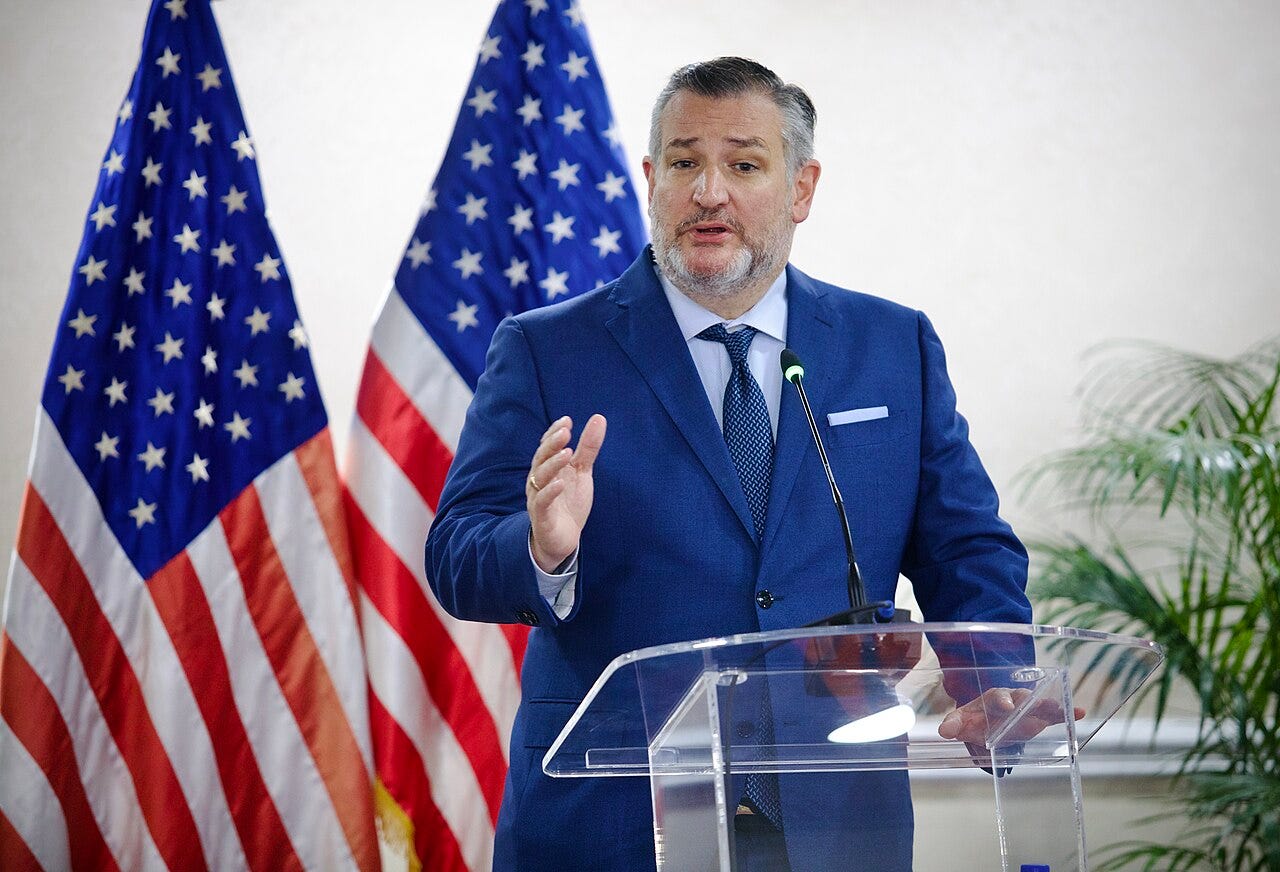
The anti-Catholic article promoted by Ted Cruz indicates where the true Church of Christ is – and where she is not.
Editors’ Notes
The scandal of Ted Cruz promoting a long Substack article on Twitter – which refers to traditional Catholics as “foreign”, as “parasites”, and many other anti-Catholic clichés – has given rise to much commentary.
Some have commented on the article’s analysis of “integralism” – a more modern word for what was previously called “Catholic social doctrine” – and the extent to which the author (and, by extension, Cruz) tie being a good American to the political support for Israel. We previously published an analysis of his “theology” here:
Are Christians obliged to ‘bless Israel’? Points missed in Cruz/Carlson commentary
Others have focused on the article’s use of anti-Catholic slurs, tropes and clichés, how it singles out “Latin Mass hardliners”, and how it attempts to drive a wedge between them and what it calls “everyday” or “Regular” Catholics – and the propriety of a sitting US senator endorsing such an article.
All this is interesting, and necessary.
However, I wish to draw attention to another aspect of the article’s focus on “traditional” Catholics, to the exclusion of “Regular Catholics” – in keeping with our ongoing explanation of why the Conciliar/Synodal Church is not the Catholic Church, as explained at length in our online “book”, Zero Marks.

The opposition of the wicked
In the words of Joseph de Maistre, quoted at length in the extract from Cardinal Louis Billot below:
“No enemy of the Christian faith was ever mistaken – all strike in vain, as they fight against God; but all know where their blows should fall.”
In his discussion of the note of holiness – one of the four ways in which the Church is rendered “distinctly” visible (viz. as the true Church of Christ) – Billot contrasts the opposition which the true Church experiences from wicked men, and the way such men treat all other religious bodies.
Let us consider some examples from the article.
The “three distinct ingredients” of what Cruz and the author oppose are:
“Integralism”, which it defines as “a pre-Vatican II political theology that holds the Catholic Church should exercise direct authority over temporal governments, that religious liberty is a Protestant error, and that a properly ordered state must subordinate itself to Church teaching.
“SSPX-adjacent traditionalism”, which it defines as “the world of the Latin Mass hardliners, the Society of Saint Pius X, the sedevacantists and near-sedevacantists who regard the Second Vatican Council as a catastrophic betrayal and the post-conciliar Church as illegitimate or gravely compromised.”
“Imported European and Middle Eastern sectarianism”, which the author does not define directly, but essentially means the proposition that there is a true religion, that one must belong to it, and that this has consequences for the civil order.
The author of the article repeatedly emphasizes that these “three distinct ingredients” do not “represent mainstream American Catholic life.” For instance:
This is not about Catholics.
The 70 million American Catholics who go to Mass on Sunday, vote their conscience, pay their taxes, coach Little League, and have been reliable partners in the pro-life movement for fifty years are not the subject of this investigation. They are, in a real sense, among its victims. The political integralist Catholicism being deployed in this operation bears no relationship to the ordinary American Catholic faith — it uses the vocabulary and symbols of a faith tradition as a vehicle for a power project that most practitioners of that faith would find alien and alarming. In fact, I would argue that but for the influencer and opinion shaper class, everyday Catholics don’t even know its happening.
This is not the position of the United States Conference of Catholic Bishops. It is not the position of Pope Francis.
The author also explains that the “SSPX-adjacent traditionalism”:
“… is drawn from a traditionalist Catholic milieu that the Vatican itself has repeatedly disciplined and that most American Catholics have never encountered. The SSPX was in irregular canonical status with Rome for decades. These are not mainstream Catholic positions. They are fringe positions that have been given a mass media platform.”
What do we see here? The author draws a clear distinction between “Regular Catholics” and what preceded Vatican II.
In one sense, the article is correct. What the author refers to as the “Catholicism” practiced by so-called “Regular Catholics” is the product that emerged from Vatican II, and advanced by the self-styled Conciliar/Synodal Church.
This system, indeed practiced by the USCCB as an organ of the Conciliar/Synodal Church, is fundamentally different to the Catholic religion. It is a distortion of it, maintaining some Catholic externals whilst emptying them of their meaning – and, in the USA and elsewhere, infected with the Americanism condemned by Pope Leo XIII in Testem Benevolentiae and Longinqua.
In this, the article’s statement of the supposed plan to infiltrate the Republican Party accurately describes what happened at Vatican II:
“Remove it, or transform it, and you have a different party. Not a party with different policies. A party with different gods.” This is what happened at Vatican II.
While practitioners of this “New Catholicism” may indeed be politically active – the article endorsed by Cruz specifically mentions the pro-life movement, for example – this political action is conducted on the terms set by the liberal order of the modern secular and pluralist state.
What does this mean for traditional Catholics, and the Conciliar/Synodal Church?
The WM Review is free for readers. This is because we believe these ideas must reach as many people as possible.
However, we also provide WM+ articles – additional material for those who choose to support this work financially.
This helps us continue producing serious Catholic research, while ensuring that the main body of material remains accessible for all.
If you want to ensure that this continues, join WM+ today.
(Clergy and seminarians can contact us for free membership.)