

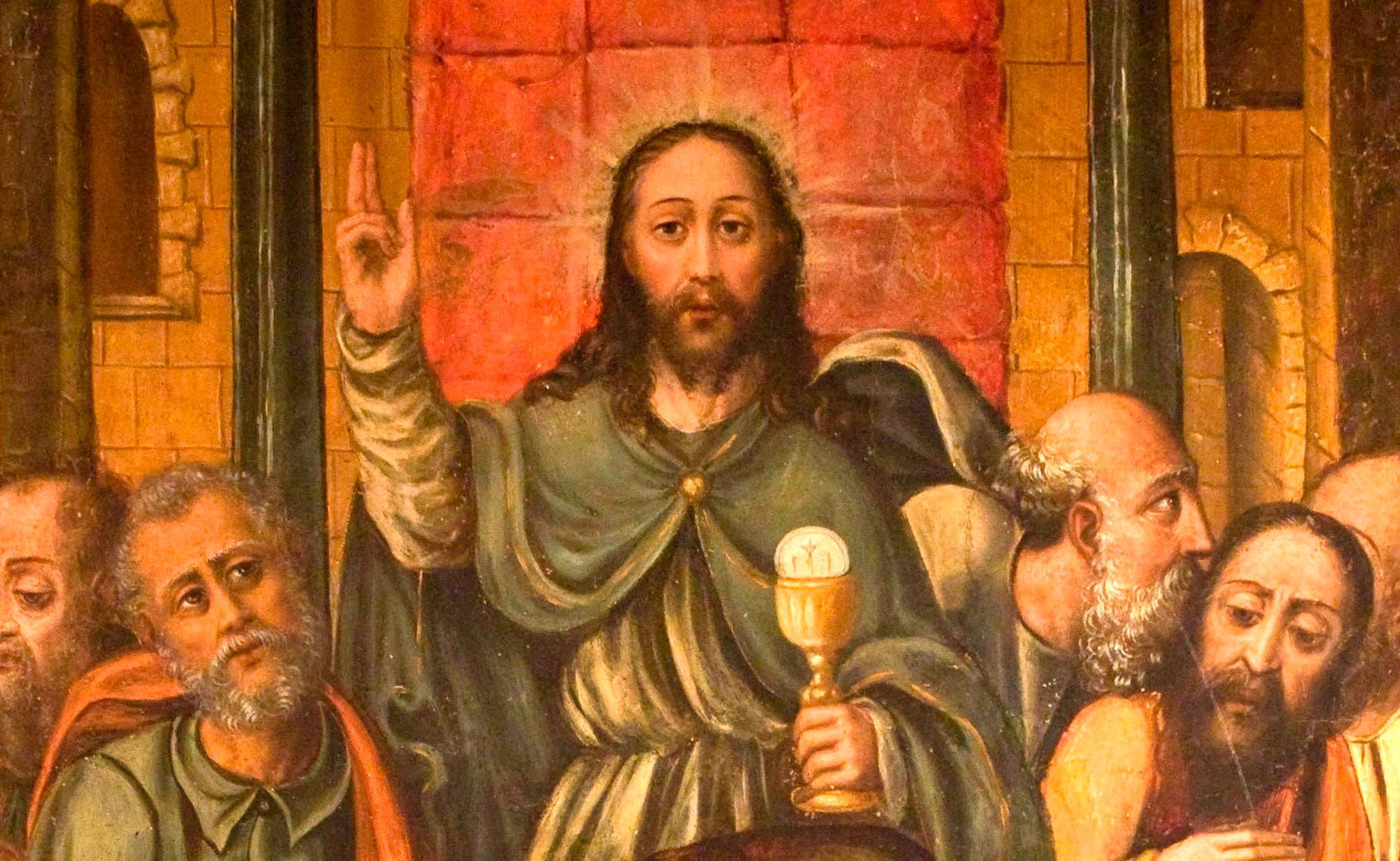
The assertion of ecumenical unity from Leo XIV is false as stated, but hits on an unintended truth.
Leo XIV’s sermon on Christian Unity
Leo XIV told representatives of schismatic and heretical sects that Christians are “already one,” during a homily closing the 2026 Week of Prayer for Christian Unity on Sunday at the Basilica of St. Paul outside the Walls in Rome.
“We are one! We already are! Let us recognize it, experience it and make it visible!” he declared to an audience that included Metropolitan Polykarpos representing the Greek Orthodox Ecumenical Patriarchate, Archbishop Khajag Barsamian from the Armenian Apostolic Church, and Bishop Anthony Ball on behalf of the Anglican Communion.
Leo’s remarks centred on the Letter to the Ephesians, which speaks of “one body, one Spirit, one hope, one Lord, one faith, one baptism, one God.” Vatican News characterized his message as stressing how “different Christian religions share the same faith.” In true Francis-style manner, he quoted his own document In Unitate Fidei, telling the mixed-religion crowd:
“We share the same faith in the one and only God, the Father of all people; we confess together the one Lord and true Son of God, Jesus Christ, and the one Holy Spirit, who inspires us and impels us towards full unity and the common witness to the Gospel.”
The sermon also invoked Francis’ claim that the Catholic Church’s synodal path “is and must be ecumenical, just as the ecumenical journey is synodal.” Leo urged Christians to develop “ecumenical synodal practices” and share “who we are, what we do and what we teach” as they look toward 2033, the 2,000th anniversary of Christ’s Passion, Death and Resurrection.
Leo also praised last year’s commemoration of the 1700th anniversary of the Council of Nicaea in İznik, Turkey, hosted by Ecumenical Patriarch Bartholomew. “Reciting the Nicene Creed together in the very place where it was formulated was a profound and unforgettable testimony to our unity in Christ,” he said, expressing gratitude that “so many Christian traditions were represented.”
The pontiff extended greetings to Cardinal Kurt Koch – the grand architect of the plan for a Synodal Pope of a Synodal Church – as well as to scholarship students and ecumenical groups participating in the celebration.
Two key doctrinal points arise from this sermon, both of which we shall address below.
The claim that Catholics are “already” one with the adherents of heretical and schismatic sects
The claim that Catholics “share the same faith” with such persons.
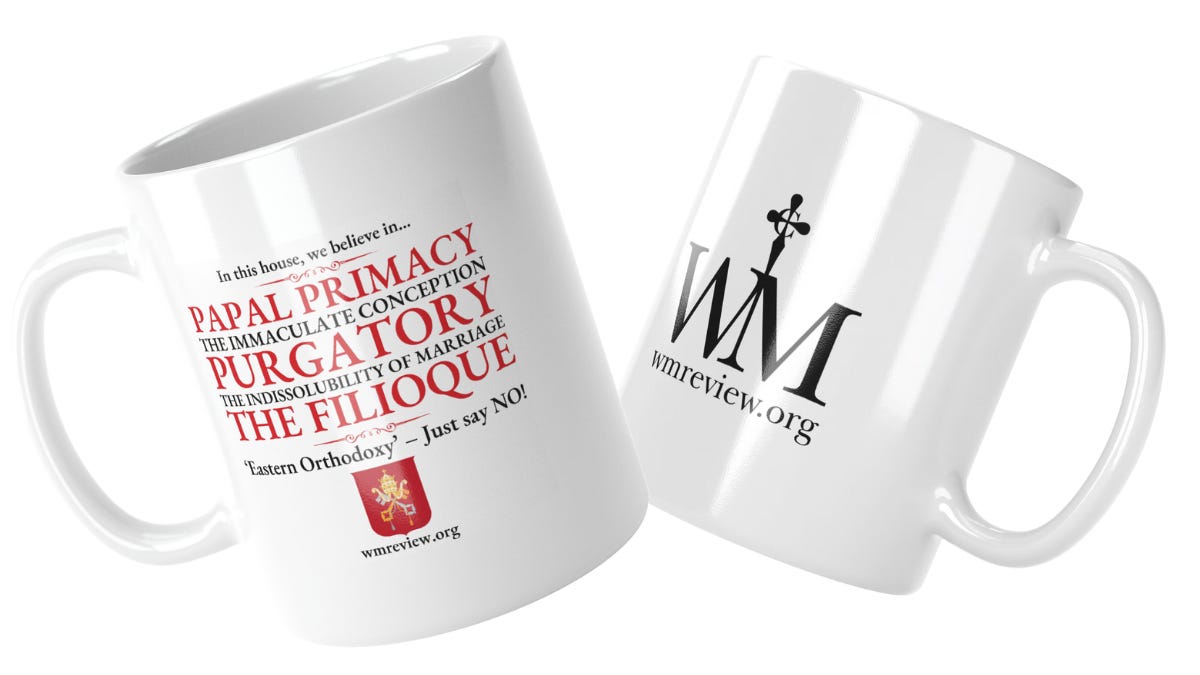
While some comments have reacted strongly against the implication that we are “already one” with the Anglicans and “share the same faith,” the claim is just as egregious with regards to the schismatic Eastern Orthodox. While the Anglicans profess very visible errors, the Eastern schismatics also deny dogmas of revelation on:
The procession of the Holy Ghost from the father and the Son (the “Filioque”)
Papal Primacy
The Immaculate Conception
Purgatory
The indissolubility of marriage.
Here is a handy mug to help you remember these essential dogmas, the denial of which renders you a heretic and thus unable to please God (Heb. 11.6):
It is also (at least) arguable that certain schools of Eastern Orthodoxy deny the dogma of divine simplicity, and thus are essentially polytheists, due to their assertion of a real distinction between God’s essence and energies. Without entering into this discussion, or recommending the source in general, the late Mr James Larson addresses the topic here.
We have also previously addressed Leo XIV’s attitudes towards the Eastern schismatics, and compared it to those of the pre-conciliar magisterium, here:

Now, let’s proceed to analyse Leo XIV’s two claims.
1. The claim that Catholics are “already” one with the adherents of heretical and schismatic sects
The Church does indeed teach that we are already one – but “we” here applies not to a ragtag body of men who claim to be Christians, but to the Catholic Church. She also teaches that Christ’s prayer before his Passion has already been fulfilled in the unity of the Church in her worship, government and faith. In order to address this point, I will be drawing on an earlier article explaining Louis Cardinal Billot’s ecclesiology and explanation of the Church’s unity.
In the Gospel of St John, Our Lord prays in terms which present the Church’s unity as a visible motive for belief in him and his Church’s claims:
“Holy Father, keep them in thy name whom thou hast given me: that they may be one, as we also are. […]
“[N]ot for them only do I pray, but for them also who through their word shall believe in me. That they all may be one, as thou, Father, in me, and I in thee; that they also may be one in us: that the world may believe that thou hast sent me.
“And the glory which thou hast given me, I have given to them: that they may be one, as we also are one. I in them, and thou in me: that they may be made perfect in one: and the world may know that thou hast sent me and hast loved them, as thou hast also loved me.” (John 17.11, 20-3)
In his encyclical on the ecumenical movement, Mortalium Animos, Pius XI notes an erroneous interpretation of this prayer, which held “that Christ Jesus merely expressed a desire and prayer, which still lacks its fulfilment.”1 The ecumenical proponents of this idea held that the sum total of Christian sects constitute the true Church; and that while unity of faith and government might one day exist, for now it could “only be regarded as a mere ideal.”2 Pius XI calls this a “false opinion” and refutes it.
Against the idea that this prayer remains to be fulfilled, Louis Cardinal Billot writes the following:
“It is certain that this prayer, which expresses the absolute will of Christ, had to be fulfilled infallibly on all points. […]
“Christ was able to address certain requests to his Father in an absolute manner, in the sense that the request concerned precisely the real obtaining of an end and not only the obtaining of means, the use of which is left to human freedom, which can always fail […].
“[T]his request of Christ could not be deprived of its effect and that it must therefore be considered as a law establishing the necessary properties of which the true Church would inevitably be endowed.
“And, as far as we know, no one has ever denied this point.”3
It is not an unusual idea that Christ’s prayers infallibly achieve their effects, when made in an absolute manner (as opposed to a mere conditional wish or “velleity”). For example, it is also taught by St Thomas Aquinas:
“[W]hat we will in accordance with the movement of sensuality, or even of the simple will, which is considered as nature is willed not absolutely but conditionally [secundum quid] – that is, provided no obstacle be discovered by reason’s deliberation. Wherefore such a will should rather be called a “velleity” than an absolute will; because one would will [vellet] if there were no obstacle. Wherefore, according to the will of reason, Christ willed nothing but what He knew God to will. Wherefore every absolute will of Christ, even human, was fulfilled, because it was in conformity with God; and consequently His every prayer was fulfilled.”4
The WM Review is free for readers. This is because we believe these ideas must reach as many people as possible.
However, we also provide WM+ articles – additional material for those who choose to support this work financially.
This helps us continue producing serious Catholic research, while ensuring that the main body of material remains accessible for all.
We have entered dark, dark times.
Many have fallen silent under Prevost, and other worrying signs have appeared since the 2025 conclave.
However, this silence has left the field wide open for writers who are only interested in telling the truth.
Amidst this darkness, we may be entering a second golden age of indie (or samizdat?) Catholic writing online – which will surpass even the heady days of 2008-2013.
If you want to ensure that this continues, join WM+ today.
(Clergy and seminarians can contact us for free membership.)