
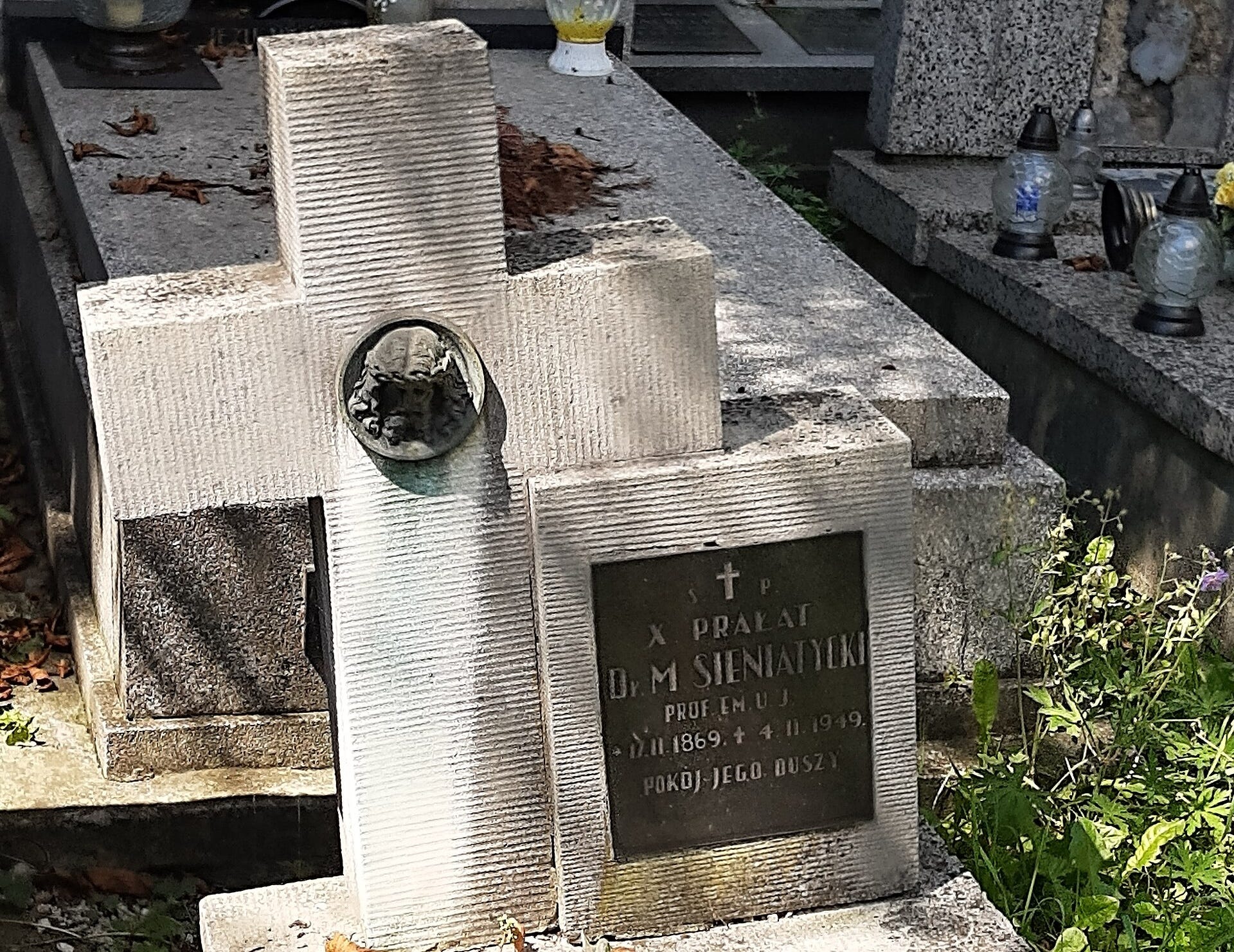
Fr Maciej Sieniatycki, recently cited by Mgr Pierre Roy, described a ‘church’ built on modernist principles. These principles are those of ‘synodality’, their ‘church’ the Conciliar/Synodal Church.
Editor’s Notes
At the time of publishing his Open Letter to the SSPX on the announced episcopal consecrations (dated 12 February, 2026), Mgr Pierre Roy’s website presented a text from one Father Maciej Sieniatycki, professor of Dogmatic Theology, taken from Przegląd Powszechny (1916). This intriguing text read as follows:
“A Church that came into being according to modernist principles—if indeed such principles could create a true religious community, which is highly doubtful—would no longer be the Church of Christ but a 20th-century creation, based on principles that are partly Protestant but primarily grounded in an ideology of agnosticism and positivism, with mystical fantasies. This new church might have both a pope and bishops, but they would be mere puppets; it might speak of dogmas, revelations, and supernatural religion, but these would be terms stripped of their ancient meaning, words without substance—how then could it truly be said that the old Church was not changed but only improved? Never; the previous Church would be destroyed, and upon its ruins would stand a 20th-century religious assembly that would begin its era of existence with the advent of the modernists.”
In order to provide the context of this comment, we have (with help from Mgr Roy and some Polish friends) located the full article, which we reproduce in English below.
Who was Fr Sieniatycki?
Fr Dr Maciej Sieniatycki (1869–1949) was a Polish Catholic priest, dogmatic theologian, and long-serving professor at the Jagiellonian University, where he held the chair of dogmatics and served as rector (1918–1919). Educated in Lwów and at the Gregorianum in Rome, he became a leading anti-Modernist scholar in Poland, publishing extensively on dogmatic theology and fundamental theology, and contributing significantly to the development of precise Polish theological terminology.
We are informed by a Polish contact that he is a much-beloved figure amongst Polish traditionalists.
The article at hand – titled ‘The Church in the Conception of the Modernists’ – is the final part of a three-part study titled Modernism in the Polish Book. Published in 1916 in Przegląd Powszechny, it is a sustained critique of the Modernist current in Catholic thought, as represented in Part IV of Marian Zdziechowski’s Pessimism, Romanticism and the Foundations of Christianity. Przegląd Powszechny was a Polish Jesuit monthly, founded in 1884, and long regarded as one of the principal Catholic intellectual journals in Poland.
Written against the backdrop of early twentieth-century debates following the Church’s formal condemnation of Modernism (in Pope St Pius X’s Pascendi Dominici Gregis, 1907), the articles confront Zdziechowski’s adoption of Kantianism, religious subjectivism, and anti-scholastic polemic.
The trajectory of the three articles begins with a defence of the intellect in religion – especially the rational knowability of God and the objectivity of causality (also defended by Cardinal Newman here). It moves to an analysis of revelation, faith, and dogma in the Modernist system, and culminates in what we present here: a description of what a “Church” built on the modernist principles would be like.
Fr Sieniatycki’s analysis in Part III reads today like a diagnosis of the “synodal project” advanced by Francis, carried forward today by Leo XIV, and having its roots in Vatican II and the earlier modernist crisis. This “project” is based on the same rejection of revelation as an objective and external reality, and its replacement with experience, “religious sense” and an evolving discernment by the community.
Some choice extracts
Synodal Papacy foreseen
Sieniatycki exposes the tendency to maintain the terminology and ideas whilst transforming the meaning, under the guise of “perfecting” or even “saving” the Catholic Church. Here is the full text to which Mgr Roy referred:
‘The reform they wish to introduce in the Church is not a reform, but the demolition of the old Church and the erection of a new one on entirely different principles. Every declaration on the part of the modernists that they wish to come to the aid of the Catholic Church against the attacks of modern culture is either feigned, or if it is sincere, then they do not see the ruinous consequences to which their system would lead the Catholic Church.
‘A Church that would arise on modernist principles – if indeed those principles can create a concrete religious community at all, which is a very doubtful matter – would no longer be the Church of Christ, but a creation of the twentieth century, based partly on Protestant principles and chiefly on the worldviews of agnosticism and positivism prevalent today among many, with an admixture of mystical dreams.
‘This new Church could have both a Pope and bishops, but they would be mere puppets; it could speak of dogmas, revelations, of a supernatural religion, but these would be names from which the old content had fled – rather, they would be words without content. So how could one truthfully maintain that the old Church had not been changed, but merely perfected? […]
‘But what is to be done with the Pope, with the bishops, with the ecclesiastical hierarchy in general? It cannot be abolished, for that would look too radical, and no one would then believe that the church of the modernists is the Catholic Church; so the old authority must be retained in name, but without the attributes of authority.
‘However, some occupation must be devised for them. Well then, they are only to track the revelations of the Saints, to correct nothing, to restrict nothing, to give no directives, but to organise those revelations, to sort them, to create a terminology for them, to formulate them into dogmas – of course only provisional ones. They are to be merely the court historians and philosophers of the church of the modernists, but not rulers or teachers of the faith, for that belongs to the Saints!’
This description is a startlingly prescient account of what is found in the 2024 document The Bishop of Rome, which sets out role of what we could call a “synodal pope.”
It also demonstrates how necessary it is for the enemies of the Church to maintain an appearance of Catholicism and Catholic structures in order to deceive.
The tendency Sieniatycki identifies is also a defining feature of modernism. In 1951, Pietro Parente defined modernism in terms of this tendency as follows:
‘A heresy, or rather a group of heresies, which have arisen in very bosom of the Church at the beginning of [the twentieth century] under the influence of modern philosophy and criticism, with the pretense of elevating and saving the Christian religion and the Catholic Church by means of a radical renovation. […]
‘In brief outline, the encyclical [Pascendi] declares modernism to be a hybrid amalgamation of verbal Catholicism with real naturalistic rationalism, based on [agnosticism, immanentism and “radical evolutionism”].’1
Invisible Church and the breakdown of authority
Sieniatycki also expresses how the modernist agenda would result in an invisible Church, even while its structures remain in place:
‘In the church of the modernists, the Saints “govern and determine what is truth and what is falsehood. The norm of their life is the inspirations of the Holy Ghost.”
“Leaving aside the fact that Christ established the Pope as the head of the entire Church and its supreme, infallible teacher in matters of faith, to whose governance therefore even the Saints are obliged to submit and whose dogmatic pronouncements they are to accept as truth – leaving that aside, I say, this principle of the modernists would bring about complete anarchy in the Church, would pulverize the Church, would make it an invisible Church.”
There is an analogous application of this criticism to those who advance, in a codified and theoretical form, the “Recognise & Resist” theories.
We have written about the issue of visibility most recently here:
Collapse into charismaticism
Under a synodal hierarchy, in a Church governed by “the Saints”, much would devolve into an pursuit of alleged miracles, visions, prophecies, and apparitions:
“It is obvious that visionaries, dreamers, crackpots, malcontents, and not infrequently also perfectly disguised impostors would present themselves as saints, and each would wish to impose his own concept of holiness upon another as the norm of conduct. Anarchy and the fragmentation of the Church into sects would ensue. For to suppose that all would agree on one thing – the only one who could do so is someone who accepts, without any proof, that all would truly be genuine saints, guided by the Holy Ghost.
“But the Holy Ghost never gave any assurance that, bypassing ecclesiastical authority and even contrary to its commands, He would Himself directly guide the saints, and history teaches that those who considered themselves to be directly guided by the Holy Ghost fell into the most monstrous errors in both faith and morals. Catholic Saints agree on one thing in faith, but only because they receive that faith through the mediation of the Pope and bishops.”
This is already the case with the so-called “Charismatic Movement” – but it is also apparent among traditionalists. We see this manifested in attempts to settle theological questions with reference to private revelations – for example, alleged Eucharistic miracles or Marian apparitions. Elsewhere, we are told that there is a prophecy of “two false popes”, which by implication rehabilitates Paul VI through to Benedict XVI.
St Vincent Ferrer – himself one of the greatest and most prodigious miracle workers in the history of the Church – rejected such an idea. The Catholic historians Frs Mourret and Thompson wrote the following, in reference to the Great Western Schism:
“This mysterious economy of divine grace can in no way disturb a Christian’s faith. Amidst the agitations of the schism, St. Vincent Ferrer very justly wrote: ‘We should not decide the legitimacy of the popes by means of prophecies or miracles or visions. The Christian people are governed by laws against which extraordinary events count nothing.’
“In other words, miracles and other spiritual favors could be granted to reward individual faith and to edify the Christian people, without serving as proofs of any pope’s legitimacy. No conclusion can rightly be drawn from them in favor of either claimant to the papacy.’2
We have published texts about this elsewhere:
Private Revelations, Theology and the Crisis – What should be their relationship?
Let us now proceed to Fr Sieniatycki’s text.
The Church in the Conception of the Modernists
Part III of Modernism in the Polish Book
Fr Dr Maciej Sieniatycki
Professor of the Jagiellonian University, Krakow
Published in Przegląd Powszechny, Oct-Dec 1916, pp. 73-82. Krakow
Scan of the original article – Re-typset text from Ultramontes.pl
Translated by The WM Review (Base text with the help of AI, text scrutinised by two Polish-speakers – to whom we offer our thanks) – some headings and line breaks added.
What is the Catholic Church today, in the opinion of the modernists, and what should it be?
The Church of today, in the opinion of the modernists, is an institution which, through unconditional obedience arising from blind, unreasoning faith, keeps the faithful in automatic submission (p. XVI). Whence did the Church acquire this lust for dominion?
“The ecclesiastical organization is saturated from bottom to top with the spirit of Roman statehood” (p. XVI).
“The tradition of the Church was formed on the soil of Rome, of Roman law and Roman statehood. It is therefore no wonder that on this soil universality was understood as dominion over the world” (p. 142).
To this end the precepts and truths of religion were bound by the Church into an “iron chain of logic.” In this way intellectualism came to reign in religion.
“To rule means to bend man in all spheres of his life under the rod of law. The foundation of legislation is religion; the stronger that foundation will be, the more tightly the truths and precepts of religion are joined together by an iron chain of logic. Hence the inclination toward rationalizing religion” (142).
In a somewhat different form the Author expresses the same thought:
“The ecclesiastical hierarchy has become mired in the pride of the consciousness of possessing truth, as though its representatives and directors were given to partake of some non-existent sacrament of logical knowledge; it operates not by holiness but by logic, and would like to conquer minds either by the irrefutable force of the proofs of its truth and divinity, or by material force where those proofs are powerless” (141).
What is the Pope?
The Pope is infallible as the spokesman of the consensus fidelium, as the organ of the entire Church...
“The Pope therefore ought to be the servus servorum Dei – instead he has become an irresponsible, autocratic monarch. This is the work of all those in whose interest it lay – above all of the popes themselves, then of the highest ecclesiastical bureaucracy, and finally of the theologians, who in this way cover their systems with the mantle of papal infallibility and canonize them” (315).
Far more radically is this thought developed on p. 317:
“The evolution of the Roman Church has proceeded in the direction of centralization and absolute autocracy – and today the Pope, endowed with the privilege of infallibility, is ready to see the inspiration of the Holy Ghost in his every caprice, and in such a disposition he is maintained, with their own interest in mind, by careerist dignitaries and theologians, so that having implanted in his soul their own views and aspirations, they may give them greater authority and force.”
“[The truth] is determined [...] by Roman monsignori [...] Guided only by personal interest, they impose on people as objects of belief that which is offensive, not only to the sense of truth trained by science, but sometimes even to the moral sense [...] The most dangerous peril for the faith arises from the fact that the spirit of criticism has entered all spheres of theology, and the ecclesiastical authorities, not understanding this spirit and finding no other answer to it than complaints, anathemas, or violent and ineffectual repressions, contribute to making more difficult the conditions under which those who belong to the Church must work” (300). [my note: Classic example of needing to save the Church]
What should the Church be according to the modernists’ prescription?
The Church in the conception of the modernists is an association of brothers and sisters striving for holiness; truth and grace alone unite the faithful. “The Saints” govern the Church and determine what is truth. The Pope and bishops are only the organ of the Saints, both as to the truths which must be believed and as to the laws which must be obeyed. They possess no authority in the strict sense of the word; they are primi inter pares.
“The Church knows no subjection, but knows only brotherhood.”
“In the Church there is no place for authority” (for in the Church, freedom ought to reign.)
“Free submission to Truth lies in the very essence of the idea of the Church, which tolerates ‘neither forced unity, for that is a lie, nor forced obedience, for that is death.’”
“The ideal Church is a harmony of individual freedoms” (280).
The ideal Church is one…
“… whose members strive for holiness, and the saints determine what is truth and what is falsehood” (299).
“In that ideal Church the highest doctrinal authority of the Pope and bishops would rest not on any special theological proficiency, but on the fact that they would submit themselves to the Holy Ghost and, being the organ of the Spirit, would explain to the faithful what should serve them as nourishment and what they should reject as poison […]”
Yet it would not be the Pope who governed the Church, but the saints; he would be merely the executor of their will:
“In the ideal Church the Pope would consider himself, and would in fact be, the organ of the spirit animating the Body of Christ, and since that spirit manifests itself most vividly and most beautifully in the saints, the saints would govern the Church – or more precisely, the Pope would govern in their name” (317).
The Pope is only the interpreter of the law which the Holy Ghost has inscribed in the hearts of the saints: “he is bound by this living book.”
“In the Church there are the living and the dead, and the voice of the Pope should be the voice of the living, that is, of the best, the saints – and only then is the Pope infallible” (309).
Ridiculousness of the modernists’ approach
The modernists’ views on the Church quoted above are characterised by the same apriorism as in the other questions already discussed by us. A concept of the Church is constructed entirely arbitrarily, a priori, without proofs and without regard for facts, and if the Catholic Church existing today does not correspond to this concept, then the Pope, the ecclesiastical hierarchy, the theologians, and so forth are reviled. Not one of the modernists asks whether his construction of the Church is in accord with Holy Scripture, with tradition, with history...
And yet the Catholic Church presents itself as a positive, divine institution – it maintains that its hierarchy is of Christ’s establishment. It proclaims papal infallibility in matters of faith and morals as a dogma of faith. It proves its claims with positive arguments. Surely one ought first to evaluate these arguments before one begins to present one’s favourite conceptions as certainties and to revile those who refuse to believe in them. For if we base the Church on aprioristic conceptions, then after the modernists others will come with still cleverer conceptions, and once again the concept and constitution of the Church will have to be changed.
That such experiments must lead the Church to ruin is as plain as the palm of one’s hand. And it is equally evident that if Christ established the Church, gave it a certain form, and willed that it remain unchanged in this form until the end of the world, then it would be sacrilege to wish to alter those forms according to human inventions. The modernists, wishing to introduce reforms that completely overthrow the foundations on which the Church stands, thereby reveal their conviction that the Church is merely a human institution.
But in that case it was necessary first to refute the arguments which the Church adduces to prove its divine origin, to demonstrate their worthlessness – and only then to defend one’s own convictions.
To be astonished that the Pope, bishops, theologians, and faithful, convinced of the divinity and immutability of their Church, are deaf to the modernists’ calls to base the Church on human aprioristic inventions, when they believe that the Catholic Church stands on divine principles – to be astonished at this smacks of naivety. After all, a man who would change his convictions, especially religious ones, before anyone has convinced him that those convictions are erroneous, would be at the very least reckless.
The modernists do not even attempt to show that the principles on which the Church and its hierarchy rest are erroneous or erroneously interpreted; rather, they set their aprioristic conceptions of the Church against an institution that proclaims itself divine, an institution with twenty centuries of existence behind it, one that has raised up countless hosts of Saints, that by its organization and inner strength has overcome so many heresies, has outlived the collapse of so many systems, has withstood so many hostile assaults...
The modernist appeal to ‘the saints’
Indeed, the Saints whom the Church has produced, and who according to the modernists are to govern the Church and teach its truths, already number in the thousands, and nowhere do we hear that they ever determined what was truth and what was falsehood, or that they governed the Church; rather, history teaches that they were the most obedient children of the Church, that they accepted dogmas proclaimed by the Pope or by councils with the greatest reverence as divine truths, and that they obeyed laws issued by the popes as children obey the commands of their parents.
So it is one of two things: either the Saints of the Catholic Church are not true Saints, or the Church, together with its organization, which raised those Saints, is a divine institution.
Indeed, the modernists maintain that the Saints are the most susceptible to the influences of the Holy Ghost – that they see truth best – and yet those thousands of Saints sanctified themselves under the direction of popes and bishops, nourished themselves on dogmas proclaimed by those popes, took as the norm of their lives the precepts of the Church issued or approved by the popes, and nowhere do we hear that things were too narrow, too stifling for them in a Church so constituted.
In the times of many of those Saints, not all popes and bishops were, alas, distinguished by holiness of life, and scholasticism reigned supreme, and yet this did not hinder their sanctification, and nowhere do we find an example of their wishing to free themselves from the authority of the Pope and bishops, as our modernists do, under the pretext “that the hierarchy operates not by holiness but by logic.” The modernists will perhaps tell me that the present times demand other virtues even of the Saints than did times past; that the present state of culture sets before itself a different ideal of holiness than did the earlier one.
The great Pope Leo XIII will answer for me:
“Only he can speak thus who overlooks the words of the Apostle: whom he foreknew he also predestined to be conformed to the image of his Son (Rom. 8:29). The teacher and model of all holiness is Christ; to His teachings must conform whoever wishes to be saved. And Christ does not change with the passing of the ages, but is the same yesterday and today and forever.”
And the Catholic Saints preserved their individual character. In the writings of the Saints we encounter various views on the methods of sanctification, from simple, sometimes naive outpourings to the loftiest flights into the realm of mysticism – but all of this is kept within the framework of Catholic concepts of dogma, of revelation, miracles, of the Church, the Pope, and so forth.
Let today’s modernists, then, also preserve the individuality of their culture, views, and methods – but all within the framework of the present Church, and then they will contribute to a deeper understanding of divine truths and the ways of salvation, will bring about a new flowering of religious thought, and will greatly serve the cause of God!
The erection of a false Church
The reform they wish to introduce in the Church is not a reform, but the demolition of the old Church and the erection of a new one on entirely different principles. Every declaration on the part of the modernists that they wish to come to the aid of the Catholic Church against the attacks of modern culture is either feigned, or if it is sincere, then they do not see the ruinous consequences to which their system would lead the Catholic Church.
A Church that would arise on modernist principles – if indeed those principles can create a concrete religious community at all, which is a very doubtful matter – would no longer be the Church of Christ, but a creation of the twentieth century, based partly on Protestant principles and chiefly on the worldviews of agnosticism and positivism prevalent today among many, with an admixture of mystical dreams.
This new Church could have both a Pope and bishops, but they would be mere puppets; it could speak of dogmas, revelations, of a supernatural religion, but these would be names from which the old content had fled – rather, they would be words without content. So how could one truthfully maintain that the old Church had not been changed, but merely perfected?
No, never – the old Church would be demolished, and on its ruins there would arise a religious assembly of the twentieth century, beginning the era of its existence from the appearance of the modernists.
An ‘invisible Church’
In the church of the modernists, the Saints “govern and determine what is truth and what is falsehood. The norm of their life is the inspirations of the Holy Ghost.”
Leaving aside the fact that Christ established the Pope as the head of the entire Church and its supreme, infallible teacher in matters of faith, to whose governance therefore even the Saints are obliged to submit and whose dogmatic pronouncements they are to accept as truth – leaving that aside, I say, this principle of the modernists would bring about complete anarchy in the Church, would pulverize the Church, would make it an invisible Church.
The Saints are to govern and teach, because the Saints are governed by the Holy Ghost! But this is exactly, to the last iota, what the Protestants invented when, not wishing to have the Church as a mediator between themselves and God, they maintained and maintain that each person receives inspirations from the Holy Ghost as to what he is to believe and how he is to act.
The collapse of unity
And what happened? A multitude of sects arose, opposed to one another, contradictory in faith, and each of them supposedly communicated directly with the Holy Ghost. For what is more natural than that a man, in a moment of religious exaltation, takes his own favourite thoughts for inspirations and revelations of the Holy Ghost? The same would happen in the Catholic Church if the principles of the modernists were applied. Saints receiving revelations from the Holy Ghost would multiply in great number, for naturally there would then be no norm of holiness, and no one would dare to question the holiness of one who is led directly by the Holy Ghost.
It is obvious that visionaries, dreamers, crackpots, malcontents, and not infrequently also perfectly disguised impostors would present themselves as saints, and each would wish to impose his own concept of holiness upon another as the norm of conduct. Anarchy and the fragmentation of the Church into sects would ensue. For to suppose that all would agree on one thing – the only one who could do so is someone who accepts, without any proof, that all would truly be genuine saints, guided by the Holy Ghost.
But the Holy Ghost never gave any assurance that, bypassing ecclesiastical authority and even contrary to its commands, He would Himself directly guide the saints, and history teaches that those who considered themselves to be directly guided by the Holy Ghost fell into the most monstrous errors in both faith and morals. Catholic Saints agree on one thing in faith, but only because they receive that faith through the mediation of the Pope and bishops.
The position of the hierarchy in a modernist Church
And what would the Pope and bishops be in such a Church where the Saints governed and determined truth?
They would have a title without any authority; they would lend their name to the goods manufactured by the saints. They could never oppose the Saints, for that would mean opposing the Holy Ghost. Either they would have to surpass the greatest saints in holiness, in order to receive greater revelations than the others, or, if not, they would have to surrender to their mercy and be the executors of their commissions – a role not to be envied!
The true rulers of the Church would be invisible. For it is impossible for a private individual to determine with certainty who is a saint and who is not. So many truly holy persons are unknown to the human eye, and so many hypocrites can, at least for a time, don the cloak of holiness. And how, in the face of this, is one to discern?
From these reflections it follows that nothing more impractical, nothing more utopian can be imagined than the modernists’ conception of the Church. One would have to be ignorant of human nature with its frailties, one would have to live solely in a world of illusion, of a pure ideal that can be realised only in heaven among the Saints themselves, to think that the principles of the modernists could create a Church or fail to destroy one already existing.
It must be admitted, however, that the idea of the Church which the modernists have created flows logically from their concept of revelation and of man’s relationship to God. Since man receives internal revelations directly from God, he needs no governing authority. The Holy Ghost replaces all authority. The Holy Ghost acts all the more effectively the fewer obstacles man places before Him, purifying himself from sin. Thus the Saints are the most perfect organs of the Holy Ghost, and therefore also the best teachers of revealed doctrine and of holiness of life. They, therefore, ought to direct all who have joined together in a religious association, in a Church.
But what is to be done with the Pope, with the bishops, with the ecclesiastical hierarchy in general? It cannot be abolished, for that would look too radical, and no one would then believe that the church of the modernists is the Catholic Church; so the old authority must be retained in name, but without the attributes of authority.
However, some occupation must be devised for them. Well then, they are only to track the revelations of the Saints, to correct nothing, to restrict nothing, to give no directives, but to organise those revelations, to sort them, to create a terminology for them, to formulate them into dogmas – of course only provisional ones. They are to be merely the court historians and philosophers of the church of the modernists, but not rulers or teachers of the faith, for that belongs to the Saints!
These are all human inventions, on which some church of human devising might perhaps be based, but never the Church of Christ, a divine institution, with a hierarchy positively established by Christ, with laws conferred upon it by Christ. In this Church there is no room for the realisation of modernist schemes.
Contrary to Scripture, tradition and history
If the modernists attempted to support their conceptions of the Church with the authority of Holy Scripture, tradition, or history, it would perhaps be advisable at this point to prove that a Church based on their schemes is decidedly contrary to Holy Scripture, to tradition, and to historical facts, and that only the organisation and teaching of the Catholic Church existing today is in accord with these authorities.
The modernists, whether because of their false views on Holy Scripture and tradition, or because they understand that it would be a Sisyphean labour to appeal to these authorities, do not attempt to appeal to them, and thereby they also release us from refuting modernist conceptions by means of the said authorities. Besides, these can easily be found in any Catholic dogmatic theology, in the history of the Catholic Church, as well as in the already extensive and very thorough literature on the origins of the Catholic Church today.3
As for what to think of the modernists’ aprioristic conceptions of the Church, we have already seen. The invectives against the Pope and the hierarchy of the Catholic Church, hurled now by the modernists, now by the Author in his book – vulgar epithets and general accusations without adducing facts – do not lend themselves to serious discussion and scholarly rebuttal.
Fr. Dr. M. Sieniatycki
HELP KEEP THE WM REVIEW ONLINE WITH WM+!
As we expand The WM Review we would like to keep providing free articles for everyone.
Our work takes a lot of time and effort to produce. If you have benefitted from it please do consider supporting us financially.
A subscription gets you access to our exclusive WM+ material, and helps ensure that we can keep writing and sharing free material for all.
You can see what readers are saying over at our Testimonials page.
And you can visit The WM Review Shop for our ‘Lovely Mugs’ and more.
(We make our WM+ material freely available to clergy, priests and seminarians upon request. Please subscribe and reply to the email if this applies to you.)
Subscribe to WM+ now to make sure you always receive our material. Thank you!
Read Next:


Follow on Twitter, YouTube and Telegram:
Twitter (The WM Review)
Pietro Parente, “Modernism”, 190-1, in Dictionary of Dogmatic Theology, Bruce Publishing Company, Milwaukee 1951.
Mourret-Thompson, A History of the Catholic Church, Vol. 5, p. 133. B. Herder Book Co., London, 1955. Available at https://archive.org/details/AHistoryOfTheCatholicChurch/VolumeFive/page/n145/mode/1up
Cf. my [Fr Sieniatycki’s] work: Początki hierarchii kościelnej [The Origins of the Ecclesiastical Hierarchy]. Lwów, 1912.