
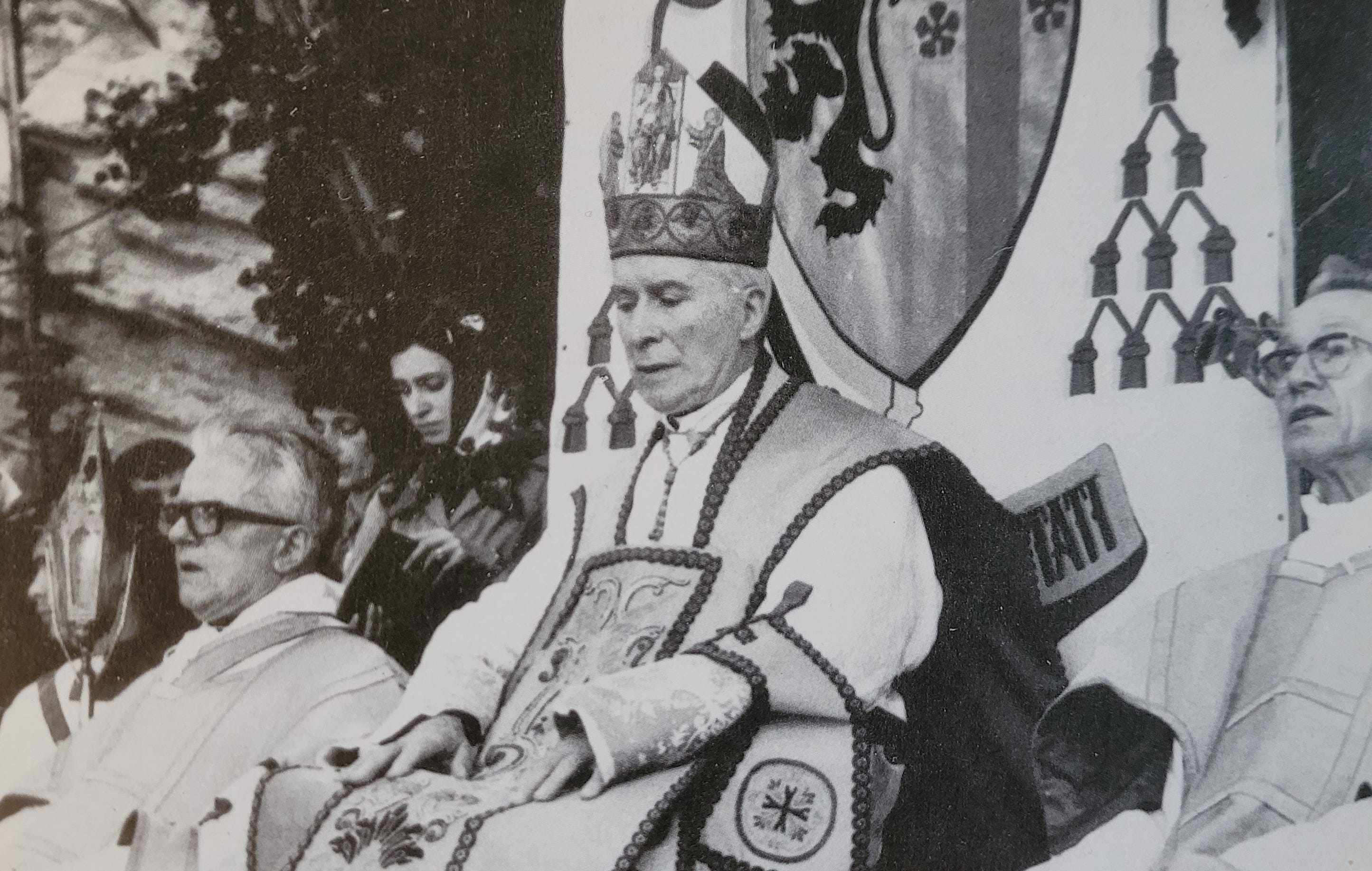
Following his 1976 ordination of seminarians against Vatican prohibitions, Archbishop Marcel Lefebvre was declared ‘suspended a divinis.’ Here is his response:
Editors’ Notes
The following text is a translation of Archbishop Marcel Lefebvre’s reflections following his 1976 suspension a divinis.
This is part of our wider examination of Lefebvre’s comments in the post-conciliar period. This study has become even more relevant since the 2 February 2026 announcement of further episcopal consecrations, to take place in July 2026. The responses to this announcement – both those positive and negative – have generally betrayed a serious lack of awareness of what Archbishop Lefebvre said and did following Vatican II.
In general, the positive responses have suggested that such consecrations are primarily to be justified on intrinsic grounds, i.e., through the rejection of canonical arguments to the contrary. In other words, they have been primarily defensive, rather than offensive; they have presented an image of Archbishop Lefebvre and the SSPX as what we have called an “edgy version of the FSSP” – in other words, a little “canonically naughty,” but otherwise basically the same.
We published a response to Kennedy Hall which addressed such tendencies, and included a selection of texts which showed that Lefebvre’s motivations were primarily doctrinal, rather than liturgical; that he saw his decision as necessary for continuing the Catholic Church1; and that he took a very critical approach to words those who had “rallied” (i.e., the FSSP, etc.).
At the same time, Bishop Donald Sanborn released a video with a similar set of texts, and indicated his belief that such an approach provided a more serious and credible justification for the consecration of bishops without pontifical mandate.2
This present text is an example of this.
The suspension
In 1975, Lefebvre’s Society of St Pius X had been suppressed by Bishop Mamie, the Bishop of Sion. Lefebvre, his Society and seminary continued regardless – albeit trying to find some arrangement with Rome for the ordinations.
These ordinations were set for 29th June 1976. Although he was forbidden to do so the day before, Lefebvre proceeded nonetheless, and the Vatican subsequently suspended him from administering ordinations on July 6, and then from all sacred things on July 22.
Lefebvre did not recognise these sanctions as legitimate, and gave a series of statements and interviews on the subject. This statement contains some of his most striking denunciations of the self-styled “Conciliar Church.”
Some highlights
“[W]e are suspended a divinis by the Conciliar Church and for the Conciliar Church, of which we refuse to be part.”
“This Conciliar Church is a schismatic Church, because it breaks with the Catholic Church of all time. It has its new dogmas, its new priesthood, its new institutions, its new worship—already condemned by the Church in many official and definitive documents.”
“The Church which affirms such errors is at once schismatic and heretical. This Conciliar Church is therefore not Catholic. Insofar as the Pope, bishops, priests, and faithful adhere to this new Church, they separate themselves from the Catholic Church.
“The Church of today is not the true Church except insofar as she continues and remains one with the Church of yesterday and of all time.”
Some comments
Archbishop Lefebvre attributes the phrase “Conciliar Church” to Archbishop Giovanni Benelli of Florence – who was made a Cardinal by Paul VI the next year. In fact, as Novus Ordo Watch drew to our attention some years ago, Lefebvre was mistaken. This odious term was first used by Paul VI himself, in an address to lay leaders in 1966:
“For it is not a matter merely of collecting and spreading the council’s teachings, but of transforming oneself into the image of the conciliar Church.”
We began using the term “Conciliar-Synodal Church” in December 2023, to refer to the latest incarnation of the conciliar church of Vatican II. In the 2024 document The Bishop of Rome, published by the Dicastery of Promoting Christian Unity, Cardinal Koch used this term (“Conciliar/Synodal” rather than “Conciliar-Synodal”), and indicating that the two terms meant the same thing.

The adoption of this phrase raises an amusing question: Had Cardinal Koch and others in the Vatican been reading The WM Review? (One can dream.)
For more on Archbisop Lefebvre’s views on the “Conciliar Church,” we refer readers to John Lane’s paper on the subject, which we edited and expanded into a three-part series in 2021. Here is the first part:

Finally, while the text below contains many excellent expressions, we should also note that a contemporaneous article in Le Monde claimed – with examples – the following point:
“Archbishop Marcel Lefebvre multiplies ‘exclusive’ interviews to the press. They do not always present the desired consistency.”3
We have considered what to make of this phenomenon of inconsistency, as well as why the Archbishop Lefebvre’s comments remain important and interest, elsewhere.
Reflections on the suspension a divinis (1976)
Archbishop Marcel Lefebvre
Published 29 July 1976.
Translated from the French by The WM Review.
It [the suspension] raises a grave problem, and it will still cause rivers of ink to flow, even if I should one day disappear from the scene of the Church militant.
In what does it consist, in reality? It deprives me of the right inherent in the priest, and all the more in the bishop, to celebrate the holy Mass, to confer the sacraments, and to preach in consecrated places. That is to say, I am forbidden to celebrate the new Mass, to confer the new sacraments, and to preach the new doctrine.
Thus, precisely because I have refused these novelties since their institution, I am now officially forbidden to use them. It is because I refuse the new Mass that I am prevented from saying it. One may thereby perceive how little harm this suspension causes me.
It is yet another proof that this new Church, which they themselves have now qualified as the “Conciliar Church,” is destroying itself. It is His Excellency Monsignor Benelli, in his letter of the 25th of June last, who designates it thus. Speaking of the seminarians, he writes:
“There is nothing despairing in their case; if they are of good will and seriously prepared for a pastoral ministry, in true fidelity to the conciliar Church, a suitable solution will afterwards be found for them; but let them begin first, for their part also, with this act of obedience to the Church.”
What could be clearer! Henceforth, it is the Conciliar Church to which one must be obedient and faithful, and no longer the Catholic Church. This is precisely our whole problem: we are suspended a divinis by the Conciliar Church and for the Conciliar Church, of which we refuse to be part.
This Conciliar Church is a schismatic Church, because it breaks with the Catholic Church of all time. It has its new dogmas, its new priesthood, its new institutions, its new worship—already condemned by the Church in many official and definitive documents.
That is why the founder of the Conciliar Church insists so much upon obedience to the Church of today, disregarding the Church of yesterday as though it no longer existed.
This Conciliar Church is schismatic because it has based its aggiornamento upon principles opposed to those of the Catholic Church: thus, the new conception of the Mass expressed in No. 5 of the Preface to the Missale Romanum and No. 7 of Chapter I which gives to the assembly a sacerdotal role it cannot possess; and likewise thus the natural right – that is, the divine right – of every person and of every group of persons to religious liberty.
This right to religious liberty is blasphemous, for it attributes to God intentions which destroy his majesty, his glory, his kingship. This right implies freedom of conscience, freedom of thought, and all the Masonic liberties.
The Church which affirms such errors is at once schismatic and heretical. This Conciliar Church is therefore not Catholic. Insofar as the Pope, bishops, priests, and faithful adhere to this new Church, they separate themselves from the Catholic Church.
The Church of today is not the true Church except insofar as she continues and remains one with the Church of yesterday and of all time. The rule of the Catholic faith is Tradition. The demand of His Excellency Monsignor Benelli is therefore illuminating: submission to the Conciliar Church, to the Church of Vatican II, to the schismatic Church.
As for us, we persevere in the Catholic Church, with the grace of our Lord Jesus Christ and the intercession of the Blessed Virgin Mary.
+Marcel Lefebvre
Ecône, 29 July 1976
HELP KEEP THE WM REVIEW ONLINE WITH WM+!
As we expand The WM Review we would like to keep providing free articles for everyone.
Our work takes a lot of time and effort to produce. If you have benefitted from it please do consider supporting us financially.
A subscription gets you access to our exclusive WM+ material, and helps ensure that we can keep writing and sharing free material for all.
You can see what readers are saying over at our Testimonials page.
And you can visit The WM Review Shop for our ‘Lovely Mugs’ and more.
(We make our WM+ material freely available to clergy, priests and seminarians upon request. Please subscribe and reply to the email if this applies to you.)
Subscribe to WM+ now to make sure you always receive our material. Thank you!
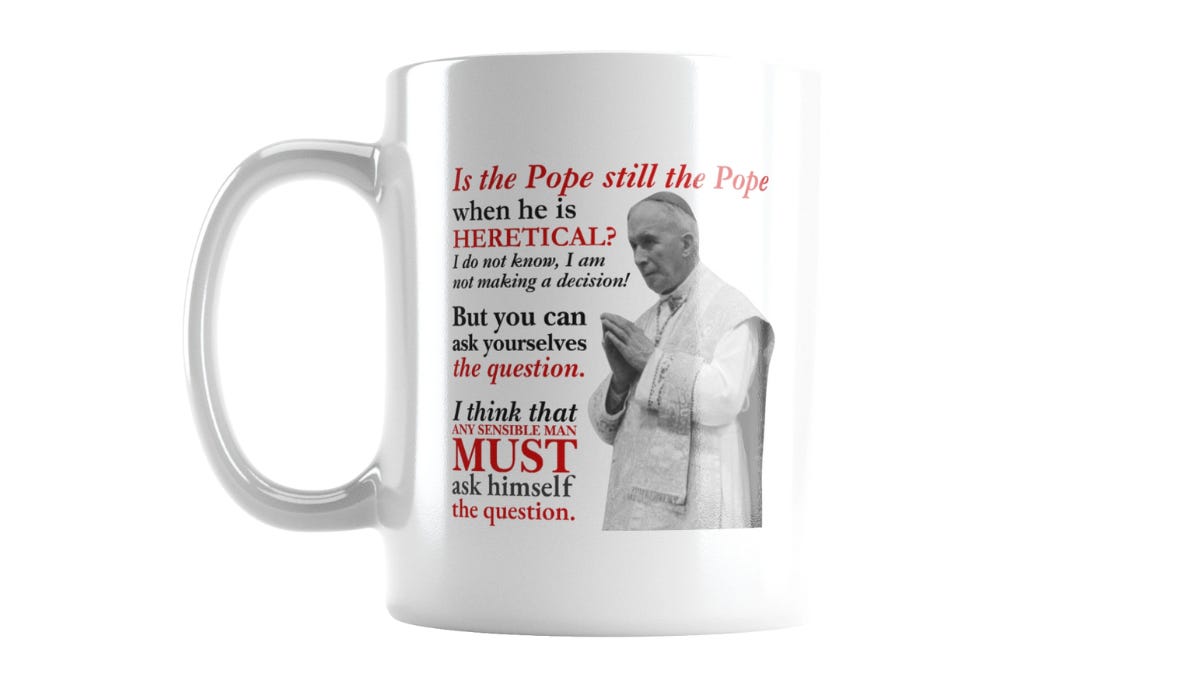
If you think these issues are important, then you can prompt conversations with this mug.
Get your Archbishop Lefebvre Mug today:
Read Next:


Follow on Twitter, YouTube and Telegram:
E.g., in the 1987 letter to the four future bishops:
“Thus evidently appears the absolute necessity of the permanence and continuation of the adorable sacrifice of Our Lord so that “His Kingdom may come.” […]
“This is what has brought upon us the persecution of the antichrist Rome. As this Rome, modernist and liberal, pursues its work destructive of the Reign of Our Lord as is proven by Assisi and the confirmation of the liberal theses of Vatican II on religious liberty, I find myself constrained by divine Providence to transmit the grace of the Catholic episcopate which I have received, so that the Church and the Catholic priesthood may continue to subsist for the glory of God and the salvation of souls. […]
“The principal purpose of this transmission is to confer the grace of holy orders for the continuation of the true sacrifice of the Holy Mass and to confer the grace of the sacrament of confirmation to children and to the faithful who request it of you.”
And in his 1990 letter to Bishop Antonio de Castro Mayer, urging him to consecrate a successor:
“This false Church is in an ever-deeper state of rupture with the Catholic Church. Resulting from these principles and facts is the absolute need to continue the Catholic episcopacy in order to continue the Catholic Church.”
Based on other words of Bishop Sanborn, one presumes that the Bishop was suggesting either a) that these texts provide a greater but still insufficient justification for consecration, or b) that the crucial point was Archbishop Lefebvre’s expressions of (at least) doubt about John Paul II’s legitimacy, in the texts which he cited.
"This odious term was first used by Paul VI himself, in an address to lay leaders in 1966" - it had been already used in the speech for the end of "Vatican II" i.e. December 1965:
"the Church of the council has been concerned, not just with herself and with her relationship of union with God, but with man—man as he really is today"
"La Chiesa del Concilio, sì, si è assai occupata, oltre che di se stessa e del rapporto che a Dio la unisce, dell’uomo, dell’uomo quale oggi in realtà si presenta"
cf. https://www.vatican.va/content/paul-vi/it/speeches/1965/documents/hf_p-vi_spe_19651207_epilogo-concilio.html
Thank you for this article. One can hope that during the proceedings to their new consecrations that the FSSPX will reiterate this position as forcefully as the Abp. did.
A theological quandary is suggested by I believe having read that somewhere the FSSPX holds or held the possibility of a position that the post-conciliar popes could somehow be head of both the RCC and the Conciliar/Synodal (and I might add as my own conclusion Freemasonic) church. This seems untenable as Abp. Lefebvre considered it heretical as he stated and thus his purported "confusion" in dialoguing during his episcopal consecrations really didn't exist. I think his thinking was fairly clear and consistent despite his desire for Rome to return to the faith, he knew he didn't require the Conciliar Pope's approval, and I think the current Superior of the FSSPX has iterated the same, that is showing deference to the See but not the occupant.