

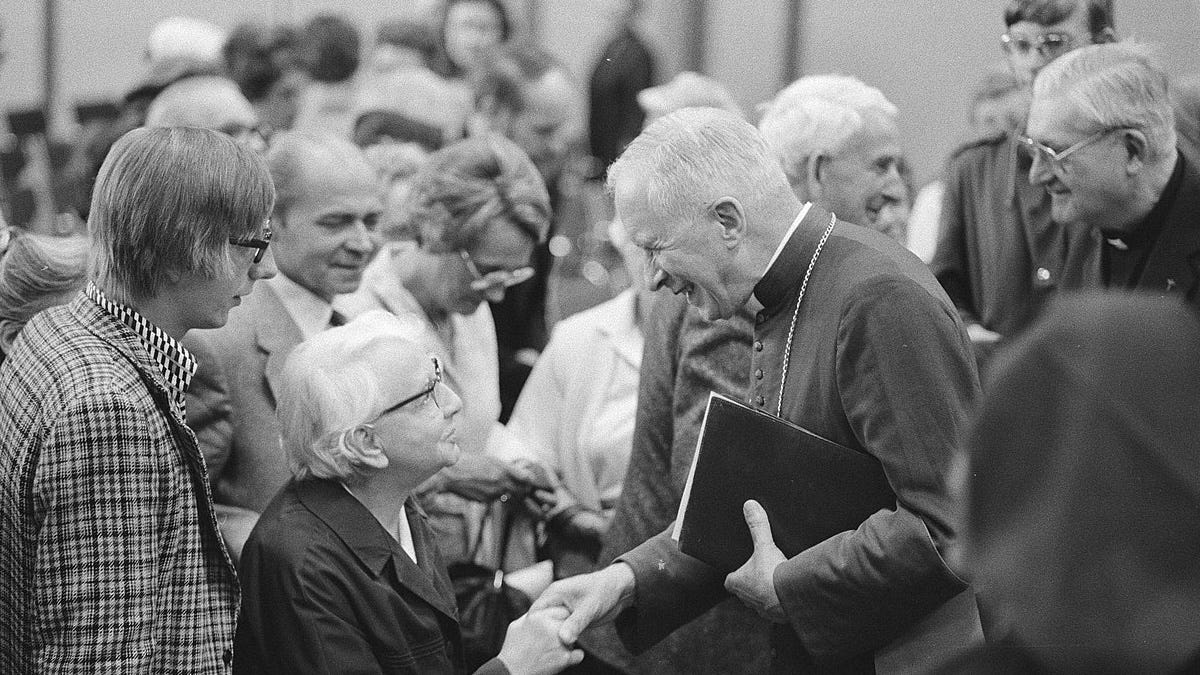
The SSPX has announced that they will be consecrating bishops 1 July 2026, apparently without pontifical mandate, following Archbishop Lefebvre’s ‘Operation Survival’ in 1988 and another in 1991.
Following the death of Bishop Bernard Tissier de Mallerais in 2024 (and also Bishop Richard Williamson in 2025), the Society of St Pius X (SSPX) has announced that they will be following in his footsteps and consecrating bishops, apparently without the permission of Leo XIV, on 1 July 2026.
This will mark the second time – and not the first, as many think – that the Society of St Pius X’s bishops have conferred episcopal consecration since 1988 (more on this below).
The statement is as follows:
Press release dated 2 February 2026.
On 2 February 2026, the feast of the Purification of the Blessed Virgin, the Reverend Father Davide Pagliarani, Superior General of the Priestly Society of Saint Pius X, during the ceremony of the taking of the cassock which he presided over at the International Seminary of Saint-Curé-d’Ars in Flavigny-sur-Ozerain, France, publicly announced his decision to entrust the bishops of the Society with the task of proceeding with new episcopal consecrations, on 1 July next.
Last August, he sought the favour of an audience with the Holy Father, making known his desire to present to the Holy Father, in a filial manner, the current situation of the Priestly Society of Saint Pius X. In a second letter, he explicitly expressed the particular need of the Society to ensure the continuation of the ministry of its bishops, who have been travelling the world for nearly forty years to respond to the many faithful attached to the Tradition of the Church and desirous, for the good of their souls, that the sacraments of Holy Orders and Confirmation be conferred.
After having long matured his reflection in prayer, and having received from the Holy See, in recent days, a letter which does not in any way respond to our requests, Father Pagliarani, in harmony with the unanimous advice of his Council, judges that the objective state of grave necessity in which souls find themselves requires such a decision.
The words he wrote on 21 November 2024, for the fiftieth anniversary of the historic declaration of Archbishop Marcel Lefebvre, are more than ever the reflection of his thought and intentions:
“It is only in the Catholic Church as it has always been, and in her unchanging Tradition, that we have the guarantee of possessing the Truth, of being able to preach it, and of being able to serve her. […]
“The Society [of Saint Pius X] is not primarily seeking its own survival. It primarily seeks the good of the Universal Church and, for this reason, the Society is, par excellence, a work of the Church, which, with unique freedom and strength, responds adequately to the specific needs of an unprecedentedly tragic era.
“This single goal is still ours today, just as it was fifty years ago.
“‘That is why, without any spirit of rebellion, bitterness, or resentment, we pursue our work of forming priests, with the timeless Magisterium as our guide. We are persuaded that we can render no greater service to the Holy Catholic Church, to the Sovereign Pontiff and to posterity (Abp. Lefebvre, Declaration of 21 November 1974)’.”
“In the coming days, the Superior General will provide further explanations regarding the present situation and his decision.
“Nos cum Prole pia benedicat Virgo Maria.
“May the Virgin Mary bless us, together with her divine Son.”Menzingen, 2 February, 2026
Not the first time
Thirty-eight years ago, on June 30, 1988, Archbishop Lefebvre carried out the "operation-survival" of Catholic Tradition by consecrating four auxiliary bishops for the Society of Saint Pius X. As noted above, two of these bishops are now dead – along with Bishop Antonio de Castro Mayer (the co-consecrator).
What is not well known is that this is not the first episcopal consecration that has taken place within the SSPX since 1988. In 1991, soon after the first consecrations, three of the SSPX bishops consecrated Fr Licínio Rangel for the Catholic remnant in the Dioceses of Campos. Both the fourth bishop (Bishop Fellay), and the Superior General (Fr Schmidberger), were in attendance. It is unclear whether permission was sought from the Vatican for this consecration.
Bishop Rangel died in 2002, having come to an agreement with the Vatican in 2001.
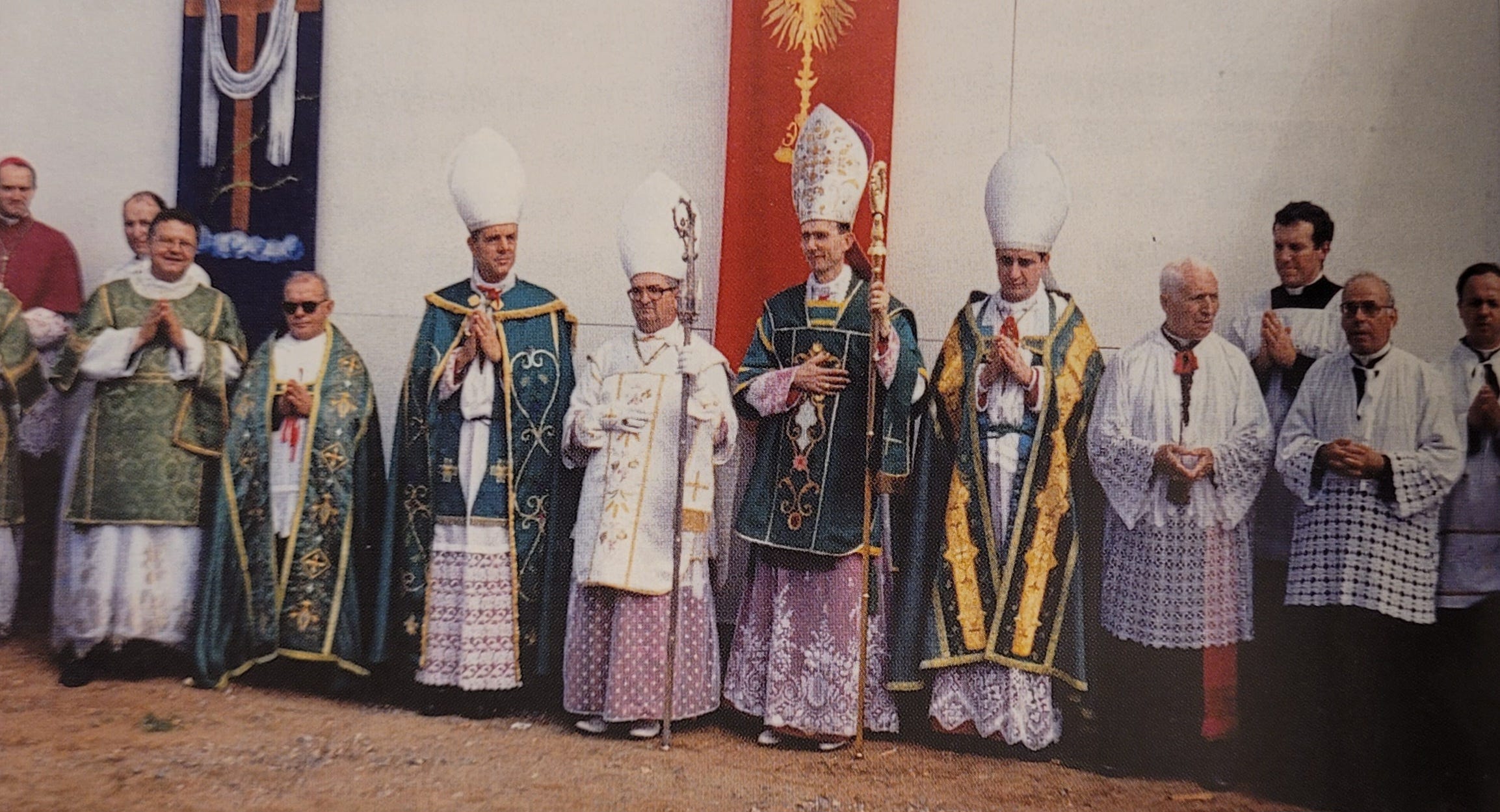
Rangel was succeeded, within those structures, by Fernando Arêas Rifan, whose consecration by Cardinal Darío Castrillón Hoyos was rendered certainly valid by Rangel’s presence as co-consecrator. Although he was one of the most stalwart defenders of tradition under de Castro Mayer, and assisted him in 1988, Rifan was pictured concelebrating the Novus Ordo Mass with Francis at Casa Santa Marta.
This consecration almost seems to have been forgotten – although not by the priests whom Rangel himself ordained for the SSPX. It was not mentioned in the 2009 decree purporting to remit the alleged excommunications of the four bishops. It also seems to have been forgotten (or overlooked) in the SSPX’s statement on the occasion of Bishop Williamson’s consecration of Bishop Jean-Michel Faure in 2015, criticising the failure to obtain permission from the Vatican.
To our knowledge, the Vatican did not publicly respond to Williamson’s consecration of Faure – nor to that of the other men he raised to the episcopate following his expulsion from the SSPX.
Excommunications – What happened in 1988
According to canon law, consecration of a bishop without pontifical mandate carries a latae sententiae excommunication for the consecrating and consecrated bishops.
This is what happened in 1988. The Vatican responded within hours, stating that the six bishops involved (Lefebvre, de Castro Mayer, Fellay, Williamson, de Galarreta and Tissier de Mallerais) had indeed excommunicated themselves. This statement was formalised by the Congregation of Bishops on 1 July 1988.
In response, the District Superiors of the SSPX issued a powerful Open Letter, which stated:
“[W]e have never wished to belong to that system which styles itself the ‘Conciliar Church,’ and which defines itself by the Novus Ordo Missæ, by indifferentist ecumenism, and by the secularisation of the whole of society.
“Yes, we have no part — nullam partem habemus — with the pantheon of religions of Assisi; our own excommunication by a decree of your Eminence or of another dicastery would be only the irrefutable proof of this.
“We would ask for nothing better than to be declared ex communione from the adulterous spirit which has blown through the Church for twenty-five years, excluded from the impious communion with unbelievers. […]
“To be therefore publicly associated with the sanction which strikes the six Catholic bishops, defenders of the faith in its integrity and totality, would be for us a mark of honour and a sign of orthodoxy before the faithful.
“For these faithful indeed have a strict right to know that the priests to whom they turn do not belong to the communion of a counterfeit Church”
Reactions, defections and reconciliations
The consecrations also prompted a number of defections from the SSPX ranks. Aided by former SSPX and former “sedevacantist” Fr Louis-Marie de Blignières (of the Fraternity of St Vincent Ferrer), a number of priests reconciled themselves with the Vatican – and thus, the Fraternity of St Peter was born.
Lefebvre himself focused a lot of attention on the reconciliation of Dom Gerard Calvet and the Benedictine monastery of Le Barroux, who had previously been a collaborator, and Le Barroux was made an Abbey. In one of his denunciations of Dom Gerard, Archbishop Lefebvre said:
“Dom Gérard has always seen only the liturgy and monastic life. He does not see clearly the theological problems of the Council, of religious liberty. He does not see the malice of these errors. He has never been greatly concerned with that. What affected him was the liturgical reform, the reform of the Benedictine monasteries. He left Tournay saying: “I cannot accept that.” So he re-established a community of monks with the liturgy, in the Benedictine spirit. Very well, it was splendid.
“But I think he did not sufficiently measure that those reforms which had led him to leave his monastery were the consequence of the errors that are in the Council. Provided that he is granted what he was seeking, that monastic spirit and the traditional liturgy, he has what he wants and the rest is indifferent to him. But he falls into a trap, for the others have conceded nothing on those false principles.
“It is a pity, for it still involves sixty monks, about twenty priests among them, and thirty nuns. There are almost a hundred young people there, completely disoriented, and whose families are worried or even divided.
“It is disastrous.”
In another address, he said:
“The more one analyzes the documents of Vatican II, and the more one analyzes their interpretation by the authorities of the Church, the more one realizes that what is at stake is not merely superficial errors, a few mistakes, ecumenism, religious liberty, collegiality, a certain Liberalism, but rather a wholesale perversion of the mind, a whole new philosophy based on modern philosophy, on subjectivism.”
38 years of operating in this paradigm makes it unlikely that many priests or religious will cease collaborating with the SSPX following these consecrations, even if another excommunication is alleged to have been incurred.
However, this may not be the case for the laity. It is well known that a certain number of the faithful have become attached to the SSPX based on similar concerns to Dom Gérard, and have been convinced of the Society’s legitimacy based on the tolerance of the Vatican. If this tolerance is revoked, it seems likely that they will also depart. Archbishop Lefebvre spoke of such departures, both lay and clerical, in 1990:
“And we must not waver for one moment either in not being with those who are in the process of betraying us. Some people are always admiring the grass in the neighbor’s field. Instead of looking to their friends, to the Church’s defenders, to those fighting on the battlefield, they look to our enemies on the other side. ‘After all, we must be charitable, we must be kind, we must not be divisive, after all, they are celebrating the Tridentine Mass, they are not as bad as everyone says’—but they are betraying us—betraying us! They are shaking hands with the Church’s destroyers. They are shaking hands with people holding modernist and liberal ideas condemned by the Church. So they are doing the devil’s work.
“Thus those who were with us and were working with us for the rights of Our Lord, for the salvation of souls, are now saying, ‘So long as they grant us the old Mass, we can shake hands with Rome, no problem.’ But we are seeing how it works out. They are in an impossible situation. Impossible. One cannot both shake hands with modernists and keep following Tradition. Not possible. Not possible.
“Now, stay in touch with them to bring them back, to convert them to Tradition, yes, if you like, that’s the right kind of ecumenism! But give the impression that after all one almost regrets any break, that one likes talking to them? No way! These are people who call us corpse-like traditionalists, they are saying that we are as rigid as corpses, ours is not a living Tradition, we are glum-faced, ours is a glum Tradition! Unbelievable! Unimaginable! What kind of relations can you have with people like that?
“This is what causes us a problem with certain layfolk, who are very nice, very good people, all for the Society, who accepted the Consecrations, but who have a kind of deep-down regret that they are no longer with the people they used to be with, people who did not accept the Consecrations and who are now against us. ‘It’s a pity we are divided’, they say, ‘why not meet up with them? Let’s go and have a drink together, reach out a hand to them’—that’s a betrayal! Those saying this give the impression that at the drop of a hat they would cross over and join those who left us. They must make up their minds.”
Justifications
The SSPX (and other traditionalist groups) have long justified such measures with a variety of different ways. Although the arguments for consecrating bishops against pontifical mandate may not be entirely convincing, we hold that Leo XIV is not the legitimate Roman Pontiff, and that the Holy See has been vacant since somewhere around the time of Paul VI.

Some have argued that episcopal consecrations, conferred without or against the will of a man wrongly considered to be Pope, are morally equivalent to those conferred without or against the will of a true Pope. As such, they argue, such consecrations would be stained by schism, at least in a subjective sense.
Under ordinary circumstances, it would be difficult to argue with such an equivalence. However, we are not in ordinary circumstances; we are in extremely confusing circumstances.
As such – and notwithstanding the possibility of obscuring key points of Catholic doctrine around the papacy – it would seem that latitude should be offered to those who seek to do what is necessary, even if one disagrees with significant parts of their rationale.
Dangers
In summary, we are pleased that the SSPX is taking this step – provided, of course, that the men chosen for the episcopate are themselves in possession of unquestionably valid priestly orders.
It is well known that a small number of SSPX members and collaborators were ordained using Paul VI’s new rite of priestly ordination, or by men whose own priestly or episcopal orders also depended on the validity of the reformed rites.
For reasons explained elsewhere, supported by much of what Archbishop Lefebvre said and did, orders putatively conferred using these rites are at best doubtful; and yet not all of these men have had the doubts resolved through conditional ordination.
This problem would not be resolved by episcopal consecration, because “per saltum” consecrations to the episcopate (i.e., consecration of a man who is not a priest) are themselves doubtful at best. St Thomas Aquinas states:
“But the episcopal power depends on the priestly power, since no one can receive the episcopal power unless he have previously the priestly power.” (Suppl. Q. 40, A. 5)
The same position is taken by the Dictionnaire de Théologie Catholique, in John Daly’s translation (with his comment):
“It must be recognized that the almost unanimous response of modern theologians is affirmative: ‘All authors consider the Consecration of a bishop to be invalid unless it is preceded by the priesthood.’”
[Emphases added, and the article goes on to quote various authorities for this assertion, including St. Alphonsus Liguori, Book 6, n. 793 of his Theologia Moralis].
(Vol. XI, col. 1388)
Being himself doubtfully consecrated (at best), such a man’s confirmations would also be doubtful, and thus impossible for Catholics to receive in good conscience. The holy oils consecrated would also be doubtful, leading to problems of validity for Confirmation and Extreme Unction. But this is nothing compared to the chaos that would be caused with regards to this bishop’s own ordinations (or even episcopal consecrations). The men ordained by such a doubtful bishop would themselves be doubtful priests, conferring doubtful sacraments.1
Such doubt is precisely what Archbishop Lefebvre stated that he was trying to avoid by the 1988 consecrations, both at the ceremony itself and on other occasions.
May God forbid such a turn of events.
One should also bear in mind that the Vatican authorities are both a) vehemently opposed to the Catholic Church, and b) not to be underestimated.
There should be no need to demonstrate the first point: the best way of demonstrating it is with the words of Archbishop Lefebvre himself, and his heirs.
With regards to the second: those occupying the Vatican are the illegitimate heirs of centuries of diplomatic technique. When ordered towards the good of the Church, this diplomacy is a great good; when ordered towards her destruction, it is a powerful and dangerous tool. Further, these men are not stupid; they are capable of turning good events towards evil.
It is unclear how they will proceed. The consecrations may be granted a mandate following this announcement; the Vatican may also try to influence the choice of consecrands in their own interests.
As the District Superiors said in 1988, excommunication from the modernist Vatican is a badge of honour; are they likely to award such a badge of honour again, especially when it is likely to benefit the SSPX?
Whether it does or not, and especially if the Vatican responds positively: “Timeo Danaos et dona ferentes” (I fear the Greeks even when bearing gifts).
We encourage readers to pray for all involved – and for the greater recognition of what alone can truly justify these episcopal consecrations and protect the work of the Society of St Pius X, namely the extended vacancy of the Holy See.
Updates
Fr Pagliarani’s sermon has now been published. In it, he states that he would like to meet with Leo XIV prior to the consecrations to discuss the particulars.
Here are the relevant sections:
Episcopal consecrations out of fidelity to the Church and to souls
“We believe that the time has come to think about the future of the Society of Saint Pius X, the future of all souls, whom we cannot forget, whom we cannot abandon, and above all, the good we can do for Holy Mother Church. And this raises a question that we have been asking ourselves for a long time and to which, perhaps, we must now give an answer. Should we wait longer before considering consecrating bishops? We have waited, prayed and observed the developments in the Church, and also sought advice. We have written to the Holy Father to present, in all simplicity, the situation of the Society, explaining these needs and at the same time to reconfirm to the Holy Father our only raison d’être, which is the good of souls.
“We wrote to the Holy Father: Your Holiness, we have but one intention, which is to make all the souls who turn to us, true sons of the Roman Catholic Church. We will never have any other intention, and we will always keep this intention. Furthermore, the good of souls corresponds to the good of the Church. The Catholic Church does not exist in the clouds. The Catholic Church exists in souls. It is souls that constitute the Church and if we love the Church, we love souls. We want their salvation and we want to do everything possible to offer them the means to attain their salvation. Therefore, we have begged the Holy Father to understand the very unique situation in which the Society finds itself, and to allow it to take the means to continue this work in such an exceptional situation. We all know that the work of the Society, once again, has no other purpose than to preserve Catholic Tradition for the good of souls.
“Well, unfortunately, these reasons do not seem to be of interest to Rome, and are not convincing. If you like, unfortunately, these reasons have not found a favourable ear with the Holy See, for the moment. We profoundly regret this situation. Therefore, what are we going to do? Are we going to abandon souls? Are we going to tell them that there is ultimately no case of necessity for the Society to continue its work? That ultimately everything is more or less fine. In other words, that there is no longer a state of necessity in the Church that would justify our apostolate and our existence so as to help the Catholic Church. It is not a question of challenging the Church – far from it! We are here to serve the Church, and we serve the Church by preaching the faith and proclaiming the truth to souls – and not by telling fables to souls.
“Can we therefore tell them that, despite everything, everything is fine? Certainly not! That would be a betrayal of souls, and betraying souls would mean betraying the Church. We simply cannot do that. This is why we think that 1st July 2026 could be a good date – an ideal date – as it is the Feast of the Most Precious Blood of Our Lord Jesus Christ. It is the feast of Redemption. Nothing else is of interests to us. What we hold most dear is the Precious Blood of Our Lord, flowing down from his feet onto the wood of the cross. Our Lady, at the foot of the cross, was the first to adore this Precious Blood, and which we continue to adore at the foot of the altar. This is the only thing that interests us, and it is the only thing that we want to give to souls – souls have a right to this, it is not a privilege, it is their right! We cannot abandon them.
“In the coming days, we intend to give you more information and greater detail. It is important to understand the reasons. It is important to understand what is at stake in all this. This is crucial. However, at the same time, we must understand all this through prayer. It is not enough to prepare our minds alone. I would even say that it is not enough to take a purely apologetic approach to all this. We must prepare hearts – our hearts – as it is a grace, and we must hold on to this grace. We must give thanks to God, and we must prepare ourselves. Yes, consecrations, once more, there will be episcopal consecrations. However, this is not to challenge the Church - it is definitely not a challenge. They will be consecrations out of fidelity to the Catholic Church and to souls.
“Furthermore, I would like to add one last consideration… I fully assume responsibility for this decision. I assume it, firstly before God. I assume it before the Blessed Virgin Mary and before Pope Saint Pius X. I assume it before the Holy Father. I would sincerely like to meet the Pope before 1st July. I would like to explain to him, so as to make it possible for him to understand our real and profound intentions, and our attachment to the Catholic Church, so that he knows it, and so that he can understand it. I also accept this responsibility before the Holy Catholic Church and before the Society, before all the members of the Society and - I repeat yet again – before all the souls who in one way or another have recourse to us, and who ask us for help now or in the future. All these souls and all these vocations that Divine Providence has sent us and who continues to send us. Before them, I assume this responsibility – each and everyone in particular, because each soul has an infinite value.
“Furthermore, in the Catholic Church, we must never forget that the law of laws, the supreme law that takes precedence over all others, is the salvation of souls. It is not the prattle of small-talk, it is not the synod, it is not ecumenism, it is not liturgical experiments, nor new ideas and a new evangelisation, it is the salvation of souls. This is the law of laws, and we all have a duty, each in our own place, to observe this law and to devote ourselves totally to defending it. Why must we do this? It is because Our Blessed Lady and Our Lord Jesus Christ taught us during their life here on this earth that they had no other intention and no other goal than the salvation of souls. Therefore, in one way or another, and according to our talents and our circumstances, each one of us must do everything we can, making our contribution to save our own souls and the souls of others. Amen.”
This story is developing…
If you liked this article, why not get it in mug form?
Get your Archbishop Lefebvre Mug today:
Further reading:


Archbishop Lefebvre and the Conciliar Church
An updated edit of John Lane’s classic study:
What did Archbishop Lefebvre really think about the ‘Conciliar Church’?
Did Lefebvre see the Conciliar Church as a separate society to the Catholic Church?
Where is the Church today? Archbishop Lefebvre and the Conciliar Church
Archbishop Lefebvre and the Sacraments
Our series examining Archbishop Lefebvre’s words, ideas and deeds in relation to the Novus Ordo sacramental rites:
Archbishop Lefebvre & Conditional Confirmations—His pastoral practice explained
Archbishop Lefebvre & Conciliar Sacraments—Do they ‘come from the Church?’
Further material:
‘I do not hesitate to administer conditional confirmation when asked’—Archbishop Lefebvre
Classic study radically overstates Lefebvre’s position on holy orders
Is desiring the sacraments individualistic and emotional? Lefebvre and others answer
Archbishop Lefebvre and ‘The Pope Question’
A series of talks given in 1986 to seminarians and priests:
Archbishop Lefebvre: Three dispositions needed by priests and seminarians today
Archbishop Lefebvre: ‘Who is this man on the throne of Peter?’
+Lefebvre: ‘Any sensible man must ask’ if a heretic is still pope, can discuss with others
Summarised (and some what softened) in an English publication from the time:
Further material:
+Marcel Lefebvre’s glowing tribute to ‘sedevacantist’ Fr Henri Mouraux
‘Medieval peasants didn’t know the pope’s name, why should we care?’ +Lefebvre answers
Various Addresses
Post-Suspension
Lead-up to the Consecrations
(See also above under “The Pope Question”)
Post-Consecrations
Articles by our friends
Archbishop Lefebvre and Sedevacantism (John Daly)
Archbishop Lefebvre and The Sedevacantist Thesis (John Lane)
Archbishop Lefebvre and The Conciliar Popes (John Lane)
Fr. Celier’s Interpretation of Archbishop Lefebvre (John Lane)
HELP KEEP THE WM REVIEW ONLINE!
As we expand The WM Review we would like to keep providing free articles for everyone.
Our work takes a lot of time and effort to produce. If you have benefitted from it please do consider supporting us financially.
A subscription from you helps ensure that we can keep writing and sharing free material for all. Plus, you will get access to our exclusive members-only material.
(We make our members-only material freely available to clergy, priests and seminarians upon request. Please subscribe and reply to the email if this applies to you.)
Subscribe now to make sure you always receive our material. Thank you!
One can read a further overview of the per saltum issue in John Daly’s Michael Davies: An Evaluation, pp. 323-348. One can find more on Archbishop Lefebvre’s positions on this issue in the series below:
Archbishop Lefebvre & Conditional Confirmations—His pastoral practice explained
Archbishop Lefebvre & Conciliar Sacraments—Do they ‘come from the Church?’
Further material:
“Although the arguments for consecrating bishops against pontifical mandate may not be entirely convincing…”
FWIW, this argument convinced me (to which the example of Cardinal Slipyj could be added):
https://www.sspxasia.com/Documents/SiSiNoNo/1999_September/The_1988_Consecrations.htm
Of course, as the author points out, at the end of the day, the point is moot, if these recent papal claimants are not legitimate.
In asserting that complying with "Rome", Provost's refusal to authorize bishops, would be a "betrayal of souls" and that the authorities are "not of interest" regarding the salvation of souls, Fr. Pagliarani holds two contradictory positions:
🔸 He recognizes Prevost as a true Vicar of Christ.
🔸 He accuses Prevost of officially acting as the Destroyers of Christ's Flock.
🔹 The Catholic Church is indefectible; therefore, her Supreme Authority, the Pope, when acting in his official capacity to govern the Universal Church, cannot issue commands or impose laws that are harmful to the salvation of souls or contrary to the Faith, cf. Auctorem Fidei, First Vatican Council.
Fr. Pagliarani moreover expresses a "sincere" desire to explain his "attachment" to the Pope, while simultaneously announcing his intent to perform the supreme jurisdictional act of consecrating bishops, explicitly forbidden by him, reducing the Papacy to a purely ornamental title.
🔹 This echoes the "Anglicanised" ecclesiology; it posits a "High Church" wing, the SSPX, that preserves the "true faith" independently of the "official" hierarchy, effectively creating a parallel Church that claims to be loyal to a monarch it ignores.
Finally, Fr. Pagliarani implies that while the visible hierarchy of Rome has abandoned the "good of souls," the true Church continues to exist in the "souls" of those who follow the Society's course. That is, he is resorting to a Protestant definition of the Church: an invisible collection of "true believers" hidden within or apart from the corrupt visible structure.
By refusing to say "Rome has defected," Fr. Pagliarani forces the true Church into the "clouds" of the Society's private judgment, violating the very visibility he claims to defend.
🔹 The Catholic Church is a Visible Society constituted by visible bonds of Faith, Sacraments, and Government. While it exists in souls, its existence is verified by its visible hierarchy and profession, cf. Pope Pius XII, Mystici Corporis.
If the Shepherd is poisoning the sheep, he is a wolf, not a bad Shepherd. To call him Shepherd while treating him as a wolf destroys the definition of the Shepherd.