
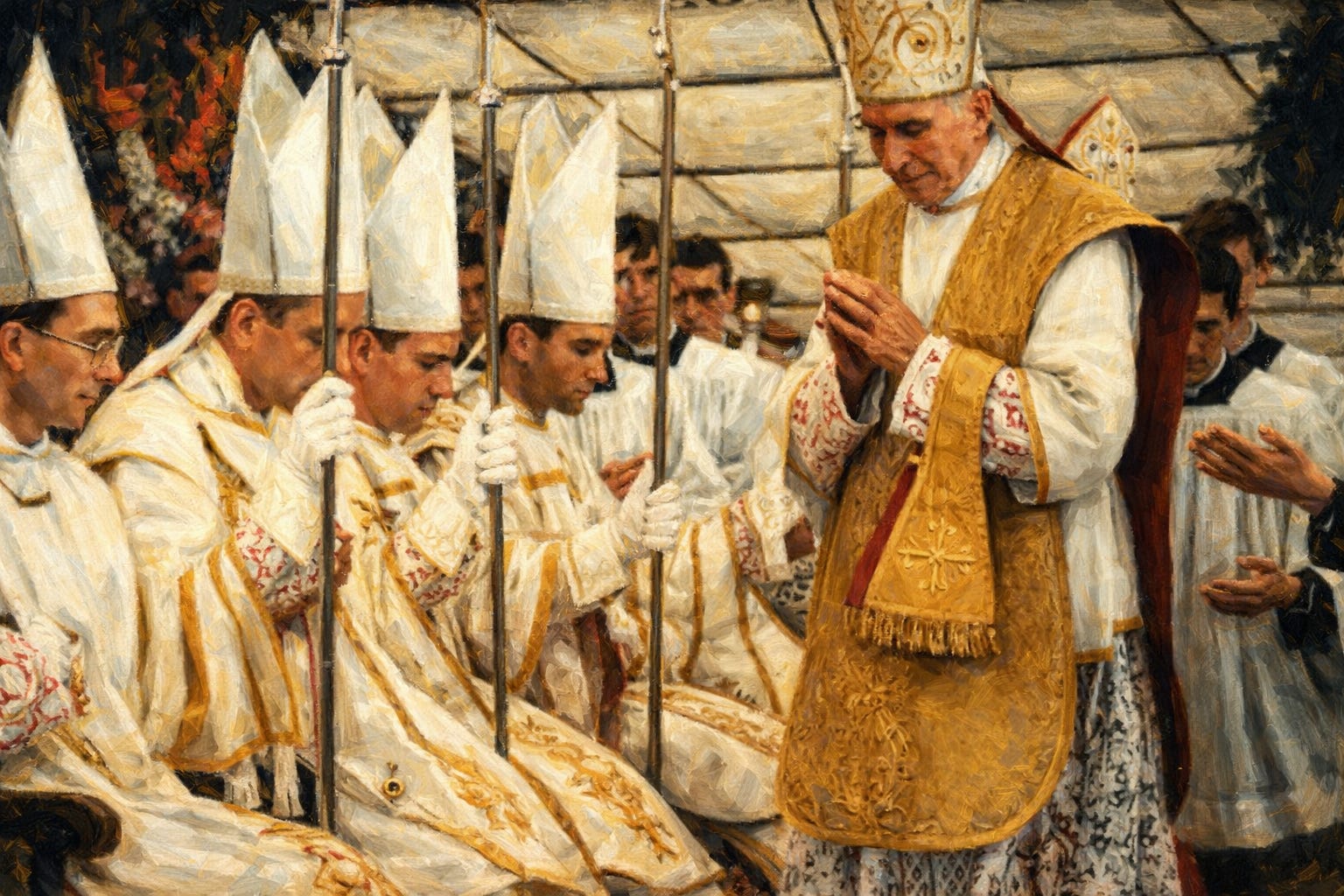
What instructions did Archbishop Marcel Lefebvre give to the four men he had chosen to consecrate to the episcopate in 1988? Some might find them surprising.
Editors’ Notes
Following the Society of St Pius X’s announcement of episcopal consecrations to take place in July 2026, it is natural to consider similarities and differences with those of 1988.
One place to begin this consideration is the letter which Archbishop Marcel Lefebvre wrote to Frs Williamson, Tissier de Mallerais, Fellay and de Galarreta in 1987.
We are publishing a new translation of this letter below, in which Lefebvre asks the four to receive episcopal consecration – conveying his intentions, and offering them instructions and advice.
Some highlights of the letter
The Archbishop describes John Paul II and his officials as “antichrists”:
“The Chair of Peter and the positions of authority in Rome being occupied by antichrists, the destruction of the Reign of Our Lord continues rapidly within His Mystical Body here below […]
“This is what has brought upon us the persecution of the antichrist Rome.”
It is certain that, around this time, Archbishop Lefebvre was again considering the possibility of taking a public stance against the legitimacy of the apparent occupant of the Holy See – and even gave a conference suggesting that priests discuss the question, and prepare the faithful for an eventual declaration of this kind. He had previously alluded to the possibility of drawing such a conclusion in the 1970s.
However, it is also certain that he continued to conduct negotiations with John Paul II and his curia. He also occasionally spoke negatively of “sedevacantists” after the consecrations.1 As such, it is difficult to discern precisely what Lefebvre meant by calling these men “antichrists.”
Lefebvre also states that the continuation of the Catholic priesthood is one of the chief motivations for the consecrations – which necessarily implies something about the validity of the new rites of priestly ordination and episcopal consecration, or at least his confidence in the validity of sacramental administration in the Conciliar milieu:
“So that the Church and the Catholic priesthood may continue to subsist for the glory of God and the salvation of souls. […]
“The principal purpose of this transmission is to confer the grace of holy orders for the continuation of the true sacrifice of the Holy Mass and to confer the grace of the sacrament of confirmation […]”
The letter also conveys the betrayal of the social reign of Christ the King as being central in Lefebvre’s considerations.
The context of the letter
The letter was published 13th June 1988 in the French La lettre aux amis. It was was later translated for The Angelus in July of the same year.
Bishop Bernard Tissier de Mallerais, in his biography of the Archbishop, gives some of the immediate context of the letter.
On July 14 [1987], Cardinal Ratzinger received Archbishop Lefebvre at the Holy Office.
At first the Cardinal persisted in arguing that “the State is incompetent in religious matters.”
“But the State has an ultimate and eternal end,” replied the Archbishop.
“Your Grace, that is the case for the Church, not the State. By itself the State does not know.”
Archbishop Lefebvre was distraught: a Cardinal and Prefect of the Holy Office wanted to show him that the State can have no religion and cannot prevent the spread of error. However, before talking about concessions, the Cardinal made a threat: the consequence of an illicit episcopal consecration would be “schism and excommunication.”
“Schism?” retorted the Archbishop. “If there is a schism, it is because of what the Vatican did at Assisi and how you replied to our Dubia: the Church is breaking with the traditional Magisterium. But the Church against her past and her Tradition is not the Catholic Church; this is why being excommunicated by a liberal, ecumenical, and revolutionary Church is a matter of indifference to us.”
As this tirade ended, Joseph Ratzinger gave in: “Let us find a practical solution. Make a moderate declaration on the Council and the new missal a bit like the one that Jean Guitton has suggested to you. Then, we would give you a bishop for ordinations, we could work out an arrangement with the diocesan bishops, and you could continue as you are doing. Ask for a Cardinal Protector, make your suggestions.”
How did Marcel Lefebvre not jump for joy? Rome was giving in! But his penetrating faith went to the very heart of the Cardinal’s rejection of doctrine. He said to himself: “So, must Jesus no longer reign? Is Jesus no longer God? Rome has lost the Faith. Rome is in apostasy. We can no longer trust this lot!”
Tissier de Mallerais proceeds to report one of Lefebvre’s most memorable denunciations of both Ratzinger and the entire Vatican II revolution:
To the Cardinal, he said:
“Eminence, even if you give us everything—a bishop, some autonomy from the bishops, the 1962 liturgy, allow us to continue our seminaries—we cannot work together because we are going in different directions. You are working to dechristianize society and the Church, and we are working to christianize them.
“For us, our Lord Jesus Christ is everything. He is our life. The Church is our Lord Jesus Christ; the priest is another Christ; the Mass is the triumph of Jesus Christ on the Cross; in our seminaries everything tends towards the reign of our Lord Jesus Christ. But you! You are doing the opposite: you have just wanted to prove to me that our Lord Jesus Christ cannot, and must not, reign over society.”
Recounting this incident, the Archbishop described the Cardinal’s attitude: “Motionless, he looked at me, his eyes expressionless, as if I had just suggested something incomprehensible or unheard of.” Then Ratzinger tried to argue that “the Church can still say whatever she wants to the State,” while Lefebvre, the intuitive master of Catholic metaphysics, did not lose sight of the true end of human societies: the Reign of Christ. Fr. de Tinguy hit the nail on the head when he said of Marcel Lefebvre: “His faith defies those who love theological quibbles.”
Tissier de Mallerais continues, explaining how internal SSPX discussions progressed :
Throughout the summer, the realism of the Archbishop’s deep faith—not pessimism, which was not in his character—made him say to himself: “We cannot work together with these enemies of our Lord’s reign.” However, the letter the Cardinal wrote him on July 28 was encouraging. Starting from a negative premise, it proved to be a prelude to the unprecedented concession of “auxiliaries”:
“The Holy See cannot grant the Society of Saint Pius X auxiliaries without the Society being given an adequate juridical structure.” The letter spoke of granting the Society “its proper autonomy” and confirmed that the seminaries, ordinations, and use of the 1962 missal could continue. It announced the “immediate and unconditional” appointment of a Cardinal Visitor who, it was true, would have to guarantee “the orthodoxy of the teaching” in the seminaries and “the ecclesial spirit,” and who would determine who was to receive orders.
Many believe that the discussions between Lefebvre and the Vatican had in view the consecration of a single bishop; Tissier de Mallerais informs us that as early as 1987, Lefebvre had already chosen the four men whom he would later consecrate.
On August 22, 1987, in Fatima, where the Archbishop went—in the absence of the Pope, who was procrastinating—to consecrate Russia to the Immaculate Heart of Mary according to the request of the Blessed Virgin, the Archbishop called a meeting of his closest collaborators: the Superior General, Fr. Schmidberger; the two assistants, Frs. Aulagnier and Bisig; and Frs. Tissier de Mallerais, Williamson, de Galarreta, and Fellay. He had already chosen some of these to become his “auxiliaries.” He underlined the excessive powers that the Cardinal Visitor would have: “It risks dividing us and driving away our seminarians.”
“We cannot follow these people. They’re in apostasy. They do not believe in the divinity of our Lord Jesus Christ who must reign. What is the use in waiting? Let’s do the consecration! I suggest the date of the feast of Christ the King, October 25.”
Many object to Lefebvre’s negotiations with the Vatican at this time. Their reasons are strong, and are only fortified by information like the above. Nonetheless, Tissier de Mallerais states why these negotiations continued:
But the general opinion of the collaborators was not to rush into things: “Let us rather wait and see where the Rome opening leads. Let us work out an appropriate canonical structure and obtain permission for the consecration. In this way we will have nothing to reproach ourselves with. We will have tried everything.”
The late bishop then explains how the letter came to be written. He also states that “he did not send it”; it is unclear whether this means that he did not send it immediately, or that it was only found after his death in 1991.
The Archbishop seemed to agree with this opinion. However, when he returned to France to stay at Gigondas with his friends Mr. and Mrs. Laurent Meunier, the peace he found there enabled him to get down on paper a letter addressed to the future bishops. It was dated August 29 and was doubtless conceived the evening before (whence the allusion to St. Augustine at the end of the letter), although he did not send it:
[There follows an extract from the letter, which we have translated in full below.]
Bishop Tissier de Mallerais concludes:
Including Christ in the Assisi pantheon and rejecting His reign over society: were these things not a rejection of His divinity, “dissolving Christ” and being, as St. John the Apostle says, an “anti-Christ” (1 Jn. 2:22; 4:3)?
Since the venue at Martigny where he had planned to hold the consecration was not available on October 25, he secretly put the date back to December 27, the feast of the Apostle St. John.
Some final comments
Many of our readers will object to aspects of the letter’s phrasing about the papacy, and justly take scandal at the idea that a true Roman Pontiff could be called an “Antichrist.” Some might also correctly point to statements made at this time which appear to contradict the ideas and sentiments conveyed in this letter.
Some may also see Lefebvre’s injunction “to remain attached to the Roman See” as a condemnation of we who hold the Holy See to be currently vacant; but whatever Lefebvre may have meant in this phrase, we must surely agree that remaining attached to the vacant See – and not to the “Antichrist” usurping it – is essential for all Catholics.
Finally, some may also object to the providential significance he attributes to his own work, which has been critiqued in great detail by Père Noël Barbara2 and others.3
Nonetheless, whatever the objections that could be raised to the contents of the letter itself, it remains a document of important historical interest and conveys a number of important ideas which are lost in the “sanitised” image of Archbishop Lefebvre that is common among North American revisionists online today.
Rather than trying to speculate about what Lefebvre might think today, or trying to justify theological positions on the basis of one’s own interpretation of Lefebvre, it is better to let the texts speak for themselves.
As we have explained at length elsewhere, the more of Archbishop Lefebvre’s texts that are available, the more it will be possible to appreciate the complexity of the situations which he faced, as well as his decisions and legacy.
We publish these texts to that end, as well for the historical importance of his writings themselves. This purpose justifies the translation and publication even of texts which occasionally contain contradictions of our own conclusions.
Let us now proceed to Archbishop Lefebvre’s letter.
Letter from Archbishop Lefebvre to the Future Bishops of the SSPX
29 August, 1987
May Thy Kingdom Come
To Reverend Fathers Williamson, Tissier de Mallerais, Fellay and de Galarreta.
Dearly beloved friends,
The Chair of Peter and the positions of authority in Rome being occupied by antichrists, the destruction of the Reign of Our Lord continues rapidly within His Mystical Body here below, especially through the corruption of the Holy Mass, the splendid expression of the triumph of Our Lord through the Cross (Regnavit a ligno Deus), and the source of the extension of His Reign in souls and in societies.
Thus evidently appears the absolute necessity of the permanence and continuation of the adorable sacrifice of Our Lord so that “His Kingdom may come.”
The corruption of the Holy Mass has brought about the corruption of the priesthood and the universal decadence of faith in the divinity of Our Lord Jesus Christ.
God has raised up the Priestly Fraternity of Saint Pius X for the maintenance and perpetuity of His glorious and expiatory sacrifice in the Church. He has chosen for Himself true priests instructed and convinced them of these divine mysteries. God has granted me the grace to prepare these Levites, and to confer upon them the priestly grace for the perseverance of the true sacrifice, according to the definition of the Council of Trent.
This is what has brought upon us the persecution of the antichrist Rome. As this Rome, modernist and liberal, pursues its work destructive of the Reign of Our Lord as is proven by Assisi and the confirmation of the liberal theses of Vatican II on religious liberty, I find myself constrained by divine Providence to transmit the grace of the Catholic episcopate which I have received, so that the Church and the Catholic priesthood may continue to subsist for the glory of God and the salvation of souls.
This is why, convinced that I am accomplishing only the holy Will of Our Lord, I come by this letter to ask you to accept to receive the grace of the Catholic episcopate, as I have already conferred it upon other priests in other circumstances.
I will confer this grace upon you, confident that without delay the See of Peter will be occupied by a successor of Peter perfectly Catholic, into whose hands you will be able to place the grace of your episcopate so that he may confirm it.
The principal purpose of this transmission is to confer the grace of holy orders for the continuation of the true sacrifice of the Holy Mass and to confer the grace of the sacrament of confirmation to children and to the faithful who request it of you.
I beseech you to remain attached to the See of Peter, to the Roman Church, Mother and Teacher of all Churches, in the integral Catholic faith, expressed in the symbols of the faith, in the catechism of the Council of Trent, in conformity with what was taught to you in your seminary. Remain faithful in the transmission of this faith so that the Reign of Our Lord may come.
Finally, I beseech you to remain attached to the Priestly Fraternity of Saint Pius X, to remain profoundly united among yourselves, submissive to its Superior General, in the Catholic faith of always, remembering this word of Saint Paul to the Galatians:
“But though we, or an angel from heaven, preach a gospel to you besides that which we have preached to you, let him be anathema. As we said before, so now I say again: If anyone preach to you a gospel, besides that which you have received, let him be anathema.” (1 Gal. 8-9)
Dearly beloved friends, be my consolation in Christ Jesus, remain strong in the faith, faithful to the true Sacrifice of the Mass, to the true and holy Priesthood of Our Lord for the triumph and glory of Jesus in Heaven and on earth, for the salvation of souls, for the salvation of my soul.
In the Hearts of Jesus and Mary, I embrace you and bless you.
Your Father in Christ Jesus.
+ Marcel Lefebvre
On the feast of Saint Augustine, 29 August 1987
Translated from the French by The WM Review
HELP KEEP THE WM REVIEW ONLINE WITH WM+!
As we expand The WM Review we would like to keep providing free articles for everyone.
Our work takes a lot of time and effort to produce. If you have benefitted from it please do consider supporting us financially.
A subscription gets you access to our exclusive WM+ material, and helps ensure that we can keep writing and sharing free material for all.
You can see what readers are saying over at our Testimonials page.
And you can visit The WM Review Shop for our ‘Lovely Mugs’ and more.
(We make our WM+ material freely available to clergy, priests and seminarians upon request. Please subscribe and reply to the email if this applies to you.)
Subscribe to WM+ now to make sure you always receive our material. Thank you!
Read Next:


If you liked this article, why not get it in mug form?
Get your Archbishop Lefebvre Mug today:
Follow on Twitter, YouTube and Telegram:
Cf. the brief allusion here, which admittedly hardly amounts to much: https://laportelatine.org/formation/crise-eglise/ecclesiadeisme/mgr-lefebvre-ce-nest-plus-seulement-une-question-de-liturgie-qui-nous-separe-de-rome-mais-une-question-de-foi-janvier-fevrier-1991
Fr Francesco Ricossa also cites the below, apparently taken from a 1989 letter:
“Our faithful would need serious studies, on the error of Dom Gérard’s rallying, on the error of sedevacantism, on the legitimacy of the consecrations.”
Letter from Archbishop Lefebvre of 20/02/1989, cited in Le Sel de la Terre No. 36, spring 2001, p. 33.
(Sodalitum, n. 53, 2002, p. 33). We have been unable to find this in the cited edition of Le Sel de la Terre.
Lefebvre’s references to “sedevacantism” often give the impression to be tied up with the personal experiences, such as that which he had with “The Nine” in 1983. In other words, comments about “sedevacantists” should not necessarily be taken as applying to “sedevacantism” or “those who hold that the See is vacant.”
See Econe Full Stop, Père Noël Barbara, 1983. This was written prior to the 1988 consecrations.
Fr Francesco Ricossa wrote of this matter:
Archbishop Thuc is not the Man of Providence…fortunately!
The TC [La Tradizione Cattolica, a publication of the Italian District of the SSPX, referring here to the work published in English under the title Sedevacantism: A False Solution to a Real Problem, published by Angelus Press] dedicates a good 6 pages to the figure of Archbishop Thuc and to the episcopal consecrations he performed. If this special edition by the TC were a class assignment, I would mark these pages in red with capital letters saying: “off topic”. […]
[T]hey accuse Archbishop Thuc of not being the “man of Providence” or “a point of reference”, due to the undoubted errors he committed. The accusation is revealing. The TC seems to need a “Man of Providence”, for “a point of reference”, beyond those objective points of reference that God has given us (Christ, the Church, the magisterium, the Pope). The TC, which accuses us of subjectivism, of charismatic tendencies, of following the leaders of sedevacantism without understanding it because of the blind trust that we have for them (and none of this is true), instead demonstrates how its position is in reality dependent upon the blind faith that they accord to one man, even though of great quality: Archbishop Lefebvre and, in practice, to his current heirs (undoubtedly endowed with lesser qualities). This is the true, the great, the only argument that convinces members of the Society and its faithful: the authority of Archbishop Lefebvre, the “Man of Providence”; so that if Archbishop Lefebvre had declared the See vacant (as he many times was on the point of doing) the true Lefebvrians, who until then had declared: “John Paul II is the Pope” would have shouted: “John Paul II is not the Pope” (an event that, comical in itself, really happened at Ecône, after the “sedevacantist” speech by Archbishop Lefebve at Easter, 1986).
As for us, we do not know “men of Providence” or “points of reference” beyond those given by Christ: His Church, the papacy, the episcopate. We think that Providence made use of Archbishop Thuc, as it did of Archbishop Lefebvre and Bishop de Castro Mayer…to whom we recognize both qualities and defects. As for canonizations, we leave them to the Pope, believing - unlike the priests of the Society - in his infallibility in this matter.
Abbé Francesco Ricossa, ‘Réponse au numéro spécial de la Tradizione cattolica sur le sédévacantisme’ in Sodalitium, n. 55, November 2003, pp. 31-73. Available in English under the seemingly incorrectly labelled n. 56, September 2003, pp. 40-1.
These late statements and exchanges between the +Abp. and various parties, including Ratzinger, have been most illuminating and interesting to say the least.
I will admit, having not ever read before what was said at the Holy Office in those days, I cheered out loud. I can almost see Ratzinger's perfectly possessed expression when faced with actual Catholicism.
Blessings and appreciation from Sydney Australia.