

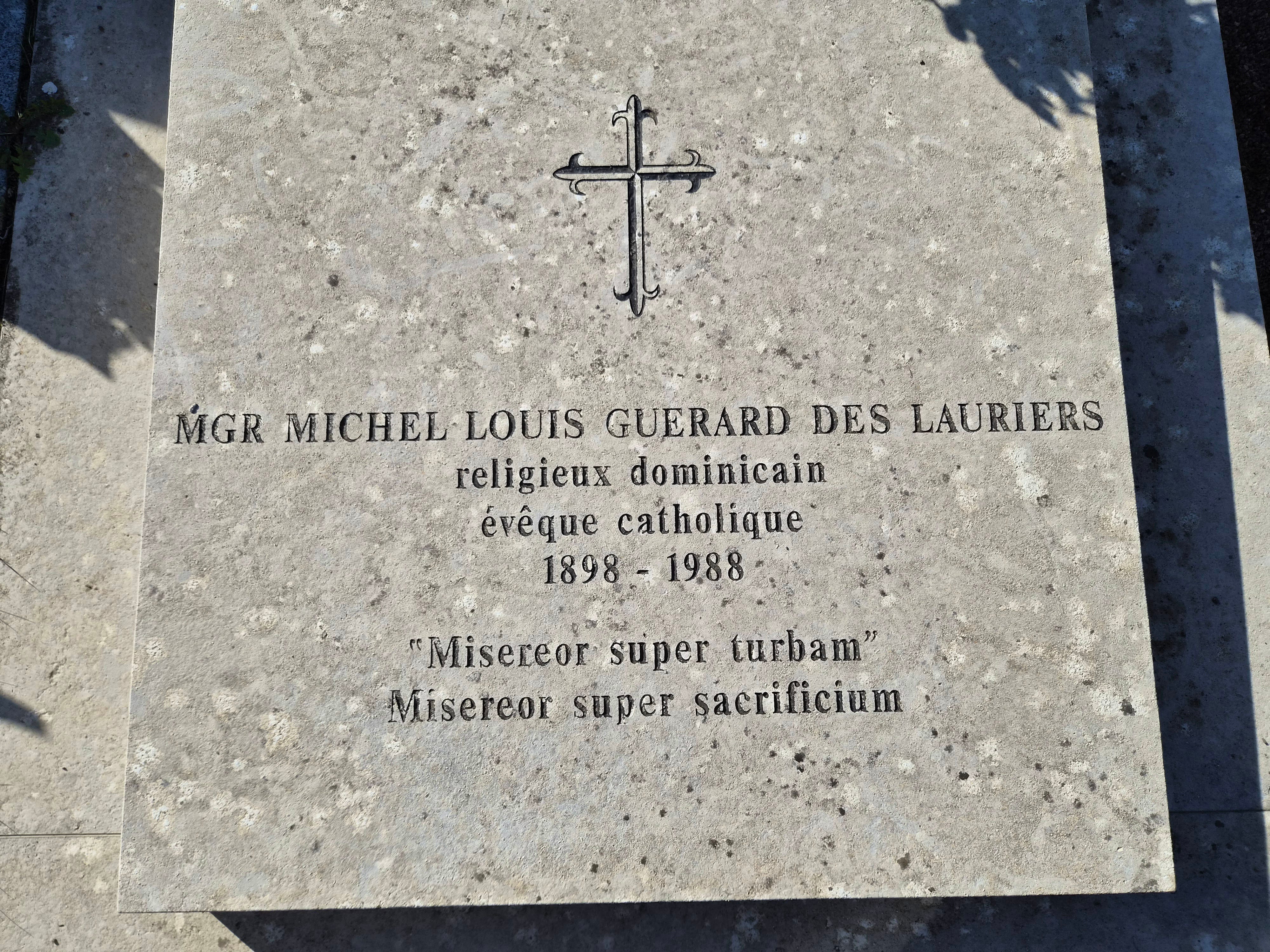
On the occasion of visiting the final resting place of Mgr Guérard des Lauriers, I have something of an ‘announcement’ to make.
Introduction
“Lord, my heart is not exalted: nor are my eyes lofty. Neither have I walked in great matters, nor in wonderful things above me.
“If I was not humble-minded, but exalted my soul: as a child that is weaned is towards his mother, so reward in my soul.”
Ps. 130
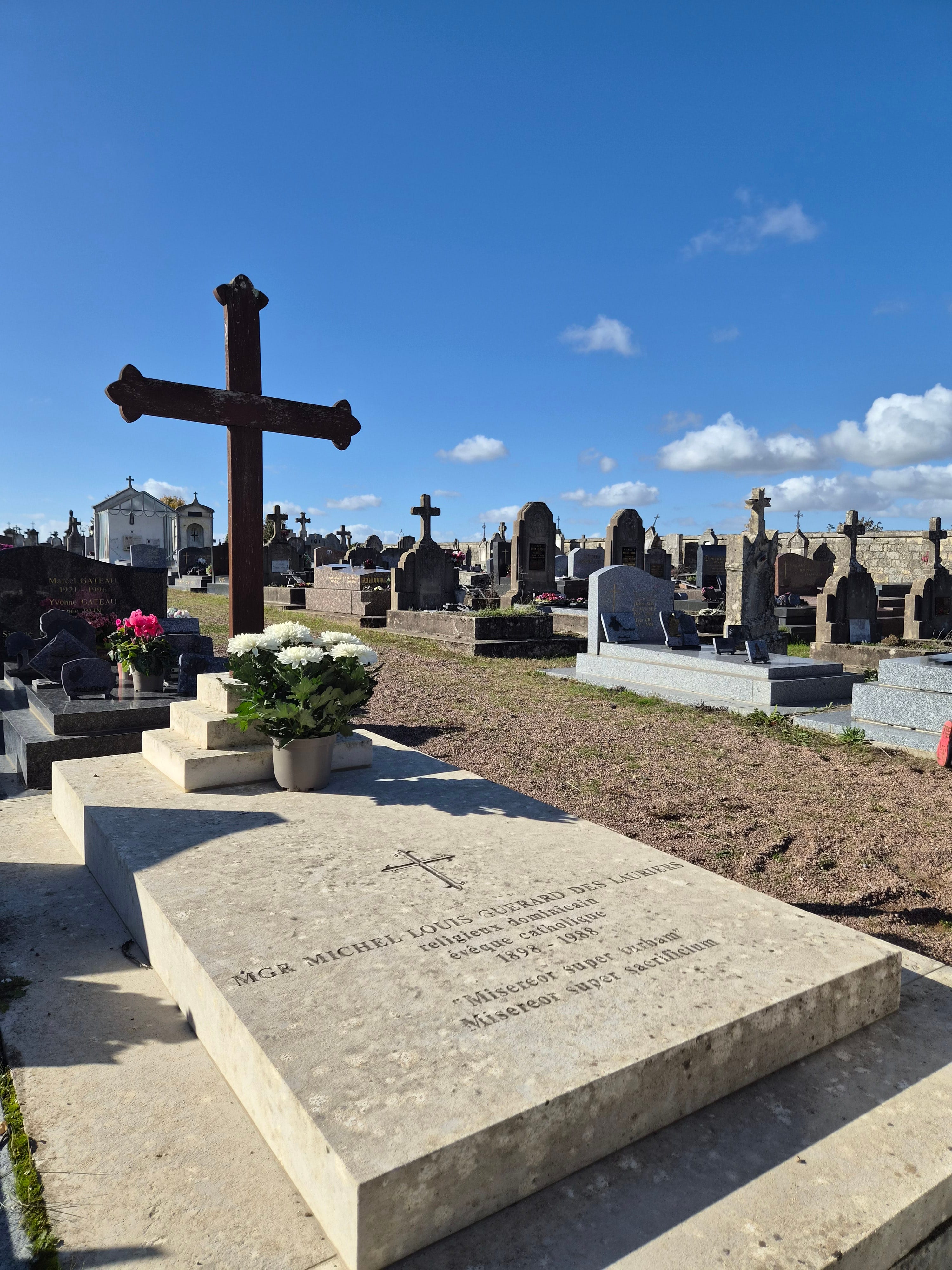
Last week, I and my family were in France, and we took the opportunity to visit the grave of Mgr Guérard des Lauriers in Raveau, Burgundy.1
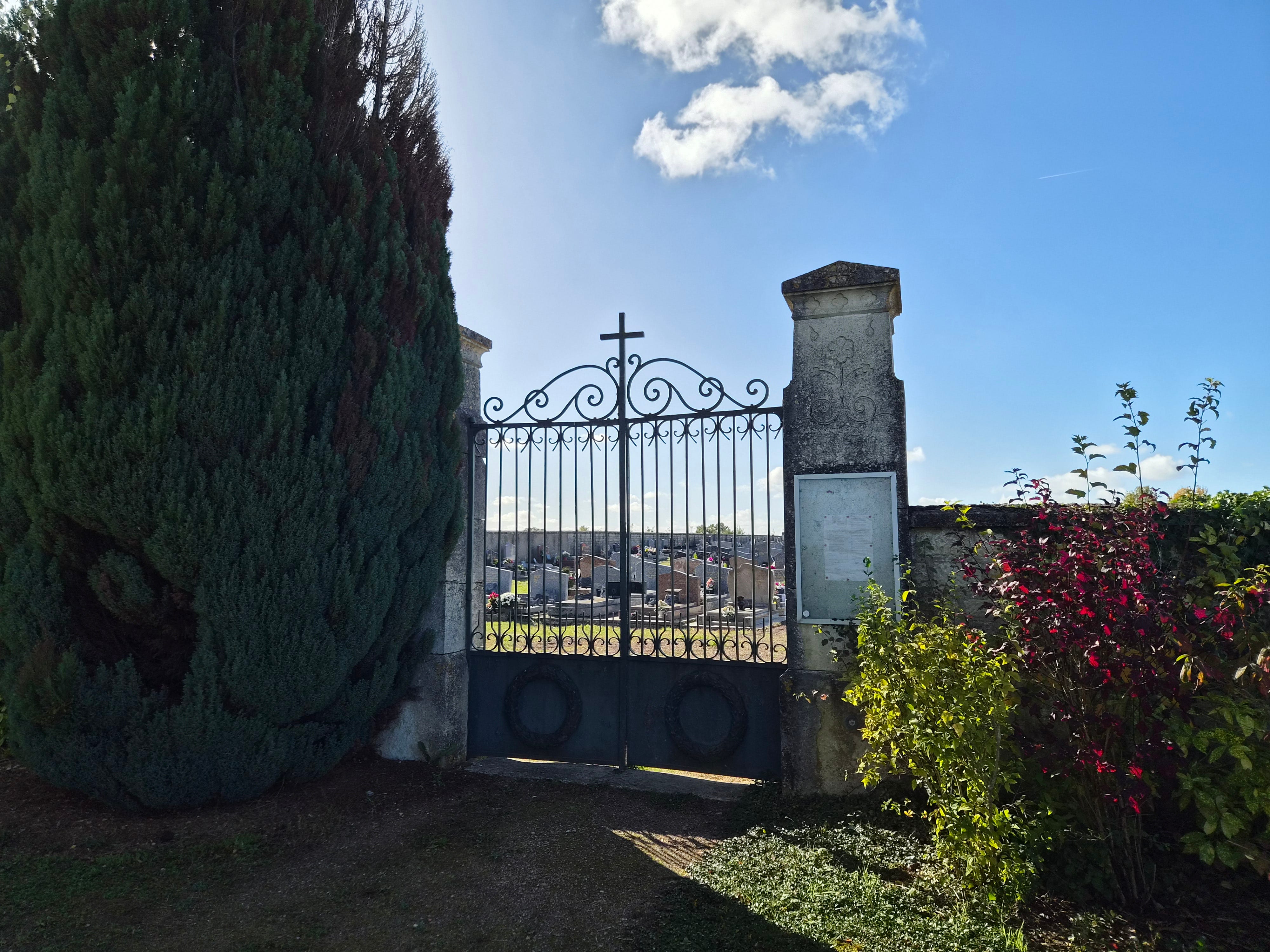
My eldest daughter found the grave quite quickly. It is located quite near the entrance, on the left, right by the “aisle” going through the cemetery.
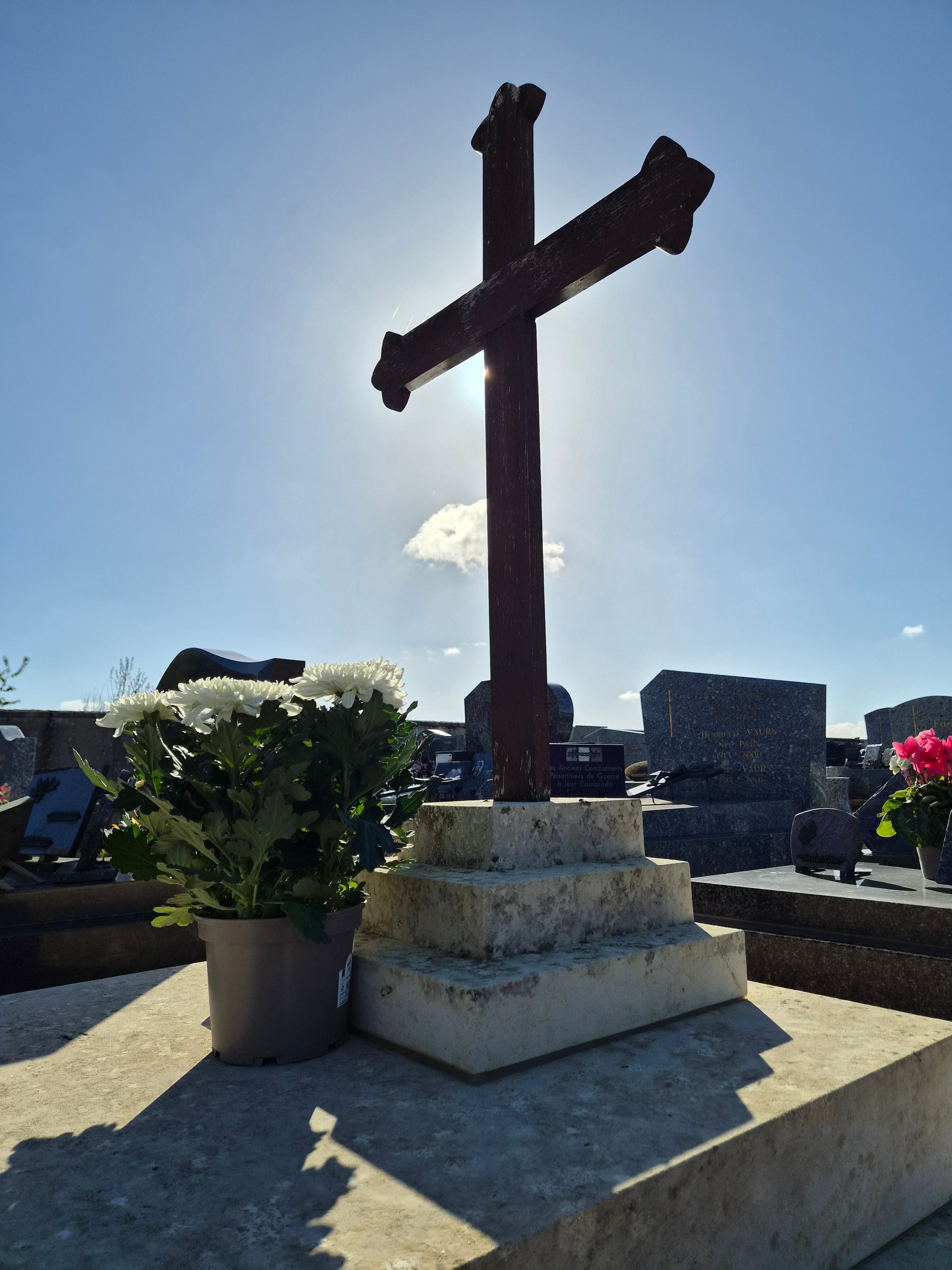
We also visited the house nearby, where he spent the final years of his life.
This large chateau is now operated by the Institute Mater Boni Consilii, and Fr Charbel Madi was kind enough to show us some of the grounds, and the chapel where Mgr Guérard offered Mass.
Before we turn to the subject of this article, let’s recall a few details about Mgr Guérard himself.
Who was Mgr Guérard?
Born on 25 October 1898 near Paris, Mgr Guérard entered the Dominican Order at age twenty-eight after having studied mathematics, eventually earning doctorates in both mathematics and theology. He taught at Saulchoir and the Lateran, contributing to theological debates of the 1950s that preceded Pius XII’s encyclical Humani Generis.
Following the Second Vatican Council, he became known for his opposition to liturgical reforms and the doctrinal deviations of the Council. He authored the critical study of the Novus Ordo Missae in 1969, which led to his removal from the Lateran faculty. He subsequently developed what became known as the “Thesis of Cassiciacum,” a means of explaining the current crisis in the Church and the status of post-conciliar papal claimants. This isolated him from more mainstream traditionalist circles, including Archbishop Lefebvre’s Society of Saint Pius X, where he briefly taught.
In 1981, he was consecrated to the episcopate by Archbishop Ngo Dinh Thuc. He himself passed the episcopate onto Bishop Robert McKenna, as well as Bishops Storck and Munari. Bishops Donald Sanborn (RCI) and Geert Stuyver (IMBC) later received episcopal consecration from Bishop McKenna, as did three others.
Mgr Guérard’s final years were increasingly isolated. However, this period offered him the opportunity to refine his thought and grow in sanctity, if Adrian Loubier’s edifying obituary is to be believed.
The Life of Msgr. Guérard des Lauriers, O.P. by Fr. Giuseppe Murro, I.M.B.C.
What this article is about
Mgr Guérard and his “Thesis of Cassiciacum” have been mentioned in articles on The WM Review on a number of occasions now. These references have been more frequent over the last year or so.
In the past, I have expressed reservations about this “Thesis” on a number of occasions. However, with the help of several priests and fellow laymen, and the reading which they have recommended, I have come to accept that the position I have held for some years is, in substance, the Thesis of Cassiciacum.
Such a conclusion is liable to be misunderstood, and others will strongly disagree with this assessment. In drawing this conclusion, I do not consider myself to have changed my mind or positions on the main points which I have previously argued to be certain. Rather, as I shall explain, I see it as coming to understand my own positions more clearly, and discovering a vocabulary, a set of distinctions and further analyses which I previously lacked.
I have tried to mark clearly where I agree with other advocates of the Thesis, where I still differ, and where I remain “on the fence” for now.
In what follows, my references to the Cahiers de Cassiciacum will, for now, generally be only to the edition in question. In due course I will provide more accurate page references for the French.
Part I
Do I ‘adhere to the Thesis of Cassiciacum’?
What was put to me
In the past year, two persons put the matter to me in the following terms:
“The body of the Thesis is the notion of being Pope materialiter and being Pope formaliter, and that the Apostolic See has been vacant formaliter since at least the close of the Council in 1965. If you accept those points, then in principle you adhere to the Thesis.”
I understand that this minimalist “definition” comes with the sanction of a very close collaborator of Mgr Guérard des Lauriers himself.
It distinguishes the Thesis itself from related arguments that surround it. On this account, it consists of two claims:
The distinction between being Pope materialiter and formaliter, and
The fact that the See has been vacant formaliter since at least the close of the Second Vatican Council.
It is worth being clear about what the first claim means, since it is easily caricatured.
What does materialiter actually mean?
In his account of the Thesis, Abbé Hervé Belmont wrote about the “reification” of the idea of a “Material Pope”. “Reification” refers to the act of transforming an abstract idea into a concrete “thing”:
“[I]t is important to pause a bit at the materialiter/formaliter distinction, as its interpretation has often been hindered by a kind of ‘reification.’
“It is not at all about affirming that there exists a matter of the Pope or a form of the Pope, and that the Popes of Vatican II are a kind of formless pontifical modelling clay, or a key that has not been filed to fit the lock. This is a simplistic reading, affected by those who keep repeating that ‘there is no matter without form’ and that this distinction is therefore nonsensical.”
For these reasons, the term “Pope (or ‘pope’) materialiter” seems to be clearer than “Material Pope”, which is sometimes used by both friends and foes of the Thesis. Certain foes might reject all such terms, on the basis that they imply that there is something “papal” about the men in question; but on such a basis, the terms “papal claimant”, “papal usurper” and “false pope” might also have to be rejected.
What, then, does the idea of someone “being ‘pope’ materialiter” mean? Mgr Guérard put it in the following terms:
“One may consider the Pope materialiter, in saying that the substance – and even the person! – who is the elected of the Conclave, supposed valid, is apt to receive, by his own consent and by the “being with” [être avec] communicated by Christ, the [metaphysically] accidental form which constitutes (or will constitute) him Pope...
“JUST AS, according to St Thomas, one considers materialiter an accidental change, in affirming that such a substance-subject there plays the role of matter (that is, that such a substantial form plays the role of matter), with regard to the accidental form which it is apt to receive.”2
The recent claimants, from Montini to Prevost, may not have been “apt” or “disposed” to receive the authority of the Papacy in the same way that Cardinal Giuseppe Sarto was in the period between his election and his acceptance, but they are still “apt” or “disposed” in a certain sense, and in a way different to all other men.
In what way are they different to all other men? And in what way can they be said to be “apt” or “disposed”? We could point to the following:
These men alone were elected in what have appeared to be conclaves of the Catholic Church
These men alone have been taken to be true Popes by almost the whole world – which could, were it not for the various obstacles to the contrary, be sufficient to constitute a kind of “second election”3
These men alone, or at least as the supposed superiors over their subordinates, physically occupy the buildings and churches of the Catholic Church.
Fr Piergiorgio Coradello IMBC recently put this matter in alternative terms:
“The ‘popes’ in question are ‘popes’ only in appearance, they are not Popes: however they have a title, at the least, a colored one. […]
“In short, even these individuals: A. Luciani, K. Wojtyla, J. Ratzinger, J. M. Bergoglio, R. F. Prevost, are not mere ‘nothings’ in the Church. They have some title to be there – whether true or colored doesn’t matter. Now a title, as we have seen from the beginning of this article, is positioned on the side of the material cause, preparing the basis for a legitimate right, for a legitimate possession; and so, precisely for this reason, the “materialiter-ity” of these individuals cannot be denied. Materialiter describes the ontology of the question, while the “colored title” does so from a canonical point of view.”4
As should be clear, the materialiter does not mean that the occupant has some fraction of papal power, or is partially the Pope, or any such thing. Fr Francesco Ricossa IMBC calls such an idea “an enormity.”5 Abbé Belmont makes the same point, saying:
“[A] Pope materialiter tantum is not Pope; he is devoid of all magisterial and jurisdictional power. From the point of view of authority, he is nothing.
“However, from the point of view of the papacy, he is a nothing, but... although deprived of all that makes a pope a Pope, he ensures a certain continuity on the Apostolic See,6 where he possesses some title, juridical or potential, to be present – which we will examine shortly.”
Elsewhere, Abbé Belmont writes:
“[T]he consistency of materialiter has not remained identical. The materialiter that can be attributed to Francis I (Bergoglio) is quite tenuous: since nothing remains of the juridical order, there is only a public fact (his being-there) which is only a proximate disposition to be recognised by the universal Church in case of a break with the new religion of Vatican II. There is still continuity (which is not without impact on the apostolicity of the Church), but this continuity is a potential continuity.”7
Père Noël Barbara, who had previously been (violently) opposed to the Thesis, went on to adopt Mgr Guérard’s explanation – and he too offered a more “minimalist” view of the Thesis and the materialiter which it posits. Speaking (one hopes) of the public sin of heresy, he wrote in his final edition of Fortes in Fide:
“For the Pope, as for simple priests, even the gravest of sins do not force him out of the Church or in any way impede his ministry. However, if he sins against the faith, he departs from the Church just like any other heretic. If he is separated from the Mystical Body of Christ, if he is not any longer a member of this Body, it is impossible that he should be the head of this Body.
“Because of his sin he is separated from Christ and as a result Christ withdraws His Authority and His assistance from him. From this point forth the only aspect of the papacy that said individual retains is the fact that he occupies the Holy See. He does this until the Church declares that he has fallen from his high estate.” (Vol. 3.12)
The fact that Père Barbara argued that such a one ceases to be Pope because of his heresy, but that he retains something materialiter until he is physically or authoritatively removed, points to another consideration.
According to the minimalist definition of the Thesis provided, it seems that exactly how a man came to be “pope” materialiter – both in terms of how he came to be disposed (i.e., was the election valid, or is it simply because he is “there” de facto?), and why he remains merely disposed (i.e., a lack of the objective intention, or some other reason) – is a secondary question, downstream of the central propositions. The same seems to apply to the various other matters associated with the Thesis – how the papal claimants might acquire authority, the status of modern cardinals and bishops, the nature of the Conciliar Church – these are developments, adjuncts, or interpretations of the Thesis.
In short, the person who is “pope” materialiter is the one who, like all others, is not the Pope, but unlike all others, is disposed to become Pope if certain conditions are fulfilled (or removed).
But this is what I have held, believed and argued for years – such as in the article I published prior to the May 2025 conclave, Fake conclave, true pope? – even if I may have placed more emphasis on the role of “universal peaceful adherence” and the “second election” in this piece.
Thus, if this is how the Thesis is to be defined, then I hold the Thesis.
I am content to say, with the terms understood as above, and with some of the distinctions and vocabulary provided by the Thesis, that the See is vacant formaliter, whilst continuing to be occupied materialiter.
How I came to this conclusion
Fr Reid Hennick, formerly of the Society of St Pius X and now of the Roman Catholic Institute – which adheres to the Thesis – has been a personal friend for several years. Following his departure and during his “sabbatical”, Fr Hennick had been reading Mgr Guérard directly – particularly the Cahiers de Cassiciacum. He later informed me of his intentions with the RCI, and strongly encouraged me to read the Cahiers – describing them as “some of the best writings on the crisis”, even if one did not accept the Thesis.
I had attempted to read the Cahiers several years before in French, but for various reasons had not been able to give them my full attention. Upon this reading, however, I was struck by the number of occasions at which I came upon passages that expressed, in much more lucid and competent terms, certain under-appreciated topics which I had been struggling to address. For example, I could point to his account of what I have previously called the “epistemology of the crisis” in the first volume (which I addressed here), his explanation of how Paul VI’s lack of authority may be passed to his successors (which I addressed here), or his explanation of the effect of schism on the theological virtue in the third and fourth volumes (which I had addressed here). In each case, I discovered that Mgr Guérard had already arrived before me.8
I also became convinced of his account of the nature of ecclesiastical authority, and its relation to Christ’s promise that “to be with” (être avec) St Peter.9
Around the same time, I started to read accounts of Mgr Guérard’s life, which I found impressive and edifying.
Prior to all this, Fr Aedan Gilchrist RCI had been telling me for a long time that the various positions for which I advocated were compatible with the Thesis, and indeed that my overall position basically was the Thesis. I found this interesting, and while I was not convinced, I continued the conversation with Fr Gilchrist for several months – continuing to read what he recommended and pursuing my own studies at the same time.
Eventually – prompted to think more about it, by a conversation with His Excellency Bishop Donald Sanborn, and after resolving the objections I am about to discuss – I came to the conclusions discussed above.
Part II
Objections and Responses
I have already mentioned the “minimalist” account presented by Père Barbara and others, which seemed more acceptable to me than other presentations.
But while I found some of these explanations interesting and increasingly compelling – above all, Mgr Guérard’s own writings – I was still not persuaded, for the following reasons.
1. The Fifth Opinion. The Thesis seemed to entail setting aside adherence to St Robert Bellarmine’s Fifth Opinion, or distorting its meaning: that a manifest heretic either ceases ipso facto to be Pope, or cannot attain office in the first place. Several advocates of the Thesis argued against the certainty of this Fifth Opinion (often in favour of the Fourth Opinion – that such a one should be deposed). But, as Bellarmine said, this opinion is “true”, and based on principles which are “most certain”. Others claimed that it did not really mean what we thought it did, due to certain comments Bellarmine made elsewhere (particularly about declarations).
2. Necessity of a declaration. Related to the former, the Thesis seemed to be premised on the idea that someone remains a Catholic and member of the Church unless and until he is removed by authority. But this seemed contrary to the standard account of the matter in theologians – as well as the connected fact that notoriety in canon law is attained not just by something being notorious in law but also notorious in fact (can. 2197). This points to another general theme, which is that the Thesis seemed to be premised on a need for declarations and certain “legal” eventualities in a way that was not justified (e.g., the requirements for a “public defection from the faith” to be fulfilled, in can. 188.4.)
3. The validity of the elections. The Thesis seemed to be premised on the idea that the conclave was valid, and those whom they elected were eligible – but, at best, this seemed far from certain. It also seemed to be premised on the possibility that an election that is neither accepted nor rejected continues to “hang” in the ether – as if a perduring non-acceptance did not result, after a certain amount of time (this being in the nature of things, and merely regulated in most cases by canon law) in a true rejection of the election.
4. The unity of the Church. The Thesis seemed to me to compromise the unity of the Church, by the insistence of many of its advocates that there was no “new Church”, and the apparent need to posit the existence of more than one religion in the same Church. But if a body lacks a property which is necessary to the Church, then it cannot be the Church. But the body of men commonly called the “Conciliar Church” (or “Conciliar/Synodal Church”) does lack such properties, principally unity. Therefore, it cannot be the Church.
5. Perpetuity of the hierarchy. The Thesis seemed to be premised on the universal defection of the hierarchy, and presented as a solution to this supposed reality. This seemed to entail denying the perpetuity of the hierarchy and an essential property of the Church.
6. The necessity of the Thesis. The Thesis also seemed to be unnecessary in various respects, and to posit an elaborate structure to reach conclusions that could be reached more simply. For example: it was not clear to me that positing a material succession (whether to the Holy See, or to the other diocesan sees) was necessary for the continuity of apostolic succession – or that it could be sufficient for this purpose (such being the case for the Eastern Orthodox or Anglican sects). Similarly, it did not seem clear to me that such an explanation was necessary or capable of explaining how a new Pope could be attained. It was also not clear to me that metaphysical certitude, or the certitude of faith, are necessary for one to conclude with certainty that the Holy See is vacant, or that arguments which might give someone personal certainty were not sufficient.
The objections based on membership (and Bellarmine’s Fifth Opinion) and the unity of the Church weighed most.
No single argument removed these difficulties. Rather, I came across a number of authors or persons who, in different ways, showed how the various points I have mentioned could be held together with the substance of the Thesis. I have come to see that my understanding of the Thesis was incomplete: some of the objections being points expressed by Mgr Guérard himself, and others being opposed merely to interpretations or presentations of the Thesis, rather than the Thesis itself. These resolutions are detailed below.
The effect was cumulative. I found that I did not have to choose between the Thesis and what I already understood to be true. Instead, with particular interpretations placed in the proper context, and with some of my own misconceptions set aside, the Thesis gave a framework into which these points fitted, and allowed me to account for them with greater precision than before.
How the objections are resolved
(Obj. 1–2) The Fifth Opinion and related matters
The resolution of the problems around the compatibility of the Thesis with the Fifth Opinion was probably the final piece in the puzzle. That solution was given to me by Fr Gilchrist, for which I am grateful.
I still hold the Fifth Opinion to be certain: a manifest heretic is not, and cannot become, the head of the Church, and no sentence is needed to bring this about. This is because of the radical incompatibility of public heresy with membership of the Church, with this membership being necessary to hold office.
Not every adherent of the Thesis would put it so. Many argue that the Thesis does not depend on the theological opinions about a heretical Pope, which Abbé Belmont calls “only permitted theses” not taken up by the Church.
Indeed Mgr Guérard stated on several occasions that one neither should nor could assert with due certainty that at least Paul VI was “personally heretical.”10 He also seems to have implied that his Thesis would no longer apply if the “popes” were shown to have lost office due to not being members of the Church.11 I understand that the late bishop also wrote a paper specifically on the question which has never been published.
But with all due respect, I think that his analysis still retains value even if Bellarmine’s Fifth Opinion is taken to apply. While I recognise that the Thesis does not depend on arguments about the Pope Heretic thesis, as Abbé Belmont put it, I do not believe that it excludes it. Nor does a need for a declaration conflict with the Fifth Opinion, depending on how the role of this declaration is understood, and what is meant by “loss of office”.
As the Pope has no superior on earth, the admonitions of which the authors speak cannot be acts of authority over him. However, the authors do acknowledge the role of a merely declaratory sentence in making the vacancy a public fact, and allowing the Church to proceed to a new election. For instance, the Wernz-Vidal commentary reads:
“Thus, it must be said that a heretical Roman Pontiff loses his power ipso facto. However, a declaratory sentence of the crime, which as merely declaratory should not be rejected, does not have the effect that the heretical Pope is judged, but rather is shown to have already been judged, i.e., the General Council declares the fact of the crime by which the Pope, through heresy, has separated himself from the Church and deprived himself of his dignity.”12
In the intervening period between the loss of office (or non-attainment of office) due to public heresy and such a declaration, what is the status of the former or putative “pope”? It seems that his status conforms to what was described above as the pope materialiter. He is not the Pope, not even partially, but he retains a physical occupation and a relationship with the papacy different to every other person. What he has lost is the papacy formaliter, and it is for the Church to remove that “material” relationship that remains. (One could say that he has already ceased to be Pope de jure, but remains “in office”, in this merely physical way, de facto – although I understand certain advocates of the Thesis would reverse those descriptions).
Canon 188.4 and tacit renunciation
We see this reality appear in canons 188.4 and 151. Here they are:
“Can. 188. Any office becomes vacant upon the fact and without any declaration by tacit resignation recognized by the law itself if a cleric […] § 4. Publicly defects from the Catholic faith.
“Can. 151. An office that is vacant by law but that perchance is still held by another illegitimately can be conferred provided that, duly according to the sacred canons, this possession is declared not to be legitimate and that mention of this declaration is made in the letter of conferral.”
In other words, one canon tells us that the office is vacant; the other tells us that the office vacant in law but held in fact (illegitimately) must be “emptied” by the Church before it can be filled. In so far as the principle behind can. 188.4 is applicable to a Pope or a papal claimant, so also is can. 151. Even if these canons are understood as not applying to the Roman Pontiff directly, they do give an indication of the mind of the Church.
Fr Coradello addresses this particular issue in the article below:
For these reasons, I continue to hold the position I have previously advocated, which is that the “public defection from the faith” mentioned does not require warnings, a condemnation, or for a person to join a sect, and that the tacit renunciation of office which is attached to the act is “in the nature of things”, rather than a penalty. These points are explained in detail by Mgr Gerald V. McDevitt below:
Further, I continue to acknowledge that can. 188.4 refers to public defection from the faith, rather than notorious; and I continue to recognise that can. 2197 states the following regarding the degrees of publicity:
Can. 2197: A delict is:
Public, if it is already known or is in such circumstances that it can be and must be prudently judged that it will easily become known;
Notorious by notoriety of law, [if it is] after a sentence by a competent judge that renders the matter an adjudicated thing, or after confession by the offender made in court in accord with Canon 1750;
Notorious by notoriety of fact, if it is publicly known and was committed under such circumstances that no clever evasion is possible and no legal opinion could excuse [the act];
Occult, if it is not public; materially occult, if the delict is hidden; formally occult, if imputability [is not known].
In addition to the definition of the term “public”, we can also note that the canon states that notoriety is established both by notoriety of law and by notoriety of fact. In other words, something may be notorious without a sentence or a confession made in accordance with can. 1750.
This particular issue was addressed in the following places:
The human mind’s ability to apprehend reality without the intervention of authority
What does it mean for something to be “public” or “notorious”?
Membership, and the need for declarations
As stated in the objection, I had supposed that the Thesis required one to hold that the papal claimants – and indeed, everyone who claims to be a Catholic – remain members of the Church until the contrary is declared by authority. Such a proposition has implications both for our understanding of the status of the papal claimants, and for the unity of the Church.
While both Mgr Guérard and several advocates of the Thesis have advocated for such a proposition, Mgr Guérard also made other comments which must be considered.
For example, his article The Church Militant in the Time of Bishop Wojtyła (Bulletin de l’Occident chrétien no. 101) advances the thesis that one cannot have moral certainty about the membership of any individual person who professes to recognise Paul VI and his successors as true Popes. Regarding the papal claimants, he stated specifically of John Paul II:
“It is therefore very precisely in so far as he occupies the Apostolic See, that is to say, in so far as he is Pope ‘materialiter,’ that W. finds himself excluded from present membership of the Church Militant, and therefore cannot be Pope ‘formaliter.’”
Regarding the problem the proposition poses for the unity of the Church, we can note that the general thesis of the article mentioned shows that he recognised that one may cease to be a member of the Church prior to a declaration, with his position being one of nescience rather than insistence that the person remained a member.
As such, my position remains the same as that I have previously articulated: I agree with Mgr Guérard’s “nescience” as a general principle (i.e. with regard to all self-identifying Catholics), but I do believe that one may attain moral certitude in practice (i.e., with regard to particular self-identifying Catholics). In other words, actual knowledge may allow one to attain moral certainty of a particular person’s membership or non-membership of the Church. Such certainty, however, does not amount to making a judgement or a declaration in any authoritative sense: it amounts to private knowledge, sufficient for one to act within one’s own sphere.
Further to the topic of membership, I had already made use of Abbé Bernard Lucien’s treatment as a means of explaining how and why non-“sedevacantists” can continue to be recognised as members of the Catholic Church. That explanation is found in the “Clarification” below:
(Obj. 3) – The validity of the conclaves
I have long held, as an opinion (and not as a certainty), that the post-conciliar conclaves are invalid. Most advocates of the Thesis hold that they are valid, for a few different reasons, although there are some different positions on the matter.
On the side of the electors, Bishop Donald Sanborn has previously argued that there is a distinction between the power to elect and the power of jurisdiction. Although I understand that he has adopted a different explanation, it was recently proposed again by Fr Coradello.13 The same priest has also argued that the post-conciliar cardinals hold at least a coloured title, and that Christ may supply what is needed for an election.
On the other hand, Abbé Belmont holds that the creation of cardinals is an act of the very jurisdiction that is absent, so that by the election of Francis “there were none left” of the true cardinals. This is why he contrasts the “public fact” of the latter’s position with the “juridical fact” of Paul VI’s – and why he says “the consistency of the materialiter has not remained identical.”
Mgr Guérard himself implied that the validity of a conclave depends on the presence of papally-appointed cardinals, when he described John Paul II as “regularly elected [I grant this until certain proof of the contrary], by a conclave that included some ten authentic cardinals [who did not protest].”14 Today, none of the cardinals were appointed by an undoubted Pope.
Mgr Guérard also recognised the possibility that the post-conciliar conclaves were invalid or defective. In the first of the Cahiers, he considers the possibility that Paul VI was never Pope at all, and states explicitly that the validity of his election is an “open question”. However, he also argues in the same place, and on several occasions, that God may supply what is lacking to an inherently invalid conclave under certain circumstances.15
Further, Fr Ricossa writes:
“Mgr Guérard des Lauriers always maintains that even if one were to demonstrate that the election of the Conclave was invalid (due to an obex affecting the electors or the elect), this elect would still be ‘at least provisionally “pope” materialiter’, until the physical or moral person empowered to do so in the Church declares the nullity of this election.”
Naturally, it would be a mistake to focus on the words “provisionally ‘pope’” without also noticing the further qualifier materialiter; which is to say that even this “provisionally ‘pope’ materialiter’ is still not the Pope.
Fr Ricossa’s comments bring us to the possible invalidity on the side of the elect, on which I maintain my former position: that public heretics (and schismatics and apostates) are not eligible to be elected, as they are non-Catholics. However, for the reasons discussed above, I admit that a non-Catholic illegitimately and even invalidly elected to the papacy is in a position different to everybody else, in that he too has a putative (and invalid) title to the papacy. Theologians have discussed the comparable matter of ineligible persons being elected to the papacy.16
By contrast, a female would not have a putative title, because while there may be debates (even if contrived) over whether or not a given public heretic is indeed such, and what this means for his claim to the papacy, there can be no such debates about a female.
For these reasons, and those discussed in relation to the materialiter, I do not think it is necessary to take a position on the validity or invalidity of the conclave – neither on the side of the electors nor the elect. What matters is that a set of facts give rise to a title, even if such a title be only a putative one. While Fr Coradello considers the papal claimants to have had a coloured title, he defines a putative title as follows:
“A Putative title. In this case, while there was no grant, there is some reason that leads one to suppose the contrary. There is a presumption that some title exists: but yet in reality there is no real title! This pure presumption, which must be reasonable, and widespread (common), comes to constitute a title, called ‘putative.’”17
How long the designation of an election endures
The Thesis is premised on the enduring designation of the “Pope materialiter”, and this is normally explained by the fact that each claimant has failed to accept the office.
Canon 175, in the section on elections, states the following:
“The election should be communicated quickly to the one elected, who must within at [most] eight useful days from the reception of the information make known whether he consents to the election or whether he refuses it; otherwise he loses all rights acquired from the election.”
Previously, I had considered that this canon indicated and managed something in the nature of things: namely, that an election cannot simply “hang” indefinitely, and that a failure to accept can and should, at some point, be construed as a refusal.
However, Abbé Damien Dutertre raises the following counter example:
“Pope Victor III was elected in 1086, but strongly refused to accept it. The Cardinals and the Roman populace tried to force him into accepting the papacy, and actually made him pontiff by force, until he was able to flee from Rome, after having deposed his pontifical insignia. He returned only one year later, in 1087, convinced at last to accept the papacy, at the sight of so many prayers and tears. This fact is presented by Passerini when discussing the necessity of the consent of the person elected.”18
Further, he presented a text from Bonacina that indicated that, in this interim period, one should indeed consider the elect in a different position to other men:
“Secondly, it does not follow that the Apostolic See is simply (simpliciter) vacant while the election has been made by the Cardinals and the person elected has not yet given his consent, as when the person elected is an absent Cardinal (as happened to Adrian VI who was in Spain in 1521), for even though the election has not yet achieved its full effect and the Apostolic See is not yet said to be occupied, for as long as the consent of the person elected has not followed; but the Apostolic See is not vacant on account of this, because the See is said to be vacant when it does not have a Pontiff in any way, but in our case it does have a Pontiff in a certain way, since a pope has already been elected, and even though he has not yet been created, he nevertheless has been as though conceived and exists, so to speak, in the womb.”19
In my comments on Abbé Belmont’s article, however, I made the following objection:
“I do concede that if these non-popes were to ‘accept the election’ in the relevant sense, then it is possible that he would accede to the office – but by other means (by some form of acclamation, and/or peaceful and universal adherence), and not by virtue of an unaccepted election.”20
But this objection is answered by the definition of materialiter and previous discussions already given. Even if we were to say a) that the election was in itself invalid, or b) that it had lapsed due to lack of acceptance, the materialiter would have remained, and is what would have given those alternative means of accession their force.
(Obj. 4) The unity of the Church, and the non-identity of the Conciliar/Synodal Church and the Catholic Church
The claim that one must accept the Conciliar/Synodal Church as the Catholic Church – and that it contains more than one religion – was, for me, one of the most insuperable problems with the Thesis.
On the contrary, I have long argued a) that the “Conciliar/Synodal Church” is not the Catholic Church; it is not, however, a sect, but rather an accidental aggregation of men of different religions and “faiths”; and b) that this division in faith is itself proof that the body in question is not the Catholic Church. This was one line of argument in my long “book” Zero Marks:
However, once again, I discovered that Mgr Guérard had already made the same point decades earlier. In his article The Wojtyłan Dictatorship, he sharply criticised men such as Archbishop Marcel Lefebvre, Abbé Georges de Nantes and Dom Gérard Calvet for adopting ideas that entailed such a multiplicity of religions in the Church. He called this a “false and subversive principle”, and wrote:
“When Archbishop Lefebvre, in his letter to the ‘pope’ dated 24 December 1978, asks that there be the Mass and the said ‘new mass,’ on an equal footing, under the control of the local bishop, this amounts to asking, and therefore to admitting, that there be two religions in the same Church. […]
“The Church thus becomes a sort of cage for religion. There is first the religion of Wojtyła, which is supposed to guarantee continuity with the past, and thus authenticity. And then, in this same cage, which would be the Church – Christian, because it is Wojtyłan – there is, according to each person’s choice, a second religion: for some, that of Écône and the “priories”; for others, that of St-Parres and the CRC; for others still, that of Le Barroux and of ‘beauty.’
“And it is this second religion – extremely anxious to secure for itself, AT ANY PRICE, the most solid foundations for the near future – which is ipso facto [!] the only one to possess the promises of eternal life.
“Now, to profess such a doctrine in act presupposes that one admits as valid, in the very bosom of the Church, a principle of peaceful coexistence! […]
“Two religions, whose radical divergence makes it impossible for them to be WITH one another, and which nevertheless are in the same ‘Church,’ because they are supposed to be FOR the same God.
“This doctrine – professed and lived, imposed and spread, by the “priories” and by the CRC, by “Le Barroux” and by Itinéraires – this doctrine is practically the negation of the Church, of the Mystical Body of Jesus Christ, of that Church whose unity is catholic [kath’holon: unity of an organic whole] by NATURE, whose ordered splendour excludes all duality.
“Will the satanically skilful remarks of “Cardinal” Ratzinger make all the ‘shamefaced’ Wojtyłans – but Wojtyłans all the same! – understand that, by claiming to be in a Church where there would in reality be two religions, they are CERTAINLY outside the Church of Jesus Christ; and that, if they wish to be IN the Church of Jesus Christ, they must say NO in words and in deeds, to the Wojtyłan dictatorship.”
Thus fell away another of the chief objections to the Thesis.
(Obj. 5) The perpetuity of the hierarchy
Most advocates of the Thesis consider it to be an established fact that the hierarchy of the Church no longer exists in act, and present the Thesis as a solution to this problem. Implicit in this is the proposition that the hierarchy of the Church can cease to exist in act.
However, in his declaration – published in 1983, and recently cited by Fr Piergiorgio Coradello in The Way We Sit – Mgr Guérard spoke of attempts to “sound the tocsin” of alarm with putative diocesan bishops:
“May God make resound the melody so carefully prepared by Fr. de Blignières in the ears of some residential bishop… imprisoned, or delayed, or retarded… sufficiently conditioned so that this bishop may not yet have been able to posit the human act which alone would change into sin the at least tacit acquiescence to the ‘sessio-W.’ All hope is not lost.
“And this simple glimmer absolutely forbids envisaging, even as a simple eventuality, the reconstitution of a pseudo-sessio from Bishops who have no ordinary jurisdiction [though they do have jurisdiction per modum actus, by virtue of the MISSIO, to validly confect whatever Sacrament it may be, in favour of whatever faithful it may be].”21
In other words, he recognised the possibility that legitimate members of the hierarchy remained.
Although the situation has changed since then, in that there are no reigning ordinaries appointed by true Popes, such a comment shows that the Thesis does not exclude the continuity of the hierarchy in act. Thus a further objection falls away.
For my part, I remain of the opinion that the hierarchy continues in act, and that there may be means by which men may legitimately attain office even under our current circumstances. However, I recognise the force of arguments attempting to prove that, under our circumstances, an absence of actual living successors of the Apostles may constitute only a per accidens interruption in the moral continuity of this hierarchy.
This is the one point on which my views have somewhat shifted, as I expressed in April of this year. I had previously written:
“[A] merely material succession is no succession in the relevant sense, just as a mere potential to reclaim jurisdiction is not jurisdiction itself. The continuing existence of the hierarchy is not safeguarded by saying that it can cease to exist in act whilst lapsing into mere potency.”
I now find it hard to dismiss the fact that the succession of the Conciliar/Synodal officers took place at least apparently according to law, resulting in at least putative titles to the various Sees – and that under our circumstances, this has a significance which is distinct from the merely material succession of the Anglicans or the Eastern Orthodox. The “material succession” of Paul VI and his successors has indeed been similar to that of those other groups, but not identical – not least because their succession has been to the indefectible Roman See, while Canterbury and Constantinople have been cut off legally.
This is addressed in the updated version of the following article:
(6) Whether the Thesis is necessary
My reasons for writing this article, and for concluding that my views have already substantially been those of the Thesis, have been because I think that the points stated are true. For example, I think that the account of authority given by Mgr Guérard, and in a more popular form by Abbé Bernard Lucien, is correct; I also think that it is correct to say that Paul VI and his successors have been “popes” materialiter, in the sense defined above.
However, the Thesis of Cassiciacum is sometimes presented as being necessary as a solution to other problems – such as that of the Apostolicity of the Church. About this, I am less sure. For example, I think that the materialiter occupation of the Holy See is a fact, but at present I am not convinced that this kind of occupation is so necessary that the Holy See would have defected, if it had not continued. The same seems to apply to the succession materialiter to diocesan sees, with the caveats made above and elsewhere.
I think that the Thesis provides an explanation as to how the Church may attain a new Pope, and that given the occupation materialiter certain means are not available; nonetheless, I continue to recognise that other means might be available under different circumstances.
I also do not yet agree with some of the sharp distinctions made by writers such as Abbé Lucien between the Thesis and “totalism” (a term I have never accepted for myself) – as if the latter based its conclusion of the vacancy wholly on arguments from heresy and membership, to the exclusion of arguments from indefectibility, and so on. Various forms of “deductive”22 and “inductive”23 arguments have indeed been used by so-called “totalists” to demonstrate the absence of Authority.
Nor am I yet convinced that metaphysical or infallible certitude is necessary to conclude that the See is vacant, or that arguments which give personal certainty are insufficient for private persons (as if the only arguments that could have value for private persons are ones which could compel the community). On the contrary, moral certainty of the vacancy seems to me to be sufficient for this. I further note that Mgr Guérard himself presented his “inductive argument” as achieving moral certainty:
“Well-conducted inductive reasoning thus produces certainty in the intellect.
“However, it must be noted that the epistemological quality of the certainty attained by induction depends on the domain of reality in which this type of reasoning is applied. […] Let us limit ourselves to observing that our object here is human action. Consequently, the certainty we must expect from the induction we are undertaking is that which is commonly considered sufficient in the order of human action. It is usually designated as ‘moral certainty.’”24
Given that the “inductive argument” is, in a certain sense, the heart of the Thesis, it seems reasonable to say that Mgr Guérard is thereby qualifying the Thesis of Cassiciacum itself as morally certain. This is, I have been informed, how his sometime collaborator Fr Louis Marie de Blignières understood the matter.
In brief, I am not enthusiastic about arguments that treat the Thesis as a necessary solution to problems, principally because I do not think the arguments to that effect are conclusive. Some of these problems may also be solved in different ways – even if only under different circumstances. The reason for concluding that I “adhere to the Thesis” is because I think that the Thesis, as defined above, is correct.
Part III
Final Considerations
Some final points on the following related topics:
The value of the Thesis of Cassiciacum. I said in the previous section that I am not enthusiastic about arguments that treat the Thesis as a necessary solution. This is because the primary consideration is truth rather than utility. However, I cannot deny that I have come to appreciate the “uses” of the Thesis and Mgr Guérard’s writings. Its principal “use”, to my mind, is supplying greater precision in the expression of various points, and a greater insight into their significance. I have already mentioned the sensation of completing challenging work, and finding that Mgr Guérard had already covered the same ground, and in a more comprehensive way. It provides a framework and terminology for expressing the status of the post-conciliar claimants, recognising that “they are not nothing”, and explaining how this is so.
“The inductive argument”. I continue to prefer arguments for our current situation based on what Mgr Guérard called the “deductive arguments”, as has been the case for many years. After such arguments, I continue to prefer those based on the Fifth Opinion of St Robert Bellarmine, and (as stated) I do not believe that they nullify the Thesis. However, I do believe the “inductive argument” of Mgr Guérard is sound, useful, and attains moral certainty.
The term “sedevacantism”. Some adherents of the Thesis eschew the term “sedevacantism”. I already expressed my dislike of this term, and agree with Père Barbara on the topic:
“Some have cleverly invented the term ‘sedevacantist’ and apply it to us in a derogatory sense; but we are no more ‘sedevacantists’ than we are ‘traditionalists’. We are Catholics, and it is precisely for that reason that we must insist so strongly on the urgent need to submit to the magisterium of the popes and of the councils.”25
Another veteran priest, Abbé Guépin, also wrote:
“Stop calling us ‘sedevacantists’ in the manner of journalists who used the qualifier ‘integristes.’ We are simply faithful Catholics, consistent in the present combat, and refusing all compromise with the Modernists – especially with their chief, JP2.”
However, for the same reasons expressed, I do not intend to adopt the similarly ugly and misleading term of “sedeprivationism” either.
My co-editor. My co-editor, Matthew McCusker, has his own views on various topics discussed at The WM Review. This article pertains to my understanding of my own views. It does not presume to commit him to the Thesis of Cassiciacum.
Part IV
Conclusion
In this article I have explained why I have concluded that the views I have held for years are, in substance, the Thesis – or at least compatible with it. These include the unique position held by each of the papal claimants since Vatican II, dating at least to the close of the Council. I have not given up the Fifth Opinion of St Robert Bellarmine, my reading of canon 188.4, my understanding of the unity of the Church, or the non-identity between the Catholic Church and the Conciliar/Synodal Church – although on the significance of a material succession, my view has somewhat shifted.
In reading Mgr Guérard, I did not find an incomprehensible dreamer, as portrayed in the article “Concerning a sedevacantist thesis”26 (recently promoted by Eric Sammons27) – nor did I find that understanding the Cahiers required knowledge of Biblical Hebrew, as I had been told as a younger man. His works require effort: but so does understanding the “codified common sense” of St Thomas. On the contrary, I found myself returning to the address of Bishop Robert McKenna, given immediately after his consecration by Mgr Guérard in 1986:
“In [Mgr Guérard], we find one of the Founding Fathers of the traditional resistance against the revolution! It is already surprising that priests with lesser competence hasten so boldly to challenge him, but that laity also act in this way exceeds all bounds!
“If one is inclined to let oneself be guided by the weight of authority alone in this dark night of the Church, where – I ask – will one find a traditional priest more qualified than him, by reason of his age, his high competence and academic experience, than Mgr Guérard des Lauriers?”
Some readers of The WM Review have previously expressed strong opposition to the Thesis of Cassiciacum, and they may be dismayed by this article. I would ask them to consider that if they agreed with the positions advocated at The WM Review prior to reading this article, then either a) they themselves are not as opposed to the Thesis as they may have believed; or b) I am mistaken, as a matter of fact, in concluding that these positions are substantially those of the Thesis, or compatible with it. In either case, there is no need for any serious disagreement between us.
On the other hand, if such persons already disagreed with the positions advocated here, then they now have an extra title under which to disagree.
In the meantime, I am grateful to the authors on whose work I have leaned, and to the clergy and laymen who took the trouble to help me – including His Excellency Bishop Donald Sanborn and Mr Stephen Heiner, who pushed me to think seriously about this matter.
If I have misrepresented any of the men mentioned, I would be grateful to be corrected.
Appendix
Suggested Reading
Below are some of the works which have helped me in coming to this conclusion.
The Cahiers de Cassiciacum
The Cahiers are still in copyright, which is why they have not been published in English. An unofficial translation of Vol. I is available here:
Other material from Mgr Guérard des Lauriers
Interview with Bishop Guérard des Lauriers OP on the Thesis of Cassiciacum
The Wojtyłan Dictatorship:
Consacrer des Évêques ? (To Consecrate Bishops?)
L’Église militante au temps de Mgr Wojtyła (The Church Militant in the Time of Mgr Wojtyła – Coming Soon)
Other material
‘By What Title...?’ (Fr Piergiorgio Coradello)
Response to the special edition of “La Tradizione Cattolica” on sedevacantism (Fr Francesco Ricossa)
Pope, Papacy & the Vacant See (Fr Francesco Ricossa)
Une consécration épiscopale valide est-elle nécessaire pour être Pape ? (Fr Francesco Ricossa)
The Problem of Authority in the Post-Conciliar Church: The Cassiciacum Thesis (Abbé Bernard Lucien)
The Cassiciacum Thesis (Abbé Hervé Belmont)
Other Problems that the Popes of Vatican II Present to the Catholic Conscience (Père Noël Barbara)
Many other articles featured in the IMBC’s Sodalitium over the years.
TheThesis.us (Most Holy Trinity Seminary / Roman Catholic Institute)
Foi Intégrale (Fr Damien Dutertre’s YouTube channel)
HELP KEEP THE WM REVIEW ONLINE WITH WM+!
As we expand The WM Review we would like to keep providing free articles for everyone.
Our work takes a lot of time and effort to produce. If you have benefitted from it please do consider supporting us financially.
A subscription gets you access to our exclusive WM+ material, and helps ensure that we can keep writing and sharing free material for all.
You can see what readers are saying over at our Testimonials page.
And you can visit The WM Review Shop for our ‘Lovely Mugs’ and more.
(We make our WM+ material freely available to clergy, priests and seminarians upon request. Please subscribe and reply to the email if this applies to you.)
Subscribe to WM+ now to make sure you always receive our material. Thank you!
Follow on Twitter, YouTube and Telegram:
Twitter (The WM Review)
All biographical details from Fr Giuseppe Murro IMBC’s Life of Mgr Guérard des Lauriers, OP.
“Varia. Ad usum Stolidorum” (Response to Myra Davidoglou), in Sous la bannière, n.08 novembre-décembre 1986. Available here: https://archive.org/details/sous-la-banniere-n.-08-novembre-decembre-1986-mgr-guerard-des-lauriers-varia.-ad-usum-stolidorum
The theologian Wilmers refers to the Church’s adherence as a “second election.” In his discussion of the election of a man suffering from impediments of human (ecclesiastical) law – such as problems with the mode of the election, or a simoniacal election. He first notes that such an election would be invalid:
“Besides impediments derived from divine law, there may also be those established by human law – that is, by decrees of supreme pontiffs.
Such an impediment would exist if the mode of election, considered in its substance, were not observed, or if someone were elected through simony.“For in such a case Julius II, by the constitution Cum tam, decreed that ‘he shall be held as no pope at all.’ (Lateran Council V, session 5; Harduin IX, 1657.)
Without doubt, the Pope can enact laws about elections to take effect after his death; and although such laws cannot bind future popes, they can bind those who are not yet popes but are only eligible for election.“Moreover, though another pope may repeal such laws, no lesser authority – for instance, the College of Cardinals or a body deprived of a head – can do so.”
However, he proceeds to explain that, if the defects were merely of ecclesiastical law, the universal and peaceful adherence of the Church would constitute the “second election” mentioned:
“Finally, it is rightly presumed that those popes who enacted laws concerning elections did not intend to invalidate anything except the first election by the Cardinals – and not the second, which is in effect made by the whole Church.
“In a word, such laws must be understood according to the principles prevailing in the Church: they intended to punish the guilty person, not the Church.
“The guilty person is truly punished, for he is bound in conscience and obliged to seek a way to make satisfaction to God.
“Thus teach, approximately, Haunold (Theologia speculativa, bk 3, treatise 1, ch. 1, controversy 7, § 5); Cardinal Pallavicini (Cursus theologicus de fide, ch. 7, n. 104); Cherubinus Mayr (Trismegistus juris pontificii, bk 1, tit. 6, § 5, n. 144); Schmalzgruber (Jus ecclesiasticum, Rome ed., vol. 1, p. 376); and Pirhing (Jus canonicum, bk 1, tit. 6, sect. 9, nn. 434–437).”
Fr William Wilmers SJ, De Christi Ecclesia, Libri Sex, 256–8. Friderici Pustet, New York, 1897.
Fr Piergiorgio Coradello IMBC, ‘By What Title...?’, in Sodalitium n. 76, pp. 6–27.
He writes:
“To say that for the Thesis of Cassiciacum being ‘pope’ materialiter means that said ‘pope’ “still has jurisdiction” is an enormity. The Thesis of Cassiciacum, in maintaining that someone is not Pope formaliter, means to say that he does not have the “being with” of Jesus Christ, divine assistance, and therefore not even the power not only of magisterium but also of jurisdiction. To affirm that a Pope could have the power of jurisdiction but not that of magisterium is an absurdity. To be still ‘pope’ materialiter means only to be the canonically designated subject to occupy the Apostolic See (at least until contrary declaration from the Church).”
Fr Francesco Ricossa IMBC, “Une consécration épiscopale valide est-elle nécessaire pour être Pape ?” (Is Valid Episcopal Consecration Necessary to Be Pope?) Sodalitium, n. 62, pp. 40–49, 2009.
See elsewhere in this article for comments on the importance, or otherwise, of this “continuity”.
Abbé Hervé Belmont, The Cassiciacum Thesis. Available at https://www.wmreview.org/p/the-cassiciacum-thesis-one-explanation
I was also put in mind of the following passage from Chesterton's Orthodoxy:
“I have often had a fancy for writing a romance about an English yachtsman who slightly miscalculated his course and discovered England under the impression that it was a new island in the South Seas. I always find, however, that I am either too busy or too lazy to write this fine work, so I may as well give it away for the purposes of philosophical illustration. There will probably be a general impression that the man who landed (armed to the teeth and talking by signs) to plant the British flag on that barbaric temple which turned out to be the Pavilion at Brighton, felt rather a fool. I am not here concerned to deny that he looked a fool. But if you imagine that he felt a fool, or at any rate that the sense of folly was his sole or his dominant emotion, then you have not studied with sufficient delicacy the rich romantic nature of the hero of this tale. His mistake was really a most enviable mistake; and he knew it, if he was the man I take him for. What could be more delightful than to have in the same few minutes all the fascinating terrors of going abroad combined with all the humane security of coming home again? What could be better than to have all the fun of discovering South Africa without the disgusting necessity of landing there? What could be more glorious than to brace one's self up to discover New South Wales and then realize, with a gush of happy tears, that it was really old South Wales. This at least seems to me the main problem for philosophers, and is in a manner the main problem of this book. How can we contrive to be at once astonished at the world and yet at home in it? How can this queer cosmic town, with its many-legged citizens, with its monstrous and ancient lamps, how can this world give us at once the fascination of a strange town and the comfort and honour of being our own town? To show that a faith or a philosophy is true from every standpoint would be too big an undertaking even for a much bigger book than this; it is necessary to follow one path of argument; and this is the path that I here propose to follow. I wish to set forth my faith as particularly answering this double spiritual need, the need for that mixture of the familiar and the unfamiliar which Christendom has rightly named romance. For the very word "romance" has in it the mystery and ancient meaning of Rome. Any one setting out to dispute anything ought always to begin by saying what he does not dispute. Beyond stating what he proposes to prove he should always state what he does not propose to prove. The thing I do not propose to prove, the thing I propose to take as common ground between myself and any average reader, is this desirability of an active and imaginative life, picturesque and full of a poetical curiosity, a life such as western man at any rate always seems to have desired. If a man says that extinction is better than existence or blank existence better than variety and adventure, then he is not one of the ordinary people to whom I am talking. If a man prefers nothing I can give him nothing. But nearly all people I have ever met in this western society in which I live would agree to the general proposition that we need this life of practical romance; the combination of something that is strange with something that is secure. We need so to view the world as to combine an idea of wonder and an idea of welcome. We need to be happy in this wonderland without once being merely comfortable. It is this achievement of my creed that I shall chiefly pursue in these pages.
“But I have a peculiar reason for mentioning the man in a yacht, who discovered England. For I am that man in a yacht. I discovered England. I do not see how this book can avoid being egotistical; and I do not quite see (to tell the truth) how it can avoid being dull. Dullness will, however, free me from the charge which I most lament; the charge of being flippant. Mere light sophistry is the thing that I happen to despise most of all things, and it is perhaps a wholesome fact that this is the thing of which I am generally accused. I know nothing so contemptible as a mere paradox; a mere ingenious defence of the indefensible. If it were true (as has been said) that Mr. Bernard Shaw lived upon paradox, then he ought to be a mere common millionaire; for a man of his mental activity could invent a sophistry every six minutes. It is as easy as lying; because it is lying. The truth is, of course, that Mr. Shaw is cruelly hampered by the fact that he cannot tell any lie unless he thinks it is the truth. I find myself under the same intolerable bondage. I never in my life said anything merely because I thought it funny; though, of course, I have had ordinary human vain-glory, and may have thought it funny because I had said it. It is one thing to describe an interview with a gorgon or a griffin, a creature who does not exist. It is another thing to discover that the rhinoceros does exist and then take pleasure in the fact that he looks as if he didn't. One searches for truth, but it may be that one pursues instinctively the more extraordinary truths. And I offer this book with the heartiest sentiments to all the jolly people who hate what I write, and regard it (very justly, for all I know), as a piece of poor clowning or a single tiresome joke.
“For if this book is a joke it is a joke against me. I am the man who with the utmost daring discovered what had been discovered before. If there is an element of farce in what follows, the farce is at my own expense; for this book explains how I fancied I was the first to set foot in Brighton and then found I was the last. It recounts my elephantine adventures in pursuit of the obvious. No one can think my case more ludicrous than I think it myself; no reader can accuse me here of trying to make a fool of him: I am the fool of this story, and no rebel shall hurl me from my throne. I freely confess all the idiotic ambitions of the end of the nineteenth century. I did, like all other solemn little boys, try to be in advance of the age. Like them I tried to be some ten minutes in advance of the truth. And I found that I was eighteen hundred years behind it. I did strain my voice with a painfully juvenile exaggeration in uttering my truths. And I was punished in the fittest and funniest way, for I have kept my truths: but I have discovered, not that they were not truths, but simply that they were not mine. When I fancied that I stood alone I was really in the ridiculous position of being backed up by all Christendom. It may be, Heaven forgive me, that I did try to be original; but I only succeeded in inventing all by myself an inferior copy of the existing traditions of civilized religion. The man from the yacht thought he was the first to find England; I thought I was the first to find Europe. I did try to found a heresy of my own; and when I had put the last touches to it, I discovered that it was orthodoxy.”
G.K. Chesterton, Orthodoxy, Chapter I.
“[…] Christ, addressing all the Apostles, promises that He will always be with them — with them, that is, insofar as they were endowed with divine rights – i.e., He promises that He will always remain protecting their rights, and that the social state which was constituted by those rights will always endure. Now, among the Apostles was also Peter, endowed with the Primacy; therefore the Primacy of Peter also must be perpetual. […]
“You will object: the rights proper to the individual Apostles’ Apostolate ceased with them; why then should not the Primacy of Peter also cease? I respond: (a) Christ addresses all the Apostles together; whence He promises that those rights will be perpetual which pertain to the body of the Apostles, not to individuals.
“Now, those singular prerogatives of the Apostles did not pertain to the body. But the Primacy of Peter did pertain to the body of the Apostles itself; for it was the principle of unity of the apostolic body, which was brought back to unity on account of it. If, therefore, all the rights of that body must remain, and the same state must endure, the right of the Primacy also must be perpetual. (b) The difference is further that the power conferred on each of the other Apostles individually was not specifically different from the power of the same Apostles taken together, nor was it, as found in individuals, necessary to the Church; wherefore, even when those special prerogatives ceased, the same rights remained in the Church and the same state endured.
“But if the Primacy of Peter had ceased, a certain right — and indeed a principal one — which existed in that body of the Apostles, insofar as it existed in their head, would have ceased, and the same social state, by which the body of the Apostles was held together, would no longer have endured. And so it is necessary that if Christ is to be always with the Apostles, He must also be always specially with Peter.”
Fr Domenico Palmieri SJ, Tractatus de Romano Pontifice: cum prolegomeno de ecclesia, p. 392–3. Prati, Ex Officina Libraria Giachetti, Filii et Soc., 1891.
“Authors who hold that Paul VI was, at that moment, heretical will logically believe that we are lost in futile dialectic. However, we believe that it is neither possible to prove with certainty that Paul VI was personally heretical, nor – all the more so – proper to affirm it.”
Cahiers de Cassiciacum (hereafter CdC), Vol. I.
One ceases to be a member due to (at least) public heresy, schism or apostasy – or exclusion by authority. In Vol. I of CdC, in the context of passing even just a cognitive judgement of schism on the person of Paul VI, Mgr Guérard writes:
“The question remains open as to whether Cardinal J.B. Montini was ever pope.
“In fidelity to the truth, we must promptly publish an important testimony that Mr. Winckler has kindly entrusted to us (Appendix I); it appears, according to this document, that at the time of his election, Cardinal J.B. Montini had the intention of not pursuing the Final Good entrusted to the Church. The reader will judge.
“If that is indeed the case, we hold that Cardinal J.B. Montini was never pope. But we consider that this affirmation must remain conditional. We repeat: only the Authority can categorically decide a question that pertains to intention.”
After providing this text, he adds:
“This text thus confirms, as one can see, the concern raised by Mr. Winckler’s testimony.
“Did Cardinal Montini have the faith when he was elected pope? Was the election valid? We confine ourselves to recalling that the question remains open.”
This comment points to two related considerations. First, that Mgr Guérard considered the possibility that the conclaves were not valid (as discussed in a further footnote below); second, that his position therefore does not strictly seem to have been that the conclaves were certainly valid, but rather that we must consider them either to have been valid, or at least to have had some value, until a contrary ruling by authority. Also, as mentioned elsewhere, Mgr Guérard also presented arguments as to why God may be considered as supplying whatever was lacking to these post-conciliar conclaves, if they were indeed invalid in themselves.
These points – even aside from the comments made in this article in relation to the value of the Thesis even if these conclaves were not valid, as noted also by Fr Francesco Ricossa IMBC – answer an objection from those who cannot accept the conclaves to have been valid. The Thesis does not necessarily entail the per se validity of these conclaves.
Available at: How does a Pope stop being the Pope? Wernz & Vidal explain - https://www.wmreview.org/p/how-does-a-pope-stop-being-the-pope
“[I]t seems to me that the colored title can be used alongside the explanation of elective authority being distinct from the power of jurisdiction, as proposed earlier by Bishop Sanborn […]”
“To Consecrate Bishops?” Included in Sodalitium no. 16, 1988. https://www.sodalitium.eu/consacrer-des-eveques%E2%80%82/
For example in CdC 1, he writes:
“c) The question of supply for the non-infallible magisterial power and for the canonical power.
“The validity of a conclave evidently pertains to canonical power.
“In all such cases, it is not impossible that a doubtful or even presumed invalid act of the ‘authority’ may, in fact, possess the efficacy it ought to have by nature, by virtue of a divinely granted supply.
“What of the two conclaves of August 24 and October 14, 1978?”
Further along, he writes:
“One might ask whether God ‘supplies.’ One might judge it impossible that He would not – or incompatible with His Wisdom that He would, in favor of a pope who would be so only materialiter. One would like to be rid of the question – but it cannot be eluded, for the answer is both yes and no.”
Elsewhere in the same work, he also writes:
“This would imply that, in order to preserve in the Church the uninterrupted succession regarded as ‘apostolicity’, God ‘supplied’ in favor of two conclaves that were, in themselves, invalid.”
The point is not to prove his point, but rather simply to point out what Mgr Guérard did and did not argue; and it does not appear that he argued that the conclaves were certainly valid.
The theologian Thil considers the possibility of an unbaptised “pope”:
“[I]t seems somehow injurious to Divine Providence itself to think that one who was not validly baptised or not legitimately ordained has ever sat, or will ever sit, in the Chair of Peter.
“Nevertheless, that we may be generous, conceding for the moment that such a case has on occasion occurred and may also occur in the future, would the apostolic succession of the Roman Pontiffs in the See of Peter therefore cease, or have to be judged interrupted in perpetuity for the future?
“By no means: for as was said a little above, apostolic succession is one thing formally and another materially. Material succession subsists in the persons who succeed Peter considered in themselves alone; formal succession, however, subsists in the authority and jurisdiction with which those legitimately seated are endowed by the institution of Christ, and which always remains unmoved in the see itself, in this sense: that each one who legitimately sits possesses that authority and jurisdiction precisely because he legitimately sits in the Chair of Peter.
“From this, however, it follows that one who is not baptised, or not legitimately ordained, would not sit legitimately in that chair, and would therefore lack the authority and jurisdiction which intrinsically inheres in that chair by the very institution of Christ, and would not have formal succession. He would, however, have material succession, because he would actually be sitting in the Chair of Peter; nor would the formal apostolic succession of subsequent legitimately seated Pontiffs be thereby cut off – since in such a case it would be just as if the Chair of Peter were vacant (sede vacare) for the entire time during which he who is illegitimately seated occupied it.”
He then continues to discuss a situation which may indeed pertain if all other things were equal – i.e., if we were not faced with the likes of the post-conciliar claimants:
“Meanwhile, however – and this is to be carefully noted – while these things were occurring, that man who was thus not baptised or invalidly ordained would have to be regarded and acknowledged continually as the legitimate Pontiff on account of the material succession alone which belonged to him, at least until the substantial error, whether of baptism or of ordination, were notoriously established – indeed, in such a way that even all his acts would have to be held as valid and obligatory in relation to the external governance of the Church.”
Fr Karl (Carolus) Thil (OESA), Exercitatio Theologica De Locis, Seu Fontibus Theologiae Christianae, Vol. II, p. 77–8. Francis Bourlié, Rome, 1820. Available at: https://archive.org/details/bub_gb_BSYxLfKeva8C/page/n84/mode/1up
Although basing himself on faulty historical data, Cardinal Torquemada also writes:
“[T]he argument of our opponents equally concludes that a woman cannot be thought to be pope and held as pope, and that a pagan or infidel who is nonetheless reputed to be a Christian and a believer cannot be held as pope — just as it concludes that a heretical pope, deprived of the papacy by divine law, cannot be held as pope. This is evident, because if a woman or a pagan were held as pope and in fact consecrated bishops and ordained and promoted Christians to ecclesiastical dignities, the ecclesiastical hierarchy would be no less confused than if a heretic, deprived of the papacy by divine law, were thought by Catholics to be pope. For although by ordaining and consecrating in fact, such a person would confer upon no one the exercise of office, nonetheless she would confer [valid] orders so long as she observed the form of the Church. A woman, however, or a pagan or Jew who had never been a Christian, would confer neither the exercise of office nor any true order, even if the form of the Church were observed.
“Since, therefore, it is established that at some time a woman was thought by all Catholics to be pope, and by the same reasoning some pagan or Jew, retaining in his heart the perfidy of infidelity, could be thought to be a Christian and could be assumed to the papacy — it is not incredible that at some time a heretic should be held as pope, even though he is not truly pope because he has been deprived of the papacy by divine law. And so it is clear that greater difficulty arises if a woman is held as pope than if the pope becomes a heretic, even though by divine law he be ipso facto deprived of the papacy. And therefore, if in the former case, by the protection of divine providence over His Church, the confusion of the entire ecclesiastical hierarchy did not follow, much less would it follow in the present case, if the pope were an occult heretic.”
Cardinal Juan de Torquemada, Summa de Ecclesia, Book IV, Part II, Ch. XX. Available here: https://scholathomistica.com/works/torquemada-summa-de-ecclesia
Fr Anton Straub SJ also writes the following, referring to his thesis that those who are secretly invalidly baptised are members of the Church per accidens:
“Therefore, so far is it from the case that, because of a defect of baptism detected by a few, a man would lose the dignity of membership together with its rights, that rather by his continuing membership he also has, by social right, the claim to be baptized. But he loses the dignity and rights of membership if the same defect becomes publicly known, and for another reason as well, if the person himself casts them off by becoming a public heretic or schismatic or contemptor of the sacraments, or if he is deprived of them by the Church expelling him, until by satisfaction he presents himself to be restored through valid baptism; for in this way the same person can be judged and punished by the Church, insofar as, from what has been said (n. 1265), anyone who has once been received into the Church remains always subject to ecclesiastical jurisdiction even after separation.
“This differs greatly from a man who, having been invalidly baptized, lives outside the Church; such a one, as soon as the invalid baptism is discovered, is not even found to be subject to the Church, since baptism itself is null and no external connection with the Church has taken place.
“It is therefore rightly judged that, for the admission of men into the Church, true sacramental baptism is required by divine law per se, while a baptism publicly presumed suffices per accidens.
“Such an arrangement is supported by the good of the Church; for the visibility of the Church and its infallibility would be endangered if a man secretly lacking baptism, otherwise living with the Church, were not a member of the Church, since even a visible head of the Church could be elected and recognized by the whole Church. Otherwise one would have to contend that God would prevent a man secretly lacking valid baptism from ever being created pope, at least endowed with supreme jurisdiction; an opinion which there is no reason to accept.”
Anton Straub, De Ecclesia Christi, Thesis XXXIV, Volumen II, footnote on pp. 695–6. Oeniponte, Typis et sumptibus Feliciani Rauch (L. Pustet), 1912.
Fr Piergiorgio Coradello IMBC, ‘By What Title...?’, in Sodalitium n. 76, pp. 6–27.
Fr Damien Dutertre, “Chapter X: On the Lack of Intention to Accept the Papacy”, n. 18. Available at https://thethesis.us/chapter-x/
Ibid., n. 12.
Found in Fr Piergiorgio Coradello IMBC, “The Way We Sit”, Sodalitium n. 77, fn. 45, p. 35.
Cf. the following:
Traditionalists, Infallibility and the Pope (Fr Anthony Cekada)
Sedevacantism and Theology of the Church (Mr John Lane)
Cf. what Mr James Larrabee wrote here:
CdC vol. 1, fn. 48.
Père Noël Barbara, Fortes in Fide, Vol 2. No. 1. Available here: https://web.archive.org/web/20260209172029/https://www.the-pope.com/fif.html
This pseudonymous article (by “Dionysius”) claimed the following:
“In 1977, a former professor of theology at the seminary at Econe, Fr. Guerard de Lauriers, published a fanciful thesis with the intention of proving without a shadow of a doubt that Paul VI, Bishop of Rome, recognized and acknowledged by the entire visible Church, was not, in fact, pope at all. This thesis is known under the title of Thesis of Cassissiacum [sic]. This Father had previously attained widespread notoriety thanks to his incomprehensible courses. This thesis ran true to form. Literally no one could understand his ‘distinctions,’ for instance, between the ‘sessio’ and the ‘missio.’”
https://web.archive.org/web/20260221000148/https://sspx.org/en/concerning-sedevacantist-thesis-30994
The various ways in which this incompetent article proceeded are addressed by Fr Ricossa in the article “Brèves réponses à certains articles de la Fraternité contre la ‘Thèse de Cassiciacum’”, in Sodalitium, n. 44, Edition française, Juillet 1997, pp. 33–38.