
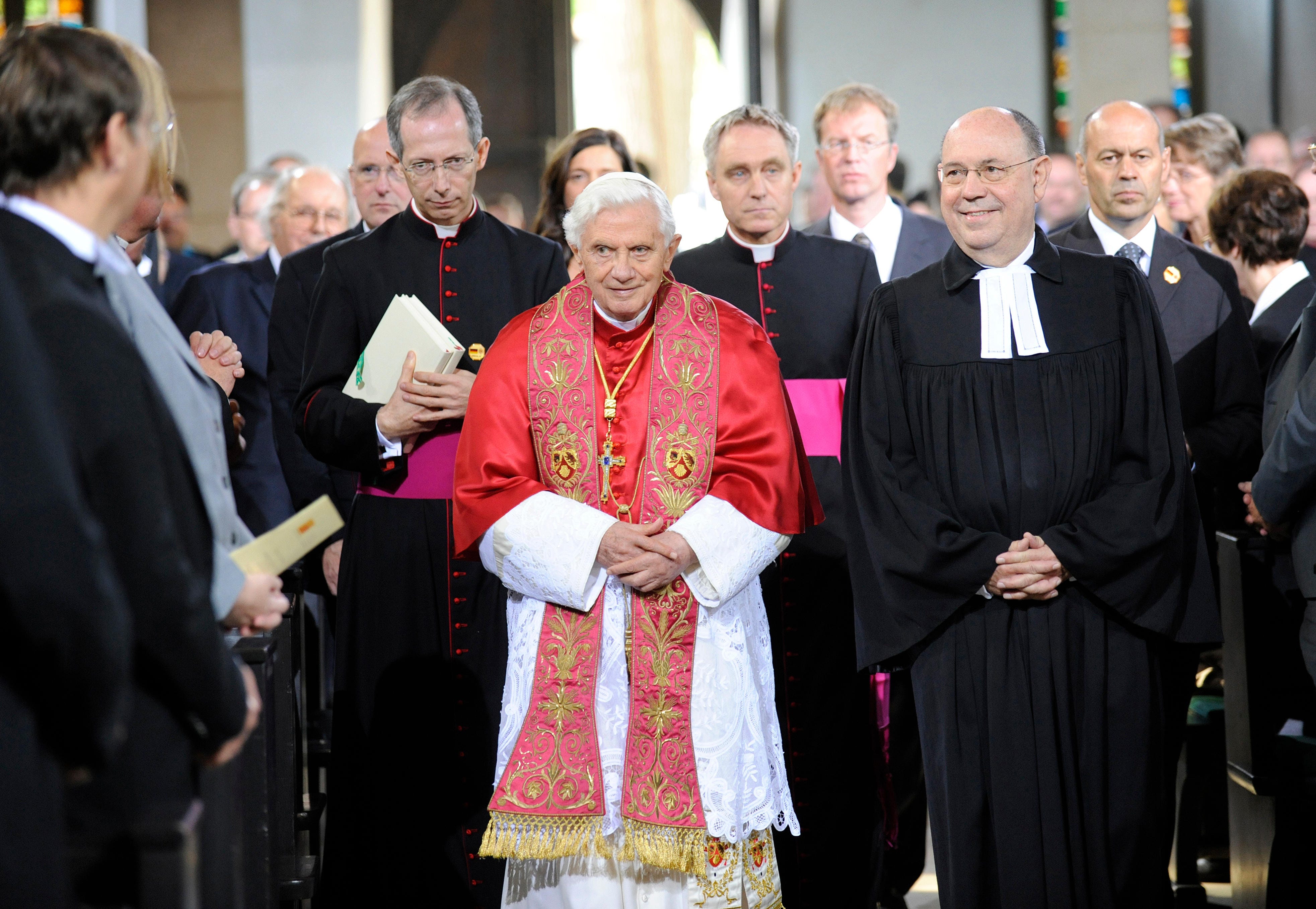
In fact, Ratzinger is ‘worse than Luther’, Mgr Guérard des Lauriers said.
Introduction
This is the fourth part of our serialisation of Mgr Guérard des Lauriers’ article The Wojtyłan Dictatorship (La Dictature Wojtylienne), published in Bulletin de l’Occident Chrétien, nos 79 – 80 of April-May 1983.
The first part addressed Archbishop Ryan and Cardinal Danneels’ conferences.
The second part set out Mgr Guérard’s analogy of the jar, the label and the content, and considered its application to Ratzinger’s “theology” of faith.
The third part applied it to his “theology” of revelation.
This present part, the fourth, applies it to his conception of catechesis, and his general (and destructive) approach to theology. Following this part, we include Mgr Guérard’s brief comments about the address of Cardinal Macharski (then the Archbishop of Kraków) and some brief comments about one of Ratzinger’s several denials of transubstantiation.
And in the next and final part, Mgr Guérard will draw together his observations – and some very interesting comments about certain wider issues. Stay tuned…
The third ‘Ratzinger operation’: the structure of catechesis
In this third ‘operation’, Ratzinger praises the fourfold structure of the Roman Catechism (Creed, Sacraments, Decalogue and Lord’s Prayer) as an ancient synthesis, going back to the origins of the Church.
He then notes that there are also four senses of Scripture. By means of a third “quaternity” (set of four), what the Christian 1) believes, 2) hopes, 3) does, and 4) the “living space” in which he does it, he welds the previous two together. Thus, according to Ratzinger, we have three connected quaternities that supposedly correspond together:
The fourfold structure of the catechism
The four senses of Holy Scripture
The fourfold ‘topography’ which he presents.
His conclusion is that the four parts of the Catechism are “the fixed points of a topography and a hermeneutic of Scripture”.
Mgr Guérard sets out Ratzinger’s argument as a syllogism, and then takes it apart. The correspondence is an artificial concordism, and the Catechism’s own authors disclaim any such intention.
More importantly, the conclusion inverts the proper order. Revelation is what “norms” the Creed, not the other way round; the Sacraments are sacraments of the faith (sacramenta fidei): they presuppose the faith rather than govern it.
Further, the Dominican bishop adds, Ratzinger’s account is aggravated by the fact that the sacraments he has in view are not the Catholic sacraments, as defined at Trent: they are, instead, the new rites of the Novus Ordo. Here Mgr Guérard draws the parallel that Ratzinger himself invited, by noting that Luther “used this structure… as naturally” as Trent did. Luther kept the catechetical form while substituting false sacraments; Ratzinger does the same, but in the name of Rome, and with a false principle to justify it. For this, and other reasons he explains, Mgr Guérard concludes that Ratzinger is, in fact, “worse than Luther.”
The bishop does grant that Ratzinger is right to lament the neglect of certain elements in post-conciliar catechesis. But he asks the obvious question: if Ratzinger understands the faith in the manner of Teilhard de Chardin, with what does he hope to supply this neglect?
Two additional parts
This part closes with the short comments on Cardinal Franciszek Macharski’s address – which dealt with “the trial of the faith”. Mgr Guérard welcomes his references to Gethsemane and to St John of the Cross. However, he objects that Macharski confuses the “nights” through which God sanctifies souls with the darkness into which the world has fallen through sin.
He also objects that Macharski relies on two conciliar teachings he regards as heretical: that the Son of God “has in a certain manner united himself to every man” (which is one of the key errors of John Paul II’s reign, with long-lasting effects) and religious liberty.
I have also taken the liberty of transferring the short extract from BOC n. 94 (Oct 1984) – titled “‘Cardinal’ J. Ratzinger and Tradition’” – to the end of this piece. This piece is about one of Ratzinger’s several denials of Transubstantiation. Although Mgr Guérard touches on this point in reference to Dom Gérard Calvet in the final part, it seemed fitting to place it here.
With this fourth part, we come to the end of the ‘main course’ – the meat of Mgr Guérard’s article. In the next and final part, we will turn to the conclusion that gave the article its title: the way in which the Conciliar/Synodal Church (which he refers to as ‘Wojtyłan’, given who was the papal claimant at the time) operates like a dictatorship.
I have described this conclusion as the ‘dessert’ of the article. In it, we will find certain reflections and analyses about the Church, which many will find surprising, given the way in which his “Thesis of Cassiciacum” is often presented.
S.D.Wr.
The Wojtyłan Dictatorship: Mgr Guérard des Lauriers
Bulletin de l’Occident Chrétien, nos 79–80, de avril-mai 1983
Originally published as La Dictature Wojtylienne
Critique of addresses by Archbishop Dermot J. Ryan and Cardinal Godfried Daneels
‘Ratzinger is Luther’: The future Benedict XVI’s ‘Tridentine Jar’
This translation is for WM subscribers. Subscribe now for FREE!