
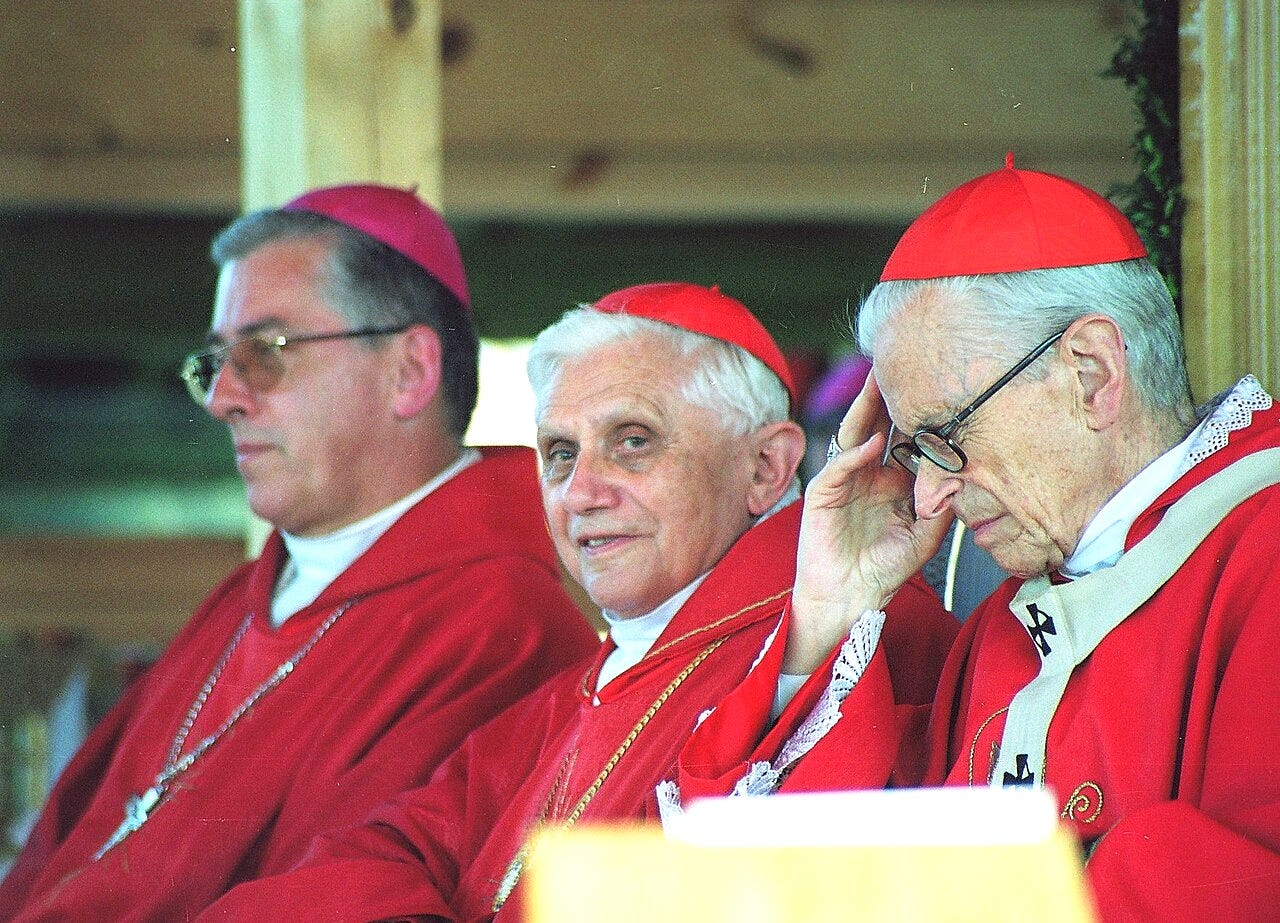
Mgr Guérard des Lauriers begins his analysis of Cardinal Ratzinger’s modernist theology – starting with his notion of faith.
Introduction
This is the second part of our serialisation of Mgr Guérard des Lauriers’ article The Wojtyłan Dictatorship (La Dictature Wojtylienne), published in Bulletin de l’Occident Chrétien, nos 79 – 80 of April-May 1983. You can read the first part, on the addresses of Archbishop Ryan and Cardinal Danneels, here.
We now come to the main course: Mgr Guérard’s critique of Cardinal Joseph Ratzinger’s address, “Transmission of the faith and the sources of the faith,” delivered with the others at Fourvière and Notre-Dame de Paris in January 1983.
Ratzinger the restorer?
This address is classic Cardinal Ratzinger: on the surface, it looks exactly like what many “traditional Catholics” were hoping for. At the time, Ratzinger had only recently been installed as the head of the Congregation for the Doctrine of the Faith. In the address, he acknowledges a “collapse of classical catechesis”, and attributes it to what Catholics today would recognise as modernist excesses.
Even more strikingly, Cardinal Ratzinger proposes to overcome the crisis by returning to the Catechism of the Council of Trent.
It is easy to see why so many were delighted. As Mgr Guérard puts it, the “average Traditionalist” reading Itinéraires and frequenting the Traditional Latin Mass could tell himself that John Paul II, through the head of the formerly Holy Office, was defending Tradition and even leaning on Trent.
But while Mgr Guérard recognises in this article that some of Ratzinger’s criticisms were “penetrating”, he did not stop there.
The jar, the label and the content
To show the problem with Ratzinger’s approach, Mgr Guérard uses the analogy of a jar and its three components:
The jar itself, as a container
The label, stating what is inside
The content itself, inside the jar.
While the jar is the most visible element, the content is the most important aspect – and the label matters insofar as it truly corresponds to the content.
In Mgr Guérard’s analysis, the “jar” is Ratzinger’s reference to the fourfold structure of the Roman Catechism: the Creed, the Sacraments, the Decalogue and the Lord’s Prayer. The “label” is what Ratzinger says is inside this structure: “Tradition”. But the real question, addressed by Mgr Guérard, is what Cardinal Ratzinger actually puts inside this structure.
His answer is that Ratzinger carries out three “operations,” each displaying a Tridentine jar and label – with a different content inside. The three “operations” are as follows:
Faith (addressed in this part). Ratzinger’s understanding of the theological virtue of faith is wholly different to that expressed by Trent, the Roman Catechism, and tradition.
Revelation (in the next part). His understanding of revelation is wholly different to that of St Thomas and Pope St Pius X.
The structure of catechesis (the subsequent part). Ratzinger arbitrarily maps the four headings of the Catechism onto the four “senses of Scripture”, which Mgr Guérard shows is an inversion of the proper order – and akin to key aspects of Luther’s revolt against the Church.
In each of these steps, we see the classic modernist manoeuvre, as expressed by Cardinal Parente’s definition of modernism:
“A heresy, or rather a group of heresies, which have arisen in the very bosom of the Church at the beginning of [the twentieth century] under the influence of modern philosophy and criticism, with the pretense of elevating and saving the Christian religion and the Catholic Church by means of a radical renovation. […]
“In brief outline, the encyclical [Pascendi] declares modernism to be a hybrid amalgamation of verbal Catholicism with real naturalistic rationalism, based on [agnosticism, immanentism and ‘radical evolutionism’].”1
The extent of Ratzinger’s modernism has been analysed by men such as the late Bishop Tissier de Mallerais and the late James Larson. Such writers have shown that the myth of Ratzinger maturing past the ideas he held as a younger priest and at Vatican II – when his modernist tendencies were already visible – is completely false.
At each step, throughout his career, Ratzinger’s approach was essentially the same: claim that powerful objections to Catholic dogma have arisen, and on that basis “rethink” the meanings of the terms of the dogma, such that it remains tenable. For example, Ratzinger took this approach to the dogma of transubstantiation itself.2
Why this matters now
Many of us came to know Ratzinger as the man of the “hermeneutic of continuity” and Summorum Pontificum, and he retains a remarkable hold even on many supposed “traditionalists”. Only last month, Dr Peter Kwasniewski wrote:
“In my home library of several thousand volumes, only a few authors enjoy the privileged status of occupying several shelves exclusively their own. […] Joseph Ratzinger belongs to this limited circle of authors whom I regard so highly that I have acquired nearly everything they wrote.”
He goes on to describe assigning Ratzinger’s works to his students, and his view that no pope since Benedict XIV has equalled him in learning. He also writes:
“At last, we had found a highly literate, sophisticated, rather audacious modern theologian who nonetheless knew and loved the Catholic tradition, explained its meaning, rebuked its assailants, and advanced its recovery. That he was the right-hand man of John Paul II and followed him to the Chair of Peter only added to the momentary elation of recovering territory after a series of brutal annexations.”
We recently engaged with Dr Kwasniewski on a related topic, and you can find those articles here:
However, while such praise is common amongst men like Dr Kwasniewski, the older traditionalists were typically far more cautious about Ratzinger – especially those who understood how his negotiations with Archbishop Marcel Lefebvre proceeded. Today, there is little excuse for failing to recognise that Ratzinger was a consummate modernist.
Mgr Guérard was writing at the first moment in which Ratzinger was presented as a restorer. He saw through this pose, and exposed him for what he was: one of the most effective instruments of the Vatican II revolution.
Whatever one makes of Mgr Guérard’s conclusions, or of his “Thesis of Cassiciacum”, his analysis of the address shows the importance of looking past Ratzinger’s traditional jar and label – and considering what is actually inside.
I look forward to sharing the parts of this “main course” with readers – but the dessert itself will also be worth the wait…
S.D.Wr.
This translation is for WM subscribers. Subscribe now for FREE!