
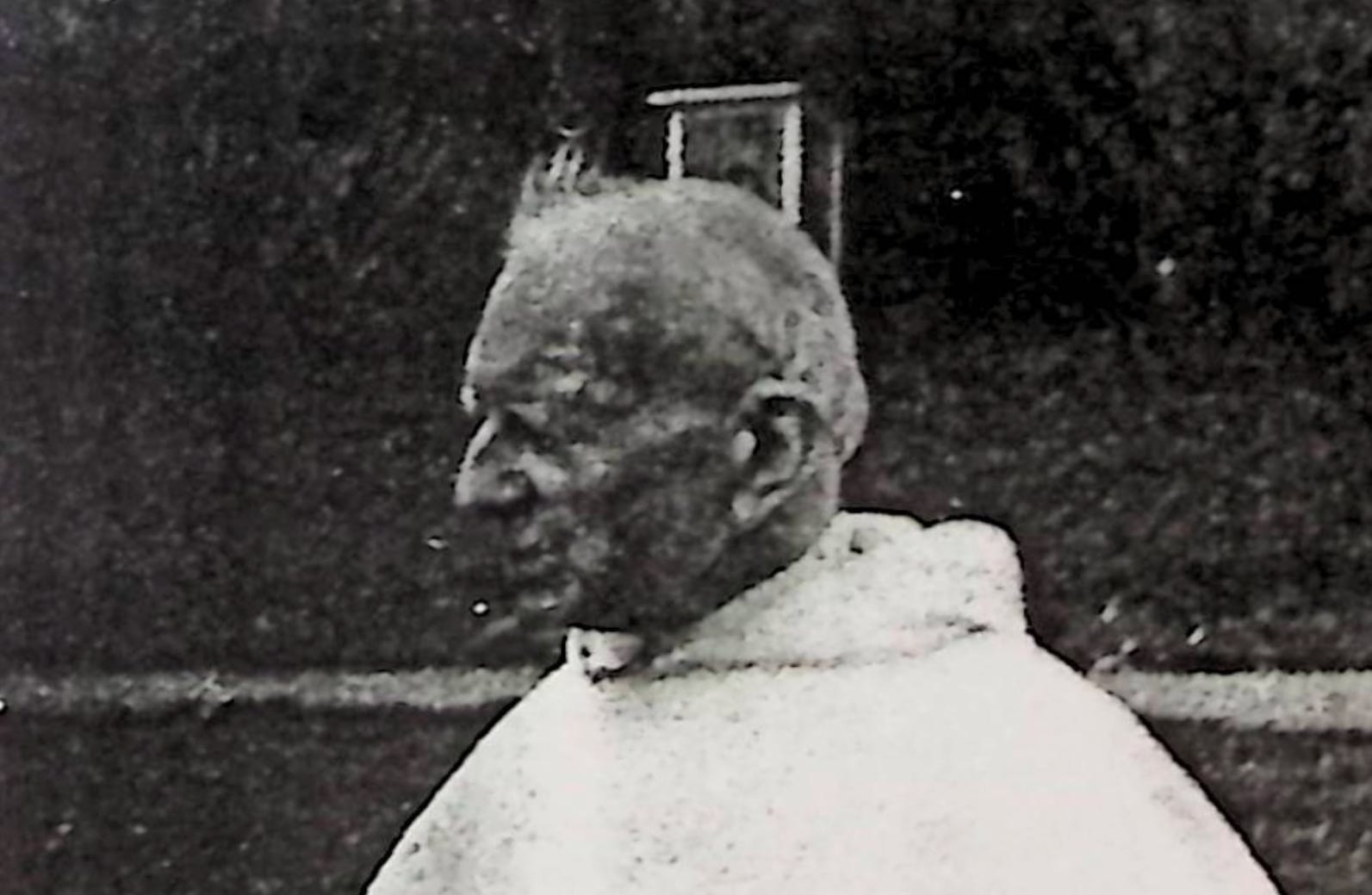
On the anniversary of Mgr Guérard des Lauriers’ passing into eternity, let us read and appreciate M. Adrien Loubier’s obituary of this giant figure of the post-conciliar epoch.
Editors’ Notes
We repeat, in large part, the introductory notes from our translation of Mgr Guérard des Lauriers’s final sermon.
His comments about the SSPX’s episcopal consecrations in that sermon – which M. Loubier echoes here – are all the more interesting given the announcement of further episcopal consecrations to take place in July 2026.
This obituary is very long – nonetheless, we encourage readers to read it in full.
On 27 February 1988, Mgr Michel Guérard des Lauriers passed to his eternal reward.
Born in 25 October 1898 near Paris, he entered the Dominican Order at age twenty-eight after having studied mathematics, eventually earning doctorates in both mathematics and theology.1 He taught at Saulchoir and the Lateran, contributing to theological debates of the 1950s that preceded Pius XII’s encyclical Humani Generis.
Following the Second Vatican Council, Mgr. Guérard became known for his opposition to liturgical reforms. He authored the critical study of the Novus Ordo Missae in 1969, which led to his removal from the Lateran faculty. He subsequently developed what became known as the “Thesis of Cassiciacum,” a means of explaining the current crisis in the Church and the status of post-conciliar papal claimants. This isolated him from more mainstream traditionalist circles, including Archbishop Lefebvre’s Society of Saint Pius X, where he briefly taught.
While he was there, Lefebvre wrote the foreword to Fr Guérard des Lauriers’ book, Réflexions sur le Nouvel Ordo Missae. This book questioned the validity of the Novus Ordo Missae. Lefebvre wrote:
“The extent and depth of the change in the Roman Rite of the Holy Sacrifice of the Mass, and its similarity to the modifications made by Luther, compel Catholics faithful to their faith to ask themselves the question of the validity of this new rite.
“Who better than the Reverend Father Guérard des Lauriers to make an informed contribution to the solution of this problem, which is still under study?”2 (Emphasis added)
The relationship between the two men broke down, and Lefebvre later distanced himself from Fr Guérard des Lauriers, and his conclusions on the Mass and the Pope, wishing to avoid “confusion and violent divisions”.
Fr Guérard des Lauriers published his “Thesis” in the Cahiers de Cassiciacum, beginning in 1979. He argued that the papal claimants from Paul VI onward had held the office materially but not formally – being validly elected, but lacking actual authority, due to their lack of a habitual intention to procure the “good-end” of the Church (and consequent failure to accept the election).
In 1981, the Dominican accepted episcopal consecration from Archbishop Ngo Dinh Thuc. He maintained that continuing the Church’s mission required episcopal consecrations independent of claimants to the papacy since Vatican II. He himself passed the episcopate onto Bishop Robert McKenna, as well as Bishops Storck and Munari. Bishops Donald Sanborn (RCI) and Geert Stuyver (IMBC) later received episcopal consecration from Bishop McKenna, as did three others.
Mgr Guérard des Lauriers final years were spent largely isolated, traveling to offer the traditional sacraments while continuing to refine his theological positions. However, this period of isolation was one in which the bishop continued to grow in sanctity and exercise outstanding supernatural virtue, according to Loubier. If Loubier’s account is even just mostly accurate, it seems that Mgr Guérard des Lauriers was a saint.
The late bishop remains a significant figure in post-Vatican II theological controversies. We publish this new translation of M. Loubier’s obituary for our readers’ edification and its historical value, without endorsing all the positions of Mgr Guérard des Lauriers – just as we have published texts by Archbishop Marcel Lefebvre and others.
You can read more about his life in Fr Giuseppe Murro IMBC’s Life of Mgr Guérard des Lauriers, OP.
In Memoriam
Obituary for Mgr Michel-Louis Guérard des Lauriers
By M. Adrien Loubier
In Sous la Bannière, n. 16, Mars-Avril, 1988.
We believe that our translation of this text is covered by fair use; if there is an existing copyright holder who would like us to remove it, they can reach us in the comments to this article.
Mgr Michel Louis Guérard des Lauriers, of the Order of Preachers, has just rendered his soul to God, in his ninetieth year.
A sign of contradiction in the terrible tempest through which we are living, he was rejected by many, yet secretly esteemed by most – and feared even by his worst enemies. Around him, a few faithful friends, among whom I was included (an honour of Divine Providence), had the signal privilege of receiving his last blessings, of bringing the solace of their friendship to his sufferings, and of partaking in the graces that accompany the passage of men of God into the celestial homeland – what is customarily called the odour of sanctity.
It is because I had this fortune that I make it my duty to devote these few lines to this hero of the Faith. I only came close to him, and truly knew him, in the last decade of his life – so long and so full – and others more senior than I could speak of his past with greater competence. But while many betrayed, abandoned, or simply fled him because they feared the turmoil that agitated our circles in these last ten years, I found myself among those who were gradually enlightened by the teaching of Mgr Guérard, who therefore sought him out, and then supported him with their feeble means. Thus I found myself among his close associates for some years.
I shall not, therefore, write here the history of Fr Guérard des Lauriers (O.P.); I shall say of it only what everyone knows, very briefly.
The outline of his life
Fr Guérard was born in 1898, and had the sad privilege of participating in and witnessing two World Wars. He lost his elder brother in the war of 1914–18. Having entered the Dominicans, he was a teacher at Lille, at the Catholic faculty. The greater part of his life was spent at Le Saulchoir, and God knows what he lived through and what he saw there!
A theologian of the very highest calibre, Fr Guérard wrote in numerous journals, most of which (like Itinéraires for example) rid themselves of him so as to change course more freely. Obliged to leave Le Saulchoir, Mgr Guérard was in a sense at the foundation of the entire traditionalist resistance, since he was the author of the “Brief Critical Examination of the Novus Ordo Missae,” which Mgr Lefebvre had presented to Paul VI by Cardinals Ottaviani and Bacci.3 An active adviser of Mgr Lefebvre, Fr Guérard was a professor at Écône until 1977, the date at which he was ousted by the growing influence of liberal tendencies.
Confronted with situations without precedent in the history of the Church, such as the crisis we have been living through for twenty or thirty years presents to us, Fr Guérard put his learning and his intelligence at the service of Truth. He elaborated, and then taught, various theses which, however controversial, are nonetheless gradually gaining acceptance.4
Episcopal consecration
In 1983, Mgr Guérard des Lauriers received the consecration and episcopal ordination from the hands of Mgr Ngo Dinh Thuc. Our purpose here is not to defend or justify the act undertaken by the Archbishop of Hué in thus conferring the fullness of the priesthood upon Mgr Guérard des Lauriers, nor the latter’s acceptance of its burden and its crosses.
Such a defence would moreover be as ridiculous as it is outdated today, when there is talk of nothing but consecrations, in a religious family that may perhaps tomorrow perform the same act, even though for ten years it has been rejecting or attempting to ridicule the only doctrines that can illuminate and justify it: those of Mgr Guérard des Lauriers.
Let us say, however, that through the tempest unleashed against him by the untimely announcement of his consecration, which he had wished to keep secret, Mgr Guérard struck us with the calm and serenity he was able to maintain. He had consented to charge his shoulders with the episcopate only to serve the Church and his neighbour through the disorders that we all foresee, in a future that it pleases Divine Providence to postpone, and he intended to exercise it only in the extreme cases that would warrant it. But Providence had decided otherwise.
Fr Barbara, after several similar efforts, pressed Mgr Ngo Dinh Thuc so insistently to obtain from him the consecration he desired, that the latter referred him to Mgr Guérard, and thus betrayed the secret. Bursting with spite, Fr Barbara unleashed the hurricane of furies of his Institut Cardinal Pie,5 and suddenly became a fierce opponent of future consecrations, having failed to obtain his own.6 Mgr Guérard then found himself at eighty-five years of age, rejected by many, including his own disciples, and obliged to live his episcopate publicly. With extraordinary calm, he faced the storm. Men came even into his house to prevent him from saying his Mass, a feat of valour owed to a few certified imbeciles of the Institut Cardinal Pie, who thus proved their “courage” as “warriors” in the face of an eighty-five-year-old man and a lady; a courage that found its limit only at the appearance of the gendarmes!
Retreat into the wilderness
Like Abraham setting out into the desert, Mgr Guérard then consented to leave behind the entire framework of an already very long life, to retire into the wilderness. At eighty-six, he purchased a property, undertook construction, and founded a house to serve as a seminary. But the young men who should have accompanied and supported him there, after having benefited from his teaching, abandoned him out of fear of reprisals, and to follow the influence of the wretched Abbé (Fr) Olivier de Blignières, who has himself just turned coat.7
It was there that the end of his life came, on the day it pleased God to appoint; struck by an incurable illness, Mgr Guérard saw his health decline since last November, and has just reached the end of his mortal life.
Mgr Guérard des Lauriers’ death
At ninety years of age, still ready and available, I can see him even now, telling me yesterday on his bed of pain: “Non recuso laborem” (I do not refuse the work).
“If God wishes to take me back, let Him take me. But if He wishes to keep me alive, I am ready to serve.”
When he died, St Louis Marie Grignion de Montfort had but a single disciple; he was reviled and vilified by all the clergy of the place, and rejected from every diocese in France save one. But he was St Louis Marie Grignion de Montfort, and no one any longer knows the names of the bishops who drove him out, nor of the clerics who vilified him. And those clerics were not all bad people; they had simply listened to the sirens of the world and to the wicked men who surrounded them. And the congregations that St Louis Marie founded still had tens of thousands of members before the Second Vatican Council.
In dying, Mgr Guérard des Lauriers apparently leaves behind him but little. But I wager that in a century, if the world still exists, his name will be better known than that of a Ratzinger or a Lustiger, or of many of the leading lights of present-day renown, and I wager that the Church, the true Church, will have long since canonised him, for She will need his learning and his doctrine to understand and to give account of the unprecedented and unparalleled crisis She will have traversed in the last quarter of the twentieth century after the birth of Our Lord Jesus Christ.
Mgr Guérard des Lauriers’ piety
“We can do nothing, feeble orators that we are, for the glory of extraordinary souls: the wise man is right to say that ‘their works alone can praise them.’” (Prov. 31.31)
I make my own these words of a celebrated orator, after this too brief recollection of so full a life, and I come to the more personal testimony I must bring to the tomb of this son of the Angelic Patriarch [St Dominic], whom it was given to me to see and to hear so often in his last years. God grant that I find the right tone to express here the filial piety his company inspired in me, and the emotion I feel before his passing.
The first of the virtues I must celebrate in Mgr Guérard des Lauriers, because it was without doubt the most striking, is piety.
It was not possible to attend with indifference the Masses he celebrated, nor the offices or prayers he led. This impression was so strong that those who had experienced it once were most often willing to overlook many inconveniences to profit from this richness of graces. And God knows that Mgr Guérard was often late on account of his great age; that the road was long to reach his home; very long for families burdened with many small children; and that his Masses lasted no less than two hours! Having set out fasting around 9am, it was toward 2pm (and very often later) before the mother could light her stove! No matter; even if other options presented themselves, we went there all the same, for the Mass and the sermon of Mgr Guérard were “something else”…
Since it is very difficult to express in words what belongs first of all to the supernatural order, I shall try to illuminate the extraordinary piety of Mgr Guérard des Lauriers by one of its most visible projections into the natural order: his faculty of kneeling.
This bordered on the prodigious, and struck all who came near him. If it is true that “man is never so great as when he is on his knees,” in the words of a celebrated author, then without doubt Mgr Guérard was a very great man; for very few could have matched him in the astonishing endurance he had for remaining on his knees for hours on end, praying, leading the faithful around him in meditation, guiding adorations or public prayers… which supposes a sufficient “intellectual availability”, one that generally becomes impossible when prolonged kneeling brings on the crushing of the kneecaps, muscle cramps, back pain, and when it is no longer possible to do anything but suffer in silence.
Yet despite the discomfort of the position, Mgr Guérard possessed this intellectual availability to a prodigious degree, constantly drawing tears of devotion from his hearers, exciting their prayers and holding their attention to the point that they did not notice the passing of the hours, though they were little practiced in prolonged meditation.
I can still see that father of a family, whom the piety of Fr Guérard had done more to bring back to the true Mass than many a discourse, saying to me:
“I only realised it at the end, but the Stations of the Cross that Fr Guérard led us through lasted nearly three hours! During all that time, apart from the few steps to go from one station to the next, he was constantly on his knees, on the tile floor, and without any support! How does he do it? I who was in the pews and had something to lean on, I was forced to sit down!”
Now this gentleman was a robust peasant, in the prime of life, hardened since childhood to the rough labor of the fields. While Fr Guérard, that day, was eighty-five years old!
As though it were yesterday, I can still see the first Mass he celebrated for us here. After the ritual prayers, remaining on his knees at the foot of the altar, he had us make a meditated thanksgiving. This practice was customary for him. Halfway between prayer and sermon, these elevations were as enriching in doctrine as they were apt to form and develop the piety of the hearers. Seized at first by the beauty of these “affections,” to use a consecrated term, I was gradually forced to notice that my tile floor was very hard; then that my back was very fragile; that cramps were taking hold of my legs… I nearly stood up… But considering Fr Guérard, who did not flinch, and who did not even have a support, while the back of the chair in front of me offered me a helpful one, I said to myself:
“You are forty, and he is eighty! You cannot stand up – you would be too ashamed! Hold on.”
And I held on, out of regard also for the youngsters of twenty who were there. I no longer know how long it lasted. (Nearly an hour, I think…) But I humbly confess that at the end, I was no longer capable of anything but “holding on,” and that when Fr Guérard rose with a single youthful thrust of the back and without leaning on anything, I do not know how I would have managed without the help of the two chairs around me to unfold my aching limbs. And I can still hear the astonished and edified comments of the young people massaging their knees in the courtyard, wondering what state they would have been in had they been eighty!
A group of girls between 14 and 18 were attending the Holy Week offices celebrated by Fr Guérard five or six years ago, in a community of religious sisters. As is the custom, they took turns for the nocturnal adoration from Maundy Thursday to Good Friday. At the crack of dawn, those who were on the last watch noticed, over there in the choir, a white form that grew more distinct with the growing light of day. It was Fr Guérard, on his knees, without support, on the last step of the altar. Questioning one another, they became certain that since 10pm or 11pm the previous evening, no one had seen him enter. Now the only possible points of passage were lit, at the back of the church, where the vigil-keepers took turns. Fr Guérard had therefore spent the entire night in adoration, on his knees, without support, perfectly still, since only daylight had just revealed his presence. And this between two days laden with offices of every kind! And he was eighty-four years old, if I count correctly.
I maintain, I affirm that this is humanly impossible. It cannot be explained without a dimension that is above nature.
Mgr Guérard des Lauriers’ learning
Is it necessary, moreover, to speak of the learning of Mgr Guérard des Lauriers? The notoriety attached to his name over many decades should be sufficient to spare me the trouble of doing so. But the flood of imbecilic calumnies that has been poured upon him in recent years, the crude simplifications spread in abundance by those who thought it more effective to keep the faithful away from his doctrine than to take the trouble to study it, have spread about him commonplaces quite comparable to those of which the Divine Master Himself was the victim – the disciple is not above the Master, and the Cross is the sign of Christians. These contradictions, so numerous, are but one more proof of the sanctity of Mgr Guérard des Lauriers.
But because of them, it is fitting to recall the prodigious gifts of intelligence and learning that flowered in this servant of God.
The gift of languages, for example. Latin, Greek, Italian, German, and several other living languages were familiar to him, to the point that the famous “Brief Critical Examination of the N.O.M.” was written by him first in Italian, and retranslated into French from the Italian especially for the edition we produced in 1983. I saw him translate the Summa Theologica of Saint Thomas at sight, as well as his Codex Juris Canonici; or again, reading in French for the faithful the texts of the Mass from the Latin of his altar missal – and adapting on the fly, with scarcely a hesitation in his voice, difficult passages from the Book of Wisdom, the literal translation of which might have been unseemly, while a quick glance of his penetrating gaze sized up in a second both his audience and what it could or could not hear.
The gift of the sciences, for Mgr Guérard des Lauriers was a great mathematician and a great physicist, and long taught these subjects. One must especially note the exceptional study published by the journal Itinéraires in the 1970s (which had not yet taken its turn). This study on so-called modern mathematics; on the intellectual disaster brought about by their introduction and generalisation through the reform of education; on the consequences that flowed from it in the order of thought – this study is of the very highest competence in every domain. It has never been challenged by anyone. It is the only serious and exhaustive one on the question.
As for philosophy and theology, it must be said that Mgr Guérard des Lauriers occupies the uncontested place of one of the greatest theologians of the century, and probably the only one who, in these latter times, has merited that title.
Endowed with a prodigious memory and an extraordinary presence of mind, which he moreover preserved to his very last moments, Mgr Guérard – in a homily as well as in ordinary conversation – would often refer to Saint Thomas from memory, indicating without hesitation: “This is found in such-and-such a part, such a chapter, such a question…” and continuing with the Latin citation, then its translation. I often supposed he must know the Summa Theologica by heart!
As for his rigour of thought, and his concern for detail, these are well enough known. For anyone who has read and studied him, it is evident that when he had delved into a question, it was no longer possible to find in it the slightest point of detail that had not been analysed, discussed, and perfectly resolved. It is in large part to this concern for the smallest detail that his studies owe their difficulty of access for those who would like to read something “easy,” something “pre-digested.” But Theology is a difficult science. One must work at it, pencil in hand, through multiple readings, and taking notes. Those who are unwilling to make the effort will understand nothing of these works of Mgr Guérard; no more, for that matter, than they will understand St Thomas Aquinas or Garrigou-Lagrange. One must know what one wants.
This concern for detail, this rigour of thought, was visible in his handwriting and in the absolute order that was found in his texts, notations, cross-references, and citations. This was so, to the point that a young woman without philosophical or theological formation could manage to decipher him without difficulty, to compose his text, and to understand it simply through the effort required by attentive reading. While the same text, printed, but read casually, by the fireside, became obscure to others for want of granting that reading the required effort.
It is relying on this example that I invite all the false intellectuals, and all the doctrinaires of convenience who claim that Fr Guérard is incomprehensible, to give themselves the trouble of making the effort to read him. By dint of contenting themselves with the pre-digested summaries of Abbé “So-and-so” and the “digests” of Fr “What’s-his-name,” many end up taking themselves for Thomist philosophers, or thinking that theology holds no more secrets for them because they have some vague memories of their Catechism of Perseverance… (which already places them among an elite!). To all of them I propose that they set to work – not reading the works of Mgr Guérard des Lauriers by the fireside, feet in their slippers, smoking their dilettante’s cigarette; but sitting upright at a desk, pencil in hand, as they would have worked at their studies at the university. And then they will understand.
Otherwise, let them trust those who do understand, let them read and seek out their summaries. But let them stop taking themselves so seriously!
Mgr Guérard des Lauriers, the Friar Preacher
Mgr Guérard des Lauriers belonged to the Order of Preachers. And a Friar Preacher he was; he was one above all.
It was in the exercise of preaching that his zeal for truth manifested itself most visibly. To the very end, in all circumstances, sick, exhausted, even dying, nothing could prevent him from preaching. Even had one implored him, in the name of his own health, not to deliver a sermon, nothing could have stopped him. Only the good of souls and the apostolate of the Word mattered to him then – and if you pointed out to him his fatigue, the long journey he had just made or was about to make, or his health, he would respond with a little shrug of indifference, and he would begin to preach.
Gravely ill with a liver disease, Mgr Guérard suffered from terrible attacks brought on by the vexations that assailed him so often, or by the slightest departure from an extremely strict diet, or simply by the fatigue of one of those numerous journeys that had him, in the ninth decade of his life, traveling the length and breadth of France and even of Europe. During these attacks, he suffered atrociously, shaken by intolerable spasms – and yet on his feet by an effort of will, at eighty-five or ninety years of age! His face would then be the colour of wax, his features drawn. But when the hour of the sermon came, scarcely had he made the Sign of the Cross and uttered the first words than an extraordinary change took place. Tottering and unable to speak a minute earlier, Mgr Guérard would gradually straighten up, his voice would grow firm, colour would return to his cheeks – it was no longer the same man. He came alive for a moment to proclaim the Word of God. But scarcely had it ended, than the attack returned.
The phenomenon was so striking that all were able to observe and comment upon it. A religious said to me not long ago:
“It is normal; his specific Dominican vocation is preaching. The grace of state brings him back to life for that.”
“It seems as though the act of preaching restores your health and stops your attacks,” I said to him one day. We were alone. “I do feel better, indeed,” he replied; “but it is at the cost of an effort of will so painful that I am left shattered for hours!”… Thus this apparent relief was but one more trial, particularly painful, the fruit of an iron will, sustained by the graces of zeal for truth and the good of souls.
And the result was there, for his word was not that of an ordinary preacher. It is staggering to see how thousands of good people will have been kept away from this wealth of learning and piety by the imbecilic calumnies of a few unscrupulous clerics and religious. And certainly it was more effective, as a means of doing harm, to keep people away from this preacher than to suffer the comparison of his sermons with their own.
I can say it: if I have often yawned, discreetly but surely, through so many weak, uninteresting sermons stitched together from banalities (often simply bad!), it has not happened to me a single time to find myself distracted during those of Mgr Guérard des Lauriers. And I have heard several hundred of them. Not once did I come away from one of those homilies without saying to myself: “I have again learned this, deepened that, discovered something else.”
Learning and piety were, moreover, sustained therein by the framework of an extremely sure rhetoric, carried to the level of a very precise technique. I recommend its analysis and imitation to all who must one day practice the art of oratory, and especially the popular sermon. I noticed a relaxation of this art of discourse only in the very last days; Mgr Guérard then spoke from the abundance of the heart, though he was exhausted; he was already a little in Heaven, and one may sense, in the last homily that we publish in this issue, the abandonment to God and the will to say everything before dying, partially replacing method and organization of thought.
But beyond rhetoric, beyond even learning and piety, what was most striking in this preaching was the Faith. It was the soul of all this zeal for truth and the good of souls, and the cause of so many riches and of a never-flagging interest.8
A man of Faith, Mgr Guérard was so above all, especially in his preaching. He was so to the very end, and on his deathbed his last counsels were still:
“Hold fast, stand firm in the Faith; remain faithful through the contradictions; terrible trials are coming; but stand firm in the Faith.”
Mgr Guérard des Lauries’ zeal for souls
On his hospital bed, I can still see this servant of God, perfectly conscious of his condition, saying to me at almost every visit I made him: “Non recuso laborem” [“I do not refuse the work.”]; if the Good Lord wishes to take me back, I am ready, but if He wishes to heal me, if He wishes to work a miracle for His servant, if I can still be of use, I am ready also: “Non recuso laborem.”
Who shall tell of the incredible availability of this great old man for any apostolate one might ask of him? To inaugurate a chapel, to give lectures; to cross France to say Mass or administer the sacraments to a few faithful who could not even pay his travel expenses; to bring Communion to the sick; to adapt his preaching for children, to say a Mass and deliver a sermon for humble peasants who no longer practiced their faith; at eighty-nine he would make a journey of 800 or 900 kilometers to confirm a few children. Whoever wished to confess to him could have done so, at any moment and in any circumstance, and this prodigious availability was all the more striking on account of its contrast with so many dissimilar cases!
Three times, when he was past eighty-three, I called upon him to bring the last sacraments to the dying. (The first time, it was for want of finding any of the young priests we had first called upon available!) His only question was: “What time do you wish to pick me up?”… and at the appointed hour he was at his doorstep, having thought of everything necessary with an astonishing practical sense; down to the detail of a small hearing aid that he had gone back to fetch from his things after I told him that the confession would likely be difficult on account of the patient’s difficulty speaking… and that day, having by distraction, because of the interest of his conversation, missed a highway junction, he interrupted himself to “scold” me: “Ah, that was where you should have turned… I thought you knew the way.” And I, who had done nothing but listen to him, was forced to apologise in confusion for a blunder he would not have committed even while talking to me about theology!
His attention to others was no less remarkable. In every circumstance, he was available, ready to listen. No objection, no difficulty presented to him left him indifferent, or received from him the somewhat rough treatment that many men of learning reserve for those who challenge their conclusions or slow the movement of their thought with questions they deem useless. In private just as in class when he gave his courses, or in lecture when he expounded his doctrine, Mgr Guérard always listened. Then he would reflect, sometimes remaining a moment in silence, eyes closed. Then he would answer, explain, patiently, often at length, with the evident concern to enlighten minds, to leave in them not the slightest zone of shadow.
Here one must render him the particular testimony of his humility. It was astonishing to see a man of his age and his learning as concerned for the humble as he was, and with a memory that, prodigious in itself, was further nourished by this attention. Such-and-such parents whom he barely knew had told him their children’s names and answered the questions of commonplace interest that one asks in a first conversation. Several months later, seeing these “little ones” for the first time, the learned theologian would call them by their first names, ask them questions about their school, take an interest in them as if he had always known them, with that particular attention that is the mark of true charity – the charity that goes straight to souls. Nothing of the first conversation had been forgotten!
No concern for others left him indifferent, and I would never finish if I wished to recount all the small gestures of which I was a witness, which manifested this profound charity, rooted in a genuine humility, in the forgetfulness of self before one’s neighbour. A few will suffice, I think, within the limits of this account.
Thus, for example, sick and nearly dying, did we not see him impose upon himself the task of gathering us together after a Midnight Mass, which was his last, and which did not end until about 3am because of his fatigue and his lateness. “I do not wish to let you leave fasting, you who have a long road ahead,” he told us! We later understood another reason for this improvised Christmas supper. An old retired mason from the area was there, who had brought chocolates for the children. It would no doubt have disappointed this widower, who would return alone to his house without family, not to give him the comfort of distributing his chocolates to small children whose smiles would accompany him on this night of festivity! And the scholar, the great theologian, the bishop, constrained himself to remain among us and to taste a chocolate; sick and dying, he stayed up until 4am, to console an old mason alone and to let a few children play.
How many young priests of my acquaintance would do well to take his example, they who think themselves so important!
That same evening, at four in the morning, Mgr Guérard des Lauriers approached a young woman to entrust to her, with a touch of mystery, a small piece of work. It was a matter of binding a children’s missal. Two weeks later, the young woman delivered this work to him on his hospital bed, even fearing she had arrived too late. She then discovered that this binding had no other purpose than to please another person whom Mgr Guérard knew to be very attached to that little missal; and that he had gone in secret to take it from her things in order to give her, from his deathbed, the pleasure of this humble gift!
The profound delicacy of such simple acts belongs to the highest charity; the charity that takes its source in the humility of true greatness; the charity that knows how to make itself small with the small, humble with the humble!
Mgr Guérard des Lauriers’ faithfulness
Faithful in great things, Mgr Guérard was also faithful in small ones.
“Never admit the admixture of a little error with truth in order to make it palatable and attract a following,” he said in the last days of his life.9 “Such a mixture would be sterile, like all hybrids.”
But this intransigence with truth, Mgr Guérard also had in the moral order, and even in small things. I can still see his eyes, so lively and so expressive, blazing with a severe fire as his torso straightened in an attitude of reproof before the butter dish that the lady of the house was offering him:
“Oh, butter, Madam, but we are in Lent!”
The butter dish quickly vanished, and we all ate our dry bread while listening to a short admonition on the observance of fasting and the example it behooved us to give in these times of laxity.
Need I add that the incident of the butter dish took place during a late lunch, around 10 or 11am, after two hours of religious ceremony for which we had remained fasting since midnight?
This great feast fell on a Friday. “Festive meal” – but fish for everyone! And such-and-such a friend, crestfallen, packed up his casserole and his beef bourguignon to go rummaging in the pantry in search of a tin of sardines.
Mgr Guérard did not jest with penance… which did not prevent him, when confronted with impossibilities, from showing mercy. “Transeat” [“I make a concession.”] he would say then.
But for himself first of all, he made no compromises. Very few men of thirty would submit themselves to the regimen to which he subjected a body of eighty-five on Sundays, when he said three Masses with hours of travel between each one!
This faithfulness to truth, as well as to the least laws of Penance, went hand in hand with faithfulness to men. Mgr Guérard des Lauriers never betrayed anyone. God knows, however, how much he himself was betrayed.
This priest, whom some accused of lacking judgment about men, often showed great consistency in his conduct. Sensitive to truth rather than to knowledge of persons, he sometimes displayed candour in their regard. Thus he would listen to everyone. But afterwards, he would verify – something that many supposed wise men often forget to do. And like all those who love truth passionately, he firmly took the side of justice and set about the means necessary to promote it.
Would someone come and tell him: “So-and-so has been looting vacation homes; or he has weapons in his house. You are wrong to trust him. Be prudent. Beware”; Mgr Guérard would listen. Then, instead of keeping the thing to himself, as people would have wished, and remaining under a cloud of suspicion and mistrust, he would do what everyone ought to do in such a case. He would speak to the friend: “This is what has been said about you. What is your answer?” Then he would verify, weigh, check. And instead of a suspicion, two certainties would result: one about the accused, the other about the accuser.
Such-and-such friends of Mgr Guérard were one day publicly accused (in their absence) of being in league with Freemasonry; this in the course of a parody of an exorcism. By a public act, in the same place, before the same persons, Mgr Guérard repaired this calumny by resorting to the proof of a public oath, in its solemn form. Requested by him to attend, certain persons refused. No doubt they would have preferred that the matter not be spoken of, and that doubt continue to hang over the accused? But Mgr Guérard des Lauriers would not have it that way, even at the risk of being shown the door of the house along with those he had defended therein.
And at the risk of afterward practicing the virtue of eutrapelia by smiling at those who had not “wished to see” the oath, and who had preferred to satisfy their curiosity through the keyhole of a sacristy!
Yes, Mgr Guérard was faithful because he was just. And he was just because he was true. Who then could claim to have found in him the slightest deviousness? The faintest shadow of falsehood?
Sign of Contradiction
The disciple is not above the Master. Like the Divine Saviour, Mgr Guérard was rejected by many, accused of sowing trouble among the crowd. No one can measure how much he suffered from it.
In our world of “Tradition”, he was a sign of contradiction, especially in the seven or eight years since the step he took (receiving the episcopal consecration from Mgr Ngo Dinh Thuc) brought to the fore the problem of the transmission of the sacraments in the face of the failure of regular authority.
But this problem had to be posed some day. In the face of Mgr Lefebvre’s hesitations and the ambiguities of his position, someone had to have the courage to recall that the good of the Church and of the faithful takes precedence over tranquillity, comfort, and consolations. And without the sacraments, what would become of the good of the Church and of the faithful?
And through the turmoil provoked by this stand, is it not remarkable to see certain of the theses of Mgr Guérard gradually making their way even into the pages of the journal “Fideliter” – such as the distinction between missio and session – which is gradually forming the framework of a position still hesitant, but nonetheless moving toward further episcopal consecrations?
Consecrations to which we are favourable—we have always said so—insofar as they seem to us inevitably destined to be the trigger that will at last clarify the situation.
Episcopal consecrations without pontifical mandate
The two churches now confronting each other must excommunicate one another, for they do not share the same faith. The Church for whom man is the road and whose pope is the pope of the rights of man, and the Church whose Jesus is the Way, the Truth, and the Life, and whose doctrine is that of the rights of God over the city and over souls; these two churches whose confrontation is concretized by the battle for Tradition, by the antagonism between the pure oblation “non una cum” and the conciliar synaxis, and between the catechism of all time and the new catechisms – these two churches must exclude one another. The ambiguity must cease.
And whether Mgr Lefebvre consecrates with the agreement of present-day Rome, thereby leading the whole of the resistance he has gathered behind him into a rallying to the bosom of the Conciliar Church; or whether he faces excommunication from present-day Rome and at last consents to address head-on the problems of the current crisis of authority – in either case we shall know where we stand. Either we shall have bishops like the others, Lustigers or Ratzingers in union with Wojtyla, whom we must reject for the same reasons – or else we shall have Catholic bishops, and the true Church will continue in the Cross, awaiting the hour when it shall please God to regenerate her.
Let us not forget that the preliminary of the ceremony of the consecration of bishops is liturgically constituted by the reading of the Roman mandate. It is the beginning of the Pontifical. This prerequisite is obligatory, and if it is lacking, then, as Mgr Guérard des Lauriers did, it must be replaced by the exposition of the reasons for which one believed it necessary to proceed without it.
These reasons are not lacking. But still one must choose the right ones and expound them wisely – which, until now, only Mgr Guérard des Lauriers has done.
And with what wisdom! Need we recall again at what cost of effort Mgr Guérard succeeded in rendering impossible the “conclavist” tendency, which, by usurping a power of jurisdiction that no current bishop among the defenders of tradition possesses, would lead to an inevitable adventure of the Palmar de Troya type, and of several other popes by the grace of themselves!
The future of Mgr Guérard des Lauriers
I have been very garrulous, and I humbly beg the pardon of my readers. May I only have made them share a little of the esteem and admiration that were mine in the presence of this servant of God.
I defer in advance to the judgment of the Church in order. But let it be permitted us to express here our certainty that one day Mgr Guérard des Lauriers will be raised to the altars. We are far from that, apparently. But it seems to us certain that the works of this exceptional theologian will one day be indispensable to the Church in order to give account of the unprecedented and unparalleled crisis that will have shaken her from her roots to her highest summit during the last quarter of the twentieth century.
May God give us back a holy Pope; may He grant us bishops, priests, theologians. And in the meantime, let us pray for the repose of the soul of Mgr Guérard des Lauriers, in the hope that he intercedes on high for our fidelity and for the Church.
Before this humble tomb in a village cemetery, where rests one of the greatest theologians of the twentieth century, who was a successor of the Apostles, one cannot but be struck by the extraordinary austerity willed by the very man who must there await the resurrection of the body. He refused even the smallest marble slab, and wished for no ornament but a simple wooden cross bearing only his name. To the very end, he will have remained the poor and mendicant friar, son of St Dominic, who all his life refused vain glory, and even the honours legitimately attached to the offices that were his.
Among us, this servant of God shone with an exceptional brightness through his intelligence and his faith. All that has now vanished, and there remains to us only the memory and the writings. But before this humble wooden cross, let us hold fast to those virtues that are inscribed in this very austerity: humility, simplicity, truth, piety… Those virtues that now form in heaven the most precious of crowns, infinitely more precious for him than that which distinguished him here below among us.
May our work of fidelity to the Church imitate these virtues, and live the Faith, the Hope, and the Charity in the humble abandonment of the Cross, until it shall please God to restore Order in His Church.
“Christus factus est pro nobis obediens usque ad mortem, mortem autem crucis.”
(Completed on this Good Friday 1988)
Adrien LOUBIER
Base text translated with the help of AI and thoroughly checked by The WM Review.
We believe that our translation of this text is covered by fair use; if there is an existing copyright holder who would like us to remove it, they can reach us in the comments to this article.
HELP KEEP THE WM REVIEW ONLINE WITH WM+!
As we expand The WM Review we would like to keep providing free articles for everyone.
Our work takes a lot of time and effort to produce. If you have benefitted from it please do consider supporting us financially.
A subscription gets you access to our exclusive WM+ material, and helps ensure that we can keep writing and sharing free material for all.
You can see what readers are saying over at our Testimonials page.
And you can visit The WM Review Shop for our ‘Lovely Mugs’ and more.
(We make our WM+ material freely available to clergy, priests and seminarians upon request. Please subscribe and reply to the email if this applies to you.)
Subscribe to WM+ now to make sure you always receive our material. Thank you!
Read Next:


Follow on Twitter, YouTube and Telegram:
Twitter (The WM Review)
All biographical details from Fr Giuseppe Murro IMBC’s Life of Mgr Guérard des Lauriers, OP.
Archbishop Lefebvre, ‘Foreword’ dated 2 February 1977, in Michel-Louis Guérard des Lauriers, Réflexions sur le Nouvel Ordo Missae, preview available at http://www.virgo-maria.org/articles/2007/Reflexions_NOM_Mgr_Guerard_1977.pdf
Original Footnotes
Available from Éditions Sainte Jeanne d’Arc, with a historical note of the highest interest.
The abundant correspondence we receive at the present bulletin, which has been, in France, for three years, almost the only one to support and disseminate these theses, is there to prove it. The hatred, the fury, the stamping of feet of the adversaries of these theses, the letters of insult that their “ringleaders” send us, or have sent to us; the violence and the bad faith of the articles they write against us are also there to confirm it. (We bear no ill will toward all these good people. The heart of one who is right is not capable of hatred. We pray for them.)
I.C.P., a sect founded by a certain Bernard Dumont and supported by Fr Barbara, which we have been denouncing for ten years, and on which we can furnish our readers with a damning dossier.
Fr Barbara has also become an enemy of the I.C.P., which attempted to expel him and dispossess him of his goods. He has asked forgiveness of everyone except Mgr Guérard, and those who tore the mask from the I.C.P. when there was still time. But no one has any longer the right, in the name of reason, to place their trust in him.
Editor’s Note: Fr Barbara later adopted the Thesis of Mgr Guérard des Lauriers, at least in some form, and defends it in Fortes in Fide, 3rd series, Vol. 8.
See S.L.B. No. 15, “Treason or Coherence.”
Most of the sermons of Mgr Guérard, thanks to the technology of the tape recorder, are preserved. Their publication will perhaps be undertaken one day and will be of the highest interest. We shall endeavour, in the present bulletin, to edit as many as possible on a regular basis.
At the last degree of suffering, having been fed for two months only by intravenous drip, Mgr Guérard never lost consciousness or lucidity of mind. Only once did I find him sleeping. The day before his death, he recognised me, blessed me, and spoke to me, though he could barely speak any longer. There is something prodigious in this. He experienced only a few hours of the coma into which he should have fallen two or three months earlier.
Ordained to the priesthood in 1931, he was a Thomist theologian in France and was noted for his involvement in preparatory work for the dogmatic definition of the Assumption of Mary, officially defined and proclaimed as infallible doctrine by Pope Pius XII in 1950.[2][3]
Thank you for this article about Msgr des Lauriers. One day, God willing, all will see what a truly holy man he was. I have always been drawn to know more about the Msgr which this article highlights the outstanding love and sacrifices he made with the utmost humility; always imitating Christ. May Monsignor des Lauriers rest in heavenly peace. Amen.