


Doubling down on insults and aggressive rhetoric is rarely the right thing to do.
Preface
Dr Peter Kwasniewski is doubling-down on his campaign against those whom he has decided are his opponents.
Following our publication of a summary of Zero Marks with a critique of his inflammatory rhetoric, it has been drawn to my attention that Dr Kwasniewski has written the following, in the comment box to Fr Thomas Crean OP’s article “A City Set on a Hill Cannot Be Hidden”:
“The moment you decide to be the judge of who is a successor of the apostles (objectively - not in terms of their personal worthiness of the office) and who isn't, you have left far behind anything recognizably Catholic. This is the line that separates reformatory traditionalism from simply schismatic traditionalism. And I say that as one who knows very well the filth and error that inhabits the halls of power.”
This comment was made in response to others by those who aren’t buying what Dr Kwasniewski is selling:
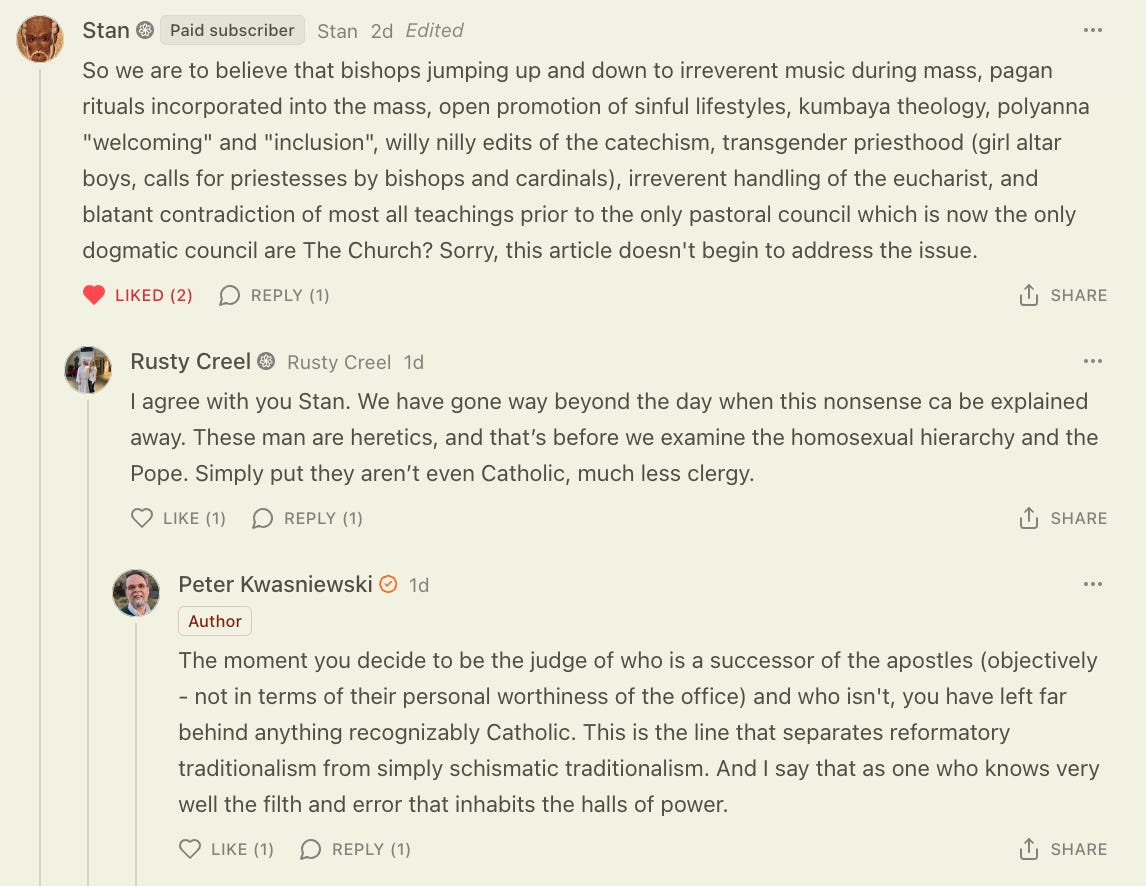
This revealing reply was made to certain commenters who found themselves unimpressed with Kwasniewski and Fr Crean’s “arguments” – or rather, the lack of arguments, and non-engagement with real arguments (as discussed in the previous piece).
In answer to Dr Kwasniewski’s claims about judgment, I am presenting an extract from my article “Archbishop Viganò and the Seat of St. Peter: A respectful reply”, published at LifeSiteNews in September 2026. This extract shows bankruptcy of such arguments about someone “deciding to be the judge of who is a successor of the apostles”.
This is because Dr Kwasniewski himself has decided to judge that Leo XIV and the bishops subject to him are successors of the apostles, and uses this as the basis for condemning those who disagree with him. One must judge that a particular person is or or is not a successor the Apostles, otherwise one cannot submit to him.
Further, as I wrote in the summary:
“[T]he location of our ‘examination’ is where it should be – i.e., in identifying the Church and the proximate rule of faith and praxis – whereas Fr Crean’s ‘examination’ consists in intervening a new proximate rule of faith and praxis in place of the teaching of the Church.”
The same applies to Dr Kwasniewski, who seeks to replace the teaching of the Church as our proximate rule of faith and praxis with, ultimately, himself and his own private studies and opinions – for instance, about what is and is not traditional.
In 2025, Novus Ordo Watch provided a list of Dr Kwasniewski’s judgments:
Pope St. Pius X’s Breviary reform bull Divino Afflatu is partly null and void
Pope St. Pius X’s revisions to the Roman Breviary were “impious” and “absurd” and “exemplified liturgical modernism”
Pope St. Pius X’s teaching on devotion and submission to the Pope is a “painful historical embarrassment”
Giovanni Battista Montini (‘Pope’ Paul VI) need not and should not be considered a saint, even though the man he considers Pope (Francis) solemnly canonized him as one
Francis’ Apostolic Letter Traditionis Custodes suppressing the use of the 1962 Missal “is absolutely null and utterly void from the first letter to the last punctuation mark”
Bishops who are removed from the government of their dioceses by the Pope for what they consider to be an unjust motive should refuse to accept this decision by defiantly clinging to power (an exhortation we have refuted here)
Priests should defy suppression of the Traditional Latin Mass, to the point of establishing independent churches if necessary until better conditions prevail
And, furthermore, he thinks using mostly the magisterial pronouncements from 1870-1958 regarding the Papacy is problematic.
No doubt this list has expanded since 2025.
In light of such judgments, his claim that “sedevacantists” are “schismatic traditionalists” – which would not be true, even if Dr Kwasniewski were correct (as considered here) – is more than a little ironic.
More of Dr Kwasniewski’s accusations
In response to a commenter sharing Zero Marks, Dr Kwasniewski falls back onto the arguments raised by Novus Ordo apologists on One Peter Five, he accuses “sedevacantists” of endangering their salvation, and of making themselves “like all the sects described by Ronald Knox in his famous book ‘Enthusiasm’”:
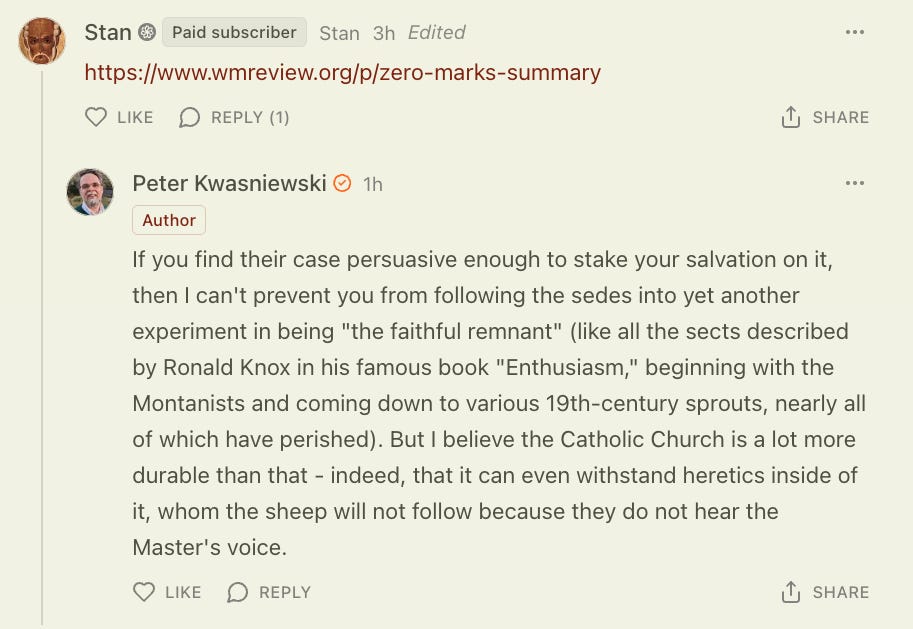
On the contrary, “sedevacantists” are no sect: they are simply those who have formed a certain conclusion. Some of them may organise themselves around this particular conclusion, and may even go to the point of making themselves a sect; others do only the former, or neither.
By contrast, the previous comment – in which Dr Kwasniewski refers to his party as that of “reformatory traditionalism” – he is accepting the un-Catholic position of the “high church” wing of the Conciliar/Synodal Church.
He says in the second comment above that he believes “the Catholic Church is a lot more durable than that” – but the durability that he proposes is that of the Anglican Church. The Anglican Communion is so “durable” that it continues to “exist” in spite of multiple warring factions which disagree, not about practical questions for a contingent crisis, but the most basic questions of the faith. For example, the disagreements in that “broad church” of Anglicanism include how to worship God, whether to baptise one’s children, how one receives revelation, and so on.
The Anglicanisation of Catholics – are we the ‘high-church wing’?
A side-chapel in the Conciliar/Synodal Church - Fr de Blignières’ proposal
This “durability” is purely naturalistic, human, and “legal”. The true durability of the Catholic Church, by contrast, is supernatural. She is endowed with certain necessary properties which she cannot lose; those who divest themselves of these properties do not harm the Church, but themselves lose any part in her. This is the very subject of Zero Marks and the associated articles. But Dr Kwasniewski cannot adhere to these truths, because the thread that he pulls in “rethinking the papacy” leads to the complete unravelling of other areas of Catholic doctrine too.
In short, accusing those whom he has decided are his opponents of being a “sect” is simply desperation.

But I think many of us “sedevacantists” would much rather be accused of being a sect, than actually be a party or wing in the Conciliar/Synodal Church. We would rather “stake our salvation” on the traditional teaching of the Church, rather than on Dr Kwasniewski’s programme of “rethinking the papacy” – presupposing as it does an unappetising mélange of Anglicanism, Eastern Orthodoxy and Old Catholicism.
A final note: the below engagement with Archbishop Viganò’s comments answer Dr Kwasniewski’s “objections”. Dr Kwasniewski has not made fewer declarations and judgments than Archbishop Viganò – as we have seen above. It should be simple enough to see the direct application of what follows to Dr Kwasniewski himself.
In the meantime repeat what I wrote at the end of the summary of Zero Marks yesterday:
“I once again invite Dr Kwasniewski – as well as Fr Crean, and anyone else who wishes to speak or write publicly on this topic – to desist from ignoring serious responses, and to engage with the arguments at hand.”
The extract follows.