
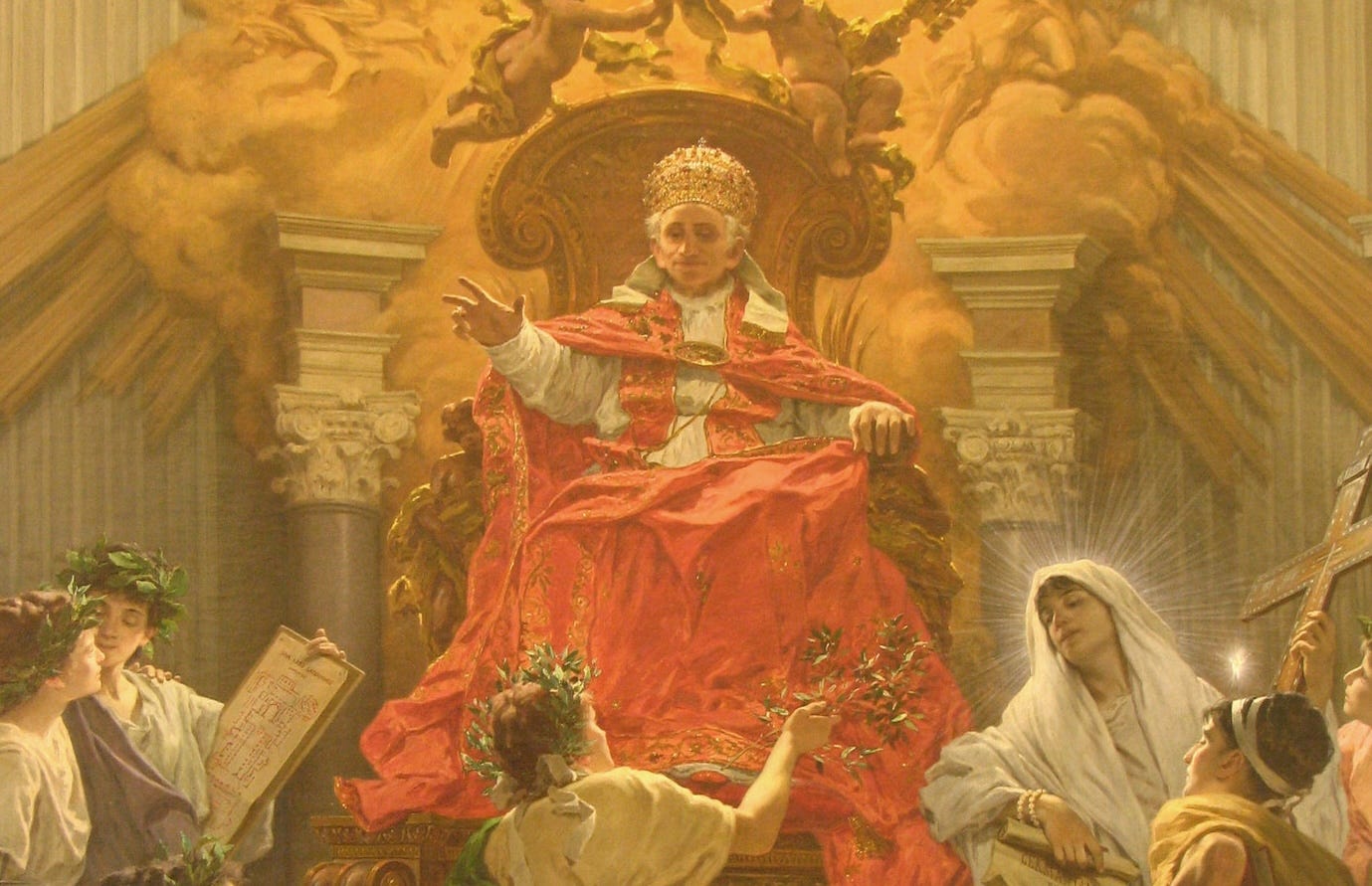
Is it possible that advocates of different positions on the crisis in the Church have been talking past each other?
Editor’s Notes
The following article, by Fr Piergiorgio Coradello IMBC, is republished from the Sodalitium magazine with the permission of the Mater Boni Consilii Institute. Fr Coradello was ordained in 2023 by Bishop Geert Stuyver.
The IMBC is an association of priests, religious and laymen that adhere to the “Cassiciacum Thesis” of Bishop Michel-Louis Guérard des Lauriers.
What is the Cassiciacum Thesis? It is based around the notion that a man can be the Pope formaliter (in which case, he is the Pope, and in possession of papal authority) or merely materialiter (in which case the “pope” is not in possession of this authority; he is not the Pope, but he is in a certain position that disposes him towards receiving that authority). The central claim of the Cassiciacum Thesis is that the Apostolic See has been vacant formaliter since at least 8th December, 1965.
This “Thesis” has been one of the principal fault lines dividing those who hold the Apostolic See to have been vacant since around the time of the Second Vatican Council. At times, this division has flared into fierce debate and animosity. In my opinion, this has sometimes been caused by the mode of argumentation and certain terms employed both by some advocates of the Thesis and by some of its critics (sometimes called “Totalists”).
Fr Coradello’s article takes a different approach to some recent presentations. He presents his claims in terms that show a greater degree of common ground than might have been obvious previously, and he takes the time to explain how certain conclusions follow even on the presuppositions of those who do not accept the Thesis. A chief interest of his work is that it opens up the possibility of reconciling aspects of the Thesis with some of the most cherished presuppositions of the “Totalists”, which have formed the basis of various objections.
However, Fr Coradello’s is not the only work that has opened up such possibilities. The following writings by Fr Noël Barbara, Fr Hervé Belmont and Fr Francesco Ricossa IMBC also appear to me to suggest as much:
‘The Cassiciacum Thesis’ – an explanation for the current crisis in the Church? (Fr Hervé Belmont)
Other Problems that the Popes of Vatican II Present to the Catholic Conscience (Fr Noël Barbara – Fortes in Fide, Series 3, Vol. 8)
Une consécration épiscopale valide est-elle nécessaire pour être Pape ? (Fr Francesco Ricossa – Sodalitium, n. 62, 2009, pp. 40–49)
At present, the Thesis is proving again to be a point of controversy. Under such conditions, an essay like Fr Coradello’s can give a clearer view of common ground and focus the debate.
For these reasons, I am grateful to Sodalitium and the IMBC for the opportunity to bring this article to the attention of our readers. It is preceded by Fr Aedan Gilchrist ICR’s Foreword to The WM Review’s republication.
Disclaimer: Needless to say, neither our publication of this text, nor the IMBC’s gracious permission for us to do so, represents a wholesale endorsement or acceptance of each other’s positions.
S.D.Wr.
Foreword to The WM Review’s Republication
Fr Aedan Gilchrist ICR
In an age that conspires against the contemplation of divine truth, one may rightly ask whether men are still capable of contemplation at all. The spirit of the world, the temptations of the flesh, and the subtle deceits of the devil increasingly militate against man’s vocation as the “animal rationale”, the rational creature composed of body and soul, and therefore against his higher vocation as a contemplative being.
Modern man seeks quick and facile answers, often comforting but misleading, preferring distraction to wisdom and utility to truth. Yet the soul was not made for distraction. Man’s natural end is the contemplation of the First Cause of all being: Ipsum Esse Subsistens, Subsistent Being Itself, God Himself.
But grace calls man to something even greater. Beyond the natural contemplation of causes, he is called to a supernatural contemplation of the inner life of the Triune God, of the Incarnate Word, and of the Mystical Body of Christ, that is, the Catholic Church, in which the divine life is communicated through grace, the gifts of the Holy Ghost, and the truths of supernatural revelation contained within the deposit of faith. In Christ, Truth is not merely known abstractly, but communicated personally to His members.
For this reason, the wisdom of Saint Thomas Aquinas remains indispensable. It has long been said: Ite ad Thomam, “Go to Thomas.” Indeed, we must go to Thomas; we must go to the Thomists. And in this present crisis in the Church, in this time of confusion and obscurity, I would also say: “Go to Michel-Louis Guérard des Lauriers,” faithful son of Saint Thomas and Saint Dominic.
To understand the intelligibility of the Faith, the nature of the Church, and the profound theological questions raised in our own time, one finds in Guérard des Lauriers not a spirit of novelty, but a contemplative theologian formed in fidelity to tradition. He sought neither controversy nor innovation, especially for their own sake, but rather endeavoured, with intellectual rigor and filial obedience to truth, to contemplate reality and the divine truths without compromise.
I wish to make the words of another priest my own, for they crystallise my thought:
“Father Guérard was a great theologian. Gifted with a keen metaphysical sense, he placed his unparalleled intellectual penetration at the service of a loving understanding of the revealed deposit. A profound and original disciple of the Common Doctor, with the surprising flashes of insight that often characterize genius—one thinks of a Cardinal Cajetan—Father Guérard was intellectually a man of tradition, open to all the sound intuitions of modern thinkers. He was one of the great representatives of the Thomistic current in the 20th century. The technicality of his expression, as well as the fact that many of his works are unfinished or unpublished, makes a thorough understanding of his thought difficult…”
It is therefore my hope that this commentary, humbly presented by Father Coradello, will render more accessible some of the deeper syntheses and theological insights of Guérard des Lauriers while remaining faithful to his thought and avoiding all misrepresentation. May it be of faithful service to the truth.
Saint Thomas teaches us that the way of wisdom is to proceed from what is more known to us toward what is more mysterious. We ascend, as it were, the steps of divine wisdom: from the evident to the obscure, from created effects to the uncreated cause, from visible realities to invisible mysteries. This ascent requires patience, humility, discipline, and above all charity. Father Garrigou-Lagrange reminds us that the theologian’s sacrifice is not merely one of time or intellectual labour, but of the whole man before the altar of truth. Theology demands purification. It requires that one sacrifice pride, vanity, and attachment to self in order to serve what is true rather than what is convenient.
This is especially necessary in times of crisis.
As Saint John, patron of contemplatives, stood faithfully beneath the Cross, not scandalised by the disfigured appearance of Christ in His Passion, so too must we avoid being scandalised when contemplating the Church undergoing this current trial and participation in the Passion in our own day.
The Mystical Body may appear, in some ways, obscured, humiliated, wounded, or disfigured before the eyes of the world, yet she can never be destroyed in her essential nature. To contemplate the Church in her participation in the Passion is not an act of despair, but an act of faith.
May we therefore imitate Saint John, the great contemplative disciple, remaining close to the Cross in silence, fidelity, and love. Our task is simple to state, though difficult to live: to seek the truth, to know the truth, to adhere to the truth, and to do the truth in charity. May all who encounter these pages find within them a source of contemplation, peace, knowledge, and deeper inquiry. May they discover not merely arguments, but an invitation to wisdom.
I thank the editors of The WM Review for making this commentary more widely available to the English-speaking world.
Our Lady, Seat of Wisdom, guide all who seek divine truth. Teach us never to be scandalised by what is difficult, but rather to embrace the intelligibility of the Cross and the salvation wrought by Christ our King.
And may Christ Himself, the Word Incarnate, Subsistent Truth, and Living God, teach us to know Him both in His Passion and in His Glory; to know His Mystical Body, the Church, both in her trials and in her triumph.
‘By what title…?’
Fr. Piergiorgio Coradello IMBC
From Sodalitium, issue no. 76, September 2025, pp. 6–27.
Introduction
Materialiter. It is difficult to find, in the non una cum world, a topic that causes more division than that of the materialiter papacy.
As our readers know, the Mater Boni Consilii Institute holds the Thesis of Cassiciacum. This thesis, the work of Father Guérard des Lauriers, was the culmination of his non una cum journey, which began with his rejection of the Novus Ordo Missae in 1969. Developed during the 1970s, and completed in the second half of that decade to provide a response to the emerging “crisis in the Church”, this thesis makes it possible to demonstrate that Paul VI and his successors are not Popes. Their behavior – habitually contrary to the glory of God and to the salvation of souls (the so-called “objective good-end of the Church”) – is incompatible with the purpose of the papacy. In fact, they demonstrate that they do not want it, whether consciously or not. Furthermore, some of their teachings lead to the same conclusion as they contradict the doctrine of the Church. This demonstrates they do not enjoy infallibility in teaching, which is one of the prerogatives of the papacy.
This, thanks to the thesis, is what we can confirm even as simple believers and priests – that is, as private persons. We must regulate our Christian life in accordance with this conclusion. It follows that to recognize as Pope someone who is not (someone who is actually working against the good of the Church), to celebrate or assist at a Mass in union with him, to follow his ordinances and teachings, means we are participating in such errors.1 On this point, all those who are faithful to Tradition are in agreement.
The thesis, however, postulates that, as private persons – priests and faithful – we cannot go any further. Although Paul VI and his successors do not have papal authority, an ecclesiastical, juridical authority is necessary in order to proceed to have a new and true Pope.2 Lacking this, the individuals in question, while not being true Popes, remain “popes” materialiter. This means that they retain what materially contributes to constituting a Pope. However they do not have that which would constitute them as such formaliter – that is, truly Popes – which is the papal authority that comes from God. They place an obstacle to this authority, whether consciously or not. Nevertheless, despite lacking authority, their condition allows for the continuity of the successors of the Apostles, a continuity that must last until the end of time (even if it is purely material continuity, and therefore one lacking in authority: we will talk about this again).
It is this point of materialiter that the so-called “totalist” sedevacantists dispute. According to them, Paul VI and his successors are not “popes”, not even materialiter, the Apostolic See is not in any way occupied. To be materialiter, and having even a passive role in the continuity of the Church would be to concede too much to someone who has no Authority in the Church. Therefore leaving other divergences aside,3 I propose to illustrate an aspect of materialiter and its consequences. To do this, I will explain the concept of a “title”.
I would like to remind you that I am not a theologian. If my intuitions regarding “title” are wrong, it is not my intention to misrepresent the metaphysics of Father Guérard des Lauriers. I also want to note that this article can be understood without taking into account the footnotes which go into specialized details that risk “disrupting” the flow of the article, especially for those who are not specialists in this field.
What titles are we talking about? What is a title?
The Latin word titulus originally indicated an inscription or an evaluation; in any case the Romans used it to mean qualifying something, illustrating it, explaining it.
We have all heard phrases and expressions such as:
“You are not entitled [non hai il titolo] to do this”.
“He became the sole heir [a pieno titolo].”
“He is the successor to a universal title [a titolo universale].”
“The court granted him an executive title [titolo esecutivo].”
“I told you this just for the record [a titolo di cronaca].”
“I am telling you this just for your information [a titolo informativo].”
“He provided a service free of charge [a titolo gratuito].”
“I have the title of purchase [il titolo d’aquisto].”
“You must get a travel document [un titolo di viaggio].”
In each of these examples, and particularly in the field of law, “proper title is the event, distinct from the material fact of delivering the thing, that justifies the taking of possession of it.”4
The title, in other words, legitimizes my taking possession of a good. A testamentary will justifies my taking possession of an inheritance; the discovery of an object that belongs to no one justifies my becoming its owner; and so on. This house is mine because I inherited it, this mushroom is mine because I found it, this object is mine because I purchased it, this salary is mine due to the work I performed under contract for it, I have these rights because of the office I received, etc. These are just a few examples to show how one cannot legitimately possess something or act legitimately without having a title to this possession or action. I cannot claim a movable or immovable asset, etc., and more generally a right, unless there is a cause that legitimizes my taking possession of it: in other words, I do not legally possess something unless I have title to it.
Note that title provides the justification, but it is not yet the taking of possession: the two may be more or less chronologically close, but they are not the same thing. If I conclude a purchase, the seller often immediately hands me the goods; however, for example, there is a passage of time from the death of a testator until the execution of their will! Therefore, title is prior to entering into possession, which is the final result. They are two separate things: the title presents itself as a condition for being able to have a legitimate possessor. It falls within the order of material causality (the material cause is the subject that will then become the final result).
What interests us in this article is title as it functions in the Church, not as to ecclesiastical goods (like benefices, incomes, moveable and immovable assets) but as regards ecclesiastical offices, and more precisely as regards the offices that entail the exercise of jurisdiction (that is, the public power to govern souls with regard to eternal life) and more generally of an ecclesiastical power. In this specific context, the title is the cause that allows one to obtain this jurisdiction or power.
In the Church, jurisdiction and the power of authority are always based on some title: to have the power to govern souls, it is necessary to have some right to it (conferred by the title). It is, in fact, a power that is both spiritual and visible, to be exercised in a spiritual and visible society (the Church); therefore the possession of this power requires first of all spiritual causes, but also visible causes; the spiritual part being the communication of power by Christ or by the superior and, if need be, the internal acceptance on the part of the elect; the visible part, the title, is constituted by mandate and, if requested, by the external acceptance on the part of the elect.5 If we were to deny that in the Church authority is always, even today, based on some title, we would admit the defectibility of the Church as Christ founded it; material and spiritual, both a human collective and the mystical Body of Christ, human and divine in every aspect, as its Head, so like its members.
In short, in every ecclesiastical office, to receive the corresponding power, a title is required, that is, a mandate that serves to qualify its recipient, to delimit the purpose, the possible actions, the time, the subjects, and the place of exercise of that power that is granted.
The questions we ask ourselves are: what type of title is necessary to justify obtaining ecclesiastical power? And what titles exist in the Church today? This is what we will try to better understand.
The kinds of title and their consequences
The law teaches that there are three kinds of titles: True title, Putative title, and Colored title.6 Of these titles, only the first is properly a title to something, while the others are false – and yet, however, as we shall see, they are actually titles and have their effects, and, as such, they are not without consequences. Let’s explain what is meant by each of them.
A True title. This occurs when a genuine right to the possession of something is actually granted. A few examples will help clarify.
Let’s take an author (of a book, a song, or an invention): for him, creation is a title to the possession of the thing and its fruits: the patent, the copyright, the intellectual authorship. Someone who, walking in a crowded place, finds a coin on the ground: it is impossible to know who dropped it; what in technical language is called “the seizure of an asset” which belonged to no one, is for him a title to the possession of the coin. A tree grows on my property without my having planted it, and begins to bear fruit: the so-called “accession”, that is, the increase of my property in a completely natural way is for me a title to possess the fruits of this tree. And finally, an example that each of us has experienced many times: any agreement among men, any contract, whether a hasty one made at the supermarket checkout counter or one for a large purchase, is a title to take possession of something: whether by sale, inheritance, donation, etc.
In the ecclesiastical sphere. A priest is appointed parish priest of a town: the appointment entitles him to the rights consequential to the care of the souls there. A cleric is entrusted with an apostolic visitation of a diocese: the mission given by the superior entitles him to have and to exercise the powers required for the task of the visitation.
In all the cases described, there was an event that fully legitimized a right.
A Putative title. In this case, while there was no grant, there is some reason that leads one to suppose the contrary. There is a presumption that some title exists: but yet in reality there is no real title! This pure presumption, which must be reasonable, and widespread (common),7 comes to constitute a title, called “putative”. In cases where the law provides, the putative title can legitimize a right.
For example, following natural law, the Italian Civil Code provides for “presumptive statute barred” (Article 2957): the law allows the presumption that, after a certain period of time, a debtor has satisfied his debt; and therefore, the creditor who has not collected the debt ceases to have any right to payment. And so the debtor, without any legitimate (nor even apparent) cause and therefore by a merely putative title (the law deems that…), becomes legitimately free from a burden, and is entitled to this freedom. Another example is usacapion: without any sale taking place between the de facto holder of an asset and the true owner, the former acquires it and the latter loses it: without any legitimate cause (not even apparent), and therefore thanks to a merely putative title, the possessor becomes the legitimate owner of an asset.
The Church supplies the jurisdiction to a priest who lacks the necessary jurisdiction to hear confessions, if only that priest has a putative title to it (Canon 209): for example, a priest who enters a Church that is not his own and sits in a confessional would easily be considered by the faithful to have title to hear confessions: by virtue of this reasonable presumption, even if that priest were without jurisdiction in that place or over those people, the Church supplies his jurisdiction, and the confessions would be valid (regardless of the intentions of this priest, who may be in good or bad faith).
And this supplied jurisdiction is provided not only in the internal forum of confession, but also for jurisdictional acts in the external forum: just as it is provided, for example, for the obtaining of an ecclesiastical benefice (Canon 1446).8
A Colored Title. The genesis of a true title occurs completely according to the rules; the formation of a putative title occurs through pure presumption; a colored title, on the other hand, is a middle ground between the two. This occurs when all the steps that would normally confer a true title are carried out, but the process is vitiated by some substantial and hidden defect that renders it invalid. It is therefore a null title, but one that appears, or seems to be valid by virtue of some legal presupposition; it is a title that has only the color of a true cause, only the appearance of truth, but lacks some essential attribute. It differs from a putative title because the latter is not supported by anything that could constitute a title, whereas for a colored title, there are flawed elements that seem to constitute a true title.
Even a colored title, in cases specified by law, is sufficient to justify taking possession; and it is important to note that a colored title is not transformed into a real title: it remains a colored title, and yet it still justifies taking possession.
An example is a “marriage” in which there is a hidden defect (one of the two engaged parties does not give a true consent, or is not fit for marriage): the exchange of consent, which normally constitutes a marriage, is vitiated, and therefore null and void, and there is no marriage; however the act took place, and thus has consequences, appearing to be true and legitimate (remember that the defect is hidden)! Children born of this “marriage” are legitimate and not illegitimate (Canon 1114); the putative spouses cannot contract a new marriage without having their “marriage” first declared null by the Church (Canon 1069 §2); in certain cases their union can be rendered valid by removing the obstacle that caused the nullity (Canons 1133-1136); the putative marriage can be rendered valid by the Church with a sanatio in radice, and by legal fiction its canonical effects become valid from the beginning, even when it was still null (Canons 1138-1139).9 And all this simply by virtue of the colored title of “spouses” possessed by these two people.10
In the case of the Great Schism, cardinals and other prelates of three obediences (Roman, Avignonese, and Pisan) participated in the conclave that elected Marin V during the Council of Constance, even though all of them were more or less doubtful, and at least those of two of the illegitimate obediences had only a colored title (and not true and real) to be cardinals and therefore able to participate in the election. It should be noted that the elect, although created a cardinal by the Pope of the Roman obedience, had separated himself from it to join that of the Pisan obedience, and had therefore been excommunicated by the “Roman” Pope.11
And all the examples given above for the putative title also apply to a colored title: the issue was debated before the promulgation (in 1917) of the new Code of Canon Law, but since the Code makes no mention of this distinction and refers only to “invalid title”, both types of invalid title (putative and colored) are sufficient for suppliance by the Church.
As we have seen, there are titles that, while not true, legitimize the possession of a right and/or allow the validity of certain acts, even acts of jurisdiction. As the reader may already intuit, these principles have consequences of great importance in the current crisis in the Church. Let’s examine them together.
Are we talking about… jurisdiction today?
Let’s be clear. About today’s difficult situation, we are not addressing the jurisdiction required for the internal forum [in practice, for confession; an interested reader can find the answer elsewhere12].
We will not speak of the ordinary jurisdiction proper to the external forum [the ordinary power of governance; let us recall, with Tradition and in particular with Pius XII, that bishops enjoy jurisdiction only by receiving it from the Pope, of whom we are, unfortunately, deprived13]. Even if one possesses a title, it does not confer jurisdiction, but is merely…a title to it. Having a claim to something is one thing, to receive that which is rightfully ours is another. In this sense, we are not speaking of the Pope’s jurisdiction, which can only come to him from Jesus Christ and by virtue of a title that is not essentially vitiated. In Montini and his successors, the absence of the objective and habitual intention to procure the good of the Church, an absence manifested by their actions, reveals to us that there is at least one essential defect in their title to the papacy (we will return to this). The current occupants of the Chair of Peter do not have a true title, and therefore cannot be in possession of the Authority. But does this mean…that they are totally devoid of a title? And are the occupants of the episcopal sees, and the “cardinals” also totally devoid of title? And are their acts without consequences? And can they not benefit from supplied jurisdiction?
We will address these issues separately (Point 1 for the pope; Point 2 for everyone; and Point 3 for the cardinals and bishops only).
Point 1 (a). The situation of the “pope”
How often have we heard: “It disgusts me to think that a Paul VI, or a Bergoglio, could have power in the Church”; “The permanence of the Church cannot depend on heretics, it is impossible”. It is an understandable revulsion; considering the heresies, the constant errors, the scandals of these figures, one is easily tempted to say: “These people cannot be anything at all in the Church.”
Let’s set aside the arguments ad absurdum against the hypothesis which sees the occupants of the Apostolic See as an absolute nothing, and therefore not even “popes” materialiter – arguments and hypotheses about which Sodalitium has already spoken.14 Let us simply try to analyze the state of things according to natural and ecclesiastical law.
First of all, let us apply to the papacy what we have said up till now regarding titles.
First of all, does it make sense to talk about “titles to the papacy”? Can anyone claim any “rights” to the papacy? I think so. Repeating the definition of title will illuminate the question: title is the event, distinct from the material fact of delivering the thing, that justifies the taking of possession of it. Do we find these elements in the process of assuming the papacy? Certainly there is something to take possession of (in a broad sense, obviously): and it is the Authority, with all that it entails (universal jurisdiction, infallibility, etc.). There is an event that justifies this taking of possession: and that is the election by the conclave along with the acceptance of the one elected [this acceptance must be upright, that is, internal15; and also manifested externally: we are made of body and soul!]. These two elements (the taking of possession, and its justification) are then distinct, as the definition of title requires: the “taking possession” of the papacy occurs with its conferral by Jesus Christ, while the justification (title) of this conferral occurs with the human process carried out first by the electoral body and then by the one elected.
Therefore, a title to the papacy exists.16
After this premise, it is a question of applying the principles to the facts. We need to distinguish between two slightly different cases: that of a Pope who ceases to be Pope (as could be the case with Paul VI), and that of an elected official who never becomes Pope (which is certainly the case from Albino Luciani to Robert F. Prevost).
In the first case we have a person who has lost possession of the divine Authority; he possessed this communication on the part of Christ but destroyed it through an objective defect in his own acceptance: this person’s will was to procure the good of the Church, and this was manifested in his acceptance of the election, but now that will is no longer such (due to objective modernism, liberalism, progressivism, etc). What remains of this person’s papacy? Substantially… nothing: he no longer possesses the Authority, having interrupted the communication, the “being with” Christ (Mt. XXVII, 20) that is the essence of the papacy: he has placed himself in a state of “capital schism” according to the expression of Fr. Guérard des Lauriers17; the papacy therefore is not there (formaliter). There is no upright and internal consent, as it has been deformed, whether consciously or not.18
This internal consent is flawed; and it is recognized as such to the extent that it is manifested externally (in a probable way by the sensus fidei of the simple faithful, in an evident way by our faith). This will, which is objectively contrary to the good of the Church, while being sufficient to vitiate the title of the elected person and to prevent him from possessing Authority, does not, however, annul the other two elements that constitute title to the papacy, namely the purely external consent, and the election. There is no papacy, but this aspect remains. While in fact this person is not the Pope, yet he is there: by virtue of his election (invalid or not), he appears to be the elect; by virtue of his external “yes”, he appears to have accepted the papacy. Whoever says that he has no title to be there must demonstrate that this person does not even have an appearance of title: the elements that are, in themselves, capable of constituting true title to the papacy are present, but one is flawed (internal consent) and the others by themselves are not sufficient to constitute it (they are the election and the only external consent). Until an Authority in the Church declares the consent to be deviant and until the “election” is not juridically quashed, whether or not it were invalid, this is the situation: the semblance of title remains. There are elements present that, in a more or less tenuous way, give an appearance (even sedevacantists, in fact, use the terms “impostor”, “false pope”, “antipope”, “usurper” for the “popes” of Vatican II, all expressions that signify a falsehood clothed and colored with deceiving truth). In other words, all the elements are present to at least meet the definition of a colored title: a null title, but one that appears valid by virtue of some juridical premise. Such a personage has at the very least a colored title.1920 Certainly, this situation is a monstrosity, the fruit and the cause of the lies whose father we know (John VIII, 44), but… it is something and not purely nothing.
It does not matter that the elected one’s defection is blatant as a consequence of his actions, and that therefore it is licit and dutiful for us not to follow them, and that consequently, from a certain point of view, the defect of this title is not hidden: it doesn’t matter, because any colored title, even in the civil sphere, can easily be identified as flawed by one or many private individuals; but until an authority with the power over this title intervenes, it remains such and exercises the influence foreseen by divine and human law, as the case may be. And in the Church, it is not the role of private individuals, even priests or bishops, to exercise acts that require authoritative power:
“Given that the Church is a wisely constituted society, the physical or moral persons authorized to declare the vacancy of authority are ipso facto juridically capable of carrying out the “provisio” [provision] of that authority. Therefore, let those who affirm: ‘The See is (totally) vacant’, and claim to impose on others the obligation to affirm this under pain of anathema, convene ‘a’ conclave; then we will stop taking them seriously”.21
The two facts described in the preceding paragraphs, namely that a certain apparently titled person: 1. does not lose everything, and 2. that the healing of such a situation is not in the power of just anyone – were intuited by those theologians who discussed the case of a “manifest (private) heretical Pope”, some proposing: 1. The necessity for deposition, but 2. on the part of an imperfect General Council; while others argued for at least 1. the necessity for a monition 2. from an authority of the Church.2223
The reader should note well: I am not saying that by virtue of their “colored” position, such a subject would obtain Authority. No, a false title (which is what a colored title is) is able to obtain the effect of a true title only by the disposition of the legislator. Now, in ecclesiastical law, a colored title can obtain a supply (of jurisdiction) only by the will of the Authority (which in our situation… does not exist or does not concern the present case). And by divine law, considering the nature of the papacy, it is contradictory to think that Christ would supply His own Authority to someone who objectively refuses it (the “being with” Christ is correlative; Christ is with Peter if Peter is with Christ and vice versa). For now, I am simply pointing out that this person is not just a pure “nothing”.
Point 1 (b). Situation of the post-conciliar “popes”
What we said in Point (1a) applies, mutatis mutandis, to those who have succeeded each other as “popes” after the presumed “first in the series”. The defect in their title does not consist in their failure of internal consent, but rather in the absence, from the very beginning, of such upright and internal consent: the mere acceptance of Vatican II is a sign of it. For them, too, the other two parts of their title remain: election and external “acceptance”.
Therefore, these subjects never had possession of Authority. In today’s conditions, some circumstances can multiply the defects of their title24; but defects are always and in any case juridically hidden (as they have never been authoritatively denounced); and with two elements of title that are always and in all cases present: election25 and apparent, external consent. The declaration of the title’s nullity must occur with the juridical (authoritative) denunciation of the defects that afflict it: this holds true for ecclesiastical law, for human law, and for natural law: before any authoritative intervention, the confessor presumed to be legitimate validly hears confessions; the debtor allows the prescription to run on, etc.
In short, even these individuals: A. Luciani, K. Wojtyla, J. Ratzinger, J. M. Bergoglio, R. F. Prevost, are not mere “nothings” in the Church. They have some title to be there – whether true or colored doesn’t matter. Now a title, as we have seen from the beginning of this article, is positioned on the side of the material cause, preparing the basis for a legitimate right, for a legitimate possession; and so, precisely for this reason, the “materialiter-ity” of these individuals cannot be denied. Materialiter describes the ontology of the question, while the “colored title” does so from a canonical point of view.
Canon law contemplates colored title (and therefore materialiter)
Let’s begin with an explanation of the terminology employed by Fr. Guérard and the law of the Church in this matter.
“An ecclesiastical office [OFFICIUM] is a charge [munus] instituted in a stable manner either by God or by the Church, which must be conferred in conformity with canonical prescriptions, and which, by its nature, entails a certain participation in ecclesiastical power, whether of order or jurisdiction.”
“The officium is founded on and measured by the munus, as is the relationship, by its foundation.”
The officium is the relationship of the hierarch (he who has jurisdiction in the Church) with Christ and his subjects. This relationship is given by Christ, but it is measured by the munus, the charge determined by the Church. In canonical terms, the munus is a simple charge; the officium is that charge united with a participation in ecclesiastical power.
The possibility of possessing a title without legitimacy (therefore a colored title – and therefore materialiter), far from being an invention, is implicitly contemplated by canon law.
“This is what Canon 151 demonstrates. It speaks, in fact, of an officium that is vacant de iure (by law), and yet this officium can still be illegitimately possessed. Now, if such an officium is vacant ‘de iure’, this means that the exercise of such ecclesiastical function, as specified by this officium, is NULLIFIED; meaning that, even if the aforementioned function corresponding to the said officium is materially exercised, the exercise has no effect. Thus, for example, if a pastor of a certain parish contracts a ‘civil marriage’, the officium: ‘pastor of such parish’, is vacant, this occurs ipso facto by the delinquent’s tacit renouncement from the moment the felony is ‘notoriously’ known (Canon 188 n. 5). In such a case, should this priest, who up to that moment was a functioning parish priest, continue to perform the same acts as before, these acts, insofar as they formally pertain to the officium of a pastor, are null; and the faithful of that parish must take no account of them. This priest, because of the offense he has committed, has rendered himself metaphysically and canonically unfit to PARTICIPATE in ecclesiastical authority as pastor. More precisely, this priest NULLIFIES for himself the OFFICIUM of which he was, until then, invested.
When the officium is vacant, the bishop must provide for it. But he must, according to Canon 151: first, declare that this officium is still illegitimately possessed [therefore, there is an apparent and juridical titularity that remains, despite the office already being vacant; and declaring it falls to the bishop who has ecclesiastical authority, and not the parishioners or any other person, n.d.a]; second, the bishop must mention this declaration in the ‘canonical provision’ that installs the new pastor. The Code of Canon Law thus recognizes as a possibility that an officium may be ‘possessed illegitimately’ by a cleric who has nevertheless nullified for himself the OFFICIUM that corresponds to this officium. Now, it would evidently be meaningless to claim that there can be possession, even if ‘illegitimate’, of a thing that in fact no longer exists. It would be meaningless to claim that the cleric who contracts a ‘civil marriage’ can possess, although illegitimately, the OFFICIUM that he nullifies ipso facto. What this cleric still possesses of the officium entrusted to him is that which in this officium is distinct from the OFFICIUM: it is the MUNUS. Indeed, the canonical provision that had established the delinquent priest as pastor of that parish still remains; it has, in the Church and by virtue of the Church, an objective effect that does not depend on the particular person from whom it emanates (Canon 183§2). To annul this canonical provision and the MUNUS which is formally its effect, a canonical ‘process’ which makes executive a judgment rendered in the Name of Christ himself is necessary. We see then that the MUNUS and the OFFICIUM can truly be separated, with the former, and it alone without the other, concretely subsisting in the person who ‘possesses it illegitimately’”.26
What is a munus [charge] that is possessed but illegitimate; that is, a canonical provision rendered null, but continuing to exist; without power and yet not declared as such; nor revoked by the authority; what is it, if not a more or less ostensible title, but without reality, and therefore, a colored title? The Code establishes a principle, it follows the nature of ecclesiastical things; it does not apply it to the papacy, but the principle remains, and, as we have seen above, it can and should be applied to the papacy. In the same way, the distinction between the formal point of view and the material point of view is not Fr. Guérard’s invention who, however, had the merit of applying it today to the papacy [St. Antoninus had already done so in the past27].
“When the Sessio ceases following a crime, between the instant in which the crime is notorious and the instant in which the sentence of the Church has executory force, the munus remains and is possessed ILLEGITIMATELY, but the officium is destroyed.
[This is the case provided for by Canon 188: the ‘renuntiatio tacita’ (tacit renunciation) expressly concerns the officium, not the munus. And such is currently the case of Wojtyla: he is deponendus [must be deposed] because he is burdened by a capital schism that only he can end, and he is ipso facto deprived of the officium (he is not the Pope FORMALITER); but he still ILLEGITIMATELY has the MUNUS (he is ‘pope’ MATERIALITER), until the Church affirms and promulgates that he has constituted himself as depositus]”.28
“Depositus [deposed] concerning the exercise of the function, deponendus [to be deposed] concerning the qualification, certainly illegitimate yet juridically real, that still remains inherent to the person”.29
We should note that the munus-officium distinction does not introduce the possibility of: on the one hand, a shepherd or Pope who truly is such, but without any power; and on the other hand, a shepherd or Pope who holds their power merely as an adjunct. It is not a distinction between being and power. No, rather it is the following distinction: on the one hand, the munus, which is the bare office received, the designation, the provision; and on the other, the officium, which, alone, is the receiving of the power over the Church, communicated by Christ; this communication is the only one that truly constitutes being a shepherd or a Pope in reality. We will explore this fully later on.
Some objections
Numerous traditionalists have advanced arguments to exclude any claim of title, even a coloured one, to the “conciliar popes”; let’s analyze the principle ones.
First objection: The elections of the “conciliar popes” are invalid because… the elected person is not eligible and/or the electors do not have the power of election, as they would be excommunicated (Can. 167 §1 n. 3). Others have studied this question specifically.30 In order to remain within the scope that I have proposed, I limit myself to observing: what Authority has ever juridically declared or denounced the excommunications that would vitiate such nominations, proceeding then to the forfeiting of these apparent titles…?31
The same can be said of the hypothesis according to which the elect and the electors would not be eligible because they belong to heretical and schismatic sects, in short, they would be outside the Church; setting aside the fact that no Authority has ever attributed these qualifications to Vatican II, I respond: Has there ever been an authoritative denunciation of the membership of these individuals in heretical and schismatic sects, a membership that would vitiate their appointments? Has there ever been an authoritative and legal nullification of this colored title that exists in fact?
Some people argue that the “popes” of Vatican II are ineligible because of their subjective heresy, following the decree of the Bull of Paul IV. One could give a specific response,32 but to stay on topic I will address the core issue: even if Paul IV’s Bull were to apply, this would simply mean that the elected person would not have the aptitude to become the Pope; however he would remain “pope” materialiter because of the fact that the election has occurred, and this juridical fact is sufficient to confer a colored title – even if it is impossible for the designated person to become Pope (also) because of the Bull (and not only due to the mere lack of objective intention to procure the good of the Church).
In short, what authority of the Church has declared these ineligibilities? No one, because we are without an Authority. Lacking an authoritative denunciation, even an ineligible one maintains a purely colored title until his election is annulled. The arguments described above all emanate from “totalist” circles, arguments that cannot be invoked unless supported by a denunciation holding ecclesiastical authority, and thus having juridical validity.
In this regard, it is of interest to note what Father Zapelena S.I. wrote about the power that someone outside the Church can have:
“That someone who is not a current member of the Church could be a subject of ecclesiastical jurisdiction results [also] from two proofs: the first is that even a manifestly heretical priest has jurisdiction to absolve a faithful who is suffering from a terminal illness, something admitted by all theologians; and then from the fact that the separated priests of the Eastern Church [schismatics] have, by tacit papal concession, jurisdiction to absolve sinners in the sacrament of penance, and this not only in the extra-ordinary case of serious illness, but in ordinary and daily cases of Christian life.33 It is true that in these cases jurisdiction is being dealt with in the internal forum; but jurisdiction in the internal forum does not differ in kind from jurisdiction in the external forum: and therefore it must be concluded that the intimate nature of jurisdiction does not essentially require that its possessor be someone who is a current member of the Church”.34
Along the same lines, we know for certain from canon law that an excommunicated person can exercise jurisdiction (and every heretic is excommunicated). Theologians then commonly admit that a bishop who is secretly a formal heretic does not lose his own jurisdiction3536. Many claim this also of the Pope, and not only as a “secret heretic” but also as a “private heretical doctor”.37 A note to the reader: I am not saying that a “pope” who teaches heresies, or who objectively does not want the good of the Church, or who was elected in a fraudulent manner, is Pope: I am only pointing out that a heretic and a schismatic, whether secret or manifest, can have a false title that even allows them to have jurisdiction and some power and role in the Church; which is already much more than what we will be interested in saying further on in this article!
Another type of objection maintains the intrinsic invalidity of G. B. Montini’s election, due to coercion over other electors. Similarly, many who discovered they were sedevacantists only upon the arrival of J. M. Bergoglio maintain his illegitimacy is due to a flaw in the election: whether because of a paradoxical will of J. Ratzinger, or because of cardinal meetings held prior to the conclave (forgetting, however, the meetings held in the home of Umberto Ortolani before the election of their “saint” Paul VI).38 As for the election of Bergoglio’s successor, some are already saying that the conclave is invalid, either due to the appointment of cardinals, or their number.
To all of them, we repeat: even admitting but not conceding that there is an intrinsic defect in the election, what authority in the Church has denounced the defects of these elections? In the absence of an authoritative denunciation, even an invalid election, until it is quashed, contributes to the creation of a colored title:
“The existence of a possible obex [impediment], discovered a posteriori, whether in the ‘Conclave’ that elects him, or in the person thus chosen, is not sufficient to invalidate this person, he is, at least provisionally, ‘pope’ MATERIALITER. This is because an indisputable fact, BUT WHICH IS NOT OF THE ONTOLOGICAL ORDER, cannot be immanent to Divine Norms themselves. Such a fact, therefore, can only have value and FORCE in the Church by virtue of an order and a promulgation made by the authentic Authority of the Church”.25
The indisputable fact is (possibly) the invalidity of the election; however, Divine Norms demand the intervention of the Church to sanction this fact; on the other hand a colored title exists by natural right and is therefore an ontological fact.
These objections fundamentally miss the mark, because they fail to consider what is necessary: the Church is a society both human and divine, and for this reason in the cases described the intervention of the Authority is required (or a public and explicit admission from the elect, which, given human psychology and even more so the psychology of the modernist, will happen with difficulty). For the same reason, it must always be possible for a Pope to be elected in the ways established by Jesus Christ, by the hand of God but with the cooperation of human means that He himself established once and for all in the apostolic hierarchy. And for the same reason, a “conciliar church” distinct in all respects from the Catholic Church does not juridically exist.
Point 2. What “power” can the acts of the individuals described in Point 1 hold within the Church?
Thus, materialiter exists; proven also by natural law, divine law, and ecclesiastical law: it corresponds to a colored title.
What can be said, then, of its effects? Is it possible that a colored title would have effects? If yes, what are they?
In the preceding points, we have seen that until an authority with power in the field intervenes, an invalid title remains nonetheless a title. This means that it exercises influence provided by law.
The “popes” in question are “popes” only in appearance, they are not Popes: however they have a title, at the least, a colored one. They are also clearly convinced of the opposite: they behave as if they are Popes, they teach, they govern (what they teach, and in what direction they govern, is another matter); naturally without any Authority or jurisdiction; but in “governing”… they make appointments. And who are appointed, specifically, as “bishops” and “cardinals”? People in the same condition, who manifestly do not desire the objective good of the Church, and therefore are unfit to govern their portions (dioceses, curia, etc.). In short, a “nomination” flawed in both its terms: in the person designated (as “bishop”, “cardinal”) who poses a hidden flaw, and in the designator (“pope”) who lacks all the ordinary requirements for appointing. And yet… the designator is not a nobody, indeed in some respects he appears to be a legitimate designator.
What he poses is a flawed act, but… it is an act (not in the sense of a valid, juridical, authoritative act; but it is still a human and public action!). It is a colored act. To be precise, it is colored by the “mere materialiter-ity” of the one who acts. From Montini to Prevost, the elected are not true Popes; their actions, however, are vested with a purely colored titularity; they are not Popes, the acts they perform are empty, and yet… Are these colored acts sufficient to confer at least a colored title to those they designated (“bishop”, “cardinal”)? Remembering the conditions for which a title is colored, it seems so: a colored title occurs when everything that would confer a title is put into effect, but it is tainted by some substantial and hidden defect, which makes the title invalid. In our case, it seems that there is a legitimate designation, but this is not the case: therefore, until they are legally quashed, the “cardinal” and the “bishop” have a colored title to the cardinalate or bishopric.3940
We will talk about this again in Point 3.
But first we ask ourselves: does a colored title allow for the performance of some act that has validity, in the hypothesis that an act posed by the holder of a “colored title” requires jurisdiction or some real power to have value?41
A colored title confers no power, it is not a true title. But above, we have seen how the State and the Church in certain circumstances supply the power, in such a way that even a colored title can issue valid acts. What about the case we are interested in, that of the Vatican II “popes”?
We can exclude the efficacy provided for colored titles by ecclesiastical law.
Is it possible, then, for Jesus Christ Himself to intervene, with the justification of a colored title, to give an effect to some act of the title holder? That Christ could provide jurisdiction is beyond any doubt (ultimately, it is from Him that all jurisdiction originates); that He could do it without the mediation of the Pope, is also beyond doubt regarding His absolute power (it implies no contradiction). But it also seems certain that He can do this with His ordered power (otherwise, ad absurdum, all jurisdiction would disappear with the death of every Pope; and as long as the current crisis endures, there would perhaps be no more sacrament of penance, which requires the confessor’s jurisdiction over the penitent).
“The hypothesis of suppliance on the part of Christ is not without foundation, even among the Authors. Billuart, O.P., for example, supposes it in the hypothetical case of the ‘heretical pope’.
“‘It is a common opinion’, writes Billluart, ‘that Christ, for the common good and the tranquility of the Church, with a special dispensation, grants jurisdiction to the manifestly heretical pope [heretical as a private doctor], as long as he has not been declared as such by the Church’ (Summa Sancti Thomæ…, t. IX, Tractatus de fide et regulis fidei, obj. 2°). [Here Billuart supports even the suppliance of Authority of jurisdiction, which cannot be admitted in our case].
“Timoteo Zapelena S.I. also hypothesizes a supplied jurisdiction, albeit limited, granted by Christ to ensure the continuity of the Church. Examining the case of the Great Western Schism, after having explained that the legitimate Pope was the Roman one, the Jesuit theologian considers what would have happened if all three ‘popes’ of the Western Schism were to be ‘doubtful’, and therefore, ‘null’. Would the Cardinals and Bishops designated by them all have been invalid? According to Zapelena, in this hypothetical case, ‘one would have to admit a supplied jurisdiction (based on the colorer title), not on the part of the Church, which does not have supreme authority, but on the part of Christ Himself, who would have granted jurisdiction to each of the antipopes as it was necessary’, that is, only for the designation of Cardinals (and Bishops) fit for the election of a Pope (op. cit. p. 115). The case analyzed by Zapelena is very similar to our own. If Billuart hypothesized supplied jurisdiction for a manifestly heretical pope, and Zapelena hypothesized it even for an antipope, there is no reason why this supplied jurisdiction would not be theologically possible also for a ‘pope’ materialiter, – limited, of course, to those acts necessary to ensure the continuity of the hierarchical structure of the Church, which is postulated by faith in the promises of Our Lord”.42
The explanation given by Abbé Lucien in illo tempore, can also be traced back to an intervention given by Christ thanks to a colored title: at present, Christ, the principal cause of divine action in the Church, cannot exercise the principal part of his spiritual mission (missio) by making use of the hierarchy and the occupants of the seats of authority (sessio) because they pose an obstacle to it. However, He can exercise the missio by making use of them as regards its secondary purpose: to maintain the existence of His Church as a visible society (The gates of hell shall not prevail…). Indeed, the sessio is essentially ordered to the missio; but from a secondary point of view, the missio is for the sessio (to perpetuate it).43 How does this happen? Bishop Guérard, in writing about the co-optation into hierarchy, wrote: The officium (in the case in question: the participation in some responsibility in the Church) is received by the hierarch through a Communication exercised by Christ to the hierarch; while the munus (the charge, and in our case: the juridical title), the foundation of the aforementioned relationship between the hierarch and Christ, is received by the hierarch through a Communication exercised by Christ but through the mediation of the Church.
“The modalities of this causality [that of the Church towards the hierarch] are extremely different: be it character conferred with the sacrament of orders, be it canonical provisions…; but ecclesiastical mediation is an essential component of this causality.
“So that from this point of view, the Communication exercised by Christ consists in applying at any moment Church’s causality to the operation that is proper to it, in the precise way that Christ established it.”
And here one could add a possible intervention in favor of today’s “diminished” operation, which is a purely material ecclesiastical mediation, that is, subsisting in colored titles and colored actions, but it is, in fact, still a mediation – and ecclesiastical mediation inasmuch as it is juridical (as a colored title; indeed, “the MUNUS remains, until the ecclesiastical causality of which it is the effect is annihilated.”)44 The colored title is not nothing. It is a juridical institution founded in natural law. It seems to be sufficient for a jurisdiction suppliance, an intervention by Christ who makes use of a purely juridical ecclesiastical mediation absent of the Authority; this is in conformity with the prerogatives of the colored title and the causality of Christ toward the Church.
Indeed, under certain conditions, with a colored title, the foundations for an intervention by Christ are all there, on His part and on the part of men.
Divinely, Christ always retains in existence things which are necessary for the good-end of the Church. It is only by moral necessity (albeit founded in natural law) that, as we have seen above, the Church or the State is moved to supply, only for specific and determined acts, to someone who has only a colored title, who would normally have no right or power. But in the case we are dealing with, the need for Christ’s intervention is rather that absolute of the good-end of the Church, and necessary for the veracity of Christ’s promise, a promise that postulates the perpetuation of the apostolic sees (The gates of hell shall not prevail…see note 47).
Juridically, the colored title we have been discussing in the preceding points seem to be both a sufficient legal basis to guarantee an intervention on the part of Christ, and also as an ultima ratio [last resort] to justify it if necessary.
Point 3. Situation of post-conciliar “bishops” and “cardinals”
Let us now turn to the “bishops” and “cardinals” who accept the Second Vatican Council. Before we return to the current case, that of “bishops” and “cardinals” appointed by materialiter “popes” who therefore have no authority, we must make a clarification regarding those prelates initially appointed by a true Authority: they had been appointed and had received jurisdiction – therefore having true title – from a true Pope up to Pius XII (or John XXIII until proven otherwise). Their adherence to the “capital schism” that began with Vatican II did not invalidate all the rights of these individuals: it made them lose, de facto, responsibility for the Church, as well as the faculty to carry out valid acts in the Church. However it did not remove, for the reasons set out in the preceding paragraphs, an appearance of legitimacy that was never authoritatively denounced, and therefore did not remove a colored title.45 The solution for their situation is speculatively simple: once the obstacle (adherence to Vatican II) has been removed, they would regain full rights and powers; once their will, objectively contrary to the good of the Church, was removed, the residential bishop or cardinal would regain his full status as such. Currently, the bishops and cardinals who had jurisdiction prior to the Council are all deceased.
What can be said, then, for the “bishops” and “cardinals” appointed by G. B. Montini and up to today? They face the same difficulty that was described for the post-Conciliar “popes” (see note 25): the flaw in the titles of bishoprics and cardinalates is no longer simply one (the flaw in their intention), but there is also a flaw in the person who appoints these “cardinals” and “bishops” (they are not appointed by a Pope). Continuing this parallel and arriving at the acts carried out by these “bishops” and “cardinals”, it seems that their value follows that of the acts of the post-Conciliar “popes”: their being “bishop” and “cardinal” is a colored title to the power to elect, therefore their acts of election are at the very least colored acts, and therefore the titles they claim to confer are “colored” as well, they give the appearance of legitimacy, and therefore allow for the colored, materialiter transmission of the occupation of hierarchical sees and the designation of a Pope when circumstances will require it.46 Moreover, according to what is established in Point 2, these acts can guarantee an intervention on the part of Christ and therefore the potential for re-establishing order in the Church, if only the obstacle: adherence to Vatican II, were removed.
And this is the minimum that anyone who believes in the apostolicity of the Church must admit: it is necessary that there exist people canonically authorized (at least by a colored title) for a papal election; the Church cannot remain totally deprived of electors of the Pope.47
Conclusion. What does the existence of colored titles entail?
We have seen how the juridical “color” of offices, and the juridical “color” of the acts and offices of “popes”, “cardinals” and potentially the “bishops” of the Council and the Post-Council is a fact confirmed by natural and ecclesiastical law. It corresponds on the canonical side to the ontological materialiter explained by Fr. Guérard; it ensures the continuity – only material, but nevertheless necessary – of the apostolic succession with regard to the hierarchy of jurisdiction. And it is adequate for an eventual divine suppliance for certain specific acts.
I hope that with this article Sodalitium has made a small contribution to showing, as Fr. Guérard said in essence, that “the perpetuation of a ‘hierarchy’ which is only MATERIALITER is not, ex se, impossible”.48
HELP KEEP THE WM REVIEW ONLINE WITH WM+!
As we expand The WM Review we would like to keep providing free articles for everyone.
Our work takes a lot of time and effort to produce. If you have benefitted from it please do consider supporting us financially.
A subscription gets you access to our exclusive WM+ material, and helps ensure that we can keep writing and sharing free material for all.
You can see what readers are saying over at our Testimonials page.
And you can visit The WM Review Shop for our ‘Lovely Mugs’ and more.
(We make our WM+ material freely available to clergy, priests and seminarians upon request. Please subscribe and reply to the email if this applies to you.)
Subscribe to WM+ now to make sure you always receive our material. Thank you!
Read Next:


While I believe that the principles in the below article are correct, it is worth revisiting in light of the comments in this essay, particularly regarding Can. 151.

Follow on Twitter, YouTube and Telegram:
Twitter (The WM Review)
Sodalitium has spoken previously at length about what this situation entails for the faithful of Tradition, especially with regard to una-cum:
The interested reader will find an in-depth study and many references on this subject, especially on who this “juridical authority” is, in FRANCESCO RICOSSA, L’elezione del papa, in Sodalitium n. 55. This article is also available on our website: https://www.sodalitium.biz/lelezione-del-papa/ [English: https://www.wmreview.org/p/who-can-elect-a-pope-fr-ricossa]
Other differences between the supporters of the Cassiciacum Thesis and the totalist sedevacantists are: the reasoning used to demonstrate that Paul VI and his successors do not have Authority; the qualification of bishops consecrated without a Roman mandate; and the origin of jurisdiction. The interested reader will find a simple critique in the text La situazione attuale della Chiesa e la Tesi di Cassiciacum, in Sodalitium n. 29 pp. 19-34. I remind you that many issues of our magazine are available free of charge at https://www.sodalitium.biz/sodalitium/ [English: https://www.sodalitiumpianum.com/sodalitium-magazine/ ]
PAUL GIRARD, Manuel de droit romain, Paris 1906, p. 304; cited in RAOUL NAZ, Dictionnaire de Droit Canonique, Letouzey et Ané, Paris 1957; entry Titre, tome VII coll. 1275-6.
Here we use the term “elected” in the broad sense, which also includes a simple appointment by a superior, without any voting on the part of a college.
That the election is a title is clear from the definition of title itself: the event, distinct from the material fact of delivering of the thing, which justifies taking possession of it. By being elected to an office, I have some rights to that office: the right of priority, the right of access, etc.
Every canonist talks about it; one particularly clear exposition is given by FELICE CAPPELLO S.I., Summa Iuris Canonici, Gregorian University, Rome 1932, tome I, nn. 254-270.
Canonical note: as to the jurisdiction supplied by the Church, authors dispute whether it is necessary for the error to be effectively widespread, or if the mere existence of a foundation that, of its own, generally leads to error is sufficient. Regardless of this discussion, “as to common error, when there is positive and probable doubt, of either law or fact, nothing prevents the full use of canon 209: ‘In common error or in positive and probable doubt either of law or fact, the Church supplies jurisdiction in both the external and internal forum’” (RAOUL NAZ, op. cit., entry Erreur commune, vol. V col. 444).
Since we are mentioning it and will return to it, let us recall the meaning of supplied jurisdiction, and above all its purpose (the highlights are mine):
“To supply jurisdiction is to confer, for individual actions, the necessary power to act validly, a power that the superior or acting judge does not have, not by office nor by delegation. Therefore, this power exists neither before the action nor after it, and the superior or the judge are correctly said to have no power (habitually), even if it is not without power that they perform an act. Indeed, where no impediment of natural or divine law opposes it, the Church can supply jurisdiction, and this is so that someone who must act, and seriously doubts his own power, can act securely with the certainty (of the suppliance), or so that the faithful, who are in good faith, are not harmed because of the error or malice of the superior”
(VERMEERSCH-CREUSEN, Epitome iuris canonici, Dessain, 6th edition Malines 1937; tome I n. 322).
The principles governing supplied jurisdiction apply to any power; Vermeersch (n. 211) after having proposed an example, he cites the textbook by Cardinal D’Annibale which I consulted:
“Of course, common error supplies for those things which pertain to the state and condition of persons, as far as these are required by law, whether civil or canonical, in order that something can be done validly; and there is no need for a colored title: as in someone who is publicly held to be a citizen…a father of a family…a wife…a clergyman…a son”
(GIUSEPPE D’ANNIBALE, Summula theologiæ moralis, Tipografia San Giuseppe, 2nd edition, Milan 1881; p. I n. 79 note 75).
A similar and more ordinary case is that of a Pope who provides supplied jurisdiction for dispensations and absolutions granted by someone who at the time did not really have the power or the jurisdiction, but seemed to have them (that is, he had a colored title; some historical examples: Clement XI on 3/12/1721 for the acts that the Patriarch of the Maronites had carried out after he had been deposed, in Iuris pontificii de Propaganda Fide, Poliglotta di P. Fide, Rome 1889, p.1 vol. II p. 344; Benedict XIV on 7/20/1846 for the acts that Maronite bishops had carried out after being under censure, ibid. vol. III p. 289).
Sodalitium has already spoken on this marriage case in https://www.sodalitium.biz/risposta-gia-data/
Cardinal Franzelin notes:
“It is on this provision of law, that is, the colored title, that numerous decrees promulgated at the time of this schism are based, especially that of Alexander V at the pseudo-Council of Pisa: ‘By certain knowledge and with the approval of this sacred Council, we ratify and approve all dispensations made by the bishops in the neutral parts (who had not adhered to any pontificate)… and all absolutions and habilitations in the penitential forum [and collations, provisions, translations in the external forum] given during the schism both by the contenders (Gregory XII and Pedro de Luna) and by the aforementioned Ordinaries’ (Harduin. T. VIII p. 22)”
(JOHANN BAPTIST FRANZELIN, De Ecclesia Christi, Poliglotta di P. Fide 1887; thesis 13, at point 5, note 1 of Scholion).
We refer the reader to M.-L. GUÉRARD DES LAURIERS, Intervista… in Sodalitium n. 13. This famous interview was included in the collection Il problema dell’Autorità e dell’episcopato nella Chiesa [The problem of Authority and of the Episcopate in the Church], published by Centro Librario Sodalitium: https://www.sodalitiumshop.it/prodotto/il-problema-dellautorita-e-dellepiscopato-nella-chiesa/
And also available on our website: https://www.sodalitium.biz/intervista-a-mons-guerard-des-lauriers-o-p-sulla-tesi-di-cassiciacum/ [English: https://www.sodalitiumpianum.com/interview-bishop-guerard/ ]
One can also see M.-L. GUÉRARD DES LAURIERS, Déclaration… in Missio et Sessio, a supplement to Sous la bannière, n. 7 of Sept-Oct. 1986. ANTHONY CEKADA, Traditional priests, Legitimate Sacraments (2003) (http://www.traditionalmass.org/images/articles/TradPriestLeg.pdf ).
Is there a need for a title even in these cases? The general principle is that in the Church, all jurisdiction is founded on a title. According to some of the authors cited, the jurisdiction for confessions in the current situation is supplied directly by Christ. This does not preclude the confessor from having a true title, given radically in priestly ordination and actualized by the need of souls (a need that would otherwise be unsatisfiable). If there were no need for any title, the door would be opened to any (arbitrary) mediation on the part of Christ, as can be seen in the phenomenon of conclavism. We wrote about it in Seconda parte: commento di Sodalitium, in Sodalitium n. 52 (special edition on the “canonical commission” of the SSPX) pp. 26-27. On this question, Father Ricossa has also recently spoken responding to a priest of the Society of Saint Pius X https://www.sodalitium.biz/un-livornese-a-nantes-medice-cura-teipsum/ .
Sodalitium has already written on the provenance of this jurisdiction, for example in L’Autorità del Vescovo: viene tramite il Papa o i fe deli? [The Authority of the Bishop: does it come through the Pope or the Faithful?] in n. 27; and more broadly in n. 52 pp. 36-41.
La situazione attuale della Chiesa e la Tesi di Cassiciacum [The Current Situation in the Church and the Thesis of Cassiciacum] in Sodalitium n. 29 pp. 19-34. Footnote n. 7, by the editorial staff of Sodalitium, to the second part of Il papato materiale [The Material Papacy] by the then FATHER DONALD SANBORN (in Sodalitium n. 48 pp. 35 36; the work was published by the CLS https://www.sodalitiumshop.it/prodotto/il-papato-materiale-de-papatu-materiali/ ).
And then the article cited in footnote 2 of the present article.
Let us clarify what “internal acceptance” means. There is a side of acceptance that is external: it is a “Yes” pronounced externally. Internal acceptance, on the other hand, is rightly consenting to exactly what one should consent to. Now, it can happen that, even in good faith, this internal acceptance is not correct, meaning it doesn’t concern what is required to be accepted, but rather something else entirely. In that case, and if the subject, either in ignorance or in bad faith, pronounces a “Yes”, it is a purely external acceptance.
In the first volume of his De Ecclesia, thesis 29, Cardinal Billot also thinks that election to the papacy is a title:
“The legitimate election as bishop of Rome being the title to the succession of Peter in the primacy over the whole Church, etc.”
More generally:
“Once the designation has been completed, the elected person acquires the ius ad rem (to the office they are elected to), which becomes ius in re by the acceptance by the elected person”
(MATTEO CONTE A CORONATA, Institutiones iuris canonici, Marietti, Turin 1928; vol. 1, no. 222). This is a point shared by all Catholic authors (for reference, see NAZ, op. cit., entry on Élection, vol. V coll. 237, 245).
However, other authors together with the Code of Canon Law (Can. 109) call the election more broadly the “condition” of the appointment (Franzelin, Cappello); and distinguish it from the granting of the title and from the introduction into possession (WERNZ-VIDAL, Ius canonicum, Gregorian University, Rome, 1937; t. III n. 523). This suggests that the election is not the sole constitutive element of the title. Election alone does not confer ius in re (the right to act on the thing which one already has in possession), this is a settled matter. For example, the simple fact of being named an heir does not make one the possessor, so the simple fact of being the elected person does not make one invested with authority. In fact, it is commonly said that election confers ius ad rem (the right to act, not on the thing, but on its current possessor, postulating an introduction into possession). For example the fact of being named an heir provides the faculty to assert rights with the executor of the will (but not yet to dispose of the inheritance). Likewise, the fact of being the elect confers rights towards the person who must confer the office/authority/property (but yet it does not confer the right to have this office/authority/property available). Therefore, depending on the case, it is the acceptance of the elect and/or the confirmation of the superior that confers the ius in re: because for the named heir to be able to dispose of the inheritance, acceptance of the inheritance and the necessary actions of the executor are required; similarly, for the elect to take possession of the goods to which the election has assigned him, acceptance by the elect and the conferral of said property by the superior are required.
I believe these two actions, acceptance and confirmation, should be separated, and that consequently the right (the title) conferred by the election alone is accordingly diminished. Certainly, a superior’s confirmation is often unnecessary; and frequently, acceptance occurs immediately after the election, is implicit, or isn’t even contemplated. But ontology and chronology should not be confused. After an election alone, the elect has a certain right (ius ad rem), but one that is remote from that which he will have after accepting. Acceptance doesn’t necessarily coincide with the taking of possession. In several cases, including the one that concerns us, the taking of possession (or introduction into possession) occurs and can only occur with an action (communication) on the part of a superior, while acceptance does nothing but bring the matter (the elected person) to its ultimate disposition, and is situated on the side of the material cause alone – therefore concerning title, not possession.
In the case of the papacy, the “good to be taken possession of” (I call it such in the broad sense) is the communication of Authority from God: the simple elect has for himself a very tenuous “title” compared to what he will have after accepting (hypothetically, before an elected person accepts his own election, those electing him can still annul it). By the very nature of its institution, God is “bound” to very little with respect to a person who is simply elected, compared to how much He is “bound” to an elect who has accepted the election without putting an obstacle in the way of it. Both rights, that of the simple elect and that of the elect who has accepted, are ius ad rem, but they are almost of two different species. The simple elect has a sort of title, but not directly to the papacy. It is true that the simple elect is already “pope” materialiter, but the elect who has accepted is ontologically closer to becoming one formaliter (indeed, as soon as an elect sincerely accepts the papacy, Jesus Christ immediately introduces him into “possession” of it, that is, immediately communicates His Authority to him).
Now, if we re-read the definition of title, we realize that every title confers ius ad rem. In fact, title is “the event, distinct from the material fact of delivering the thing, that makes the taking of possession justified.” If in the case of an election, one arrives at the properly so-called ius ad rem only with acceptance, we must include in the title also acceptance on the part of the elected person.
And therefore, prior to acceptance, everything that properly constitutes title is not yet there; if there is a defect in the acceptance, the title is colored; if there is a defect in the election, the title is similarly colored, although more radically.
Capital schism consists in the fact that “the ‘authority’ finds itself objectively to be in a state of schism: ‘essential’ schism with regard to the nature of the schism; ‘capital’ schism because it is that of ‘authority’; a state of schism because it lasts, since the ‘authority’ has not remedied it.” (Cahiers de Cassiciacum n. 3-4 ch. III; further explanations are present in the same work, and in the Interview indicated in Footnote 12).
This is what the Thesis of Cassiciacum of Fr. Guérard des Lauriers explains, and regarding it the reader will find abundant material in past issues of Sodalitium. One can see the correlations presented in https://www.sodalitium.biz/category/tesi-di-cassiciacum/ , or the references summarized in Issue 70-71 pp. 144-146 https://www.sodalitium.biz/la-spiegazione-tomista-dello-stato-attuale-dellautorita-nella-chiesa/
And with this, we would like to “reappropriate” Monsignor Benigni, who, in my opinion, was quoted inappropriately by a confrere…
“Between the death of the Pope and the election of his successor (sede vacante), the Cardinal Camerlengo is the head of the Sacred College”
(UMBERTO BENIGNI in The Catholic Encyclopedia, Robert Appleton Company, New York 1908; vol. 3, entry on Camerlengo, p. 217).
Our confrere believed this to be a definition of “sede vacante,” and invoked it against the materialiter-formaliter distinction; to which we respond:
“An office is said to be vacant if it lacks a titleholder or a possessor. Canon 183 § 1 lists the cases of vacancy: death, resignation, removal, dismissal, transfer, expiration of a time established by the act of provision. The diversity of these causes allows us to distinguish different types of vacancy: an office can be vacante plene, that is, de jure and de facto, and this occurs when there is no holder or current possessor following death. It can be vacant “minus plene,” or de jure tantum not de facto, when there is no legitimate titleholder but it is entrusted to a current possessor without title; finally, it can be vacant improprie, that is, in fact but not in law, when there is a holder in good standing who does not have possession, either because he has lost it or has not yet been able to take said possession”
(R. NAZ, op. cit., entry Offices ecclesiastiques, t. VI col. 1086).
All canonists agree on this: the “vacancy” of an office is an analogical term; Msgr. Benigni, writing an article on the Camerlengo of the Sacred College, and not a canonical treatise on the papacy, speaks of sede vacante “plene,” and not “minus plene”.
I say that he has “at the very least” a colored title because this is necessary to safeguard the material apostolicity of the Church. In the power of orders, the Apostles have successors thanks to valid episcopal consecrations and priestly ordinations. In the power of jurisdiction, the successors are titular.
Bishop Guérard des Lauriers also spoke in these terms [the highlights are mine]:
“There is no reason not to disobey the ‘orders’ ostensibly brought forth by Mons. Wojtyla as if he supposedly were Pope; since he is not the Vicar of Jesus Christ; all the orders brought about by this pseudo-title are IN VAIN, NULL, without any bearing on reality. THERE IS NO NEED to disobey, but rather one must IGNORE.”
(Interview… p. 18).
By M.-L. GUÉRARD DES LAURIERS, Consacrare dei Vescovi? [To Consecrate Bishops?] in Sodalitium n. 16 p. 20 (this article is also presented in the volume indicated in Footnote 12.)
On this dual aspect of ecclesiastical hierarchy, the same author explains:
“Just as Christ, ‘to whom all judgment is entrusted’ (John V, 22-27), is seated on His Throne of Glory, so the Twelve must participate in this Sessio and in this Judgment (Matthew 19, 28). We call this aspect of the Church and its hierarchy the SESSIO, an aspect permanently realized in the universe of Glory, for the Church triumphant, but inherent in the very nature of the Church, and consequently belonging to the Church militant. The Sessio of the Twelve and their successors therefore manifests that of Christ, from whom it proceeds; in the same way in which their Missio, manifests and brings to completion that of Christ. But, unlike the Missio, the Sessio IS NOT COMMUNICATED TO ALL THE SAME WAY. ORIGINALLY it is communicated in the mediation of Peter who receives it fully; whereas it is possessed PERSONALLY and IMMEDIATELY by each of the Apostles and their successors after reception, since ‘Bishops are established over their flock by the Holy Spirit’ (Acts XX, 28). This is why it is impossible to ‘dismiss’ a Bishop or even a Parish Priest…or a Pope. To declare the vacancy of an illegitimately occupied munus [the bare office; we will speak about it later, ed.], a canonical process is necessary in which the judge, through the mediation of the Church, is ultimately Christ Himself.”
(M.-L. GUÉRARD DES LAURIERS, Réflexions brèves concernant la situation actuelle de l’Église militante, unpublished typescript, circa 1985)
A summary of the various positions can be found in BERNARD LUCIEN, La situation actuelle de l’Autorité dans l’Église, Documents de catholicité, Brussels 1985; ch. VI L’argument du pape hérétique: première difficulté.
It is the same principle followed by Canon Law for the provision of offices.
“A vacant office is one that lacks either a holder or a possessor. If it lacks both, it is said to be fully vacant, that is by law and de facto; if it lacks only a titleholder [of a true title, ed.], whereas someone maintains possession with a colored title, it is said to be vacant by law only and not de facto; if it lacks a titleholder because the person entitled to it has not yet obtained possession or has been deprived of it, it is said to be vacant de facto only and not by law. (…)
”Having said this (…) the provision of an office that is not vacant de facto [that is, having a titleholder – even if only a colored one, and this is the second case mentioned above, n.d.a] is possible, but a certain way of proceeding is necessary. In fact, a case must be instituted against the possessor, either by the one requesting the office or by the promoter of justice (Can. 1696 § 2), and only after it is defined according to the norm of law (Can. 1693-1700) and the possession is declared illegitimate, can such an office be conferred, with the letters of conferral making mention of the judicial declaration (Can 262, 1447)”
(GIOVANNI CHELODI, Ius de personis, n. 135; Libreria editrice Tridentum, Trent 1926. The highlights are the author’s.) This is the principle established by Canon 151.
Naturally, we must distinguish between one possessor and another: not every possessor is legitimate, and not every possessor can licitly or validly perform the duties of the charge he possesses or “occupies”.
The Canons cited do not directly refer to the papacy; however they demonstrate to us the mens [mind] of the Church and the principles of law regarding such or similar cases.
The possible invalidity of Holy Orders does not fall within these circumstances: certainly if the crisis situation persists and the purely material succession is prolonged, and a liturgical reform undermines the validity of Holy Orders, then “since the new rite is doubtful, the ‘occupants’ (of the Apostolic See) will soon be nothing more than supernumeraries” (M.-L. GUÉRARD DES LAURIERS, Interview… p. 20) inasmuch as there is the possibility that they are not even bishops, priests, or clerics. But this doesn’t impede for such “supernumerary” to be a titleholder. In normal conditions, a layman can have a true title to the papacy, and be elected Pope or bishop, and with regard to jurisdiction he can even become so (Pius XII, Constitution Vacantis Apostolicæ Sedis).
Another question afflicts the post-Vatican II conclaves: their validity. Father Guérard responded:
“Even if we admit as being possible, and it seems probable to us, save for better judgment, that the conclaves of August 24 and October 14, 1978, were valid, despite the arbitrary exclusion of the octogenarian cardinals, a difficulty remains. In fact, the cardinals who elected Cardinal Luciani and Cardinal Wojtyla were, for the most part, appointed by Cardinal Montini. Now, as we explain in this study, if Cardinal Montini was truly pope in the sense that, during his lifetime, the Apostolic See could have no other occupant, he was only the pope ‘materially’. For, lacking the real and effective intention of promoting the divine Good that Christ entrusted to the Church, Cardinal Montini was not a pope. Montini did not receive the communication of ‘being with’, promised directly by Christ (Mt. XXVIII, 20), and was not Pope ‘formally’.
“Under these conditions, the acts established by Paul VI are, per se, invalid. ‘Per se’, meaning without a supplied jurisdiction dispensed by God for the divine Good that He has entrusted to the Church.
“Does such suppliance exist? (…) The validity of a conclave clearly comes from canonical power.
“In all these cases, it is not impossible that a certain doubtful or even presumed-invalid act of ‘authority’ may have, de facto, the full effect that it is meant to have by nature, by virtue of a divinely granted suppliance.
”What happened at the conclaves of August 24 and October 14, 1978? (…) If John Paul II adheres to Vatican II as a Council instead of declaring it ‘heretical’, it is not impossible that he is pope only materialiter, similar to the catechumen who commits a mortal sin at the moment of baptism. This presupposes that, in order to preserve the uninterrupted succession in the Church that is considered to be ‘apostolicity’, God ‘supplied’ in favor of two conclaves that were, in themselves, invalid.
“But it could equally be said that John Paul II is pope formaliter. The sign of it would be if he disqualified Vatican II as a Council, and if he clearly abrogated the apparent promulgation of the so-called New Mass. From this perspective, the question of ‘Paul VI’ was and remains certainly different from the question of ‘John Paul II’.
”But this second question exists because it is a consequence of the first. Just as it is impossible to believe with certainty that a proposition is true because Vatican II affirmed it, even though Vatican II did recall many truths, so it is impossible to believe with certainty that John Paul II is Pope because he is the legitimate elect of a Conclave burdened by the same mortgage that weighs on Vatican II. One might ask whether God ‘supplies’. One might consider it impossible that He wouldn’t, or that it would not be in conformity with His wisdom that He would do it in favor of a pope who would only be so materialiter… One would want to be freed from the question, but it cannot be avoided that there is a ‘yes and no’ at the same time.”
(Le Siège Apostolique est-il vacant? in Cahiers de Cassiciacum n. 1, Association Saint-Hermenegild, Nice 1979). Further on in this article I will attempt to give a response to this question. Bishop Sanborn had done so in the work cited in footnote 14.
M.-L. GUÉRARD DES LAURIERS, Réflexions brèves…
FRANCESCO RICOSSA, Papa, Papato e Sede vacante, in un testo di Sant’Antonino e nel pensiero di Padre Guérard des Lauriers, in Sodalitium n. 67. [English: https://www.sodalitiumpianum.com/pope-papacy-sede-vacante-saint-antoninus-father-guerard-des-lauriers/]
M.-L. GUÉRARD DES LAURIERS, Réflexions brèves… [The highlights are mine].
M.-L. GUÉRARD DES LAURIERS, Depositus? Deponendus?, in the introduction.
For example BERNARD LUCIEN, op. cit., Ch. VIII L’argument du Pape hérétique : une solution canonique? (pp. 85-92).
“For a sentence of excommunication to have the effect of excluding from suffrage, it must be valid; as an invalid sentence cannot produce any juridical effect. The sentence must also be carried out according to the norm of law, generally in a court, but even if it involves a certain delict, there must still be an extrajudicial precept (Canons 1933§4 and 1576§1 n. 1). For an excommunicated person to be excluded from active election, he must be certainly excommunicated. The sentence excluding the excommunicated person from the right of suffrage is generally left to the discretion of the Superior, but the Superior can be forced to issue such a sentence if an interested party or the common good requires it. Since the Code requires a sentence, if someone were to incur a censure ad modum præcepti particularis, given that in such a case there is no sentence, the censured person is not absolutely excluded from suffrage”
(CONTE A CORONATA, op. cit., n. 231).
In the Church, therefore, to be excluded from suffrage in ordinary elections, a sentence is necessary; regardless of the fact that papal election is not regulated by common law; and regardless of what, for papal elections, has been in force in Canon law since Clement VI (Constitution Ne romani of 12/6/1311) and ultimately confirmed by Pius XII (Apostolic Constitution Vacantis Apostolicæ Sedis of 12/8/1945, at n. 34): by reason of the Conclave and only by reason of it, both with regard to active and passive election, excommunications, suspensions and interdicts that weigh on cardinals are suspended.
Like the answer that had already been given by Fr. Guérard:
“If the ‘pope’ abjures his error, it is up to the Conclave to ‘decide’ the alternative: either this repentant ‘pope’ returns to being Pope formaliter; or, in accordance with the Bull of Paul IV, this ‘pope’ has alienated himself from the ability to become Pope formaliter, ability which had been conferred on him BEFORE THE CHURCH, by being regularly elected by a valid Conclave. The Church never judges the Pope. But it is up to the Church [a Conclave convened by the hierarchical body of residential bishops who fully profess the Catholic Faith] to decide whether, YES or NO, there exists in the repentant ‘pope’ a ‘canonical revival’ of the aptitude to be Pope. Thus the Church judges in the ‘pope’ only what, in the latter, formally pertains to the Church”
(Fr. Guérard in Sodalitium n. 13 p. 30 [the highlights are mine]). It is the same doctrine of Cardinal Girolamo Albani (see Sodalitium n. 56 pp. 24 and 42 nota 69).
As the Mater Boni Consilii Institute, we believe that Paul IV’s bull Cum ex apostolatus is excluded from the question:
“Regarding ‘Cum ex apostolatus’, Elena Bonora speaks of a ‘legislative measure characterized by the ambiguity of its interpretations and the breadth and gravity of its implications,’ which found a precedent in Julius II’s bull ‘Cum tam divinis’ of February 16, 1513, on the nullity of simoniacal elections. But ‘who was the one responsible for assuming such a role,’ that is, for establishing whether someone had been a heretic or suspected of heresy? ‘The General Council? The College of Cardinals?’ (certainly not private individuals!). Excluding these entities, only the Tribunal of the Holy Office remained, as was indeed the case in the Morone trial. The legal criterion for excluding him from active and passive voice in the conclave was precisely the ongoing trial by the Inquisition. And this is what the Bull of St. Pius V effectively reconfirmed, which once again entrusted all questions of faith to the Inquisition.”
(From The Bull “Cum ex apostolatus officio” of Pope Paul IV. Historical Notes, in Sodalitium n. 70-71 p. 29; I also refer to the articles Un documento attuale di papa Paolo IV sulla giurisdizione degli eretici: la Costituzione Apostolica “Cum ex Apostolatus” [A current document of Pope Paul IV on the jurisdiction of heretics: the Apostolic Constitution “Cum ex Apostolatus”], in Sodalitium n. 14; “‘L’eresia ai vertici della Chiesa’ (M. FIRPO)… l’incredibile storia del cardinal Morone [Heresy at the Summit of the Church, in the 16th century; the incredible story of Cardinal Morone], in Sodalitium n. 36; Risposta al numero speciale de “La Tradizione cattolica” sul sedevacantismo [Response to the special issue of “La Tradizione cattolica” on sedevacantism], in Sodalitium n. 56 on pp. 27-29).
What Tribunal or authority has condemned the post-Vatican II “popes” and “bishops”? Or has declared their election, which actually took place, as null?
Getting into the specifics of the topic of heresy, one might observe: given but not granted that a heretic can’t even become elected (not the legitimate possessor, only the elected!) nor an elector, one must not confuse material heresy with formal heresy, nor publicity with notoriety. A material heretic can still be a member of the Church, and a public heretic can nonetheless be only a material heretic. Furthermore, a formal heretic can only be so publicly and not notoriously (and therefore without juridical value; these are basic notions that anyone who has studied Canon law and theology knows).
Until all the juridical requirements for exclusion from the Church are fulfilled, a person can still be a titleholder, even if only a colored one.
If things were truly the same as suggested in this opinion reported by Fr. Zapelena, this would occur solely through the goodness of Holy Mother Church, and not because the schismatics are in a regular situation or have a right to it! And naturally, this does not authorize the Catholic faithful to turn to a minister separated from the Church for the sacraments; on this subject, see the article: Il nuovo codice di diritto canonico, l’amministrazione dei sacramenti e l’ecumenismo [The New Code of Canon Law, the Administration of the Sacraments and Ecumenism], in Sodalitium n. 57.
TIMOTEO ZAPELENA S.I., De Ecclesia Christi, Pontifical University Gregoriana, Rome 1954, p. apologetic-dogmatic pp. 390-391. These two arguments are valid only if jurisdiction were truly required in these two cases; I intend to discuss them in a future article if necessary.
Here is the translation of Canon 2264 of the Pius-Benedictine Code:
“Acts of jurisdiction, whether for the external forum or the internal forum, placed by one excommunicated are illicit; and if a condemnatory or declaratory sentence has been laid down, they are also invalid with due regard for the prescription of Canon 2261 § 3; otherwise, they are valid and, indeed, are even licit if they are sought by a member of the faithful according to the norm of the mentioned Canon 2261 § 2.”
Some of the authors who discuss the issue of the secret heretical bishop who does not lose his jurisdiction are Cardinal Cajetan, De auctoritate Papæ et Concilii, tr. 1 chap. 19. Cardinal LOUIS BILLOT, Tractatus de Ecclesia Christi, Giachetti, figlio & soci, Prato 1909; vol. 1 th. 29§2. Father TIMOTEO ZAPELENA, op. cit., p. apol.-dogm., pp. 390-391.
A separate question: by virtue of what title do the subjects in the cited cases obtain jurisdiction (if it is effectively a supplied jurisdiction)? For the manifest heretic priest in danger of death, it seems to be a true title because it is explicitly granted by the Church. For schismatic priests, it is either a putative title by reason of common error, or a true title but tacitly granted (as Zapelena says). For the secret heretical bishop it is not easy to say; there are reasons for all three types of title.
“The Pope (…) is constituted a member of the Church by personal faith, which he can lose, and head of the Church by jurisdiction and power which is compossible with heresy.”
(RENÉ BILLUART, De Incarn., diss. IX art. 2). So too Cajetan, John of St. Thomas (and Fr. Guérard des Lauriers).
Moreover, as we have seen, the Code of Canon Law itself provides for the possibility of jurisdiction for someone who is not a member of the Church; if the Church has affirmed this, it means that the fact does not imply a contradiction.
Not to mention the fact that, for these latest “neo-sedevacantists”, the modernism of Francis is indigestible, while that of Paul VI, John Paul II, and Benedict XVI – equal in substance and principles – would be “catholicism”… No, in each of the “pontificates” following Vatican II, one finds a lack of objective and habitual intention to procure the true good of the Church. And this is due to repeated acts contrary to the confirmation in faith and morals, as well as to the mere acceptance of Vatican II. The sincerely interested reader need only look through, for example, the installments of the column L’Osservatore Romano in Sodalitium.
It matters little that there are two defects and not just one, as was the case with the “pope”, and that one of these defects is even in the person who in some way seems to grant the title: the defect in the recipient is not the only defect that allows for the existence of a colored title. For example, a simoniacal act is deprived of any force (Canon 729), and an act extorted by violence is invalid (Canon (103§1). In these cases a defect exists on the part of the conferor as well (the simoniac or a victim of extortion), and yet even for these acts, the authors foresee the possibility of a colored title.
If one were not convinced, I could at least concede that according to the classification of some canonists, this title would not be colored, but would still be putative (for example P. CONTE CORONATA writes:
“Title is putative […] for example, if the title for ecclesiastical jurisdiction was conferred by a civil prince, or by a superior who was himself incompetent” (op. cit., n. 291).
But P. Vermeersch, for example, says that yes, a defect in the conferor can also give rise to a colored title:
“Title is the action on which the right is founded; it is called colored if it has only the color, that is, the appearance of truth, because either the conferor or the recipient, or the act of conferring itself, suffers from a hidden defect, for example if a delegator were bound by a hidden excommunication or a hidden suspension” (op. cit., n. 322.4).
The effect of an act with a defect in the conferor is, therefore, a disputed one. Personally I am inclined towards the presence of a colored title and not merely a putative one.
Someone might object: while it is true that a colored title is enough to obtain possession of a thing, this is only in cases provided for by law and, in the examples cited, with supplied jurisdiction on the part of the Church; which is not possible in the case of supreme jurisdiction for the reasons already stated (see above, the paragraph Are we talking about…jurisdiction today?), and therefore these “holders of colored titles” cannot make valid nominations. To which I respond: I am not saying that these individuals perform valid acts of Authority; I am not saying that a legal fiction is being implemented; I am simply saying that, at the very least, a colored title that remains as such and does not lead to the transfer of possession is sufficient to color another act.
Likewise, I am not saying that these individuals possess the power to create cardinals and legitimately appoint bishops: their appointments are merely colored, not true (see again the difference between the different types of titles explained at the beginning of this article). The effects that follow their acts are not authentic legitimate actions proceeding from an authentic and legitimate power: they are the effects that can (must) follow a purely colored title. Bishop Guérard said so at the time, and the Mater Boni Consilii Institute supports it: “Wojtyla’s ‘sessio’ and ‘missio’ are NOT the ‘Sessio’ and ‘Missio’ of the Church founded by Jesus Christ” (FR. GUÉRARD, Consacrare dei vescovi? [To consecrate bishops?], see the reference in footnote 21). Anyone who accuses the supporters of the Cassiciacum thesis of being una cum, and of recognizing the authority of Vatican II, demonstrates that they know neither the positions nor likely not even the arguments put forward for forty years or more.
It is a hypothesis that could be realized both for the current actions of a “holder of a colored title” as well as in the case of a holder of a colored title who emerges from capital schism and thus recovers his responsibility towards the Church. The analysis of this hypothesis falls outside the scope of this article; but it is a question that, as we will see, is resolved “at its source” by a colored title.
Furthermore, it seems to me that the colored title can be used alongside the explanation of elective authority being distinct from the power of jurisdiction, as proposed earlier by Bishop Sanborn in his work cited in footnote 14.
Sodalitium n. 48 pp. 35-36 footnote 7.
BERNARD LUCIEN, op. cit., in Ch. X Permanence matérielle de la hiérarchie (pp. 97-103 especially p. 100).
That Divinely supplied jurisdiction for this power was the hypothesis of Fr. Guérard des Lauriers seems confirmed by what he wrote in the first issue of the Cahiers de Cassiciacum (see footnote 25).
M.-L. GUÉRARD DES LAURIERS, Réflexions brèves… [The highlights are mine].
This explains to the reader the variability in the way Sodalitium has been written over the years: a representative of the modernist group can sometimes be described as cardinal or bishop because he has a colored title; or as “cardinal” or “bishop” because he does not have a true title. This is what Fr. Guérard already had been doing, writing pope, but with a lower case p, or “pope” with quotation marks to signify the materiality of Montini and Wojtyla.
Earlier in the text I mentioned that the defect of consent is what constitutes the essential defect in the lack of Authority, while any defect in election is a secondary defect. If I call only the internal defect the “essential obstacle”, and not the one originating from outside, this is not by whim, but rather to follow what seems to me to be, if not the doctrine, at least the mens and the intuition of the Church, which is always assisted by the Holy Ghost in matters pertaining to its own purpose. Here are some examples I came across while browsing just a few of the decrees of the Sacred Congregation for the Propagation of the Faith signed by the Pope. I chose this category because in mission territories, given the distance from Rome and many precarious circumstances, it is easier to incur some difficulty or irregularity in ecclesiastical procedures. The highlights are mine. These quotations show, in addition to the fact that the external defect of a title is secondary, the simple fact that the colored title is sufficient for the Authority to confer validity and jurisdiction in the Church, and they corroborate all the doctrine set forth so far in this article.
A colored title “possessed” by an act is sufficient for a total sanatio of external defects. To some Augustinian friars who rebelled against the election of superiors within the Order, Blessed Innocent XI, after commanding them to submit, said of these elections “that we, by certain knowledge and by the fullness of apostolic authority, wish that all and every defect, even substantial, of law and fact, that may have existed in such elections and confirmations, be considered remedied; that they be held as having been legitimately and canonically carried out” (Constitution Exponi nobis of 03/241678, in Iuris pontificii de Propaganda Fide, Poliglotta di Propaganda Fide, Rome 1889; pars 1 vol. II p. 13). Some analogous decisions concerning the election of Eastern bishops can be found in ibid. vol. IV pp. 420, 422; vol. V p. 151; or regarding the election of religious superiors, vol. IV p. 518. In all these cases, in spite of substantial defects that made it only a “colored” election – that is, only legitimate in appearance – the Pope healed it from the beginning.
Clement XI wrote to Fr. Claude de Videlou S.J. (who opposed his own nomination as Bishop and Apostolic Vicar of Quei-Cheu by General Visitor Tournon on the basis of his vow not to receive dignities from outside the Company except by obedience) ordered that, notwithstanding the vow and the oath, the appointment and the injunction of consecration “shall be valid and have full force from the beginning, and shall support you in everything; therefore, we dispense you as if you had never made or taken the said vow and oath. […] We supply and heal all that has been said to have occurred, or can be considered or claimed to have occurred.” (Constitution Fraternitatis tuæ of 03/25/1711, ibid. p. 292). Here the election, in a broad sense, understood as an appointment by a superior, was only apparently valid; yet it is made valid from the very beginning.
Similarly a colored title is relied upon for decrees by religious superiors, vol. II pp. 39, 41, 430, 517; or for acts of sovereigns:
“…we confirm and approve…And all and each such de jure and de facto defects, and from the solemnities that must necessarily be observed on similar occasions, and any other defect, however formal or substantial, if they have occurred in any way in what has been described or in other principal or accessory aspects, or that can be said, thought, or claimed to have occurred, we most fully and most amply supply, comprehensively supply, and we entirely remove and abolish them” (vol. II, p. 110).
What’s more, the colored title of an externally defective act can have effects in the Church. Once again, Pope Clement XI, having already declared the acts of various people who arrogated to themselves a jurisdiction they did not have as “null, invalid, and void” from the beginning, continued:
“And nevertheless, for greater caution, and as to the extent necessary, we revoke, quash, annul, and abolish each and every one of them, emptying them of all force and effect” (Constitution Ex commissis of January 19, 1706, vol. IV, p. 240).
If the Pope considers it opportune to invalidate acts that are in themselves invalid from the beginning, it means he recognizes that for some reason they could have had validity, and this “some reason” would have been a potential colored title or putative title.
Furthermore, for the examples cited in footnote 9.
What’s more: a person who possesses a merely colored title is not prevented from performing actions and elections. It is worth noting the practice of pontifical acts to absolve individuals, “ad effectum præsentium tantum consequendum” and “huius tantum rei gratia”, from any excommunication, suspension, interdict, sentence, censure and penalty not only on the occasion of simple concessions, but also in the confirmation of past acts of the Sacred Congregations (e.g. ibid. vol. II pp. 157, 395, vol. IV p. 696) or of cardinals (vol. II pp. 51, 64, 115, 201, 204, 206, 286); or in the confirmation of acts that have already been performed by the very persons being absolved (vol. IV pp. 240, 486); or even in the confirmation of the election of the person being absolved! And these elections, shortly before being healed and confirmed, are declared either valid, illicit, or dubiously valid (ibid. pp. 264, 517, 646). It even happens that the Pope explicitly recognizes the validity of an election as well as its confirmation by the Cardinal Prefect of the Propaganda of the Faith, and despite this decides to remedy “ad cautelam” all defects, even substantial ones (ibid. p. 523).
In these cases, it is not a question of the Pope establishing something out of thin air, but rather confirming an act (of the electors; of the Roman Congregations) that was already considered valid! But perhaps there was some defect – which tells us that the validity came from a colored title – and therefore the Pope corrected this defect so that the title was true with certainty.
And one should not say that absolutions and sanations are only a habitual formula, empty of their effectiveness: the Popes clearly distinguish between confirming an act absolutely and confirming an act “quatenus canonice fuerit factum” “insofar as it was done canonically” (in which case they confirm it only on the condition that there are no external defects; e.g., ibid., pp. 213, 220, 739). In the first case, they admit validity by a mere colored title; in the second, they require a true title. It doesn’t always happen that Popes absolve; and absolution itself isn’t always accompanied by the sanatio of defects; and the sanatio of defects doesn’t always also include the substantial ones. In short, it’s not a matter of ipso facto, “automatic” absolutions and sanations; the colored title is sometimes taken into consideration, and sometimes it is not. (As for the reason for these suppliances of jurisdiction despite the validity of the previous act and title, see what we said about the reason for supplied jurisdiction in footnote 8).
In short, what does the addition of absolutions and sanations mean, if not that the Popes foresee the possibility that these acts and titles are colored (substantially defective)? But even more, what does it mean that such “colored” acts are confirmed (a confirmation to which absolution and sanatio are merely added) if not that these acts and titles, even if (externally) defective, are considered to be already valid? It means that the validity of a merely colored title is admitted, a colored title which, though externally flawed, nonetheless grants every validity to an election.
This is not the topic of my article, but given its important connection with the colored title, I offer only a quotation and some references.
“That which Our Lord Jesus Christ, the Prince of shepherds and the supreme Shepherd of sheep, established in the blessed Apostle Peter for the perpetual salvation and perennial good of the Church, by the same Author must endure always in the Church, which was founded upon a rock and will endure firm until the end of the ages. ‘No one doubts, rather all ages have known that the holy and most blessed Peter, prince and head of the apostles and pillar of faith and foundation of the Catholic Church, received the keys of the kingdom from our Lord Jesus Christ, the Savior and Redeemer of the human race; and up to this time and always it is he who, in the person of his successors, the bishops of the holy See of Rome, which was founded by him and consecrated by his blood, who ‘lives’, presides and ‘exercises the power to judge.’ (Saint Irenaeus) (…) If anyone then says that it is not from the institution of Christ the Lord Himself, or by divine right that the blessed Peter has perpetual successors in the primacy over the universal Church, or that the Roman Pontiff is not the successor of blessed Peter in the same primacy, let him be anathema.” ((First) Vatican Council, DS. 3056, 3058).
“‘And the gates of hell shall not prevail against it.’ ‘To whom,’ asks Origen, ‘does the word ‘it’ refer? To the rock on which Christ built the Church, or to the Church itself? The phrase is ambiguous: does it mean that the rock and the Church are almost one and the same thing? I believe this to be true; for neither against the rock on which Christ built the Church, nor against the Church itself will the gates of hell prevail’” (Leo XIII, encyclical Satis cognitum).
An example that can be proposed if, at this point, a reluctance to grant any power to these figures was to re-emerge, at least in the described options: over the centuries and especially after the Protestant revolt and the founding of Freemasonry, it has happened that there have been heretical or Freemason cardinals, and that they have participated in conclaves: without the intervention of a colored title and of a suppleance on the part of Christ, for their vote and therefore perhaps even for the one elected, the apostolicity of the Church would no longer be guaranteed, which is impossible (some examples of these cardinals can be found in Sodalitium, nn. 36 and 70-71 cited in footnote 28 for heretical cardinals; and for Freemason cardinals in ROSARIO ESPOSITO, Le grandi concordanze tra Chiesa e Massoneria [The great concordances between the Church and Freemasonry], Nardini, Florence 1987 in Chapter X – The Freemason Clergy). It is not clear what difficulty lies in admitting a possible legal fiction or a legal presumption implemented by Christ himself with regard to the colored titles we have been speaking about, with the consequent jurisdiction supplied on His part.
The interested reader will find further targeted explanations in Sodalitium n. 53 pp. 11-12; n. 55 pp. 18-30; n. 56 pp. 22-24; and in n. 47 pp. 9-13. A particularly clear illustration is in the booklet written by Father Francesco Ricossa: Don Paladino e la “tesi di Cassiciacum” [Father Paladino and the “Thesis of Cassiciacum”], CLS, Verrua Savoia 1999 https://www.sodalitiumshop.it/prodotto/don-paladino-e-la-tesi-di-cassiciacum-risposta-al-libro-petrus-es-tu/
I also recommend the second session of the 20th Convegno di studi albertariani:
Intervista… (reference in footnote 12). We note en passant that this interview was released after the book by B. Lucien cited in this article (footnote 22)
I think I addressed it here for example:
https://www.wmreview.org/p/the-status-of-the-churchs-hierarchy
One may register a cat for a dog race convincing punters that this is fine due to the " 'hidden' defect "– it’s a manifest cat – but, the defect not withstanding, the feline may choose to be a dog some day, like any self-identified liberated animal, then, by golly, ‘habeamus canem!’