
It is very surprising to see what Mgr Guérard des Lauriers said would be ‘practically a negation of the Church’.
Introduction
This is the fifth and final part of our serialisation of Mgr Guérard des Lauriers’ article The Wojtyłan Dictatorship (La Dictature Wojtylienne), published in Bulletin de l’Occident Chrétien, nos 79 – 80 of April-May 1983.
The first part addressed Archbishop Ryan and Cardinal Danneels’ conferences.
The second part set out Mgr Guérard’s analogy of the jar, the label and the content, and considered its application to Ratzinger’s “theology” of faith.
The third part applied it to Ratzinger’s “theology” of revelation.
The fourth part, applied it to Ratzinger’s conception of catechesis, and his general (and destructive) approach to theology. Following that, we included Mgr Guérard’s brief comments about the address of Cardinal Macharski (then the Archbishop of Kraków) and some brief comments about one of Ratzinger’s several denials of transubstantiation.
And in this fifth and final part, we will see Mgr Guérard draw together his observations – and some very interesting comments about certain wider issues.
A faith in Man, imposed by force
Each of the speakers, in the conferences Mgr Guérard critiques, shows his allegiance to John Paul II. The “faith” that the conferences set out to “transmit” is a faith in Man, the faith of Vatican II and Redemptor hominis, in which God and Christ are retained – but subordinated to man.
Such a “faith” cannot be the theological virtue, which is a gift of God and cannot be passed on by human means. Since it does not come from Heaven, Mgr Guérard argues, it can only survive by being imposed. Every revolution must end in dictatorship if it is to perpetuate itself. In the conciliar Church, this is a dictatorship of faith, over which Cardinal Ratzinger “masterfully presides”.
The true Faith is also imposed, but with true authority. She imposes nothing but what she has received, and the believer’s assent rests on God revealing, moved interiorly by grace – with the proposition of the Church merely as the necessary condition. One the other hand, a “faith” of human origin has no such support, and so it can only be held in place from outside, by the exercise of power. This is why Mgr Guérard speaks of dictatorship rather than authority: in his view, those imposing this faith possess no authority in the Church at all – and what is imposed without authority, against what was always believed, is imposed by raw power alone.
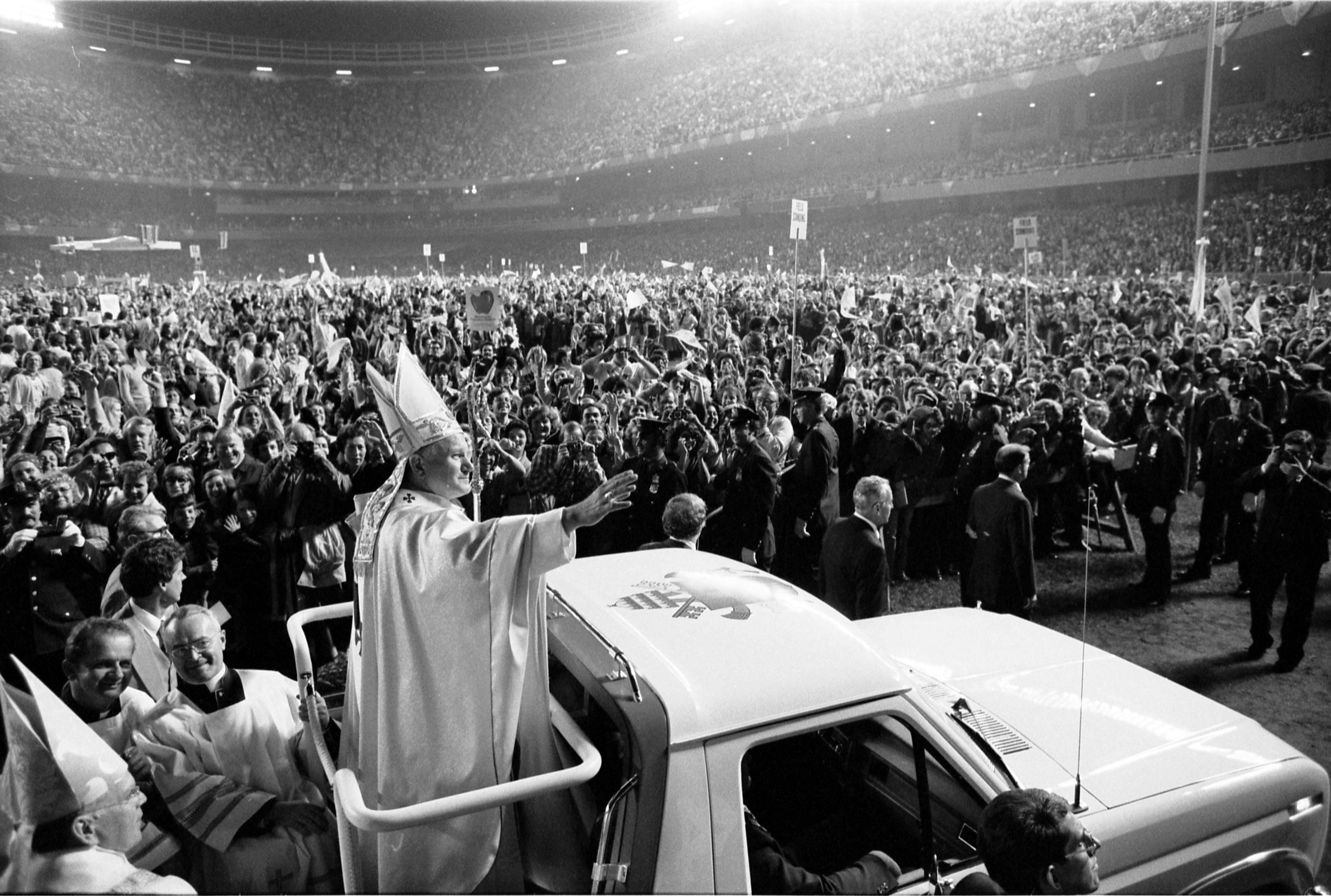
But the supreme skill of a dictator is to recruit his opponents as partisans. On the one hand, we can see the extraordinary “Rock Star” cult of personality that surrounded John Paul II, and from which his successors have continued to benefit in greater or lesser degrees. One effect of this was that the “conservatives”, who remained opposed to various aspects of the Novus Ordo revolution, nonetheless accepted many of the errors and innovations on the strength of the man whom they adored as “pope”.
However, there remained a set of men who opposed all (or almost all) of the revolution, and indeed John Paul II and his successors – and yet continued to claim that they were “in communion” with him, without being “for” him. In this regard, Mgr Guérard names certain leading figures of the traditionalist resistance: the Abbé de Nantes and the CRC, Dom Gérard Calvet of Le Barroux, Jean Madiran’s Itinéraires, and Archbishop Lefebvre himself.
His charge is that all of them, however different, apply the same false principle on which the dictatorship rests – being “with” John Paul II while refusing to be “for” him.
‘Cage for Religion’
However, the grounds of Mgr Guérard’s objection to this is extremely interesting: he says that each of the men mentioned, in different ways, assume and accept “that there be two religions in the same Church”.
He condemns them specifically for this idea, stating that it would make the Church “a sort of cage for religion” – and would practically result in “the negation of the Church, of the Mystical Body of Jesus Christ – of that Church whose unity is catholic by NATURE, and whose ordered splendour excludes all duality.”
This is precisely the point which I have been arguing for years: both a) that the “Conciliar/Synodal Church” is not the Catholic Church, and b) that one reason for this is that it is, indeed, a “cage” for multiple religions (or an accidental aggregation of men of different religions and “faiths”), and thus divided in faith. This was the thesis of my long “book” Zero Marks:
But it is not only what I have long held and argued to be the case. It is also the opposite of what I considered to be one of the most insuperable objections to the Thesis itself, which is often presented as entailing the idea that at least two religions can coexist within the one Church – which I understood to be excluded by the Church’s property of unity. It is thus very striking to see Mgr Guérard making these same arguments himself.
Readers may find the bishop's language about the early traditionalist “pioneers” – particularly Archbishop Lefebvre – very hard. Certainly in sharing these writings, I do not intend to endorse each and every aspect of what is written.
But it is worth considering how events unfolded. The arrangement Archbishop Lefebvre asked for in 1978 was eventually granted, after a fashion, by Ratzinger himself. As Benedict XVI, he declared in Summorum Pontificum that the old and new rites were two “forms” of the one Roman rite. The “cage” that Mgr Guérard described in 1983 – a divided “Church” made up of many wings – became official policy, and has come to be accepted by nearly all “traditionalists”. This mistaken belief has, in fact, become one of the chief obstacles to the advance of the true analysis of the situation:
That the Holy See has been vacant since at least 1965.
S.D.Wr.
The Wojtyłan Dictatorship: Mgr Guérard des Lauriers
Bulletin de l’Occident Chrétien, nos 79–80, de avril-mai 1983
Originally published as La Dictature Wojtylienne
Critique of addresses by Archbishop Dermot J. Ryan and Cardinal Godfried Daneels
‘Ratzinger is Luther’: The future Benedict XVI’s ‘Tridentine Jar’
This translation is for WM subscribers. Subscribe now for FREE!