
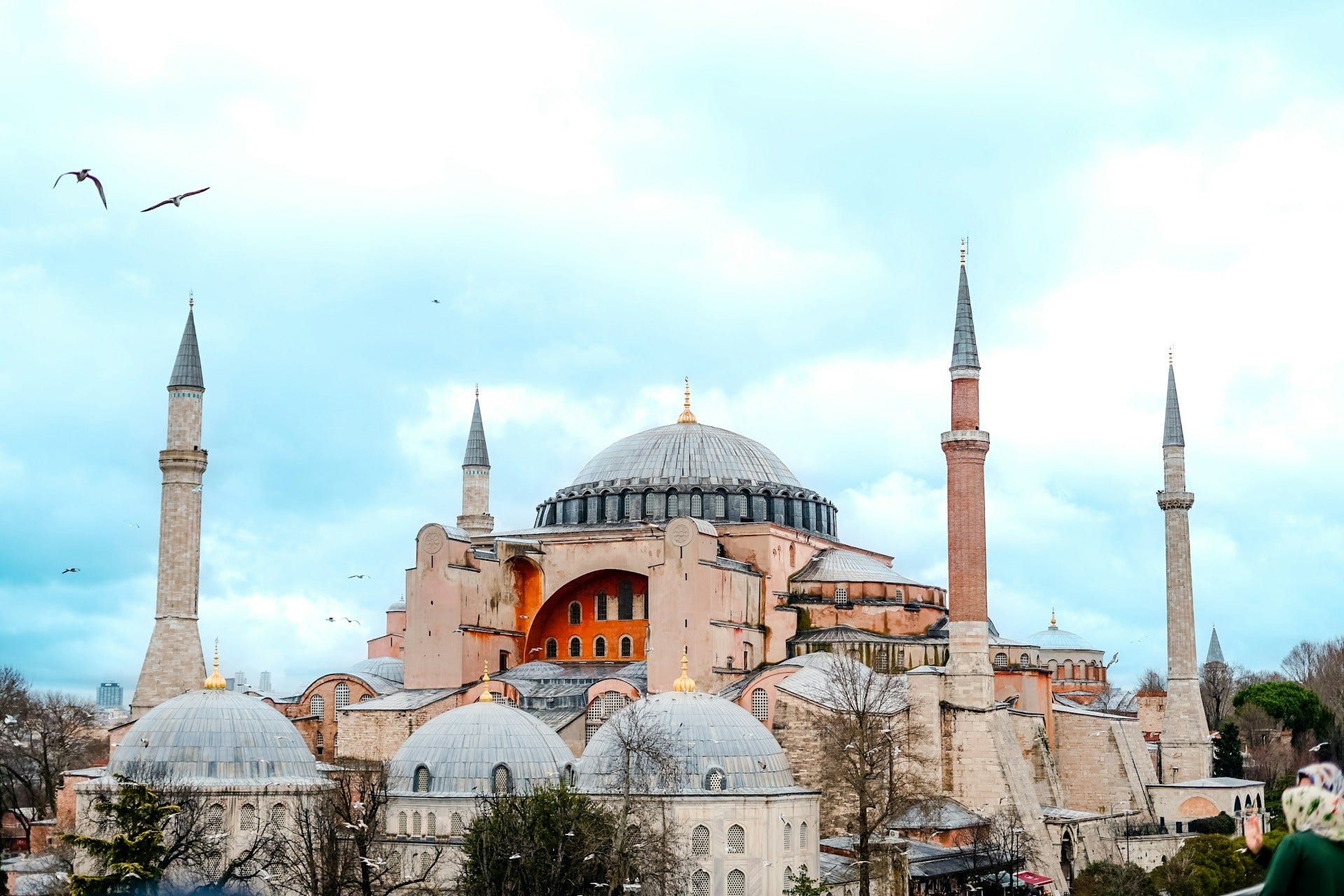
Completely contrary to the ‘Orthodox’ narrative, the problems lie in Constantinopolitan ambitions and pretensions, not the Papacy.
Editors’ Notes
This is the tenth and final part of a serialisation of Orestes’ Brownson’s engagement with “Eastern Orthodoxy.”
It was originally published in two articles.
Article I
The background of this engagement – including that of the ex-Catholic author Abbé Vladimir (René-François) Guettée and his book The Schismatic Papacy – can be found in the first part. Here are the parts we have seen so far:
Those parts made up one article; Brownson then proceeded to a second, much longer article. As such, this tenth part is also the seventh part of the second article – which systematically dismantles Guettée’s attempted appeal to the Councils:
Article II
Eastern Orthodox? Why the sixth canon of Nicæa isn’t an argument
Eastern Orthodoxy? Rome did not have primacy merely for being the capital city
Eastern Orthodoxy? No, Pope Leo the Great is not a witness against papal primacy
Eastern Orthodoxy? ‘Orthodox proofs’ from Chalcedon undermine their own case
Eastern Orthodoxy? St Gregory the Great and the ‘Universal Bishop’ title
Eastern Orthodoxy? Scraping the barrel with irrelevant authorities
Eastern Orthodoxy? The problem was always Constantinople, not the Papacy
Why are we publishing this?
For more on why we might bother republishing a nineteenth century review of a nineteenth century book, see the previous part. In short, Guettée’s book continues to bring the ill-informed into the Photian schism, and so Browson’s review and refutation continues to be of enduring importance.
However, in this final part, Brownson gives his definitive analysis of this “treasure” of “Orthodox” apologetics:
“It is in relation to its purpose the weakest and absurdest book we have ever read, and has not, so far as the author is concerned, a Christian thought from beginning to end. […]
“If M. Guettée’s readers will weigh well the arguments for the papacy he reproduces for the sake of refuting them, and his quotations from the fathers and the Roman pontiffs for the sake of blunting their force, they will find that, in spite of misquotations, mistranslations, and misrepresentations, the book carries with it its own antidote.”
As the contemporary “Orthodox” are publishing such works and encouraging Roman Catholics to enter into schism and heresy, they surely cannot complain about us publishing Brownson’s piece in response. We do so in good will, with the hope that they will instead return to the Church of Christ – outside of which there is absolutely no salvation whatsoever.

The problem was always Constantinople, not the Papacy
Guettée’s ‘The Schismatic Papacy’
Orestes Brownson
Originally published as “Guetté’s Papacy Schismatic’1
From The Catholic World, 1867
Published in The Works of Orestes A. Brownson, Vol. VIII
Thorndike Nourse, Deroit, 1884. pp 491-500
Headings and some line breaks added by The WM Review
Constantinople at the heart of the problem
The whole controversy originated in the attempt to raise the see of Constantinople, which was not an apostolic, a patriarchal, or even a metropolitan see, to the rank and authority of the first see in the church after that of the see of Rome, contrary to the sixth canon of Nicæa, to the constitution of the church, to ancient usage, and to the prejudice of the bishops of Alexandria and Antioch, and the metropolitans of Pontus, Asia (Minor), and Thrace.
On what ground does the author seek to defend this attempt, always resisted by the Roman pontiffs and the whole West? Simply on the ground that the rank and authority of a see are derived from the splendor and importance of the city in the empire. He assigns and pretends to assign no other ground.
“The Nicæan council,” he says, “in consecrating the usage by which the bishop of Rome was regarded as the first in honor in the church, had in view not so much the apostolic origin of his see as the splendor which he acquired from the importance of the city of Rome…
“Why, then, should not the bishop of Constantinople have been received as second in rank, Constantinople having become the second capital of the empire; since the bishop of Rome was first in rank, only because of its position as the first capital?” (pp. 100, 101.)
The argument is worthless, because its premises are false. In the first place, the question is one of authority as well as of rank. In the second place, the Council of Nicæa did not consecrate the usage by which the primacy, whether of honor or jurisdiction, was ascribed to the bishop of Rome, but confirmed the usage by which the bishop of Alexandria, the bishop of Antioch, and other metropolitans held a certain rank, and enjoyed certain privileges, and gave as their reason that a like usage or custom obtained with the bishop of Rome. In the third place, the council says not one word about the splendor acquired by the Roman pontiff from the importance of the city of Rome; and we have proved that, whatever his rank and authority, he derived it from the fact that his see was held to be the see of Peter, and he the successor of Peter, the prince of the apostles.
Finally, the author has no ground for his assertion, except the third canon of the second general council and the twenty-eighth of the fourth, the latter authoritatively annulled and the former declared to be without effect by St. Leo, and neither ever receiving the sanction or assent of the universal church. The ground on which the bishop of Constantinople based his ambitious pretensions, that of being bishop of the second capital of the empire, is wholly untenable.
“Alia ratio est rerum secularium, alia divinarum,” says St. Leo.
“We laughed,” says Pope St. Gelasius as cited by the author, p. 198, “at what they (the Eastern bishops) claim for Acacius (bishop of Constantinople) because he was bishop of the imperial city… The power of the secular empire is one thing, the distribution of ecclesiastical dignities is quite a different thing.
“However small a city may be, it does not diminish the greatness of the prince who dwells there; but it is quite as true that the presence of the emperor does not change the order of religion; and such a city should rather profit by its advantages to preserve the freedom of religion, by keeping peaceably within its proper limits.”
Rome wins the day
From first to last, one is struck, in reading the history of the controversy, not only with the superior calmness and dignity of the Roman pontiffs, but with their profound wisdom and catholic sense.
They defend throughout the catholicity of the church against Greek nationalism, and the independence of the kingdom of Christ on earth against its subjection to the secular empire, which was attempted and finally succeeded at Constantinople, and is the case in Russia, Great Britain, and all modern schismatical and heretical states and empires.
The author sees and appreciates nothing of this; he comprehends nothing of the church as the mystic body of Christ, the continuous representation of the Incarnation; his ideas are external, political, unspiritual, and, as far as appears from his book, pagan rather than Christian. The church he recognizes, as far as he recognizes any, is national, not catholic, and holds from the imperial authority, not from Christ, and has no completeness in itself.
Nationalistic ideas at root of the schism
It was precisely in nationalism, in regarding the church as organized for the Roman Empire, not for the whole world, and in recognizing the authority of the civil power in theological and ecclesiastical matters, as the author himself unwittingly shows, that the Greek schism originated.
The bishop of Constantinople, having in the hierarchy no apostolic, patriarchal, or metropolitan rank or authority beyond that which is held by every suffragan bishop, was obliged, in order to defend his ambitious aspirations to the second rank in the church, to give the hierarchy a secular origin, and to fall back on the imperial authority to support him. The idea was pagan, not Christian, and was but too acceptable to the Byzantine Cæsars.
In pagan Rome the emperor was at once imperator and pontifex maximus, and held in his own person the supreme authority in both civil and religious matters. He preserved the tradition of this in Christian Rome, and continually struggled to be under Christianity what he had been under paganism.
In the West the imperial pretensions were in the main successfully resisted, though not without long and bitter struggles, which have not even yet completely ended; but in the East, owing to the ambition and frequent heresy of the bishop of Constantinople, rarely faithful to the church after Constantinople became an imperial capital, and until the great patriarchates of Alexandria, Antioch, and Jerusalem, weakened by the Arian, Nestorian, monophysite, and monothelite heresies, and betrayed by the heretics, had fallen, through the pride, treachery, and imbecility of the Byzantine court, under the power of the Mohamedans, those bitter enemies of the cross, the emperor was enabled to grasp the pontifical power, to bring the administration of religion under his despotic control, to make and unmake, murder or exile bishops at his will or the caprices of the ladies of his court.
Hence the Greek schism.
And this is what M, Guettée defends; and because the Roman pontiffs did all in their power to resist such open profanation and secularizing of the church, he has the impudence to contend that it was the usurpations of Rome that caused the schism, and he has found a Protestant Episcopal Bishop in Western New York ignorant enough or shameless enough to uphold him, and to assure us that he is a Catholic in the true sense of the word!
Hypocritical and opportunistic imperial ‘theology’
Notwithstanding the author defends the usurpations of the imperial authority and the ambitious pretensions of the courtly bishops of Constantinople, and maintains that all the general councils held in the East were convoked and presided over by the emperors, he does not blush to object to the Council of Florence on the ground that the reunion effected in that council was brought about by the ambition of a few Eastern prelates and the undue pressure of the emperor of Constantinople.
If the intervention of the Emperor did not in his judgment vitiate the third canon of the first Council of Constantinople, or the twenty-eighth canon of Chalcedon, or the fifth or sixth general council, what right has he to pretend that a far less intervention on the Emperor’s part vitiated the canons of the Council of Florence?
On the principles he has defended throughout, the emperor may convoke, preside over a council, dictate and confirm its acts, without detriment to its authority as a general council. He is by his own principles then, bound to accept the canons of Florence as the voice of the universal church, for they were adopted by the East and West united, and are and have been constantly adhered to by the West and the Eastern churches proper, and resisted only by heretics and schismatics, who have no voice in the church.
Conclusion to the series
We need proceed no further. We have said enough to refute the author in principle, and are tired of him, as must be our readers.
We said in the beginning that he had told us nothing in his book that we did not know before; but we are obliged to confess that the examination of authorities into which it has forced us has made us feel as we never felt before how truly the church is founded on Peter, brought home to us the deep debt of gratitude the world owes to the Roman pontiffs, and enabled us to see more clearly than we ever had done the utter groundlessness, the glaring iniquity, and the open paganism of the Greek schism.
The author has made us, we almost fear, an ultra-papist, and certainly has strengthened our attachment, already strong, to the Holy Apostolic See. He has served to us the office of the drunken Helotæ to the Spartan youth. It is in relation to its purpose the weakest and absurdest book we have ever read, and has not, so far as the author is concerned, a Christian thought from beginning to end.
If this book fairly represents the Christian intelligence and sentiments of the non-united Greeks, it is hard to see wherein they are to be preferred to the Turks, or why Christendom should seek their deliverance from the Mohammedan yoke.
If M. Guettée’s readers will weigh well the arguments for the papacy he reproduces for the sake of refuting them, and his quotations from the fathers and the Roman pontiffs for the sake of blunting their force, they will find that, in spite of misquotations, mistranslations, and misrepresentations, the book carries with it its own antidote.
HELP KEEP THE WM REVIEW ONLINE WITH WM+!
As we expand The WM Review we would like to keep providing free articles for everyone.
Our work takes a lot of time and effort to produce. If you have benefitted from it please do consider supporting us financially.
A subscription gets you access to our exclusive WM+ material, and helps ensure that we can keep writing and sharing free material for all.
You can see what readers are saying over at our Testimonials page.
(We make our WM+ material freely available to clergy, priests and seminarians upon request. Please subscribe and reply to the email if this applies to you.)
Subscribe to WM+ now to make sure you always receive our material. Thank you!
If you enjoyed this article, then why not get it in mug form?
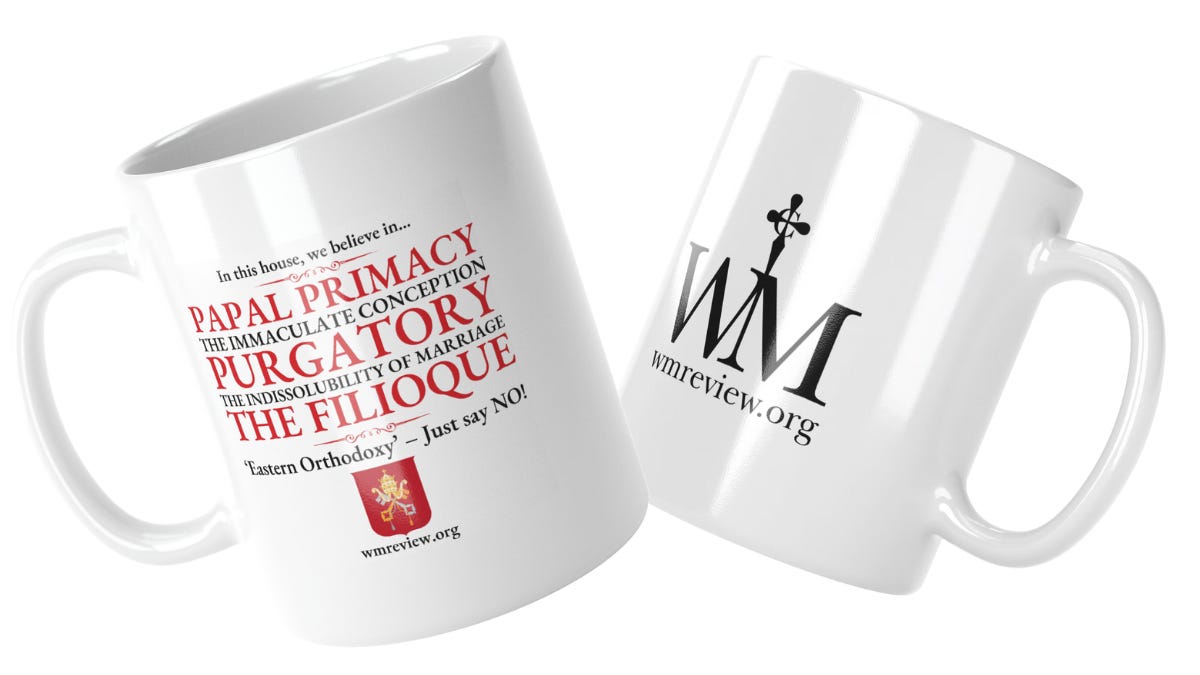
(Now, now, our Eastern “Orthodox” friends, don’t get too stressed. It’s all in good humour. We wish you well, and pray for your good.)
Read Next:
Orestes Brownson’s review of Abbé Guettée’s The Papacy Schismatic:
Article II
Eastern Orthodox? Why the sixth canon of Nicæa isn’t an argument
Eastern Orthodoxy? Rome did not have primacy merely for being the capital city
Eastern Orthodoxy? No, Pope Leo the Great is not a witness against papal primacy
Eastern Orthodoxy? ‘Orthodox proofs’ from Chalcedon undermine their own case
Eastern Orthodoxy? St Gregory the Great and the ‘Universal Bishop’ title
Eastern Orthodoxy? Scraping the barrel with irrelevant authorities
Eastern Orthodoxy? The problem was always Constantinople, not the Papacy

Follow on Twitter, YouTube and Telegram:
Twitter (The WM Review)
The Papacy: Its Historic Origin and Primitive Relations with the Eastern Churches. By the Abbé Guettée, D.D.
Translated from the French, and prefaced by an original biographical notice of the author, with an Introduction by A. Cleveland Coxe, Bishop of Western New York. New York: 1867.
The original article is available in OCR form here.
And yet, in spite of many challanges, the Orthodox are comparatively free of the liturgical and doctrinal chaos you and many others cite as a running rampant in the Latin Rite. Does nobody in the west consider that it might be the highly centralized modern Papacy, dogmatized in Pastor Aeternus, that is the very reason for all that you decry? For that is the big difderentiator between east and west. No connection or correlation, possibly?
This part deserves repeating:
"They [the Roman Pontiffs] defend throughout the catholicity of the church against Greek nationalism, and the independence of the kingdom of Christ on earth against its subjection to the secular empire, which was attempted and finally succeeded at Constantinople, and is the case in Russia, Great Britain, and all modern schismatical and heretical states and empires."
What most people don't understand is that there is no such thing as a universal Eastern Schismatic ("Orthodox") Church, it is just a bunch of independent national sects, with the emphasis being on "national". The schismatics have no notion of what a universal church is, unlike Catholics, who are at home in any church where a Catholic liturgy is celebrated, whether Roman, Greek, Coptic, Armenian etc. We don't even have to know the language.