
Having dispatched several of his key arguments, Orestes Brownson shows that ‘Orthodox’ apologist Abbé Guettée cannot string a coherent argument together.
Editors’ Notes
This is the ninth part of a serialisation of Orestes’ Brownson’s engagement with “Eastern Orthodoxy.”
It was originally published in two articles.
Article I
The background of this engagement – including that of the ex-Catholic author Abbé Vladimir (René-François) Guettée and his book The Schismatic Papacy – can be found in the first part. Here are the parts we have seen so far:
Those parts made up one article; Brownson then proceeded to a second, much longer article. As such, this sixth part is also the ninth part of the second article – which systematically dismantles Guettée’s attempted appeal to the Councils:
Article II
Eastern Orthodox? Why the sixth canon of Nicæa isn’t an argument
Eastern Orthodoxy? Rome did not have primacy merely for being the capital city
Eastern Orthodoxy? No, Pope Leo the Great is not a witness against papal primacy
Eastern Orthodoxy? ‘Orthodox proofs’ from Chalcedon undermine their own case
Eastern Orthodoxy? St Gregory the Great and the ‘Universal Bishop’ title
Eastern Orthodoxy? Scraping the barrel with irrelevant authorities
Why are we publishing this?
For more on why we might bother republishing a nineteenth century review of a nineteenth century book, see the first part. In short, Guettée’s book continues to bring the ill-informed into the Photian schism, and so Browson’s review and refutation continues to be of enduring importance.
As the contemporary “Orthodox” are publishing such works and encouraging Roman Catholics to enter into schism and heresy, they surely cannot complain about us publishing Brownson’s piece in response. We do so in good will, with the hope that they will instead return to the Church of Christ – outside of which there is absolutely no salvation whatsoever.

Scraping the Barrel with irrelevant authorities
Guettée’s ‘The Schismatic Papacy,’ Part 2.1
Orestes Brownson
Originally published as “Guetté’s Papacy Schismatic’1
From The Catholic World, 1867
Published in The Works of Orestes A. Brownson, Vol. VIII
Thorndike Nourse, Deroit, 1884. pp 491-500
Headings and some line breaks added by The WM Review
Scraping the barrel
The author is unhappy in his witnesses, and they are all too decidedly Roman to testify otherwise than against him. He cites other eminent fathers of the fourth and fifth centuries, but he raises no new questions, and makes no points in his favor not already met and disposed of; and we may, therefore, pass over what he adduces, since, as we continue to remind our readers, we are not adducing our proofs of the papal authority, but refuting his arguments or pretended arguments against it.
In his fifth division, chapter, or section, the author examines “the authority of the bishop of Rome in the sixth, seventh, and eighth centuries.” We have anticipated him in regard to St. Gregory the Great, the most prominent papal figure in these centuries, and shown that this great pontiff and doctor, who justly ranks along with St. Leo, offers no testimony in support of the author’s vain attempt to prove the papacy schismatic.
We have read this section of his book with care, but we find that, while he shows very clearly that the Roman pontiff, to save the faith and the constitution and canons of the church from the attacks of the heretics and schismatics of the East, was obliged to intervene with his supreme authority in the affairs of the Eastern churches more frequently than in earlier ages, he brings forward nothing different from what has already been refuted to prove that they did not possess the authority which they exercised by divine right.
We may say, then, that the author has totally failed to establish his first conclusion, that “the bishop of Rome did not for eight centuries possess the sovereignty of divine right which he has since sought to exercise.” The facts he adduces prove that during those centuries the popes did exercise all the authority they have as supreme pontiffs since exercised, and that they professed to exercise it by divine right, and without any contradiction by the universal church.
No doubt the author has adduced instances in which general councils have recognized it, and made it the basis of their action; but this does not prove that the papal authority was conferred by the church, and was held only by ecclesiastical right. No doubt the civil authority on more than one occasion recognized it and made it the law of the empire, but this does not prove that it was held as a grant of the emperor, but the reverse rather.
The author, then, has not refuted the argument from possession, turned the presumption against the papacy, or proved that he and his friends the non-united Greeks are not decidedly schismatics in resisting the Council of Florence, in which both the East and West were represented and united.
Guettée’s second contention: That papal claims caused the schism
The author, having failed to establish his first conclusion, notwithstanding his misquotations, mistranslations, and misrepresentations of facts, which are numerous and barefaced enough to excite the envy of his editor, the Protestant Episcopal Bishop of Western New York, cannot prove his second conclusion, namely: The pretension of the bishops of Rome to the sovereignty of divine right over the whole church was the cause of the division.
This depends on the first, and falls with it; for it is necessary to deny the divine authority of the pope to govern the whole church before his assumption and exercise of that authority can be held to be a usurpation, and the cause of the divisions which result from resistance to it. Resistance otherwise is illegal, unauthorized, and conclusive evidence of schism, or, rather, is undeniably itself schism.
The resistance on the part of the Eastern bishops and prelates to the Roman pontiff in the exercise of his legitimate authority was schism, as much so as an armed insurrection against the political sovereign is rebellion, and the rebels cannot allege that the sovereign in the exercise of his legitimate authority is the cause of their rebellion, and hold him responsible for it.
The burden of proof is on the schismatics, not Catholics
The author, forgetting that the pope is in possession, and that throughout the presumption is in favor of his authority, argues as if the presumption was on the other side, and the onus probandi was on us.
He, therefore, concludes that every exercise of papal jurisdiction beyond the patriarchate of the West is a usurpation, and resistance to it justifiable, unless we are able to prove the contrary. We deny it, and maintain that it is for him to prove that jurisdiction is usurped, and not held by divine right. The laboring oar is in his hands. It is always for those who resist authority to justify their resistance.
The author can justify his resistance to papal authority only by producing some law of God or some canon of the universal church that restricts the jurisdiction of the Roman pontiff to the Western patriarchate, and forbids him to exercise jurisdiction over the whole church. A law or edict to that effect of the empire or canon of the Eastern churches alone, could it be produced, would not avail him; it must be a decision of the universal church, even according to his own doctrine. He alleges no such act or canon, and can allege none, for all the acts or canons of the universal church bearing on the question, unhappily for him, are the other way.
The failure to produce relevant and authoritative canons
The author adduces the third canon of the second general council, and the twenty-eighth of the fourth, but these canons, having never been assented to by the West, are without the authority of the universal church. And, besides, they do not distinctly deny the supreme authority of the bishop of Rome, and only profess to confer the first rank and authority after the Roman pontiff on the bishop of Constantinople.
It is a strong presumption against the author that he does not even allege any law or canon of the universal church which the popes have violated, and his charge against them is that of presenting themselves as defenders of the canons against innovation, as in the refusal of St. Leo to accept the twenty-eighth canon of Chalcedon.
But the author, with his usual facility, refutes himself, and shows that it was not the pretension of the bishops of Rome, but the pretensions of the bishop of Constantinople and of the secular government that caused the division. We have seen that the third canon of the second general council, and the twenty-eighth of the fourth, which was annulled by St. Leo, were in violation of the canons, but were prompted by the ambition of the bishop of Constantinople and the secular authority.
“We can perceive,” says the author, p. 100…
“… in the struggles between the bishops of Rome and Constantinople, respecting the twenty-eighth canon of the council of Chalcedon, the origin of the dissensions which afterward led to an entire rupture.”
The real cause of the rupture
And why did these dissensions lead to an entire rupture? Certainly because the same parties continued to maintain the same claims in relation to each other. The ground of the dissension remained always the same.
The question, then, is, which party in the beginning was in the right, and which was in the wrong? “In principle,” says the author on the same page, “St. Leo was right;” that is, right in defending the canons of the holy fathers and the decrees of the venerable Council of Nicæa against their violation and subversion by the innovations of Constantinople and Chalcedon. St. Leo, the author himself says, presented himself as the defender of antiquity and the canons of Nicæa; he must, then, have been right not only in principle, but in fact.
The real cause of the division was not the pretension of the bishops of Rome to an authority which they did not possess, but their refusal to assent to the violent and shameless usurpations of Constantinople. The attitude of the popes and the ground on which they resisted from first to last were distinctly taken by St. Leo in his letter to the emperor, Marcian, already cited:
“Privilegia ecclesiarum, sanctorum Patrum canonibus instituta et venerabilis Nicænæ synodi fixa decretis, nulla possunt improbitate convelli, nulla mutari novitate.”2
But St. Leo “could not deny,” says the author, “that one general council had the same rights as another that had preceded it.” But, even if so, none of the innovations proposed by the East and opposed by the bishops of Rome have ever had the authority of a general council. There is and can be, even according to the author and his schismatic Greek friends, no general council without the bishop of Rome; and the canons on which the author relies were from the first resisted by the Roman pontiff, and, therefore, could not override or abrogate the decrees of the Council of Nicæa.
HELP KEEP THE WM REVIEW ONLINE WITH WM+!
As we expand The WM Review we would like to keep providing free articles for everyone.
Our work takes a lot of time and effort to produce. If you have benefitted from it please do consider supporting us financially.
A subscription gets you access to our exclusive WM+ material, and helps ensure that we can keep writing and sharing free material for all.
You can see what readers are saying over at our Testimonials page.
(We make our WM+ material freely available to clergy, priests and seminarians upon request. Please subscribe and reply to the email if this applies to you.)
Subscribe to WM+ now to make sure you always receive our material. Thank you!
If you enjoyed this article, then why not get it in mug form?
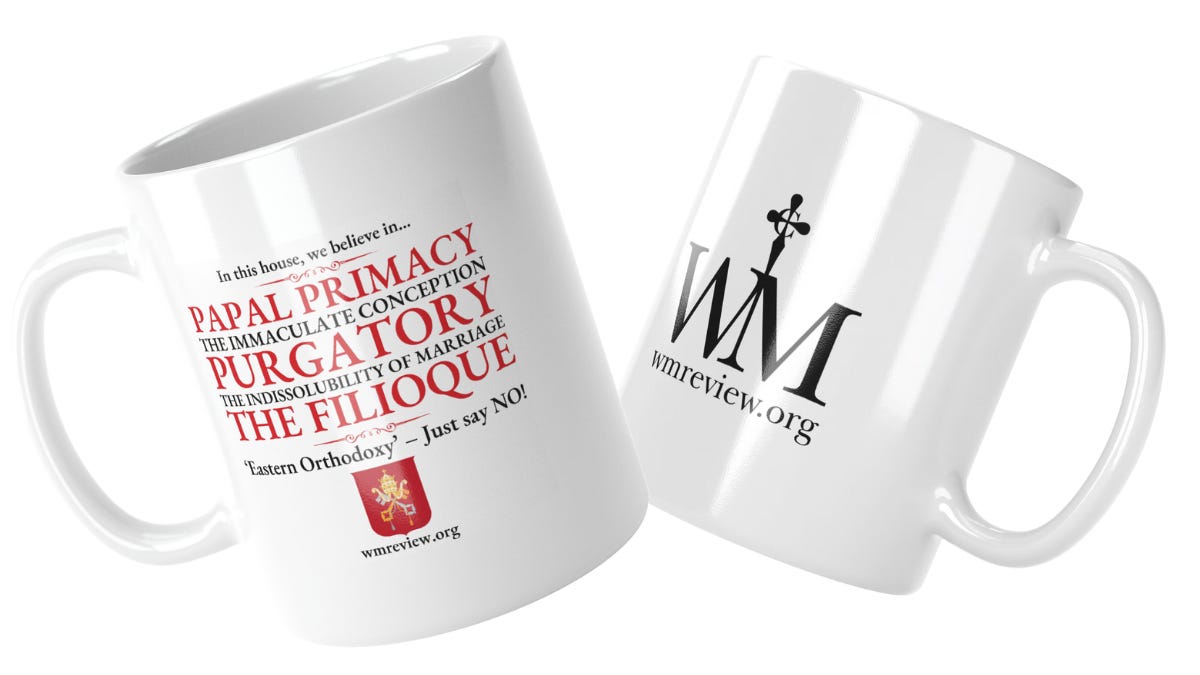
(Now, now, our Eastern “Orthodox” friends, don’t get too stressed. It’s all in good humour. We wish you well, and pray for your good.)
Read Next:
Orestes Brownson’s review of Abbé Guettée’s The Papacy Schismatic:
Article II
Eastern Orthodox? Why the sixth canon of Nicæa isn’t an argument
Eastern Orthodoxy? Rome did not have primacy merely for being the capital city
Eastern Orthodoxy? No, Pope Leo the Great is not a witness against papal primacy
Eastern Orthodoxy? ‘Orthodox proofs’ from Chalcedon undermine their own case
Eastern Orthodoxy? St Gregory the Great and the ‘Universal Bishop’ title
Eastern Orthodoxy? Scraping the barrel with irrelevant authorities

Follow on Twitter, YouTube and Telegram:
Twitter (The WM Review)
The Papacy: Its Historic Origin and Primitive Relations with the Eastern Churches. By the Abbé Guettée, D.D.
Translated from the French, and prefaced by an original biographical notice of the author, with an Introduction by A. Cleveland Coxe, Bishop of Western New York. New York: 1867.
The original article is available in OCR form here.
Ad Marcianum Augustum, epist. 105
These refutations of the eastern orthodox have particular relevance today. The current crisis have left some less informed catholics contemplating the orthodox option as an escape from the present chaos without recognising the serious inherent dangers. Excellent work and timing.