
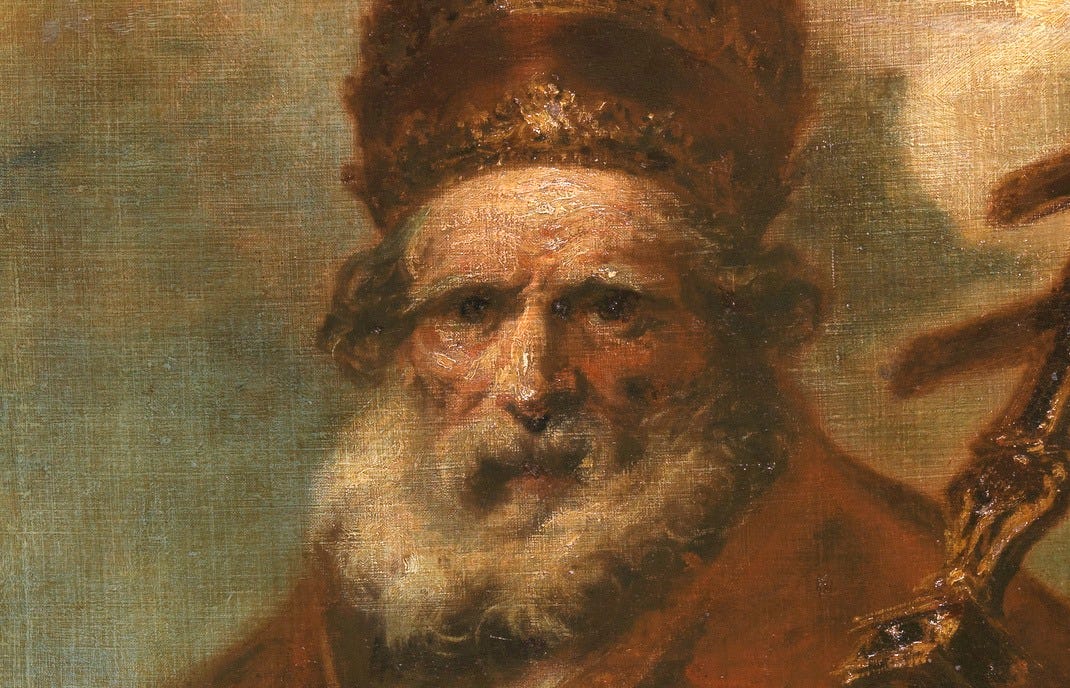
The ‘Orthodox’ priest whose work Orestes Brownson is critiquing next tries to claim that Pope St Leo the Great rejected papal primacy. Unsurprisingly, this is false.
Editors’ Notes
This is the sixth part of a serialisation of Orestes’ Brownson’s engagement with “Eastern Orthodoxy.”
Article I
The background of this engagement – including that of the ex-Catholic author Abbé Vladimir (René-François) Guettée and his book The Schismatic Papacy – can be found in the first part. Here are the parts we have seen so far:
Those parts made up one article; Brownson then proceeded to a second, much longer article. As such, this sixth part is also the third part of the second article – which systematically dismantles Guettée’s attempted appeal to the Councils:
Article II
Eastern Orthodox? Why the sixth canon of Nicæa isn’t an argument
Eastern Orthodoxy? Rome did not have primacy merely for being the capital city
Eastern Orthodoxy? No, Pope Leo the Great is not a witness against papal primacy
For more on why we might bother republishing a nineteenth century review of a nineteenth century book, see the previous part. In short, Guettée’s book continues to bring the ill-informed into the Photian schism, and so Browson’s review and refutation continues to be of enduring importance.
As the contemporary “Orthodox” are publishing such works like Guettée's and encouraging Roman Catholics to enter into schism and heresy, they surely cannot complain about us publishing Brownson’s piece in response. We do so in good will, with the hope that they will instead return to the Church of Christ – outside of which there is absolutely no salvation whatsoever.

No, Pope Leo the Great is not a witness against papal primacy
Guettée’s ‘The Schismatic Papacy,’ Part 2.1
Orestes Brownson
Originally published as “Guetté’s Papacy Schismatic’1
From The Catholic World, 1867
Published in The Works of Orestes A. Brownson, Vol. VIII
Thorndike Nourse, Deroit, 1884. pp 491-500
Headings and some line breaks added by The WM Review
The status of Chalcedon and the role of the Pope
The council [of Chalcedon] is generally accepted as the fourth general council, but only by virtue of the papal confirmation, and only so far as the pope confirmed its acts.
In many respects the council was a scandalous assembly, almost wholly controlled by the emperor and the Byzantine lawyers or magistrates, who have no authority in the church of God. The part taken by the emperor and civil magistrates wholly vitiated it as a council of the church, and all the authority its acts had or could have for the church was derived from their confirmation by St. Leo the Great.
But bad as the council was, the twenty-eighth canon never received its sanction. It was introduced by the civil magistrates, and when only one hundred and fifty bishops, all orientals, out of the six hundred composing the council, were present, and no more subscribed it. It was resisted by the legates of the Roman pontiff and protested against; the patriarchal churches of Alexandria and Antioch were unrepresented. Dioscurus, bishop of the former, was excluded for his crimes, and Macarius of Antioch had just been deposed by the emperor and council for heresy and expelled; a large number of prelates had withdrawn, and only the rump of the council remained. It is idle to pretend that the canon in question was the act even of the council, far less of the universal church.
The dilemma for the ‘Orthodox’
Now, either Leo the Roman pontiff had authority to confirm the acts of the Council of Chalcedon, and by his authority as supreme pastor of the church to heal their defects and make them binding on the universal church, or he had not.
If he had, the controversy is ended, for that is precisely what Mr. Guettée denies; if he had not, as Mr. Guettée contends, then the acts of Chalcedon have in themselves no authority for the church, since through the tyranny of the emperor Marcian and the civil magistrates it was not a free council, and, though legally convoked and presided over, was not capable of binding the church.
The author may take which horn of the dilemma he chooses, for the pope refused to confirm the twenty-eighth canon, and declared it null and void from the beginning.
The fathers of the council, or a portion of them, in the name of the council, addressed a letter to the Roman pontiff in which they recognize him as the constituted interpreter of the words and faith of Peter for all, explain what they have done, the motives from which they have acted, and pray him “to honor their judgment by his decrees” that is, confirm their acts. St. Leo confirmed those of their acts that pertained to the definition of faith, but refused to confirm the twenty-eighth canon, which he annulled and declared void, as enacted without authority, and against the canons.
The attempted escape
Mr. Guettée says, pp. 97, 98, that the council did not ask the Roman pontiff to confirm the canon in question,
“… but by his own decrees to honor the judgment which had been rendered. If the confirmation of the bishop of Rome had been necessary, would the decree of Chalcedon have been a judgment, a promulgated decision, before that confirmation?”
An authoritatively “promulgated decision” certainly not; but the author forgets that the canon had not been promulgated, and never became “a promulgated decision.” As to its being a judgment, a final or complete judgment it was not, and the council, by calling it nostrum judicium, do not pretend that it was. They present it to the Roman pontiff only as an inchoate judgment, to be completed by his confirmation. They tell the pope that his legates have protested against it, probably because they wished to preserve to him its initiation, and that in adopting it they…
“… had deferred to the emperor, to the senate, and the whole imperial city, thinking only to finish the work which his holiness, who always delights to diffuse his favors, had begun.”
The plain English of which is, We have enacted the canon out of deference to the civil authority and the wishes of the imperial city, subject to your approval. Rogamus igitur, honora et tuis sententiis nostrum judicium. “We pray you, therefore, to honor our judgment by your decrees.”2
If this does not mean asking the pope to confirm their act or judgment, we know not what would so mean. It is certain that St. Leo himself, who is one of the author’s anti-papal authorities, so understood it, as is evident from his replies to the emperor, the empress, and Anatolius, bishop of Constantinople, the assertion of M. Guettée to the contrary notwithstanding.
Further evidence of the necessity of papal approval
The Emperor Marcian wrote expressly to St. Leo, begging him to confirm by his apostolic authority the acts of the council, and especially the twenty-eighth canon, because without his confirmation they would have no authority. The Empress Pulcheria wrote him to the same effect, and finally Anatolius did the same. To the emperor the Roman pontiff replied, and set forth the reasons why he could not confirm the canon in question.
He makes short work with M. Guettée’s doctrine, broached in the second council, and extended in the twenty-eighth canon of Chalcedon, that the rank and authority of the see derive from the rank, authority, or importance of the city in which it is established. He denies that the fact that Constantinople was the second capital of the empire, or the new Rome, was any reason for elevating its bishop to the patriarchal rank and authority.
“Let, as we desire, the city of Constantinople have its glory, and, protected by the right hand of God, may it long enjoy the reign of your clemency; but different is the reason of secular things from the reason of divine things, and no edifice will be stable unless it is built on that rock (St. Matthew xvi. 18) which the Lord has laid for a foundation.
“Who covets what is not his due shall lose what is his own. Let it suffice this man (Anatolius), that by the aid of your piety and my assent and favor, he has obtained the episcopate of so great a city. Let him not disdain the imperial city because he cannot make it an apostolic see; and let him by no means hope to enlarge his power at the expense of others.”
It is very clear from this that St. Leo did by no means concede that the bishop of Constantinople was entitled to be clothed with patriarchal power and take precedence of the patriarch of Alexandria, because he had his see in what had become the second capital of the empire. Alia ratio est rerum secularium, alia divinarum; nec præter illam petram quam Dominus in fundamento posuit, stabilis erit ulla constructio; that is, only what is built on Peter, the rock, will stand, and in vain do you build on the greatness, splendor, and dignity of earthly cities.3
If M. Guettée had remembered this, he would never have turned from the chair of Peter, or allowed himself to be seduced by the nationalism of the Greek sophists, and the misguided ambition of the bishop of Constantinople. Alas! he left his father’s house, and, famished in the far country to which he has wandered, he is forced to feed on husks with the swine he tends. What can that man think of the church of God who holds that the dignity and authority or its prelates have only a secular origin?
Why St Leo refused the canon
St. Leo unequivocally refuses, in his reply to the solicitations of the emperor, to confirm the twenty-eighth canon.
“And why,” asks the author, p. 98…
“… did he refuse his assent? Because the decree of Chalcedon took from the bishop of Alexandria the second rank, and the third from the bishop of Antioch, and was in so far forth contrary to the sixth canon of Nicæa, and because the same decree prejudiced the rights of several primates or metropolitans…”
… that is, of Pontus, Asia Minor, and Thrace.
This we think was reason enough, and proves that the Roman pontiff was not only the chief custodian of the faith, but also of the canons. “The bishop of Constantinople,” says St. Leo, as cited by the author…
“… in spite of the glory of his church, cannot make it apostolic; he has no right to aggrandize it at the expense of churches whose privileges, established by the canons of the holy fathers, and settled by the decrees of the venerable Council of Nicæa, cannot be unsettled by perversity nor violated by innovation.”
St. Leo in the whole controversy appears as the defender of the canons against innovation, and of the catholicity of the church against Greek nationalism.
The author continues, same page:
“In his letter to the Empress Pulcheria, St. Leo declares that he has ‘annulled the decree of Chalcedon by the authority of St. Peter.’ These words seem at first sight to mean that he claimed for himself a sovereign [supreme] authority in the church in the name of St. Peter.”
Undoubtedly, not only at first sight, but at every sight. The pope uses the strongest terms to be found in the Latin language, and terms which can be used only by one having the supreme authority, irritus and cassare. He refuses to ratify it, declares it null, and says, “per auctoritatem Beati Petri apostoli,” he makes it void. He could make no greater assumption of authority.
Another contrived escape refuted
“But,” adds the author, upon a more careful and unbiased examination of his letter and other writings…
“… we are convinced that St. Leo only spoke as the bishop of an apostolic see, and that in this character he claimed the right, in the name of the apostles who founded his church, and of the Western countries which he represented, to resist any attempt of the Eastern Church to decide alone matters of general interest to the whole church,” pp. 98, 99.
If he is convinced, we are not. If such was St. Leo’s meaning, why did he not say so? Why did he annul when he only meant that the canon was null, because decreed by Orientals alone; or why did he not assign that reason for annulling it, and not the reason that it was repugnant to the canons of the holy fathers and the decrees of the Council of Nicæa?
“The proof that he regarded matters in this light (p. 99,) is that he does not claim for himself any personal authority of divine origin, descended to him from St. Peter, but that, on the contrary, he presents himself as the defender of the canons, and looks upon the rights and reciprocal duties of the churches as having been established by the fathers and fixed by the Council of Nicæa. He does not pretend that his church has any exceptional rights, emanating from another source.” (p. 99)
This proof is inconclusive. St. Leo had no occasion to claim personal authority for himself, for whatever authority he had was official, not personal, and inhered in him as the successor of Peter in the apostolic see of Rome, and in this capacity he most assuredly did claim to have authority, when he declared to the Empress Pulcheria, as we have seen, that, “by authority of Peter, he annulled and made void and of none effect,” the decree of Chalcedon.
What the author says he did not do, is precisely what he did do. He does not annul and make void the decree by authority vested in him by the canons, or which he holds by ecclesiastical right, but “by the authority of Peter.”
He, moreover, was not defending the rights and prerogatives of his own see, nor his authority as metropolitan, patriarch, or supreme pontiff, for this was not called into question; the council most fully recognized it, and in his letter defining the faith against Eutyches, it professed to hear the voice of Peter. He was defending the canons, not for himself, nor for churches subjected to him as patriarch of the West, but for Alexandria, Antioch, and the metropolitans of Pontus, Asia Minor, and Thrace, which the twenty-eighth canon of Chalcedon sought to subject to the bishop of Constantinople; and he therefore had no occasion to dwell on the exceptional rights, or rights not derived from the canons, but from God through Peter, of the Roman Church. It sufficed him to exercise them, which he did do effectually.
“By ecclesiastical right he is the first bishop of the church,” the author continues…
“… besides, he occupies the apostolic see of the West; in these characters he must interfere and prevent the ambition of one particular church from impairing rights that the canons have accorded to other bishops too feeble to resist.”
Wherefore must he do so? In these characters he might offer his advice, he might even refuse his assent to acts he disapproved; but he could not authoritatively interfere in any matters outside of his own particular diocese, or his own patriarchate, far less to annul and make void acts which did not concern him in either of these characters. He had no right to interfere in the way he did, except as supreme pontiff and head of the whole church, and Roman theologians have never claimed for the Roman pontiff greater power than St. Leo exercised in the case of the Council of Chalcedon.
Absurd conclusions drawn from the premises
“After reading all that St. Leo has written against the canon of the council of Chalcedon, it cannot be doubtful what he meant.”
We agree to that, nor is it doubtful what he did. He annulled and made void by authority of Peter an act of a general council, and null and void it remained.
“He does not claim for himself the autocracy which Roman theologians make the groundwork of the papal authority.”
Very likely not, for nobody claims it for the Roman pontiff, as we showed in our former article. He is the supreme pastor, not the autocrat, of the church.
“In his letter to the fathers of the council of Chalcedon he only styles himself ‘guardian of the Catholic faith and of the constitutions of the fathers,’ and not chief and master of the church by divine right.”
Does he deny that he is chief and master by divine right? Certainly not, and no one can read his letters without feeling that in every word and syllable he speaks as a superior, in the language and tone of supreme authority. His reply to Anatolius is such as could be written only by a superior not only in rank, but in authority, and while replete with the affection of a father, it is marked by the majestic severity of supreme power.
HELP KEEP THE WM REVIEW ONLINE WITH WM+!
As we expand The WM Review we would like to keep providing free articles for everyone.
Our work takes a lot of time and effort to produce. If you have benefitted from it please do consider supporting us financially.
A subscription gets you access to our exclusive WM+ material, and helps ensure that we can keep writing and sharing free material for all.
You can see what readers are saying over at our Testimonials page.
(We make our WM+ material freely available to clergy, priests and seminarians upon request. Please subscribe and reply to the email if this applies to you.)
Subscribe to WM+ now to make sure you always receive our material. Thank you!
If you enjoyed this article, then why not get it in mug form?
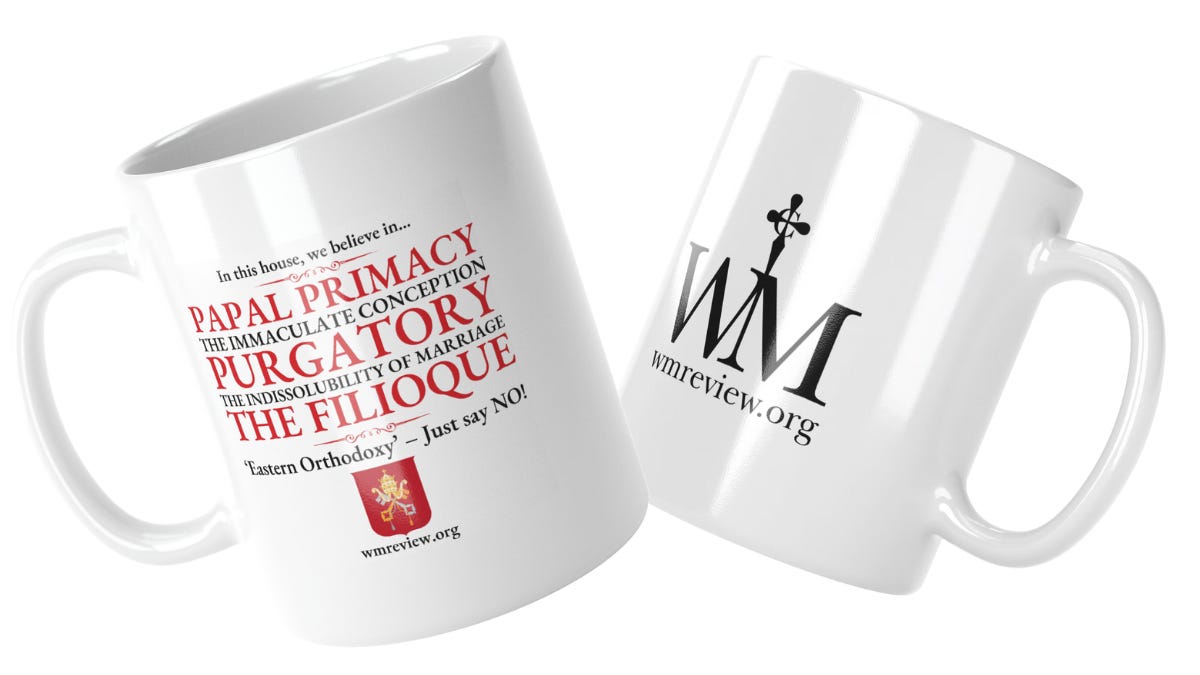
(Now, now, our Eastern “Orthodox” friends, don’t get too stressed. It’s all in good humour. We wish you well, and pray for your good.)
Read Next:
Orestes Brownson’s review of Abbé Guettée’s The Papacy Schismatic:
Article II
Eastern Orthodox? Why the sixth canon of Nicæa isn’t an argument
Eastern Orthodoxy? Rome did not have primacy merely for being the capital city
Eastern Orthodoxy? No, Pope Leo the Great is not a witness against papal primacy


Follow on Twitter, YouTube and Telegram:
Twitter (The WM Review)
The Papacy: Its Historic Origin and Primitive Relations with the Eastern Churches. By the Abbé Guettée, D.D.
Translated from the French, and prefaced by an original biographical notice of the author, with an Introduction by A. Cleveland Coxe, Bishop of Western New York. New York: 1867.
The original article is available in OCR form here.
Op. S. Leon., tom. i. col. 960-962. Migne’s edition.
Ibidem, ad Marcianum Augustum, epist. civ.
I would like to see Mr Wright and others address the Donation of Constantine, Pseudo Isidorian decretals and the Symmachian forgeries. The effects of these have had far reaching effects on the Church.