
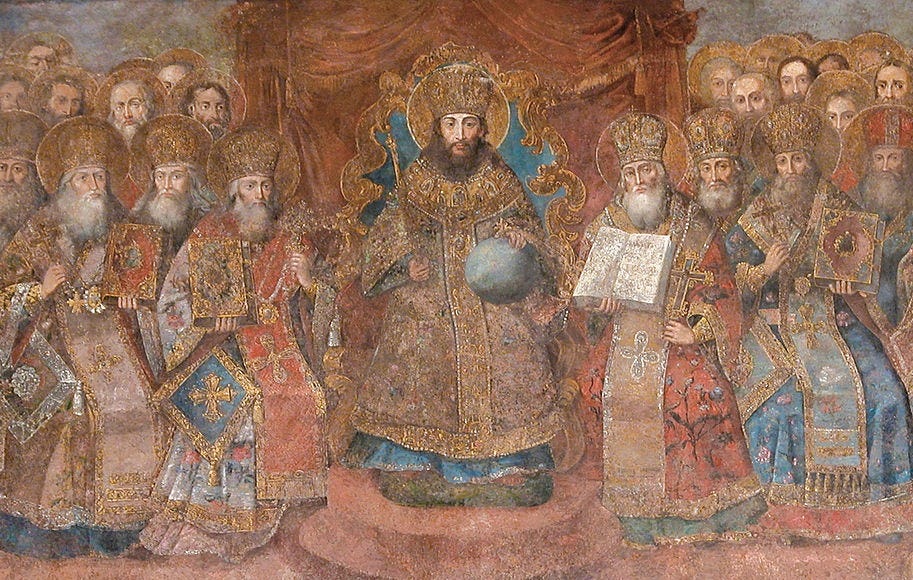
Was the Roman Church preeminent just because of the city’s civil status? Was St Peter ever its bishop? Orestes Brownson shows Orthodox apologist Guettée is grasping at straws.
Editors’ Notes
This is the fourth part of a serialisation of Orestes’ Brownson’s engagement with “Eastern Orthodoxy.”
The background of this engagement – including that of the ex-Catholic author Abbé Vladimir (René-François) Guettée and his book The Schismatic Papacy – can be found in the first part:
The second part addressed Guettée’s surprising attempts to claim St Cyprian of Carthage as evidence for a patristic rejection of papal primacy.
In the third part, Brownson addresses Guettée’s misuse of Tertullian, the so-called Apostolic Tradition and the history of the Church.
Those parts made up one article; Brownson then proceeded to a second, much longer article. As such, this fourth part is also the first part of the second article.
In this part, then, Brownson addresses an argument, which uses the Council of Nicæa’s sixth canon to argue that the Roman primacy was based on the city’s civil status, rather than the Pope’s divine right. Brownson obliterates this argument in his usual style, trapping the apostate cleric Guettée between the horns of a dilemma, both of which refute him.
Brownson stresses that he is not making a positive case for the Roman Catholic Church, but specifically refuting the appalling and nonsensical arguments proposed by Guettée.
Why bother publishing this old review?
Why bother republishing a nineteenth century review of a nineteenth century book – especially by Orestes Brownson, a man with doctrinal problems of his own?
For a start, because the arguments mounted by the Eastern Orthodox have not significantly changed. As Brownson says at the end of this piece:
“The work is rambling, and made up of details most wearisome to read, and difficult to bring into a shape in which its real value can be brought to the test, but it is a fair specimen in spirit and arrangement of the works written against the Roman and Catholic Church, and contains in some form all that schismatics allege first and last against her.
“We may as well make it our text-book for the discussion as any other.”
Many Catholics continue to be seduced into schism by such arguments – and by a faulty understanding of the contemporary crisis in the Church.
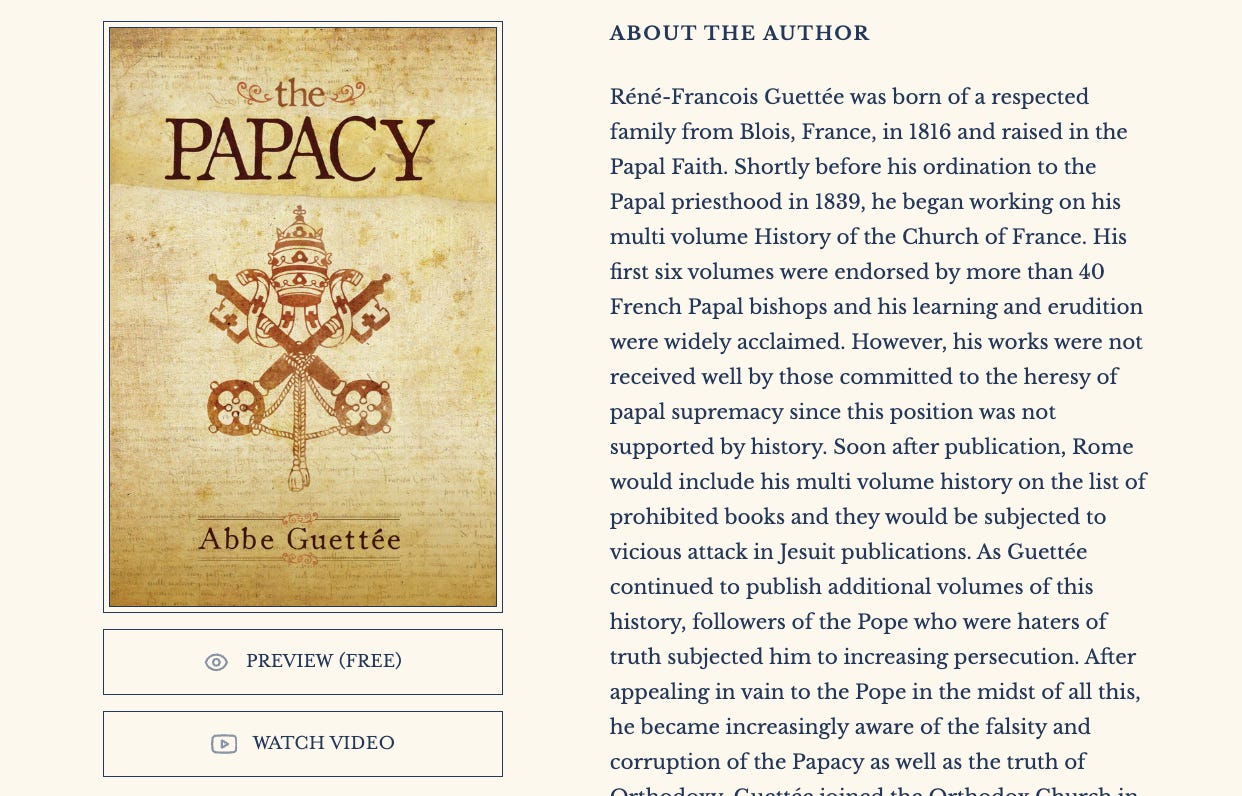
Further, Guettée’s book is still in print, by an “Orthodox” publisher whose catalogue includes a two-volume work titled The Errors of the Latins, The Rise and Fall of the Papacy, and other pro-schism and anti-Catholic works:
In 2024, an “Orthodox” account on Twitter told us that Guettée’s book continues to be popular today:

If Guettée’s book continues to bring the ill-informed into the Photian schism, then Browson’s review and refutation of enduring importance.
As the contemporary “Orthodox” are publishing such works and encouraging Roman Catholics to enter into schism and heresy, they surely cannot complain about us publishing Brownson’s piece in response. We do so in good will, with the hope that they will instead return to the Church of Christ – outside of which there is absolutely no salvation whatsoever.

Ex-Catholic Guettée proposes an argument based on the sixth canon of Nicæa
Guettée’s ‘The Schismatic Papacy,’ Part 2.1
Orestes Brownson
Originally published as “Guetté’s Papacy Schismatic’1
From The Catholic World, 1867
Published in The Works of Orestes A. Brownson, Vol. VIII
Thorndike Nourse, Deroit, 1884. pp 491-500
Headings and some line breaks added by The WM Review
Introduction: Guettée’s Two Central Claims Against Roman Primacy
M. Guettée, it will be remembered, undertakes to establish two propositions. First:
“The bishop of Rome did not for eight centuries possess the authority of divine right which he has since sought to exercise”
And second,
“The pretension of the bishop of Rome to the sovereignty of divine right over the whole church was the real cause of the division,” or schism between the East and the West.
Summary of the Argument Thus Far
To the first proposition, we have replied, the bishop of Rome is in possession, and it is for the author to prove that he is not rightfully in possession. This he can do only by proving either, first, that no such title by divine right was ever issued; or, second, that it vests in an adverse claimant.
He sets up no adverse claimant, but attempts to make it appear that no such title as is claimed was ever issued. This he attempts to do by showing that the proofs of title usually relied on by Catholic writers are negatived by the Holy Scriptures and the testimony of the fathers and councils of the first eight centuries.
We have seen that he has signally failed so far as the Holy Scriptures and the fathers of the first three centuries are concerned; nay, that instead of proving his proposition, he has by his own witnesses refuted it, and proved that the title did issue, and did vest in St. Peter, and consequently now vests in the bishop of Rome as Peter’s successor.
This alone is enough for us, and renders any further discussion of the first proposition unnecessary. After the testimony of St. Cyprian, who is his own witness, the author really has nothing more to say. He has lost his case. But, ignorant of this, he proceeds in the fourth division of his work to interrogate the fathers and councils of the fourth and fifth centuries, but even less successfully, as we now proceed to show. We only beg the reader to bear in mind that we are not adducing our proofs of the papacy by divine right, but are simply examining the proofs the author adduces against it. We do not put forth the strength of our cause, which is not necessary in the present argument; we are only showing the weakness of the case the author makes against us.
Guettée’s Misinterpretation of the Sixth Canon of Nicaea
The author attempts to devise an argument against the papal authority from the sixth canon of the Council of Nicaea. This canon, as he cites it, reads:
“Let the ancient custom be preserved that exists in Egypt, Lybia, and Pentapolis, that the bishop of Alexandria have authority in all these countries, since that has also passed into a custom for the bishop of Rome. Let the churches at Antioch and in the other provinces preserve also their privileges.”
It must not be supposed that the author cites the canon with any degree of exactness, or faithfully renders it; but let that pass. From this canon two consequences, he contends, necessarily follow. First:
“[That] the council declared that the authority of the bishop of Rome extended over a limited district, like that of the bishop of Alexandria; and second that this authority was only based on usage.” (p. 95.)
But the authority of the bishop of Rome was not in question before the council, for that nobody disputed. “The object of the canon,” the author himself says, pp. 93, 94…
“…was to defend the authority of the bishop of Alexandria against the partisans of Meletius, bishop of Lycopolis, who refused to recognize it in episcopal ordinations… therefore was merely to confirm the ancient customs respecting these ordinations, and, in general, the privileges consecrated by ancient usages.
“Now, according to an ancient custom Rome enjoyed certain prerogatives that no one contested. The council makes use of this fact in order to confirm the similar prerogatives of Alexandria, Antioch, and other churches.”
The question before the council, and which it met by this canon, evidently was not the primacy of the see of Rome—although it would seem from the form in which the papal legate, Paschasinus, quoted it, without contradiction, in the Council of Chalcedon, that the Council of Nicæa took care to reserve that primacy—but certain customary rights, privileges, and dignities which the bishops of Alexandria, Antioch, and some other churches held in common with the bishop of Rome. As the ancient custom was preserved in the Roman church, the council says, so let it be in Alexandria, Antioch, and other churches. The council refers to the custom in Rome as a reason for confirming the similar custom which had obtained elsewhere, and which had been violated by Meletius of Lycopolis in Egypt, and by his partisans.
The Ancient Pattern of Decentralized Church Administration
To understand this, we must recollect that prior to the fall of the great patriarchates of Alexandria and the East, the administration of ecclesiastical affairs was less centralized than at present. Now nearly all, if not all, bishops depend immediately on the Holy See, but in the early ages they depended on it only mediately.
The bishops of a province or of a patriarchate depended immediately on their exarch, metropolitan, or patriarch, and only mediately through him on the bishop of Rome. The appointment or election of the patriarch, and of the exarch or metropolitan of a church independent of any patriarch, as were the churches of Asia Minor, Pontus, and Thrace, needed the papal confirmation, but not their suffragans or the bishops subject to their immediate jurisdiction. The patriarch or metropolitan confirmed their election, ordained or deposed them by his own authority, subject of course to appeal to Rome.
Lycopolis, by ancient custom or canons of the fathers, depended on the bishop of Alexandria, who was its bishop’s immediate superior. For some reason, Meletius, bishop of Lycopolis, had been deposed by the bishop of Alexandria, and deprived of his functions; but he refused to submit, ordained bishops by his own authority, contrary to the ancient custom, and created a schism. It was to meet this case, and others like it, that the council decreed the sixth canon.
Distinguishing Patriarchal from Papal Authority
The authority confirmed by that canon was the authority of patriarchs, as they were subsequently called, and of metropolitans by usage independent of any patriarchal jurisdiction, and therefore the authority of the bishop of Rome which it recognized as derived from usage, could have been only his authority as metropolitan of the Suburbicarian churches, called the Roman territory, or as patriarch of the West.
That this authority was limited, and dependent on ancient usage or custom, nobody disputes; but this is distinct from his authority as supreme pontiff or governor of the whole church. There are instances enough on record of metropolitan churches, like Aquileia, and those of Illyrium and Bulgaria, disputing their immediate dependence on the bishop of Rome, that never dreamed of calling in question his authority as supreme pontiff, or governor of the whole church.
The schismatic Armenians do not deny and never have denied the supreme authority in the whole church of the bishop of Rome; they only assert that the pope gave to their apostle, Gregory the Illuminator, and to his successors, the independent government of the church in Armenia. St. Cyprian depended on the bishop of Rome, and acknowledged the papal authority, but it is questionable if he depended on him as patriarch of the West. We suspect Carthage was independent of patriarchal jurisdiction, and that St. Cyprian had no superior but the pope.
However this may have been, the fact that churches did not depend immediately on the bishop of Rome did not in any sense deny or impair his universal authority as supreme pontiff. So the argument against the papacy from the sixth canon of the Council of Nicæa, like the author’s other arguments, proves nothing to his purpose.
Guettée’s Self-Defeating Logic Regarding Nicaea’s Authority
M. Guettée, in his blind hatred of Rome, after having alleged the authority of the Council of Nicæa in his own favor, undertakes to prove that it was no council of the church at all, but merely a council of the empire. He labors hard to prove that it was convoked by the Emperor Constantine by virtue of his imperial authority alone, that the emperor presided in its sessions, and confirmed and promulgated its acts.
Does he not see that if it was so, the council had no ecclesiastical authority, and therefore that its acts have no bearing on the question before us? If any thing is certain, it is that the church, as a polity, is independent of the state, and that civil rulers or magistrates, as such, have no authority in her government. Civil rulers have often usurped authority over the church and oppressed her: they did so at Constantinople, as Gregory III complains; they attempted to do so all through the middle ages in the West, and they do so now to a most fearful extent in the Russian Empire, as in all European Protestant states; but the authority they exercise is usurped, and is repugnant to the very nature and constitution of the church. Our Lord said, “My kingdom is not of this world.”
The non-united Greeks as well as Catholics hold that there is and can be no ecumenical council without the bishop of Rome to convoke it, preside over it, and to confirm and promulgate its acts; and hence they confess their inability to hold an ecumenical council, and therefore really acknowledge that they are not the Catholic Church in its integrity, though they claim to hold the orthodox faith.
They admit the Roman church is the primatial see, and that the presidency of a general council belongs to the bishop of Rome by the right and dignity of his see. If he did not preside in the Council of Nicæa in person or by his legates or representatives, and approve formally or virtually its acts, it could not, by their own doctrine have the authority of a general council. The confirmation and promulgation of its canons by the emperor might make them laws or edicts of the empire, but could not make them canons of the church.
The Historical Reality: Rome’s Role in Convening and Ratifying Nicaea
It would be no difficult matter to prove that the author is as much out in his facts as in his inferences. The universal church has recognized the Council of Nicæa as a legitimate council, and there are ample authorities to prove that its convocation and indiction were at the request or with the assent of the Roman pontiff, that he presided over it by his legates, Osius, bishop of Cordova, and Vitus and Vincentius, two Roman presbyters; that he virtually, if not formally, confirmed and published its acts; and that whatever the emperor did was merely executory; but the question is foreign to our present argument, and we have no space to indulge in extraneous or irrelevant discussions.
If we were endeavoring to prove the papacy, we should adduce the proofs; but our line of argument requires us only to refute the reasons the author alleges for asserting that the papacy is schismatic. If the Council of Nicæa was simply an imperial council, we have nothing to do with it; if it was a true general council of the church, it makes nothing for the author, for the sixth canon, the only one relied on, has, as the author cites it, no reference to the jurisdiction of the holy apostolic see of Rome.
HELP KEEP THE WM REVIEW ONLINE WITH WM+!
As we expand The WM Review we would like to keep providing free articles for everyone.
Our work takes a lot of time and effort to produce. If you have benefitted from it please do consider supporting us financially.
A subscription gets you access to our exclusive WM+ material, and helps ensure that we can keep writing and sharing free material for all.
You can see what readers are saying over at our Testimonials page.
(We make our WM+ material freely available to clergy, priests and seminarians upon request. Please subscribe and reply to the email if this applies to you.)
Subscribe to WM+ now to make sure you always receive our material. Thank you!
If you enjoyed this article, then why not get it in mug form?
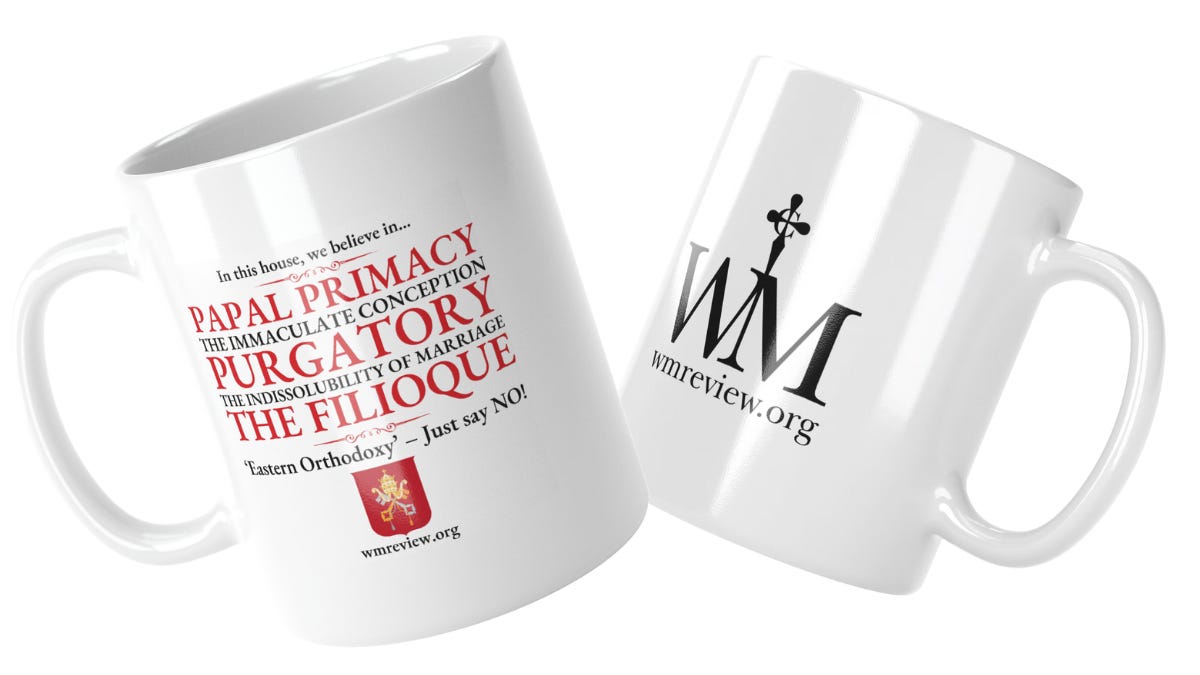
(Now, now, our Eastern “Orthodox” friends, don’t get too stressed. It’s all in good humour. We wish you well, and pray for your good.)
Read Next:


.jpg)
Follow on Twitter, YouTube and Telegram:
Twitter (The WM Review)
The Papacy: Its Historic Origin and Primitive Relations with the Eastern Churches. By the Abbé Guettée, D.D.
Translated from the French, and prefaced by an original biographical notice of the author, with an Introduction by A. Cleveland Coxe, Bishop of Western New York. New York: 1867.
The original article is available in OCR form here.
The Eastern Schismatics refused to be governed by Peter ultimately out of pride. Their fathers submitted to Peter, but they refused. Their return to unity necessarily involves an amount of humiliation, of recognizing that both they and their sects were wrong to oppose the Principle of Unity. This requires humility, which is hard to find.
If, as you say, there hasn't actually been a pope since at least the mid '60s, and we show no signs of getting one anytime soon, then who exactly are the Eastern Orthodox in schism with?