
Eastern ‘Orthodox’ Abbé Guettée’s appeal to Constantinople and Chalcedon collapses under Brownson’s scrutiny.
Editors’ Notes
This is the fifth part of a serialisation of Orestes’ Brownson’s engagement with “Eastern Orthodoxy.”
Article I
The background of this engagement – including that of the ex-Catholic author Abbé Vladimir (René-François) Guettée and his book The Schismatic Papacy – can be found in the first part. Here are the parts we have seen so far:
Those parts made up one article; Brownson then proceeded to a second, much longer article. As such, this fourth part is also the first part of the second article – which systematically dismantles Guettée’s attempted appeal to the Councils.
Article II
Eastern Orthodox? Why the sixth canon of Nicæa isn’t an argument
Eastern Orthodoxy? Rome did not have primacy merely for being the capital city
For more on why we might bother republishing a nineteenth century review of a nineteenth century book, see the previous part. In short, Guettée’s book continues to bring the ill-informed into the Photian schism, and so Browson’s review and refutation continues to be of enduring importance.
As the contemporary “Orthodox” are publishing such works and encouraging Roman Catholics to enter into schism and heresy, they surely cannot complain about us publishing Brownson’s piece in response. We do so in good will, with the hope that they will instead return to the Church of Christ – outside of which there is absolutely no salvation whatsoever.

Rome did not have primacy merely for being the capital city
Guettée’s ‘The Schismatic Papacy,’ Part 2.1
Orestes Brownson
Originally published as “Guetté’s Papacy Schismatic’1
From The Catholic World, 1867
Published in The Works of Orestes A. Brownson, Vol. VIII
Thorndike Nourse, Deroit, 1884. pp 491-500
Headings and some line breaks added by The WM Review
The First Council of Constantinople
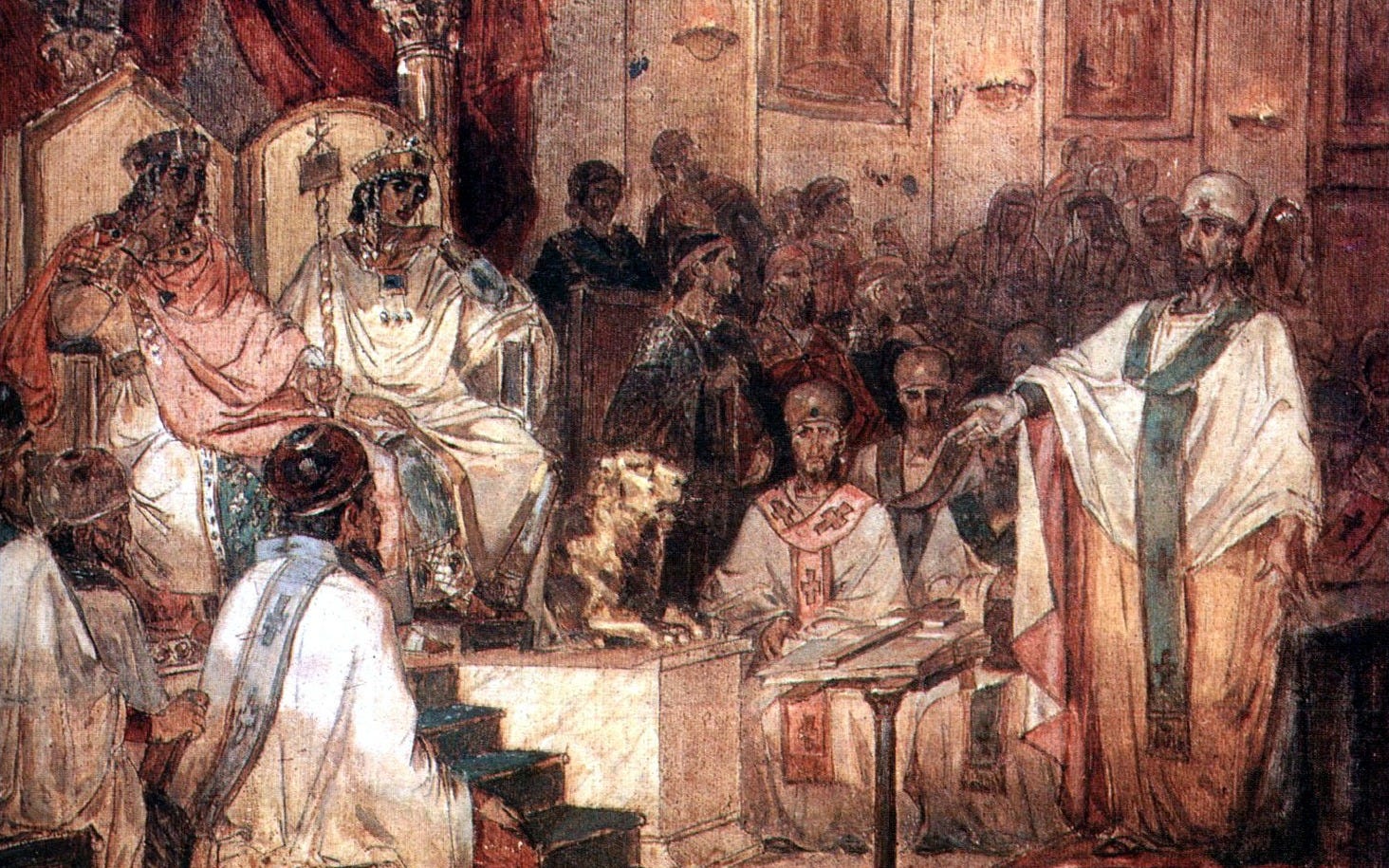
M. Guettée pretends that the third canon of the second general council, the first of Constantinople, contains a denial of the papal authority by divine right. The canon, as he cites it, which is only the concluding part of it, says:
“Let the bishop of Constantinople have the primacy of honor (priores honoris partes) after the bishop of Rome, because Constantinople is the new Rome.”
Hence he concludes that as the primacy conferred on the bishop of Constantinople was only a primacy of honor, the bishop of Rome had only a primacy of honor; and as the primacy of honor was conferred on the bishop of Constantinople because that city was the new Rome, so the primacy of the bishop of Rome was conferred because he was the bishop of old Rome, or the capital of the empire.
The reasoning, which is Guettéean, if we may coin a word, is admirable, and we shall soon see what St. Leo the Great thinks of it. But the canon does not affect the authority, rank, or dignity of the bishop of Rome; it simply gives the bishop of Constantinople the precedence of the bishop of Alexandria, who had hitherto held the first rank after the bishop of Rome. It conferred on him no power, and took nothing from the authority of any one else. It was simply a matter of politeness.
Besides, the canon remained without effect.
The Council of Chalcedon
From the second general council the author rushes, pp. 96, 97, to the fourth, the Council of Chalcedon, held under the pontificate of St. Leo Magnus, in 451, and lights upon the twenty-eighth canon of that council, which, as he gives it, reads:
“In all things following the decrees of the holy fathers, and recognizing the canon just read (the third of the second council) by the one hundred and fifty bishops well beloved of God, we decree and establish the same thing touching the most holy church of Constantinople, the new Rome.
“Most justly did the fathers grant privileges to the see of ancient Rome, because she was the reigning (capital) city. Moved by the same motive the one hundred and fifty bishops well beloved of God grant equal privileges to the most holy see of the new Rome, thinking, very properly, that the city that has the honor to be the seat of the empire and the senate should enjoy in ecclesiastical things the same privileges as Rome, the ancient queen city, since the former, although of later origin, has been raised and honored as much as the former.
“In consequence of this decree the council subjected the dioceses of Pontus, Asia (Asia Minor), and Thrace to the jurisdiction of Constantinople.”
Of course the author cites the canon with his usual inexactness, and makes it appear even more illogical and absurd than it really was.
The alleged canon professes to decree and establish the same thing decreed and established by the one hundred and fifty bishops who composed the second council, in their third canon, which, as we have seen, was simply that the bishop of Constantinople should have the primacy of honor after the bishop of Rome, that is the second rank in the church. The canon, therefore, does not deprive the Roman pontiff of his rank, dignity, and authority as primate of the whole church, and therefore did not, as it could not, raise the see of Constantinople to an equal rank and dignity with the see of Rome.
This was never pretended, and is not pretended by the author himself. The council never could, without stultifying itself, have intended any thing of the sort, for it gave to the bishop of Rome the title of “universal bishop,” and it says expressly
“We consider the primacy of all and the chief honor, according to the canons, should be preserved to the most beloved of God, the archbishop of Rome.”2
The non-united Greeks and the author himself concede that the church of Rome was and is the first church in rank and dignity.
Whatever value, then, is to be attached to this twenty-eighth canon it did not and was not designed to affect in any respect the rank, dignity, or authority of the Roman pontiff. What was attempted by it was to erect the non-apostolic see of Constantinople or Byzantium into a patriarchal see, with jurisdiction over the metropolitans of Pontus, Asia Minor, Thrace, and such as should be ordained in barbarous countries, that is, in countries lying beyond the limits of the empire, and to give its bishops the first rank after the patriarch of the West.
It sought to reduce the bishop of Alexandria from the second to the third, and the bishop of Antioch from the third to the fourth rank, but it did not touch the power or authority of either. It violated the rights and privileges of the metropolitans of Pontus, Asia Minor, and Thrace, by subjecting them to a patriarchal jurisdiction from which, by ancient usage, confirmed by the sixth canon of the Council of Nicæa they were exempt.
The real reason this canon is cited
The author relies on this canon because it asserts that the privileges of the see of Rome were granted by the fathers, and granted because Rome was the capital city of the empire. This sustains his position, that the importance the fathers attached to the see of Rome was not because it was the see of Peter, but because it was the see of the capital—a position we showed, in our previous article, to be untenable—and also that the authority exercised by the Roman pontiff over the whole church, which he cannot deny, was not by divine right, but by ecclesiastical right.
But even if this last were so, since there is confessedly no act of the universal church revoking the grant, the power would be legitimate, and the author and his friends the non-united Greeks would be bound by a law of the church to obey the Roman pontiff, and clearly schismatics in refusing to obey him.
But we have seen from St. Cyprian, the author’s own witness, that the primacy was conferred by our Lord himself on the Roman pontiff as the successor of Peter to constitute him the visible centre and source of unity and authority. Besides, a canon, beyond what it decrees or defines, is not authoritative, and it is lawful to dispute the logic of a general council, and even the historical facts it alleges, at least so far as they can be separated from the definition or decree itself. The purpose of the canon of Chalcedon was not to define or decree that the privileges of the see of Rome were granted by the fathers, and because it was the see of the capital of the empire, but to elevate the see of Constantinople to the rank and authority of a patriarchal see, immediately after the see of Rome, and simply assigns this as a reason for doing so; and a very poor reason it was, too, at least in the judgment of St. Leo the Great, as we shall soon see.
But there is something more to be said in regard to this twenty-eighth canon of the Council of Chalcedon.
HELP KEEP THE WM REVIEW ONLINE WITH WM+!
As we expand The WM Review we would like to keep providing free articles for everyone.
Our work takes a lot of time and effort to produce. If you have benefitted from it please do consider supporting us financially.
A subscription gets you access to our exclusive WM+ material, and helps ensure that we can keep writing and sharing free material for all.
You can see what readers are saying over at our Testimonials page.
(We make our WM+ material freely available to clergy, priests and seminarians upon request. Please subscribe and reply to the email if this applies to you.)
Subscribe to WM+ now to make sure you always receive our material. Thank you!
If you enjoyed this article, then why not get it in mug form?
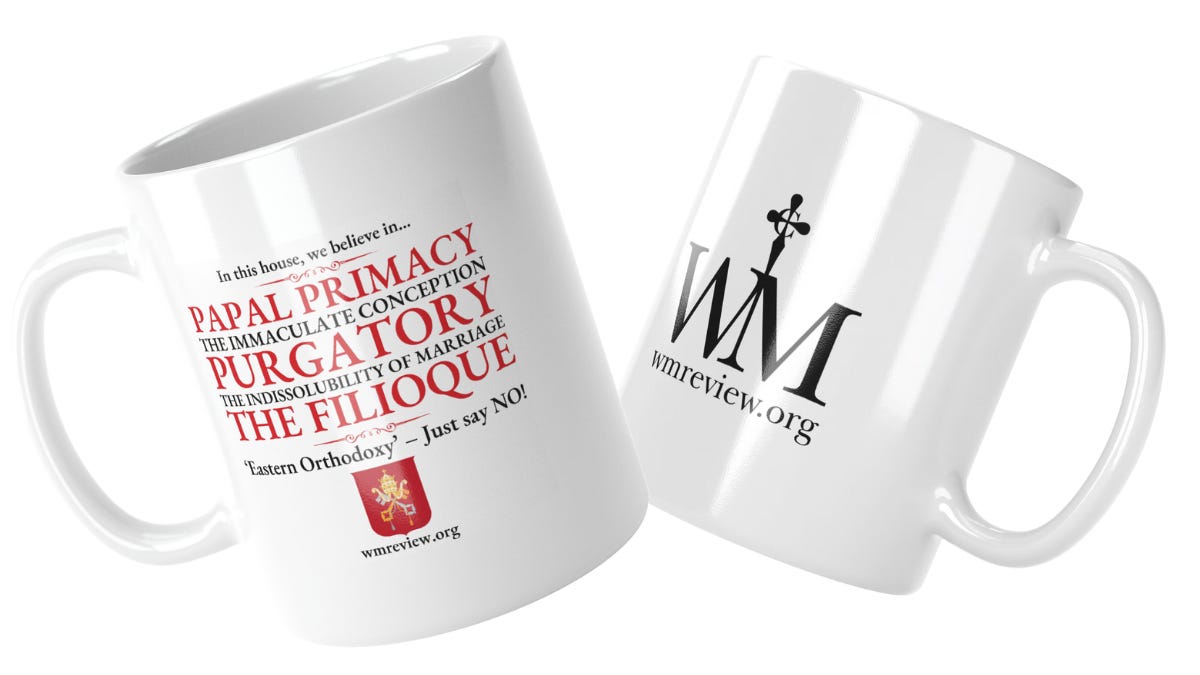
(Now, now, our Eastern “Orthodox” friends, don’t get too stressed. It’s all in good humour. We wish you well, and pray for your good.)
Read Next:
Article I
Article II
Eastern Orthodox? Why the sixth canon of Nicæa isn’t an argument
Eastern Orthodoxy? Rome did not have primacy merely for being the capital city

Follow on Twitter, YouTube and Telegram:
Twitter (The WM Review)
The Papacy: Its Historic Origin and Primitive Relations with the Eastern Churches. By the Abbé Guettée, D.D.
Translated from the French, and prefaced by an original biographical notice of the author, with an Introduction by A. Cleveland Coxe, Bishop of Western New York. New York: 1867.
The original article is available in OCR form here.
Act xvi. Labbe, IV. col. 817.
I appreciate this article. I hope this can lead to a fruitful discussion about the Donation of Constantine, the Pseudo Isidorian Decretals and the Symmachian Forgeries as these examples have really given potential converts pause and caught many Catholics off guard due to the ramifications.
We don't reject Rome historical role as first among equals, and welcome the Pope's return to that role when he rejects the heterodox innovations he acquired and proclaimed. You reject him for his post-Vatican II heterodoxy, we since pretty much the 11th century. Sadly, you have to deal with Pastor Aeternus and all the cognitive dissonance that generates. Never having elevated the Papacy to that high level falsely attributed to the Pope in PA, recognizing his heterodoxy does not require us make up even more innovations to smooth over the conundrums - like sedevacantism. Why would God require us to adhere to a visible center of unity that demands acceptance of liturgical abuse and doctrinal confusion and obtuseness? Further, isn't the idea of pledging allegiance to a non-material notion like "Eternal Rome" smack of an attack on the incarnate nature of the Church as the Bride of Christ?