
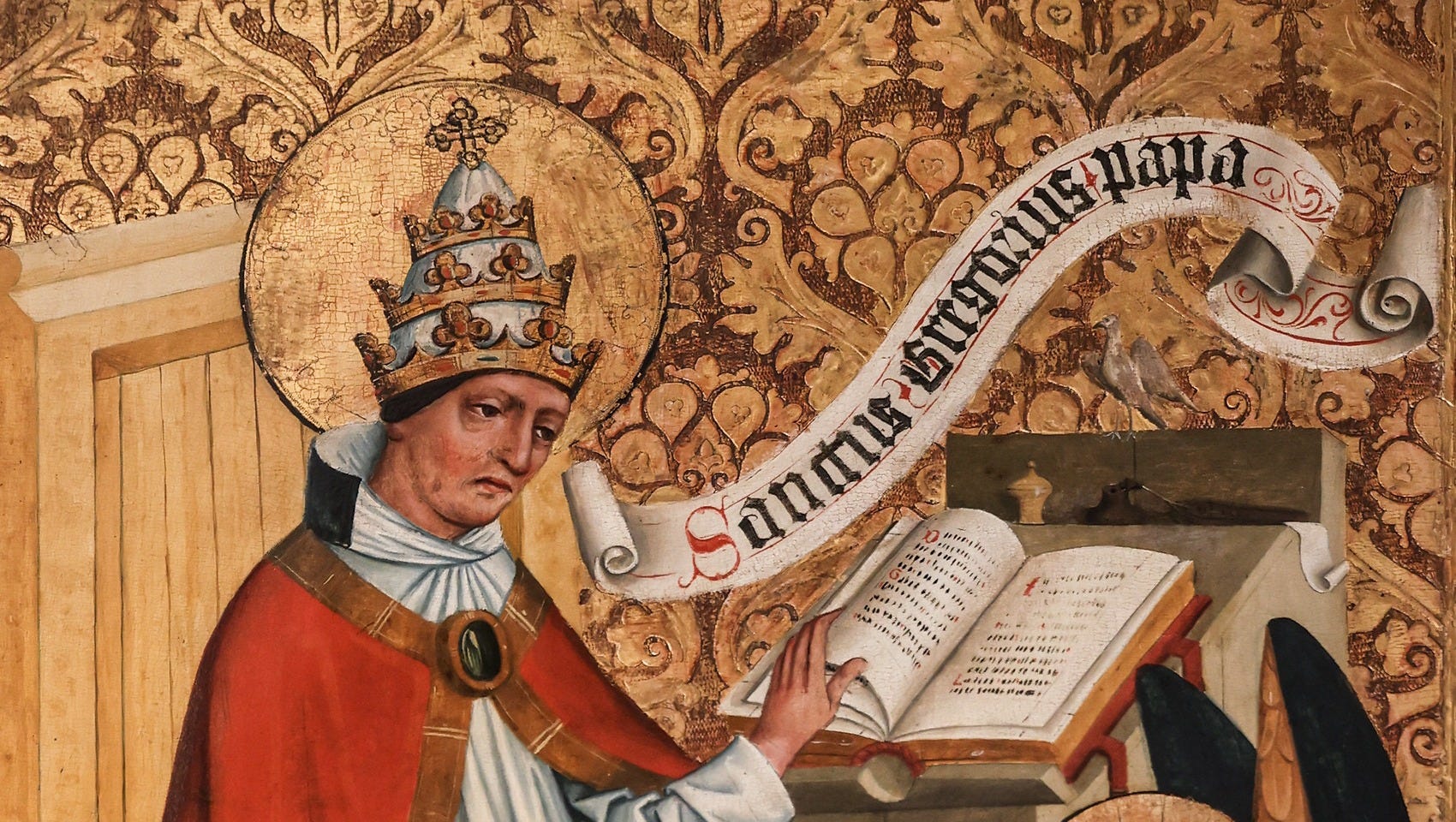
In the early Church, the title ‘Universal Bishop’ was rejected. What does this mean for the Papal claims?
Editors’ Notes
This is the eighth part of a serialisation of Orestes’ Brownson’s engagement with “Eastern Orthodoxy.”
It was originally published in two articles.
Article I
The background of this engagement – including that of the ex-Catholic author Abbé Vladimir (René-François) Guettée and his book The Schismatic Papacy – can be found in the first part. Here are the parts we have seen so far:
Those parts made up one article; Brownson then proceeded to a second, much longer article. As such, this fifth part is also the eighth part of the second article.
Article II
Eastern Orthodox? Why the sixth canon of Nicæa isn’t an argument
Eastern Orthodoxy? Rome did not have primacy merely for being the capital city
Eastern Orthodoxy? No, Pope Leo the Great is not a witness against papal primacy
Eastern Orthodoxy? ‘Orthodox proofs’ from Chalcedon undermine their own case
Eastern Orthodoxy? St Gregory the Great and the ‘Universal Bishop’ title
Why are we publishing this?
For more on why we might bother republishing a nineteenth century review of a nineteenth century book, see the previous part. In short, Guettée’s book continues to bring the ill-informed into the Photian schism, and so Browson’s review and refutation continues to be of enduring importance.
As the contemporary “Orthodox” are publishing such works and encouraging Roman Catholics to enter into schism and heresy, they surely cannot complain about us publishing Brownson’s piece in response. We do so in good will, with the hope that they will instead return to the Church of Christ – outside of which there is absolutely no salvation whatsoever.

St Gregory the Great and the ‘Universal Bishop’ title
Guettée’s ‘The Schismatic Papacy,’ Part 2.1
Orestes Brownson
Originally published as “Guetté’s Papacy Schismatic’1
From The Catholic World, 1867
Published in The Works of Orestes A. Brownson, Vol. VIII
Thorndike Nourse, Deroit, 1884. pp 491-500
Headings and some line breaks added by The WM Review
St Gregory the Great’s rejection of the title of ‘universal bishop’
The author imagines that he gets an argument against the papacy from St. Leo’s refusal to accept the title of universal bishop offered him by the Council of Chalcedon, as we learn from Pope St. Gregory the Great. He also thinks the argument is strengthened by the fact that St. Gregory himself disclaimed it; and he therefore claims both of these great pontiffs and great saints as witnesses against the pretensions of the bishops of Rome. If they had believed in their jurisdiction by divine right over the whole church, would they have refused the title of universal bishop?
John the Faster, Bishop of Constantinople, on some occasion summoned a particular council, and signed its acts, which he transmitted to Pope Pelagius II as universal patriarch, for which, as St. Gregory says, Pelagius, “in virtue of the authority of the apostle St. Peter, nullified the acts of the synod.”
Gregory succeeded Pelagius, and immediately on his accession to the pontificate wrote to the patriarchs of Alexandria, Antioch, and Jerusalem, condemning the title, and warning them and the whole church of the danger it threatened; and also he wrote to John the Faster himself, admonishing him of the impropriety of the title, not only as savoring of pride and vanity, but as involving a most serious error against faith, and beseeching him to lay it aside, lest he be obliged to cut him off from the communion of the church, and depose him from his bishopric.
What St Gregory the Great actually said
He does not at all disclaim his own authority as supreme pastor and governor of the universal church, but quietly assumes it. Thus, he writes to the Emperor Maurice, as cited by the author:
“All who know the gospel know that the care of the whole church was confided by our Lord himself to Peter, the first (St. Gregory says prince) of all the apostles.
“Indeed, he said to him, ‘Peter, lovest thou me? Feed my sheep.’ Again he said to him: ‘Satan has desired to sift thee as wheat; but I have prayed for thee, that thy faith fail not; and when thou art converted, strengthen thy brethren.’ It was also said to him: ‘Thou art Peter, and upon this rock will I build my church, and the gates of hell shall not prevail against it; and I will give thee the keys of the kingdom of heaven, and whatsoever thou shalt bind on earth shall be bound in heaven, and whatsoever thou shalt loose on earth shall be loosed in heaven.’
“He thus received the keys of the celestial kingdom; the power to bind and loose was given him; the care of all the church and the primacy [principatus—principality, or primacy of jurisdiction] were committed to him, and yet he did not call himself universal apostle.
“But that holy man John (bishop of Constantinople), my brother in the priesthood [cosacerdos], would fain assume the title of universal bishop! O tempora! O mores!” (pp. 212, 213.)
“It is certain,” St. Gregory continues…
“… that this title was offered to the Roman pontiff by the venerable council of Chalcedon, to honor Blessed Peter, prince of the apostles.
“But none of us has consented to use this particular title, [title of singularity,] lest by conferring a special matter on one alone, all priests would be deprived of the honor which is their due.
“How, then, while we are not ambitious of the glory of a title which has been offered us, does another, to whom no one has offered it, have the presumption to take it?” (pp. 214, 215.)
In his letter to Eulogius of Alexandria and Anastasius of Antioch, St. Gregory is more explicit still:
“As your holiness, whom I particularly venerate, well knows, this title of universal, was offered by the Council of Chalcedon to the bishop [pontiff of the apostolic see, which by God’s grace I serve. But none of my predecessors would use this impious word, because in reality, if a patriarch be called universal, it takes from all others the title of patriarch.”
The true grounds of the problem with the title of ‘universal bishop’
The author [Guettée], after quoting a passage from another letter to Eulogius, adds:
“Thus did Pope Gregory condemn even in the person of the bishops of Rome the title of pope and universal.”
But in this he is mistaken, as his own quotation shows. Eulogius answers that he will not give the title of universal patriarch to the bishop of Constantinople, but that he gives that of universal pope to the Roman pontiff. “No,” says St. Gregory, “if your holiness calls me universal pope, you deny yourself what I should then be altogether.”
The author interpolates in his quotation the copulative and, which is not in St. Gregory’s text. It is not to the title of pope that St. Gregory objects, which was and is applied to simple presbyters, but the title universal, which he will not permit to be applied to any man, because it excludes others from all participation in the hierarchy, or even the priesthood.
If you call a man a universal presbyter, you deny that any others are presbyters; if you call any one universal bishop, you exclude all others from the episcopate; if you call any one universal patriarch, you deny the patriarchate to all others; and if you call the bishop of Rome universal pope, since as such he possesses the priesthood, and both the apostolate and the episcopate in their plenitude, you exclude all others from sharing the priesthood, the episcopate, or the apostolate, even the pope himself from the church, and deny the solidarity of apostles, bishops, and presbyters, asserted, as we have seen, by St. Cyprian.
Eulogius was priest, bishop, and patriarch, and as such was the brother of the Roman pontiff. This brotherhood remained all the same, whether the Roman pontiff had or not supreme jurisdiction over the whole church. When Eulogius called St. Gregory, not, as the author says, pope and universal, but universal pope, he denied this brotherhood, and deprived himself of his own priestly, episcopal, and apostolic character. Hence, St. Gregory, after saying to him and other bishops, “I know what I am, and what you are; by your place or office, you are my brothers, by your virtues, my fathers,” he adds, in reference to the title of universal which Eulogius had given him:
“I beseech your holiness to do so no more in future, for you take from yourself what you give in excess to another. I do not ask to increase in dignities, but in virtues. I do not esteem that an honor by which my brethren are deprived of theirs.
“For my honor is the honor of the universal church, my honor is the unshaken firmness of my brethren. Then am I truly honored when to no one is denied the honor that is his due. For, if your holiness calls me universal pope, you deny that you are yourself what I should be confessed to be universally. Sed absit hoc. Recedant verba quæ vanitatem inflant, et charitatem vulnerant.”2
What this means for the papacy
We may call the bishop of Rome pope of the universal church, but not universal pope, nor universal bishop, because he only possesses in its plenitude what is possessed in a degree by every member of the hierarchy, and even now, as always, the pope addresses the bishops in communion with him as “Venerable Brethren.”
The argument against the claim of the bishop of Rome to jurisdiction in the universal church, which the author attempts to build on the refusal of the title of universal bishop by St. Leo, and that of universal pope, papa universalis, by St. Gregory, is refuted by St. Gregory himself, as cited in the volume before us, pp. 212, 213.
The holy pontiff and doctor, after asserting that our Lord had given to Peter the primacy of jurisdiction, and confided to him the care of the universal church, adds that Peter “did not call himself universal apostle.” Peter was not the only apostle, and the others could not be excluded from the apostleship. He was prince of the apostles, their chief, the centre of apostolic unity and authority, as St. Cyprian explains, and had the care and jurisdiction (principatus) of the universal church, as Gregory asserts, but inclusive, not exclusive of the other apostles. Peter held in relation to the other apostles and the whole church all the supremacy claimed by Catholics for the bishop of Rome.
If, then, the refusal of the title of universal apostle by St. Peter did not negative his supreme authority, why should the refusal of the title of universal bishop or universal pope by the bishops of Rome negative their supremacy, or their primacy of jurisdiction in the whole church? Peter held that primacy, and yet was not universal apostle, and why not, then, the bishop of Rome, without being universal bishop or universal pope?
HELP KEEP THE WM REVIEW ONLINE WITH WM+!
As we expand The WM Review we would like to keep providing free articles for everyone.
Our work takes a lot of time and effort to produce. If you have benefitted from it please do consider supporting us financially.
A subscription gets you access to our exclusive WM+ material, and helps ensure that we can keep writing and sharing free material for all.
You can see what readers are saying over at our Testimonials page.
(We make our WM+ material freely available to clergy, priests and seminarians upon request. Please subscribe and reply to the email if this applies to you.)
Subscribe to WM+ now to make sure you always receive our material. Thank you!
If you enjoyed this article, then why not get it in mug form?
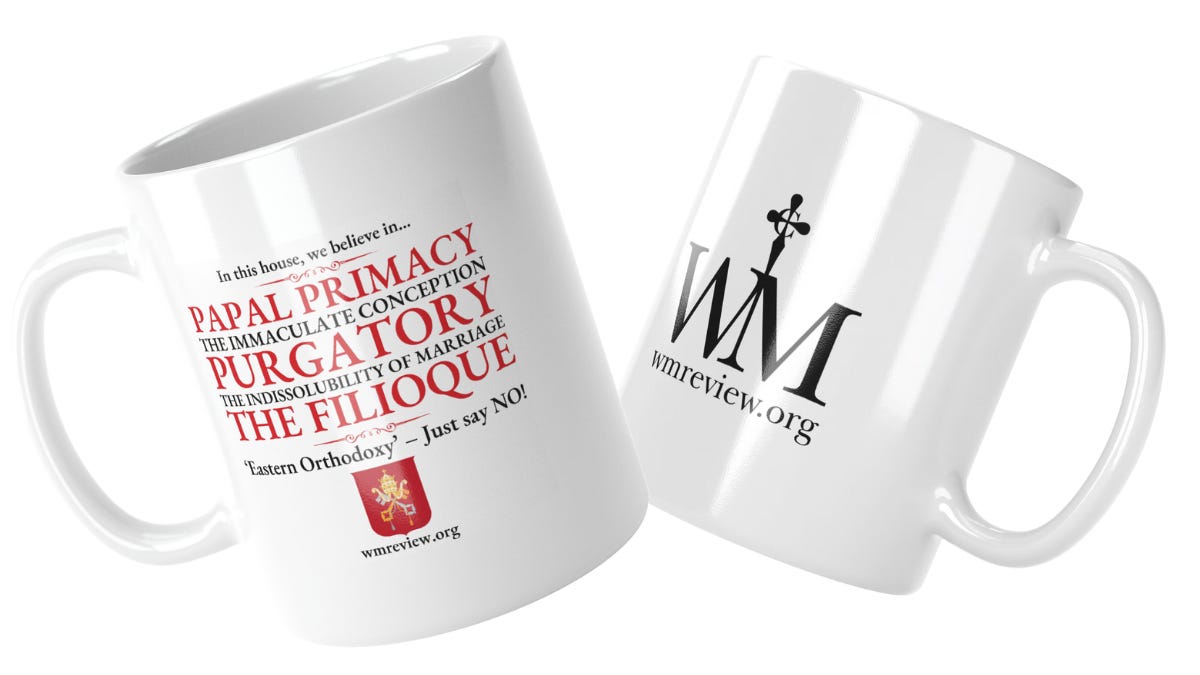
(Now, now, our Eastern “Orthodox” friends, don’t get too stressed. It’s all in good humour. We wish you well, and pray for your good.)
Read Next:
Orestes Brownson’s review of Abbé Guettée’s The Papacy Schismatic:
Article II
Eastern Orthodox? Why the sixth canon of Nicæa isn’t an argument
Eastern Orthodoxy? Rome did not have primacy merely for being the capital city
Eastern Orthodoxy? No, Pope Leo the Great is not a witness against papal primacy
Eastern Orthodoxy? ‘Orthodox proofs’ from Chalcedon undermine their own case
Eastern Orthodoxy? St Gregory the Great and the ‘Universal Bishop’ title

Follow on Twitter, YouTube and Telegram:
Twitter (The WM Review)
The Papacy: Its Historic Origin and Primitive Relations with the Eastern Churches. By the Abbé Guettée, D.D.
Translated from the French, and prefaced by an original biographical notice of the author, with an Introduction by A. Cleveland Coxe, Bishop of Western New York. New York: 1867.
The original article is available in OCR form here.
“Op. S. Gregorii Magni, lib. viii. epist. xxx. Mignes’ edition, tom. iii. col. 933.