
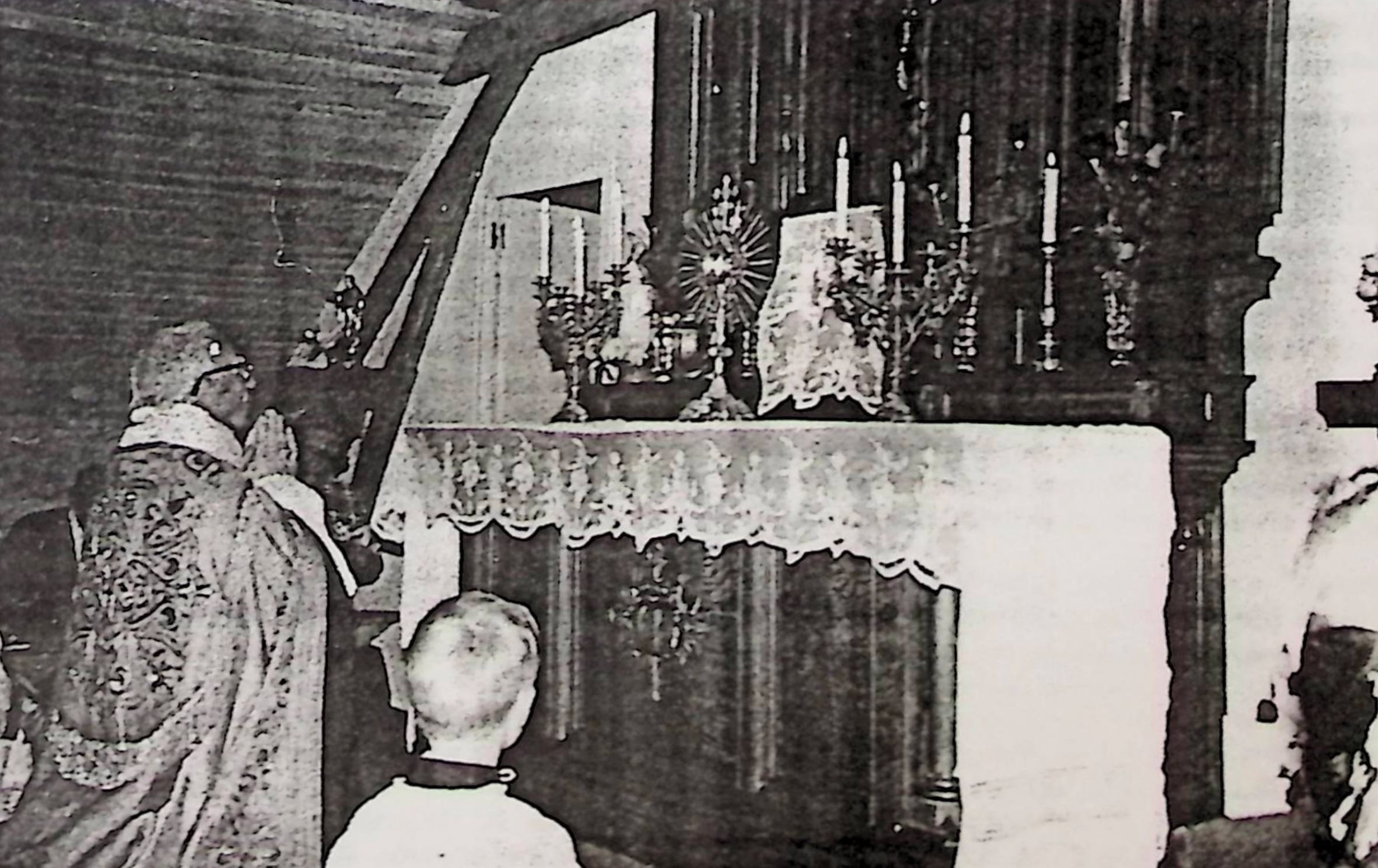
On 1 March 1988, Bishop Franco Munari delivered this eulogy at the Requiem of Mgr Guérard des Lauriers.
Editors’ Notes
This is the last of the three articles we are publishing for the anniversary of Mgr Guérard des Lauriers’ death and passing into eternity. It was delivered by Bishop Franco Munari, whom Mgr Guérard des Lauriers consecrated to the episcopate shortly before his death, on 25th November 1987.
Here are the three articles, as well as his final sermon in January 1987:
The late bishop remains a significant figure in post-Vatican II theological controversies. We publish these new translations for our readers’ edification and its historical value, without endorsing all the positions of Mgr Guérard des Lauriers – just as we have published texts by Archbishop Marcel Lefebvre and others.
Homily Delivered on 1 March 1988
For the Funeral of Mgr Guérard des Lauriers
By Mgr Franco Munari
In Sous la Bannière, n. 16, Mars-Avril, 1988.
We believe that our translation of this text is covered by fair use; if there is an existing copyright holder who would like us to remove it, they can reach us in the comments to this article.
Life of Silence
In the name of the Father and of the Son and of the Holy Spirit, amen.
Dear faithful, I have just said to you: “Silentium Pater Praedicatorum.”
Very recently, Mgr Guérard would say this to us, for at bottom, silence was his way of living. When I speak of silence, I mean by that not simply the fact of not speaking, or of keeping quiet here or there, but of living interiorly in a state of silence. And even in the midst of the most terrible events – and God knows we are living through terrible events – Mgr Guérard maintained this silent state.
Silence also means: keeping silent every time the truth is not at stake. Who among us knows how to keep silent each time the truth is not at stake? Monseigneur lived by speaking very little outwardly, and by being in interior silence all the time. And if I tell you this, it is because, perhaps a month and a half ago, speaking to me of his approaching burial, he said to me:
“You will say a few words, above all to console the people. But I would not want words to be wasted on me. And so I ask you, if by chance, here or there, at the meal, at the cemetery, anywhere, one or another should wish to say a word, ask him, for mercy’s sake, not to do so. I prefer it thus.”
Once again, even in thinking of his death, he thought of silence – that not too much be said about him.
Memories of Mgr Guérard des Lauriers
It is for this reason that I address these few words to you; I cannot deliver a panegyric for Mgr Guérard; I have not the means, and he himself would not have appreciated it. I shall simply share with you my few memories of him. I came to know him recently, a year and a half ago, and you see therefore that almost his entire life is unknown to me. So I shall speak to you only of those few times we spent near him.
Who, then, is this man who has just left us, and whom we shall no longer have the joy of having among us?
One may say that he was a man of faith, a man of virtue, and a man of the Church.
His faith
His faith, I confess to you, is what always struck me the most. I would say that his faith was almost visible. We are priests, we have lived in traditionalist circles, and in our circles, one speaks all the time of the faith to be safeguarded, to be saved, to be defended. And yet often these are but words, mere talk; they are not a truth, a reality.
Mgr Guérard, on the contrary, gave me this impression at once. He lived by faith. It was to faith that he had recourse at every moment; it was the spring from which he drew to find answers to the difficulties of life, to seek the light of understanding, and to find solutions also, on the occasion of this crisis we are living through.
A very few days ago, a priest asked him, to know a little of what was happening in his heart:
“Monseigneur, does the good God speak to you? What do you feel within yourself?”
He said:
“Jesus is silent! I live by pure faith.”
And it was like that to the end. I believe that the great trial he had to endure was above all this one: to live by pure faith to the very end; and God knows how much this faith cost him. You know well that, for not a few years now, he lived in this state of almost complete isolation, of abandonment. It was, at bottom, for questions of faith that he lived thus, for practically everyone had turned their backs on him. It was this faith that had given the reasons for his struggle, for his combat during these years, and it is this faith that he has taken with him to the tomb.
What is this faith of Mgr Guérard? It was quite simply, I believe, the Truth. He loved the Truth, he sought the Truth; the Truth was the reason for everything. For him, Faith and Truth coincided. It was this truth, the truth of God Himself, that always allowed him to resist; not to let himself go in the face of abandonment, of betrayal, often of calumnies… What has not been said about Mgr Guérard!?
He lived by that. He died with that in his soul. And I believe that, especially during his last illness, faith, the Truth, and therefore the duty to resist to the very end in the name of the Faith, was at bottom his reason for living. For himself, he expected nothing more. He had been saying for a long time:
“I am abandoned; I am at equal distance from life and from death; God will decide.”
Yet he suffered; he wanted this suffering to be well accepted by his soul; he sought perfection in this suffering, in this illness. He kept his lucidity until almost the last minute. And so he was aware that death was approaching. He was perfectly lucid even when he could no longer speak. He understood everything, but his mouth no longer moved, his tongue no longer uttered sounds.
His faith remains therefore his first testimony. A faith which for him, I repeat, coincided with the guarding of the deposit of the Church, as the Church gives it to us. And moreover, the pure oblation – to keep the Catholic Mass without stain, nor defiled by anything whatsoever.
A man of virtue
I said: a man of faith and a man of virtue.
Here too, it is not for us, obviously, to say whether Monseigneur was a saint or not a saint. Each of us has many memories, for Monseigneur liked to converse with anyone in private. So I can speak only of what, in Monseigneur, struck me the most in his virtue. And even if this may surprise you, I would say that the virtues that struck me were gentleness and tenderness. It has been said of Monseigneur that he was hard, rigid, not pastoral, demanding. And I tell you: blessed be that intransigence. Dom Sarda y Salvany tells us that intransigence, supreme intransigence in Catholicism, coincides with supreme charity.
In Monseigneur, you see, I never saw this rigidity. When one was with him, immediately the man was transformed; he gave all his wise counsel; he smiled, and one left these conversations perfectly happy. For he had given, in very few words, light for the intelligence, warmth for the soul and the heart… one had received everything, and all of that very simply.
What was called his rigidity, his hardness – that was situated at another level, and it was precisely at the level of faith, where, at all costs, he was determined to resist to the end.
To speak of imprudence in Mgr Guérard is to do him wrong. For I believe that, despite his solitude, if there was a man of faith who always tried to employ the maximum of prudence, insofar as it depended on him, he did so; and where imprudence occurred, he apologised, he disavowed, he regretted. And this too, one must do, when one is so alone, and attacked by all the world.
So his virtue, for me, is his tenderness. And this tenderness, perfectly united to this strength. I believe we owe him this testimony, now that he is no longer among us in his body; we owe him this testimony of fidelity to this way of acting.
A moment ago I was telling you that we have lived in traditionalist circles, where much is said about the defence of the faith: “We defend the faith”… “The faith first and foremost”… “What does the Church ask of us at baptism? It is the Faith”… We were raised like that; but after all, do we defend the faith? Do we sacrifice everything for the faith of the Church? Are we ready to lose everything for the faith of the Church? Yes or no? Mgr Guérard was certainly convinced that one had to be ready to lose everything, if need be, for the faith of the Church. And if that, in the eyes of the world, means hardness, rigidity, intransigence, an unpastoral spirit – I repeat: blessed be all of that! I thank God, in my priestly life, for having known a man like that.
A man of the Church
Finally, I said that he was a man of the Church. Here too, all polemic must be avoided. Monseigneur wanted this day to be a day of peace, of prayer, not a day of tears; if possible a day of joy, in any case a day of hope. But one must speak of this love he had for the Church.
To speak of his faith is at bottom to speak of what he nourished toward the Church. And the Church – not as often, in the Catholic world, people invent it; each has his own idea of the Church; each decides what is primary in the Church; each decides what one must fight over regarding the Church.
Monseigneur was a Dominican, a Thomist, a Catholic – therefore a realist, objective. And in his soul, everything was very clear: what came first, and what came after. And in the Church, obviously, what came first was the fact that she is the society instituted, constituted by Our Lord in a certain manner, and that the teaching of the Church concerning her own constitution is there, as it is defined, and one discusses it no more. On this he held fast in order to live as a man of the Church. And his theological opinion, his thesis, his analysis of the situation of the Church – which is very often misunderstood (I would even say which has not been understood by many people; which has never been seriously refuted) – remains there as the treasure he gives us.
I have the impression that the more time passes, the more what Mgr Guérard wrote and said about the situation of the Church becomes visibly true. What was something that touched on theology, not easy to understand for most, becomes the life of the Church. For it is the only explanation.
And even regarding the Church, he had been saying, since we knew him – thus recently – that at bottom he thought that henceforth everything was in the hands of God alone. He did not really believe that the solution to the present situation could come from the men who are there. He thought it was rather a divine intervention that could resolve it; without wishing to decide the matter, of course; without wishing to decide.
So even in this sense, his love for the Church had taken on an even higher substance. This absolute confidence in divine intervention, when it comes, had made him love the Church even more; and this gave him at bottom a new confidence that perhaps three years ago, seven years ago, he did not have so much – when one hoped in things that were rather human… of course the Church herself is divine; but it is also human; one hoped of course to see personages say things, events take place…
He loved the Church by hoping in God. I do not believe there was anything that troubled him in these last times. Although apparently he did not particularly want to go to Heaven… Let us understand each other: he wanted to go to Heaven; but he did not quite want to leave the earth. He would say:
“I do not know whether I am still useful or not. So I abandon myself.”
As soon as a little health returned to him, there he was, starting again – even if he was still very, very ill – to make plans… even long-term plans. Then the illness would return more strongly, and he was ready to die.
Yes, I think – especially for us who are young, but not only for the young – this was a marvellous example. To see a person of ninety years, until the last minute, on his deathbed, seized, interested, anguished, desirous of doing something for the Church; to the very end, he had no other interest.
Even for us, there are often moments of weakness, when one wants to stop for a little while, to say to oneself: Well, I shall take two days of rest, to recover my spirits, to regain my strength. One acts as if, sometimes, one could set aside this concern for the Church. Well, Mgr Guérard did not have that weakness. He was taken up with it all the time. He was not sad; he suffered in his faith for the Church, seeing what he saw. But this in no way touched his great hope for the Church.
And so, at bottom, from these few words I have wished to address to you, I think that what must be retained is that in him, what shone most brightly were the theological virtues: Faith, hope, and charity. The three great virtues, the most important because they touch God directly; those virtues which he now no longer has – at least faith and hope – for he has only charity where he is. On earth, he lived by faith, hope, and charity. In his own way. Not perhaps as we imagine that the saints must do; but that is not for us to judge, of course.
But each of us, if he wished to taste, if he wished to profit, to take for himself, from this faith, this hope, this charity of Mgr Guérard des Lauriers – had no difficulty. One simply had to help oneself.
‘Unto Death’
I conclude by repeating what he still said to us very often; when he was a little better, he would give little talks; he would end these conversations by saying: “Never forget: Usque ad mortem.” He repeated this, almost like a fixed idea: “Usque ad mortem” – unto death. This is at bottom what he himself repeated in his soul, and he repeated it to us to make us understand: the future means unto death; if God does not intervene, each of us must, in his place, with faith, continue to fight for the Church, “Usque ad mortem.”
And here we have him, with his body, for these last minutes, among us. It is painful, all of this, for he is indeed the father – he is our father – who is no longer here. He is a bishop, for he lived his episcopate with immense dignity, despite all that it cost him. And without claiming the honours of the episcopate; he desired only the burden of the episcopate, to do what he believed to be just – always out of love for the Church, without seeking himself, and in the purest faith.
The beatific vision
Let us retain of Mgr Guérard all that he left us of good; and at bottom, he left us everything. And let us pray for his soul, which is no longer here; we shall not be able to speak with him; we shall no longer see his little smile, for he smiled often. But we can hope that he is in heaven. We can hope that there is an angel there who protects us and who now will probably be even more useful than on earth. For those who remain and who love him, one has the impression that one will not be able to carry on without him. But from heaven – it is he who told us this often – one can do much more for men who suffer on earth. Where he is now, I think, before this Holy Trinity which he so loved – finally, Mgr Guérard sees the Holy Trinity; think of that.
Think of that. He is before this God whom he so tried, out of love, to understand, to know on earth; with theological intuitions that were sometimes brilliant. He stands before that. He is before God.
Then, you see, if Mgr Guérard is there before the Most Holy Trinity, I think that he desires to help us, that he is eager to do so, that he is powerful before God, for he is a witness to the faith in this time of dreadful crisis; and that therefore we can turn to him. Let us pray for his soul. One never knows. But let us act as if he were in heaven, for no one can forbid us that. And let each of us keep all the personal memories we have, but above all – for this is what he would have wished to tell us, I believe, one minute after his death:
“Keep the faith; bear witness to the faith; the whole faith of the Church; and let no one touch, or tamper with, the pure oblation.”
This is what he told us for years; this is what we must continue to do now.
Imitation of Mgr Guérard des Lauriers
So let each of us make an examination of conscience. For if one has understood what Mgr Guérard was, if one loves him or claims to love him, one must in principle be formed according to these intuitions he had. Perfectly logical and reasonable intuitions, nourished by faith – and orient oneself in that direction. Let us not invent, each for ourselves, a Mgr Guérard. There was only one, and he was such as he presented himself, as he spoke, as he wrote, as he acted.
We do not have the duty, of course, to imitate persons materially; that is not the issue; but truly to take to heart his way of acting in the Church, of thinking and acting in the Church – this, I believe, is the inheritance he leaves us. And it is for each of us to carry it out.
I thank you very much for having come. I think he would be happy; I think he is happy to see you all here. Several among you had to make long journeys to come, and we are not in a place where it is easy to arrive. Let us persevere in this faith. Let us not forget Mgr Guérard, and let us not forget the Truth he preached to us. For this is what gave him a reason to live, especially during these last twenty years. This is what obliged him to sacrifice everything – to live, he who was a monk, a contemplative, made in principle to live in a cloister, to live like that, alone if need be, for the Faith.
Let us ask Mgr Guérard, if he is in Heaven as I believe, to help us. Only a fortnight ago, he was saying to me:
“Behold, the persecution is beginning. But not a small persecution; a great persecution is going to begin; prepare yourselves.”
And if one asked him: But what is this, Monseigneur? What do you mean by that? He would repeat:
“Behold, the persecution is coming. Prepare yourselves.”
One never knows what is going to happen. The situation, of course, has not improved – that of the world as well as that of the Church. So let us be ready; if there are difficult times, if the persecutions come upon us, we may perhaps have doubts; we may perhaps be ready to falter. Then let us not forget what Mgr Guérard did for us all, and this “usque ad mortem” – “unto death.”
In the name of the Father and of the Son and of the Holy Spirit, Amen.
Base text translated with the help of AI and thoroughly checked by The WM Review.
We believe that our translation of this text is covered by fair use; if there is an existing copyright holder who would like us to remove it, they can reach us in the comments to this article.
HELP KEEP THE WM REVIEW ONLINE WITH WM+!
As we expand The WM Review we would like to keep providing free articles for everyone.
Our work takes a lot of time and effort to produce. If you have benefitted from it please do consider supporting us financially.
A subscription gets you access to our exclusive WM+ material, and helps ensure that we can keep writing and sharing free material for all.
You can see what readers are saying over at our Testimonials page.
And you can visit The WM Review Shop for our ‘Lovely Mugs’ and more.
(We make our WM+ material freely available to clergy, priests and seminarians upon request. Please subscribe and reply to the email if this applies to you.)
Subscribe to WM+ now to make sure you always receive our material. Thank you!
Read Next:


Follow on Twitter, YouTube and Telegram:
Twitter (The WM Review)
I had very little knowledge about Msgr. Guerard d.L. Apart from his being the author of "sede-privationism" and that he had been consecrated a bishop by Msgr Thuc. Very interesting article and helps us to know who he was and his role in the preservation of the Catholic faith and in the resistance to the Conciliar heresy.