
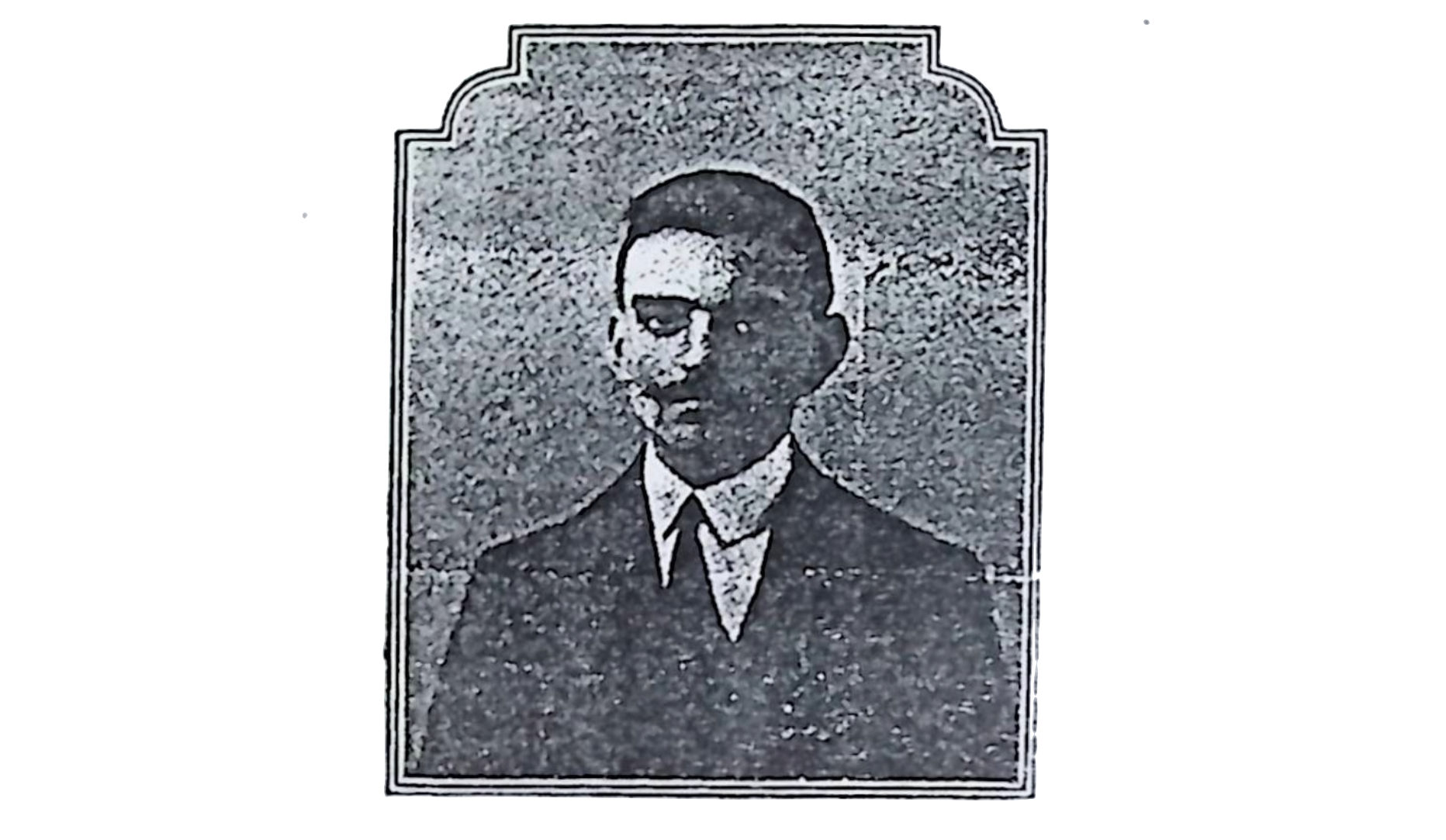
To continue marking the anniversary of Mgr Guérard des Lauiers’ death – here is what his brother had to say.
Abridged Biography of Mgr Michel-Louis Guérard des Lauriers
By Jacques Guérard des Lauriers, his brother
With supplementary notes from Sous la Bannière
In Sous la Bannière, n. 16, Mars-Avril, 1988.
We believe that our translation of this text is covered by fair use; if there is an existing copyright holder who would like us to remove it, they can reach us in the comments to this article.
25 October 1898: in Suresnes, in the western suburbs of Paris, a male child has just been born, to whom his parents give the name Michel.
27 February 1988: in Cosne, in the Nièvre, Mgr Michel Guérard des Lauriers surrenders his soul to God.
What was his journey between these two dates? And what was the origin of this uncommon name, which seems to announce that its bearer would also be exceptional?
Let us go back to the Thirty Years’ War, in Flanders. The battle rages at Berg op Zoom; a group of the King’s dragoons is in difficulty, but one of them heroically takes the initiative that will turn the situation around. His name? Michel Guérard, who received as a reward a palm of laurel with the right to join it to his name.
These character traits – responsibility, tenacity, and courage – are often found among his descendants, with perhaps more or less intensity, but real nonetheless. Those who knew and frequented Mgr Guérard des Lauriers will certainly not contradict this assertion.
To finish situating the young Michel in his surroundings, let us return to Suresnes, a small village at the time, clustered at the foot of Mont Valérien around its old fourteenth-century church, in poor condition. His elder brother Maurice would make his First Communion there in 1905, which would be the last ceremony in that building before its demolition, ordered by the anticlerical municipal council, which, to better assert its opinions, had the bells melted down to cast a bust to the glory of Émile Zola.
During these events, a young Brother came to enlarge the household: Jacques, and every Sunday we all went together to attend Mass in a shed converted into a chapel,1 more than two kilometres from the house.
In 1907 a new parish priest, M. Jossier, was appointed to Suresnes by Cardinal Richard to restore the parish. Enterprising, dynamic, enthusiastic, driven by a profound faith, he had the new church built in six years, while at the same time developing the parochial works and ceremonies and religious instruction for the young, assisted in this domain by Fr Massenet, a curate, a saintly priest loved by the whole population, and who left his mark on the young Michel.
The years pass… the age of studies has arrived for each at his level. The eldest, Maurice, is at the Collège Chaptal where he is preparing his baccalauréat in the hope of then entering Saint-Cyr. Michel, at the communal school, distinguishes himself from class to class as a prodigy, always first in every subject. But alas, tragedy strikes: after several months of a serious illness, their father dies on 8 January 1913.
The eldest would not go to Saint-Cyr, but would leave for the war in 1914 and be killed on 26 October 1918.
Michel passes brilliantly the entrance examination for the Collège Chaptal, where he continues to outclass all the other pupils; he passes his baccalauréat with highest honours. But in 1917 he is mobilised with the 113th Infantry Regiment at Orléans, then at Ancenis at the Officer Candidate School. It is with this rank that he is sent to the front.
Thank God, the war ends and in 1919 he is demobilised. It is back to Chaptal, for the time needed to prepare the entrance examination for the École Normale Supérieure, where naturally he enters ranked number one. Throughout his entire stay he would be the “cacique” [the one who is always first at everything] of his class, which would earn him the Prix Vouché, enabling him to go to Rome to prepare his thesis and his agrégation – titles which he obtained easily, given his specialisation in mathematics.
His stay in Rome was the occasion for our Mother and me to go to the Basilica of St Peter, to attend the ceremonies for the opening of the Holy Door, and the proclamation of the feast of Christ the King. And it was following an audience granted by the Pope that my brother revealed to us that he was considering entering the Order of Dominicans as soon as his university work was completed. This he did in 1927.
After the novitiate at Amiens he joined the convent of Le Saulchoir at Kain, near Tournai in Belgium, where he was ordained on 29 July 1931.
A new law authorising religious congregations to return to France, Le Saulchoir transferred to Soisy-sur-Seine near Corbeil, in the former château of Madame de Pompadour. The Rev. Fr Guérard des Lauriers immediately distinguished himself by his relentless dedication to work, which very often made him forget the hour of the offices or of meals. He certainly performed his “Venia”2 with a sincerely contrite expression. But how can one correct oneself when deep within one thinks that “the hour is an auxiliary variable”? And then the ceremonial of meals – what a waste of time, what an interruption in the intellectual process of research!
Is it not preferable to continue working until the first signs of hunger? One need only go down to the kitchens and consume a few leftovers from the bottom of the pots, congealed and indigestible…
This contempt for “contingencies” and for natural realities ended up creating a chronic state of ill health, which the Reverend Father endured with resignation, courage, and submission to the Divine Will, for fifty years. Doctor of Theology, professor at Le Saulchoir, he divided his time between his courses and his numerous writings: articles in journals or books. Rigorous with himself, he was so with others, and would brook no compromise on the fulfilment of each person’s duty, nor on morality, nor on education, nor on the spiritual and hierarchical values of the Church…
The Second Vatican Council was for him a dreadful shock. Offended in his profound faith, which united in his mind God and the Church, he could not accept the reforms that opposed everything he had believed, all the spiritual values that had given rise to his priestly vocation.
A nonagenarian, he did not hesitate to throw himself into the fight to rally, after having convinced them, all those who, bewildered and scandalised by the results of the new religious practices, and wished to find again the guides who had made the Faith radiate throughout the world.
Like our ancestor Michel Guérard, he “dared.”
May God crown his work!
His brother: Jacques Guérard des Lauriers
Supplementary Notes
Mgr Guérard was humble. Perhaps too humble, for even the people in his circle were unaware of many things about his ecclesiastical career, yet so full. Thus, for example, it was by chance that I came to learn of the important role that Fr Guérard played in the preparation of the proclamation of the dogma of the Assumption by Pius XII. Even so, I learned only little, for he remained discreet.
We know that he taught Theology and Philosophy at the Angelicum and at the Lateran University in Rome, as well as at the universities of Le Saulchoir.
Mgr Guérard had accumulated in his youth an impressive array of university degrees. He was agrégé in mathematics, Doctor of Science, Master and Doctor of Theology, and Doctor of Philosophy…
His brother told us that he was a spiritual son of Fr Mondanet, a great Dominican figure of Le Saulchoir.
We reproduce here a portrait of the young Michel Guérard des Lauriers, for whose mediocre quality we ask the reader’s indulgence, as we have, as a source document, only the photocopy of a 1919 issue of the magazine “Je Sais Tout.” [Ed.: this is the featured image of this article]. This issue publishes an interview with Michel Guérard, then “cacique” of the École Normale Supérieure. (This is how they designate the “major,” the one who is always first in everything.)
It seemed to us that it should interest our readers to reproduce below some of the answers that this young man of twenty-one gave to the journalist, in which those who knew him later will already be able to recognise him:
SLB
“The system of instruction in force at the École,” says M. Guérard des Lauriers, “includes courses at the Sorbonne and special conferences: those of the second year have as their essential aim the development of the spirit of research; those of the third year are a practical preparation with a view to the agrégation.”
“The opposition of the two objects – initiating minds into free research and preparing candidates for a rigorous competition – is certainly radical. To sacrifice the first to the second would, however, be a grave error: one teaches well only a tenth of what one knows; or rather, one succeeds in conveying to the minds of one’s pupils only a small part of what one knows, which is not the same thing.”
M. Guérard des Lauriers:
“To be admitted to the École, one needs: the firm will to succeed, a minimum of intelligence and of health. The main thing is organised work, by which one seeks not so much knowledge in itself as intellectual methods. When one has found the central viewpoints from which to survey a course, the general ideas that govern that course, their logical sequence, the questions of detail graft themselves on afterwards.”
And to pursue “a brilliant career”?
“Understanding by ‘brilliant career’ the fact of forming pupils who will have gained, in every respect, from contact with their teacher, and not that of obtaining a well-paid post where one has little worry, I believe that:
“For one who has oriented himself toward higher education, all the qualities indispensable to researchers are required: the ‘higher’ must live, and life is, for him, a constant renewal;
“For one who has preferred secondary education, what is necessary is: initiative, the faculties of adaptation, an unshakeable will to banish routine and mediocrity. I imagine it must be a harsh trial when one has been teaching the same class for a long time. A professor never has the right to rest on what he has acquired, however considerable: he always has everything still to learn. Among good pupils, there are two kinds: original natures and perfected machines. Unless he is to form only perfected machines, the professor must also be a man.
“The great problem of education is the question of culture. In my opinion, teaching is still too bookish; there is too much effort to cram knowledge into brains, instead of forming minds.”
Base text translated with the help of AI and thoroughly checked by The WM Review.
We believe that our translation of this text is covered by fair use; if there is an existing copyright holder who would like us to remove it, they can reach us in the comments to this article.
HELP KEEP THE WM REVIEW ONLINE WITH WM+!
As we expand The WM Review we would like to keep providing free articles for everyone.
Our work takes a lot of time and effort to produce. If you have benefitted from it please do consider supporting us financially.
A subscription gets you access to our exclusive WM+ material, and helps ensure that we can keep writing and sharing free material for all.
You can see what readers are saying over at our Testimonials page.
And you can visit The WM Review Shop for our ‘Lovely Mugs’ and more.
(We make our WM+ material freely available to clergy, priests and seminarians upon request. Please subscribe and reply to the email if this applies to you.)
Subscribe to WM+ now to make sure you always receive our material. Thank you!
Read Next:


Follow on Twitter, YouTube and Telegram:
Twitter (The WM Review)
One can scarcely believe it! 1905; the Combes ministry was merely foreshadowing the anti-clericalism of the modernist clerics, who today oblige the faithful to likewise convert sheds into chapels!
This word “Venia” designates the penance that Saint Dominic imposes on his religious for each fault they commit. It consists, before the whole community, of throwing oneself full-length on the ground, and remaining thus until the superior lifts the penance by granting “mercy” with a knock on the lectern.