

Chapter I of ‘Zero Marks’ explains the Church’s teaching about her own unity, and shows that the Conciliar/Synodal Church of Vatican II is very much found wanting.
Author’s Notes
The following is Chapter I of my “book”, ‘Zero Marks’ – Why the Conciliar/Synodal Church is not the Catholic Church, Part II of my response to Fr Thomas Crean OP’s article “A City Set on a Hill Cannot Be Hidden: The Perpetual Visibility of the Catholic Church Under the Pope.”
Peter Kwasniewski described Fr Crean’s article as “a definitive rebuttal of sedevacantism, at the level of first principles.”
Zero Marks is very long and detailed (over 30,000 words). The WM Review has published it in full first for WM+ members, and is releasing each of the five chapters separately for all readers.
This first chapter deals with the property and note of unity, which Cardinal Louis Billot described as “the principal property with which [Our Lord] wished to clothe his Church forever.” It covers the following topics:
What is unity?
Unity of Faith as the most important aspect
How the note of unity may be obscured – or the property absent
The Conciliar/Synodal Church and unity
More surveys revealing the disunity of the Conciliar/Synodal Church
The 2014 Univision ‘Global Survey of Roman Catholics’
The disunity of faith and its source
Conclusions on the property of unity.
I discussed this chapter with Stephen Kokx over at Kokx News:
For Part I of this response, see below:
For the Introduction of Zero Marks, see the full piece here:
Before proceeding, I shall restate my definition of the Conciliar/Synodal Church, my thesis, and a necessary clarification:
Definition: By “Conciliar/Synodal Church,” I mean the body of men who recognise Leo XIV as their Pope and spiritual leader, claim to be subject to him, and whom he (and his officers) recognise as being in good standing with him.
Thesis: The Conciliar/Synodal Church, considered as such, is not the Roman Catholic Church.
Clarification: By “not the Roman Catholic Church”, I mean that this body of men, considered as such, is not identical with the Roman Catholic Church. Taken as defined, it is a body composed of both Catholics and non-Catholics and lacks certain essential properties of the Roman Catholic Church; for this reason, it cannot be identified with that Church. The thesis therefore concerns the identity and nature of the body itself, considered as a social reality or accidental aggregation, rather than the status of the individuals within it. It does not deny the continued visibility of the Catholic Church; rather, it denies that this visibility, and membership of the Church, are determined by the boundaries of the Conciliar/Synodal Church as defined. Accordingly, it does not imply a) that this body constitutes a false sect (since it is an accidental aggregation of Catholics and non-Catholics, rather than a true society); b) that no Catholics exist within it; or c) that a man ceases to be a Catholic simply by being included in this body. Some of these points are clarified in Zero Marks, or will be clarified further elsewhere.
Chapter II – on the property/note of holiness – will be released next week. If you want to make sure you receive these instalments, hit subscribe now:
‘ZERO MARKS’ – WHY THE CONCILIAR/SYNODAL CHURCH IS NOT THE CATHOLIC CHURCH
By S.D. Wright
Part I: ‘Radically insufficient’ – Reply to Fr Crean on the Church’s visibility
Part II: ‘Zero Marks’ – Why the Conciliar/Synodal Church is not the Catholic Church
Chapter I: Unity
What is unity?
The Church is one in faith, government and worship. Being “one Church” does not just mean that Christ has only one true Church. This is, in fact, the Church’s unicity; treating unicity as a note would be begging the question, as any individual sect could claim to be the one Church of Christ.
Instead, the property of unity means that the Church is internally and externally one, or united.
The Church is one by right and in fact. She is one by right, in that Christ gave his true Church the power to demand and enforce the unity with which he endowed her.1 But this property of unity is visible only insofar as it is manifested externally: this is why unity is a note insofar as it is unity of fact.
Christ’s prayer before his Passion indicates that he efficaciously willed a unity for his Church which would distinguish her as his Church:
“[N]ot for them only do I pray, but for them also who through their word shall believe in me. That they all may be one, as thou, Father, in me, and I in thee; that they also may be one in us: that the world may believe that thou hast sent me.
“And the glory which thou hast given me, I have given to them: that, they may be one, as we also are one. I in them, and thou in me: that they may be made perfect in one: and the world may know that thou hast sent me and hast loved them, as thou hast also loved me.” (John 17.20-23 – emphases added)
Louis Cardinal Billot explicitly links this prayer – which he said must infallibly be fulfilled2 – to the notes of the Church:
“[T]his unity is implored by Christ so that it may be a sign of his mission and a mark of the true Church. […]
“Therefore this unity – besides the fact that it is expressly placed in a visible and manifest reality – cannot belong to any false church. For it is asked as a manifestation of the singular love with which the Father loves the Church, as though embracing the Son together with his spouse in one love.
“Likewise it must stand as a perpetual argument, commending before the world the very mission of Christ.”3
Billot also describes this unity as “the principal property with which [Our Lord] wished to clothe his Church forever.”4
The Church is normally treated as being necessarily and visibly united in three ways:
In government
In worship
In faith.
Let us examine these three ways in which the Church is united.
Unity of Government (also referred to as communion or social charity) is, as Salaverri says, “the agreement of wills working for the same social end under the supreme power of the Church of ruling.”5
We shall defer dealing with the Church’s government to our discussion of the Apostolicity of the Church – the fourth of the four properties. In the meantime, here is Cardinal Billot’s explanation of how the role and raison d’être of the unity of government is to ensure the unity of faith and charity:
“The unity of government is in reality the principle that generates and preserves the other two – one of which concerns the intelligence [faith] and the other the will [charity].”6
We shall see in this chapter that the Conciliar/Synodal Church’s alleged “unity of government” cannot be said to produce unity of intelligence/faith at all; and without faith, it is impossible to have charity.7
Unity of Worship is, to cite Salaverri again, “harmony in the celebration of sacrifice and in the use of the sacraments and of liturgical acts, under the supreme power of the Church of sanctifying.”8
The note of unity is not impaired by different liturgical rites (i.e., the Byzantine rite, etc.) because they are all expressions of the same faith. As the theologian Fr Berry writes:
“[T]he Sacraments, sacrifice, prayer, and other acts of worship,—not only demand, but in fact are, outward professions of faith, and that the one faith taught throughout the world.”9
The main focus of this treatment will indeed be the Conciliar/Synodal Church’s disunity of faith – but let us pause to consider whether it can claim to be united in worship.
Do we see visible “harmony in the celebration of sacrifice” in the Conciliar/Synodal Church? The liturgy is one of the most controversial issues in that milieu – with groups calling for the suppression of either the traditional Roman rites or the Novus Ordo rites, refusing to attend one or the other set of rites, and hurling insulting epithets at each other.
Further, in the main form of worship, there is not even visibly a sacrifice: and the sacrificial nature of the liturgy has been consistently downplayed since the definition of the Mass given in the original Institutio Generalis:
“The Lord’s Supper or Mass is the sacred assembly [synaxis] or congregation of the people of God gathering together, with a priest presiding, in order to celebrate the memorial of the Lord. For this reason, Christ’s promise applies supremely to such a local gathering of the Church: ‘Where two or three come together in my name, there am I in their midst.’ (Mt 18:20).”10
As “The Ottaviani Intervention” of 1969 said, of both this definition and the rite itself:
“As is only too evident, the emphasis is obsessively placed upon the supper and the memorial instead of upon the unbloody renewal of the Sacrifice of Calvary. The formula ‘The Memorial of the Passion and Resurrection of the Lord’, besides, is inexact, the Mass being the memorial of the Sacrifice alone, in itself redemptive, while the Resurrection is the consequent fruit of it.”11
The Institutio Generalis was “clarified” to some degree, in part due to the protests of the faithful.12 But although the bare wording of the definition was improved, the “obsessively placed” emphasis on away from the sacrificial nature of the Mass remains in the Novus Ordo rite. In other words, the sacrificial nature of the Novus Ordo is at least difficult to perceive (to put it mildly).
We do not see a great deal of “use of the sacraments and of liturgical acts” at all. Vatican II saw an enormous number of Catholics ceasing to practise their religion altogether – and today, a similarly enormous number of self-identified Catholics either rarely or never attend Mass at all. For many self-identified Catholics, the sacrament of Penance is simply not a part of their life – which is often offered during short windows of time or only upon request. The state of teaching, practice, discipline and oversight also means that one can have little confidence in the baptisms of Conciliar/Synodal ministers, given the proliferation of videos which indicate at least doubtful or even invalid administration. Even if the Conciliar/Synodal Church might be said to maintain unity of worship, it has at least been obscured.
Finally, as unity of worship is an expression of both unity of faith and charity, it is clear that a body which is disunited in faith can be united in neither worship nor charity.
Unity of Faith pertains to the Church teaching, believing and professing the same doctrine. But internal belief is only manifested insofar as it is professed externally, and so only teaching and professing the faith pertain to the note of unity.
Today, many appear to reduce unity to that of government, but of the three manifestations of unity mentioned above, unity of faith has traditionally been treated by theologians as the most fundamental. Billot not only described unity as the “principal property” of the four in question, but also stated that this “principal property” itself consisted principally in the external profession of faith:
“This unity consists principally in the common profession of the same faith, taught by a social magisterium.”13
Elsewhere, he states that unity of faith is “the most important aspect of the note of unity,” and that “unity of communion” (or government) presupposes it.14
Unity of Faith as the most important aspect
Pope Leo XIII taught:
“Agreement and union of minds is the necessary foundation of this perfect concord amongst men, from which concurrence of wills and similarity of action are the natural results.
“Wherefore, in His divine wisdom, He ordained in His Church Unity of Faith; a virtue which is the first of those bonds which unite man to God, and whence we receive the name of the faithful – ‘one Lord, one faith, one baptism’ (Eph. iv., 5).
“That is, as there is one Lord and one baptism, so should all Christians, without exception, have but one faith.”15
He draws out the consequences of this as follows:
“The Church, founded on these principles and mindful of her office, has done nothing with greater zeal and endeavour than she has displayed in guarding the integrity of the faith. Hence she regarded as rebels and expelled from the ranks of her children all who held beliefs on any point of doctrine different from her own. […]
“The practice of the Church has always been the same, as is shown by the unanimous teaching of the Fathers, who were wont to hold as outside Catholic communion, and alien to the Church, whoever would recede in the least degree from any point of doctrine proposed by her authoritative Magisterium.”16
This is why the Church is defined as “the congregation of the faithful,” and why Pope Pius XII reaffirms that membership of the Church depends, among other criteria, on “profession of the true faith.”17 It is also why heresy, at least when publicly manifested, is one of three sins that severs a man from the body of the Church.18
As previously noted, Billot teaches that the unity of faith primarily depends on the exercise of the Church’s teaching authority:
“[I]t is established first that what is implied is a unity which depends upon the public magisterium as upon its proper principle, because this is what the nature of social unity requires.”19
This unity is thus manifested in this primary sense by the actual, visible submission of all the faithful to the teaching authority of the magisterium.20
He continues, explaining that it is manifested in a secondary sense – though perhaps more obvious to us as a striking sign of God’s Church – through the united external profession of all the dogmas of the Catholic religion, by all the faithful:
“It is established second that what is implied is a unity which prevails with respect to all matters of belief, and not with respect to only certain so-called ‘fundamental’ articles – with contradictory and mutually conflicting professions meanwhile existing regarding the remaining non-fundamental articles – because this is repugnant to the nature of the faith of which unity is predicated.”21
Unity of faith is also the most striking aspect of this property as a note. Any society may be united in its recognition of an authority, or in its ritual observance – but no society except the Church has ever manifested a unity of faith like that of the Church. Fr Berry describes this unity as follows, treating it as so obvious as not to require any proof:
“Unity in the profession of faith is a natural consequence of the unity of doctrine; a mere corollary to be explained rather than proved.”22
But even as a “natural consequence” of the unity of doctrine (or teaching), the unity of profession was understood to be an evident, striking fact, sufficient to mark the true Church from false claimants. This is taken as a given everywhere, whether it be magisterial documents, theology textbooks or catechisms for the instruction of children. As an example of the latter, the 1649 Douay Catechism provides a succinct summary of that in which the unity of profession consists:
“All her members live under one evangelical law, obey the same supreme head, and profess the same faith even to the least article, and use the same sacraments and Sacrifice.”23
The striking character of this note is expressed beautifully by M.J. Rhodes:
“Though they may be utter strangers to each other in the flesh, and divided in temporal position as far as men can be divided from their fellow-men, there will be found one and the self-same faith, one and the self-same rule of morals, the self-same sacraments, and the self-same belief respecting those sacraments; there will be found but one mind, one heart, and one voice, as regards all the doctrines and commandments of the Church. This is unity, and it is divine; it is no mere human coincidence or contrivance. The finger of God is here, reversing the confusion of Babel. It is the unity of God’s one Church throughout the universal globe; and it has been her unity through more than eighteen centuries and a half.
“It is a matter to be looked to, and a test to be applied, for the absence of such unity denotes the absence of God.”24
As is clear, this visible unity of faith, both in teaching and in doctrine, is not an ideal, or something that can be achieved or lost at different times.25 It is a necessary property, visible to the senses, so remarkable as to be a note of the Church, and so necessary that its absence is that a given body is not the Church.
How the note of unity may be obscured – or the property absent
All three aspects of the note of unity may be accidentally obscured, whilst unity remains present as a property (and even as a visible note), through factors such as:
Individuals confused or erring in good faith about settled questions, provided that they remain actually and visibly submissive to the supreme authority of the Holy See26
Fierce debates about matters, even doctrinal, which have not been definitively settled or are not on the level of dogma and divine revelation
Multiple papal claimants or other such crises, such as in the Great Western Schism27
Extended vacancies of the Holy See or of various diocesan sees, in which those subject to the respective authorities would be deprived of the actual exercise of authority which maintains the Church’s unity of faith28
It may also be the case that this visibility is obscured by the Church refraining from taking positive action against every individual public heretic. But, as Berry says:
“It is a well-known fact that the Church has always demanded the strictest unity in the profession of faith; those who refused to profess even a single doctrine, were condemned as heretics who had already ceased to be members.”29
Such public heretics are already visibly disunited from the Church. We will address this potential objection further below.
In spite of such accidental obscuration caused by any of these factors, the Church would remain united, and even visibly so.
However, the property of unity is manifestly absent – as opposed to obscured – when phenomena exist that are incompatible with the property of unity itself. Consider Cardinal Billot’s comparison between the marks of holiness and unity, emphasising the fundamental impossibility that a body divided in faith could be the Church:
“The holiness of the members we are talking about here concerns individuals directly – and it is indirectly, through these individuals, that holiness can be attributed to the society whose visible principles and mediations contribute to produce this life of grace.
“Unity, however, deals immediately with the collectivity itself, from which it removes division in the profession of faith. Furthermore, the wicked in the Church do not prevent it from containing saints as well, who show it to be true. But if heretics were in the Church, they would formally remove the indivisibility of the society which is of the very definition of unity.”30
If the Church is necessarily united in its external profession of faith, then a body which is not so united – or even has multiple religions being professed within its boundaries – shows itself by that fact not to be the Church.
The Conciliar/Synodal Church and unity
Fr Crean, and others of the same mind, wish to tell us that the self-styled Conciliar/Synodal Church is the “perpetually visible Church.” But this body of men is visibly disunited in faith.
Large percentages of its adherents openly reject what they know to be Church teaching, and express disregard for the exercise and authority of the Roman magisterium.
Consider the results of the 2019 Pew Research survey What Americans Know About Religion. Only 31% of the American Catholics polled professed belief in the dogma of transubstantiation – with the other 69% claiming that “the bread and wine used in Communion ‘are symbols of the body and blood of Jesus Christ.’”31
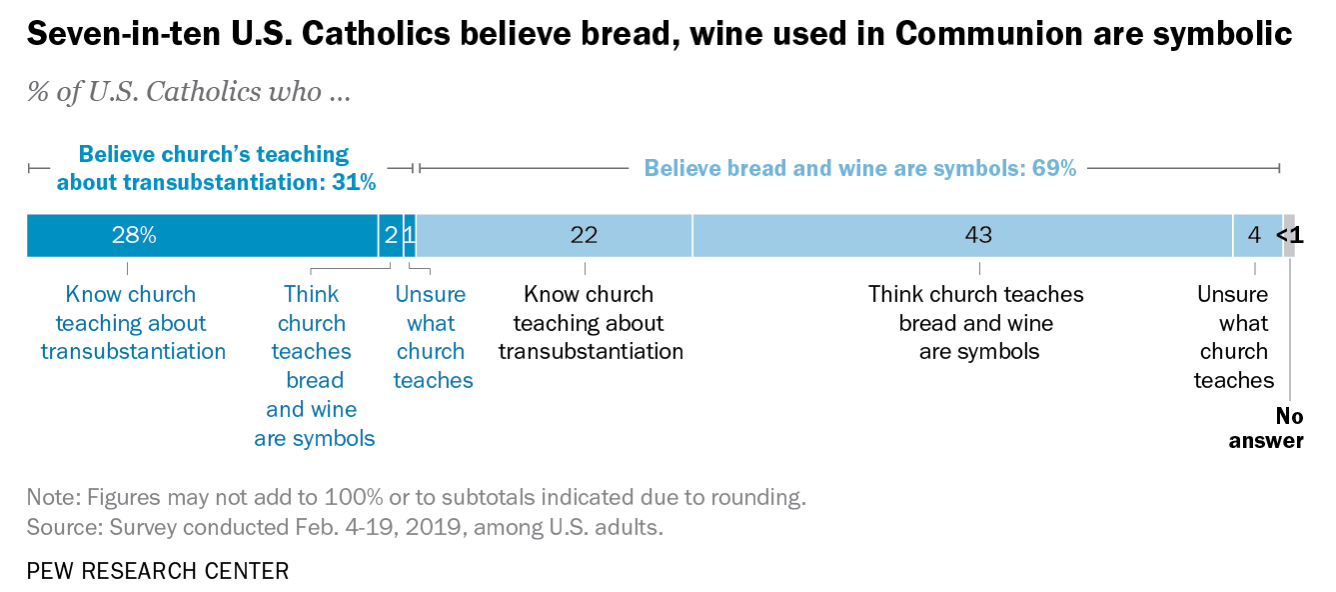
Nearly a third of this latter group – over 22% of those polled – stated that they were aware of the Church’s actual teaching, and yet rejected it. The same poll found that even 37% of respondents who were weekly Mass-goers did not accept the teaching of the Church on this matter.
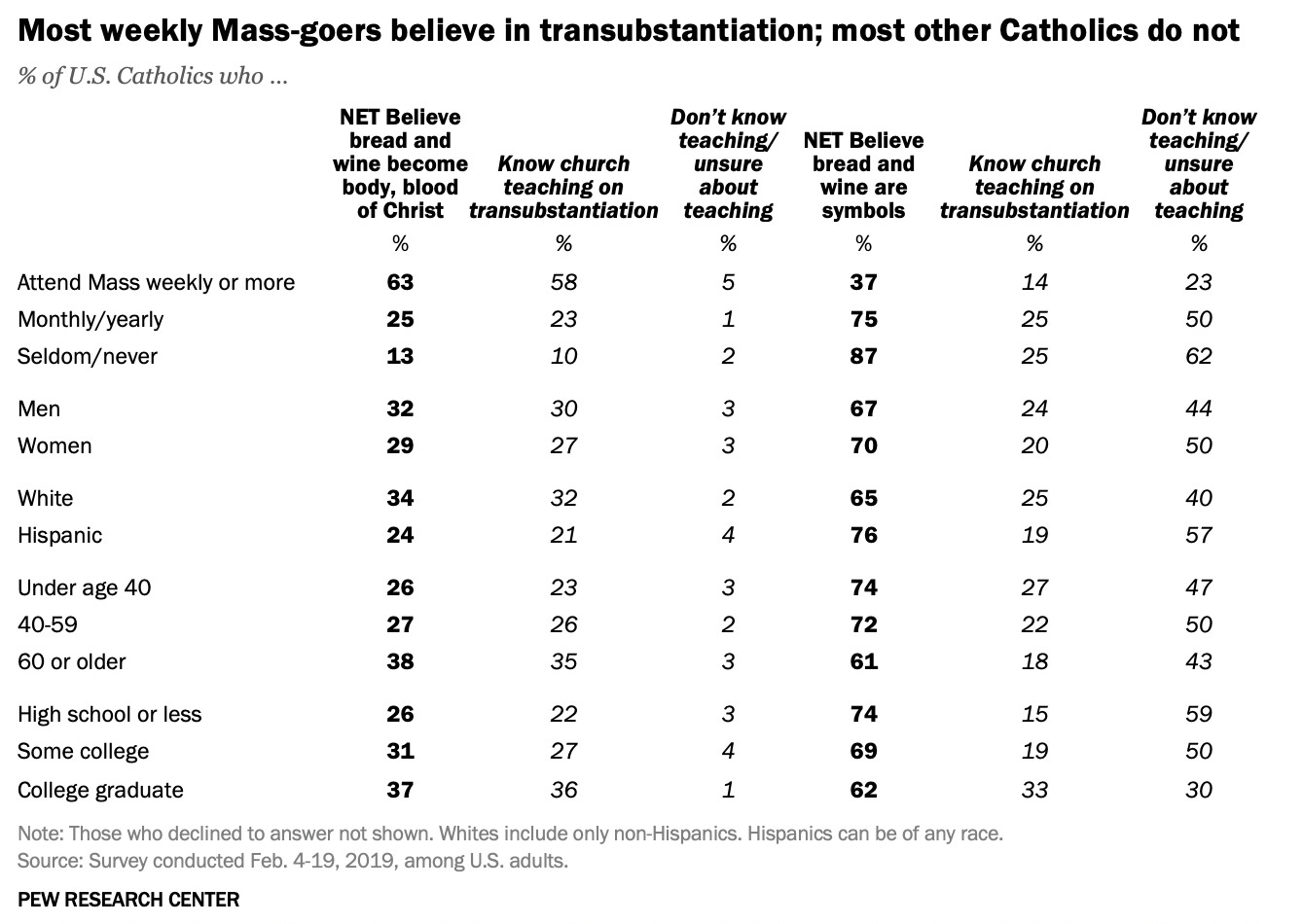
A survey like this reveals the existence of three basic groups:
Those who believe and profess belief in this dogma
Those who do not believe or profess belief in this dogma, but who may be erring in good faith, and may still be submissive to the magisterium
Those who knowingly and openly reject both the dogma and the magisterium which proposes it.
And yet all of these people are generally considered to be Catholics, and as members of the Catholic Church.
Another survey from Pew Research Center (2002) found startling division on the matter of abortion. Only 53% of those identified as Catholics believed abortion was morally wrong.32 76% of respondents claimed that abortion should be legal in some cases; 13% said that it should be legal in all cases. Only 10% said that it should be illegal in all cases.33 .
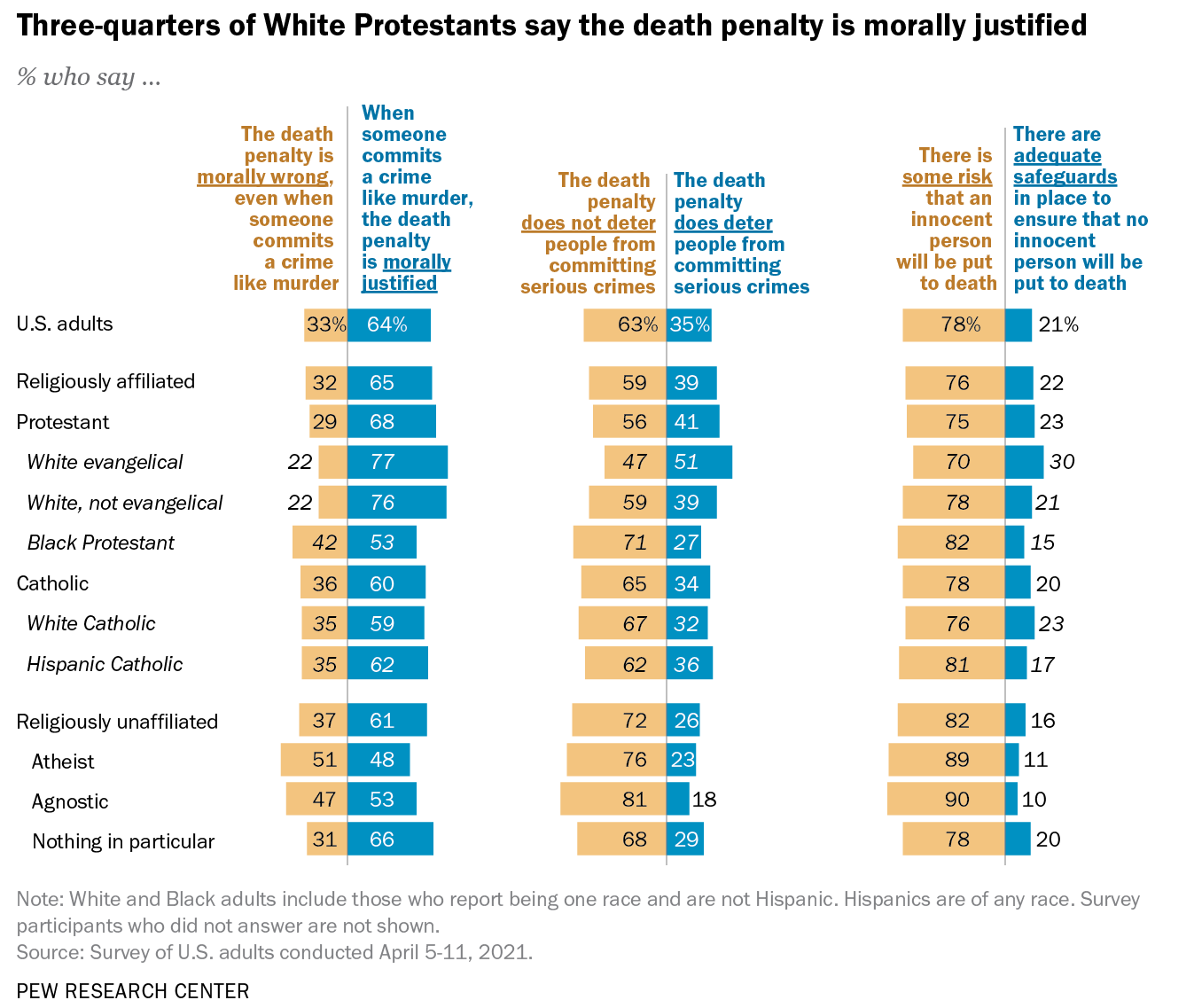
A 2021 Pew Research Center survey found that 36% of American Catholic respondents consider the death penalty to be morally wrong.34
Fr Crean himself rightly stated:
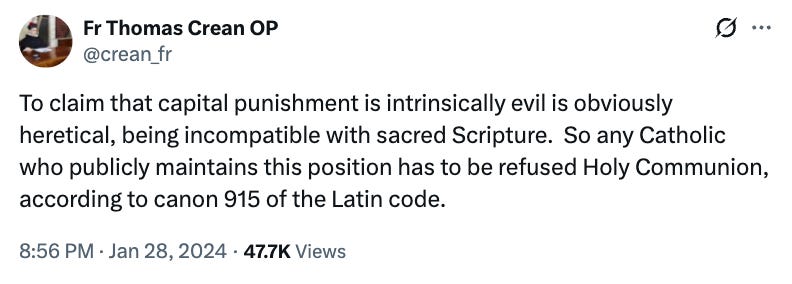
“To claim that capital punishment is intrinsically evil is obviously heretical, being incompatible with sacred Scripture. So any Catholic who publicly maintains this position has to be refused Holy Communion, according to canon 915 of the Latin code.”35
While Fr Crean is correct in saying that those who maintain this position are to be denied Holy Communion, the issue cannot be reduced to one of sin. The primary issue for our purposes is massive and visible disunity in faith.
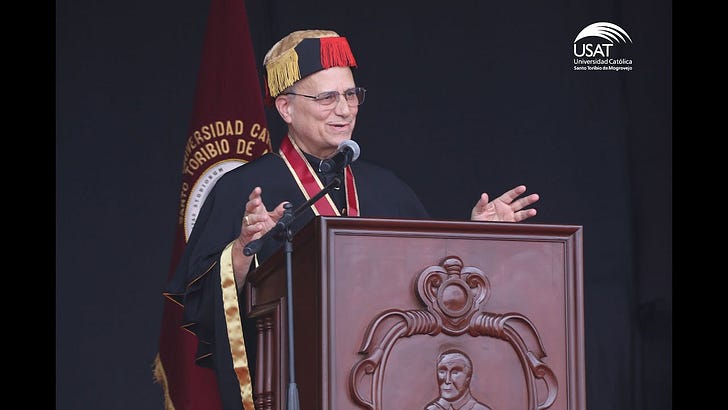
A further issue is the fact that Leo XIV, while he was the bishop of Chiclayo, publicly presented Francis’ teaching as entailing “the absolute exclusion of the death penalty”36 – an idea he has repeated on numerous other occasions.37
We are thus entitled to ask whether Fr Crean would thus consider himself bound to refuse Holy Communion to the man he holds to be Pope – and not simply for being in a state of public sin, but for making a claim that is “obviously heretical.” We are also entitled to ask how the Conciliar/Synodal Church can be visibly united in faith under these circumstances.
More surveys revealing the disunity of the Conciliar/Synodal Church
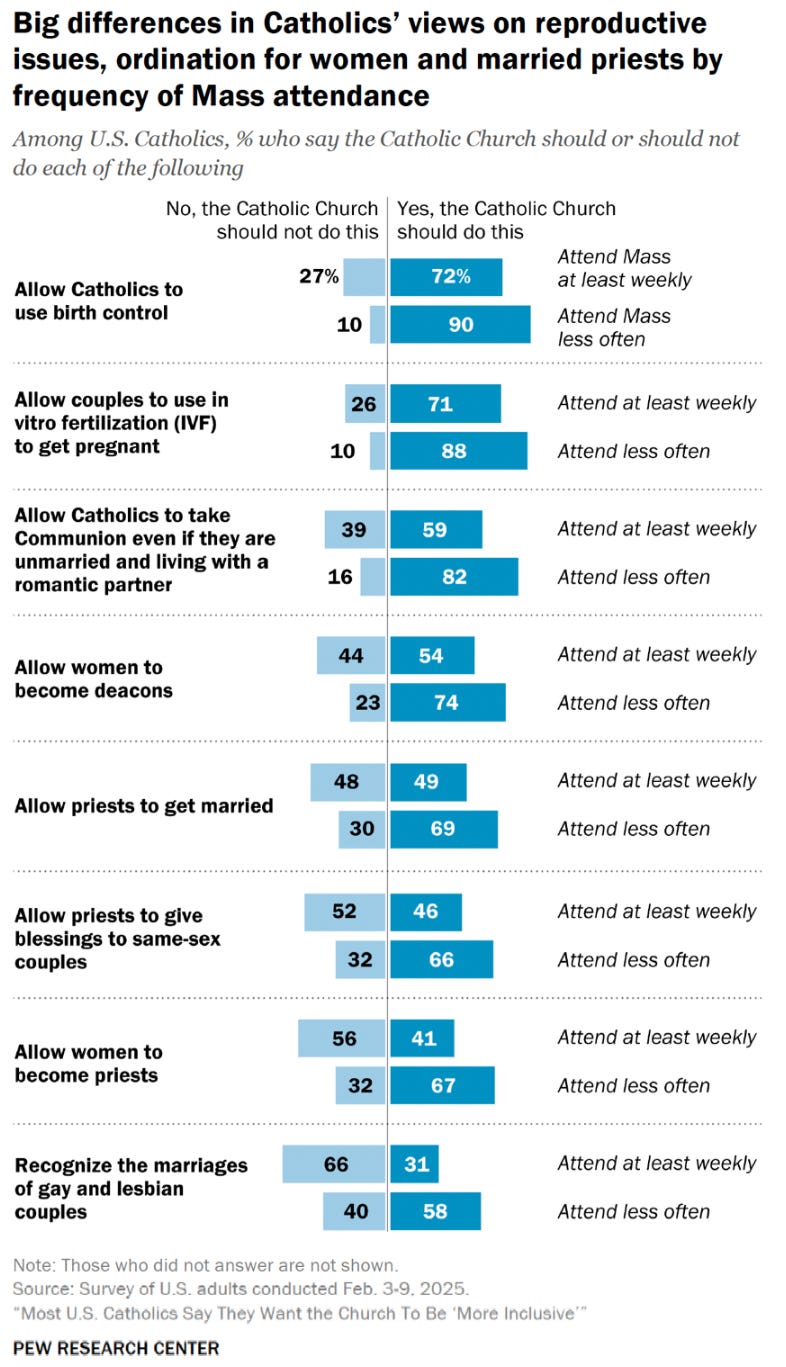
In 2025, yet another Pew Research Center survey uncovered even more shocking results. The result for self-identified US Catholics who go to Mass less often than weekly are bad enough, but here are the results for those who do attend Mass weekly:
72% say the Church should allow birth control (contrary to what Fr Crean himself called the “infallible and irreformable teaching” of Paul VI’s Humanae Vitae.38)
71% were in favour of IVF
59% were in favour of Communion for those living in concubinage
54% were in favour of female deacons
41% were in favour of female priests
46% were in favour of priests blessing same-sex couples
31% were in favour of Church-recognised same-sex “marriages”.39
So far we have been considering surveys of US Catholics. Some might suggest that results might be different elsewhere – and that, for example, African respondents might indicate a greater prevalence of orthodoxy, and thus also the mark of unity; others might allege the same for groups like the Fraternity of St Peter. It might be alleged that their continuity within the unity of faith shows that the Conciliar/Synodal Church is still united.
This objection is without worth. Without denying the continuity of such groups within the unity of faith, let us recall again Cardinal Billot’s comparison between the marks of holiness and unity: unity of faith pertains to the collective, and so it is meaningless to suggest that it is maintained by a section of the collective elsewhere in the world. This is simply first to deny that this body is divided, and then to provide further proof that it is indeed divided.40 As a result, the radical disunity of US Catholics is itself sufficient to indicate the disunity of the Conciliar/Synodal Church as a whole: US Catholics are, of course, part of this collective.
However, in 2014, Bendixen & Amandi International carried out a global survey of self-identified Catholics, which indicated that these results are far from limited to the USA – and that sizeable numbers of respondents from Africa are also visibly disunited.41
The 2014 Univision ‘Global Survey of Roman Catholics’
The 2024 survey yielded the following results.
Divorce and Remarriage: 58% of respondents rejected the Church’s teaching that divorced and remarried persons are living in sin and should be deprived of Holy Communion. Only 45% of those who “frequently” attended Mass agreed with the Church’s teaching. Broken down by continent, this teaching was rejected by:
19% of African respondents
46% of Asia/Pacific respondents
75% of European respondents
67% of Latin American respondents
60% of North American respondents
Abortion: 65% of respondents rejected the Church’s teaching on abortion. This was rejected by:
40% of Democratic Republic of the Congo respondents
35% of Ugandan respondents
27% of Filipino respondents
Contraception: 78% of respondents (and 72% of “frequent” Mass attendees) supported the use of contraceptives. This included:
86% of European respondents
44% of African respondents
91% of Latin American respondents
79% of US respondents
31% of Filipino respondents.
Women priests: 45% of respondents rejected the Church’s teaching on female ordination to the priesthood. This included 37% of “frequent” Mass attendees, and:
64% of European respondents
59% of North American respondents
49% of Latin American respondents
21% of Asia/Pacific respondents
17% of African respondents
Homosexual marriage: 30% of respondents rejected the Church’s teaching on same-sex marriage. This included:
15% of Polish respondents
14% of Filipino respondents
Here is an example of the survey’s visual analysis:
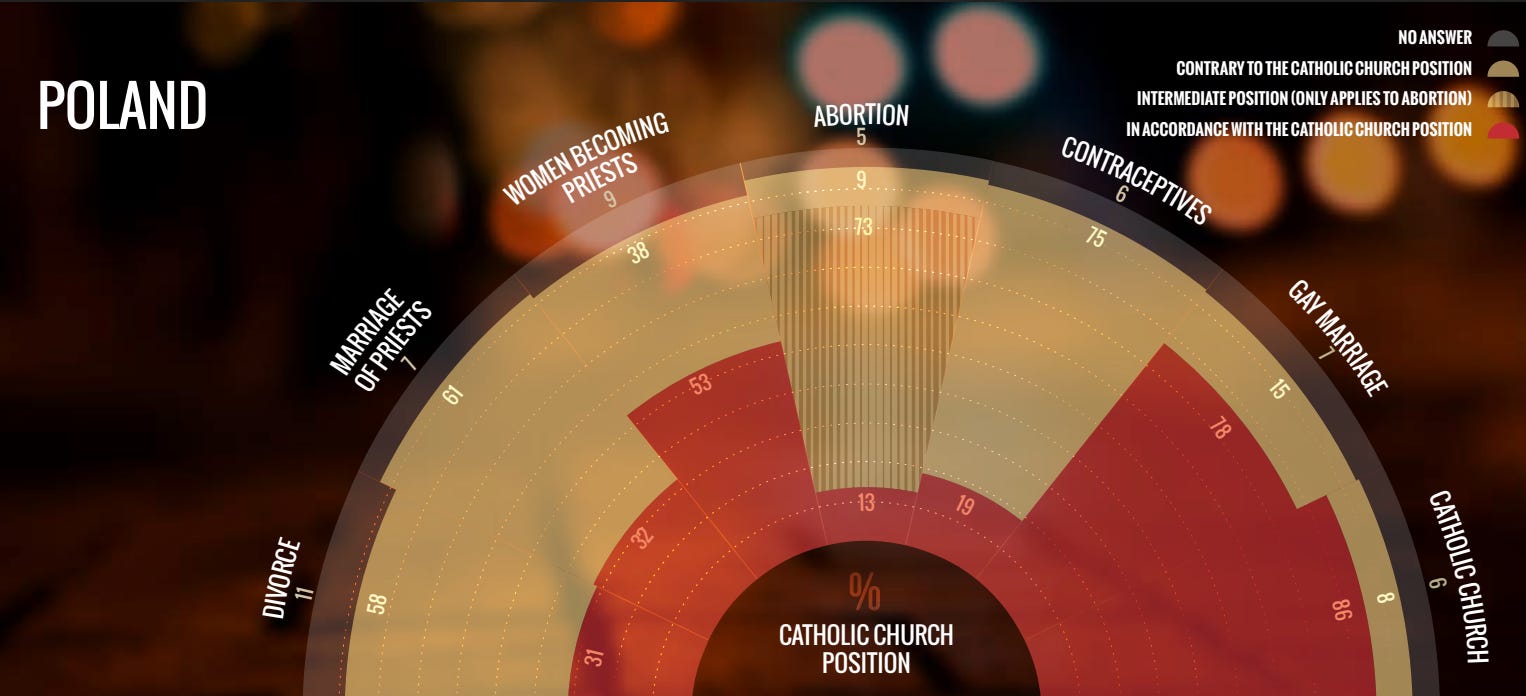
The above results show that, even while countries like Poland, the Philippines or African nations have larger numbers of those who accept more of the Church’s teaching on the above areas, there are substantial numbers of those who do not. Nor can we take too much comfort from 99% of African respondents opposing same-sex marriage, as this is only one issue amongst many – in which their responses are much more varied.
This survey is also over 10 years old, and we can be reasonably certain that the numbers of those who reject the Church’s teaching have increased since that time.
Further, we all have enough personal experience and anecdotal evidence to know that this same phenomenon applies afflicts the Conciliar/Synodal Church – as we have defined it above – wherever it is found. As an example: even the international Catholic dating agency Catholic Match allows its users to select which of six certain dogmas they accept, and allows other users to filter their searches by adherence to or rejection of these dogmas.
Fr Crean himself witnesses to the disunity of faith. He was the third signatory of the 2019 Open Letter to the Bishops of the Catholic Church, which accused Francis of “the canonical delict of heresy.”42 This letter included seven points of dogma – for example, matters pertaining to Amoris Laetitia, as well as God allegedly willing a diversity of religions, along with proof of their dogmatic status and of Francis’ deviation from them.
Even aside from disunity between Francis and the signatories, it is also evident that the heresies of which they accused him are also held by an enormous number amongst the Conciliar/Synodal Church, and the Open Letter provides further evidence of this (e.g., with reference to the Bishops of Buenos Aires).
The disunity of faith and its source
What is the source of this disunity? As we already addressed at the beginning of this section, the Church’s visible unity of faith applies to her teaching as much as to her profession – not least because the teaching of the Church is what causes the profession of faith. As such, the visibly disunited profession of faith is principally caused by a) disunity amongst the hierarchy of the Conciliar/Synodal Church in teaching – both between each other, and sometimes even within their own teaching, which is in turn caused by b) the failure (or refusal) to “teach with authority.” Here is what Romano Amerio wrote in 1985:
“The external fact is the disunity of the Church, visible in the disunity of the bishops among themselves, and with the Pope. The internal fact producing [this disunity] is the renunciation, that is, the non-functioning, of papal authority itself, from which the renunciation of all other authority derives. […]
“There is never a papal document on which the episcopates of the world fail to take up their own position, and in their train, but independently of them, theologians and the laity do the same, contradicting each other in their turn. A host of documents is thus churned out, displaying a disorderly variety in which authority is multiplied and so nullified.”43
We will return to the “internal fact” later in this analysis. But the “external fact” is so obvious as to make examples unnecessary. Nonetheless, we could point to:
The response to Paul VI’s Humanae Vitae on the part of the Canadian Conference of Catholic Bishops (the “Winnipeg Statement”) – as well as other such conferences44
The German Bishops’ Conference’s “Synodal Way”
The reception of Fiducia Supplicans and Amoris Laetitia by various bishops’ conferences
These examples are significant flashpoints, but even aside from them, there is no visible unity of faith between men like Bishop Tomash Peta of Astana, Kazakhstan, and men like Bishop John Stowe of Lexington, Kentucky. These two “camps” cannot credibly be said to teach the same body of doctrine.45
The disunity in the Conciliar/Synodal Church is such that men such as Roberto de Mattei,46 Fr Linus Clovis47 and others have acknowledged the presence of different religions within its structures – and yet the adherents of these “different religions” are construed as members of this body, and in good standing.
It is simply not credible to suggest that the Conciliar/Synodal Church – the body of men who currently recognise Leo XIV as their leader, and are in good standing with him – enjoys either the property of unity, willed for it by God, or its external manifestation in the note of unity. Its members are not united in what they profess to believe; nor do all its dissenting members even pretend to profess what the Church teaches; nor can they all be said to be subject to the alleged magisterium. The same applies to what its hierarchy teaches.
Although de Mattei and Fr Clovis were referring to the situation under Francis, the new religion began earlier – with Vatican II. I have explained and defended this thesis here:
Conclusions on the property of unity
What I have described is no accidental obscuring of the note of unity. It certainly cannot be resolved by alleging that the unity of law remains in the Conciliar/Synodal Church, through a united submission to the Roman Pontiff:
First, because the objects of disunity are more fundamental than examples given for accidental obscuration (i.e., they do not pertain to difficult or obscure points of doctrine, or even the secondary object of infallibility).
Second, because there is no such united submission to the teaching, governing and sanctifying authority of the alleged Roman Pontiff; many members of the Conciliar/Synodal Church openly disregard the exercise of this (alleged) authority in its (alleged) Popes.
Third, because many persons openly reject the idea that the Roman Pontiff has the authority to settle such matters, and is the principle by which even legitimate disunity could be settled.
Nor can it be resolved by saying that, even in normal times, the Church did not identify and deal with every single public heretic, such that they continued to present themselves as Catholics and be taken as such.
First, refraining from dealing with a certain number of public heretics is not comparable with the radical disunity we see in the Conciliar/Synodal Church, caused precisely by an enormous number of public heretics holding themselves out as Catholics, and being treated as such. Further, the Catholic Church holds that open heretics cease to be her members prior to being dealt with by authority.48 As such, a certain number of visible non-Catholics purporting to be Catholics do not undermine the visible unity of the Church, because they are already acknowledged as being non-members by virtue of their public heresy.
But it is precisely this principle which is denied by those who claim that the Conciliar/Synodal Church is the Catholic Church. They cannot, therefore, appeal to it as an explanation for the Conciliar/Synodal Church’s visible disunity of faith.49
Frank Sheed, the twentieth century apologist, writer and publisher, also said the following, which demonstrates both that this objection did not seriously apply to the Church prior to Vatican II, and that the current disunity is sufficient to show that the Conciliar/Synodal Church is not the same Church:
“[T]here was a vast body of doctrine to which the Church had definitely committed herself.
“Catholics knew this. If they did not accept it, they simply dropped out. Officially that is still the position. All the Council documents assume it; no statement of Pope or hierarchy varies from it. Yet things are not the same. There really is a crisis of faith, though the Vatican Council did not discuss it. There are two main elements in it. The dropping out continues, perhaps at an accelerated pace. What is new is the number of Catholics who hold themselves free to differ from Pope and Council but do not drop out.
“[…] We cannot read the future: the falling away might grow to a flood, and the Church be reduced everywhere—might dwindle very much indeed. She would have to re-think her redemptive functioning. Yet she could still be the same Church.
“Whereas if she accepts the presence within her of men who deny teachings to which she has committed herself, she will not.”50
He also wrote elsewhere:
“[V]iews are also propounded, unrebuked, which if they should come to be accepted would really mean that it would no longer be the same Church.”51
Such, on both counts, is the case today.
In short, we are not faced with a difficulty of verifying the mark of unity, but the verification of the absence of the property of unity. And, as Romano Amerio stated:
“Since a thing’s unity is a sign of its being, the condition of its being can be judged from the degree of its unity, inasmuch as it falls to pieces as its unifying principle weakens. Ens et unum convertuntur is true of moral entities no less than physical ones. A molecule ceases to be with the breakup of the atoms of which it consisted. An animal ceases to be the moment its mass of cells loses the vital link that made it one organism.
“By the same token a moral entity loses its being when it loses its own unity. The Church consists of numbers of people undivided among themselves and divided from all other groups, and insofar as it is a community, that is a Church, it is one. This one Church is kept in being by a unifying principle through which individuals become members of a society, that is, parts of a whole in which individuals exist as one. The level of being of that community which is the Church can be determined from the level of its unity.
“Now, in the present circumstances, its unity is fractured in three respects: doctrine, worship and government.”52
The conclusion is obvious. This radical disunity alone – demonstrating the lack of a necessary property – is sufficient to conclude that the Conciliar/Synodal Church is not the Catholic Church. Fr Crean’s “perpetually visible Church” might have visible structures, but they are not distinctly visible as those of the Catholic Church – quite the contrary.
We have published many articles on this topic:
The Anglicanisation of Catholics – are we the ‘high-church wing’?
The Visible Unity of the Church I – on what it means to believe in “One” Holy, Catholic and Apostolic Church
The Visible Unity of the Church II – More on what it means for the Church to be “visibly” one
The Visible Unity of the Church III – Reconciling the Church’s teachings about her own unity with the current crisis
Notes on the nature of heresy, in light of the unity of the Catholic Church
How is the Church “visibly united in faith,” according to twentieth-century master of ecclesiology Cardinal Billot?
Why is “unity of faith” so crucial for making the Church visible, according to Cardinal Billot?
Christ’s prayer and the unity of the Church – Cardinal Billot
The Church’s Unity of Faith – St Francis de Sales
St Thomas More: Heretics leave the unity of the Catholic Church by their own act
Leo XIV: ‘We are one! We already are!’ Correct – but not as intended
A side-chapel in the Conciliar/Synodal Church - Fr de Blignières’ proposal
As an aside, it is also obvious that a radically divided society cannot be said to be “universally and peacefully adhering” to its purported leader as its proximate rule of faith. This is addressed further below:
To summarise, we could end the discussion here, as the absence of even one negative property is sufficient to prove the point.
However, let us continue to consider the other properties and notes, which were also overlooked by Fr Crean.
End of Chapter I
Zero Marks addresses the four notes and properties in five chapters.
We have first published it in full for WM+ members, and will be releasing each chapter separately for all readers.
Here is what is covered in the next chapters:
Chapter II: Holiness
What is holiness?
I. The note of holiness
Canonisations in the Conciliar/Synodal Church
Institutes of Perfection in the Conciliar/Synodal Church
2. The property of holiness
Fr Crean as a witness to the unholiness of the Conciliar/Synodal doctrine
Treating that which is holy with contempt
Conclusions on the property of holinessChapter III: Catholicity
What is catholicity?
How the property of catholicity could be lacking
The Eastern Schismatics
Rejection of evangelisation with the euphemism of ‘proselytism’
Treatment of false sects as legitimate
What this means for the catholicity of the Church
‘No mission to the Jews’
The prevalence of these ideas in the Conciliar/Synodal Church
Conclusions on the property of catholicityChapter IV: Apostolicity as a Note
What is apostolicity?
Apostolic Succession
Formal and material succession
Fr Crean’s reduction of visibility to a claim to material succession
The exercise of apostolic authority
Renunciation of apostolic authority
The renunciation of authority continues
What are the consequences for this renunciation of authority?
Conclusions on the note of apostolicityChapter V: Apostolicity as a Property
Rupture with apostolic doctrine
Some specific ruptures with apostolic doctrine
The Conciliar/Synodal Church is not apostolic in origin
Questions asked about the Conciliar/Synodal Church
Conclusions on apostolicityConclusion to ‘Zero Marks’
Appendix
Bishop Tissier de Mallerais and the ‘four causes’ of the Conciliar Church
References and Notes
Subscribe to WM+ now to access the whole of Zero Marks.
‘Zero Marks’ – Why the Conciliar/Synodal Church is not the Catholic Church
Priests, religious and seminarians can contact us for free membership and full access.
HELP KEEP THE WM REVIEW ONLINE WITH WM+!
As we expand The WM Review we would like to keep providing free articles for everyone.
Our work takes a lot of time and effort to produce. If you have benefitted from it please do consider supporting us financially.
A subscription gets you access to our exclusive WM+ material, and helps ensure that we can keep writing and sharing free material for all.
You can see what readers are saying over at our Testimonials page.
And you can visit The WM Review Shop for our ‘Lovely Mugs’ and more.
(We make our WM+ material freely available to clergy, priests and seminarians upon request. Please subscribe and reply to the email if this applies to you.)
Subscribe to WM+ now to make sure you always receive our material. Thank you!
Read Next:


Follow on Twitter, YouTube and Telegram:
Twitter (The WM Review)
Salaverri, n. 1155.
“[T]his request of Christ could not be deprived of its effect and that it must therefore be considered as a law establishing the necessary properties of which the true Church would inevitably be endowed.
“And, as far as we know, no one has ever denied this point.”
Louis Cardinal Billot, Tractatus de Ecclesia Christi, Tomus Prior, Prati ex Officina Libraria Giachetti, Filii et soc, 1909, p 146. Translated with DeepL from the French translation by l L’Abbé Jean-Michel Gleize SSPX, published as L’Église I – Sa divine institution et ses notes, Courrier de Rome, Versailles, 2009, n. 208. [Translations from Gleize’s edition marked accordingly].
Billot, p. 156 (Gleize, n. 225).
Salaverri, n. 1154.
Billot p. 146 (Gleize n. 208) https://archive.org/details/tractatusdeeccle01bill/page/146/mode/1up
Further along, Billot writes:
“But the unity of communion in the society of believers presupposes the unity of faith, which, as pertaining most especially to the present mark, demands a somewhat fuller explanation, and for this reason was reserved for the last place. In the first place, this unity is considered, no differently from the preceding ones, as consisting in a visible fact — namely, in an exterior profession — which indeed of itself and in the majority of cases is necessarily conjoined with internal faith itself, although per accidens and in fewer cases it can exist without it. Next, the unity of which we now speak is a unity that is not fortuitous, not casual, but stable, having a proportionate and perpetual principle, and consequently a unity not merely of fact but also of right. And because in every society the unifying principle must be said to reside in the social authority, it is already apparent that this stable unity of faith depends by the nature of the thing upon the magisterium of those who have been sent to teach all nations, to preach the Gospel to every creature — in a word, to govern and administer the kingdom of God upon earth. Third, the unity of which we speak is of such a kind that it bears upon the entire complex of matters of belief taken absolutely as a whole, although in different ways, according to the diverse condition of the objects which are supposed to have been already sufficiently proposed in the proximate rule of faith, or not. And indeed the unity of faith must follow the condition of faith itself. Now it pertains to the essential nature of theological faith that it believe without discrimination all and each of the things revealed by God, because the motive which is the divine authority is equally applied to all and each of them. And therefore if it is rejected with respect to any one of the things revealed, by that very fact it is rejected with respect to the rest, nor is it possible that you truly believe God revealing that He is one and triune, if perchance you do not believe Him when He reveals that Abraham had two sons, and so on for other matters. But indeed it will also be most evident to everyone that an act of faith cannot be elicited in the same manner both toward those things which have already been explicitly proposed as comprehended within the scope of revealed truths, and toward those things which, although objectively pertaining to the deposit of revelation, have not yet become known to us as such. For the former are a determinate object of faith both in themselves and with respect to us; whence it comes about that our faith must also bear upon them in a determinate manner. The latter, however, are determinate indeed in themselves, but not yet with respect to us; and therefore they can in no way be an object of explicit faith, except only in desire and in the preparation of the mind — namely, when a sufficient proposal concerning them shall have been made. All these things, I say, flow openly from the essential nature of divine faith; and whatever is said concerning unity must necessarily be consonant with them, since this unity is nothing other than a property of faith itself as considered in the multitude of the society of believers. Now therefore, if you hold well to what was noted above, and what is also urged by evident reason — namely, that the proposal of revealed truths which suffices for a common faith in the society cannot descend except from the social authority — you will easily see that the unity of faith of which we now speak ultimately implies this and nothing else: that all should agree in a determinate confession of all articles already proposed by the authority of the magisterium, and should show themselves prepared for a unanimous confession, equally determinate and explicit, concerning whatever other revealed truths, as soon as these happen to be explicitly proposed and defined by the aforesaid magisterium, to which in matters of faith all profess themselves subject.”
pp. 148-50, https://archive.org/details/tractatusdeeccle01bill/page/148/mode/1up
At present, in the highly unusual period in which we find ourselves, unity of faith or social charity that remains amongst those who call themselves Catholics is principally due to their adherence to the pre-conciliar magisterium and government of the Church, not to the supposed hierarchy of Paul VI and his successors.
Salaverri, n. 1154.
Berry, p. 54.
Rev E. Sylvester Berry, The Church of Christ: An Apologetic and Dogmatic Treatise, p. 54. Mount St Mary’s Seminary, 1955, published now by Wipf and Stock Publishers, Eugene, Oregon, 2009.
Translation taken from Fr Anthony Cekada, Work of Human Hands, p. 106. SGG Resources, West Chester, OH. Institutio Generais Missalis Romani, 1969. IGMR available here: https://archive.ccwatershed.org/media/pdfs/13/08/22/15-12-23_0.pdf
Short Critical Study of the Novus Ordo Missae (The Ottaviani Intervention), Ch. II. https://lms.org.uk/ottaviani-intervention.
Cekada, pp. 148-157.
Billot, p 146 (Gleize, n. 208).
“[T]he unity of communion supposes, in the society of believers, the unity of faith. This is the most important aspect of the note of unity, and requires a little more explanation.”
Billot 148, Gleize n. 212
Pope Leo XIII, Encyclical Satis Cognitum, n. 6.
Ibid., n. 9
Pope Pius XII, Encyclical Mystici Corporis, n. 22.
“For not every sin, however grave it may be, is such as of its own nature to sever a man from the Body of the Church, as does schism or heresy or apostasy.”
Ibid. n. 23.
Billot, p. 150. Available at: https://archive.org/details/tractatusdeeccle01bill/page/150/mode/1up
We have argued elsewhere that those who are taken to be the Popes of the Catholic Church, and almost all of their hierarchy, are illegitimate – and so texts like Billot’s may appear to pose a difficulty for us. However, this is not the case.
As already suggested above in the body of this chapter, any continued adherence to the Catholic religion as it was traditionally believed and lived is principally due to Catholics adhering to what they had received prior to Vatican II; that which followed Vatican II simply either a) confuses such persons, or b) is received only in light of what came before.
As a result, it would be deeply incongruous for any “sedeplenist” traditionalist – or even a “conservative” – to urge such an objection against us: they cannot possibly claim that their adherence to the Catholic religion “depends upon the public magisterium” of Paul VI and his successors “as upon its proper principle, because this is what the nature of social unity requires.” Such an objection simply manifests a profound lack of self-awareness.
Elsewhere in this essay, we provide a number of authorities explaining how the Church’s unity continues during a vacancy of the Holy See, in part due to “keeping the unity of communion with the Petrine See even when vacant, in view of the successor who is awaited and will indefectibly come,” (Franzelin, p. 223) and in part due to a continued observance of the law (and, a fortiori, teaching) that is already in force.
Ibid., pp. 150-1. The passage continues as follows:
“As regards, however, this very distinction between fundamental and non-fundamental articles, note carefully that it can be understood in two ways. First, on the part of the subject matter alone: namely, inasmuch as among the objects of revelation, certain ones implicitly contain others, or are such that every individual believer must be expressly instructed concerning them, for the reason that it does not suffice for them to be believed by that confused faith whereby one believes in general whatever God has revealed; rather, they must be distinctly known in themselves, by a necessity either of means or at least of precept.
“Certain other objects, however, are such that explicit knowledge of them is not strictly necessary for salvation, and which therefore can be unknown without prejudice to the spiritual life, provided the mind is prepared to believe them also explicitly, once a sufficient proposal has been made. And in this sense, the aforementioned distinction is reasonably admitted, all the more so because it is impossible that all things revealed by God be distinctly known, especially by each and every one of the faithful.
“In this sense, those things contained in the Creed could be called fundamental, and much more so those two things which the Apostle enumerates in Hebrews 11:6, since in them the whole doctrine of faith is in a certain manner rooted.
“But in an altogether different sense, the distinction between fundamental and non-fundamental articles was invented by the Protestants – namely, on the part of the authority or the obligation of believing – as though among revealed truths there were certain indifferent ones, concerning which each person would be free to hold whatever opinion he pleased, so that contradictory confessions would in no way be prejudicial to the truth of the faith and its unity.
“And in this way, the distinction is manifestly impious and absurd, because it utterly overthrows the authority of God and erects into a principle the legitimacy of heresy, which is nothing other than eclecticism in the matter of revealed doctrine. To these points many other considerations could still be added, which however will find a more opportune place in what follows.”
The definition of unity adopted by many today – i.e., unity around a few “fundamental” points of dogma – is precisely what Billot condemns as “manifestly impious and absurd.”
Berry, p. 98
Henry Turberville, The Douay Catechism or An Abridgement of the Christian Doctrine, published 1649. In Tradivox II, Sophia Institute Press, 2021, Q3 p 132
M.J. Rhodes The Visible Unity of the Catholic Church Maintained against Opposite Theories Vol I, p. 35. Longmans, Green, London, 1870.
Note that Fr Berry also wrote:
“Before beginning an examination of the Anglican claims, it should be noted that such an examination is really unnecessary, because the Anglican Church is notoriously deficient in another essential mark of the Church; it lacks unity of doctrine, and therefore could not be the true Church of Christ even though it possessed Catholicity and Apostolicity, as claimed.”
This same principle applies to the Conciliar/Synodal Church, whose partisans claim for it the latter two notes even while it manifestly lacks the former.
Berry, p. 99.
Billot again writes:
“This unity is not fluctuating, not transitory, not a mere matter of fact; rather it is firm, perpetual, stable in every respect, and enduring immovably to the very end, according to that saying: “That they may be perfected,” that is, brought to completion, ‘in one — τετελειωμένοι εἰς ἕν.’”
Billot, p. 159. https://archive.org/details/tractatusdeeccle01bill/page/159/mode/1up
On such cases, and how they obscure rather than destroy the visible unity of faith, Fr Victor White OP wrote the following in Blackfriars in 1941:
“There is something wrong with the facile assumption that the distinction of Catholics from non-Catholics, of members of the Church from non-members of the Church, is always a manifest one. Certainly there are those who clearly are such, and those who pretty clearly are not. […]
“Certainly the Church is visible, and visible by reason of the visibility of her members and her organisation. But the edges are very blurred.”
Cardinal Billot explained this point further, with specific reference to the visibility of the Church:
“This visibility also deals with the whole group considered all together, and not each person taken singly […] For this visibility certainly does not require that there be no doubt about anyone at all about whether he be a member of the Church or not, but it is sufficient that there be certitude about most of them; and I mean that certitude which is moral certitude, and sufficient in practice among men.”
Victor White OP, ‘Membership of the Church’, Blackfriars, September 1941, Vol. 22. No. 258 (September 1941), pp. 455-470, 457.
Louis Cardinal Billot, Tractatus de Ecclesia Christi, Tomus Prior, Prati ex Officina Libraria Giachetti, Filii et soc, 1909, 282. Quoted in English in White, 456.
Salaverri provides an overview of how this situation should be understood, in relation to the Church’s unity of faith and of government:
1278. Scholium. On the Western Schism (1378-1417).[7]
The history of this unfortunate so-called Schism in our time is now folly clear. According to it, the Catholic Church seems to have been divided from the year 1378 to 1409, into two factions, namely the Roman and the Avignon, to which, from the year 1409, was added a third faction, namely, of Pisa. Therefore, for 38 years the unity of government in the Catholic Church seems to have been lacking.
In the light of History it can be conceded that this disastrous period of 38 years surely was a brief and sad evident period of confusion in the unity of the Catholic Church.[8]
1279. In order to solve the difficulty arising from this situation, three main solutions are proposed by Theologians:
There were several factions in the Church, I distinguish. One of which was legitimate, namely, the Roman, but the others were schismatic, and therefore separated from the unity of the Church, conceded; all of which are legitimate and persevering in the unity of the Church, denied. Thus more or less Straub.[9]
There were in the Church several factions. I distinguish. All legitimate, denied; one of which, namely the Roman, was legitimate, but the others were schismatic, I subdistinguish: materially, conceded; formally, denied. Thus De Groot and De San.[10]
1280. There were in the Church several factions. I distinguish. All legitimate, denied; one of which, namely the Roman, was legitimate, but the others schismatic, I subdistinguish: with formal schism, denied; with purely material schism, again I subdistinguish: with real and proper schism, that is, with a firm and absolute will of not obeying the true Pontiff, denied; with apparent schism and in the improper sense, that is, with an undecided and conditioned will of not obeying a doubtful Pontiff or one about whom it is not certain that he is the true Pontiff, again I subdistinguish: with such a schism whereby the visibility of unity was obscured, conceded; whereby the visibility itself of unity was destroyed, denied. Thus more or less Dorsch.[11] The same position is found more developed by D’Herbigny.[12]
All these solution presuppose as already proven historically that the legitimate one, of the two or three contenders, is the one who succeeded and lived in Rome, as is certain from the works which we just cited in note 7.
1281. The so-called Western Schism cannot be said to be a formal and proper schism, because, according to the ancient notion of schism which St. Thomas has transmitted to us in his Summa, more than a hundred years before the beginning of the so-called Western Schism; he says that in the proper sense “schismatics are those who refuse to submit to the Sovereign Pontiff, and to hold communion with those members of the Church who acknowledge his supremacy.”[13] Now at that time no one refused to submit to the Sovereign Pontiff, and in fact everyone was trying to find out who really was the legitimate Sovereign Pontiff, so that they could be obedient to him. Therefore there was not a voluntary separation from unity, but merely a disagreement concerning a question of fact, namely, whether this man or that man was the true Sovereign Pontiff. This controversy surely obscured the visibility of unity, but it by no means destroyed it, because it openly revealed the desire for unity common to all. It was like the situation in a Kingdom, during a struggle and civil war among factions disputing about the legitimate successor, when no one says that the Kingdom itself is divided or that the visibility of unity has disappeared; rather, the situation is that the various factions of one and the same Kingdom are fighting over the legitimacy of the person who should legally be ruling over them.
1282. Rightly, therefore, the well-known Protestant historian, Ferdinand Gregorovius, concluded: “A temporal Kingdom caught up in such difficulties would certainly perish; but the organization of the ecclesiastical Kingdom was so wonderfully perfect and the idea of the Primacy so indestructible, that this Schism, surely the most serious of all, did nothing else but demonstrate the indivisibility of the Church.”[14]
1283. Actually, however, unity in faith and worship was evident. The unity of government was also present, because the legitimate Pontiff exercised the power of government:
By himself, as is clear, in the part of the faithful that was obedient to him;
Through his own delegates, in other parts of the faithful, which, given the common error then or the positive and probable doubt, obeyed others whom they thought to be legitimate. For, from the earliest antiquity this principle has been observed in the Church: In a common error or in a positive or probable doubt, the Church supplies jurisdiction (CIC 209 [1917]).[15] Therefore the true Sovereign Pontiff in those circumstances, by supplying jurisdiction, exercised his own proper power of government also through Pontiffs, Bishops and Priests of the other factions, as through his own delegates.
Elsewhere, Salaverri also answers the following objection on the same matter:
1067. 3. At least during the so-called Western Schism (1378-1417), there were factions or schismatic sects, several of which belonged to the same Church of Christ. Therefore schism does not ipso facto separate from the body of the Church.
Response. I deny the supposition, namely, that it was a schism separating people from the Body of the Church. For, during those controversies, when all were trying to discover who in fact really was the legitimate successor of St. Peter so that all might give him the obedience due to him, there was no formal schism or one coming from an attitude of secession; in fact there was not even a material schism in the proper sense, as we shall explain at length in the scholium attached to thesis 31, n.1278-1283.
1139. Objections. A. Against the unicity of the Church. Contrary factions are not opposed to social uniqueness, while contending with the administration and being governed by mutually independent powers. But various groups of Christians are contrary factions, while contending with the administration of the Church and being governed by mutually independent powers. Therefore various groups of Christians are not opposed to the social uniqueness of the Church.
I distinguish the major. Such factions are not opposed to the social uniqueness, if only de facto, but not by right (de iure) they are independent in government, I bypass the major; if not only de facto, but also by right they are constituted with an independent government, denied. I also distinguish the minor. Various groups of Christians are contrary factions, and not only de facto, but also by right constituted with an independent government, conceded; they are contrary factions and only de facto, but not by right are they constituted with an independent government, denied. And under the given distinctions, I deny the consequent and the consequence. In the distinction above of the major, I said that I “bypass,” because I do not want to spend time on this general question, although really the State, while civil wars are going on, and the Church, during the time of the so-called “Western Schism” seem to us to have had factions only de facto, but not by right, with an independent government, which then were not opposed to the social uniqueness of the States or of the Church.
1274. 8. At least at the time of the so-called Western Schism, from the year 1378 to 1417, the unity of the Catholic Church was divided into several factions. Therefore if at one time it was not one, it never was the true Church.
I distinguish the antecedent. It was divided into several factions, all of which were legitimate, denied; of which one, namely the Roman, was legitimate, but the other schismatic, I subdistinguish: with formal schism, denied; with purely material schism, again I subdistinguish: with a real and proper schism, or with an obstinate will of not obeying the true Supreme Pontiff, denied; with a schism in the improper sense, or with an undecided and conditioned will of not obeying a doubtful Pontiff, again I subdistinguish: and with such apparent schism the visibility of the unity of the Church was obscured, conceded; the visibility itself was removed, denied. There is an explanation of these distinctions below in the scholium, n. 1278-1283.
Vatican I teaches the following of the papacy:
“This gift of truth and never-failing faith was therefore divinely conferred on Peter and his successors in this see so that they might discharge their exalted office for the salvation of all, and so that the whole flock of Christ might be kept away by them from the poisonous food of error and be nourished with the sustenance of heavenly doctrine. Thus the tendency to schism is removed and the whole church is preserved in unity, and, resting on its foundation, can stand firm against the gates of hell.”
(Pastor Aeternus)
The same applies, in a lesser degree, to bishops over their respective dioceses, and governing in subjection to and unity with the papacy.
Berry, p. 99.
Billot, De Ecclesia, 1909, p. 146
Pew Research Center, ‘Just one-third of U.S. Catholics agree with their church that Eucharist is body, blood of Christ’, 5 August 2019. Available at https://www.pewresearch.org/short-reads/2019/08/05/transubstantiation-eucharist-u-s-catholics/
Pew Research Center, ‘2. Social and moral considerations on abortion’, America’s Abortion Quandary. 6 May 2022. Available at https://www.pewresearch.org/religion/2022/05/06/social-and-moral-considerations-on-abortion/
Pew Research Center, America’s Abortion Quandary, 6 May 2022. Available at https://www.pewresearch.org/religion/2022/05/06/americas-abortion-quandary/
Pew Research Center, Unlike other U.S. religious groups, most atheists and agnostics oppose the death penalty, 15 June 2021. Available at https://www.pewresearch.org/short-reads/2021/06/15/unlike-other-u-s-religious-groups-most-atheists-and-agnostics-oppose-the-death-penalty/
Mons. Robert F. Prevost OSA, Diocesan Bulletin N. 10, February 2021, pp 12-13. Addressed here.
For instance:

He has repeated this several times since he was elected in May 2025.
Fr Thomas Crean OP, Concerning Humanae Vitae, 22 July 2011. Available at: http://www.christendom-awake.org/pages/thomas-crean/cath-herald-hv-letters.htm
Pew Research Center, Most U.S. Catholics Say They Want the Church To Be ‘More Inclusive’, 30 April 2025. Available at: https://www.pewresearch.org/religion/2025/04/30/most-us-catholics-say-they-want-the-church-to-be-more-inclusive/
This should be obvious, but for those who it is not:
Let us imagine a single circle, representing the Catholic Church prior to the Council. It is united as a single shape. One cannot divide this circle up – even by drawing a smaller circle inside it – and say one part continues the unity of the whole for the rest of the shape, without thereby admitting that the circle as a whole is divided.
But this is the very essence of what is being alleged, and so it is not a refutation or explanation at all. It simply makes no sense to say that a part can continue the unity of faith for the whole: either one must admit that the Church is reduced to at least the degree of the smaller part (with some fuzziness around the edges), or that the Church is divided in her profession of faith (and her teaching). But this is untenable, ergo, etc.
Global Survey of Roman Catholics, 2014. Figures taken from the following documents:
Fr Thomas Crean OP et al., Open letter to the bishops of the Catholic Church, Easter Week 2019. Available at https://s3.documentcloud.org/documents/5983408/Open-Letter-to-the-Bishops-of-the-Catholic.pdf
Romano Amerio, Iota Unum – A study of the changes in the Catholic Church in the XXth century, pp. 143, 147. Sarto House, Kansas City MO, 1996.
Canadian Bishops’ Statement on the Encyclical ‘Humanae Vitae’ (“The Winnipeg Statement”), 27 September 1968. Available online: https://isidore.co/misc/Res%20pro%20Deo/Modernism/modernism/winnipeg.html
Bishop Peta, for example, along with four others, published a document titled Declaration of the truths relating to some of the most common errors in the life of the Church of our time – which is evidently intended as a public refusal of assent to the doctrine of Francis, on the basis of its discontinuity with and contradiction of Catholic doctrine.
Cardinals Burke and Pujats, Archbishops Peta and Lenga, Bishop Schneider, Declaration of the truths relating to some of the most common errors in the life of the Church of our time. 31 May 2019. Available at: https://onepeterfive-wp.s3.amazonaws.com/wp-content/uploads/2019/06/Declaration_Truths_Errors_final_version_clean.pdf
“There is only one Catholic Church, in which today cohabitate in a confused and fragmentary way different and counterpoised theologies and philosophies. It is more correct to speak of a Bergoglian theology, of a Bergoglian philosophy, of Bergoglian morality, and, if one wishes, of a Bergoglian religion…”
Roberto de Mattei, Love for the Papacy & Filial Resistance to the Pope in the History of the Church, p. 138. Angelico Press, New York, 2019.
“It is self-evident that the Catholic Church and the anti-Church currently co-exist in the same sacramental, liturgical and juridical space. The latter, having grown stronger, is now attempting to pass itself off as the true Church, all the better to induct, or coerce, the faithful into becoming adherents, promoters and defenders of a secular ideology”
Fr Linus Clovis, ‘The Catholic Church and the anti-Church currently co-exist in the same sacramental, liturgical and juridical space’, Voice of the Family, 22 Mary 2017. Available at https://web.archive.org/web/20250317220520/https://voiceofthefamily.com/the-catholic-church-and-the-anti-church-currently-co-exist-in-the-same-sacramental-liturgical-and-juridical-space/
Berry wrote:
“It is a well-known fact that the Church has always demanded the strictest unity in the profession of faith; those who refused to profess even a single doctrine, were condemned as heretics who had already ceased to be members.”
Cf. also Van Noort, with reference to why material heretics cannot be members of the Church:
“[I]f public material heretics remained members of the Church, the visibility and unity of Christ’s Church would perish. If these purely material heretics were considered members of the Catholic Church in the strict sense of the term, how would one ever locate the ‘Catholic Church’? How would the Church be one body? How would it profess one faith? Where would be its visibility? Where its unity? For these and other reasons we find it difficult to see any intrinsic probability to the opinion which would allow for public heretics, in good faith, remaining members of the Church.”
Berry, p. 99
Mgr. G. Van Noort, ‘Christ’s Church’, Dogmatic Theology II, p. 242. Newman Press, Maryland 1957.
As for the possibility of “liminal cases”, cf. Fr Victor White OP, cited above.
Frank J. Sheed, Is It the Same Church? pp. 156. Pflaum Press, Dayton Ohio, 1968. See here:
Sheed., p. 189.
Amerio, p. 715.
Could we not characterize this series of articles as: “a definitive rebuttal of R&R-ism, at the level of first principles.”?
I would be strongly inclined to respond, "yes" to this question.
Very thorough exposition. Thank you.