

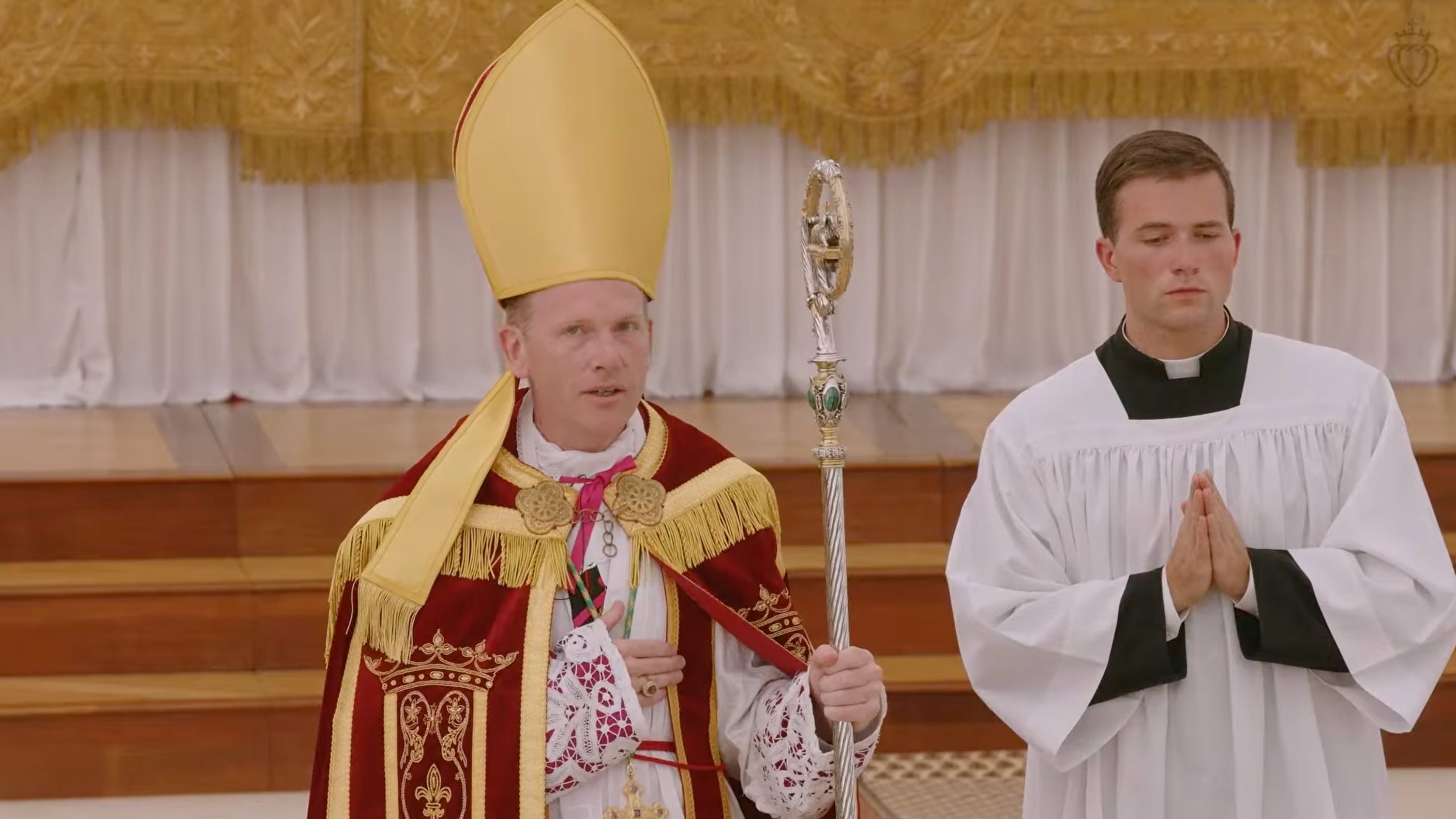
A number of former ‘SSPX sympathisers’ recently signalled their imminent break-up from the Society, specifically with their denials of the ‘new religion’.
(The WM Review) – As everyone is aware, today was the day on which Bishops Alfonso de Galarreta and Bernard Fellay consecrated four new bishops for the SSPX.
Writing anything about the event itself seemed superfluous, given the amount of coverage it has received online. However, the sermon delivered by Mgr Michael Goldade at the Pontifical Vespers following the ceremony deserves mention.
The full sermon – which contains a number of inspiring comments and salutary reminders – follows this article.
However, it is necessary to focus on a few dramatic comments – not out of a love for the polemical, but to recognise the nature of the current crisis facing the Church.
Recognition of the ‘new religion’
Mgr Goldade said:
“[T]he faithful – these faithful who do not understand the complexities of modernism, of the modernist disease – that they see something is wrong, something is dying with this new religion, and that in fact it is Tradition which is making a restoration, which is giving life.”
He also said:
“[T]oday we see such wreckage. If the Catholic Church in her Tradition brings forth life, the modernist church is a desert. It kills everything that it touches. It kills the supernatural life. It kills the sources of grace. It dries up everything, because it has placed man in the place of God, and therefore turned away from the sources of life.”
What we shall focus on here is Mgr Goldade’s recognition that there is a “new religion”, based around the “cult of man” – having “placed man in the place of God” – which was, incidentally, the thesis of the article below. It was written shortly after Leo XIV’s election, to explain the consequences of his stated “complete commitment” to Vatican II:
Fair-weather friends of the SSPX
The force of Mgr Goldade’s comments was something of a surprise, after a series of more “filial” sermons and letters from Superior General Fr Davide Pagliarani. But his phrases are of particular interest, given a number of exchanges that took place in the lead up to the consecrations.
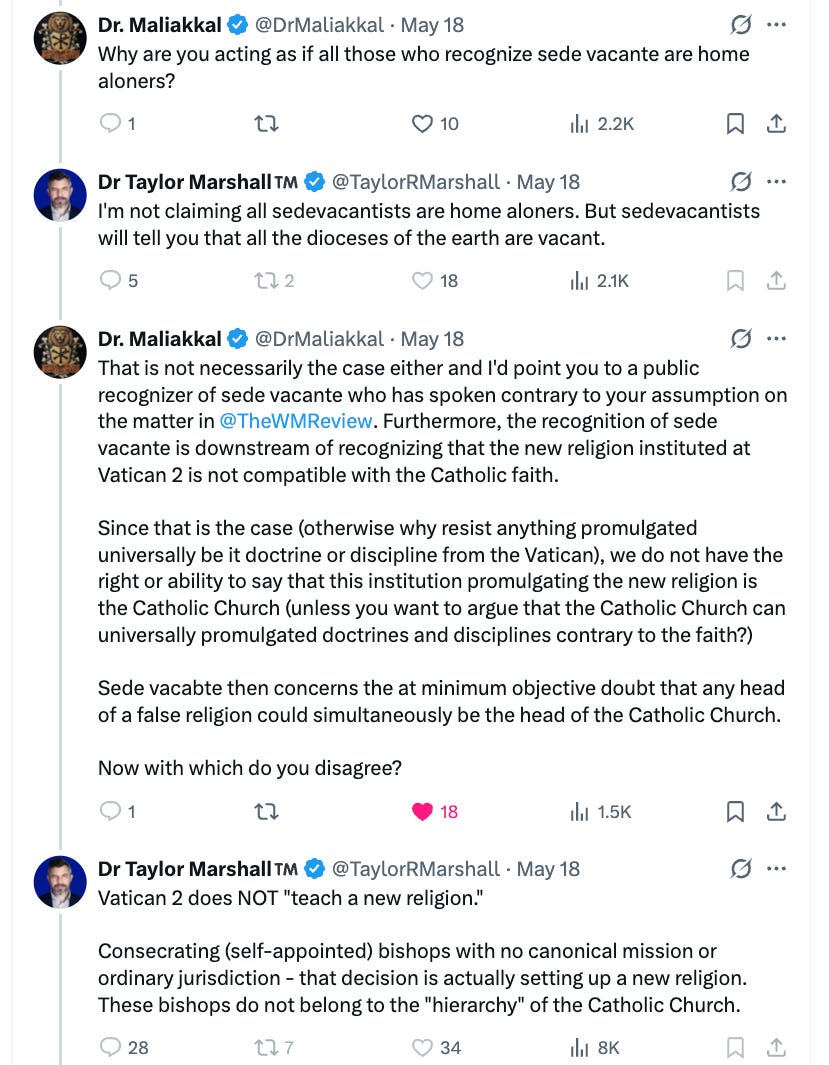
In particular, the sometime (and inconsistent) SSPX-sympathiser Dr Taylor Marshall criticised the claim that Vatican II inaugurated a “new religion”, presenting this claim as if it were a tenet of “sedevacantism”.
For example, the below comment was risibly presented in as an argument against “sedevacantism”:
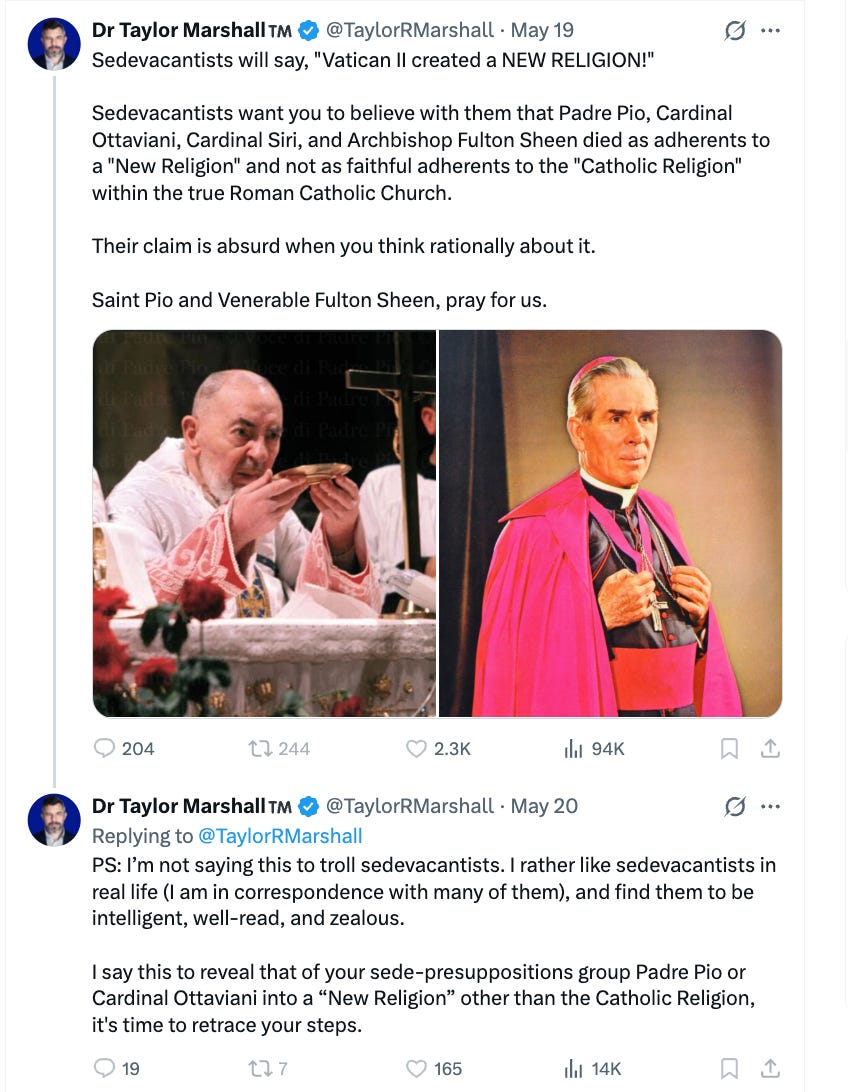
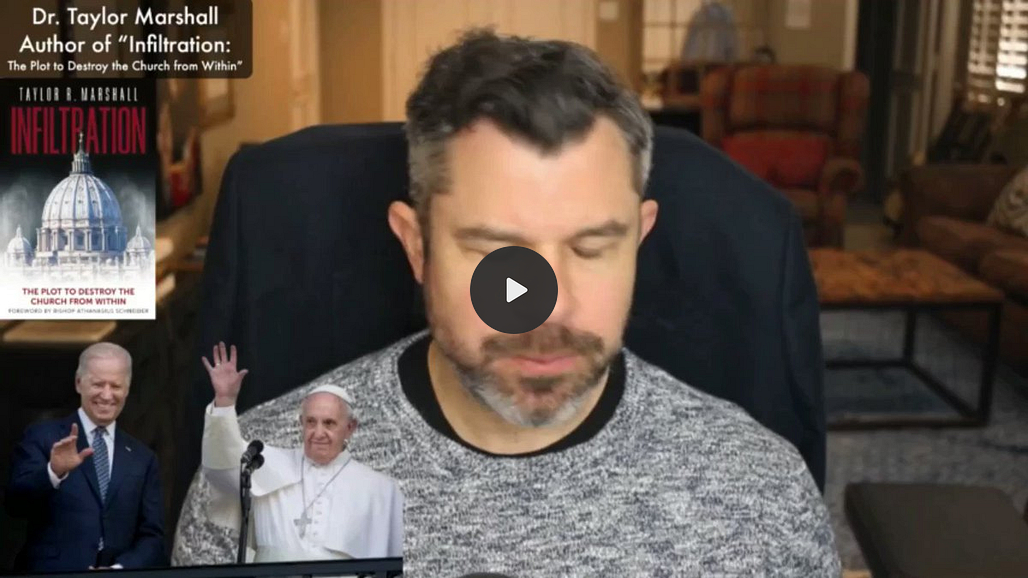
Incidentally, Marshall published a tweet in 2022, stating that “Pope Francis pushes New Religion.”

We have seen this kind of phenomenon before. Several years ago, two prominent SSPX apologists became disillusioned with the Society, and began to separate themselves from it. Before this was public knowledge, they published an article purporting to attack “sedevacantists” – but anyone alive to the issues was able to see that it was actually an attack on the SSPX.
(At the time, I believed that those in charge at One Peter Five, where it was published, were simply too dense or blinded by ideology to realise this; in fact, it later emerged that they had requested the authors change references to the SSPX to sedevacantists.)
But these texts are also illustrative of another common phenomenon: those who begin associating with the SSPX without understanding the critiques of Vatican II and so on, treating the Society as if it were essentially an “edgy version of the FSSP”, with some irregularity or “canonical naughtiness”; and proceeding to lecture everyone else about “What the SSPX stands for” – and always in a somewhat diluted form.
This issue is discussed here:
What is a religion?
In order to understand why Vatican II inaugurated a new (and therefore false) religion, we must first understand the concept of religion itself.
A “religion”, according to the theologian Fr Michaele Nicolau SJ, is “a complex of truths, duties and rites, whereby man is bound to God.”1
The three heads he mentions as making up the notion of religion – “truth, duties and rites” – correspond to doctrine (what is believed), discipline (the way of life enjoined), and liturgy (the worship offered).
The Catholic Church is the sole divinely-appointed bearer of the true religion in the world. This means that her doctrine is true, her disciplines are safe and conducive to the salvation of souls, and her liturgical rites are fitted to bring glory to God. Such is the teaching of Pope Leo XIII in his encyclical Satis Cognitum (n. 9).
Fr Nicolau explains that any religion which “contains errors”, or carries out “incorrectly the fundamental and essential dependence of man on a personal God”, is a false religion.2 This is so, even if it is “mostly true […] since ‘any defect makes something bad’”.3 As the axiom states, bonum ex integra causa, malum ex quocumque defectu.
It is alleged “problems” in the Vatican II documents does not constitute the construction of a new religion: but this is to radically downplay the “problem” of Vatican II – which definitively imposed errors which were previously definitively condemned, and changed almost every aspect of the Catholic religion.
Further, a religion which authoritatively preaches even one false doctrine, enjoins even one harmful discipline universally, or whose liturgy is not fitted to bring glory to God, is by that very fact a new religion – and therefore a false religion. As Louis Cardinal Billot wrote:
“[I]t is impossible that a religion should be truly called holy which possesses even a single dogma, whether speculative or practical, that is repugnant to holiness.”4
But since the one true religion is immutable, the result of any such substantial change would necessarily result in a false religion, which would separate itself from the indefectible Church.
This is precisely what happened at Vatican II – as recognised by Archbishop Lefebvre himself.
NB: I discussed these matters in my “book” Spotless and Unsullied – as well as the impossibility of this “new religion” existing within the Catholic Church:
… and with Stephen Kokx on the Integrity Magazine podcast:
Archbishop Lefebvre and the ‘new religion’
We engaged with Marshall’s comments as follows – and you can see his reply below:
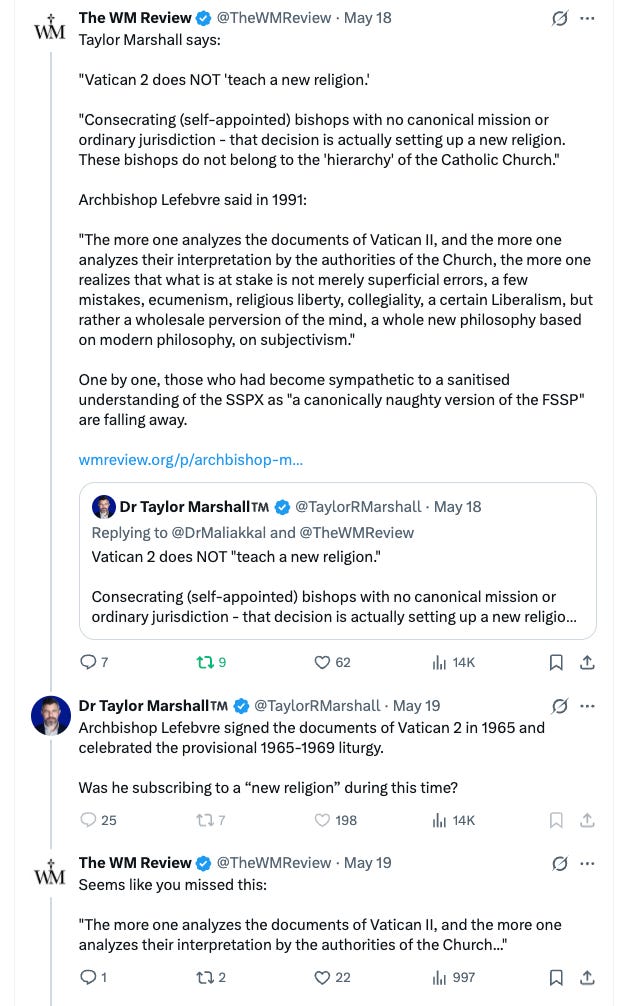
We could also have pointed out the following text from Archbishop Lefebvre’s Spiritual Journey:
“I can hear them say: ‘You exaggerate! There are many good bishops who pray, who have the Faith, who are edifying...’ They may have been saints, but as soon as they accept the false religious liberty, hence the secular State; false ecumenism, and hence the admission of many ways of salvation; liturgical reform, and hence the practical negation of the Sacrifice of the Mass; the new catechisms with all their errors and heresies—they are officially contributing to the revolution within the Church and to its destruction!
“The current Pope [sic] and bishops no longer hand down Our Lord Jesus Christ, but rather a sentimental, superficial, charismatic religiosity, through which, as a general rule, the true grace of the Holy Ghost no longer passes. This new religion is not the Catholic religion; it is sterile, incapable of sanctifying society and the family.
“One single thing is necessary for the continuation of the Catholic Church: fully Catholic bishops, who make no compromise with error; who found Catholic seminaries, where young candidates for the priesthood can nourish themselves with the milk of true doctrine, placing Our Lord Jesus Christ at the center of their intellects, of their wills, of their hearts; who have a living faith, profound charity, a devotion without bounds, uniting them to Our Lord.”5
Lefebvre also said elsewhere:
“We are not of this religion. We do not accept this new religion. We are of the religion of all time, of the Catholic religion. We are not of that universal religion, as they call it today. It is no longer the Catholic religion. We are not of that liberal, modernist religion that has its worship, its priests, its faith, its catechisms, its Bible.”6
This idea was present throughout the whole of Lefebvre’s writings and speeches. The existence of a new religion is also central to Prometheus, the book by SSPX seminary professor Fr Alvaro Calderón.
Far from being a “sedevacantist” talking point, or even an SSPX point, the rupture between the Catholic religion and the new religion of Vatican II was foundational premise of the “traditionalist” response.
Two such examples are as follows. The initial English issue of Fr Noël Barbara’s Fortes in Fide – published under the auspices of the SSPX’s Fr Peter Morgan was titled:
CATHOLICS!
BEWARE!
A NEW RELIGION HAS BEEN ESTABLISHED,
THE RELIGION OF MAN AND THE WORLD!
The idea of the “cult of man” was also foundational to the traditionalist pioneer Abbé Georges de Nantes – and the phrase itself was drawn from Paul VI’s own words.
Importance of the term ‘new religion’
A chief dividing line is between those who recognise the existence of the new religion of Vatican II, and those do not. The last few years – particularly since the SSPX’s gains during the COVID-19 debacle – have seen a great muddying of that line, particularly by high profile men such as Marshall positioning themselves as sympathetic to the SSPX.
Ever since the announcement of 2 February 2025, this positioning has been falling apart, and we are seeing a “great uncoupling” of these “tradservative” pundits from the SSPX. The response of such men to the idea of a new religion demonstrates a radical disconnect with the historic “traditionalist” position regarding Vatican II. This is why Catholics should simply disregard these intruding “influencers” in their attempts to influence them.
This “great uncoupling” could not have come sooner – although whether it will result in all the goods for which we might hope is in God’s hands.
In the meantime, while we may regret their continued attempts to recognise Leo XIV as the Pope, we may nonetheless appreciate Mgr Goldade recognising, in his initial sermon, the existence of the new religion of Vatican II.
It is expected that the Vatican will issue some sort of declaration regarding excommunications on 2 July 2026. You can read more about this topic here:
Further Reading
What Leo XIV’s ‘complete commitment’ to Vatican II REALLY means
‘Spotless and Unsullied’ – Indefectibility and the Extended Vacancy
‘The greatest hope of the world’ – Paul VI on the United Nations
‘CATHOLICS! Beware! A new religion has been established!’ (Fortes in Fide)
Sermon of Mgr Michael Goldade SSPX
Pontifical Vespers, 1 July 2026
Superior General, your Excellencies, Fathers, Religious, faithful,
The Superior General asked that I deliver a few words in English for all of our pilgrims who have come so far from around the world to attend these extraordinary ceremonies of the consecrations.
I have two thoughts to share with you.
The first is that the newly consecrated are very touched by your fidelity, your prayers, your sacrifices. Even before the ceremonies today, we heard many stories of even heroic prayers and offerings being made for the new bishops. Thank you so much for that. And then of course during the ceremony today, while we had much time during the Thanksgiving to pray the Rosary, to reflect, and then to watch you in the rain praying for the newly elect. And then as we went around the field, to see the eager faces and the look of hope for the future of the Church, and maybe especially at that moment the sense of the responsibility for the new bishops weighed heavy upon us. So we thank you for your prayers, your sacrifices, and encourage more.
And then secondly, these consecrations are a sign of the vitality of Holy Mother the Church. Holy Mother the Church, the Bride of Christ, to whom was given – and only to whom was given – the means to sanctify souls, to prepare souls for the kingdom of heaven. She contains all that is necessary for the salvation of souls. And this is a reminder of that life, and the life-source in Our Lord Jesus Christ, which is found in the Catholic Church. You see in these beautiful cathedrals artistic renderings of life: you have vinery, greenery, flowing water – and it’s not just something natural. It’s a symbol of the supernatural life that comes through the Catholic Church. She washes souls. She cleanses them of sin. She prepares them. She raises them up even to great sanctity, to martyrdom, to be members of heaven.
And we have to believe that. We have to have faith in that. Of course, today we see such wreckage. If the Catholic Church in her Tradition brings forth life, the modernist church is a desert. It kills. It kills everything that it touches. It kills the supernatural life. It kills the sources of grace. It dries up everything, because it has placed man in the place of God, and therefore turned away from the sources of life. So this is a reminder today to be faithful – to be faithful to this sacred entrustment which Our Lord has given to His Church and continues down through the apostolic Tradition.
I heard many times, in fact, leading up to the consecrations, from faithful who are not part of our circles, from those outside of the Society, even outside of Tradition – I heard a common thought, a common sentiment: “The Church needs these consecrations.” And that was surprising to me. But it shows that the faithful – these faithful who do not understand the complexities of modernism, of the modernist disease — that they see something is wrong, something is dying with this new religion, and that in fact it is Tradition which is making a restoration, which is giving life. Yes, my dear faithful, we do need these consecrations. We do need to continue this sacred legacy of Archbishop Lefebvre, given by Holy Mother Church. And I encourage you yourselves to be faithful, keep your families faithful to these holy institutions, these sacred institutions: the Mass, the Sacraments – and never let them go. And if you are faithful, you will see beautiful fruits in your families, beautiful growth in your parishes, in schools, and many, many more vocations – many, many young who want to sacrifice for Holy Mother Church, want to give themselves to Holy Mother Church.
In the Name of the Father, and of the Son, and of the Holy Ghost. Amen.
HELP KEEP THE WM REVIEW ONLINE WITH WM+!
As we expand The WM Review we would like to keep providing free articles for everyone.
Our work takes a lot of time and effort to produce. If you have benefitted from it please do consider supporting us financially.
A subscription gets you access to our exclusive WM+ material, and helps ensure that we can keep writing and sharing free material for all.
You can see what readers are saying over at our Testimonials page.
And you can visit The WM Review Shop for our ‘Lovely Mugs’ and more.
(We make our WM+ material freely available to clergy, priests and seminarians upon request. Please subscribe and reply to the email if this applies to you.)
Subscribe to WM+ now to make sure you always receive our material. Thank you!
Read Next:
Can heretics excommunicate? Foundational canonical text says they cannot
What Leo XIV’s ‘complete commitment’ to Vatican II REALLY means
‘Spotless and Unsullied’ – Indefectibility and the Extended Vacancy
‘The greatest hope of the world’ – Paul VI on the United Nations
‘CATHOLICS! Beware! A new religion has been established!’ (Fortes in Fide)
Follow on Twitter, YouTube and Telegram:
Twitter (The WM Review)
Nicolau defines religion as follows:
“[T]he whole idea of religion is based on this relation of dependence of man on God.
“But since man is an intellectual being, included in the moral order, which he must follow freely with his acts of intellect and will: that ontological relation to God requires that man be joined to God with the bonds of intellect and will, and not just according to one faculty but according to all of them. This moral bond, namely, with the activity of the intellect and will, joining the whole man to God—this is what we call ‘religion.’ […]
“If religion is considered objectively, or in itself, it is a complex of truths, duties and rites, whereby man is bound to God and in practice acknowledges His supreme excellence and dominion.”
Michaele Nicolau SJ, Sacrae Theologiae Summa IA (Introduction to Theology), Part II, nn. 5, 6. Trans. By Kenneth Baker SJ, Keep the Faith, USA 2015.
“[R]eligion is divided into true and false, according as it carries out correctly or incorrectly the fundamental and essential dependence of man on a personal God.
“But the religion that is fundamentally, or as to its substance, true, can be less correct or false inasmuch as it contains errors about other religious questions (v.gr., the Protestant religion errs about religious authority and the use of the sacraments); and since ‘any defect makes something bad,’ such a religion is said to be false.”
Nicolau, Part II, n. 8.
Ibid.
Louis Cardinal Billot, Tractatus de Ecclesia Christi, Tomus Prior, p. 174. Prati ex Officina Libraria Giachetti, Filii et soc, 1909. Text translated by Fr Julian Larrabee. Available here: https://archive.org/details/tractatusdeeccle01bill/page/174/mode/1up).
Archbishop Lefebvre, Spiritual Journey, Prologue.
Archbishop Lefebvre, Ordination Sermon June 29 1976. Available at https://www.sspxasia.com/Documents/Archbishop-Lefebvre/Sermon-at-the-ordination-of-13-priests-June29-1976.htm
God bless Bp. Goldade. Ad multos annos!
But this is not a new thing that the SSPX calls it a new religion. They have been calling it a new religion.
Its the refusal to arrive at the logical conclusion that is discouraging.
Who is the leader of this new religion?
Who is the defender of the Catholic religion?
SSPX is bending over backward to defend themselves to the "conservative" Novus Ordo parishioners but dismiss the sedevacantist position. Its so frustrating.