

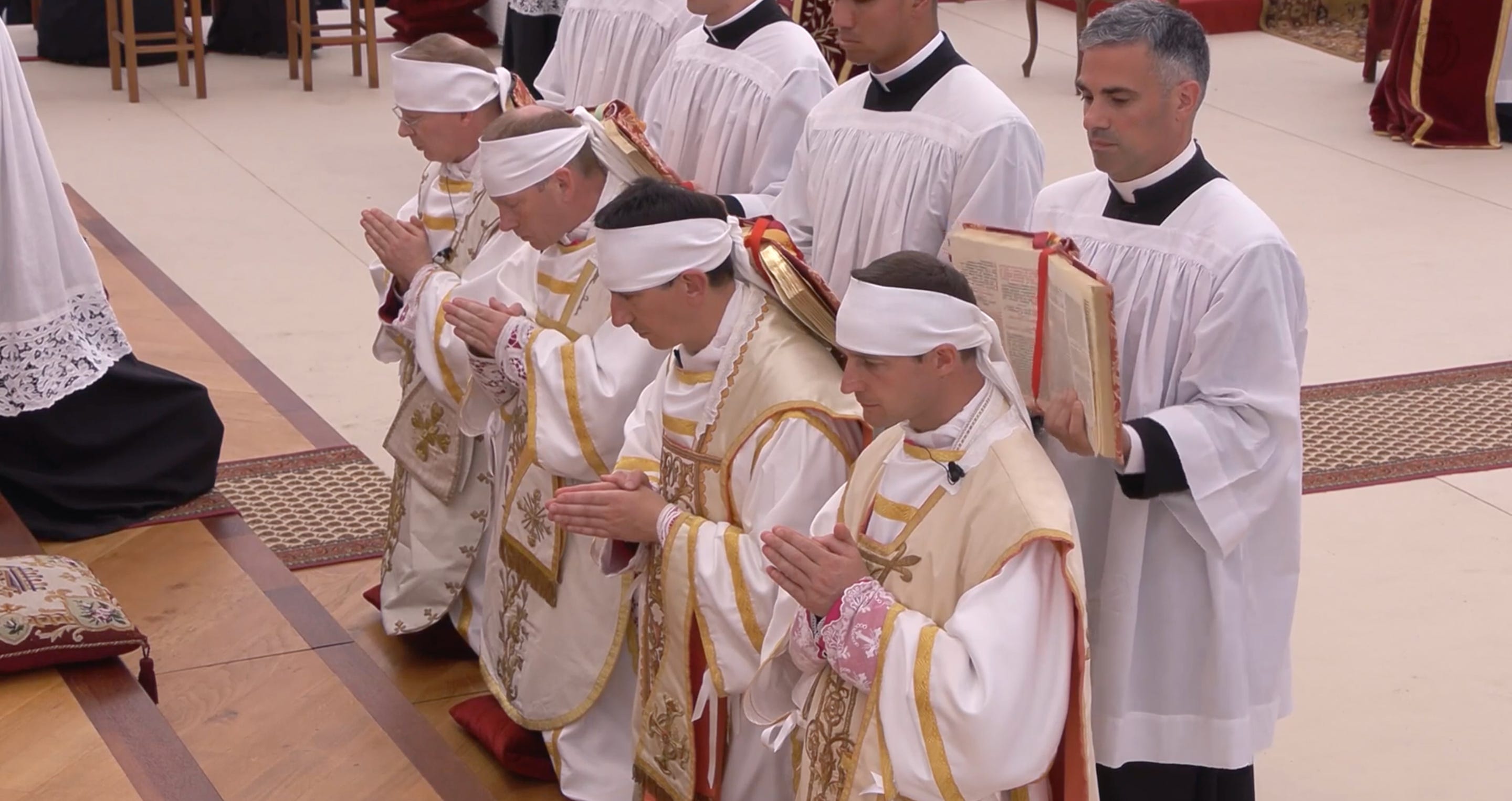
Leo XIV’s Vatican has issued a statement declaring that the six bishops and priests are in schism and excommunicated.
(WM Round-Up) – Cardinal Víctor Manuel Fernández, the supposed Prefect of the “Dicastery for the Doctrine of the Faith”, has issued a decree of excommunication against the SSPX, accompanied by an explanatory note.
While some are claiming that the provisions of this decree go further than those of 1988, this does not seem to be the case. Its provisions are, in some cases, stated with greater clarity or certainty – but the common opinions about the 1988 excommunications appears to be incorrect.
You can read my analysis of the differences and similarities here.
The summary of this analysis was as follows:
Thus, the 2026 does not really seem to establish a different situation to that which was in force between 1988 and 2009, except insofar as the provisions it seeks to impose are stated with greater clarity and certainty.
All the “sacred ministers” of the SSPX – the bishops, as well as priests and other ministers – are now clearly stated to be in schism with the Vatican, and excommunicated.
It no longer merely “seems beyond doubt”, as it was said in 1996, that the sacred ministers of the SSPX “formally adhere” to Archbishop Lefebvre’s “schism”: the new decree now simply says that the ministers “are in schism and must therefore be considered schismatics […] being subject to the excommunication provided for by law.”
The documents do not directly discuss the status of brothers, religious of either sex, or members of the Third Order; but line of argument would seem to include them.
Some of the laity “are to be regarded as schismatics and excommunicated”
The situation of the laity is identical to that following 1988: it is conditional on “formal adherence”1 (as defined in the 1996 document), and expressed with only a little more clarity or certainty: “[T]hose who formally adhere to the [SSPX] under the conditions established [in 1996], still in force, which this Dicastery makes its own, are to be regarded as schismatics and excommunicated.”
Permissions for the valid confessions and marriages appear to have been revoked.
Regarding the last point: Being without authority himself, the provisions of Francis did not cause any intrinsic change to the validity of these sacraments. However, the SSPX will now have to return the arguments previously employed with regard to the validity of these sacraments – arguments which certain parties associated with the SSPX have, to some extent undermined in the course of defending the Bergoglian provisions.
However, all this is null and void – for the following reason.
Heretics cannot excommunicate
As I have been explaining over the last few days, Pope St Celestine and others, which holds that the preachers of heresy are unable to excommunicate others. He wrote the following of the heretic Nestorius:
If anyone has been excommunicated or stripped of the dignity of bishop or cleric by Bishop Nestorius, or by others who follow him, from the time they began to preach such things, it is manifest that this person has persisted and does persist in our communion; and we do not consider him removed, because the sentence of one who had already shown himself deserving of removal could not remove anyone. (Emphasis added)
This letter, and others from St Celestine expressing the same doctrine, were taken up by later saints, doctors, theologians and canonists: the doctrine was considered something “easily proved“, and used to derive conclusions on other disputed matters.
In other words, the problem is on the side of those issuing the excommunications and not on the injustice of the penalty or the righteousness of those unjustly excommunicated. This is why the previously mentioned article concludes as follows:
[I]t is certain that those who preach heresy are unable to excommunicate. But Leo XIV and many of his collaborators preach heresy. Therefore, they are unable to excommunicate. They are similarly unable to issue declaratory sentences of automatic excommunications, or to designate groups as schismatic sects such that those “formally adhering” to them incur an automatic excommunication.
The question of whether the automatic excommunication for consecrating bishops without Roman mandate applies today, in the extended vacancy of the Holy See (which is not recognised by the SSPX), is debated. If this penalty did apply, then the bishops involved would indeed incur it.
But even if we conclude that it does not apply, one would have to consider whether one is bound to abide by the effects of a declaratory sentence, even for an excommunication which did not in fact take place. The penalties levelled against the other ministers, the laity, and the organisation itself are also latae sententiae, but are based on the judgement that the SSPX is a schismatic movement; thus, the establishment of these penalties depends on the validity of such a judgement.
The answer to these questions – and to those relating to the priests and laity “formally adhering” to the SSPX – turn not on the justice or validity of the excommunication, but the persons attempting to inflict it.
Readers may find the full explanation of this argument – and its important implications for the alleged legitimacy of Leo XIV and his recent predecessors – in the article below:

The relevant decrees can be found at the end of this article.
More about 1988’s excommunications
According to canon law, consecration of a bishop without pontifical mandate carries a latae sententiae excommunication for the consecrating and consecrated bishops.
In 1988, the Vatican responded within hours, stating that the six bishops involved (Lefebvre, de Castro Mayer, Fellay, Williamson, de Galarreta and Tissier de Mallerais) had indeed excommunicated themselves. This statement was formalised by the Congregation of Bishops on 1 July 1988.
As mentioned above, common opinion held that this was limited to the bishops – but a closer reading of the Vatican’s texts show that they applied it to the other ministers and even to the laity, even if this was not always enforced (and notwithstanding behaviour appearing to be to the contrary – such as the case of the “Hawaii Six”).
In 1991, soon after the first consecrations, three of the SSPX bishops consecrated Fr Licínio Rangel for the Catholic remnant in the Dioceses of Campos. Both the fourth bishop (Bishop Fellay), and the Superior General (Fr Schmidberger), were in attendance. It is unclear whether permission was sought from the Vatican for this consecration.
Bishop Rangel died in 2002, having come to an agreement with the Vatican in 2001. The Vatican does not appear to have declared Rangel to have been excommunicated for this, nor did the 2009 “lifting” of the excommunications of the four SSPX bishops mention it. However, in 2001, the Vatican did refer to “the excommunication [which Bishop Rangel] incurred on 28 July 1991.” To our knowledge, the Vatican did not declare Bishop Williamson to have incurred excommunication for the episcopal consecrations which he conferred after being ejected from the SSPX.
However, in July 2024, the Vatican did declare Archbishop Carlo Maria Viganò to have incurred an automatic excommunication – for “the reserved delict of schism”.
Reactions to the 1988 excommunication
In response to the 1988 excommunication, the District Superiors of the SSPX issued a powerful Open Letter, which stated:
“[W]e have never wished to belong to that system which styles itself the ‘Conciliar Church,’ and which defines itself by the Novus Ordo Missæ, by indifferentist ecumenism, and by the secularisation of the whole of society.
“Yes, we have no part – nullam partem habemus – with the pantheon of religions of Assisi; our own excommunication by a decree of your Eminence or of another dicastery would be only the irrefutable proof of this.
“We would ask for nothing better than to be declared ex communione from the adulterous spirit which has blown through the Church for twenty-five years, excluded from the impious communion with unbelievers. […]
“To be therefore publicly associated with the sanction which strikes the six Catholic bishops, defenders of the faith in its integrity and totality, would be for us a mark of honour and a sign of orthodoxy before the faithful.
“For these faithful indeed have a strict right to know that the priests to whom they turn do not belong to the communion of a counterfeit Church.”
While we agree with the sentiment, we cannot agree with the idea that an excommunication by a true Pope can serve as a badge of honour, even if it is only a mistaken declaration of an alleged automatic excommunication which never occurred. The Church has also repeatedly condemned that idea that an unjust excommunication is not something to be feared, and – all things being equal – to be observed, if declared.
But all things are not equal: these declarations are issuing from some of the most monstrous heretics the world has seen. Aside from continued adherence to the “super-heresy” of Vatican II, we could consider the following for Leo XIV alone:
Alleging that a unity of faith exists with heretics, and communion with Muslims
Denying the legitimacy of the death penalty (which he also did on several occasions prior to his election)
Praising the interreligious prayer meeting of Assisi in 1986, and the Abu Dhabi declaration
Denying the dogma Outside the Church there is no salvation through his endorsement of his predecessor’s error of the “ecumenism of blood”
Praising Fiducia Supplicans and Amoris Laetitia
Denying the immutability of Catholic dogma, by countenancing the possibility of changes if “attitudes” change
Presenting a naturalistic vision for world politics, along with errors condemned by previous Popes
Preaching the undiluted doctrine of modernism very soon after his election, with what appear to be many deliberate allusions to Pope St. Pius X’s condemnation of the heresy.
Further, there is indeed a schism; but the schism on the side of those who are adhering the heresies and the new, false religion of Vatican II. As Archbishop Lefebvre himself said in 1987:
“Schism?” retorted the Archbishop. “If there is a schism, it is because of what the Vatican did at Assisi and how you replied to our Dubia: the Church is breaking with the traditional Magisterium. But the Church against her past and her Tradition is not the Catholic Church; this is why being excommunicated by a liberal, ecumenical, and revolutionary Church is a matter of indifference to us.”
In short, neither Leo XIV nor Fernández are capable of excommunicating anyone.
Will Fr Pagliarani, or the current district superiors of the SSPX, issue a statement as strong as that of 1988?
This would be surprising, given Fr Pagliarani’s very “fillial” response to Leo XIV’s letter dated 29 June 2026, and the nature of his sermon at the consecrations. However, he did refer to the “exaltation of man” that lies at the heart of the Vatican II religion – and the newly consecrated Bishop Michael Goldade went so far as to call it a “new religion”.
A statement like that of 1988 may be surprising, but surprising things can and do happen.
RELEVANT DOCUMENTS
DICASTERY FOR THE DOCTRINE OF THE FAITH
Prot. N. 99/2009
DECREE
Notwithstanding the warnings addressed to the Superior General of the Priestly Fraternity of Saint Pius X, Bishop Alfonso de Galarreta, having carried out an act of a schismatic nature by means of the episcopal consecration of four presbyters, without pontifical mandate and against the will of the Supreme Pontiff, has incurred ipso facto the penalties provided for by can. 1387 and can. 1364 §1 CIC 2021.
I therefore declare, for all juridical effects, that both the aforesaid Bishop Alfonso de Galarreta and Pascal Schreiber, Michael Goldade, Michel Poinsinet de Sivry, and Marc Hanappier have incurred ipso facto the excommunication latae sententiae reserved to the Apostolic See.
I further declare that Bishop Bernard Fellay, having participated directly in the liturgical celebration as co-consecrator, having thus publicly adhered to the schismatic act, has incurred the excommunication latae sententiae provided for by can. 1364 §1 CIC 2021.
Clerics and lay faithful are warned not to adhere to the schism of the Priestly Fraternity of Saint Pius X, for they would incur ipso facto the penalty of excommunication latae sententiae.
From the Palace of the Dicastery, 2 July 2026
Víctor M. Card. Fernández
Prefect
John J. Kennedy
Titular Archbishop of Ossero, Secretary for the Disciplinary Section
Msgr Armando Matteo
Secretary for the Doctrinal Section
Explanatory Note of the Dicastery for the Doctrine of the Faith, 02.07.2026
Prot. N. 99/2009
EXPLANATORY NOTE
From the time of Saint Paul VI until the most recent discussions, held recently at this Dicastery, the manifold attempts to bring the adherents of the movement begun by Msgr Marcel Lefebvre back to full communion with the Catholic Church have proved fruitless. This situation has been further aggravated by the recent episcopal consecrations celebrated without pontifical mandate, against the will of the Holy Father, in open violation of canon law. Therefore, this Dicastery, in the faithful exercise of the functions entrusted to it, deems it necessary to point out that this act has constituted the delict of schism, with the canonical consequences for the sacred ministers and for the lay faithful involved. Indeed, as was already declared in 1988, “such disobedience — which carries with it a practical rejection of the Roman Primacy — constitutes a schismatic act” (cf. John Paul II, Ap. Letter Ecclesia Dei, 3).
In this regard, henceforth:
The sacred ministers belonging to the Priestly Fraternity of Saint Pius X are in schism and must therefore be considered schismatics (cf. Ecclesia Dei, 5(c); Pontifical Council for Legislative Texts, Explanatory Note on the excommunication for schism incurred by adherents to the movement of Bishop Marcel Lefebvre, 24.08.1996, 5–6), being subject to the excommunication provided for by law (can. 1364 §1 CIC).
As regards the lay faithful, those who formally adhere to the Priestly Fraternity of Saint Pius X under the conditions established in the Explanatory Note of the Pontifical Council for Legislative Texts of 1996 (cf. ibidem, 7), still in force, which this Dicastery makes its own, are to be regarded as schismatics and excommunicated.
The holy People of God are advised, finally, that the sacred ministers of the Priestly Fraternity of Saint Pius X administer the sacraments illicitly, and that the sacrament of penance administered by them and marriages assisted by them are invalid.
The Church, as a caring mother, will welcome with sincere affection and heartfelt solicitude all those who wish to return to full communion. The Apostolic Nuncios will have at their disposal the procedures that Ordinaries may employ in the various cases.
Finally, all the faithful are exhorted to remain steadfast in communion with the Roman Pontiff, with the Bishops in communion with him, and with the whole Church (cf. Lumen Gentium, 22; can. 751 CIC), and to refrain from participating in celebrations and activities promoted by the aforesaid Priestly Fraternity of Saint Pius X.
From the Palace of the Dicastery, 2 July 2026
Víctor M. Card. Fernández
Prefect
Msgr Armando Matteo
Secretary for the Doctrinal Section
John J. Kennedy
Titular Archbishop of Ossero, Secretary for the Disciplinary Section
[01078-IT.01] [Original text: Italian]
[B0568-XX.01]
V. On the excommunication for schism incurred by adherents to the movement of Bishop Marcel Lefebvre
Pontifical Council for Legislative Texts
Communicationes, 29 [1997] 239–243
Following information recently disseminated by certain media outlets, this Pontifical Council has deemed it appropriate to make publicly available an explanatory Note which it had sent to the Congregation for Bishops.
Vatican City, 24 August 1996
Most Reverend Eminence,
By letter of 26 July of the current year, Prot. N. XXX, Your Most Reverend Eminence forwarded to this Pontifical Council a letter from His Excellency Msgr Norbert Brunner, Bishop of Sion in Switzerland, in which the Prelate — in view of certain confused reports in the press — requested an authoritative interpretation of the Motu Proprio “Ecclesia Dei” and of the subsequent Decree of that Congregation concerning the excommunication imposed upon Bishop Marcel Lefebvre, the four Bishops ordained by him, and Bishop Emeritus Antonio de Castro. At the same time, Your Eminence requested the opinion of this Dicastery regarding the terms of the reply to be given to the above-mentioned Prelate.
In this regard, I have the honour to inform you that the problem raised by the Ordinary of Sion does not appear to require an authentic interpretation either of the Motu Proprio “Ecclesia Dei” of 2 July 1988, or of the Decree of that Congregation for Bishops of 1 July 1988, or of the relevant canons of the CIC: 1364, §1 and 1382.
The Prelate in fact bases his request on needs of a pastoral nature, in order to put an end to erroneous interpretations, but he does not offer any element suggesting the existence or well-founded probability of a genuine “dubium iuris” in the normative provisions of the aforesaid documents — an indispensable condition for an “authentic interpretation.”
Nonetheless, in order to meet the request of that Dicastery, the attached Note offers certain considerations and suggestions, in the hope that they may be of use for the clarifying response which that Congregation intends to give to the Bishop of Sion.
If, on the other hand, the confusion of which the Prelate speaks in his letter were significant from a pastoral point of view — also because it extends to other dioceses and nations where the Lefebvrist movement is active — one might envisage a general declaration by the Holy See, to be prepared in collaboration with the Congregation for the Doctrine of the Faith (cf. Note, no. 5).
I take this occasion to confirm myself, with sentiments of profound veneration,
of Your Most Reverend Eminence
the most devoted
Julián Herranz
Titular Archbishop of Vertara
President
Marino Maccarelli
Under-Secretary
NOTE
1. From the Motu Proprio “Ecclesia Dei” of 2 July 1988 and from the Decree “Dominus Marcellus Lefebvre” of the Congregation for Bishops, dated 1 July 1988, it appears first of all that the schism of Monsignor Lefebvre was declared in immediate relation to the episcopal ordinations carried out on 30 June 1988 without a pontifical mandate (cf. CIC, can. 1382). Nevertheless, it also appears clearly from the aforesaid documents that this most grave act of disobedience constituted the consummation of a progressive global situation of a schismatic nature.
2. Indeed, no. 4 of the Motu Proprio explains what the “doctrinal root of this schismatic act” was, and no. 5(c) warns that a “formal adherence to the schism” (by which is to be understood “the movement of Archbishop Lefebvre”) would entail the excommunication established by the universal law of the Church (CIC, can. 1364, §1). The Decree of the Congregation for Bishops likewise makes explicit reference to the “schismatic nature” of the aforesaid episcopal ordinations and recalls the most grave penalty of excommunication that would be entailed by adherence “to the schism of Monsignor Lefebvre.”
3. Unfortunately, the schismatic act that gave rise to the Motu Proprio and the Decree did nothing other than bring to completion, in a particularly visible and unequivocal manner — through a most grave formal act of disobedience to the Roman Pontiff — a process of distancing from the communio hierarchica. As long as there are no changes leading to the re-establishment of this necessary communio, the entire Lefebvrist movement is to be regarded as schismatic, a formal declaration of the Supreme Authority existing in this regard.
4. No judgement can be offered on the arguments of Murray’s disputed thesis, because it is not known, and the two articles that allude to it appear confused. In any case, the validity of the excommunications of the Bishops declared in the Motu Proprio and the Decree cannot reasonably be called into doubt. In particular, it does not seem that any exempting or attenuating circumstance can be found with regard to the imputability of the penalty (cf. CIC, cann. 1323–1324). As for the state of necessity in which Msgr Lefebvre believed himself to be, it should be borne in mind that such a state must be verified objectively, and that there is never a necessity to ordain Bishops against the will of the Roman Pontiff, Head of the College of Bishops. This would indeed signify the possibility of “serving” the Church by means of an attack against her unity in a matter connected with the very foundations of that unity.
5. As the Motu Proprio declares at no. 5(c), the latae sententiae excommunication for schism concerns those who “formally adhere” to the said schismatic movement. Even though the question of the exact scope of the notion of “formal adherence to the schism” ought to be put to the competent Congregation for the Doctrine of the Faith, it seems to this Pontifical Council that such adherence must imply two complementary elements:
(a) one of an internal nature, consisting in freely and consciously sharing in the substance of the schism — that is, in opting for the followers of Lefebvre in such a way that this option is placed above obedience to the Pope (at the root of this attitude there will habitually be positions contrary to the Magisterium of the Church);
(b) another of an external character, consisting in the exteriorisation of that option, the most manifest sign of which will be exclusive participation in Lefebvrist “ecclesial” acts, without taking part in acts of the Catholic Church (this is, however, a sign that is not univocal, since it is possible that some of the faithful may take part in the liturgical functions of the followers of Lefebvre without, however, sharing their schismatic spirit).
6. In the case of Lefebvrist deacons and priests, it seems beyond doubt that their ministerial activity within the schismatic movement is a more than evident sign that the two requisites mentioned above (no. 5) are met and that there is therefore a formal adherence.
7. In the case, however, of other faithful, it is obvious that occasional participation in liturgical acts or activities of the Lefebvrist movement, carried out without making one’s own the attitude of doctrinal and disciplinary disunity of that movement, is not sufficient for one to speak of formal adherence to the movement. In pastoral practice it may prove more difficult to judge their situation. Account must be taken above all of the intention of the person, and of the translation of that interior disposition into acts. The various situations must therefore be judged case by case, in the competent settings of the external forum and the internal forum.
8. In any event, it will always be necessary to distinguish the moral question of whether or not the sin of schism exists from the juridical-penal question of the existence of the delict of schism and its consequent sanction. To the latter, the provisions of Book VI of the CIC are to be applied (including cann. 1323–1324).
9. It does not seem advisable to formalise further (though the competent Dicastery should be consulted on the matter: cf. Ap. Const. “Pastor Bonus,” art. 52) the requirements for the delict of schism. There would perhaps be a risk of creating more problems through a penal-type normative rigidity that does not capture well all the cases: leaving out cases of substantial schism, or encompassing external behaviours that are not always subjectively schismatic.
10. Also from the pastoral point of view, it would seem appropriate to recommend further to the sacred Pastors all the norms of the Motu Proprio “Ecclesia Dei” by which the solicitude of the Vicar of Christ encouraged dialogue and the employment of the supernatural and human means necessary to facilitate the return of the Lefebvrists to full ecclesial communion.
Vatican City, 24 August 1996
HELP KEEP THE WM REVIEW ONLINE WITH WM+!
As we expand The WM Review we would like to keep providing free articles for everyone.
Our work takes a lot of time and effort to produce. If you have benefitted from it please do consider supporting us financially.
A subscription gets you access to our exclusive WM+ material, and helps ensure that we can keep writing and sharing free material for all.
You can see what readers are saying over at our Testimonials page.
And you can visit The WM Review Shop for our ‘Lovely Mugs’ and more.
(We make our WM+ material freely available to clergy, priests and seminarians upon request. Please subscribe and reply to the email if this applies to you.)
Subscribe to WM+ now to make sure you always receive our material. Thank you!
Read Next:

Follow on Twitter, YouTube and Telegram:
Twitter (The WM Review)
The 1996 document states:
5. As the Motu Proprio declares at no. 5(c), the latae sententiae excommunication for schism concerns those who “formally adhere” to the said schismatic movement. Even though the question of the exact scope of the notion of “formal adherence to the schism” ought to be put to the competent Congregation for the Doctrine of the Faith, it seems to this Pontifical Council that such adherence must imply two complementary elements:
(a) one of an internal nature, consisting in freely and consciously sharing in the substance of the schism – that is, in opting for the followers of Lefebvre in such a way that this option is placed above obedience to the Pope (at the root of this attitude there will habitually be positions contrary to the Magisterium of the Church);
(b) another of an external character, consisting in the exteriorisation of that option, the most manifest sign of which will be exclusive participation in Lefebvrist “ecclesial” acts, without taking part in acts of the Catholic Church (this is, however, a sign that is not univocal, since it is possible that some of the faithful may take part in the liturgical functions of the followers of Lefebvre without, however, sharing their schismatic spirit).
6. In the case of Lefebvrist deacons and priests, it seems beyond doubt that their ministerial activity within the schismatic movement is a more than evident sign that the two requisites mentioned above (no. 5) are met and that there is therefore a formal adherence.
7. In the case, however, of other faithful, it is obvious that occasional participation in liturgical acts or activities of the Lefebvrist movement, carried out without making one’s own the attitude of doctrinal and disciplinary disunity of that movement, is not sufficient for one to speak of formal adherence to the movement. In pastoral practice it may prove more difficult to judge their situation. Account must be taken above all of the intention of the person, and of the translation of that interior disposition into acts. The various situations must therefore be judged case by case, in the competent settings of the external forum and the internal forum.
This article gives me a lot to consider. So many people have weighed in over the past several days, with various takes and various degrees of seriousness— who knew the internet held so many historians who were also theologians and canon lawyers?
But in all seriousness, this WM Review article is helpful for someone like myself, who is just trying to sort out what to do going forward. I appreciate that the author is treating the situation with the gravity and objectivity it warrants.
The wrong Bishops are being excommunicated by the Sons of Vatican II.