
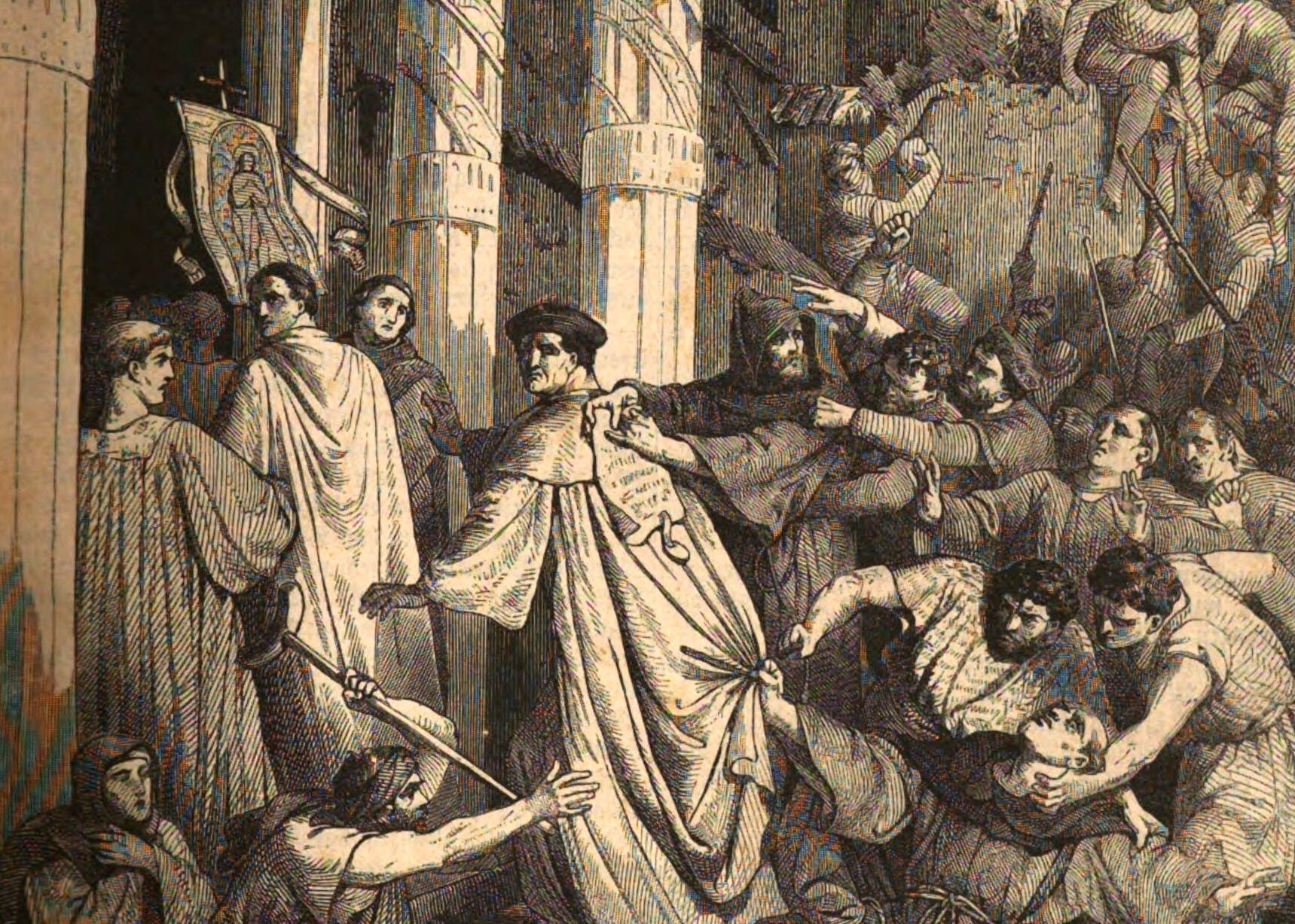
The full text of the Causa in which the important canons of Gratian’s Decretum appear – explaining why heretics have no power, and cannot excommunicate Catholics.
Editor’s Notes
This article reproduces the entirety of Causa XXIV, Quest. I, along with Gratian’s commentaries.
In an accompanying article, I have explained the history, context and interpretation of the so-called canon Audivimus, and its relevance to any excommunications which may be levelled by Leo XIV against the SSPX and other traditionalists.
Can heretics excommunicate? Foundational canonical text says they cannot
‘Audivimus’, ‘Achatius’ and Causa XXIV: Heretics Excommunicating Catholics
Church teaching says you can’t be excommunicated by a heretic
Heretics REALLY can’t excommunicate: More clarifications in light of SSPX excommunications
Abp. Lefebvre and the ‘heretics can’t excommunicate’ argument
Here is the text itself.
Causa XXIV, Quest. I
Decretum Gratiani
C. I–XLII
Verified against Aemilius Friedberg’s Corpus Iuris Canonici, Pars Prior (Decretum Magistri Gratiani), Akademische Druck, U. Verlagsanstalt, Graz, 1959, pp. 965–983.
A certain bishop, having lapsed into heresy, deprived some of his priests of their office and marked them with a sentence of excommunication. After his death he is accused of heresy and condemned, together with his followers and his entire household. (Qu. I.) Here it is first asked whether one who has lapsed into heresy can deprive anyone of office or mark them with a sentence [of excommunication]. (Qu. II.) Secondly, whether anyone can be excommunicated after death. (Qu. III.) Thirdly, whether an entire household is to be excommunicated for the sin of one person.
QUESTION I
GRATIAN:
That someone cannot be deposed or excommunicated by a heretic is easily proved. For every heretic either follows a heresy already condemned, or fabricates a new one. He who follows a heresy already condemned makes himself a participant in that condemnation.
Whence, when Acacius complained that he had been condemned by the Apostolic See without synodal authority, Gelasius wrote against him, saying:
C. I. [Achatius] He who falls into a heresy already condemned makes himself a participant in that condemnation.
Acacius did not become the inventor of a new error, but an imitator of an old one, and therefore it was not necessary that new decrees be issued against him, but only that the old ones be renewed. And so I became the executor of an old decree, not the promulgator of a new one. For whoever falls into a heresy once condemned involves himself in its condemnation.
C. II. What a synod has once decreed against any heresy is not to be reconsidered.
The same [Gelasius, in his letter to the Bishops of Dardania.]
Our forebears, discerning by divine inspiration, necessarily took the precaution that what a synod, once convoked against any heresy, had promulgated for the communion of the faith and for Catholic and Apostolic truth, they would not allow to be mutilated by subsequent reconsiderations, lest an occasion be given to the wicked of assailing what had been decreed as remedies; but, once the originator of any madness and his error alike had been condemned, they judged it sufficient that whoever at any time became a sharer in this error should be bound by the original sentence of its condemnation.
§. 1. Thus did the synod condemn Sabellius, nor was it necessary that his followers be condemned afterwards; but according to the tenor of the existing decree, the universal Church held that those who were participants either in his wickedness or in communion with him were to be rejected. Thus, the synod, having once condemned Arius, Eunomius, Macedonius, and Nestorius, does not permit the matter to come again to new councils.
C. III. It is not fitting to proceed further against him who relapses into a condemned heresy.
Likewise Felix.
Acacius was not the inventor of a new or peculiar error, such that new decrees should proceed against him; rather, he mingled his own communion with the crime of another. And so it was necessary that he should fall back, by a just balance, upon that sentence which the originator of the error, together with his successors, had received through synodal agreement.
GRATIAN:
If, therefore, that bishop lapsed into a heresy already condemned, he was condemned by the already existing excommunication and could not condemn others. For one who is excommunicated cannot excommunicate others.
Whence Alexander II writes to Bishop Valerius, the Martyr:
C. IV. [Audivimus] An excommunicated person cannot excommunicate another.
We have heard that Henry, called Archbishop of Ravenna, has attempted to excommunicate you. But since, being excommunicated, he could not excommunicate you, by apostolic authority we command you, absolving you and your people, never to trouble yourselves about it.
GRATIAN:
But if he fabricated a new heresy from his own heart, from the moment he began to preach such things, he could condemn no one – because one who is already prostrate cannot cast down another.
For the power of binding or loosing was given by the Lord to true priests, not to false ones. For when He was about to say to the Apostles, “Whose sins you shall remit,” etc., He first said, “Receive the Holy Ghost,” so as to show clearly to all that he who does not have the Holy Ghost cannot retain or remit sins. Moreover, no one receives the Holy Ghost except within the Church, because the Spirit Himself creates that very unity through grace.
§. 1. Whence, “Receive the Holy Ghost” was said only to those gathered together in one place, nor did the Holy Ghost descend on the day of Pentecost except upon those gathered together in one place. And just as He is not received outside the Church, so He effects nothing outside her. Since, therefore, as the Apostle says, the Spirit makes us ask and the Spirit obtains, outside the Church He neither causes us to ask nor to obtain. Whence the Lord, about to say, “Whatever you shall ask,” etc., first said, “If two of you shall agree on earth,” etc. And again: “Wherever two or three are gathered in my name, there I am in the midst of them;” showing clearly to all that He does not dwell in the hearts of those who, following the singularity of pride, tear themselves away from the structure of the Body of Christ.
But in those in whom Christ does not dwell, the Holy Ghost, fleeing the divisions of minds, has no place. Since, therefore, to remit or retain sins, to excommunicate or reconcile, is the work of the Holy Ghost and the power of Christ, it is manifest that those who are outside the Church can neither bind nor loose, nor restore to ecclesiastical communion by reconciliation, nor deprive of that fellowship by excommunication – a fellowship which they themselves, polluted by heresy or schism or branded by sentence, are proved to lack entirely. Whence, when the Lord gave to all the disciples equal power of binding and loosing, He promised to Peter, for all and before all, the keys of the kingdom of heaven, saying:
“I will give to you the keys of the kingdom of heaven.”
Whoever, therefore, has been estranged from the unity of the Church (which is understood through Peter), cannot execrate, cannot consecrate; he has no power of excommunication or reconciliation. Whence the Apostle, when he wrote that the fornicator of Corinth was to be excommunicated, said:
“I indeed, absent in body but present in spirit, have already judged as if present him who has so acted, in the name of our Lord Jesus Christ, you being gathered together, and my spirit, with the power of our Lord Jesus Christ, to deliver such a one to Satan for the destruction of the flesh.”
In this, showing the form of excommunication, he taught that only a faithful person is to be censured, and only by a faithful person. For in the name of the Lord and with His power cooperating, only a faithful person can effect anything, since no one can say “Lord Jesus” except in the Holy Ghost.
Likewise, since the Lord forbids the lamb to be eaten outside the Catholic Church, those who by their profession of faith are estranged from her are not expelled from a participation which they abandoned of their own will, but are allowed to depart – just as those who, hearing “Unless you eat the flesh of the Son of Man and drink His blood,” etc., said: “This is a hard saying, and who can hear it?” and so went away backwards, not repelled but allowed to depart. Hence also the Apostle, when treating of those to be excommunicated, prefaced his words with: “If anyone who is called a brother;” but regarding unbelievers he added, saying: “Those who are outside, God will judge.”
But regarding those who are within, He has committed judgment to us. Just as it is apparent from the Apostle’s word “brother,” and from what he added concerning believers and unbelievers, that only a believer is to be excommunicated, so from the fact that this is written only to the faithful – or rather, because just as he who blesses is greater than him who is blessed, so he who curses by office is greater than him who is cursed – it is perfectly clear that he who departs from the integrity of the Catholic faith has no power whatsoever of malediction or benediction.
For he cannot curse a Catholic, since the Catholic is his superior; nor can he pass sentence upon one estranged from the faith, as upon one equal to himself.
Now these things which have been said about heretics, schismatics, and excommunicated persons – namely, that they do not have the power of binding or loosing – are proved by the authorities of many.
For Pope Leo says: [Sermon III on the anniversary of his assumption, and Sermon II on the birthday of the Apostles]
C. V. No one is loosed or bound except him whom the authority of Blessed Peter has loosed or bound.
The privilege of Peter therefore endures wherever judgment is rendered according to his just rule (aequitas); nor will there be excessive severity or laxity, where nothing shall be loosed or bound except what Blessed Peter has either bound or loosed.
C. VI. In the person of Peter, the Church received the power of binding and loosing.
Likewise Augustine, on John. [Tract. L, on chapter 12]
“Whatever you shall bind on earth shall be bound also in heaven.”
If this was said to Peter alone, the Church does not do this. But if it is done also in the Church (for indeed those things which are bound on earth are bound in heaven, and those things which are loosed on earth are loosed also in heaven – because when the Church excommunicates, the excommunicated person is bound in heaven; and when the Church reconciles, the reconciled person is loosed in heaven), if this then is done in the Church, Peter, when he received the keys, signified the holy Church.
If in the person of Peter the good in the Church were signified, in the person of Judas the evil in the Church were signified.
C. VII. One who is firm by his own merits is sometimes disturbed by the merits of others.
Likewise Ambrose. [On Luke, chapter 5]
The ship that has Peter is not troubled; the one that has Judas is troubled. Although the many merits of the disciples were sailing in that ship, still the treachery of the betrayer was tossing it. In both ships Peter is present: but he who is firm by his own merits is disturbed by the merits of others.
Let us therefore beware of the faithless man, let us beware of the betrayer, lest through one man many of us be tossed about.
Therefore this ship is not troubled, in which prudence sails, faithlessness is absent, and faith prevails. For how could it be troubled, when he presided over it in whom is the foundation of the Church? There, therefore, is disturbance, where faith is small; there is security, where love is perfect.
And so, although others are commanded to cast their nets, to Peter alone it is said: “Put out into the deep” – that is, into the depth of disputations. For what is so deep as to see the depth of the riches, to know the Son of God, and to take up the profession of the divine generation? – which, although the human mind cannot fully grasp by the investigation of reason, yet the fullness of faith embraces.
C. VIII. Peter alone received the command to catch a fish with a hook.
The same [Ambrose], a little further on in the same place.
There is another apostolic kind of fishing, by which kind the Lord commands Peter alone to fish, saying:
“Cast a hook, and take the fish that first comes up.”
C. IX. Let no disturbance draw you from the path of the Apostolic See, which has always destroyed all heresies.
Likewise Pope Lucius, to all Bishops.
Do not, therefore, on account of any disturbance, withdraw from the right faith and the apostolic path, knowing that according to the Saviour’s saying, blessed are those who suffer persecution for the sake of justice.
This is the living tradition of the Apostles; this is the true love which must be preached, and especially cherished, fostered, and confidently held by all.
This is the holy and apostolic mother of all churches, the Church of Christ, which by the grace of Almighty God is proved never to have strayed from the path of apostolic tradition, nor has it succumbed to corruption by the novelties of heretics; but as it received in its beginning the rule of the Christian faith from its founders, the princes of the Apostles of Christ, it remains inviolate unto the end.
C. X. The faith of the Roman Church destroys all heresies and fosters none.
Likewise Sixtus [Pope Sixtus II, to Bishop Gratus, Letter I].
I am mindful that I preside under the name of that Church whose confession was glorified by the Lord Jesus Christ, and whose faith fosters no heresy but indeed destroys all of them. I understand, moreover, that it is not permitted for me to do otherwise than to devote all my efforts to that cause in which the salvation of the universal Church is assailed.
C. XI. The Roman Church has succumbed to no heresies.
Likewise Pope Eusebius. [To the Bishops of Tuscany, Letter III]
In the Apostolic See, the Catholic religion has always been preserved without stain.
C. XII. Whenever a matter of faith is debated, it should be referred to the Roman Church.
Likewise Innocent [Pope Innocent, to the Bishops of the Council of Milevis, Letter XXVI].
Whenever a matter of faith is debated, I consider that all our brothers and fellow bishops ought to refer it to none other than Peter – that is, to the authority of his name and office (as your affection has now referred it) – in a way that can be of benefit to all the churches throughout the world.
C. XIII. The Roman Church has had greater zeal for the Christian religion than all others.
Likewise Pope Julius [to the Eastern Bishops, Letter I].
The responsibility of our office does not allow us to dissemble; we have no freedom to be silent, since upon us lies a greater zeal for the Christian religion than upon all others.
C. XIV. That faith which the Roman Church commends does not fear the mouths of others.
Likewise Jerome [to Damasus, in the exposition of the Creed].
This is the faith, most blessed Pope, which we have learned in the Catholic Church and which we have always held; in which if anything has been expressed perhaps with less skill or insufficient caution, we desire to be corrected by you, who hold both the See and the faith of Peter.
But if this our confession is approved by the judgment of your apostleship, whoever wishes to find fault with me will prove himself to be unskilled, or malicious, or indeed not Catholic but heretical.
Likewise: §. 1. The holy Roman Church, which has always remained immaculate, by the Lord’s providence and with Blessed Peter the Apostle bringing his aid, will in the future remain without any insult from heretics, and will persist firm and immovable for all time.
C. XV. It is not permitted to think or to will anything other than what the Roman Church holds.
Likewise Marcellus, to all the Bishops established throughout Antioch [Letter I].
We ask you, most beloved brethren, that you teach and hold nothing other than what you have received from Blessed Peter the Apostle and the other Apostles and Fathers.
For he himself is the head of the whole Church, to whom the Lord said: “Thou art Peter, and upon this rock I will build my Church.”
His see was first established among you, and afterwards, by the Lord’s command, it was transferred to Rome, over which, with the help of divine grace, we preside this day.
But if your Church of Antioch, which was once the first, has yielded to the Roman See, there is none that is not subject to its jurisdiction. And you ought not to deviate from its governance, to which, by God’s disposing grace, all greater ecclesiastical matters have been commanded to be referred, so that they may be regularly disposed by that see from which they took their origin.
C. XVI. It is not lawful for the Alexandrian Church to disagree with the Roman Church.
Likewise Bishop Leo to Bishop Dioscorus of Alexandria [Letter LXXIX, al. LXXXI].
Since the most blessed Apostle Peter received the primacy from the Lord, and the Roman Church persists in his institutions, it is wrong to believe that the holy bishop Mark, his disciple, who first governed the Alexandrian Church, established the decrees of his traditions by different rules; since without doubt, from the same font of grace, the disciple and the master were of one spirit, nor could the one ordained hand on anything other than what he received from the one who ordained him.
C. XVII. By the profession of its faith, the Roman Church has cut off the ear of error.
Likewise Gregory.
If Peter, in his zeal, struck off the ear, he taught that they ought not to have in appearance what they did not have in function.
But the good Lord also restored hearing to that man, showing in accordance with the prophetic sayings that even those who were wounded in the Passion of Christ can be healed if they are converted, because every sin is washed away in the ministry of faith.
Peter, then, cuts off the ear. Why Peter? Because it is he who received the keys of the kingdom of heaven. For he condemns who also absolves, since he has obtained the same power of binding and loosing. And he cuts off the ear of one who hears wrongly; he cuts off with a spiritual sword the inner ear of one who understands wrongly.
Let us beware lest someone’s ear be cut off: the Passion of the Lord is being read. If we refer the weakness of bodily suffering to His divinity, the ear is cut off – and it is cut off by Peter, who did not suffer Christ to be considered merely a prophet but taught that He was to be acknowledged as the Son of God by a faithful confession.
C. XVIII. Outside the unity of the Church the Holy Ghost is not received.
Likewise Cyprian [in his treatise On the Unity of the Church].
The Lord says to Peter: “I say to you that thou art Peter, and upon this rock I will build my Church.”
He builds the Church upon one, and although after His resurrection He bestows equal power on all the Apostles and says: “As the Father has sent me, I also send you. Receive the Holy Ghost,” nevertheless, in order to manifest unity, by His own authority He arranged that the origin of that same unity should begin from one.
The other Apostles were certainly what Peter was, endowed with an equal share of honour and power. But the beginning proceeds from unity, so that the Church of Christ may be shown to be one – which one Church the Holy Ghost in the Song of Songs also designates in the person of the Lord Christ, saying:
“One is my dove, my perfect one; she is the only one of her mother, the chosen one of her who bore her.”
This unity of the Church the blessed Apostle Paul also teaches and demonstrates the sacrament of unity, saying:
“One body and one spirit: one hope of your calling. One Lord, one faith, one baptism, one God.”
This unity we must firmly hold and vindicate, especially we bishops who preside in the Church of God, so that we may also prove the episcopate itself to be one and undivided. Let no one deceive the brotherhood; let no one corrupt the truth of the faith by a faithless prevarication.
§. 1. The episcopate is one, of which a share is held by each bishop in its entirety. And the Church is one, which is extended ever more widely into a multitude by the increase of its fruitfulness; as there are many rays of the sun, but one light; and many branches of a tree, but one trunk firmly rooted; and as many streams flow from one spring, and though a profusion seems to be spread abroad by the abundance of its overflowing plenty, yet unity is preserved in its origin.
Pluck a ray of the sun from its body: its unity does not admit of division. Break a branch from the tree: the broken branch cannot bud. Cut off a stream from the spring: the severed stream dries up. So too the Church of the Lord, flooded with light, extends her rays throughout the whole world; yet it is one light which is diffused everywhere, and the unity of the body is not divided. She stretches her branches over the whole earth in the abundance of her fruitfulness; she pours forth her flowing streams far and wide; yet there is one head and one origin, and one mother, rich in the fruits of her fertility.
The Bride of Christ cannot be made an adulteress: she is uncorrupted and chaste. She knows one home; she guards the sanctity of one chamber with chaste modesty.
C. XIX. He who abandons the unity of the universal Church does not have God as Father.
The same [Cyprian], a little further on in the same place.
He is a stranger, he is profane, he is an enemy: he cannot have God as Father who does not hold the unity of the universal Church.
The same: §. 1. When the Lord urged unanimity and peace upon His disciples, He said:
“I say to you, that if two of you agree on earth concerning anything whatever you shall ask, it shall be done for you by my Father who is in heaven. For wherever two or three are gathered in my name, I am with them…”
… showing that the most is granted not to a multitude but to the unanimity of those who pray. “If two of you,” He says, “agree on earth”: He placed unanimity first, He set the concord of peace before all, teaching us faithfully and firmly to agree.
But how can one agree with another, who does not agree with the body of the Church itself and with the whole brotherhood? How can two or three be gathered in the name of Christ who, it is certain, are separated from Christ and from His Gospel?
C. XX. He who does not hold the unity of Catholic peace does not have the power of binding and loosing.
Likewise Jerome.
Having considered all things, I think I do not speak rashly in saying that some are so in the house of God that they themselves are that same house of God which is said to be built upon the rock, which is called the unique dove, the beautiful bride without wrinkle or spot, and the garden enclosed and the sealed fountain and the well of living water and the paradise with fruit trees; which house also received the keys and the power of loosing and binding.
If anyone despises this house when it corrects and rebukes: “Let him be to you,” He says, “as a heathen and a publican.” Of this house it is said: “Lord, I have loved the beauty of your house and the place where your glory dwells;” and: “He who makes the like-minded dwell in a house;” and: “I was glad when they said to me: we shall go into the house of the Lord;” and: “Blessed are those who dwell in your house; they shall praise you for ever and ever.”
C. XXI. Various crimes are to be afflicted with various penalties.
Likewise Jerome.
Let us not bring deceitful scales in which we weigh what we will according to our own judgment, saying, this is heavy, this is light; but let us bring the divine scale from the Holy Scriptures, as from the Lord’s treasuries, and in it let us weigh what is graver.
At the time when the Lord showed by recent examples of punishments that former offences must be guarded against, and an idol was fabricated and worshipped, and a prophetic book was burned by the anger of a contemptuous king, and schism was attempted: idolatry was punished by the sword, the burning of the book by slaughter in war and captivity abroad, and schism by a chasm in the earth, its authors being buried alive, and the rest consumed by heavenly fire.
Who then will doubt that the crime was more heinous which was more severely punished?
C. XXII. The Lord accepts sacrifice from the Church alone.
Likewise Gregory, in the Moralia [Book XXXV, c. 6].
Because truth is discerned only in the Catholic Church, the Lord declares that the place from which He is seen is with Him.
Moses is placed in the rock to contemplate the face of God, because unless one holds the solidity of faith, he does not recognise the divine presence. Of this solidity the Lord says:
“Upon this rock I will build my Church.”
§. 1. For she alone is the one through whom the Lord willingly accepts sacrifice; she alone who intercedes for those who err with confidence. Whence also the Lord commanded concerning the sacrifice of the lamb, saying:
“In one house you shall eat it, nor shall you carry any of its flesh out of doors.”
For it is eaten in one house, because the true sacrifice is immolated to the Redeemer in the one Catholic Church. The divine law forbids carrying its flesh outside, because it forbids giving what is holy to dogs. She alone guards those placed within her by the strong bond of charity.
Whence also the waters of the flood indeed lifted the ark to greater heights, but destroyed all whom it found outside the ark.
C. XXIII. He who tears apart His body does not show faith to Christ.
Likewise Ambrose [in the funeral oration on the death of his brother].
Satyrus called the bishop Cyprian to himself, and thought no grace true except that of the true faith, and inquired of him whether he was of the Catholic bishops – that is, whether he was in communion with the Roman Church.
And perhaps in that place the church of that region was in schism. For Lucifer had separated himself from our communion, and although he had gone into exile for the faith and had left heirs of his faith, Satyrus did not think there was faith in schism.
For even if they maintained faith toward God, they did not maintain it toward the Church of God, whose limbs, as it were, they suffered to be divided and whose members to be torn apart. For since Christ suffered for the sake of the Church, and the Church is the Body of Christ, faith in Christ does not seem to be shown by those who void His passion and tear it apart.
And so, although he held a debt of grace and feared to sail as a debtor of so great a name, he preferred to cross over to where he could safely pay his debt. For he judged the grace of divine payment to consist in affection and faith, which indeed, as soon as the opportunity of the Church was more freely available, he did not delay to fulfil, and both received the grace he had desired and preserved the grace he had received.
C. XXIV. One must withdraw even bodily from him who does not hold the faith of Christ.
Likewise Bede, on the Epistle of John [Second Epistle, single chapter].
“Everyone who withdraws and does not remain in the doctrine of Christ does not have God. He who remains in the doctrine of Christ, he has both the Son and the Father. If anyone comes to you and does not bring this doctrine, do not receive him into your house, and do not say ‘Hail’ to him. For he who says ‘Hail’ to him shares in his evil works.”
What John taught in words about avoiding schismatics or heretics, he also showed in deeds.
§. 1. For his most holy auditor and most courageous martyr Polycarp, Bishop of Smyrna, relates of him that at a certain time, when he had entered the baths at Ephesus for the purpose of bathing and had seen Cerinthus there, he immediately leaped up and departed without bathing, saying:
“Let us flee from here, lest the very baths collapse, in which Cerinthus, the enemy of the truth, is bathing.”
The same Polycarp also, when he once met Marcion, who said to him, “Do you recognise us?” replied: “I recognise the firstborn of Satan.”
C. XXV. He is profane who attempts to eat the lamb outside the Church of Blessed Peter.
Likewise Jerome [to Damasus].
Since the ancient East, dashed together by the fury of peoples, is tearing into little pieces the seamless tunic of the Lord, woven from the top, and foxes are destroying the vineyard of Christ; among the broken cisterns that hold no water, it is difficult to understand where the sealed fountain and that enclosed garden might be.
Therefore I decided to consult the Chair of Peter and the faith praised by the apostolic mouth, now seeking food for my soul from the place where I once received the garment of Christ.
Nor indeed could the vastness of so great a melting element and the intervening breadth of lands prevent me from the search for the precious pearl. Wherever the body shall be, there the eagles will gather.
Now that the patrimony has been squandered by evil offspring, among you alone is the uncorrupted authority of the Fathers preserved. There, in the rich soil of its ground, the earth brings back the purity of the Lord’s seed a hundredfold; here the grain, buried in furrows, degenerates into darnel and wild oats. Now in the West the Sun of Justice rises; but in the East, that Lucifer who had fallen has set his throne above the stars.
You are the light of the world, you are the salt of the earth, you are the vessels of gold and silver; here earthen vessels await the iron rod and eternal fire.
Although, therefore, your greatness terrifies me, your humanity invites me. From the priest I beg salvation for the victim; from the shepherd, the sheep begs protection. Away with the envy of the Roman eminence; away with ambition. I speak with the successor of the fisherman, the disciple of Christ. Following no leader but Christ, I am joined in communion with your blessedness – that is, with the Chair of Peter. Upon that rock I know the Church was founded. Whoever eats the lamb outside this house is profane. If anyone was not in the ark of Noah, he shall perish when the flood reigns.
And because, on account of my sins, I have migrated to that wilderness which borders Syria at the boundary with barbarian lands, I cannot always seek the holy things of the Lord from your holiness, with so many spaces intervening; and so I follow your colleagues, the Egyptian confessors, and in a small boat I lie hidden among the cargo ships. I do not know Vitalis, I reject Meletius, I am ignorant of Paulinus. Whoever does not gather with you scatters; that is, he who is not of Christ is of the Antichrist.
C. XXVI. The fellowship of heretics is to be fled by Catholics.
Likewise Ambrose [in his commentaries on Luke, chapter 9].
What house is more worthy of the entrance of apostolic preaching than the holy Church? Or who seems more to be preferred above all than Christ, who was accustomed to wash the feet of His guests, and does not allow those whom He has received into His house to dwell with polluted steps, but, though they are stained by their former life, deigns nonetheless to cleanse them for the future? He therefore is the only one whom no one ought to desert, no one to exchange, to whom it is rightly said:
“Lord, to whom shall we go? You have the words of eternal life, and we believe.”
You see the keeper of heavenly commands who, because he did not change his lodging, merited the fellowship of a heavenly habitation. Faith is therefore commanded to be sought first in the Church, in which, if Christ be the dweller, it is without doubt to be entered. But if a faithless people or a heretical teacher should deform the dwelling, then the communion of heretics is to be avoided, the synagogue is to be fled, the dust of the feet is to be shaken off, lest by the crumbling dryness of barren faithlessness, as by dry and sandy ground, the footprint of your mind be polluted.
For just as the preacher of the Gospel must take upon himself the bodily infirmities of the faithful people – according to what is written: “Who is weak, and I am not weak?” – so, if there is a Church that rejects the faith and does not possess the foundations of apostolic preaching, lest it sprinkle any stain of faithlessness, it must be abandoned. This the Apostle also clearly declared, saying:
“After a first admonition, avoid a heretical man.”
C. XXVII. He who is divided from the unity of the Church can neither be loosed from sins nor enter the kingdom of heaven.
Likewise Bede, on Matthew [in the homily for the feast of the Apostles Peter and Paul, on Matthew chapter 16].
Whoever in any way segregates himself from the unity of faith or fellowship of the Apostle Peter, such a one can neither be absolved from the bonds of sins nor enter the gate of the heavenly kingdom.
C. XXVIII. Sacrifices of those whose faith and life are disapproved are not to be received.
Likewise Jerome, on the prophet Amos [on chapter 5].
“I hate and have rejected your festivities, and I will not accept the odour of your assemblies. For if you offer me holocausts and your gifts, I will not accept them, and I will not regard the vows of your fatted offerings.”
§. 1. God hates, and not only hates but rejects, the festivities of those who do not celebrate the festivities of God, but their own.
And after a few words: §. 2. To hate, and not to smell, and to reject – He speaks by human likeness, so that we may recognise God’s disposition in our own terms. And if they offer holocausts, so that they appear to fast, give alms, and promise chastity (which are true holocausts), the Lord does not receive them. For He judges not the greatness of the sacrifices but the merits and motives of those who offer them.
§. 3. Whence also the widow who had put two small coins into the treasury is preferred by the Saviour above all, because the Lord looks not at what is offered but at the will of those who offer.
C. XXIX. Where charity is not, there neither faith nor justice has a place.
Likewise Augustine [On the Sermon of the Lord on the Mount, Book I, chapter 9].
Where sound faith is not, there justice cannot be, because the just man lives by faith.
Nor let schismatics promise themselves anything from this reward, because likewise, where charity is not, there justice cannot be.
For the love of neighbour works no evil – which, if heretics possessed it, they would not tear apart the Body of Christ, which is the Church.
C. XXX. He who departs from the faith loses the perfection of the Spirit.
Likewise Innocent [Pope Innocent, to Alexander, Letter XVIII].
Heretics, since they have departed from the Catholic faith, have lost the perfection of the Spirit which they had received.
C. XXXI. Heretics utterly lack the power of sacred office.
Likewise Cyprian, greeting Magnus his son [Book I, Letter 6].
We say that absolutely all heretics and schismatics possess nothing of power or right.
For this reason Novatian neither ought nor can be exempted from himself being counted among the adversaries and antichrists, since he stands outside the Church and acts against the peace and love of Christ.
And shortly after: §. 1. The Church is one, and being one, cannot be both within and without. For if it is with Novatian, it was not with Cornelius. But if it was with Cornelius, who succeeded Bishop Fabian by legitimate ordination, and whom the Lord glorified not only with the honour of the priesthood but also with martyrdom, then Novatian is not in the Church, nor can he be accounted a bishop, who, having despised the evangelical and apostolic tradition, succeeded no one and sprang from himself. For he can in no way have or hold the Church who was not ordained in the Church.
And shortly after: §. 2. As for the claim that they know the same God the Father, the same Son Christ, the same Holy Ghost as we do, this cannot avail such men.
And below: §. 3. We find that in such a crime, not only the leaders and originators, but also the participants are destined for punishment, unless they separate themselves from communion with the wicked, the Lord commanding through Moses and saying:
“Separate yourselves from the tents of these most hardened men, and do not touch anything that is theirs, lest you perish together in their sins.”
And what the Lord had threatened through Moses He fulfilled, so that whoever had not separated himself from Korah, Dathan, and Abiram immediately paid the penalties for impious communion.
By this example it is shown and proved that all who mingle themselves with schismatics against their superiors and priests in irreligious temerity will be liable to punishment and guilt; as also the Holy Ghost testifies through the prophet Hosea and says: “Their sacrifices are as the bread of mourners; all who eat them shall be defiled” – clearly teaching and showing that all without exception shall be joined in punishment with their leaders, who have been defiled by their sin.
What merits, therefore, can they have before God who are divinely visited with punishments?
And below: §. 4. But if outside the Church all heretics and schismatics do not have the Holy Ghost, and therefore hands are laid upon them among us – so that what is not there, and cannot be given there, may be received here – it is manifest that remission of sins also cannot be given through them, since it is established that they do not have the Holy Ghost.
C. XXXII. Let those who strive against the peace of the Church be stripped of their own honour.
Likewise Pope Liberius [in his letter to Athanasius].
Those who are against the peace of the Church, if they hold dignity or the belt of military service, let them be stripped of these.
If they are private citizens, and if they are noble, let them suffer the confiscation of their property; but if they are of low birth, let them not only be beaten in body but also punished with perpetual exile.
C. XXXIII. A bishop established in schism does not consecrate.
Likewise Pope Pelagius.
Shamefully – so to speak – it is a robbery in division: one not consecrated but execrated as a bishop.
For if we examine the very name of consecration with a reasonable and penetrating understanding, can he who refuses to be consecrated with the universal Church be called or be consecrated in any way? For to consecrate is to make sacred together. But one who is divided from the bowels of the Church and separated from the apostolic sees execrates rather than consecrates.
Rightly, therefore, he can only be called execrated, not consecrated, whom the Church does not recognise as being made sacred together with the members joined in unity.
Let us see, however, whether he even preserved the custom of those very regions in his irregular ordination. Indeed, this was the ancient custom: since, because of the distance or the difficulty of the journey, it would have been burdensome for them to be ordained by the Apostolic See, the bishops of Milan and Aquileia were to ordain each other, yet in such a way that the bishop of the other city was to come to the city in which the bishop was to be ordained, so that the election of the one to be ordained might be better and more easily ascertained by the ordaining bishop present there, with the consent of the universal Church over which he was to be placed, and that the one who was to be raised to the episcopate – and yet was not to be made subject to his ordainer – should be ordained in his own church.
For indeed, since, as we have said, the Church is one, of which it is said in the Song of Songs, “One is my dove,” it is certain that there is no other than that which is founded in the apostolic root, from which it cannot be doubted that the faith itself was propagated throughout the whole world.
And although this is very well known to you, let us nevertheless confirm it by the testimony of the blessed Augustine. Hear what that most illustrious Doctor of the Church says in a certain work of his. For he says:
“But if in no way can a church in which there is schism rightly be called a church, it remains that – since the Church cannot not exist – she is that one which, established in the root of the apostolic see through the successions of bishops, the wickedness of men (even if it cannot be identified and excluded, but must be tolerated for a time according to the circumstances) can in no way extinguish.”
C. XXXIV. He who consents to schismatics does not share in unity.
The same [Pelagius].
Schism itself, which is a Greek word, signifies a split.
But a split cannot exist in unity. Therefore he who communicates with schismatics does not communicate with unity. They have made factions for themselves, and, to speak now in the words of the Apostle Jude, separating themselves from that which is one, they do not have the Spirit. From all of which it follows that, because they are not one in unity, because they wished to be in a faction, because they do not have the Spirit, they cannot have the sacrifice of the Body of Christ.
§. 1. However, our question now is not whether we should tolerate the wicked, but whether we ought to be joined to schismatics. Even if they themselves, although abounding in their own opinion, yet being placed within the maternal womb, were seeking the truth, they were not to be repelled by us, until the truth of the matter had become clear to them under the guidance of reason. But because they have divided themselves from the universal Church, as the blessed Augustine says, every Catholic securely detests the party which he knows does not communicate with the universal Church, strengthened by the apostolic sees.
§. 2. Nor does it lighten their crime – rather it increases it – that you say they resisted for a long time against receiving into their communion those who communicated with the apostolic sees. For in this, while those also are to be blamed who wished to communicate with such people, yet far more are those to be execrated who despised communion with the apostolic sees not only in bishops but even in laypeople. But neither does it profit them that you report in the same letter that they suspended themselves from our communion either through ignorance of reason or through the simplicity of their understanding. For this itself is precisely the reason why they are schismatics: because what divided them was not a different judgment of opinion, but certain matters brought before them – unknown to them, yet feared – and believing rashly against the Apostolic See, a most wicked suspicion separated them.
§. 3. Which the blessed Augustine specifically denounces as schism, saying of such people:
“Against the authority of those churches which merited to receive letters from the Apostolic See, one who believes rashly cannot repel from himself the most monstrous crime of schism.”
In sum: either you believe that they are the Church (and then, since there cannot be two Churches, you will judge us – God forbid – to be the schismatics), or, if it is established that the true Church exists in the apostolic sees, then acknowledge that they are divided from unity, and that the question of communion is removed, since it is established that true communion can exist only in unity.
§. 4. Do not, therefore, as though there were no difference between schismatics and the Church, wish to associate indiscriminately with the sacrifices of both. What the schismatic confects is not the Body of Christ, if we are guided by truth. For no one can fabricate a divided Christ without incurring the Apostle’s reproof. One, as has been often said, is the Church which is the Body of Christ, and she cannot be divided into two or more. For as soon as anyone departs from her, she ceases to be the Church.
C. XXXV. From the moment a bishop teaches things contrary to the faith, he cannot despoil another.
Likewise Pope Nicholas writes to the Emperor Michael [Letter VII].
Pope Celestine says, writing to the Eastern bishops:
“If anyone has been excommunicated or stripped of the dignity of bishop or cleric by Bishop Nestorius, or by others who follow him, from the time they began to preach such things, it is manifest that this person has persisted and does persist in our communion; and we do not consider him removed, because the sentence of one who had already shown himself deserving of removal could not remove anyone.”
C. XXXVI. Those who are excommunicated by heretics are not to be considered excommunicated.
The same [Pope Nicholas], to the Clergy of Constantinople.
He [Pope St Celestine] says:
“The authority of our See has openly decreed that no bishop, nor cleric, nor anyone of any Christian profession, who has been cast down from communion or from his position by Nestorius or those like him, from the time they began to preach such things, is to be regarded as having been cast out or excommunicated; but all of these continue to this day in our communion, because one who wavered in preaching such things could not cast down or remove anyone.
“Do you understand, Emperor, from the above-mentioned authorities, that those who had themselves long since been removed could not remove – I will not say their own superior – but anyone at all; nor could those already prostrate cast down anyone else?”
C. XXXVII. Excommunicated persons are not to be received for the purpose of judging.
Likewise Pope Nicholas [a little further on in the same place].
We are amazed how excommunicated persons were received for the purpose of judging, since according to the apostolic canons they are forbidden to be received even in mere communion without letters of commendation. For it is absurd that one who is not permitted, according to the sacred rules, even to communicate with the least, should be permitted to judge concerning those who are nearly his superiors.
GRATIAN:
By these authorities it is clearly shown that, from the moment anyone begins to teach anything against the faith, he can neither cast down nor condemn anyone.
§. 1. However, the following statement of Augustine is objected:
“Those departing from the faith lose neither baptism nor the power of baptising.”
Since, therefore, both powers – namely, that of baptising and that of excommunicating – follow the priestly anointing, those departing from the faith will either retain both or lack both.
But the power of office is one thing, and its execution is another. Often the power of office is either received without its execution – as by monks in the priestly anointing – or, once received, is retained without its execution – as by the suspended, from whom administration is taken away but power is not removed.
From those departing from the faith, therefore, the power is not taken away, just as it is not restored to those returning, lest injury seem to be done not to the man but to the sacrament. Whence those baptised or ordained by heretics, when they return to the unity of the Catholic faith, if perchance for the sake of ecclesiastical peace they are received in their own orders, the sacrament will not be repeated that is proved to have been administered in the form of the Church; but through the imposition of hands the virtue of the sacrament will be bestowed, which outside the Church is taught to have been conferred on no one.
Since, therefore, both powers remain in heretics, if a heretic excommunicates a Catholic or another heretic, in order to draw him into communion with his heresy, the sentence lacks force, because it is unjust.
§. 2. But if he passes sentence upon a Catholic living wickedly, or upon a heretic given over to shameful deeds or crimes, so that each may return to the rule of right living, whether both, or only the heretic, is bound by his sentence seems a question worthy of investigation.
But it can be said that a Catholic is by no means bound by the sentence of a heretic. For he cannot strike with the sword of the mouth one whom he cannot accuse, or against whom he cannot testify.
For if those whom divine testimonies do not support – because they are outside the Church – have lost the weight of human testimony against those who appear to be in the Church, neither will those who have been proved to have departed from her faith – and have therefore been condemned by the Church – be able to have the weight of ecclesiastical authority against those same persons.
But a heretic seems to have power over a heretic, just as the devil too has power over the wicked, as over his own flock.
Whence Augustine writes to Vincentius, a Donatist and Rogatist [Letter XLVIII]:
C. XXXVIII. One excommunicated by heretics for a crime is not to be received by Catholics.
Whoever has received one cast out by you for some crime or vice in the same way as those are received who, apart from the error by which you are separated from us, have lived without crime among you – this displeases us.
But you do not easily prove such cases, and if you do, we tolerate some whom we cannot correct or punish; nor on account of the chaff do we leave the threshing floor of the Lord, nor on account of the bad fish do we break the nets of the Lord, nor on account of the goats to be separated at the end do we desert the flock of the Lord, nor on account of the vessels made for dishonour do we depart from the house of the Lord.
C. XXXIX. Whoever is excommunicated by heretics on account of discipline is not to be received by Catholics.
The same [Augustine], to Eusebius [Letter CLXIX].
A certain subdeacon of the Spanish church, called Primus, when he was forbidden from undisciplined access to consecrated virgins and despised the orderly and sound commands, was removed from the clergy.
§. 1. For my part, if it pleases the Lord, I observe this practice: that whoever has been degraded among [heretics] on account of discipline and wishes to cross over to the Catholic Church should be received in the humiliation of penance – to which they themselves would perhaps have compelled him, had he wished to remain among them.
GRATIAN:
But this statement of Augustine is understood to have been made not on account of the sentence, whose power is nothing outside the Church, but in detestation of the crimes which must be punished equally in heretics as in Catholics.
However, that saying of Augustine can be understood as referring to the power of baptising, not to that of binding or loosing, or administering the other sacraments. For baptism, whether administered by a heretic or even by a layman, provided it is received in the unity of the Catholic faith, will not lack its effect.
But the other sacraments – such as those of the sacred Body and Blood of the Lord, of excommunication or reconciliation – if administered by a heretic or by a Catholic who is not a priest, will have either no effect or a deadly one. Whence they are by no means to be received from them by faithful people.
Hence Augustine writes in Book I of On the Uniqueness of Baptism [Against the Donatists, chapter 2]:
C. XL. One placed in extremity may even receive penance from a heretic.
If extreme necessity should perhaps compel someone, and he does not find a Catholic through whom to receive it, and preserving Catholic peace in his soul, he receives through someone placed outside Catholic unity what he would have received within that Catholic unity itself – if he should then also immediately depart from this life, we consider him to be nothing other than a Catholic.
But if he is delivered from bodily death, when he returns in bodily presence to the Catholic congregation from which he had never departed in heart, we not only do not disapprove of what he did, but we most securely and most truly praise it, since he believed God to be present to his heart, where he preserved unity, and he was unwilling to depart from this life without the sacrament of holy baptism (which, wherever he found it, he recognised as belonging not to men but to God).
But if anyone, when he could receive it within the Church itself, by some perversity of mind chooses to be baptised in schism, even if he afterwards comes to the Catholic Church, it is certain that the sacrament – which can be received elsewhere but cannot profit elsewhere – profits him there.
He is perverse and wicked, and all the more pernicious the more knowingly so.
C. XLI. Let him do penance for a year who unknowingly received prohibited communion from the hand of a heretic.
Likewise Pope Julian.
If anyone has given or received communion from the hand of a heretic and does not know that the Catholic Church forbids this, and later comes to understand, let him do penance for a full year. But if he knows and has been negligent, and later does penance, let him do penance for ten years. Others judge seven, and some, more leniently, that he should do penance for five years.
§. 1. If anyone has permitted a heretic to celebrate his mass in a Catholic church and does not know it, let him do penance for forty days; if out of reverence for the heretic, let him do penance for one year; if in condemnation of the Catholic Church and of the Roman custom, let him be cast out of the Church as a heretic, unless he does penance; if he does penance, let him do penance for ten years.
If he has departed from the Catholic Church and joined a congregation of heretics and persuaded others, and later does penance, let him do penance for twelve years: three outside the Church and seven among the hearers, and two more outside communion.
Concerning these it is said in the canon that in the twelfth year they may receive communion without the offering.
C. XLII. It is better to face death than to receive communion from the hand of a heretic.
Likewise Gregory [Pope Gregory, Book III of the Dialogues, chapter 31].
King Hermenegild, a young man, began to despise the earthly kingdom, and seeking the heavenly one with ardent desire, he lay in chains and sackcloth, pouring out prayers to Almighty God for his own strengthening, and he despised the glory of the passing world all the more sublimely because, even in bonds, he recognised it to be nothing, since it could be taken away.
But when the festal day of Easter arrived, in the silence of the dead of night his perfidious father sent an Arian bishop to him, so that he might receive communion of the sacrilegious consecration from his hand and thereby merit a return to his father’s favour. But the man devoted to God reproached the Arian bishop as he came, as was fitting, and repelled his faithlessness from himself with worthy rebukes; for although outwardly he lay in chains, yet within himself he stood secure on the great summit of his mind.
When the Arian bishop returned, the father flew into a rage and immediately sent his attendants to kill the most steadfast confessor of God on the spot where he lay.
HELP KEEP THE WM REVIEW ONLINE WITH WM+!
As we expand The WM Review we would like to keep providing free articles for everyone.
Our work takes a lot of time and effort to produce. If you have benefitted from it please do consider supporting us financially.
A subscription gets you access to our exclusive WM+ material, and helps ensure that we can keep writing and sharing free material for all.
You can see what readers are saying over at our Testimonials page.
And you can visit The WM Review Shop for our ‘Lovely Mugs’ and more.
(We make our WM+ material freely available to clergy, priests and seminarians upon request. Please subscribe and reply to the email if this applies to you.)
Subscribe to WM+ now to make sure you always receive our material. Thank you!
Read Next:
Can heretics excommunicate? Foundational canonical text says they cannot
‘Audivimus’, ‘Achatius’ and Causa XXIV: Heretics Excommunicating Catholics
Church teaching says you can’t be excommunicated by a heretic
Heretics REALLY can’t excommunicate: More clarifications in light of SSPX excommunications
Abp. Lefebvre and the ‘heretics can’t excommunicate’ argument
Follow on Twitter, YouTube and Telegram:
Twitter (The WM Review)